









Interviews
What Is Technical Interview Questions Explained
Learn what is technical interview questions, the main types, how interviewers score answers, and a practical 2026 prep plan.
Interview Pilot Editorial Team
Updated November 1, 2026
20 min read
Technical interview questions are structured work-sample prompts that test whether you can apply job-relevant knowledge under realistic constraints, not a trivia quiz. That distinction changes how you should prepare. You're not trying to recite the largest glossary or guess a secret password. You're showing an interviewer a small, observable slice of work: how you frame a problem, choose an approach, test it, explain costs, and recover when your first idea doesn't hold.
A correct final answer helps, but it's rarely the whole score. A candidate can land on the right output with tangled reasoning that nobody would trust in production. Another candidate can miss the optimal solution and still show strong decomposition, sensible testing, and clear communication. Strong interviewers know the difference, and they score for it deliberately.
What Technical Interview Questions Are
Say you're interviewing for a software role and the interviewer asks you to remove duplicates from a sorted list. On the surface, it looks like a small coding puzzle. Underneath, it's a work sample. The interviewer is watching whether you clarify if the list can be changed in place, propose a simple baseline, keep your pointers straight, test the empty and single-item cases, and state the time and memory cost without being prompted.
That's the useful mental model for what is technical interview questions in practice. The prompt is a compressed task with constraints, ambiguity, and a time box. Your answer is evidence about how you'd handle a real ticket when the spec is incomplete and a teammate is waiting for your reasoning.
In software engineering, that slice of work usually takes a few familiar forms.
- Writing or explaining code: You implement a constrained function or walk through existing logic line by line.
- Algorithms and data structures: You choose a structure, justify it, and reason about correctness and complexity.
- Debugging: You're handed unfamiliar, broken code and asked to find what's wrong before you fix anything.
- System design: You sketch a service that can grow, then defend storage, caching, and failure choices.
- Trade-off talk: You explain why you'd pick the simpler option now and what would make you revisit it.
Why structure beats a casual chat
A structured interview gives every candidate comparable prompts, evaluation criteria, and scoring standards. That matters because informal impressions drift. One interviewer rewards confidence, another rewards speed, and the same candidate looks strong in one room and unclear in the next for reasons that have nothing to do with the job.
Selection research summarized in Codility's engineering assessment ROI guide reports that a 2022 meta-analysis found a correlation of approximately 0.42 between structured interviews and job performance, compared with 0.19 for unstructured interviews, while work-sample tests were reported at 0.33. Those coefficients aren't percentages and they don't guarantee you'll hire well. They show relative strength. Comparable tasks scored the same way carry more signal than free-form conversation.
For you as a candidate, the implication is practical. Don't prepare as if you're heading into a personality chat where charm fills the gaps. Prepare for a repeatable task with a visible scoring logic. Restate the problem, state your assumptions, show a baseline, test it, and name the cost. If you do those things consistently, you're giving every interviewer the same clear evidence to score, which is exactly what the format is built to collect.
Types of Technical Interview Questions
Think of the table below as a map of a typical interview loop, not a menu where every item matters equally. Different rounds collect different evidence, and your job description usually tells you which two or three will dominate.
| Type | What you are asked to do | Main signal |
|---|---|---|
| Algorithms and data structures | Write or trace code for a constrained problem | Decomposition, correctness, complexity |
| System design | Sketch a scalable service and name trade-offs | Architecture judgment and communication |
| Domain and role-specific | Apply SQL, ML, product metrics, or finance methods to a realistic case | Job knowledge under constraints |
| Debugging and code review | Find a defect or improve existing code | Testing, code quality, production sense |
| Live coding with narration | Solve while thinking aloud | Technical skill plus communication under observation |
When each row shows up
Algorithms and data structures rounds usually appear early as a screen, often in a tight sitting where you're expected to move from clarification to working code. The realistic constraint is usually an underspecified input. Can the list be empty? Are duplicates allowed? Candidates who ask before coding look deliberate. Candidates who guess without checking often solve a problem nobody asked.
System design rounds come later and run longer, because the interviewer needs time to push on your choices. You'll sketch components, then get pressed on what breaks first, where consistency matters, and what you'd simplify under budget pressure. The constraint here isn't syntax. It's that there's no single right architecture, so yourspoken trade-offs are the answer.
Domain and role-specific questions test whether you can use the tools of the actual job. A data candidate writes SQL against an events table and has to define the grain and timezone. A machine learning candidate justifies a metric before picking a model. A finance candidate walks through a valuation and names the assumption doing the heavy lifting. The early screening round often previews this, which is why it helps to understand how a technical screening interview is usually structured before you're in one.
Debugging and code review rounds flip the direction. Instead of writing fresh code, you're handed something fragile and asked what's wrong, what's risky, and what you'd test first. Strong candidates reproduce the failure with a concrete input before editing. Weak ones start rewriting immediately and lose the evidence.
Live coding with narration isn't a separate topic so much as a delivery mode layered over the others. The same algorithm problem becomes harder when you have to think out loud, because silence reads as being stuck even when you're making progress privately. Narrating your next small step keeps the interviewer inside your reasoning.
Match your prep time to the rows your target role actually names, instead of drilling every pattern as if they carry equal weight.
A backend role that mentions distributed systems and production debugging deserves different hours than an analyst role built around SQL and metric definitions. Read the posting like an interviewer wrote it, because one probably did.
How Interviewers Score Each Answer
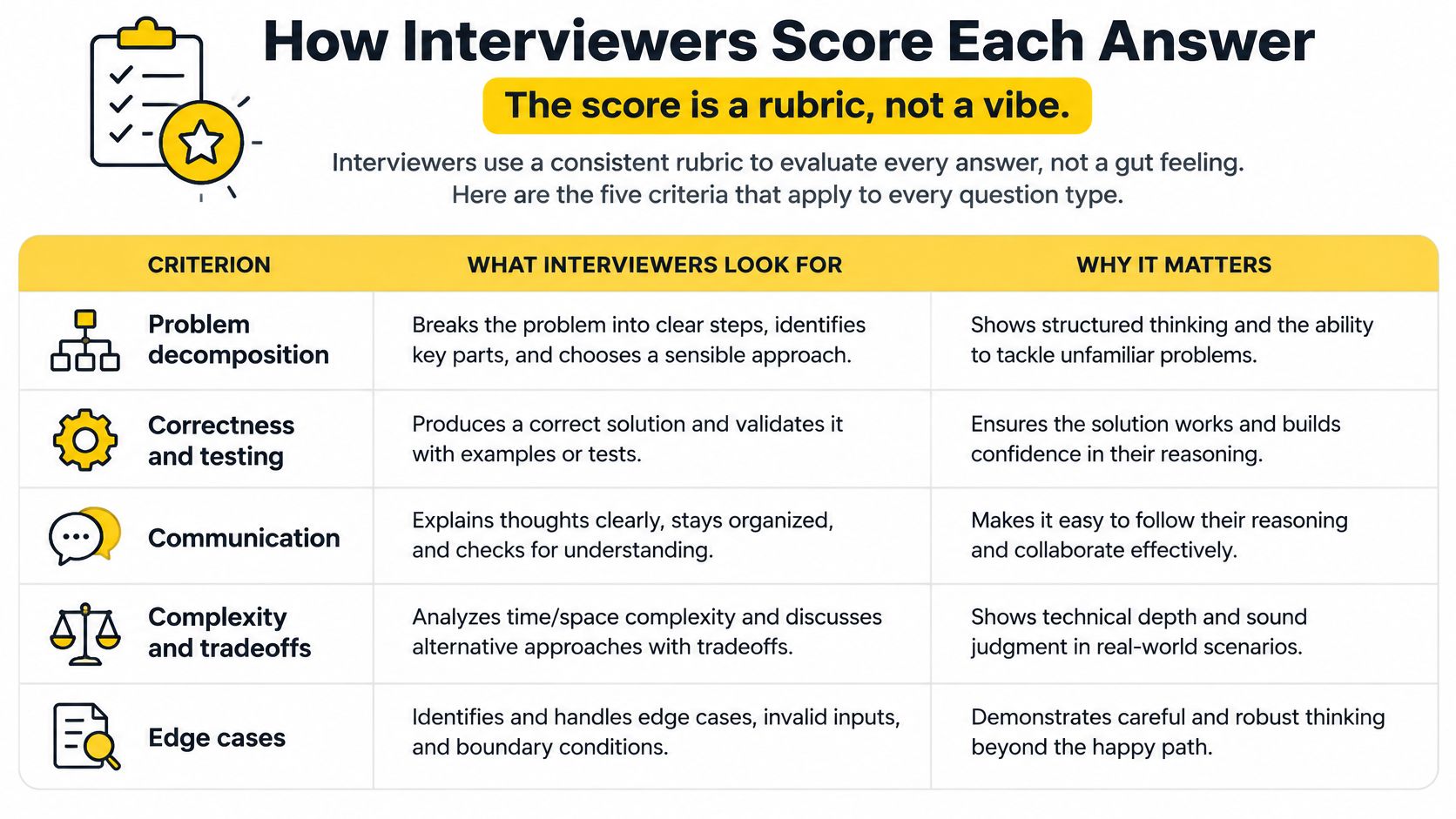
Interviewers who run a disciplined loop don't score on a vibe. They score against a rubric, and the same five criteria tend to cut across coding, design, and domain rounds even though the weight on each one shifts.
The chart below lays out those five criteria so you can score your own practice answers the way an interviewer would.
| Criterion | Strong signal | Weak signal |
|---|---|---|
| Problem decomposition | Restates constraints and splits the task before coding | Jumps to an implementation with no plan |
| Correctness and testing | Names edge cases and walks a small test | Covers only the happy path |
| Complexity and trade-offs | States time and space and a simpler alternative | Never mentions cost or alternatives |
| Communication | Narrates assumptions and clarifies ambiguity | Stays silent until a final answer |
| Code or artifact quality | Clear names, small pieces, basic error handling | One dense block that is hard to follow |
How to read the signals
Decomposition is visible in the first two minutes. Restating the input, output, and one constraint tells the interviewer you can scope work before committing to it. Jumping straight into code tells them you might build the wrong thing quickly.
Correctness and testing is where careful candidates separate themselves. Naming the empty input, the single element, and one boundary value, then walking your code through the smallest case out loud, shows a testing instinct that transfers directly to production work. Covering only the happy path leaves the interviewer guessing whether you'd ship the same blind spots.
Complexity and trade-offs doesn't require a lecture. One sentence on time and space, plus one sentence on the simpler approach you rejected and why, is usually enough. In a design round, the equivalent is naming what fails first and where you'd accept eventual consistency.
Communication is scored because engineering is collaborative. Narrating assumptions and asking one good clarifying question shows how you'd behave in a design review. Long silence forces the interviewer to score only the artifact, which rarely helps you. Reading technical interview feedback examples can help you recognize how these signals get written up after a loop.
Code or artifact quality is about whether another person could maintain what you produced. Clear names, small functions, and basic error handling signal professional habits. One dense block signals the opposite, even if it runs.
You can miss the optimal solution and still score well if your reasoning is structured and you say plainly what you don't know yet.
Before any loop, ask the recruiter which criteria the rounds weight most. A design round and a coding round don't share the same top criterion, and preparing as if they do wastes your best practice hours.
Example Questions by Role and Round
Full solutions teach you less than strong opening moves. Interviewers form judgments early, so each example below gives you the prompt, the first move a strong candidate makes, and the trap that catches people who rush.
Software engineering rounds
Algorithms. "Write a function that checks whether two strings are anagrams." Your first move is to confirm the rules before touching code. Does case matter? Do spaces count? Should you optimize for time or memory? The trap is sorting immediately and discovering halfway through that the interviewer expected case-insensitive comparison. Two clarifying questions cost you twenty seconds and save the whole approach.
Debugging. "This function returns the wrong total when the list is empty. Find the bug." Start by stating the failing input and the expected versus actual output out loud. That pins down the symptom before you change anything. The trap is editing on instinct. Once you modify code you haven't reproduced the failure in, you can't tell whether your fix worked or just moved the problem.
System design. "Design a URL shortener that handles very heavy redirect traffic." Open by asking about the read versus write ratio and how consistent reads need to be right after a link is created. Those two answers drive your storage and caching choices. The trap is drawing boxes immediately. A diagram built on unstated assumptions invites follow-ups you can't defend.
Data, data science, and product rounds
Data and SQL. "Write a query for weekly active users from an events table." Define the grain first. Is a week a calendar week or a rolling window, and in which timezone? What counts as active, any event or a specific one? The trap is writing elegant SQL that answers a subtly different question than the stakeholder asked.
Data science. "Build a model to predict customer churn." Choose your evaluation metric and a simple baseline before naming any model. A rule like "customers inactive for a set period churn" gives you something honest to beat. The trap is reaching for a complex model before you've said how you'd know it works or what a wrong prediction costs the business.
Product or consulting. "Estimate the impact of launching this feature." Lay out your assumptions in the open and name the one you'd test first, usually the adoption rate or the conversion step with the widest uncertainty. The trap is presenting a single magic number with false precision. Interviewers trust a range with stated assumptions far more than a confident point estimate.
Treat these as patterns, not predictions. No company is obligated to use this exact wording, and memorizing scripts for these six prompts won't generalize. What generalizes is the opening discipline. Clarify, define, baseline, then solve. That sequence works on prompts you've never seen, which is the entire point of the exercise.
How Observation Changes Measure Performance
Live "whiteboard" coding, where you solve a problem in front of an interviewer while explaining your reasoning, spread widely as the default software screen. It's still common. It's also not a neutral measuring instrument, and treating it as one leads both candidates and employers to misread the results.
An account in Our Code World's analysis of the technical interview as a hiring signal describes a randomized controlled study published in 2020 examining 48 computer-science students in public and private coding-interview conditions, where performance in the observed condition fell by more than half while stress and cognitive load were significantly higher. Both groups did the same type of technical work. The only difference was being watched.
What the whiteboard actually measures
A sports drill run in front of a crowd measures your skill, but it also measures how you perform while people evaluate you in real time. Those aren't the same trait. A strong engineer who thinks carefully and tests methodically can look shaky under observation, while a confident narrator can look stronger than their code deserves.
A rigorous process separates job-relevant capability from avoidable interview stress. Clear prompts, consistent scoring, realistic tasks, and room to explain your reasoning all shrink the gap between what the interview measures and what the job requires. When a company skips those safeguards, it's partly running a stress test and calling it a skills test.
You can't redesign the company's process from the candidate chair, but three habits keep observation from swallowing your performance.
- Restate the prompt first: Saying the problem back in your own words buys thinking time and confirms you're solving the right thing.
- Narrate the next small step: You don't need the full solution mapped out. Naming your immediate move keeps the interviewer oriented and stops silence from reading as confusion.
- Ask for a moment to test one case: Walking a tiny input through your code is a legitimate pause that also produces evidence of care.
None of these habits erase the observation effect, and anyone who promises they will is overselling. They do convert dead air into scorable signal. Keep perspective too. A private take-home or realistic work sample can reveal a different slice of skill than a watched whiteboard, so one weak live round doesn't automatically make you a weak engineer. It makes you someone whose measured performance dropped under observation, which the evidence says is a normal human response.
What a Technical Interview Does Not Prove
Here's the uncomfortable version. Memorizing more patterns has diminishing returns, and past a point, another week of puzzle drilling adds less to your candidacy than one piece of job-like evidence.
The limits of the format are easier to see in the visual below.
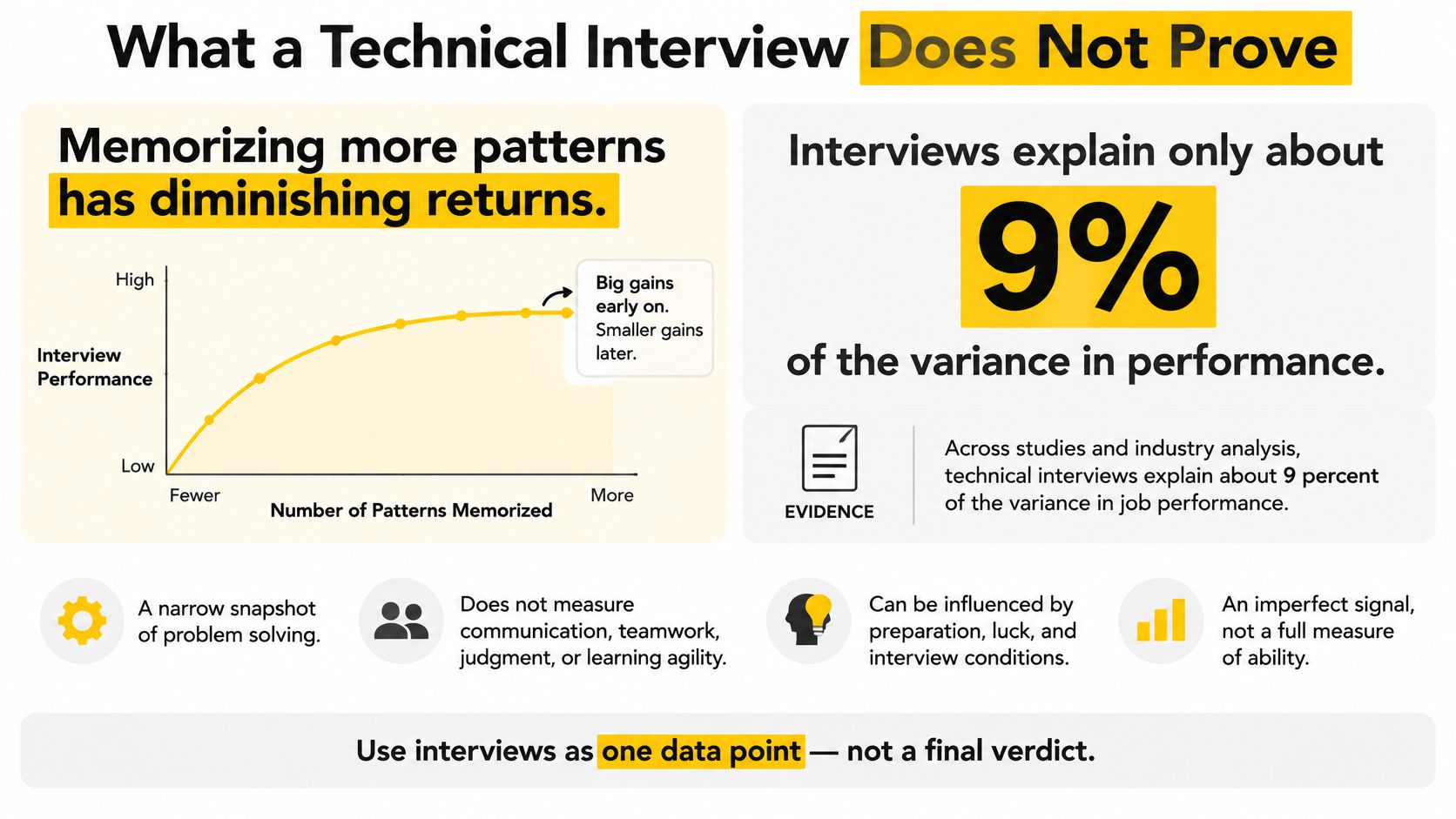
Industry coverage in TestGorilla's report on interviews not assessing skills cites a synthesis reporting that interviews explain only about 9% of the variance in future job performance, and its analysis of more than 23,000 interviews found technical skills were explored in depth only 55% of the time even after five interviews, while 93% of candidates had never been asked about AI skills. Read that plainly. A coding-round win is a weak proxy for job performance on its own, and many loops don't even probe technical depth thoroughly despite consuming five rounds of everyone's time.
What the puzzle round misses
A timed algorithm problem says little about how you debug a production incident at an inconvenient hour. It doesn't show whether your code reviews are kind and precise, whether your system judgment holds up when requirements change mid-quarter, or whether you write the kind of documentation that saves the next person a day. Algorithm fluency, debugging, code review, system judgment, communication, and production experience are distinct capabilities. Most loops sample one or two and infer the rest.
That gap cuts both ways. If you're a strong production engineer who's rusty on puzzles, the interview understates you. If you're a polished puzzle solver who's never owned a service, it overstates you. Neither error is visible from inside a single round.
What to do with that knowledge
Inside the interview, two moves help when you don't know the optimal solution. First, ask how the answer will be evaluated, because knowing whether they weight correctness or communication changes where you spend your remaining minutes. Second, show the reasoning anyway. State your assumption, offer a correct baseline, name its cost, and describe the trade-off you'd investigate next. Structured partial progress beats a frozen silence every time.
Outside the interview, bring evidence the format can't see. A small portfolio piece with tests, a short postmortem you wrote after something broke, or a one-page design note explaining a decision and its alternatives all demonstrate production judgment directly. That kind of structured, job-like evidence is more informative than another puzzle round, for you and for the employer. You're not gaming the process by offering it. You're patching a known hole in what the process measures.
Six-Step Prep Plan
Preparation works when it's a short loop you repeat, not a heroic binge the weekend before. The six steps below fit into a normal week, and each one targets a specific weakness in how candidates usually prepare.
The flow below shows the six steps in sequence.
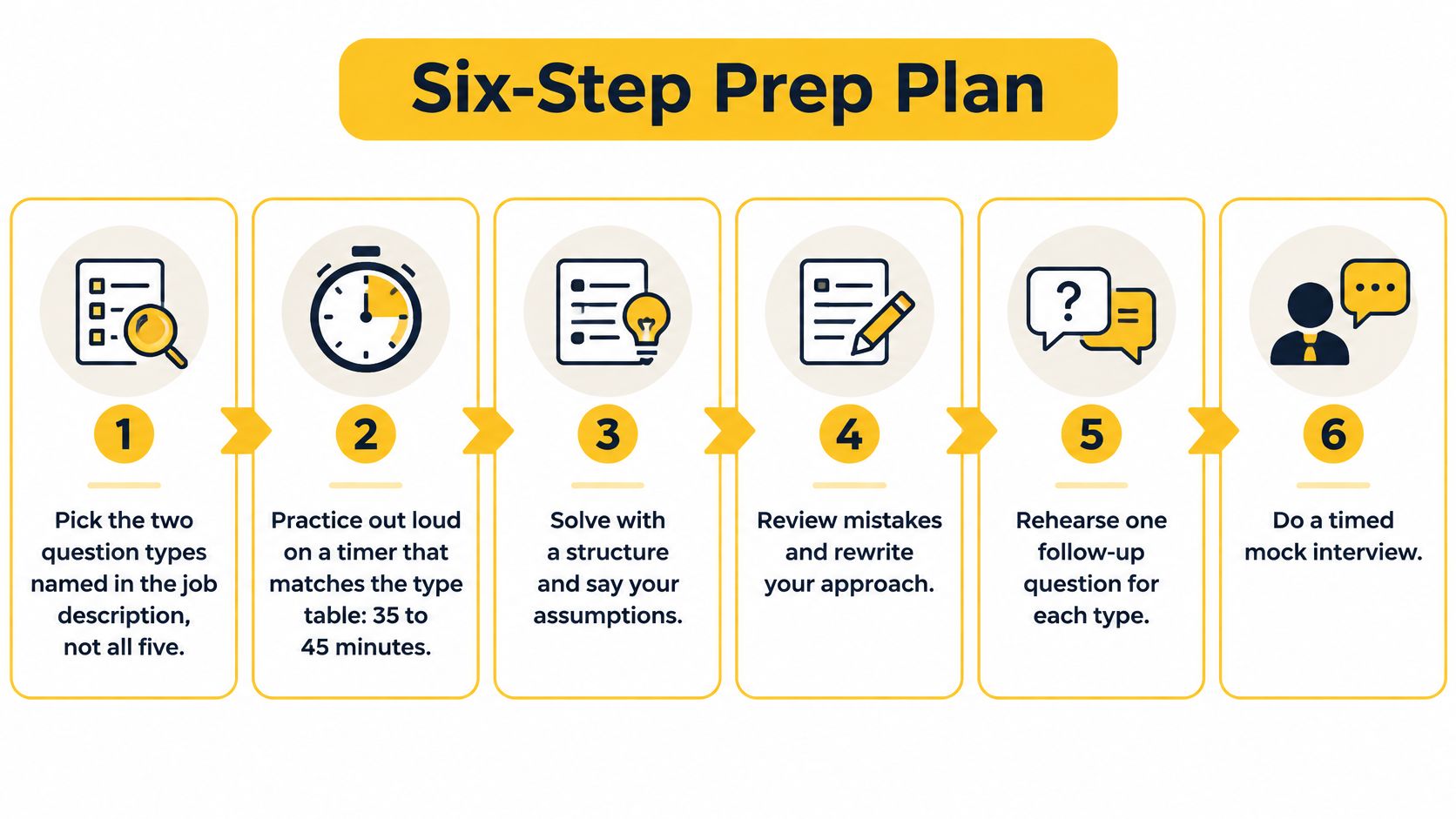
- Pick two question types from the job description. Not all five. If the posting stresses SQL and pipelines, algorithm marathons are a distraction. Let the employer's own words set your syllabus.
- Practice out loud on a timer. Set 35 to 45 minutes for algorithm-style reps and longer sittings for design work. Speaking while solving feels awkward in practice and natural in the interview only if you've rehearsed the combination, because narration is a separate skill from solving.
- Score every rep against the five criteria. Decomposition, correctness and testing, complexity and trade-offs, communication, and quality. Then rewrite only the weakest one. Fixing one criterion per rep compounds faster than vaguely resolving to "do better."
- Build one work-sample artifact. A short debugging writeup or a one-page design note gives you evidence a puzzle round can't show, and it gives you concrete material to reference when an interviewer asks about real projects.
- Rehearse your stuck sentence. Say it until it's boring. "I don't know the optimal approach yet, so here's a correct baseline, its cost, and what I'd test next." Candidates who have this sentence ready don't panic when they need it.
- Ask about the rules before any live round. Are external tools allowed? How will the answer be evaluated? Does a human review the result? This matters more than it used to, since coverage in Computerworld's report on employers using AI to interview candidates describes a 2025 survey in which 21% of U.S. organizations and 20% of U.K. organizations used generative AI to conduct at least initial candidate interviews.
Weekly rhythm: Two timed sessions, one honest debrief against the scoring criteria, and one update to your work-sample artifact beats seven days of unfocused drilling.
If you want structured material to practice against, our software engineer question list covers programming, data structures, algorithms, system design, debugging, testing, production and collaboration, and our AI mock interviews come with an evaluation of your answers so your debrief step has something concrete to work from.
Handling AI-Mediated Interviews
Many rounds are now run or scored partly by AI, sometimes with a human reviewing afterward and sometimes with the automated score carrying real weight on its own. That changes your job as a candidate in specific ways, and guessing at the rules is the worst available strategy.
The diagram below traces how an AI-mediated round typically flows, from setup through scoring.
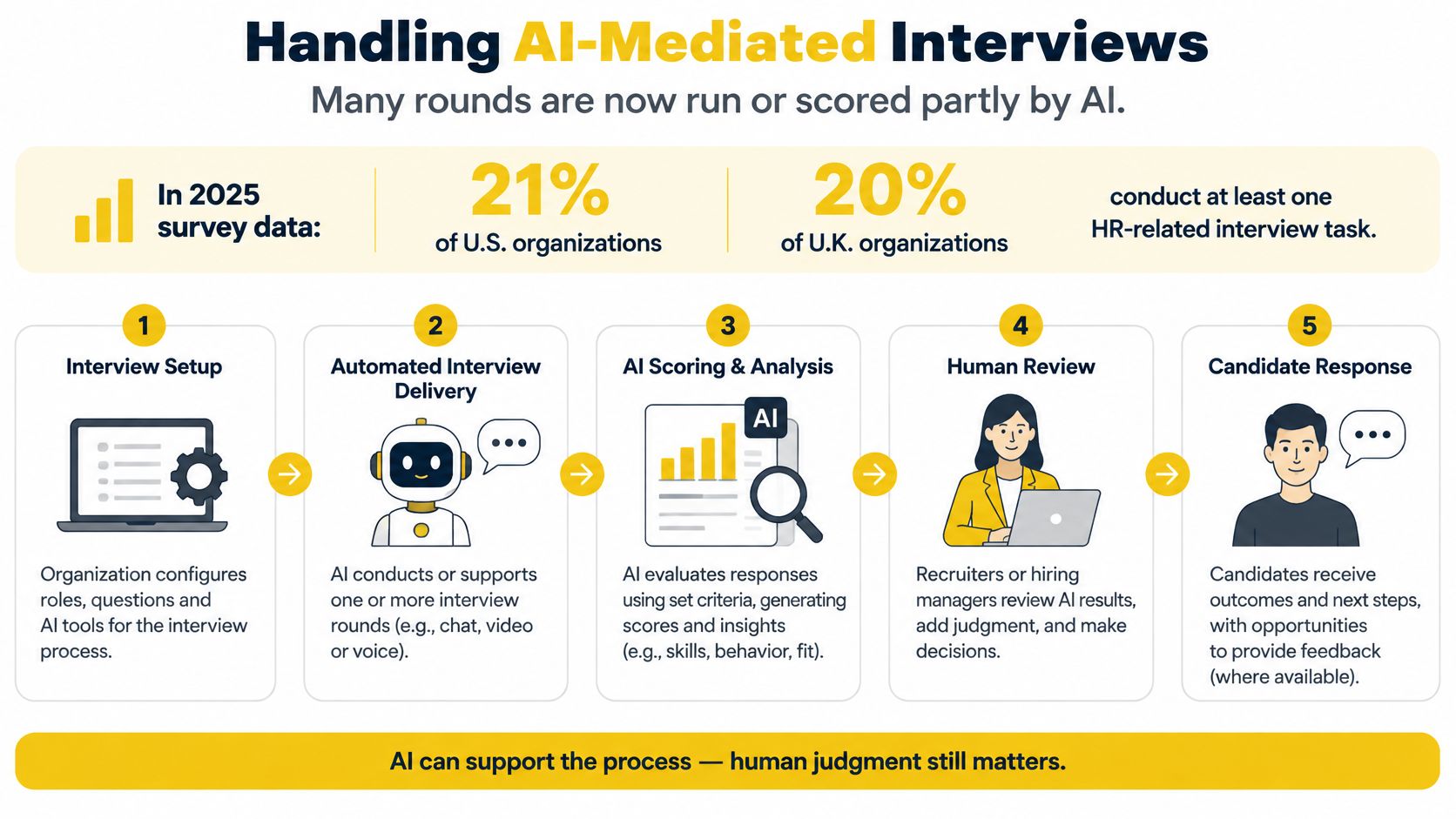
Candidate trust in automated evaluation is low, and some skepticism is healthy. An automated scorer can reward surface features like pacing and phrasing that have little to do with whether you'd do the job well. Understanding how AI interviews work before you're inside one helps you separate what's being measured from what merely looks measurable.
Four things to clarify and do
- Ask about tools and review in advance: Find out whether external tools are allowed, whether the session is disclosed as AI-run, and whether a human reviews the outcome. Reasonable employers answer these questions without friction.
- Narrate your assumptions explicitly: An automated scorer can't read your face or infer your reasoning from a pause. Spoken structure, with your baseline, your test case, and your trade-off stated in words, is what gets captured.
- Request human review or accommodation when needed: If the format disadvantages you for a legitimate reason, ask. Making the request early and specifically is a professional move, not a complaint.
- Keep undisclosed real-time assistance off the table: Secret help during an evaluated round defeats the purpose of the assessment and risks the offer if it surfaces. Preparation tools before the interview are a different matter entirely.
The video below walks through how these AI-mediated rounds feel from the candidate side, so the format isn't a surprise when you meet it.
One more shift is worth preparing for. Interviewers increasingly ask how you use AI tools in your actual work, and they care about whether you can critically evaluate AI output rather than paste it in trustingly. Have one concrete example ready where you caught a plausible but wrong AI suggestion and can explain how you verified it. That single story demonstrates judgment that both human and automated evaluators are learning to look for, and it's the kind of answer that's hard to fake under follow-up questioning.
Technical rounds reward visible reasoning, and that's a trainable skill. Interview Pilot gives you AI mock interviews with an evaluation of your answers, plus a software engineer question set spanning programming, algorithms, system design, and debugging, so you can rehearse out loud and score yourself against the same criteria interviewers use. Visit Interview Pilot to run your first timed practice session before your next loop.
Topics
technical interview questions
coding interviews
system design
interview prep
what is technical interview questions
Continue reading

Interviews
10 Career Development Tools to Grow Faster in 2026
Compare 10 career development tools for 2026: interview prep, courses, assessments, skills mapping, resumes, and live AI interview support.
October 23, 2026
16 min read

Interviews
Mock Interview Coaching That Actually Works in 2026
Practical mock interview coaching guide for 2026 covering AI-driven rehearsal, realistic feedback loops, and how to build a study plan that improves real
October 17, 2026
14 min read

Interviews
Best Data Science Interview Book: What to Read in 2026
Find the best data science interview book for your role, with a comparison of top titles, reading plans, and how to pair books with live practice tools.
October 15, 2026
13 min read