












Interviews
Technical Screening Interview: What It Is and How to Pass
Understand what a technical screening interview is, the formats used, how hiring teams evaluate candidates, and practical strategies to pass and move forward.
Interview Pilot Editorial Team
Updated October 4, 2026
15 min read

Technical candidates average 3.5 hours of interviews before receiving an offer, so a technical screening interview is rarely a quick checkpoint. It's a lengthy, multi-stage filter designed to test different kinds of evidence before a company commits to a hire.
That reality explains why capable candidates often leave a screening process feeling confused. They may prepare for one coding question, then encounter a recruiter conversation, a timed assessment, a live debugging session, a system design discussion, and a final review that rewards communication as much as syntax.
The central mistake is assuming that every stage measures the same thing. It doesn't. A coding test measures execution under constraints, a live interview exposes reasoning and communication, and a take-home assignment reveals how someone makes trade-offs without an interviewer watching every keystroke. Candidates perform better when they identify the format psychology behind each stage instead of treating preparation as a generic list of algorithm exercises.
Why Technical Screening Interviews Feel Longer Than They Should
A candidate can start the week expecting a short call with an engineer and end it managing several separate evaluations. The first conversation may focus on background, the next on coding, and another on design or debugging. Each stage feels like a repeat of the last one because the company is still asking, in different ways, whether the candidate can solve technical problems.
The time commitment is not just a perception. Technical candidates averaged 3.5 hours of interviews before receiving an offer, while total interview time for a technical hire reached 23.3 hours, compared with 12.2 hours for a business hire. The same benchmark reported 17.6 interviews per technical hire on average, up from about 11 interviews per hire in 2021, a 52% increase. (Ashby's recruiting productivity benchmark)
That expansion changes the candidate's job. You're no longer preparing for one event. You're maintaining concentration across a sequence of interviews in which each evaluator sees only part of your ability.
The stress comes from uncertainty, not only difficulty
Consider two candidates with similar experience. One knows the company uses a timed coding assessment followed by a structured technical discussion. The other receives a calendar invitation titled “technical conversation” and has no idea whether to review data structures, system design, debugging, or past projects. The second candidate may spend more time preparing and still feel less ready because the uncertainty consumes attention.
A long process also creates misleading feedback. If you don't advance after an early screen, you might conclude that your technical skills failed. In reality, the company may have been filtering for a narrow combination of experience, communication style, availability, or evidence from one specific exercise. A rejection is information about the match between your signal and that stage, not a complete measurement of your engineering ability.
What candidates should infer from the process
The number of rounds tells you that the hiring team is collecting several signals, but it doesn't guarantee that the process is well designed. A company can add interviews without improving decision quality. Repeated conversations with no shared rubric often produce fatigue for everyone and allow personal preference to replace evidence.
Practical rule: Treat every stage as a different test. Ask what output the interviewer needs from you, then prepare to make that output visible.
Before the first call, ask the recruiter what format to expect, whether external tools are permitted, how long the exercise lasts, and what topics the team intends to assess. Those questions aren't signs of weakness. They help you distinguish between a process that measures job-relevant ability and one that expects candidates to guess the rules.
What a Technical Screening Interview Actually Is
A technical screening interview is a selection gate. It helps a hiring team decide which candidates should receive the time and cost of later evaluation, while giving the candidate an early opportunity to demonstrate technical judgment beyond the résumé.
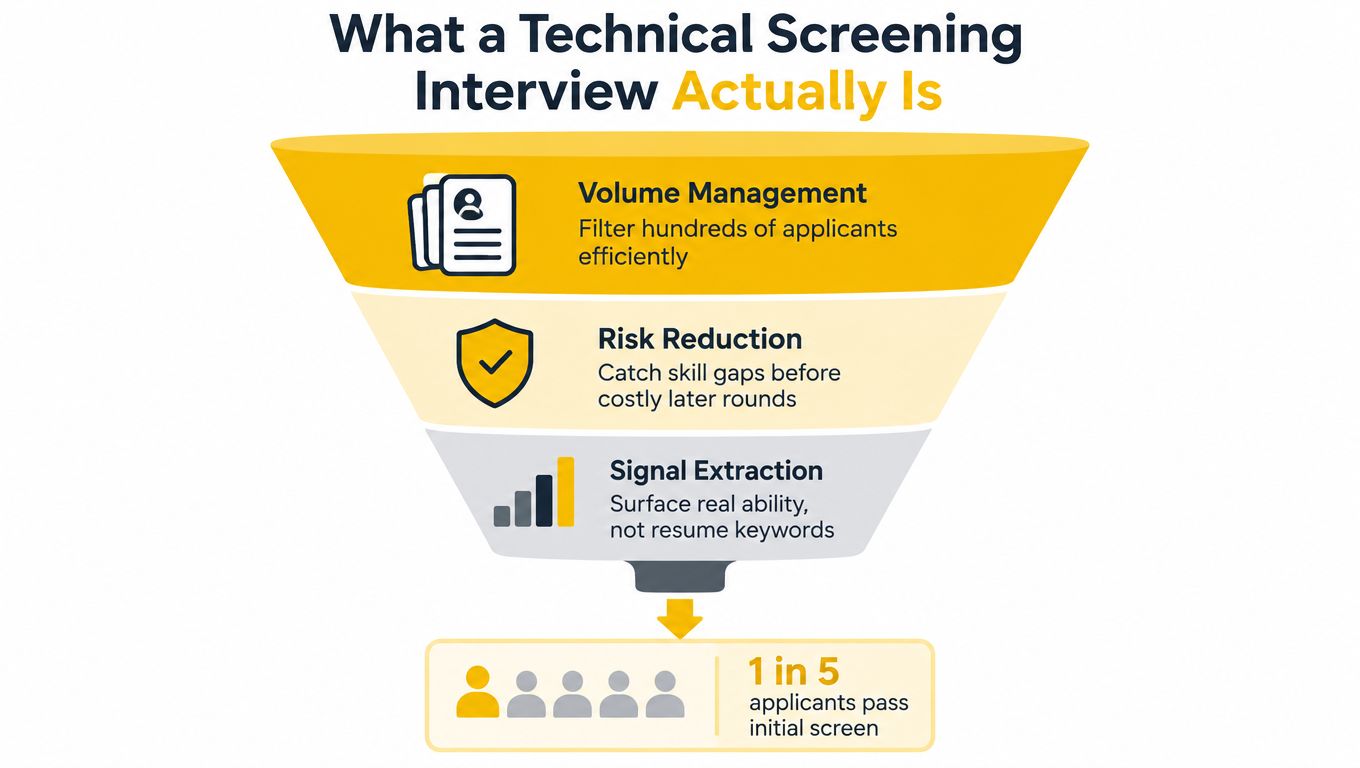
The gate usually performs three jobs:
- Volume management: Recruiters and engineers need a repeatable way to narrow a large applicant pool.
- Risk reduction: A company wants to identify major skill gaps before assigning several employees to later interviews.
- Signal extraction: The team wants evidence of problem-solving, technical judgment, communication, and learning ability that a résumé may not provide.
The funnel is especially narrow for technical roles. HackerRank's 2025 benchmark reported that most recruiting teams advanced only 10% to 19% of phone-screened candidates to the onsite stage, while 17% of teams reported a phone-screen pass-through rate of 40% or more. Across all teams, the average share advanced was 34%. The same benchmark noted that software engineering roles at large technology companies typically convert 10% to 15% of inbound applicants into a technical screen and about 2% to 5% from application to onsite. (HackerRank's 2025 Tech Recruiting Benchmark Report)
Why the gate can feel harsher than the job
A screening interview compresses a broad role into a small number of observable moments. An engineer may spend months maintaining production systems, investigating failures, reviewing pull requests, and collaborating with product teams. A screening exercise may ask that engineer to solve an unfamiliar problem while explaining each decision to a stranger.
That compression creates trade-offs. Hiring teams get a faster comparison between candidates, but they can miss people who need context before showing their best work. Candidates get a chance to demonstrate capability, but they must do so within rules that may not resemble daily engineering.
A low advance rate therefore reflects both competition and funnel design. It doesn't automatically mean that every person who fails the screen lacks the skills required for the role.
The signal hiring teams are trying to isolate
Good screening questions aren't difficult merely to create pressure. They expose choices. Can you clarify an ambiguous requirement? Do you choose a sensible data structure? Can you identify an edge case before it causes a failure? Do you notice when a solution is correct but unsuitable for the stated constraints?
Those signals help a team decide whether to invest in deeper evaluation. They also explain why a technically correct answer can still produce a weak result if the candidate can't communicate assumptions or respond to changing requirements.
Common Technical Screening Interview Formats and What They Reveal
The format determines what the interviewer can observe. A timed coding test creates a controlled environment, a live phone screen exposes the reasoning process, and a take-home project shows how the candidate works with more freedom. None is universally superior.
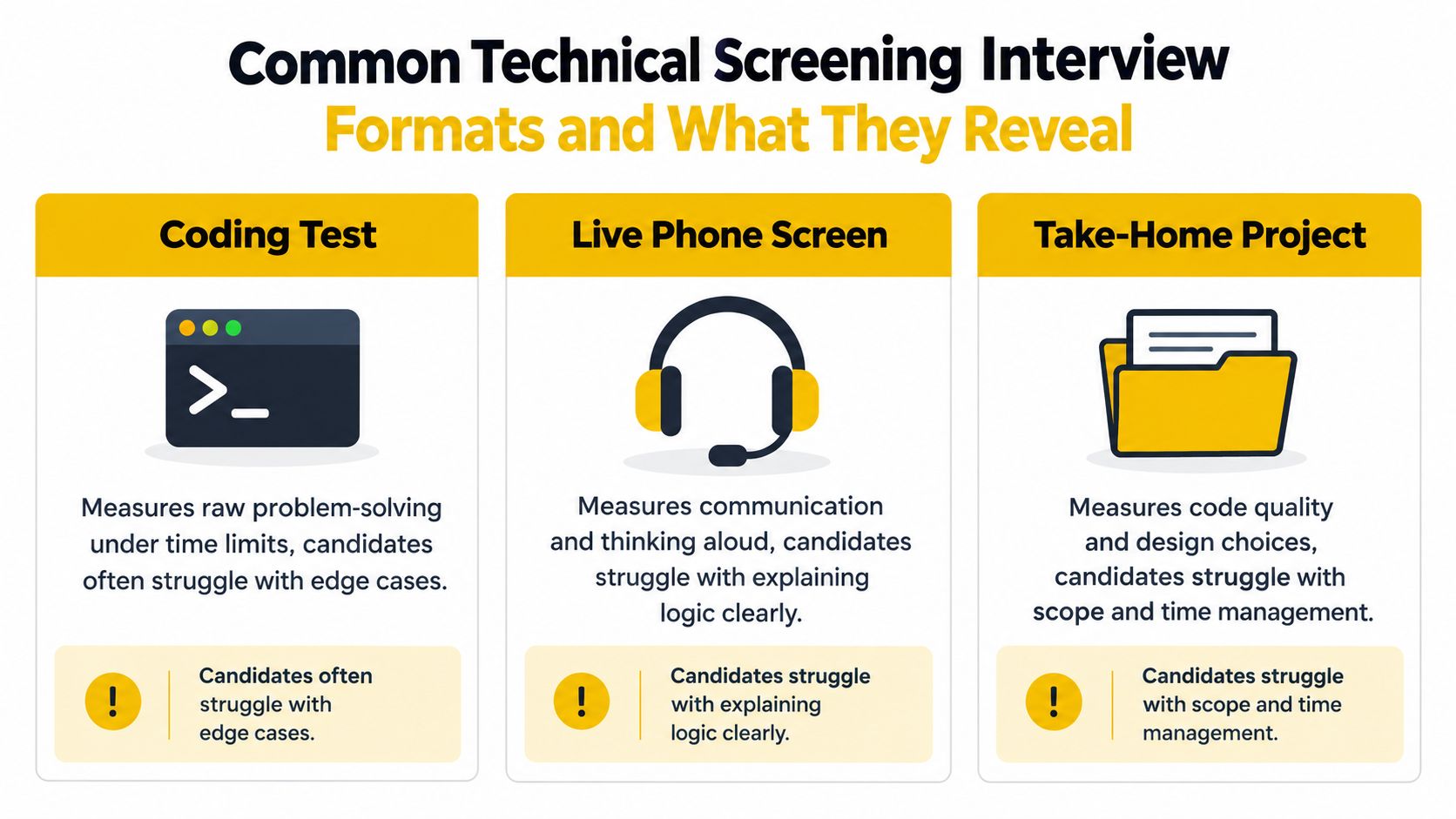
| Format | What it reveals | Where candidates commonly lose signal |
|---|---|---|
| Coding test | Raw problem-solving under time limits | Edge cases, pacing, and incomplete validation |
| Live phone screen | Communication and thinking aloud | Unclear explanations and silent reasoning |
| Take-home project | Code quality and design choices | Uncontrolled scope and weak time management |
Coding tests reward disciplined execution
A coding test makes the candidate's output easy to compare. It can reveal whether you translate a requirement into a working solution, test ordinary and unusual inputs, and improve an approach when the first version is inefficient.
The common failure is treating the test as a race to produce code. Candidates often skip requirement clarification, write a solution before choosing a representation, or stop after the happy path works. Hiring teams may notice the missing validation before they notice the clever algorithm.
Preparation should therefore include a verbal routine, even when the test is asynchronous. Read the prompt, state assumptions, outline the approach, implement a small version, test it, and then discuss complexity or limitations. This routine creates evidence of judgment rather than leaving the evaluator with a block of code and no context.
Live phone screens expose the reasoning process
A live screen measures more than whether you reach a correct answer. It reveals how you react to ambiguity, how you receive a hint, and whether you can explain a decision without narrating every private thought. Silence can become a problem because the interviewer can't distinguish between deep reasoning and being completely stuck.
Use short progress updates instead of a continuous monologue. Explain the current assumption, name the next decision, and ask a focused question when the prompt leaves room for interpretation. Candidates preparing for this format can use a focused collection of phone screen interview questions to practice answering aloud rather than reading solutions silently.
For hiring managers who want role-specific prompts, an interview guide for crypto hiring managers can help connect technical questions with the demands of a specialized environment.
Take-home projects reveal trade-offs
A take-home project gives candidates more control over setup, testing, documentation, and revision. It can show whether someone produces maintainable code, chooses an appropriate scope, and explains design decisions clearly.
The risk is that the assignment becomes a test of unpaid time or access to outside help. Candidates struggle when they build a large product instead of a focused demonstration, or when they submit polished code without a clear README explaining what they chose not to build.
A strong submission makes boundaries explicit. State the assumptions, describe the architecture, include tests for important behavior, and identify the next improvement you'd make with more time. That explanation gives the reviewer a way to evaluate judgment instead of rewarding surface complexity.
How Observation and Interview Design Affect Performance
Live coding is often treated as a neutral way to observe ability. It isn't neutral for every candidate. The interviewer's presence changes the task by adding social evaluation, time pressure, and the need to explain decisions while solving the problem.
A controlled study involving 48 computer-science students found that performance dropped by more than half when students were watched by an interviewer. Stress and cognitive load were also significantly higher than in a private interview setting. (North Carolina State University's summary of the interview anxiety study)

Observation changes the measured behavior
A candidate who solves problems effectively alone may lose working memory during a live session. They may forget a familiar pattern, misread a simple condition, or spend too much attention predicting the interviewer's reaction. That does not make the result meaningless, but it means the result contains both technical ability and performance under observation.
Candidates can reduce the effect by rehearsing in the same mode they'll face. Solve problems aloud, use a shared editor during practice, and ask a partner to interrupt with clarifying questions. The purpose isn't to imitate a hostile interviewer. It's to make explanation and recovery familiar enough that they don't consume all your attention.
If you blank, don't hide the state of the problem. Say what you know, identify the missing piece, and test a smaller example. Guidance on what to say when you don't know the answer in a technical interview can help turn uncertainty into observable reasoning.
Format quality is part of hiring quality
A well-designed process acknowledges the limitations of its tools. A private or asynchronous task may produce a cleaner view of coding ability, while a live conversation can then test communication, collaboration, and the ability to respond to feedback. Teams should avoid using live pressure as a substitute for a job-relevant assessment.
Candidates can evaluate the company, too. Ask whether the exercise resembles work the role requires, whether interviewers use a shared rubric, and whether the team permits questions about requirements. A company that can explain its evaluation method is more likely to distinguish signal from nerves.
A screening should reveal how you work, not merely how well you perform while being watched.
Evidence-Based Criteria Hiring Teams Use to Evaluate Candidates
The strongest technical screens measure observable work and score it consistently. They don't rely on whether an interviewer feels an immediate connection with a candidate or prefers one communication style.
Research summarized by P---
Interviewing Engineers for Impact reports validity around r = 0.51 for structured interviews, r = 0.54 for work-sample tests, and roughly r = 0.38 for unstructured interviews. (Pioneers' overview of evidence-based engineering interviews) In plain language, structured interviews and work samples provide stronger evidence of later performance than loose conversations because they connect evaluation to defined behavior.
What structure looks like in practice
A structured technical screen gives candidates comparable prompts, consistent time expectations, and a scoring rubric. The interviewer may score problem decomposition, correctness, testing, communication, and response to feedback separately instead of reducing the entire session to a vague impression.
A work sample can be a coding task, debugging exercise, design review, or project discussion. The format matters less than the connection to the role. A backend engineer might need to reason about data consistency and failure handling, while a frontend engineer might need to discuss state management, accessibility, and performance trade-offs.
A practical evaluation stack can combine:
- Initial context: Review experience and confirm that the candidate has worked with relevant systems or responsibilities.
- Job-focused exercise: Ask the candidate to perform a representative task, with enough context to make the result interpretable.
- Rubric-based discussion: Explore decisions, alternatives, testing, and communication using consistent questions.
- Evidence review: Separate a correct result from the quality of the reasoning that produced it.
How candidates can recognize a serious process
Candidates can't see the internal scorecard, but they can look for clues. A recruiter who explains the format, an interviewer who states the assessment criteria, and a team that leaves time for questions are all signs of deliberate design. Vague prompts, shifting expectations, and multiple interviewers asking unrelated versions of the same question create more noise.
Candidates should prepare for the criteria that a good rubric usually exposes: clarity of assumptions, correctness, maintainability, testing discipline, technical trade-offs, and collaboration. Memorizing a large collection of solutions may help with familiarity, but it won't replace the ability to explain why an approach fits the problem.
For a broader perspective on evaluating engineering ability during recruitment, this technical interviewing resource from nexus IT group is useful because it connects interview questions with practical assessment concerns.
How to Prepare for Technical Screening Interviews Effectively
Preparation works best when it mirrors the conditions you'll face. Don't spend all your time reading solutions if the actual assessment requires you to explain, debug, or make design trade-offs aloud.
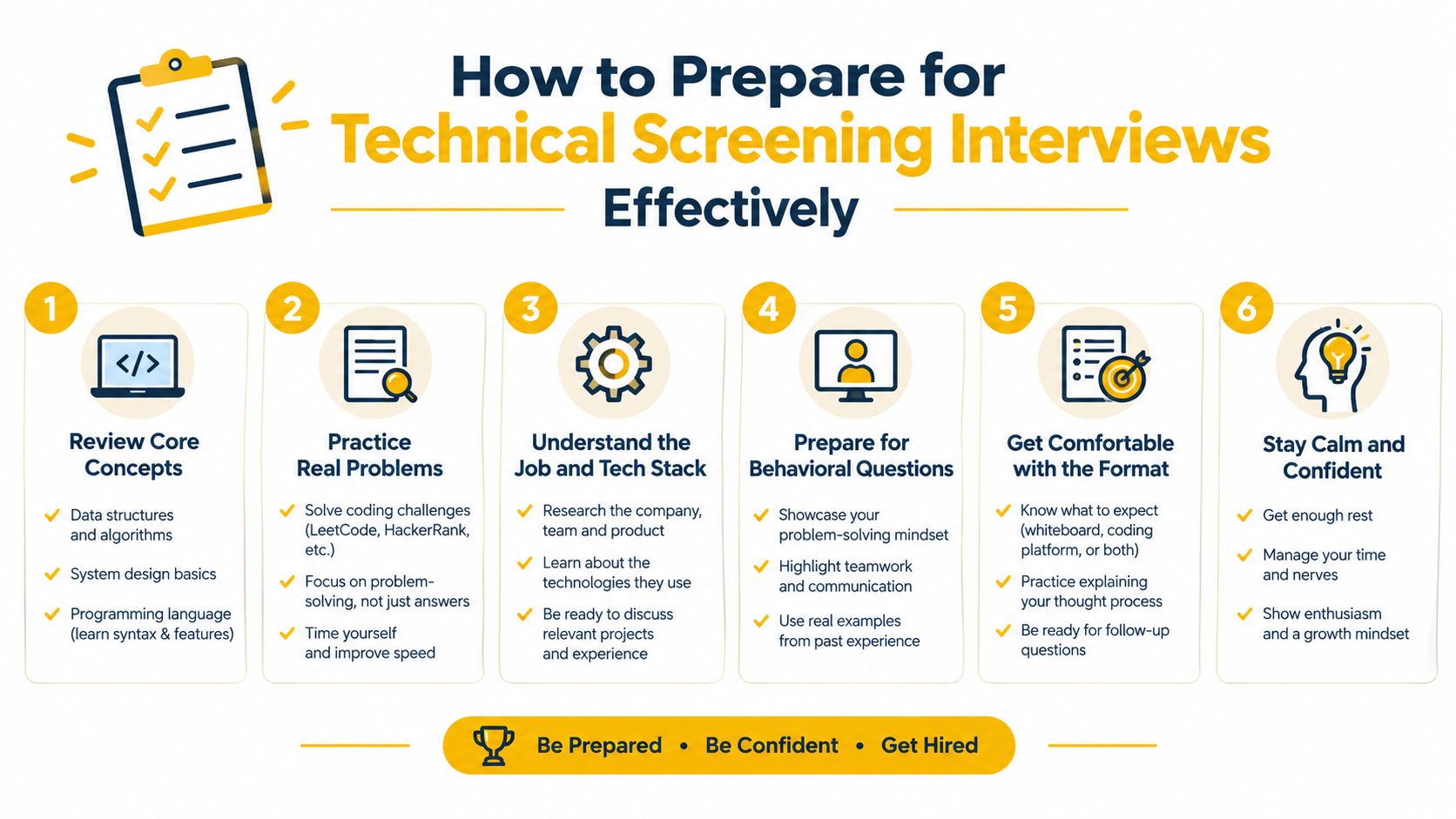
Start with the process. Confirm the interview format, permitted tools, expected topics, and whether coding assistance is allowed. Recent survey data found that 24.54% of teams used asynchronous technical tests, 49.82% used live coding interviews, and 75.27% relied on technical discussion. The same source reported that most companies kept coding rounds AI-free despite experimenting with coding assistants. (CoderPad and CodinGame's 2025 tech hiring survey)
Build preparation around repetition
Use a question bank to identify patterns, then solve representative problems without immediately checking an answer. Follow each exercise with a short explanation of the approach, a test plan, and a note about what you'd improve.
Guided mock interviews add the missing social pressure. Practice with a colleague, record yourself, or use an AI rehearsal tool that asks follow-up questions. A service such as Interview Pilot offers guided mock interview practice, a searchable question bank, and real-time suggested answers for online interviews, but candidates should follow the actual employer's rules and never assume live assistance is permitted.
If you're also comparing roles that support location flexibility, a premium remote job search can help you find opportunities whose interview process and working model match your preferences. Preparation is more productive when you target roles you genuinely want rather than rehearsing without a clear fit.
Use this guide on how to prepare for a technical interview to turn the process into a repeatable routine:
- Clarify the format: Find out what will be tested and what tools are allowed.
- Practice representative tasks: Match the exercise type, time pressure, and communication demands.
- Review mistakes: Track recurring issues such as edge cases, unclear assumptions, or rushed testing.
- Rehearse recovery: Practice responding when you need a hint or don't know the answer.
- Prepare questions: Ask how the team evaluates performance and how the role uses the assessed skills.
Interview Pilot provides guided mock interviews, a searchable bank of technical questions, and real-time answer suggestions for online interview practice. Use it to rehearse the specific format you expect, then visit Interview Pilot to build a more structured preparation routine.
Topics
technical screening interview
coding interview
job interview prep
tech hiring
interview strategies
Continue reading

Interviews
8 Star Interview Answer Examples for Behavioral Questions
Master 8 star interview answer examples for engineering, product, finance, and data roles, with STAR breakdowns, customization tips, and practice tactics.
October 4, 2026
23 min read

Interviews
Software Engineer Technical Interview Questions and Answers
Master software engineer technical interview questions and answers with worked approaches, practice tips, and resources for algorithms, systems, and design.
October 4, 2026
19 min read

Interviews
10 Technical Interview Questions Software Engineer
Master technical interview questions software engineer candidates face, from algorithms and data structures to system design, with practical answer tips.
October 3, 2026
20 min read