









Interviews
How to Ace Behavioral Interview with STAR
See how to ace behavioral interview rounds with 6-8 scored stories, a timed STAR answer, follow-up practice, and a rehearsal that stays credible.
Interview Pilot Editorial Team
Updated October 31, 2026
16 min read

Memorizing polished STAR answers is popular behavioral interview advice. It's also a poor place to start. A fluent story doesn't give an interviewer much to score if they can't identify the decision you owned, the alternatives you considered, and what changed afterward.
The practical answer to how to ace a behavioral interview is to prepare evidence you can explain under questioning, not a performance you can repeat without interruption. Build your story notes first, shape them into concise answers, and rehearse the uncomfortable follow-ups. Use AI to challenge your account before interview day, not to manufacture one during it.
A Story Library Interviewers Can Score
Past behavior is evidence; a promise about future behavior isn't the same thing. The U.S. Office of Personnel Management's structured interview guidance describes behavioral interviewing as gathering evidence from previous work or life situations and notes its particular value for complex professional and managerial roles.
That distinction should change your preparation. An interviewer assessing collaboration needs an example of how you handled competing interests, not your description of yourself as collaborative. Someone assessing judgment needs to understand what information you had when you decided, not just whether the project eventually succeeded.
Build an evidence sheet before writing answers
Start with approximately six to eight true experiences that cover the recurring competencies below. Treat that as a practical preparation target, not a reason to stretch weak material into separate stories. A substantial experience can cover several competencies when the actions support each one.
Eight stories that cover a behavioral interview
| Competency | Prompt to rehearse | Evidence to capture |
|---|---|---|
| Conflict resolution | Tell me about a disagreement with a teammate or stakeholder. | The opposing view, your decision, and what changed in the working relationship |
| Failure | Describe a time you missed a goal. | The miss in numbers, what you owned, and the fix you put in place |
| Leadership | Tell me about leading without formal authority. | Who you influenced, the ask, and the outcome you can measure |
| Prioritization | Describe competing deadlines. | What you dropped or sequenced, the constraint, and what still shipped |
| Teamwork | Tell me about a shared win. | Team context versus the actions that were yours alone |
| Ambiguity | Describe a vague assignment. | The assumption you tested, the choice you made, and the result |
| Customer impact | Tell me about helping a customer or user. | Who was affected, the action, and the change in time, cost, or satisfaction |
| Learning | Describe feedback that changed how you work. | The feedback, the new behavior, and proof it stuck |
For each experience, write a short situation line, then name the decision you personally owned. Add a scale marker: team size, deadline, budget responsibility, delivery time, affected customers, or another detail that establishes the difficulty. Finish with the outcome and the lesson you applied afterward.
Don't confuse scale with impact. Managing a large project establishes context, but it doesn't prove that your contribution improved anything. Capture both what you were working with and what changed because of your actions.
Choose stories with defensible details
Check your notes against records you're entitled to access, such as performance reviews, project summaries, or your own work log. Don't download confidential material for interview preparation. Where a result is sensitive, describe the operational change without exposing protected information.
A story with a modest outcome and a clear decision is more useful than an impressive project where your contribution is hard to isolate. Remove experiences that require a long explanation before the interviewer can understand your role.
Selection rule: Choose the story where you can explain the decision, not merely name the achievement.
Finally, star the pair with the clearest relevant numbers for your target role. Those are strong opening candidates, but keep the remaining experiences available so you don't force every question into the same project.
How to Build a STAR Answer in Minutes
A STAR answer is not a script to memorize. It is a flexible split of evidence: give enough context to make the decision clear, spend the most time on what you did, and close with the result. For a two-minute answer, aim for 1.5–2.5 minutes in rehearsal, with roughly 20–25% for situation and task, 50–60% for actions, and 20–25% for results and reflection. Adjust the balance when the decision or outcome needs more explanation.
STAR time split for a two-minute answer
| Answer part | Share of the answer | About this long in 2 minutes | Put here |
|---|---|---|---|
| Situation and task | 20–25% | 25–30 seconds | Constraint, your owned outcome, no backstory |
| Actions | 50–60% | 60–72 seconds | Your decisions, trade-offs, and steps, using I |
| Result and lesson | 20–25% | 25–30 seconds | What changed, a number if you have one, one lesson |
Use this visual to check the speaking order before you rehearse.
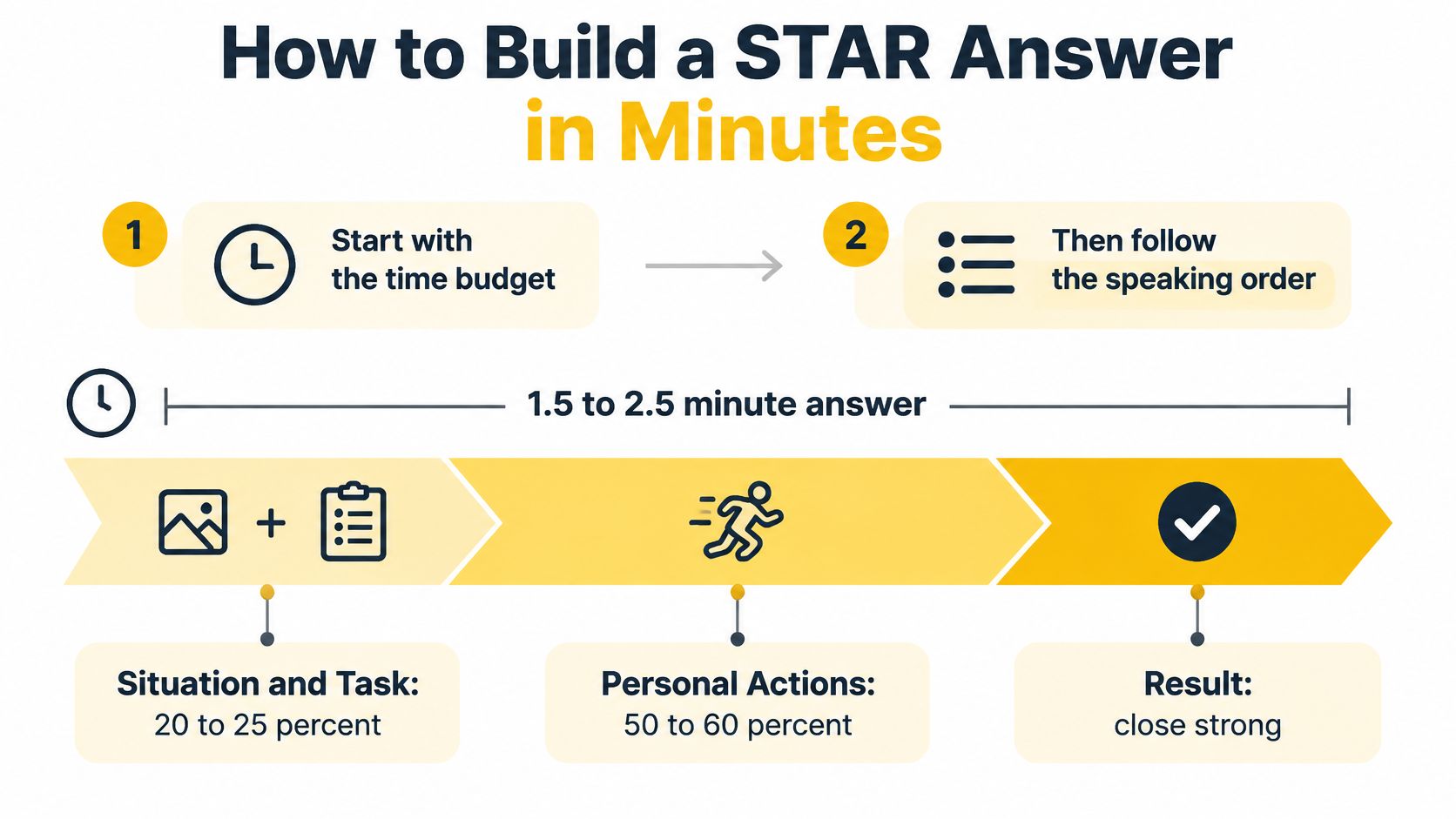
Speak in decision order
- Establish the situation. Name the project and the constraint that made it difficult. Skip company history unless it explains the decision.
- Define your task. State the outcome you owned. “Supported a launch” is vague; “owned release readiness” gives the interviewer something specific to examine.
- Explain your actions. Describe the options, what you chose, and why. Use “I” for your contribution and “we” for shared work.
- Report the result. Connect the outcome to the original task, then name what you learned or changed.
- Stop. Leave room for follow-up rather than adding a second example.
Actions carry the most weight because they show judgment. If you list steps without explaining a trade-off, the interviewer may not know what made the decision difficult. Say which reasonable alternative you rejected and why.
A launch example without the filler
Suppose a launch is slipping because the team keeps accepting nonessential requests. Your responsibility is release readiness, not managing every contributor.
A concise answer could explain how you separated essential customer workflows from optional features, reviewed proposed cuts with the technical lead, and secured agreement from the customer-facing team. Include the cost of the decision: some customers would wait for the extra functionality.
Close with the actual release outcome and any verified change in defects or customer issues. If defects were not measured consistently, don't claim a reduction. State what shipped, what remained unresolved, and how acceptance was checked.
For more guidance on structuring interview answers, review how context, action, and outcome work together. Then rehearse with a phone timer. If the setup takes too long, cut background rather than rushing through the decision. Speak less context, not faster actions.
Tailor Stories to the Job Requirements
The most dramatic story in your library may be the wrong answer for this employer. A crisis-management example won't necessarily demonstrate mentoring, and delivering a project doesn't automatically prove customer judgment. Match the evidence to the responsibility the hiring team is trying to fill.
Open the actual posting and mark requirements that recur in the responsibilities and must-have criteria. Look for work, not adjectives: resolving stakeholder disagreements, shipping under a deadline, mentoring colleagues, improving an operational metric, or deciding with incomplete information.
Match the responsibility, not just the vocabulary
Attach a primary story and a backup to each important requirement. Write the competency beside each match so you know whether you're demonstrating influence, accountability, prioritization, or another behavior. This behavioral competencies guide can help distinguish overlapping labels.
Translate the result into the employer's language without changing the underlying facts. An operations interviewer may care about cycle time; an engineering interviewer may care about reliability or incident recovery. A product interviewer may want to understand adoption and what you chose not to build.
Requirement-to-story mapping for one posting
| Job requirement | Story A | Story B |
|---|---|---|
| Ambiguity under a deadline | Failure story, prioritization result line | Failure story, learning result line |
| Stakeholder conflict | Conflict story, result line in the employer's metric | Leadership story, showing agreement on a shared decision |
The ambiguity row illustrates alternative angles on the same experience, not independent coverage. Keep a different backup available in case the interviewer asks for another example.
Reuse facts without rewriting history
Consider a hypothetical project manager posting that emphasizes ambiguity and customer impact. Your failure story concerns an onboarding rollout where you accepted an unclear request, discovered a dependency too late, and missed the intended handoff.
For a prioritization question, emphasize how you separated urgent customer needs from optional work once the problem became visible. Your result line should describe what you recovered, what you deferred, and what still missed the deadline.
For a learning question, emphasize why you accepted the ambiguity and how you changed your intake process. Your result line should describe subsequent use of the dependency check and the evidence that colleagues adopted it, if that happened.
The events don't change. The relevant decision and closing emphasis do.
Tailoring means selecting relevant facts. It doesn't mean improving the facts to fit the posting.
Reject stories whose scope you can only make relevant by exaggerating your authority. A smaller example of personally resolving a dependency can demonstrate more than a major transformation where you attended meetings.
Prepare a brief bridge explaining the connection to the role, but don't announce a competency label and expect it to substitute for evidence. Finish your interview notes with the requirement, the primary story, and the backup, not a page of rewritten scripts.
Stay Credible When Follow-Ups Get Specific
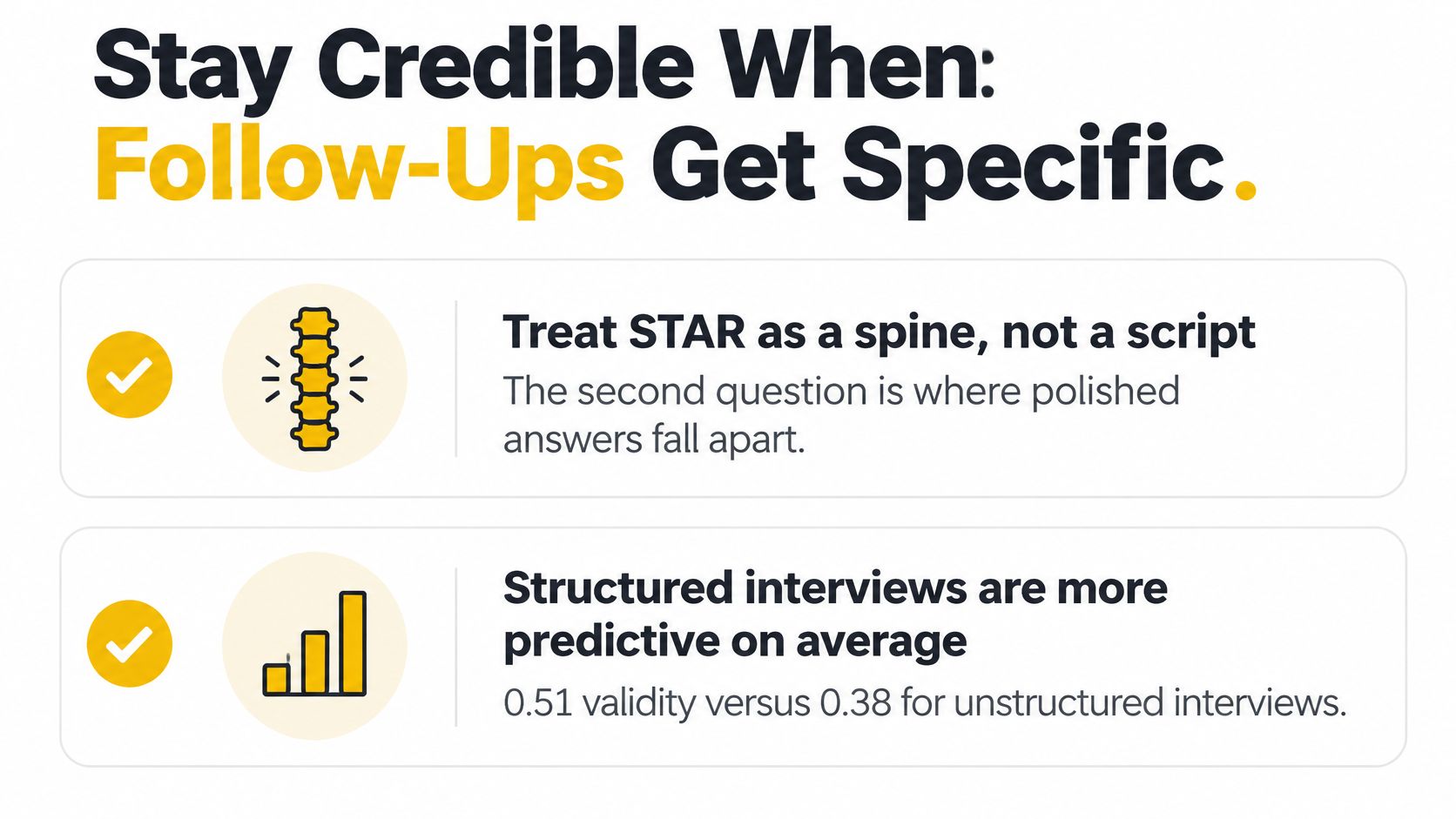
What did you personally do? That follow-up exposes the gap between a polished project summary and a credible behavioral answer. If you have to restart the story to identify your contribution, the original answer probably hid it.
The article Structured Interviews Moving Beyond Mean Validity reports average validity around 0.51 for structured interviews versus about 0.38 for unstructured interviews, while emphasizing variation in effectiveness and the influence of interviewer preconceptions. Preparation can improve the evidence you provide; it can't guarantee an unbiased interpretation.
Use the checklist below to pressure-test your account rather than memorize a smoother version.
Prepare the uncomfortable probes
For every story, practice these questions:
- What did you personally do? Identify the analysis, conversation, document, escalation, or decision that was yours.
- What would your manager say? Explain your contribution without claiming to know another person's private assessment. Include feedback you received.
- What failed? Name the unresolved problem, mistaken assumption, or consequence you'd handle differently.
For a team result, distinguish contribution from attribution. You may have designed the handoff process while colleagues executed it. Say that, rather than claiming the entire outcome or becoming so cautious that you erase your own work.
Follow-ups also test sequence. Be ready to explain what happened after you sent the email, who disagreed with the proposal, and what evidence caused you to change direction. Those details make your reasoning inspectable.
Give mixed results without disguising the miss
A mixed outcome isn't a defective story. It can reveal whether you understand competing objectives and take responsibility for consequences.
In a hypothetical launch example, you might explain that the release missed the promised date but passed the customer's agreed acceptance checks. State both outcomes together, then distinguish the sound decision from the mistake: cutting scope may have been justified, while warning the customer late was not.
Avoid turning every failure into a hidden triumph. If your action didn't work, explain what you learned and what later behavior supports that lesson. Don't invent a recovery to make the ending cleaner.
The same principle applies when your experience is limited. A class project, volunteer role, or shift-level decision is acceptable material when it directly demonstrates the requested behavior. Borrowing a colleague's actions isn't.
Replace jargon with an observable action
A hypothetical candidate saying they ensured stakeholder alignment gives the interviewer little to examine. A candidate explaining that they asked the finance lead to remove optional reporting work before the cutoff gives the interviewer a decision to probe.
Unnatural phrasing alone doesn't prove that an answer is fabricated. The practical problem is language you can't unpack into actual events.
Run a rehearsal with an initial answer, an unexpected probe, and a short correction. Don't restart when you omit a detail. Clarify it conversationally, then continue.
Practice With AI Before Interview Day
Behavioral interviews reward evidence, not answers that sound polished. Use AI to rehearse how you explain real decisions and results. Don't let it invent details or produce undisclosed answers during a live interview.
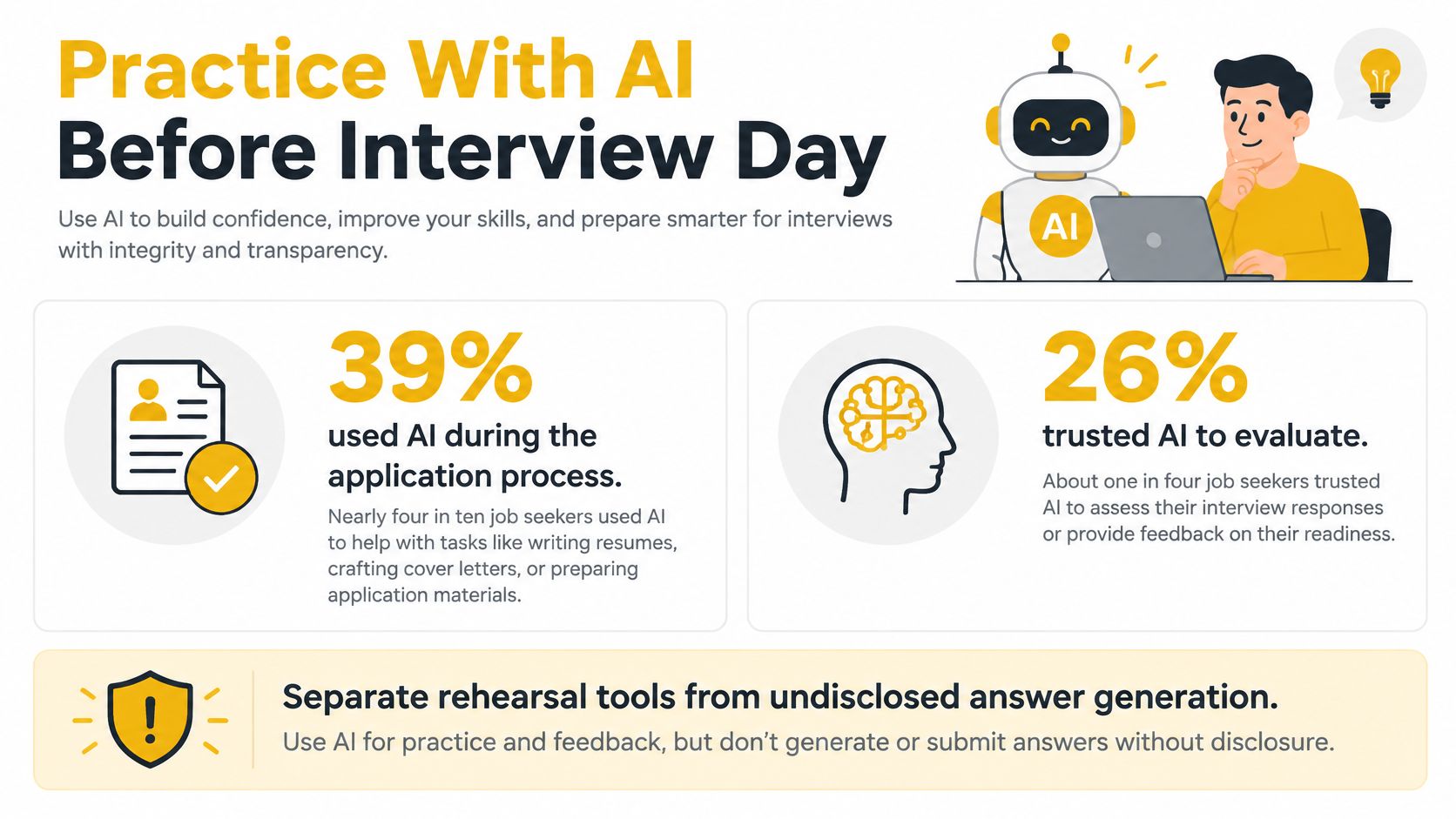
Give the tool facts and ask for challenges
Start with rough notes about a real experience, not a request for an impressive answer. Remove customer names, confidential financial details, internal identifiers, and personal information about colleagues before entering material into a tool.
Use AI to cluster experiences by competency, trim excess setup while preserving your decision and outcome, and generate follow-up questions about unclear ownership or missing evidence. You can also rehearse explaining the same event in language you can comfortably speak.
A useful prompt asks the tool to challenge your story, identify questions your notes cannot answer, and avoid inventing facts. Verify every suggested change against your memory or legitimate records. A polished sentence is no improvement if you cannot defend its details.
This guide to using AI for interview practice offers a way to structure rehearsal around your own experience.
Set boundaries before an automated round
Ask the recruiter whether the interview is recorded, whether automated assessment contributes to evaluation, and what language or accommodation options are available. If you need assistive technology, confirm the permitted setup instead of assuming it is allowed or prohibited.
Never let a tool invent metrics, employers, responsibilities, or actions. Don't use undisclosed live answer generation unless the employer has explicitly permitted it. Permission to use notes or accessibility support does not automatically authorize generated responses.
For a broader preparation routine, the following video can accompany your spoken practice.
Your interview evidence comes from what you did, the decisions you made, and the outcomes you can explain. LinkedIn headshot insights address profile images, a separate part of professional presentation.
Ownership test: If you can't retell the answer with the tool closed, it isn't ready.
Run a Final Rehearsal and Walk In Ready
Spend your final preparation session testing retrieval, not editing sentences. Choose your starred stories and a backup, then ask a practice partner to select prompts without telling you which experience to use. You need to practice choosing the right example as well as delivering it.
Speak aloud under a timer and pause for a probe after each answer. Don't restart because you stumble over a phrase. In a live interview, a brief clarification is more useful than trying to recreate a perfect opening.
Make the mock round diagnostic
Use our AI mock interviews for a practice round and an evaluation of your answers. The mock records your answer whether or not Record Interview Audio is on, because the evaluation's Delivery Score is judged from that recording. Treat the session as recorded and keep confidential material out of your examples.
Review the attempt for concrete issues rather than deciding whether you sounded impressive:
- Relevance. Did you answer the actual prompt, or redirect it toward a favorite achievement?
- Decision depth. Could a listener identify the option you rejected and why?
- Delivery. Did you rush the important action details after spending too long on setup?
- Defensibility. Could you explain where each result came from and what it measured?
Choose the most consequential weakness and fix that before repeating the answer. Rewriting every sentence after a mock can make the next attempt less natural without improving the evidence.
Finish with a compact interview sheet
Before a first interview, our help center suggests a 5-minute checklist. Use that preparation window to confirm your workspace, resume context, and target role so setup doesn't consume the start of the session.
Keep a compact reference sheet with story labels, result figures, and reminders about the decisions you want to explain. Don't turn it into a transcript to read. Where a number is approximate, mark it clearly; where you lack a reliable figure, use a specific qualitative outcome.
Close your notes and retell the hardest example once more. If the explanation breaks down, simplify the account until you can describe it in your own words.
Leave live assistance out of the actual interview unless the employer has allowed it. Walk in ready to listen, choose relevant evidence, and answer the follow-up, not defend a script.
Interview Pilot offers AI mock interviews with answer evaluations to help you test your behavioral stories before interview day. Visit Interview Pilot, rehearse a role-relevant answer, and use the feedback to strengthen the decisions, results, and delivery you can explain on your own.
Topics
behavioral interview
STAR method
interview answers
job interview prep
story library
Continue reading

Interviews
8 Star Interview Answer Examples for Behavioral Questions
Master 8 star interview answer examples for engineering, product, finance, and data roles, with STAR breakdowns, customization tips, and practice tactics.
October 4, 2026
23 min read

Interviews
10 Behavioral Questions for Interviews: STAR Answer Guide
Master behavioral questions for interviews with 10 STAR-based examples, sample answers, role-level variations, and practice prompts for every career stage.
October 17, 2026
19 min read
Interviews
Who Are Your Heroes: How to Answer in Any Interview
Learn how to answer "who are your heroes" in interviews with confidence. Get practical examples, a simple structure, and tips to stand out in 2026.
September 6, 2026
12 min read