









Interviews
Mock Interview Coaching That Actually Works in 2026
Practical mock interview coaching guide for 2026 covering AI-driven rehearsal, realistic feedback loops, and how to build a study plan that improves real
Interview Pilot Editorial Team
Updated October 17, 2026
14 min read

You've rehearsed your introduction, picked a strong teamwork story, and practiced until the answers sound smooth. Then the interviewer asks what you'd do differently, and you lose your place. You know the experience. You just haven't practiced explaining it outside the version you memorized.
Mock interview coaching should train adaptability, not recitation. Useful practice gives you a task, exposes a specific gap, and lets you try a better response. That's a training loop you can use whether you're preparing with a professional coach, a peer, or an automated interviewer.
Why Most Practice Never Makes It to the Real Interview
Consider a practice session built around a familiar behavioral question: describe a time you handled conflict. You deliver your prepared story, explain the disagreement, and finish with a positive result. Your practice partner says it sounded good.
Then they ask whether your colleague would describe the situation the same way.
Suddenly, the answer isn't smooth. You repeat background details, defend your decision, or forget to address the question. This is a hypothetical example, but it illustrates an important distinction: knowing a story isn't the same as being able to interrogate it.
Rehearse the reasoning behind the answer
Word-for-word preparation gives you a fixed route through an answer. A live interviewer may want a different route, asking about your assumptions, personal contribution, or the consequences of your decision. If you've only practiced the original wording, you haven't rehearsed that change.
Keep a story map instead of a script. Capture the problem, your responsibility, the decision you made, the evidence behind it, and what happened afterward. Those pieces let you rebuild an answer around the question asked.
A useful rehearsal ends with a changed behavior, not merely a familiar question answered again.
There's evidence that structured practice can support readiness, but it shouldn't become a hiring promise. In an Australian study of graduate paramedic practice interviews, all fourteen participants agreed or strongly agreed that the exercise improved confidence and preparation; eleven of twelve follow-up respondents reported successful interviews and employment offers. The small, specialized cohort means those employment outcomes can't be generalized to job seekers broadly.
Give each session a practical purpose
Before rehearsing, name the behavior you're testing: explaining ownership, answering follow-ups, or choosing relevant evidence. Afterward, identify what changed and what still needs work.
Preparation can also include resources that reflect your circumstances. Readers seeking faith-aware support can explore PrayerPetals' career help for Christian women alongside their rehearsal work. Keep that broader support connected to a concrete practice objective rather than using preparation resources as a substitute for answering aloud.
Choosing the Right Coaching Format for Your Role
Choose a coaching format by the feedback you need, not by how polished the service looks. Someone struggling with executive-level judgment needs a different practice partner from someone checking whether they can explain a technical solution clearly.
Start with the target interview. Use this guide to interview formats to scope what you need to rehearse, then assess whether your partner or tool can reproduce that task credibly.
Match the format to the problem
Human coaches are worth considering when interpretation matters. A capable coach can challenge a leadership narrative, identify weak positioning, and explore whether your answer demonstrates the seniority the role requires. The trade-offs are fees, scheduling, and variable expertise. Ask how they evaluate answers before committing.
Peer practice is a practical supplement when you need conversational rehearsal without a professional coaching fee. It works better when both people use an agreed rubric and take the interviewer role seriously. Friendly reassurance isn't enough, and a peer may not know whether your technical or commercial reasoning is sound.
AI mock sessions offer another way to rehearse prompts and review responses without coordinating with a partner. Automated feedback needs scrutiny, particularly when an answer depends on specialist knowledge or unusual career circumstances. Don't accept a favorable score as proof that your reasoning is correct.
Coaching format trade-offs at a glance
| Dimension | Human coach | Peer practice | AI mock sessions |
|---|---|---|---|
| Cost | Professional fee varies | May avoid coaching fees | Check access and plan limits |
| Scheduling | Requires an appointment | Requires coordination | Can support independent practice |
| Feedback depth | Depends on expertise | Depends on partner knowledge | Depends on evaluation design |
| Consistency | Ask about the rubric | Agree on criteria beforehand | Check how repeat responses are judged |
| Strongest fit | Nuanced behavioral and senior panels | Conversational practice and follow-ups | Repeatable prompts and answer review |
| Main caution | Credentials don't establish role expertise | Kindness can replace critique | Fluent feedback can miss substance |
Use a conditional decision rule
On a tight timeline for a technical role, automated practice can be a starting point, provided you can verify technical correctness separately. For nuanced senior or executive panels, prioritize a human coach with relevant experience. Use peers once you know what useful feedback should contain.
For negotiation-heavy roles, distinguish interview rehearsal from learning the underlying skill. You might compare real estate negotiation courses through Ashby and Graff while choosing how to rehearse your interview explanations. A polished account of negotiation won't compensate for weak negotiation judgment.
What Good Feedback Actually Looks Like
“Be more confident” describes an impression, not an action. “Tighten that answer” leaves you guessing whether to remove context, shorten the result, or stop repeating yourself. Useful feedback identifies an observable behavior and a testable change.
In a study of collaborative multimodal mock-interview assignments, 76% of entry-level respondents reported improved interview skills, 87% identified improvement areas, and 84% better understood likely questions; among upper-level respondents, those figures were 89%, 91%, and 95%, respectively. The same study found 66% of entry-level respondents considered feedback helpful, while 11% considered it unhelpful. These are learner-reported outcomes, not verified hiring results, and the feedback responses reinforce why coaching quality deserves its own assessment.
Separate diagnosis from judgment
Compare “you sound uncertain” with a more usable observation: you described the team's work but never identified your own decision. The second comment points to something you can change without pretending to be a different person.
Good feedback should also identify what to preserve. If your explanation is accurate and relevant, don't rebuild it just because the delivery wasn't polished. Change the weak component while retaining the evidence.
Use these components to assess the feedback you receive.
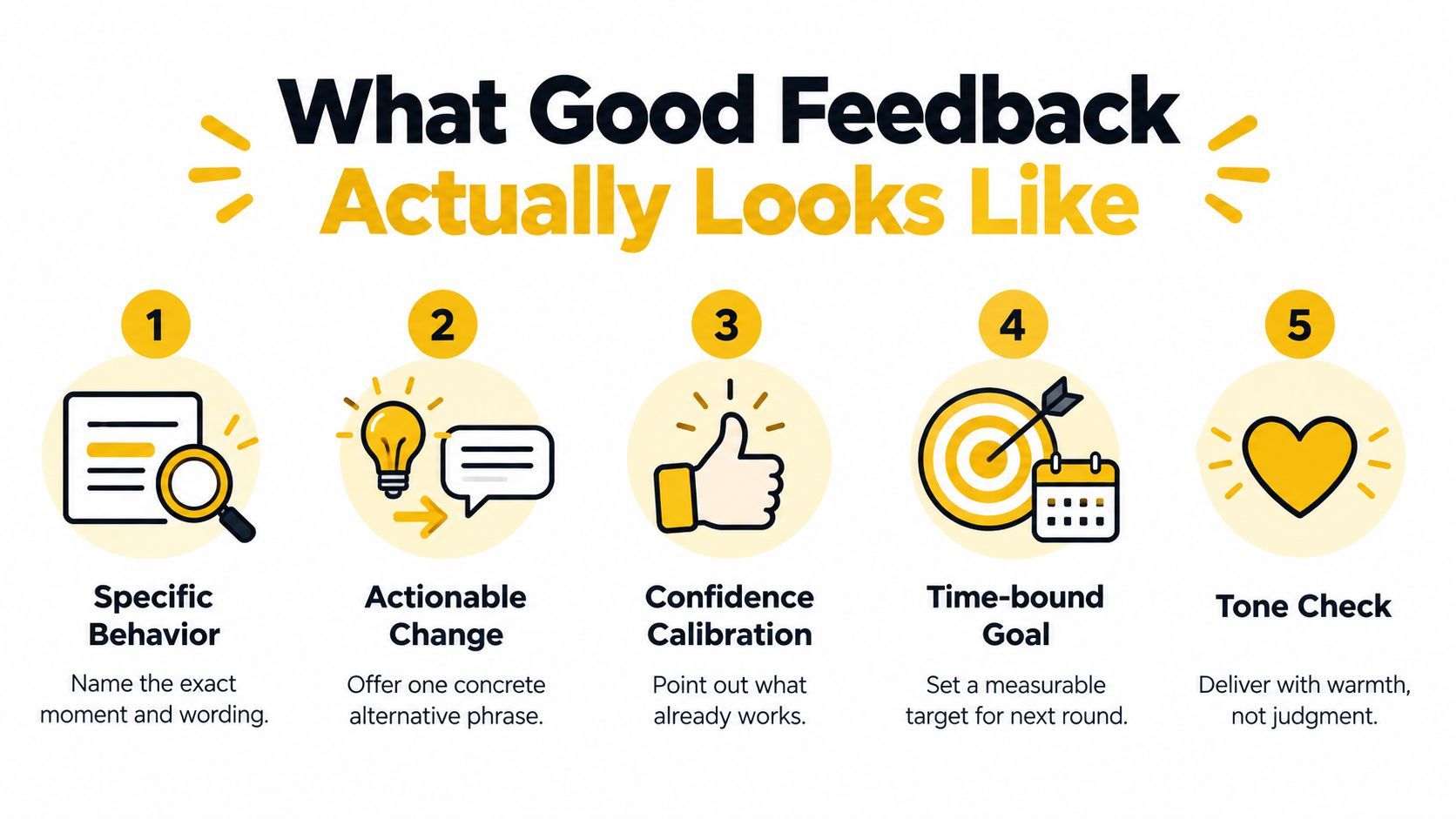
Ask for feedback you can act on
Paste this prompt into an automated session or give it to your coach:
Identify the exact wording or moment that weakened my answer. Explain whether the problem was relevance, evidence, structure, or delivery. Suggest a concrete revision, identify something worth keeping, and give me an observable target for the next attempt.
A target might be naming your decision before describing implementation, or answering the requested question before adding context. Neither requires an invented numerical score.
Challenge feedback that confuses personal preference with job relevance. Ask what an interviewer would fail to understand, and why the proposed revision would help. The next attempt should test the diagnosis, not merely satisfy the coach's preferred speaking style.
A Single Rehearsal Block Done Right
Build a rehearsal block around a specific role, a selected question, and a behavior you want to improve. A bounded session is easier to review than an open-ended evening of answering whatever appears next.
Set up your workspace before starting so you can focus on the response rather than managing notes and equipment.

Select questions with a reason
Warm up by explaining why the role fits your experience. Then choose a question tied to a requirement in the job description, rather than browsing a question bank indefinitely.
For an accounting role, use HireAccountants' accounting interview questions for accountants as a starting resource, then check the selected prompt against the actual vacancy. For a behavioral answer, these STAR interview answer examples can help you distinguish situation, task, action, and result without turning the structure into a rigid script.
Worked example: suppose you're practicing an answer about improving a reporting process. Deliver it aloud and record it if you're comfortable doing so. Before replaying it, write down what you intended the interviewer to understand: the reporting problem, your contribution, and the evidence that the change helped.
Then review separate dimensions:
- Content: Did you explain your actual responsibility, or imply ownership of the whole team's work?
- Structure: Could a listener follow the decision without needing extra background?
- Delivery: Were key points understandable, with pauses where the listener needed them?
Don't collapse these into a single impression such as “pretty good.” An organized answer can still lack evidence, and a hesitant answer can contain strong reasoning.
Capture, revise, and retest
Use this debrief prompt:
Summarize what my answer demonstrated. Identify the most important missing evidence, distinguish it from a delivery issue, and suggest a revision that preserves factual accuracy. Ask a follow-up question that tests the revised answer.
Revise the weak passage, then answer a related prompt rather than immediately reciting the identical version. Keep the original recording, your diagnosis, and the revision together so you can compare behaviors instead of relying on memory.
If you prefer video alongside written practice, use it as a supplement, then return to your own response for the debrief.
Finish by naming the next test. If the answer now explains your contribution clearly, the next session might examine whether you can defend the decision when challenged.
Adding Realism Without Burning Yourself Out
Another clean answer to another familiar question isn't necessarily the next useful challenge. Once the fundamentals hold, practice should test what happens when the interviewer changes the task.
A qualitative study of Malaysian undergraduates found that seventeen participants described benefits involving confidence, communication, and professional expectations, while some criticized simulations for lacking realism and requested more help applying practice to actual interviews. That's a reason to test transfer deliberately, not evidence that harsher practice always works better.
Increase uncertainty gradually
Graduated realism means adding difficulty while keeping the practice task understandable. Start with a clear prompt and useful feedback. Then introduce ambiguity, a follow-up challenge, or a tighter answer window without changing everything at once.
Use the progression below as a practice design, not a demand to tolerate escalating discomfort.
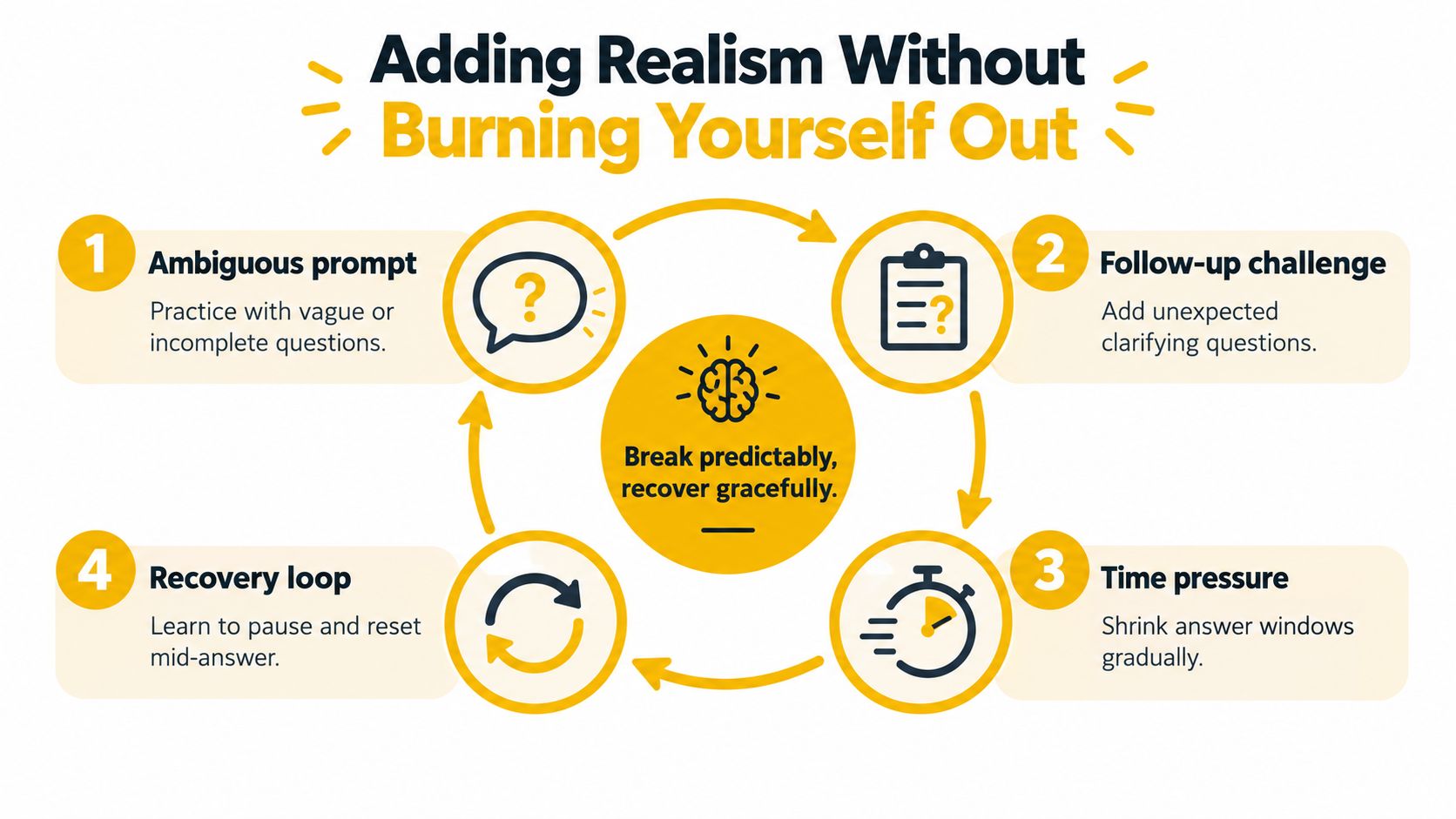
An ambiguous prompt tests whether you clarify scope. A skeptical follow-up tests whether you can explain your assumptions. Time pressure tests whether you can prioritize the answer rather than compress every detail into rushed speech.
For technical preparation, ask the practice interviewer to change a requirement after you've proposed an approach. For a behavioral session, have them question the result or ask what you learned from the decision. These are rehearsal exercises, not claims about how every employer interviews.
Measure recovery, not just composure
Watch what you do after disruption. Do you acknowledge the new question, ask for clarification, and revise your reasoning? Or do you keep delivering the answer you prepared?
Pressure rule: Add difficulty only while you can still identify what happened and make a useful adjustment.
If practice becomes repeatedly confusing or distressing, reduce the complexity and isolate the sticking point. A technology-failure rehearsal might just involve explaining how you'd reconnect and resume, rather than sabotaging an entire session.
The desired outcome isn't an unflappable performance. It's recoverable performance: noticing a misunderstanding, correcting it, and continuing without abandoning the evidence you came to discuss.
Adapting Coaching When Standard Advice Doesn't Fit You
Coaching shouldn't treat sustained eye contact, facial expressiveness, or a particular vocal style as universal signs of competence. For neurodivergent and disabled candidates, those expectations can shift rehearsal away from demonstrating ability and toward concealing difference.
A study of neurodivergent students and alumni identified nervousness (10%), maintaining eye contact (8%), and lack of confidence (8%) as employer-perceived challenges. Those perceptions don't establish that the candidates lacked role competence. A useful coaching approach separates evidence relevant to the job from subjective expectations about presentation.
Design the session around access
Agree on practice conditions before receiving feedback. Accessibility isn't a reward for performing well under unsuitable conditions.
- Communication mode: Use verbal-only practice when visual evaluation distracts from assessing the answer.
- Processing time: Build in pauses to interpret questions and organize responses.
- Assistive technology: Test the rehearsal interface with the screen reader or other tools you use.
- Sensory conditions: Adjust lighting, sound, camera positioning, or seating to support concentration.
- Language needs: Rehearse in the expected interview language, using multilingual tools where helpful without assuming they interpret every specialist term correctly.
Use this checklist to keep adaptations connected to your performance goals.
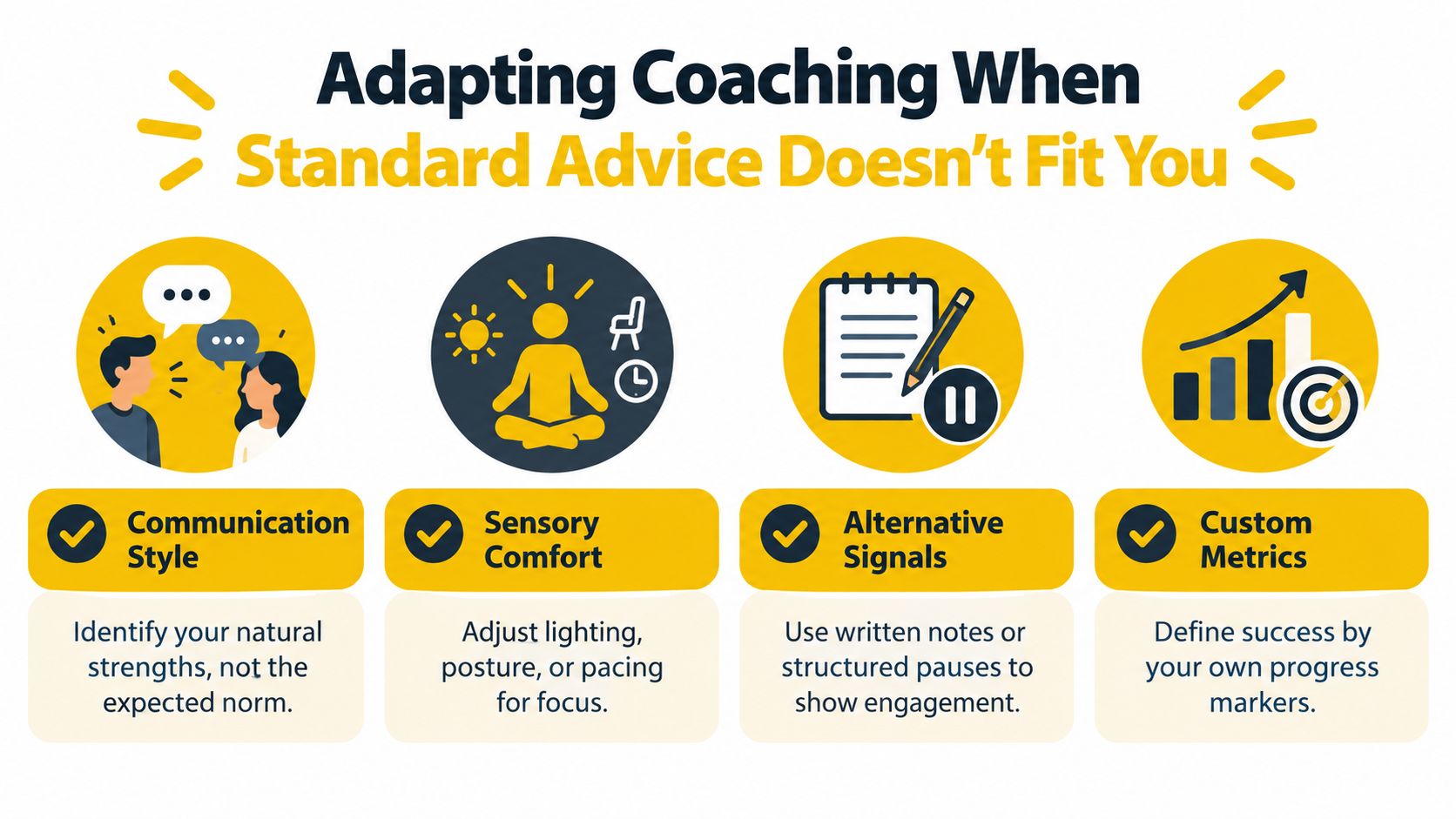
Practice requests without self-stigmatizing
An accommodation request can focus on the process: “I'd like additional processing time after questions so I can give a complete response.” That's sample wording to adapt, not a requirement to disclose personal information in a particular way. Confirm arrangements with the employer rather than assuming your preferred practice conditions will be available.
If you're rehearsing independently, use this guide to practicing for an interview by yourself to help organize the session, then adapt the review criteria to your needs.
Evaluate whether your answer demonstrated relevant knowledge, explained decisions, and addressed the question. Don't define improvement as looking less disabled or neurodivergent. Candidates may choose strategies for navigating employer expectations, but a coach shouldn't frame disability-related traits as defects to eliminate.
A Four-Week Coaching Plan With Exit Criteria
Use this proposed schedule as a flexible training plan, not evidence that everyone needs the same preparation period. Repeat a stage when its checkpoint remains unresolved.
Establish the answer foundation
- Week one: Select target roles, examine requirements, and scope the questions worth practicing. Checkpoint: Can you explain what each selected question is testing and which experience you'll use?
- Week two: Build clear answers with human, peer, or automated feedback. Checkpoint: Can you identify your contribution and support the result without relying on memorized wording?
Test performance under interview conditions
- Week three: Apply graduated realism and review how you respond to changes. Checkpoint: Can you recover from an unexpected follow-up while still addressing the interviewer's concern?
- Week four: Simulate the relevant interview sequence, including behavioral discussion and technical or case work where applicable. Use the device, assistive technology, and agreed accommodations you expect to need. Checkpoint: Can you complete the rehearsal and identify only bounded, actionable improvements rather than unresolved fundamentals?
Stop conditions matter. If you're still missing evidence, return to answer development. If access problems prevent a fair rehearsal, resolve those before judging readiness. Once you can respond accurately, adapt, and recover, shift from repeated full simulations to targeted maintenance.
Interview Pilot offers guided AI mock interview practice and a searchable question bank, making it one option for running this training loop independently. Visit Interview Pilot, choose a role-relevant prompt, and use your next session to identify a specific gap, revise the answer, and test the change.
Topics
mock interview coaching
interview prep
AI interview practice
behavioral interview
career coaching
Continue reading

Interviews
Mock Interview Meaning: A Practical Guide to Rehearsing
Learn the mock interview meaning, how simulated interviews build confidence, the main types, and how to practice effectively before your next real interview.
September 29, 2026
16 min read

Interviews
Best Data Science Interview Book: What to Read in 2026
Find the best data science interview book for your role, with a comparison of top titles, reading plans, and how to pair books with live practice tools.
October 15, 2026
13 min read
Interviews
8 Star Interview Answer Examples for Behavioral Questions
Master 8 star interview answer examples for engineering, product, finance, and data roles, with STAR breakdowns, customization tips, and practice tactics.
October 4, 2026
23 min read