












Interviews
How to Practice for an Interview by Yourself
Run a useful solo interview practice session with recorded answers, an evidence-based review sheet, and focused retries instead of memorized scripts.
Interview Pilot Editorial Team
4 min read
Answer realistic questions aloud, review what you actually said, and retry one specific weakness at a time. Reading sample answers silently is useful preparation, but it does not tell you whether you can explain your own experience clearly in a conversation.
Recording and reviewing practice answers is also used in structured programs: New York's Department of Labor describes self-review and adviser review in its mock-interview resource. You can apply the basic record-and-review approach with a device you already own; you do not need a paid tool.
Choose a small, relevant question set
Take the job description and select questions covering an introduction, a relevant project, a difficulty, and your interest in the work. Add one question that you find uncomfortable or tend to avoid.
Use our behavioral question collection to choose prompts, not to memorize other people's achievements. If your introduction needs work, review how to answer "Tell me about yourself" separately.
For a technical interview, include the actual kind of work expected: explaining a solution, interpreting an example, or completing a practice task. A fluent introduction does not replace technical preparation.
Run a first take without constant restarting
Place your questions out of view of your answer notes. Read one, pause to think, then answer aloud. Record audio or video if comfortable. If you do not want to record, write a few notes immediately after the answer, but recognize that memory is less precise than playback.
Finish the answer even if the opening feels awkward. In a real conversation, you often need to recover rather than restart. Use a simple phrase such as "Let me explain that more clearly" when necessary.
Keep recordings private. Avoid naming confidential clients or exposing work documents in the background. If you use a third-party practice service, understand its storage and sharing settings before uploading sensitive information.
Review substance before delivery
Use these observable questions rather than rating yourself on whether you looked impressive:
| Check | Evidence to look for |
|---|---|
| Did I answer the actual question? | A direct response, not a loosely related story |
| Is the example understandable? | Enough context to understand the problem |
| Is my contribution clear? | Specific things I decided or did |
| Is there an outcome? | What changed, or what I learned when it did not work |
| Can I defend the details? | No invented figures, titles, responsibilities, or certainty |
| Does the answer end? | A clear conclusion rather than a second unrelated story |
Then listen for long detours, rushed explanations, or technical language your audience may not understand. Do not treat an accent, a natural pause, or lack of theatrical enthusiasm as a defect to erase.
Revise one weak part
Suppose your first answer includes: "There was confusion, so we worked together and sorted it out."
A more specific fictional revision might be:
Two teams had different delivery dates in their schedules. I compared the order confirmation with both calendars, checked the deadline with the project owner, and sent one corrected schedule. Both teams then planned against the same date.
The improvement is not fancy wording. The listener can now tell what the problem was, what the speaker did, and what changed. Use your real facts to make the same kind of revision.
Record a second attempt using bullet reminders, not a sentence-by-sentence script. Then try a differently worded question to check whether you understand the example well enough to adapt it.
Use a session you can repeat
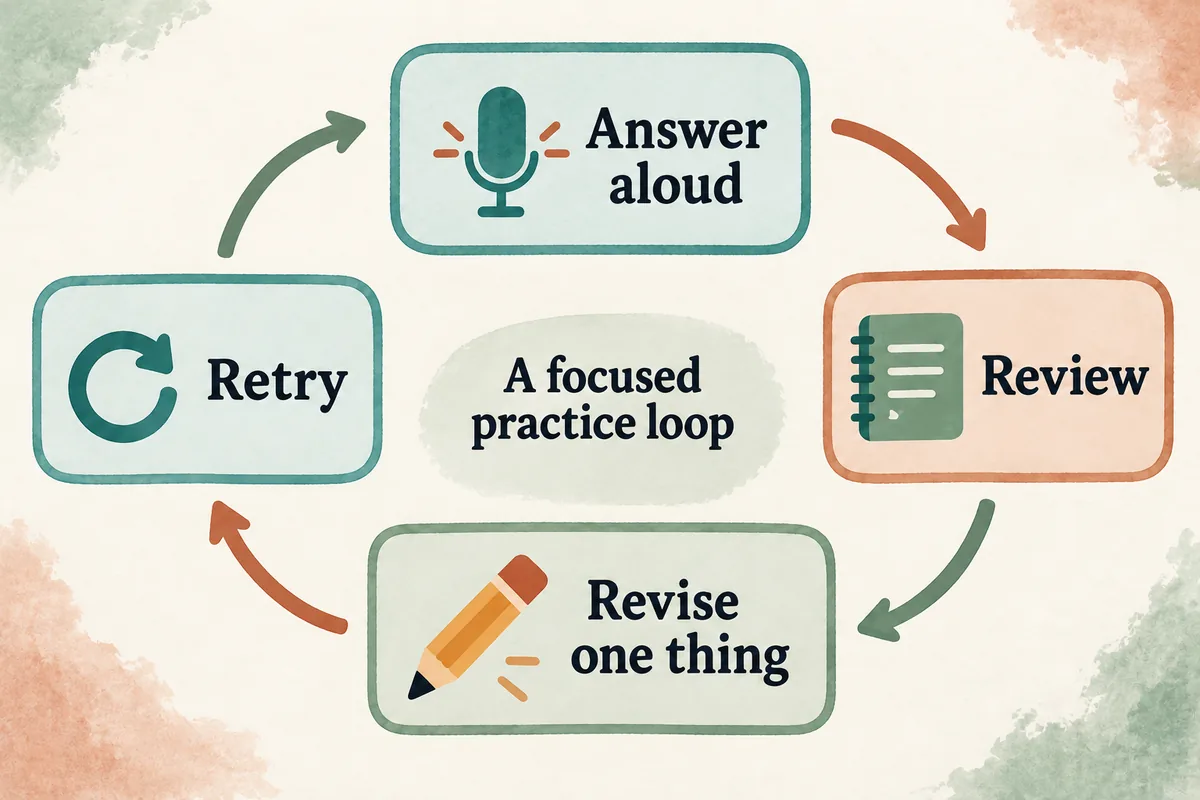
Each retry tests a specific revision, rather than repeating the same answer unchanged.
One possible 30-minute session is five minutes choosing questions, ten answering, ten reviewing, and five retrying the weakest answer. This is a sample allocation, not a required duration or a measured best practice.
Finish by writing the next practice task: "Explain my contribution sooner" is actionable; "Become more confident" is not specific enough.
Solo practice cannot fully test interruptions, unfamiliar follow-ups, or whether a specialist finds your reasoning convincing. Add another person's feedback when available. If an unexpected question exposes a genuine knowledge gap, practice an honest response to not knowing rather than inventing expertise.
Topics
interview practice
mock interviews
Continue reading

Interviews
Mock Interview Meaning: A Practical Guide to Rehearsing
Learn the mock interview meaning, how simulated interviews build confidence, the main types, and how to practice effectively before your next real interview.
September 29, 2026
16 min read

Interviews
Behavioral Interview Questions to Ask Candidates
Use behavioral interview questions to ask candidates with competency-based scoring guidance, ideal answer indicators, and practical follow-up tactics.
October 1, 2026
22 min read

Interviews
Interview Questions STAR Method Guide
Master interview questions STAR method with role-specific examples, timing breakdowns, and AI practice tips for technical and behavioral rounds.
September 30, 2026
14 min read