









Interviews
Best Data Science Interview Book: What to Read in 2026
Find the best data science interview book for your role, with a comparison of top titles, reading plans, and how to pair books with live practice tools.
Interview Pilot Editorial Team
Updated October 15, 2026
13 min read
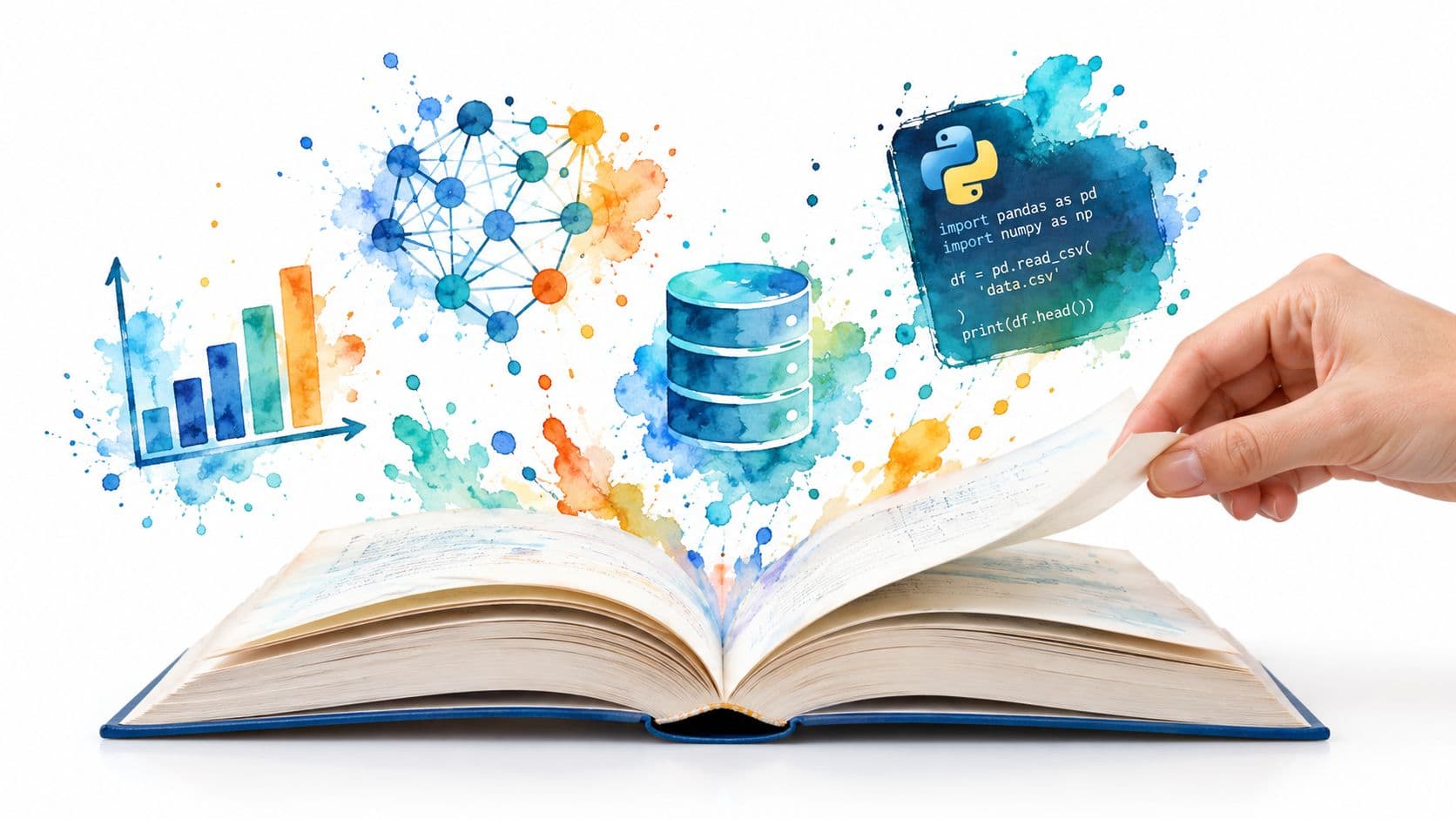
The worst advice about a data science interview book is still the most common: buy one thick title, memorize it cover to cover, and expect it to carry you through every loop. That approach used to feel reasonable when interviews were narrower. It falls apart now, because the market has split into analyst, ML, ML engineering, and AI product tracks, and each one tests a different mix of SQL, statistics, modeling, system design, and stakeholder judgment.
A better way to think about prep is simple. Pick a book for the role you want, then pair it with live practice and answer support for the interview format you'll face. If you want a broad study shelf while you sort that out, the PracHub prep library is useful as a starting point, but it's not a substitute for choosing the right path.
Why One Data Science Interview Book Is Not Enough Anymore
A single data science interview book can still help, but it can't be the whole plan. The role has fragmented, and candidates now get screened for different mixes of SQL, coding, statistics, experimentation, machine learning, and product reasoning depending on whether they're interviewing for analyst, ML, ML engineering, or AI product work.
That split matters because interview books usually compress the field into one generic funnel. An analyst candidate needs crisp metric thinking and business communication. An ML engineer needs deployment judgment, trade-offs, and stronger system thinking. An AI product candidate needs to explain model behavior, data quality, and user impact without hiding behind jargon.
Pick the book by role, not by popularity
Practical rule: if a book doesn't match the job description, it's a bad first purchase.
That's the mistake I see most candidates make. They buy the highest-rated title, then discover the book is either too shallow for modeling roles or too academic for business-facing analytics roles. The better move is to choose the book that matches your target loop, then fill the gaps with mock interviews and a question bank.
A good prep stack has to reflect the live interview market, not nostalgia. Books are strongest when they organize the material, but they're weakest when they pretend every interview asks the same questions in the same style. If you're aiming at a modern online interview, the book should be your foundation, not your finish line.
How Data Science Became a Multi-Domain Profession
Data science didn't start as a single profession with one tidy playbook. John Tukey described data analysis as a distinct activity in 1962, C. F. Jeff Wu proposed data science as an alternative name for statistics in 1985 and again in 1997, and William Cleveland pushed in 2001 for statistics to expand into a broader discipline centered on data analysis, computation, and practical problem-solving. By around 2008, the data scientist title had gained wider recognition as Jeff Hammerbacher and DJ Patil built teams that blended programming, statistics, and product judgment. The field's development explains why interviews now reach across disciplines instead of staying inside one academic silo.
Why the interview now spans six domains
That history is the reason a credible prep book has to cover probability and statistics, programming, databases, machine learning, experimentation, and business communication. Early definitions linked data design, collection, analysis, and applied interpretation, so interviewers still expect candidates to move from raw data to decisions without losing the thread.
A shallow book that only drills formulas misses the point. A deep book that only drills code misses it too. The profession was built by combining statistical reasoning with software engineering, large-scale computation, and product-oriented work, so interview questions naturally probe all of those layers at once. Candidates who understand that history stop treating prep like trivia recall and start treating it like professional judgment.
What Every Book Has to Cover
A serious data science interview book earns its place by preparing you for the questions hiring teams ask. If it only lists topics, skip it. The book has to make you explain choices, defend trade-offs, and show judgment under pressure.
| Domain | What interviewers probe | What good books usually do well | Where they often fall short |
|---|---|---|---|
| SQL and databases | Query logic, joins, aggregation, filtering, data shape | Covers common patterns and table reasoning | Often too easy or too synthetic |
| Python or R | Code fluency, data manipulation, edge cases | Gives syntax and small exercises | Rarely feels like a live coding round |
| Statistics and probability | Distributions, uncertainty, inference | Explains the concepts candidates repeat most often | Sometimes skips intuition for speed |
| Machine learning | Model choice, validation, bias, fit | Introduces standard algorithms and trade-offs | Can become a glossary instead of judgment |
| Experimentation | A/B testing, hypothesis framing, validity | Covers core test logic and interpretation | Too many books stop before real-world pitfalls |
| Business case storytelling | Metrics, trade-offs, stakeholder communication | Shows how to answer clearly | This is usually the weakest area |
Use the table as a buying filter
Before you buy, compare the book against the role expectations in the data scientist interview guide. That matters because the interview surface changes by role. Analysts need strong SQL and metrics judgment. ML candidates need model selection, validation, and error analysis. AI product candidates need sharper communication around trade-offs, risk, and user impact.
In one widely cited survey of data science interviews, SQL appears in more than 90% of loops, machine learning in more than 85%, and Python in about 80%. A book that treats those areas as optional is behind the market. The same goes for books that ignore data management and analytics skills, because hiring teams still expect candidates to reason cleanly from messy data to a business answer.
Open the table of contents and check for four things: handling missing data, defending a metric, explaining uncertainty, and talking through trade-offs when no perfect answer exists. If those pieces are absent, the book is incomplete, even if the examples look polished.
Comparing the Top Data Science Interview Books
I care less about whether a book is famous and more about whether it survives a real interview loop. A useful comparison comes down to coverage, depth, freshness, accuracy, and production judgment. That's where many books diverge hard.
The most common split is between breadth books and depth books. Breadth books help generalists and analysts. Depth books help modelers and ML candidates. A few titles try to do both and end up doing neither especially well.
| Book | Best For | Strength | Known Limit |
|---|---|---|---|
| Ace the Data Science Interview | Analysts and generalists | Broad coverage of common interview patterns | Can feel like a checklist if you stop at reading |
| Data Science Interview Questions and Answers | ML-focused candidates | Stronger emphasis on modeling and theory | Less helpful for cross-functional storytelling |
| Cracking the Data Science Interview | Candidates who want a fast overview | Easy to skim, useful for early-stage prep | Tends to age faster and can feel thin |
| Interviewing Data Scientists | Candidates who want role context and hiring judgment | Better framing around what interviewers care about | Not enough on its own for live coding or SQL depth |
My blunt recommendation
If you're an analyst, start with the most practical breadth book and spend your energy on SQL, metrics, and case answers. If you're targeting ML, choose the title that goes deeper on modeling and validation, then add live coding and system prompts. If you're aiming at ML engineering or AI product roles, no book alone is enough, because you need deployment, evaluation, and communication practice layered on top.
One thing to avoid is overtrusting the answer key. Public reviews have flagged books with incomplete solutions and even mathematical or editorial errors, and a major roundup makes the same point bluntly, books can't replace practice across SQL, Python, and statistics. That's why I prefer to treat any book as a structured syllabus, not an authority.
For a separate overview of study options and sequencing, the Interview Pilot prep guide is a useful companion. It's not a shortcut, but it helps you avoid mixing up roles and prep styles.
The 8-Week Reading Plan
A book only matters if you turn it into retrieval practice. I'd rather see a candidate work through one solid data science interview book for eight focused weeks than skim three books badly. Use the schedule below for live interview prep, not casual reading.
Weeks 1 to 2 build the core
Start with SQL, core statistics, and basic probability. Read a section, then solve problems and explain the answer out loud. Do 20 SQL problems across joins, grouping, and subqueries, then defend each solution as if a hiring manager is challenging it.
Add one statistics drill every day. Cover missing data, outliers, distributions, confidence intervals, and hypothesis testing. If the book gives you a formula, say when you would use it and when you would not.
Weeks 3 to 5 move into modeling and coding
Use these weeks for Python or R, model selection, evaluation, and experiment design. Record yourself explaining one model in 5 minutes, then review the recording for jargon, missing assumptions, and weak conclusions. That is where many candidates fall apart under pressure.
A candidate who can explain trade-offs clearly usually outperforms a candidate who only memorizes definitions.
Weeks 6 to 8 shift to interview performance
Use the final stretch for timed mocks, business cases, and mixed question sets. Revisit earlier chapters in short review sessions so the material stays active. Schedule at least one session where you defend a metric choice, one where you interpret an experiment, and one where you walk through a model failure.
Leave week eight with patterns in your head and words in your mouth. Reading alone will not do that. Rehearsal will.
Pairing Books With Mock Interviews and Live Practice
Books solve one problem, verbal performance solves another. A candidate can understand a chapter perfectly and still stumble when a recruiter interrupts, changes the prompt, or asks for a clearer answer. That's why you need a layered stack, not a single resource.
Match the tool to the weakness
A searchable question bank is for breadth. Timed mock interviews are for fluency. Live answer assistance is for the actual online interview environment, where you have to respond while the clock is running and the pressure is real. These tools do different jobs, and pretending they're interchangeable is lazy prep.
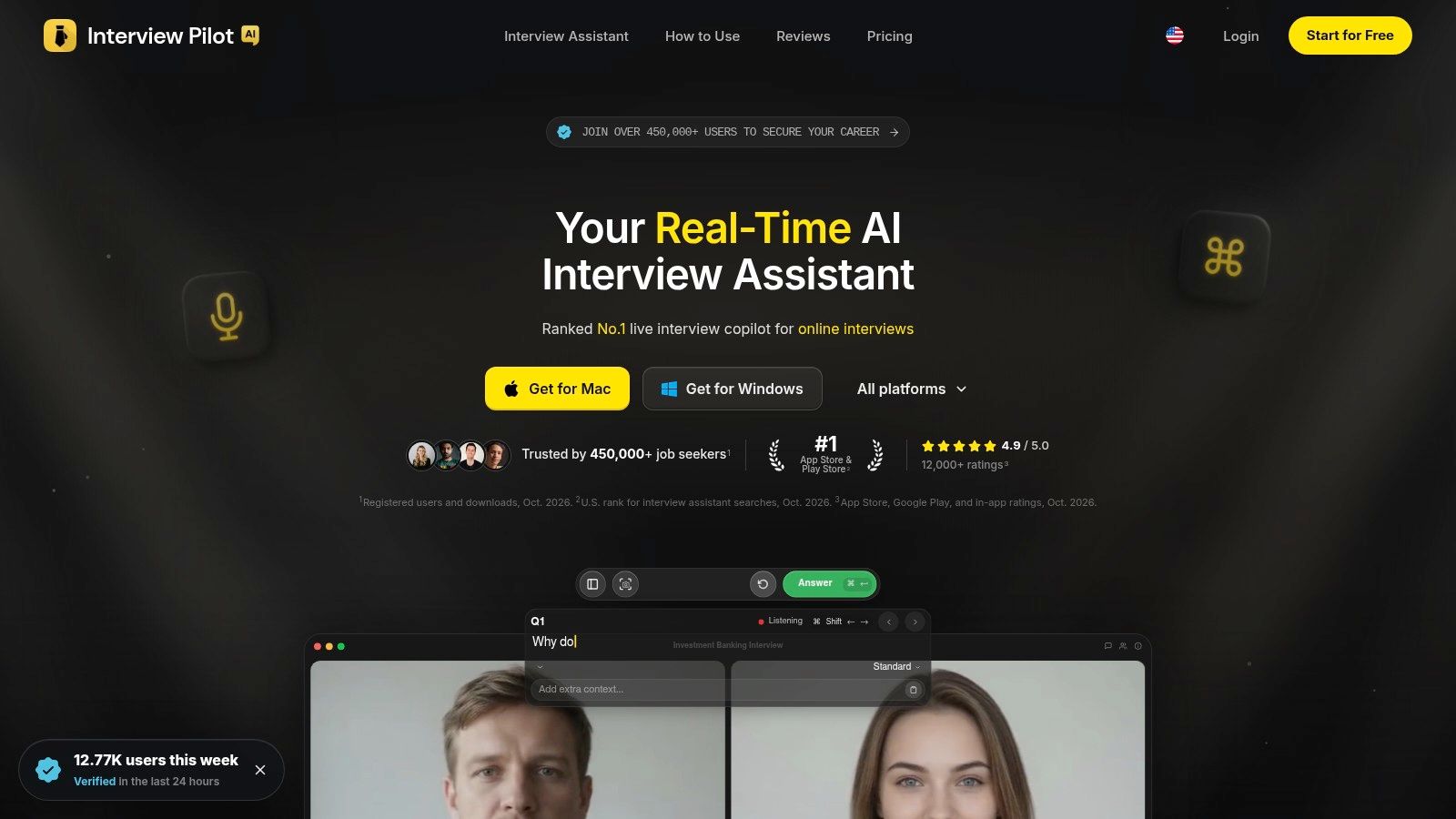
One practical option is Interview Pilot, which offers live suggested answers, guided mock sessions, and a question bank across interview formats, including data science. Use that kind of tool to pressure-test your answers, not to replace the hard work of learning the material.
For a visual example of how live support fits into online interview prep, watch this short demo:
Make practice measurable
Record your mocks, then review the transcript and mark every spot where you rambled, hedged, or skipped the actual decision. The goal is to reduce hesitation and tighten your structure. If a question exposes a weak spot in SQL, statistics, or model evaluation, go back to the book the same day and close the gap.
That cycle, study, mock, review, repeat, is what turns a book into interview readiness. Without it, you're just collecting pages.
The Gap Most Books Still Miss
The biggest miss in most interview books is not technical content. It's production judgment, ethics, and stakeholder communication. Those are the skills that separate someone who can answer a question from someone who can defend a decision.
Drill the judgment, not just the answer
When you read a case study, force three questions. What's the trade-off if data quality is weak? What happens if the metric is biased? What would I tell an executive who wants certainty where none exists? That habit matters more than parroting a definition.
This is also where newer prompts belong. Practice how you'd evaluate LLM outputs, how you'd handle data governance concerns, and how you'd defend a metric design choice under ambiguity. Those conversations reveal whether you can operate in a real team, not just pass a quiz.
Close the soft-skill gaps directly
- Uncertainty communication. Give a 60-second explanation of a result, then restate it in plain language for a nontechnical manager.
- Decision framing. Take one answer and explain what you'd do if latency, cost, or interpretability became the primary constraint.
- Ambiguity handling. Pick a vague prompt and state the assumptions you'd need before recommending a path.
Recent employer reporting points to data management and analytics as ongoing skill gaps, so these are not optional niceties. They're the parts of the job that books usually under-cover, and hiring managers notice immediately when they're missing.
Choosing Your Book and Starting This Week
Pick the book that matches your target role, not your anxiety. Analysts need breadth and business framing. ML candidates need modeling depth. ML engineering and AI product candidates need to add deployment, evaluation, and communication on top of the book.
Then use a strict 8-week plan and a layered practice stack. Read, drill, mock, review, and repeat. If you start today, your first move is simple, choose the role, audit the book against the six core domains, schedule the first mock, and write down the judgment gap you need to close.
If you want a faster way to turn a book into interview performance, use Interview Pilot for guided mock sessions, live answer support, and role-specific practice while you study. It fits this exact problem, because the core challenge isn't finding information, it's saying the right thing under pressure. Visit Interview Pilot and build your prep around the role you want.
Topics
data science interview book
data science prep
interview prep
ML interview
SQL interview
Continue reading

Interviews
Interview Questions STAR Method Guide
Master interview questions STAR method with role-specific examples, timing breakdowns, and AI practice tips for technical and behavioral rounds.
September 30, 2026
14 min read

Interviews
Mock Interview Meaning: A Practical Guide to Rehearsing
Learn the mock interview meaning, how simulated interviews build confidence, the main types, and how to practice effectively before your next real interview.
September 29, 2026
16 min read

Interviews
What Is Behavioral Based Interviewing and How to Master It
Learn what is behavioral based interviewing, how the STAR method works, real answer examples for candidates, scoring tips for interviewers, and proven prep
September 20, 2026
20 min read