












Interviews
Interview Questions STAR Method Guide
Master interview questions STAR method with role-specific examples, timing breakdowns, and AI practice tips for technical and behavioral rounds.
Interview Pilot Editorial Team
Updated September 30, 2026
14 min read

You hear, "Tell me about a time when you handled a difficult stakeholder," and your mind goes blank. You remember several relevant projects, but the details arrive out of order. You spend too long explaining the background, rush through what you did, and finish without making the outcome clear.
That's why knowing how to handle interview questions with the STAR method matters. STAR gives you a reliable way to turn experience into evidence, while still leaving room for technical judgment, business context, and honest reflection.
Why the STAR Method Dominates Behavioral Interviews
A hiring manager asks a software engineer about a production incident, a finance candidate about a reporting error, or a product manager about a disputed launch decision. The answer has to show what happened, what the candidate owned, how they chose a response, and what changed afterward. Behavioral interviews assess that evidence rather than relying on personality claims such as “I'm collaborative” or “I work well under pressure.” For more context, see this guide to what behavioral interviewing assesses.
The STAR method organizes that evidence into four parts: Situation, Task, Action, and Result. It separates your decisions from the team's broader work and gives the interviewer a clear way to judge your contribution. Without that structure, candidates often describe an impressive project while leaving their own reasoning unclear.
Structured behavioral interviews have a stronger relationship with job performance than unstructured interviews in the interview literature. One cited estimate places validity at 0.51 for structured behavioral interviews compared with 0.20 for unstructured interviews, as summarized in interview validity research on the STAR method. The figures do not guarantee a strong answer. They show why employers use a consistent format to compare evidence across candidates.
Practical rule: Treat every behavioral question as a request for one specific piece of evidence, not an invitation to deliver your autobiography.
Why interviewers listen for structure
Interviewers usually evaluate several dimensions together:
- Ownership: Did you personally make decisions, or rely on “we”?
- Judgment: Did you identify the central problem and choose a sensible response?
- Execution: Did your actions show skill, prioritization, and follow-through?
- Impact: Did your work change an outcome that matters?
- Reflection: Can you explain what you learned when the result was imperfect?
STAR does not replace these criteria. It makes each one easier to hear. A technical interviewer may focus on diagnosis and trade-offs, a finance interviewer on controls and accuracy, and a product interviewer on prioritization and stakeholder judgment. The framework keeps those differences visible without changing the answer's basic shape.
Development Dimensions International says it introduced the method in 1974 through its Targeted Selection approach, describing STAR as a framework that has shaped behavioral interviewing for more than 50 years in its history of the STAR method. Its longevity helps explain why the format appears in university career guidance, employer training, and interviews across technical and commercial roles.
Timing also signals judgment. MIT recommends 20% Situation, 10% Task, 60% Action, and 10% Result in its STAR method guidance for behavioral interviews. Use those proportions as a practical emphasis, not a script. The interviewer needs your reasoning and behavior far more than a lengthy project introduction.
Deconstructing the Framework and Timing Your Answer
You have two minutes to explain a messy project, and the interviewer needs to hear both your judgment and your contribution. A reliable structure keeps the story focused without making it sound rehearsed. Choose the example before you start, then hold four mental labels in mind. You do not need to announce them.
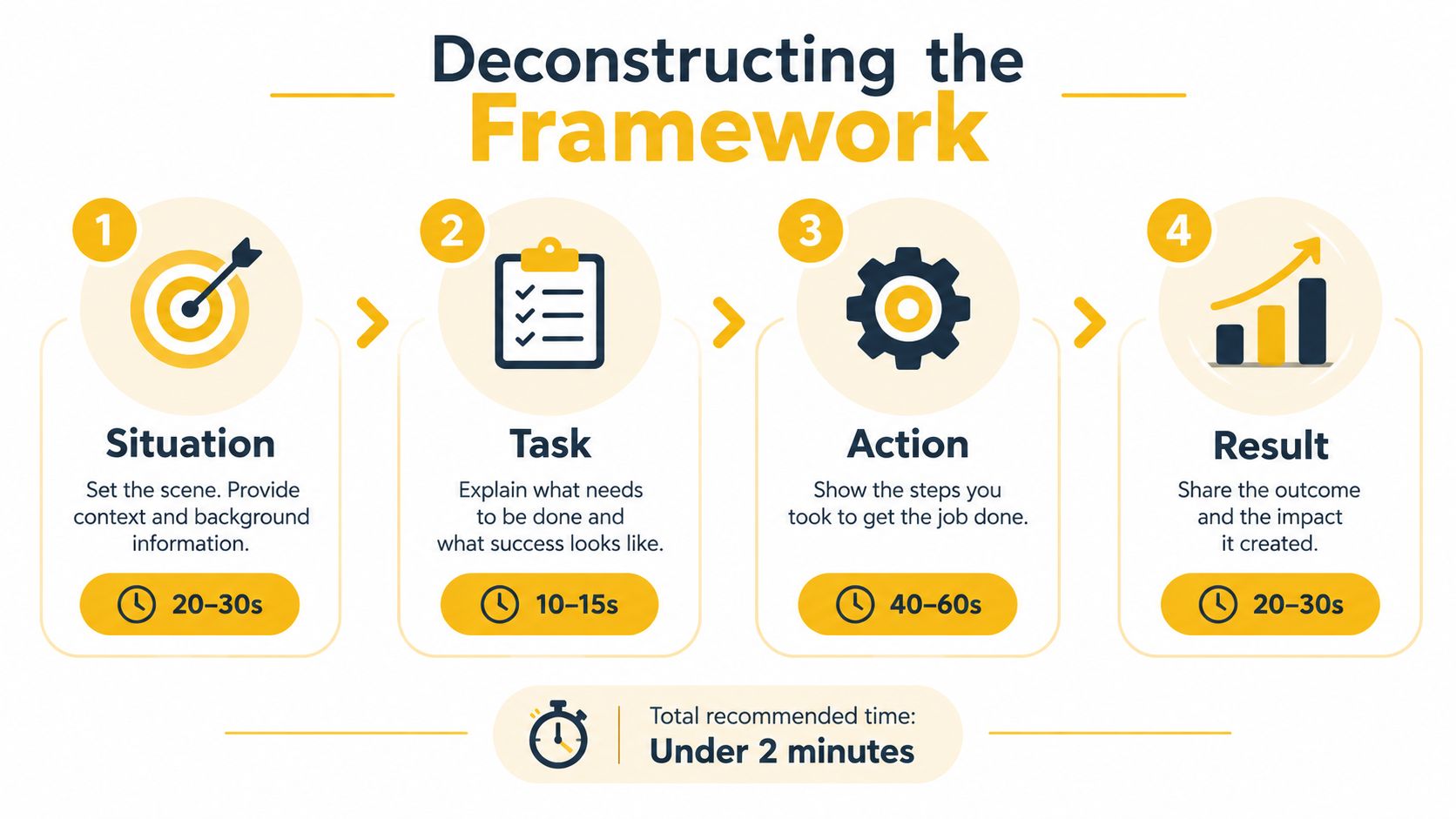
Situation
Give the context required to understand the problem, then stop. Name the team, project, customer, or operating constraint and explain why the issue mattered. A useful Situation answers: What was happening, and why did it matter?
For a technical role, that might be a reliability problem during a major release. For finance, it could be a reporting discrepancy before a deadline. For product, it could be a customer need competing with a committed roadmap. Leave out company history, background meetings, and system details that do not affect the decision.
Task
State your responsibility in one clear sentence. The Task defines the outcome you owned or the decision you had to make, rather than repeating the Situation.
For example: “I was responsible for finding the source of the discrepancy, recommending a correction, and protecting the reporting deadline.” This gives the interviewer a standard for judging your choices. It also separates your role from the team's broader work, which matters when an answer includes several contributors.
Action
The Action section carries the answer. Explain what you did, in sequence, and why you selected that approach. Include the investigation, trade-offs, communication, tools, and adjustments that shaped the result.
For a two-minute response, MIT's career-center framework recommends 20% Situation, 10% Task, 60% Action, and 10% Result. Treat those proportions as timing guidance, not a script. A technical candidate can use the Action time to explain diagnosis and a rejected alternative. A finance candidate can show how controls, verification, and deadline pressure shaped the decision. A product candidate can describe prioritization, stakeholder disagreement, and the evidence used to choose.
Use verbs that reveal decisions: diagnosed, compared, scoped, escalated, tested, negotiated, automated, documented, and measured. If the interviewer asks about conflict, explain how you gathered the other person's perspective and reached a decision. If the question concerns a failure, spend the Action time on the choice that created the problem and the correction you made, rather than defending the original plan.
Result
End with what changed because of your work. A result may be a business metric, technical measure, deadline met, quality improvement, customer response, or process change. Use a real figure when you have one, but never invent precision.
The structured-interview research describes STAR as a unified four-part answer and emphasizes that clear outcomes make an intervention easier to evaluate. Mixed results are acceptable. State the outcome, explain what you learned, and identify the specific change you made afterward.
Annotated Examples for Technical and Business Roles
Generic stories fail because they don't show how a candidate thinks in the target role. The same STAR structure can support very different evidence for a data scientist, product manager, or financial analyst.
Data scientist debugging a model
Situation: “A demand model began producing unstable predictions after we added a new feature source. The issue was affecting confidence in the model's recommendations.”
Task: “I owned the investigation and needed to determine whether the problem came from data quality, feature construction, or model behavior.”
Action: “I reproduced the issue on a controlled sample, compared feature distributions between training and production data, and found that one input was being transformed differently across the two pipelines. I added validation checks, aligned the transformation logic, and retrained the model. I also reviewed the evaluation design with an engineer so we could distinguish a genuine model improvement from leakage.”
Result: “The predictions stabilized, the team regained confidence in the output, and the validation checks became part of the deployment process. I documented the root cause and the diagnostic sequence so future investigations wouldn't begin from guesswork.”
The answer works because it includes reproduction, distribution comparison, pipeline consistency, leakage awareness, and prevention. It doesn't bury the technical reasoning beneath a dramatic narrative. Replace the qualitative result with your actual model-performance or operational measure if you have one.
Product manager resolving stakeholder conflict
Situation: “Engineering and sales disagreed about whether a release should prioritize a customer-specific integration or a broader usability issue affecting more users.”
Task: “I needed to recommend a sequence that protected the release objective without dismissing either team's concern.”
Action: “I separated the disagreement into customer impact, delivery risk, and strategic value. I gathered evidence from support themes, account requirements, and engineering estimates, then facilitated a decision meeting around those criteria rather than around departmental preferences. We agreed to address the usability issue in the release and define a smaller integration scope with a clear follow-up condition.”
Result: “The teams aligned on the decision, the release moved forward, and the next planning cycle used the same prioritization criteria.”
The strongest phrase here is not “I resolved a conflict.” It's the decision logic: criteria, evidence, scope, and follow-up conditions. That language shows product judgment.
Candidates preparing for broader behavioral prompts can compare this style with the behavioral interview questions and answers guide, but they should adapt any example to their own experience rather than memorize it.
Financial analyst handling a deadline
Situation: “A reporting package contained inconsistent figures shortly before it was due to senior stakeholders.”
Task: “I was responsible for identifying the source of the inconsistency, correcting the analysis, and communicating any limitation clearly.”
Action: “I reconciled the figures to the underlying records, isolated the mismatch to a timing difference, and checked the treatment with the relevant accounting partner. I created a short audit trail showing the original figure, the corrected treatment, and the assumption behind the adjustment. I then told the reviewer what had changed and what still required confirmation.”
Result: “The package was delivered with a defensible explanation, and the reconciliation steps were added to the team's review process.”
For finance roles, words such as reconciliation, assumption, audit trail, materiality, control, and review make the answer credible. Don't claim that you “saved the company” unless you can explain the mechanism and support the outcome with a real measure.
Navigating Failure and High-Pressure Prompts
Many candidates prepare polished success stories and treat failure questions as an afterthought. That approach is backwards. Questions about mistakes, deadlines, and conflict test whether you can take responsibility without becoming defensive.
Analysis of a 42,206-response behavioral dataset found especially low average scores for mistakes, project deadlines, and conflict resolution. The cited averages were 47.3 out of 100 for “Tell me about a time you made a mistake,” 49.8 for project-deadline questions, and 52.0 for conflict-resolution questions, according to the analysis of the lowest-scoring behavioral interview prompts. The analysis identifies weak or missing Result sections as a recurring problem.
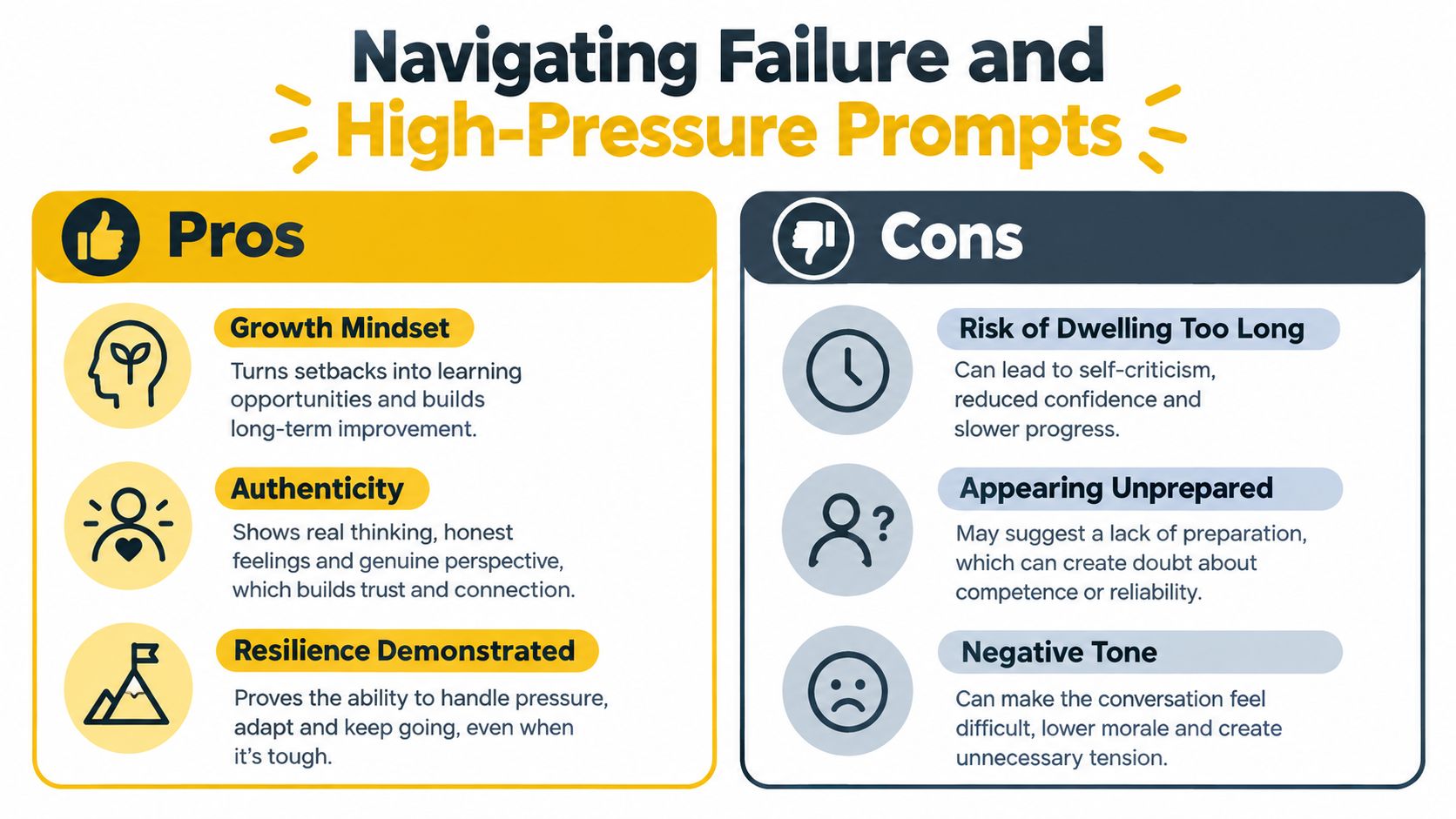
What makes a failure answer credible
A weak answer usually takes one of three forms:
- The disguised success: “My weakness is that I care too much.”
- The blame transfer: “The project failed because another team didn't deliver.”
- The unfinished confession: The candidate explains the mistake but never says what changed afterward.
A better answer names a genuine decision or omission, describes the immediate response, and shows the control you introduced afterward. The Result can be negative. What matters is whether you understood the consequence and changed your operating method.
A credible failure story has two outcomes: what happened in the original situation, and what your later change prevented or improved.
For a missed deadline, don't spend most of the answer defending the original estimate. Explain how you detected the risk, what you communicated, what you deprioritized, and how you reset expectations. For conflict, avoid presenting the other person as irrational. Describe the competing interests, your contribution to the tension, and the conversation that produced a workable decision.
A recovery-first structure
Use this sequence when the question concerns failure or pressure:
- Name the context and your responsibility. Don't hide behind the team.
- State the mistake or pressure point plainly. Avoid dramatic language.
- Explain the containment action. Show how you protected customers, colleagues, data, or delivery.
- Describe the root-cause review. Separate the immediate error from the process weakness.
- Finish with the change and its evidence. Mention the new review, alert, checklist, escalation rule, or communication habit, then give the actual outcome.
STAR needs judgment rather than mechanical balance here. The Action section may include both the response to the event and the later prevention work. If the interviewer asks what you'd do differently, answer directly instead of pretending the original approach was flawless.
Accelerating Preparation with AI Mock Interviews
Reading sample answers teaches recognition. It doesn't guarantee retrieval under pressure. Rehearsal should force you to choose a story quickly, speak naturally, handle follow-ups, and notice when your Action or Result is too thin.
An AI mock interview tool can make that practice more deliberate. Use a role-specific question bank to create sessions around debugging, investment analysis, product prioritization, stakeholder management, or operational pressure. Then ask the system to evaluate ownership, technical depth, concision, measurable outcomes, and follow-up readiness, rather than accepting a generic score.
Interview Pilot's AI mock interview can be used for guided rehearsal of behavioral and technical prompts. Treat its feedback as an editing partner, not as an authority on your experience. If it suggests a stronger Result, supply the actual outcome yourself. If it recommends a polished sentence you wouldn't say, rewrite it in your own voice.
Build a rehearsal loop
A practical session has four passes:
- Recall: Answer without notes so you can identify which stories come to mind under pressure.
- Structure: Mark each sentence as Situation, Task, Action, or Result and remove background that doesn't support the decision.
- Challenge: Practice follow-ups such as “Why did you choose that approach?”, “Who disagreed?”, and “What would you change?”
- Delivery: Repeat the answer with a calmer pace, clear transitions, and enough detail for the target role.
For remote interviews, review your camera framing, microphone quality, screen arrangement, and note placement before the session. If you're also refining your visual presentation for applications or profiles, professional headshot inspiration can help you assess how your image supports a credible professional presence.
Use AI assistance ethically. It can help you rehearse, organize stories, identify repetition, and simulate questioning. During a live interview, follow the employer's rules and don't use undisclosed assistance where it would violate the interview conditions or compromise the assessment.
The following video can provide another visual prompt for practicing delivery and structure:
Your Final Interview Day Checklist
In the hour before the interview, stop rewriting every answer. Your job is to make your best evidence easy to retrieve.
- Map your stories: Prepare five adaptable examples covering achievement, failure, conflict, pressure, and technical or analytical problem-solving.
- Write outcome cues: For each story, note the outcome, the relevant metric if you have one, and the lesson that followed.
- Test your setup: Check the camera, microphone, connection, lighting, and interview platform before joining.
- Review the role: Match each story to a responsibility or skill in the job description.
- Prepare questions: Bring thoughtful questions about priorities, success measures, collaboration, and the team's current challenges.
- Control your pace: Pause after the question, answer in complete thoughts, and slow down slightly if an accent or nerves affect clarity.
Keep a small keyword sheet nearby if the interview format allows it. Use prompts such as “root cause,” “my decision,” “trade-off,” and “result”, not a script. The aim is to sound prepared without sounding memorized.
Before you enter, take a breath and remember what the interviewer needs: a clear account of a real situation, your responsibility, the actions you chose, and the evidence that followed. You don't need a perfect story. You need an honest one that makes your judgment visible.
Interview Pilot offers guided AI mock interviews, role-specific question practice, and live interview assistance for technical and behavioral preparation. Use it to rehearse STAR responses, sharpen your Action and Result sections, and visit Interview Pilot to build a practice routine around your next interview.
Topics
interview questions star method
behavioral interviews
STAR method examples
interview prep
Interview Pilot
Continue reading

Interviews
Mock Interview Meaning: A Practical Guide to Rehearsing
Learn the mock interview meaning, how simulated interviews build confidence, the main types, and how to practice effectively before your next real interview.
September 29, 2026
16 min read

Interviews
What Is Behavioral Based Interviewing and How to Master It
Learn what is behavioral based interviewing, how the STAR method works, real answer examples for candidates, scoring tips for interviewers, and proven prep
September 20, 2026
20 min read

Interviews
How to Answer Tell Me About Yourself Interview
Learn how to answer tell me about yourself interview questions with a clear formula, real scripts by role, and timing tips that help you stand out fast.
September 16, 2026
15 min read