












Interviews
What Is Behavioral Based Interviewing and How to Master It
Learn what is behavioral based interviewing, how the STAR method works, real answer examples for candidates, scoring tips for interviewers, and proven prep
Interview Pilot Editorial Team
Updated September 20, 2026
20 min read

Behavioral based interviewing is a structured interview method that asks candidates for specific past examples to predict how they'll handle real job situations, and research summaries report structured behavioral interviews around r = .42 versus about r = .20 for unstructured interviews. In older large-scale hiring research, structured, job-related interviews reached .44 while standard interviews were .08 in one comparison, and behavior-based interviews were .54 versus .07 for standard interviews.
If you're reading this before an interview, you're probably trying to decode what the employer wants when they say, “We use behavioral questions.” If you're the one hiring, you may be wondering why this format keeps showing up in serious recruiting systems while casual interviews still feel easier.
The short answer is that behavioral interviews ask for evidence, not opinions. A traditional interview might ask whether you're a strong collaborator. A behavioral interview asks you to prove it with a real story.
That difference matters because vague questions often reward confidence, charm, or fast talking. Behavioral questions are designed to surface something more useful: what you did, in a real situation, when something important was at stake.
The Core Idea Behind Behavioral Based Interviewing
A lot of candidates freeze on open-ended questions like “Tell me about yourself” because the prompt is too loose. Your brain starts searching everywhere at once. School? Work? Personality? Career goals? The result is often a rambling answer that doesn't show much.
Behavioral based interviewing works differently. It gives your memory a handle.
What the method actually means
Behavioral based interviewing asks for a specific example from your past because the interviewer wants evidence of how you behave under real conditions. The core principle is simple: past behavior is treated as the strongest available indicator of future job performance, especially when questions are tied to the job and scored consistently, as described in this overview of behavioral interviewing history and its early development.
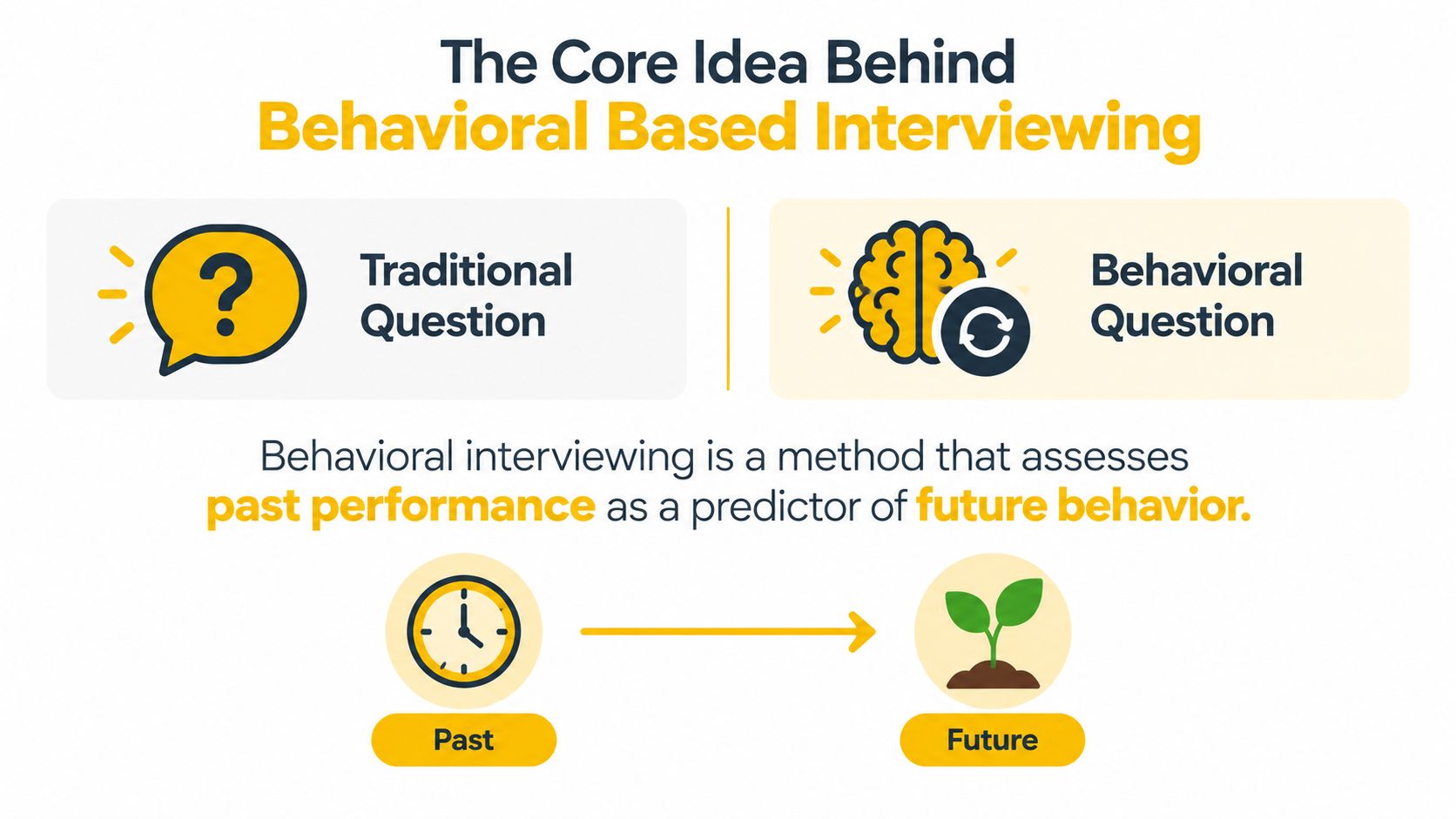
A traditional interview often sounds like this:
- Hypothetical prompt: “How would you handle a conflict with a coworker?”
- General prompt: “Are you good under pressure?”
- Impression prompt: “What kind of team player are you?”
A behavioral interview changes the wording:
- Past-behavior prompt: “Tell me about a time you had a conflict with a coworker.”
- Evidence prompt: “Describe a situation where you worked under pressure.”
- Observed-behavior prompt: “Give me an example of how you contributed to a team result.”
Why this feels easier once you understand it
When a question points to a real event, people answer better. You aren't inventing an ideal version of yourself. You're retrieving a memory, choosing what mattered, and explaining your role.
Strong behavioral answers sound less like self-promotion and more like testimony. You were there. You did the work. You can walk someone through it.
This is also where people mix up behavioral and situational interviews. A situational interview asks what you would do in a future scenario. If you want a clean comparison, this guide on what is a situational interview shows how the two formats differ.
The biggest misconception is that behavioral interviewing is just STAR. It isn't. STAR is only the answer format. The interview itself is a method for collecting comparable evidence across candidates.
Why Structured Interviews Replaced Gut Feelings
A hiring manager finishes three interviews for the same role. One candidate was confident and charming. Another was quieter but gave specific examples. A third reminded the manager of someone they liked on a past team. If the decision rests on memory and chemistry alone, the strongest performer in the job may not be the one who gets the offer.
That problem pushed companies toward structured interviews.
The shift did not happen because structure sounds more professional. It happened because unstructured interviews are hard to compare. If each candidate gets different questions, different follow-ups, and different standards, the interview stops working like an assessment and starts working like a conversation with uneven rules.
Early behavioral interviewing work helped formalize a better alternative. DDI's development of behavior-based interviewing and the STAR response pattern gave interviewers a repeatable way to ask for evidence from real past events, as summarized in this review of DDI's behavioral interview development.
The evidence that changed hiring
Researchers did not just prefer structure in theory. Large reviews found that interviews become more predictive when they are tied to the job, asked consistently, and scored against shared criteria.
A useful way to read the evidence is to focus on the pattern, not a pile of decimals. In the research summary above, structured, job-related interviews showed stronger validity than standard interviews. Behavior-based interviews also outperformed standard interviews, and interview systems built from formal job analysis performed especially well. The exact coefficients differ by study design, but the direction is consistent. More structure usually means better prediction.
A simpler view of the research
| Interview approach | What the evidence pattern showed |
|---|---|
| Standard, loosely run interview | Weak predictor of job performance |
| Structured, job-related interview | Meaningfully stronger predictor |
| Behavior-based interview | Stronger than standard interviews |
| Structured interview built from job analysis | Among the strongest results reported |
That is the reason gut-feel interviewing lost ground. Hiring teams wanted a method that worked more like a scorecard and less like a first impression.
A structured interview works like a calibrated measuring tool. Two people can still interpret what they hear, but they are measuring against the same marks. Without those marks, each interviewer invents their own ruler.
What structure changes in practice
A structured interview usually includes four parts:
- Job-linked questions: Each question connects to a skill or behavior the role requires.
- Consistent prompts: Candidates hear the same core questions, which makes comparisons fairer.
- Scoring criteria: Interviewers rate answers against defined standards instead of general likeability.
- Evidence notes: Notes capture what the candidate did, said, decided, or achieved.
This matters for candidates and interviewers in different ways. Candidates need to bring proof, not slogans. Interviewers need to collect comparable evidence, not chase a good vibe.
That distinction matters even more now that some interviews are reviewed by AI tools or conducted by algorithmic systems. A loose, personality-driven answer can still impress a human in the moment. A structured process, especially one assisted by software, rewards clear examples, concrete actions, and results that can be identified and scored.
The STAR Method Explained Step by Step
Once you know what behavioral interviewing is, the next question is usually, “How am I supposed to answer these?” The most common answer framework is STAR.
STAR stands for Situation, Task, Action, Result. It isn't magic. It's a way to stop smart people from telling confusing stories.
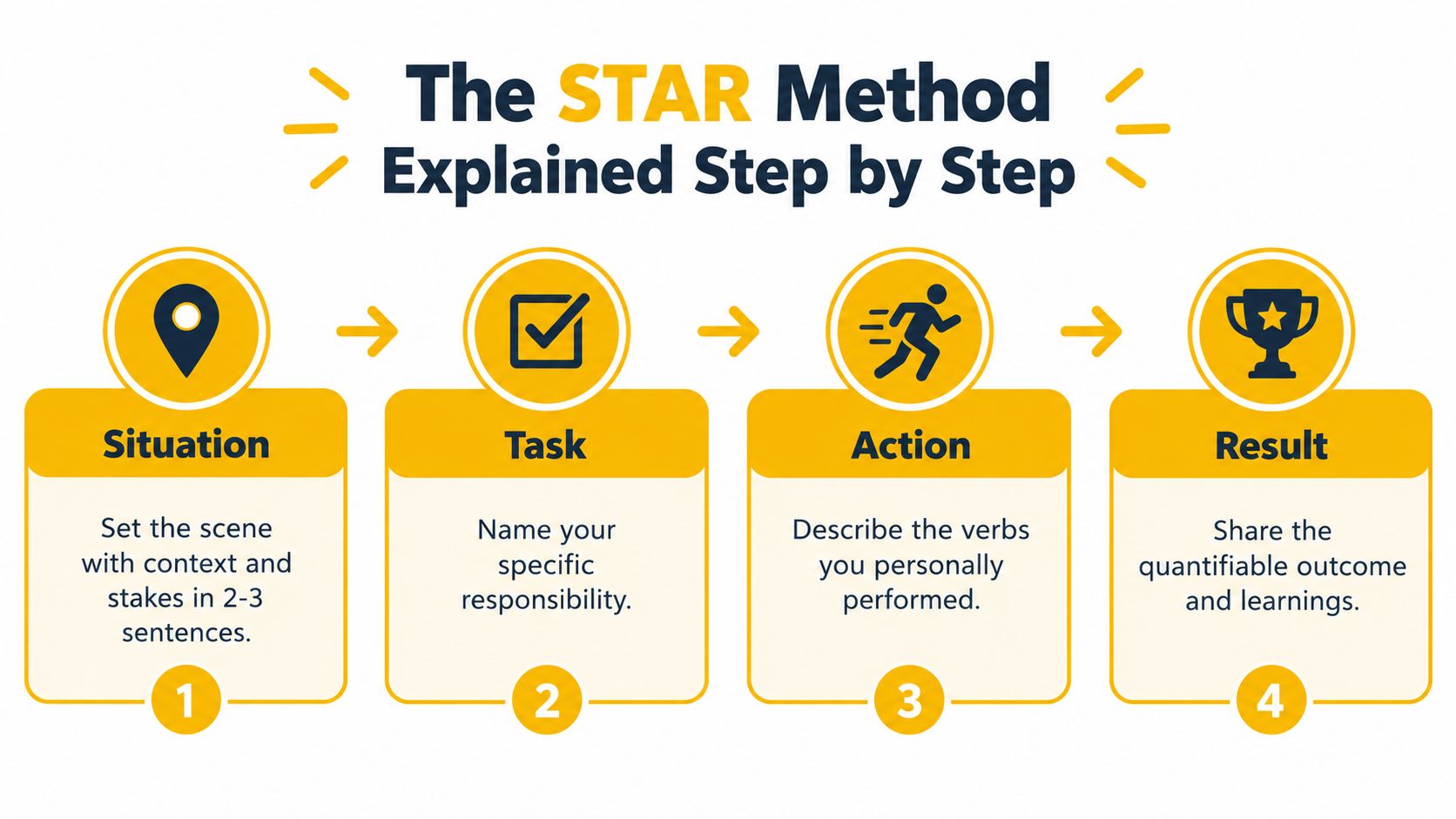
A simple STAR answer in motion
Take this question: “Tell me about a time you had to retain an unhappy customer.”
We'll use one example all the way through. Say you're a customer success lead.
Situation
“One of our largest accounts was considering leaving after a rough product rollout. Their team had logged repeated support issues, and the renewal conversation was approaching.”Task
“I owned the recovery plan. My job was to rebuild trust, coordinate internally, and give the client a clear path forward before the renewal decision.”Action
“I reviewed every open issue, grouped them by urgency, pulled in product and support leads for a daily update cycle, and met with the client twice a week. I also created a shared tracker so they could see what was fixed, what was blocked, and who owned each next step.”Result
“The client stayed, the relationship stabilized, and the account moved from escalations to a routine cadence over the next quarter. I also carried that tracker format into other at-risk accounts.”
Where candidates usually go wrong
Most weak STAR answers fail in one of two places.
First problem: they spend too long on the background.
If your Situation takes most of the answer, the interviewer still doesn't know what you did.
Second problem: they skip the Result.
That leaves the story unfinished. Even if the outcome was mixed, you still need to say what happened and what you learned.
Later in the article you'll see side-by-side examples, but before that, this walkthrough is worth watching because hearing STAR out loud often makes it click faster than reading about it.
What interviewers listen for most
If you remember only one part of STAR, remember Action. That's where interviewers separate contributors from passengers.
Look at the verbs in a strong Action section:
- I analyzed
- I proposed
- I escalated
- I reorganized
- I coached
- I documented
If your answer mostly uses “we,” the interviewer may not know whether you led, helped, or observed.
Strong and Weak STAR Answer Examples Compared
Let's use one question and compare three different responses:
“Tell me about a time you led a team through a difficult change.”
Behavioral interviewing becomes much easier to understand. You don't learn it by memorizing definitions. You learn it by hearing the difference between a scoreable answer and a fuzzy one.
Three versions of the same answer
| Answer Variant | Situation Specificity | Task Ownership | Action Detail | Result Strength | Likely Score |
|---|---|---|---|---|---|
| Strong example one | Clear and concrete | Strong | Specific and visible | Clear outcome | High |
| Strong example two | Clear enough | Strong | Concrete but less detailed | Qualitative outcome | Solid |
| Weak example | Vague | Unclear | General duties only | Missing | Low |
Strong answer one
“Our company changed CRM systems in the middle of quarter-end reporting, and my team was frustrated because the new process added steps while deadlines stayed the same. I managed the operations team responsible for daily reporting accuracy, so I had to keep the work moving and lower the resistance. I broke the rollout into short training blocks, assigned one point person per shift, collected daily friction points, and met with the systems lead every afternoon to get fixes or workarounds in place. By the end of the transition, the team was using the new workflow consistently, and reporting confidence recovered because people knew where to escalate issues.”
Why it works: the candidate gives context, names ownership, describes visible leadership actions, and lands the story.
Strong answer two
“When our support team moved from email queues to a new ticketing process, several teammates felt the change would slow them down and hurt response quality. I wasn't the manager, but I was the senior specialist asked to help the team adapt. I created a quick-start guide based on the most common issues, sat with teammates during the first few days to answer questions, and shared patterns with leadership so they could simplify the setup. The transition was still bumpy, but the team stopped treating the system as the enemy and started using it with more confidence.”
Why it works: there isn't a hard metric, but the answer still shows ownership, behavior, and a visible shift.
Weak answer
“I've led change a lot in my career. One example would be when our team had to adjust to a new process. Everyone had to be flexible, and we all worked together to make it happen. I think the main thing is communication and staying positive. In the end, it worked out.”
Why it falls apart: no real scene, no clear role, no concrete action, no actual outcome.
What interviewers reward and what they penalize
If you want more examples to practice with, this set of STAR method examples is useful because you can study how answers change by question type.
Interviewers usually reward:
- Specificity: A named event, challenge, or moment.
- Ownership: Clear use of “I” when describing responsibility.
- Behavior: Actions someone could observe.
- Closure: A result, lesson, or consequence.
Interviewers usually penalize:
- Vague verbs: “Helped,” “supported,” “was involved.”
- Team fog: Too much “we” and not enough personal contribution.
- Advice instead of evidence: Talking about beliefs, not behavior.
- No ending: Stories that drift off without saying what happened.
If a story could describe almost anyone on the team, it probably isn't strong enough for a behavioral interview.
How Candidates Can Build a Story Bank Before the Interview
The best behavioral interview prep doesn't start with random practice questions. It starts with building a story bank. That's just a private set of examples you can reuse, adapt, and shorten depending on the prompt.
Most candidates already have enough stories. They just haven't organized them.
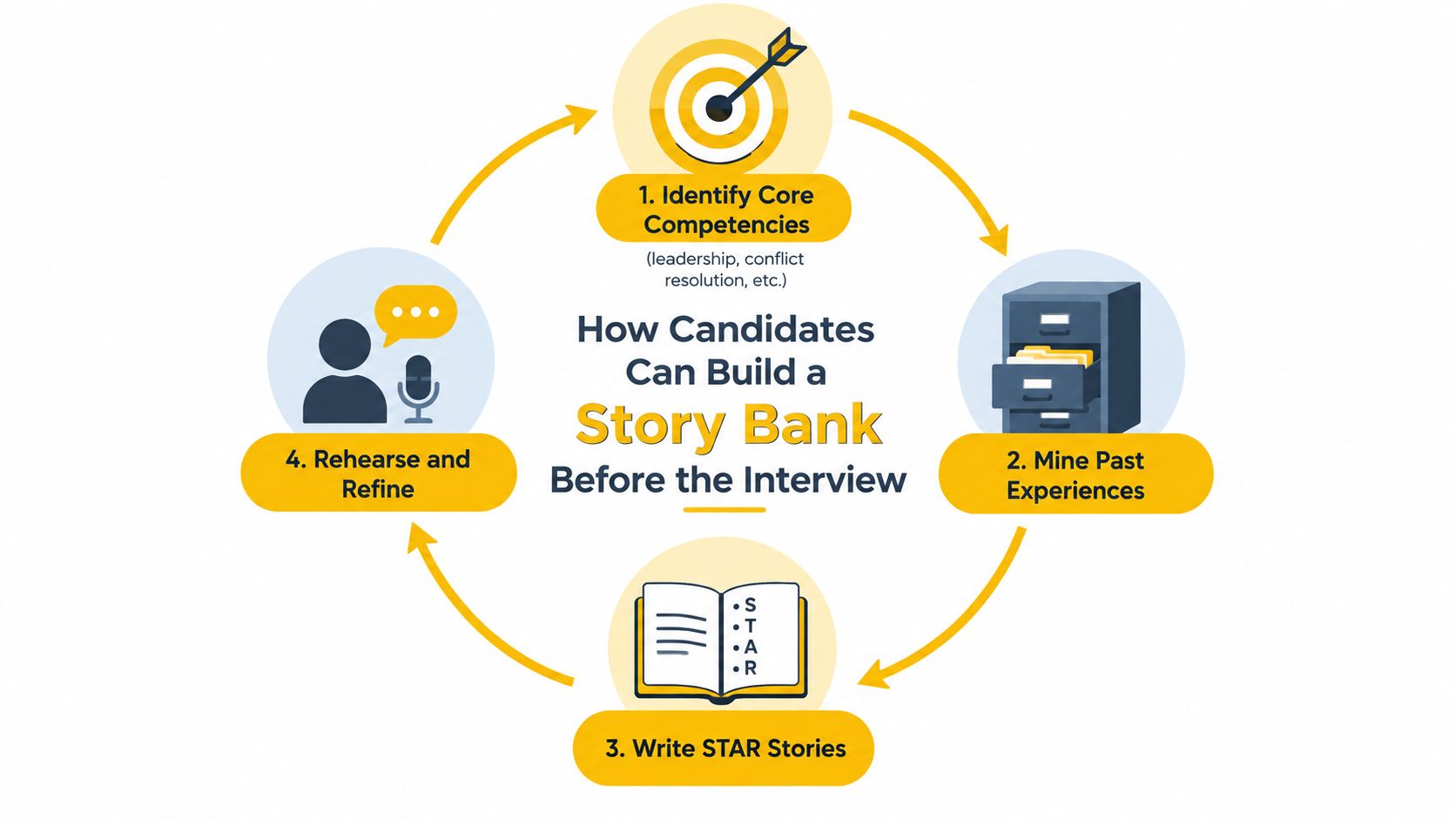
Start with competencies, not memories
Don't begin by asking, “What stories do I have?” Start by asking, “What behaviors am I likely to be tested on?”
Common behavioral themes include:
- Leadership
- Conflict resolution
- Failure and recovery
- Prioritization
- Collaboration
- Customer focus
- Adaptability
- Problem solving
For each theme, write down at least a couple of possible stories. They can come from work, school, internships, volunteer projects, freelancing, caregiving, or community roles. That matters because structured interviews can still disadvantage people whose experience is non-linear or harder to package into standard workplace anecdotes, a nuance discussed in this overview of behavioral interviewing and transferable experience.
A simple story-bank template
Use one page or note per story. Include:
- Context: What was happening?
- Your role: What were you responsible for?
- Your actions: What did you do?
- Outcome: What changed?
- Lesson: What did you learn?
If you want extra practice material, a bank of behavioral interview questions and answers can help you pressure-test whether your stories cover the common prompts.
Make your examples more flexible
A useful story bank has range. Don't make every story a flawless success.
Include a mix like this:
- A win story: Something you improved or delivered well.
- A conflict story: A disagreement you handled.
- A failure story: Something that didn't go your way.
- A stretch story: A moment when you had to learn fast.
- A teamwork story: A result you influenced without formal authority.
Candidates often think they need perfect stories. They don't. They need believable stories with clear behavior.
The final step is rehearsal. Turn each story into a spoken version that feels natural. Aim for a clean answer that you can deliver without reading. Say it out loud. Trim the setup. Strengthen the action verbs. Make sure the ending is there.
How Interviewers Design and Score Behavioral Questions
From the interviewer side, behavioral interviewing only works if the design is disciplined. If the question is vague, the scoring is vague. If the scoring is vague, the decision slides back toward instinct.
Good interviewers don't just collect stories. They collect comparable evidence.
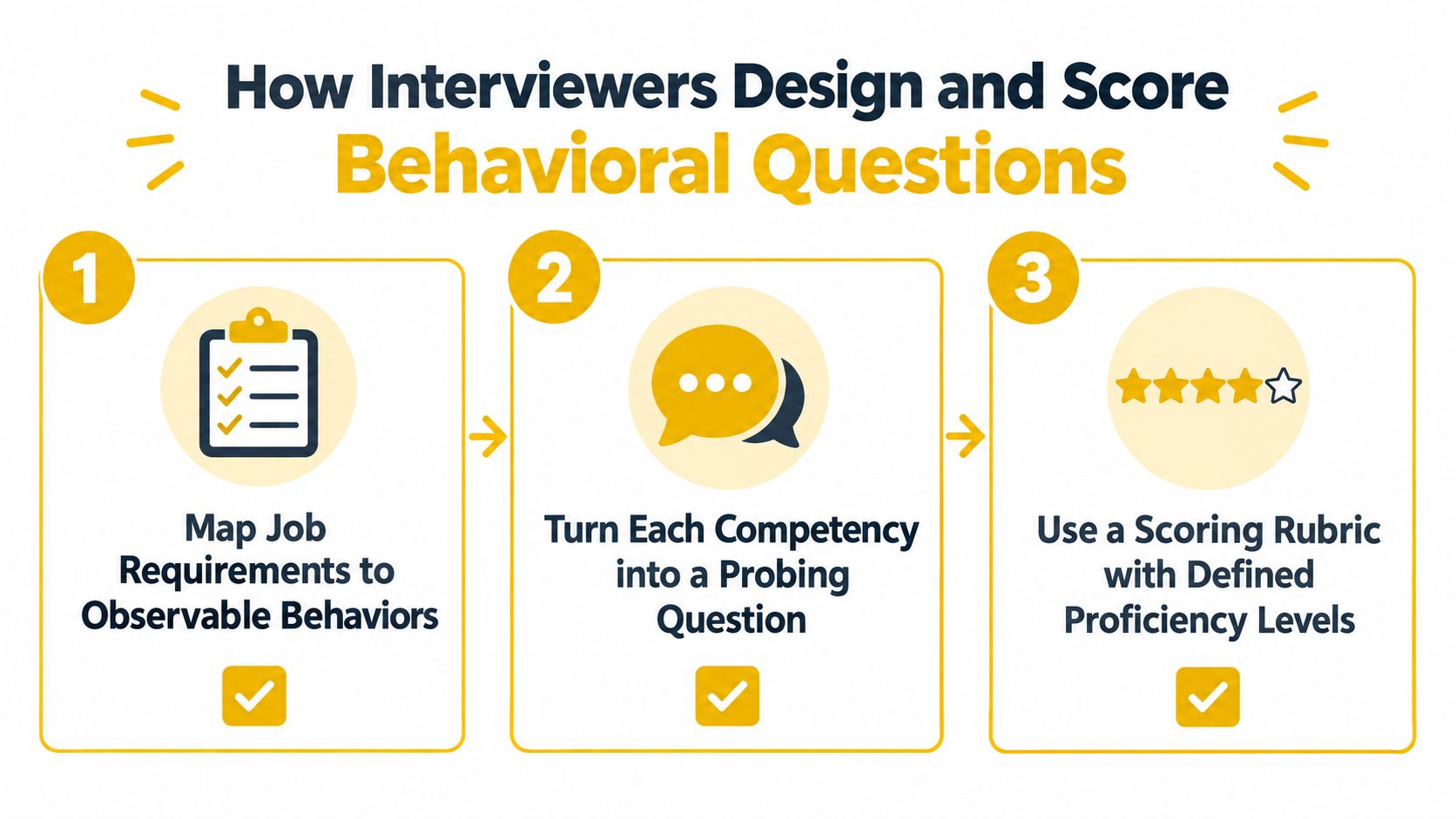
Start with the job, not with favorite questions
The cleanest process begins with observable behaviors. If the role requires stakeholder management, define what that looks like. If it requires prioritization, define that too.
A simple design flow looks like this:
- Map the requirement: “Manages competing deadlines across teams.”
- Translate it into behavior: “Explains trade-offs, resets expectations, escalates early.”
- Write a prompt: “Tell me about a time you had to manage competing priorities across teams.”
That keeps questions tied to the actual role instead of generic personality testing.
Use anchored scoring, not open-ended impressions
Once the question exists, the interviewer needs a way to score the answer. The strongest evidence review in the provided research notes structured behavioral interviews around r = .42 compared with about r = .20 for unstructured interviews, and explains that standardized questions, anchored scoring rubrics, and consistent evaluation criteria improve comparability by reducing interviewer discretion in this evidence review of past-behavior interviewing.
A practical rubric usually asks:
- Did the candidate provide a real example?
- Was their role clear?
- Did they describe concrete actions?
- Did they explain the outcome?
- Did the behavior match the competency being tested?
Follow-up questions that improve scoring
Behavioral interviews often need probing. A thin first answer doesn't always mean weak experience. Sometimes the candidate just answered too broadly.
Helpful follow-ups include:
- “What was your specific part?”
- “What did you do first?”
- “How did the other person respond?”
- “What happened in the end?”
The note an interviewer should write is not “great energy.” It should be “candidate described escalating a cross-team blocker, setting a review cadence, and documenting ownership.”
That style of note is more defensible, easier to compare, and less biased because it points to behavior rather than impression.
What Changes When the Interviewer Is an Algorithm
AI hasn't erased behavioral interviewing. It has changed the surface of it.
The old advice assumed a human asked the question, listened for judgment and substance, and filled in small gaps with intuition. That is no longer always true. Recent reporting says AI interview systems can generate transcripts, score candidates with rubrics, and rank them for recruiters. A 2026 CNBC report also says nearly two-thirds of job seekers reported they had already been interviewed by AI, and some candidates are refusing AI interviews because the process feels cold or insulting, according to this reporting on AI interview systems and job seeker reactions.
What AI tends to notice
A human interviewer might forgive a messy opening if the story gets better. An algorithm may be more literal.
AI-assisted interview tools often care about whether your answer is complete and internally consistent. That can shift what “good” sounds like.
A human panel often rewards:
- Judgment
- Depth
- Nuance
- Rapport
An algorithm may also flag:
- Long silence gaps
- Missing Result sections
- Contradictory self-descriptions
- Uneven pacing across answers
How candidates should adapt
Don't abandon STAR. Tighten it.
If you're speaking to an AI-mediated system, aim for answers that are:
- Clearly structured: The system can detect whether you answered the prompt.
- Evenly paced: Avoid racing through Action and fading out before Result.
- Consistent: If one story presents you as highly decisive and the next makes your role sound passive, that mismatch may stand out more.
One caution matters here. Over-rehearsed answers can sound unnatural. If your story has a rigid rhythm and every sentence lands with the same cadence, it may feel less believable to humans and less natural to systems analyzing speech patterns.
One practical way to prepare is to record yourself on a webcam tool and listen for filler words, speed swings, and missing endings. Interview Pilot is one option that offers AI mock interview sessions, a behavioral question bank, and personalized responses based on your background. A simple phone recording app can also do the job if you just need playback.
Your Behavioral Interview Prep Checklist and Common Pitfalls
By this point, the answer to what is behavioral based interviewing should feel concrete. It's a structured way to collect proof from past behavior. The only question left is whether you'll prepare for it in a structured way too.
Candidate checklist
If you're interviewing, keep your prep simple and repeatable.
- Build a story bank: Cover leadership, conflict, failure, teamwork, prioritization, and adaptability.
- Draft answers in STAR bullets: Don't script full paragraphs at first.
- Rehearse aloud: Spoken answers reveal weak spots fast.
- Prepare transferable examples: Use academic projects, caregiving, volunteer work, or freelance experience if your path hasn't been linear.
- End every story cleanly: Say what happened, what changed, or what you learned.
Common candidate mistakes include:
- Talking in circles: The story never lands.
- Hiding inside “we”: The interviewer can't isolate your contribution.
- Skipping the result: The answer sounds unfinished.
- Using one story for everything: It makes your range look narrow.
Interviewer checklist
If you're hiring, structure is not optional. It's the method.
- Tie each question to one competency: Don't let one question test everything.
- Ask the same core questions: Comparability matters.
- Use anchored notes: Capture behavior, not feeling.
- Probe missing parts: Especially role clarity and outcome.
- Score after evidence is collected: Don't let a strong first impression distort the rest.
A helpful way to review how other teams talk about recruiting workflows is to browse hiring tag, especially if you're refining how sourcing and interviewing fit together.
The fairness point people skip
Behavioral interviews are often described as best practice, and they can be. But they aren't automatically fair just because they use STAR language.
They become fairer when both sides do the hard part. Candidates need help translating real experience into evidence. Interviewers need to score what was said, not who said it more smoothly.
Structure doesn't help if nobody follows it. A behavioral interview with loose questions and vague scoring is still a gut-feel interview in nicer clothing.
If you remember one thing, make it this: a strong behavioral interview answer is not a polished speech. It's a clear account of a real moment, with your role, your actions, and the outcome made easy to understand.
If you want help practicing this kind of answer before the interview, Interview Pilot offers AI mock interviews, real-time interview support, and a searchable question bank built around common behavioral and technical prompts. It's useful when you want to turn rough work stories into sharper STAR answers and hear how they sound before you're under pressure.
Topics
behavioral interviewing
STAR method
interview prep
behavioral questions
STAR technique
Continue reading

Interviews
How to Prepare for a Competency-Based Interview
Learn how to answer competency based interview questions and answers with STAR examples, a prep framework, and practice questions that map to scoring rubrics.
July 26, 2026
10 min read

Interviews
How to Answer Tell Me About Yourself Interview
Learn how to answer tell me about yourself interview questions with a clear formula, real scripts by role, and timing tips that help you stand out fast.
September 16, 2026
15 min read
Interviews
8 Problem Solving Scenarios to Ace Your Interview
Ace your next interview with these 8 problem solving scenarios. Learn step-by-step frameworks and model approaches for technical and behavioral questions.
September 7, 2026
17 min read