









Interviews
Phone Interview Preparation Checklist for 2026
Phone interview preparation checklist with room and line setup, timed STAR stories, and scripts for a 15–30 minute screen.
Interview Pilot Editorial Team
Updated November 2, 2026
19 min read
Freezing on a phone screen is common enough that it has a name: blank-page syndrome. The pressure is different from an in-person interview. There is no face to read, no nod to follow, and only a short window to sound relevant.
Phone interview preparation is a 15 to 30 minute audio performance, not a memorized script. You rehearse answers out loud until they sound like speech, then make two decisions before the call: who is evaluating you, and whether any AI assistance is allowed. Build concise answers, test how you sound, and keep one repair line ready for the moment you freeze, mishear a question, or lose the thread.
What to Finish Before a 30 Minute Screen
Start with the timeline, not with general research. A phone screen is an early gate, not a full assessment, and industry career guidance summarized by OneHour Digital's job interview preparation statistics describes employers using these calls to evaluate baseline qualifications, communication, motivation, availability, compensation expectations, and whether you should advance. That same guidance puts the call at approximately 15 to 30 minutes, with a practical target of a 60 to 90 second professional introduction, several role-specific examples, and two or three informed questions.
That list tells you what to finish. If you can't name your availability, say a calm pay range, or explain why this role fits your experience, more company trivia won't save you. The screen rewards direct evidence that connects what you've done to what the posting asks for.
Phone interview preparation timeline
| When | Task | Pass check |
|---|---|---|
| Two days before | Map 5 to 8 job competencies, your availability, and a researched pay range | You can name the top three requirements without the posting |
| Night before | Draft a 60 to 90 second intro, 3 to 5 story bullets, and 2 to 3 interviewer questions | Each story can be said in about 90 seconds |
| 30 minutes before | Headset, battery, signal, notifications off, one-page notes beside you | A 30-second recording is clear, with no echo or clipping |
| Call start | Confirm who is calling, the number, and the time zone. Have the backup number ready | You can reach the interviewer within one minute if the line drops |
Work backward from the pass checks. Two days before, highlight verbs and required tools in the posting. Turn them into competencies such as stakeholder management, data analysis, or incident handling. Write your earliest start date, notice period, work authorization limits if relevant, and the pay range you've researched for the location and level.
The night before, shrink everything to speakable size. Your introduction needs four parts: current focus, strongest relevant proof, one measurable result, and why you're speaking with this employer. Your stories need bullets, not paragraphs.
If you need the posting open to remember why you applied, you're not ready for a 15 minute screen yet.
Thirty minutes before, stop writing new answers. Test the phone, headset, signal, and voicemail greeting. Confirm who calls whom, which number they'll use, and what you'll do if the call drops. Treat this as a formal interview, because slides and body language won't carry a weak answer for you.
Set Up the Room and the Line
Treat the screen like a 15 to 30 minute audio performance. The interviewer cannot see your notes, your face, or your careful preparation, so the only evidence that travels is your voice, your timing, and how cleanly you handle turn-taking. The Oregon Department of Consumer and Business Services STAR method guidance supports the same discipline: choose one specific event, emphasize your individual actions, and be concise about the outcome.
Before the call, make two decisions that candidates often postpone until they hear a strange question. First, know who is likely evaluating you: a recruiter checking basics, a hiring manager testing judgment, or a recorded screen reviewed later. Second, decide how you will use assistance. If the employer bans AI tools or expects unaided answers, keep support to paper notes and rehearsed stories.
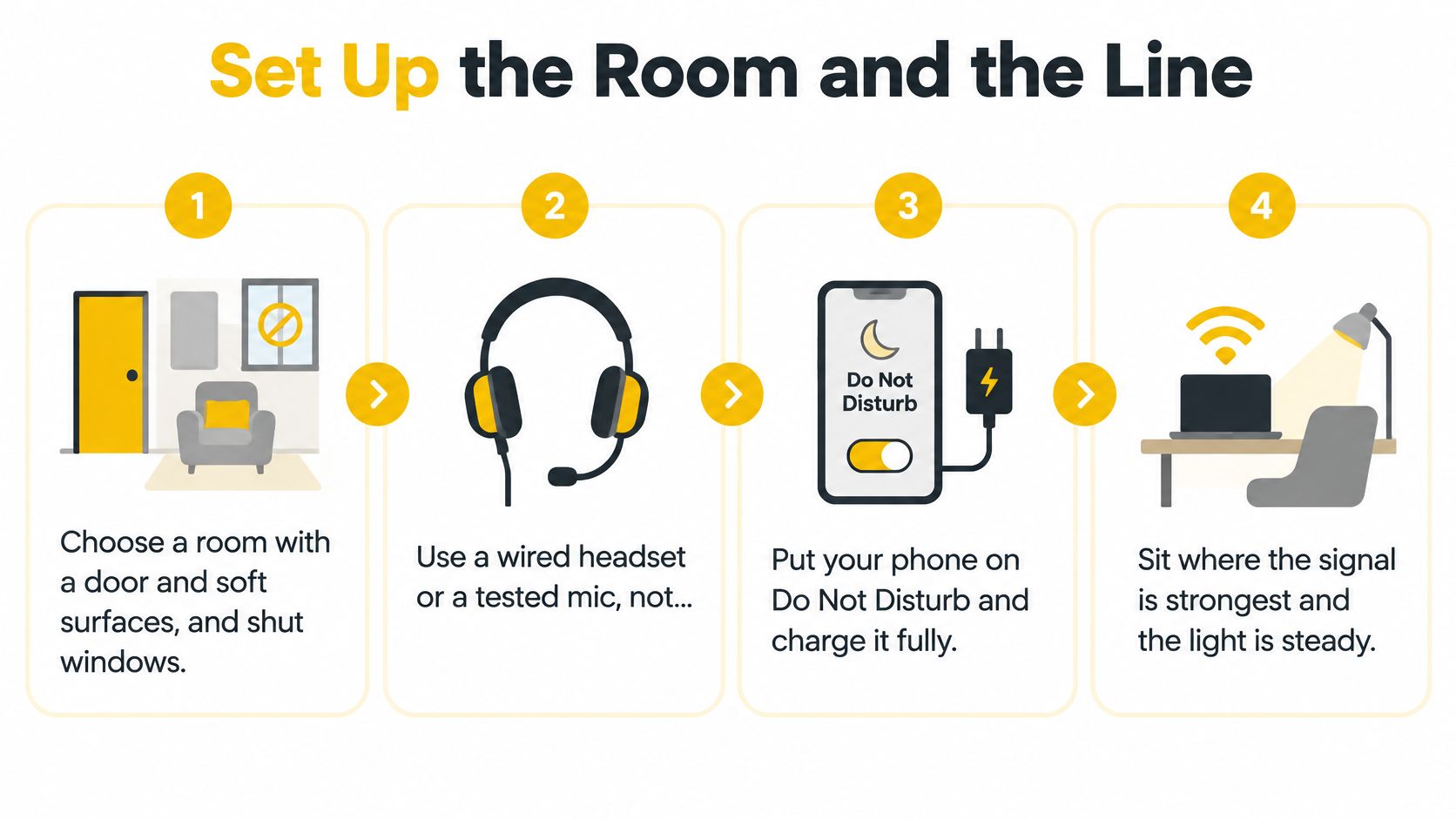
This visual sums up the basic room setup before you test it properly.
Run the setup in order
- Choose a room with a door and soft surfaces. Shut windows and doors. Curtains, a rug, and upholstered furniture absorb reflections that make a bare room sound distant.
- Use a wired headset or a tested microphone. Don't use speakerphone. Room reflections and automatic gain control can clip consonants and make it harder to hear when the interviewer starts speaking.
- Charge the phone and confirm your connection. Check mobile signal or Wi-Fi calling from the exact chair where you'll sit. If bars drop when you move to your desk, work through signal troubleshooting with SwiftNet Wifi before the call, not during it.
- Record a professional voicemail greeting. Say your full name and that you'll return the call promptly. Replace joke greetings and old messages that name a previous employer.
- Silence every notification source. Turn on Do Not Disturb on the phone. Close or mute laptop chat, email, calendars, and smartwatch alerts too.
- Record 30 seconds and listen back. Check volume, echo, background noise, and pace. If s and t sounds blur, move the microphone slightly away from your mouth and speak more slowly.
- Place a one-page matrix beside the phone. Use only four columns: competency, example, metric, and one clarification question. Anything longer becomes a document you search while the interviewer waits.
- Set out water, the job posting, and a backup contact route. Keep the interviewer's number or email where you can reach it in seconds. Sit or stand upright so your breathing supports a steady voice.
Test where you'll take the call, at a similar time if traffic, neighbors, or household noise follow a pattern. A kitchen with hard surfaces, a stairwell, or a car on Bluetooth can change your sound completely, so a clean test in the bedroom tells you little about the call in the kitchen.
Control turn-taking on the call
Use the same sequence for most answers. Acknowledge the question, give a one-sentence headline, provide the evidence, then stop. If the interviewer wants more, you can offer a choice: "Would you like more detail on the approach or the result?" That closing question prevents the common phone failure where you keep adding context because silence feels like disapproval.
Silence has a different meaning on audio. In person, a pause can invite eye contact and a nod. On the phone, three quiet seconds can feel like a dropped line. Mark the pause instead of filling it: "That's the full result. I'll pause there." The interviewer gets a clear signal that you finished, and you keep the answer short enough to be remembered.
If your voices overlap, don't guess the missing words. Pause and use this exact repair: "Please continue. I want to make sure I heard that correctly." Then wait. A short pause sounds thoughtful. Talking over the interviewer while trying to reconstruct the question sounds careless.
Most technical failures are preventable. A dead battery, speakerphone echo, a notification chime, or a voicemail joke creates a problem before your qualifications get heard. Clean audio won't carry a weak answer, and bad audio can make strong evidence hard to evaluate. Your goal is a call where the interviewer spends energy on your examples, not on decoding the line.
Time Your STAR Stories Out Loud
A 15 to 30 minute phone screen is an audio performance, not a reading test. The interviewer cannot see your notes or your hands. Your story has to land through pace, specificity, and a clean ending.
Memorized paragraphs sound read on the phone and collapse when a follow-up comes from the middle. A story works like a route you can retrace under pressure, not a transcript. Build routes you can retrieve by competency.
Before timing, settle two questions. Is the listener a recruiter checking fit, a hiring manager checking depth, or a panel checking evidence? That answer changes how much technical detail belongs in Action. And confirm whether AI assistance is permitted on the call. If it is not, rehearse without it so your timing reflects actual performance.
University career guidance from MIT Career Advising and Professional Development on the STAR method recommends preparing 3 to 5 stories and gives a rough split of 20% Situation, 10% Task, 60% Action, and 10% Result. Treat that split as a timing tool, not a formula. A 75-second answer built on it gives you roughly 15 seconds for Situation, 8 for Task, 45 for Action, and 8 for Result.
Build the story bank
First, extract the competencies from the posting. Look for repeated nouns and decision verbs. "Partner with operations to reduce backlog" points to teamwork, prioritization, and measurable problem-solving. "Own customer escalations" points to conflict, judgment, and communication under pressure.
Then choose stories that cover leadership, conflict, failure, problem-solving, teamwork, and one measurable achievement. You do not need a separate story for every label. One product launch might prove leadership and problem-solving. One missed deadline can address failure and teamwork if your personal decisions and the recovery are clear. For worked structures you can adapt, review these STAR interview answer examples and convert them into your own bullets.
Spend your seconds where they count
Keep the Situation to one specific event in a single sentence. "Last spring our support queue doubled after a billing release" is enough. Skip the company history and the org chart. The interviewer needs a setting, not a documentary.
Make the Task yours. Say what you owned, not what the whole team owned. "I was responsible for triaging the billing complaints and deciding which cases went to engineering" gives the listener a clear role.
Spend most of the answer on Action. Name decisions you personally made, trade-offs you considered, and tools or steps you chose. Replace "we improved communication" with "I started a daily 15 minute triage, tagged cases by revenue risk, and sent engineering a ranked list." The second version can be evaluated. The first cannot.
End with a Result that includes a number, a technical outcome, or a specific learning. If you do not have a revenue figure, use time saved, error reduction, repeat tickets avoided, adoption, accuracy, or what you changed in your process afterward. Do not invent precision. A defensible before and after is better than a dramatic percentage you cannot explain.
Write three or four bullet prompts per story. Rehearse aloud with a timer. Aim for 60 to 90 seconds per story, then practice the same competency with a different example. That second pass tests retrieval, not recitation. If you can only answer "Tell me about a conflict" with one rigid script, a small change in wording can leave you stuck. If you can swap examples and keep the timing, you have built a story you can use on the call.
Scripts for the Questions They Actually Ask
Scripts work when they give you a skeleton, not a paragraph to recite. Keep each line short enough to say in one breath group, then stop. Your notes should remind you what to say next, not supply every word.
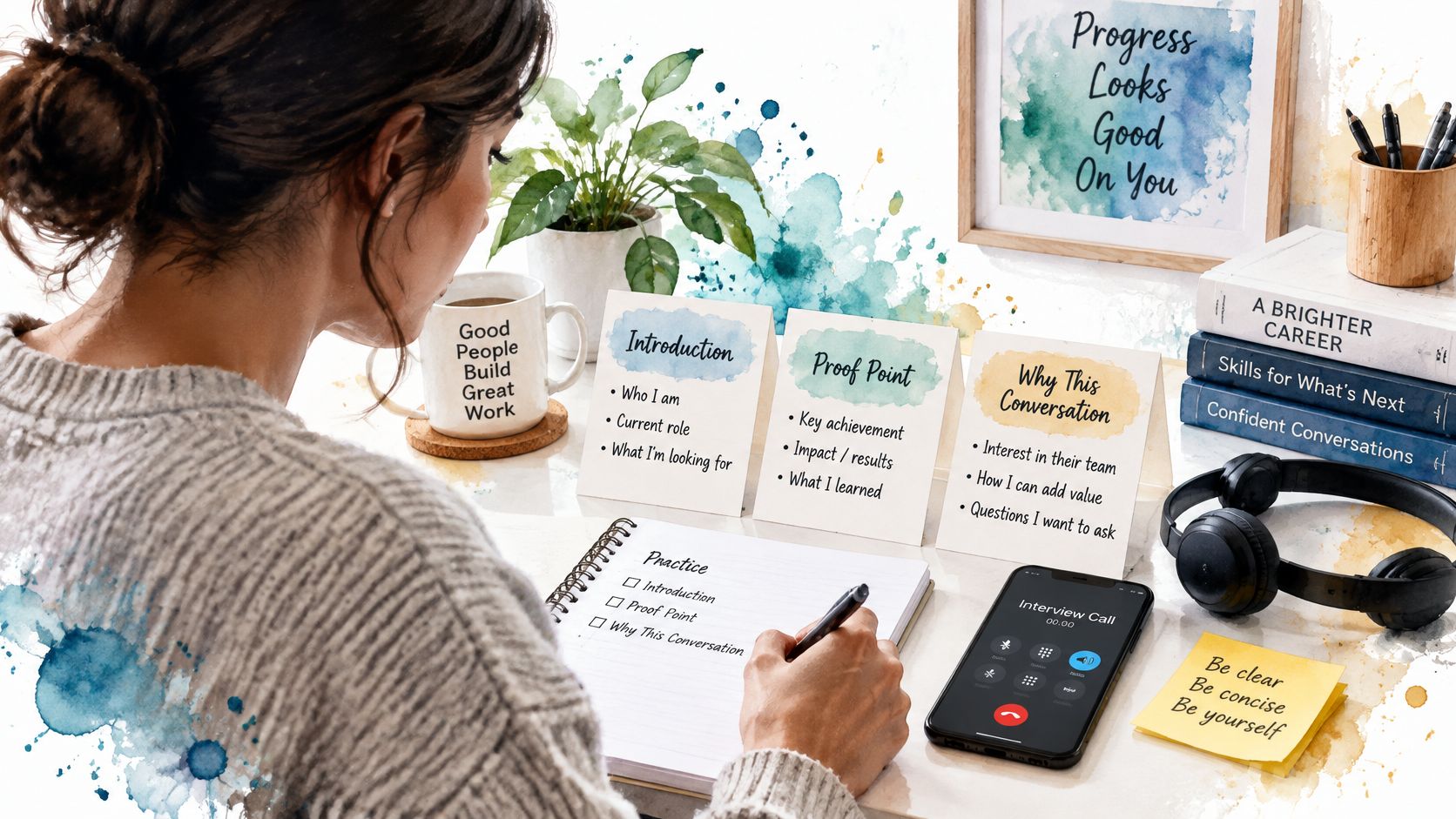
Keep the desk layout simple while you practice these moments.
Introduction and motivation
For "Tell me about yourself," use name, current focus, one proof point tied to the posting, and why this conversation makes sense.
Say you're a career switcher moving from retail operations into customer success. Try: "I'm Maya Chen. For the past three years I've run shift operations for a multi-site retailer, where I rebuilt onboarding checklists and reduced repeat scheduling errors. That work pushed me toward customer success because the part I do best is diagnosing why users get stuck. This role stands out because it combines onboarding with direct customer problem-solving."
Now say you're a recent graduate. Don't list courses. Name a project and its outcome: "I'm Daniel Osei, a recent data analytics graduate. For my capstone I cleaned a messy sales dataset in Python and built a Tableau dashboard the sponsor used to spot underperforming regions. I'm looking for analyst work where I can keep turning operational data into decisions, which is why this role caught my attention."
For motivation, pair one checked employer fact with the problem you want to work on. "I saw your team is expanding onboarding for mid-sized clinics. I want to work on implementation problems where training quality affects adoption." That beats praising the brand or saying you've always loved the company.
Watch how concise answers land when they're spoken rather than read.
Strength, gap, and pay
For a strength, pick one competency from your matrix and attach the result. "My strongest match is escalation triage. I created a priority rubric that helped our team clear urgent cases first and cut repeat contacts." Don't offer a list of adjectives with no evidence.
For a gap, name the issue, the fix already in progress, and stop. "I haven't used your CRM in production yet. I've completed the vendor's core training and built a small test workflow, so my learning curve is on your configuration rather than the basics." There's no need for an apology monologue.
For pay, provide the range you've researched and relate flexibility to the scope. "Based on the level and location, I'm targeting the range mentioned in your posting if the responsibilities align with what we've discussed today. I'm flexible once I understand the full package and scope." If no range is posted, calmly state your own. Avoid giving a single desperate number or refusing to engage if the recruiter needs to verify alignment.
Choose two or three closing questions. Ask how the role is judged in the first 90 days. Ask what the team is trying to fix. Ask what the next step is and when you'll hear. Those questions show judgment without turning the end of the screen into an interrogation.
Reusable close: "Thanks for walking me through the role. The onboarding work maps closely to the triage and training I described, so I'm very interested. What is the next step, and when should I expect to hear from you?"
After the call, send one follow-up email within 24 hours. Thank the interviewer, restate one fit point from the conversation, and name the next step they gave you. Keep it brief. A thank-you note that repeats your whole resume creates work for the reader.
Tips for Freezes AI Screens and Bad Audio
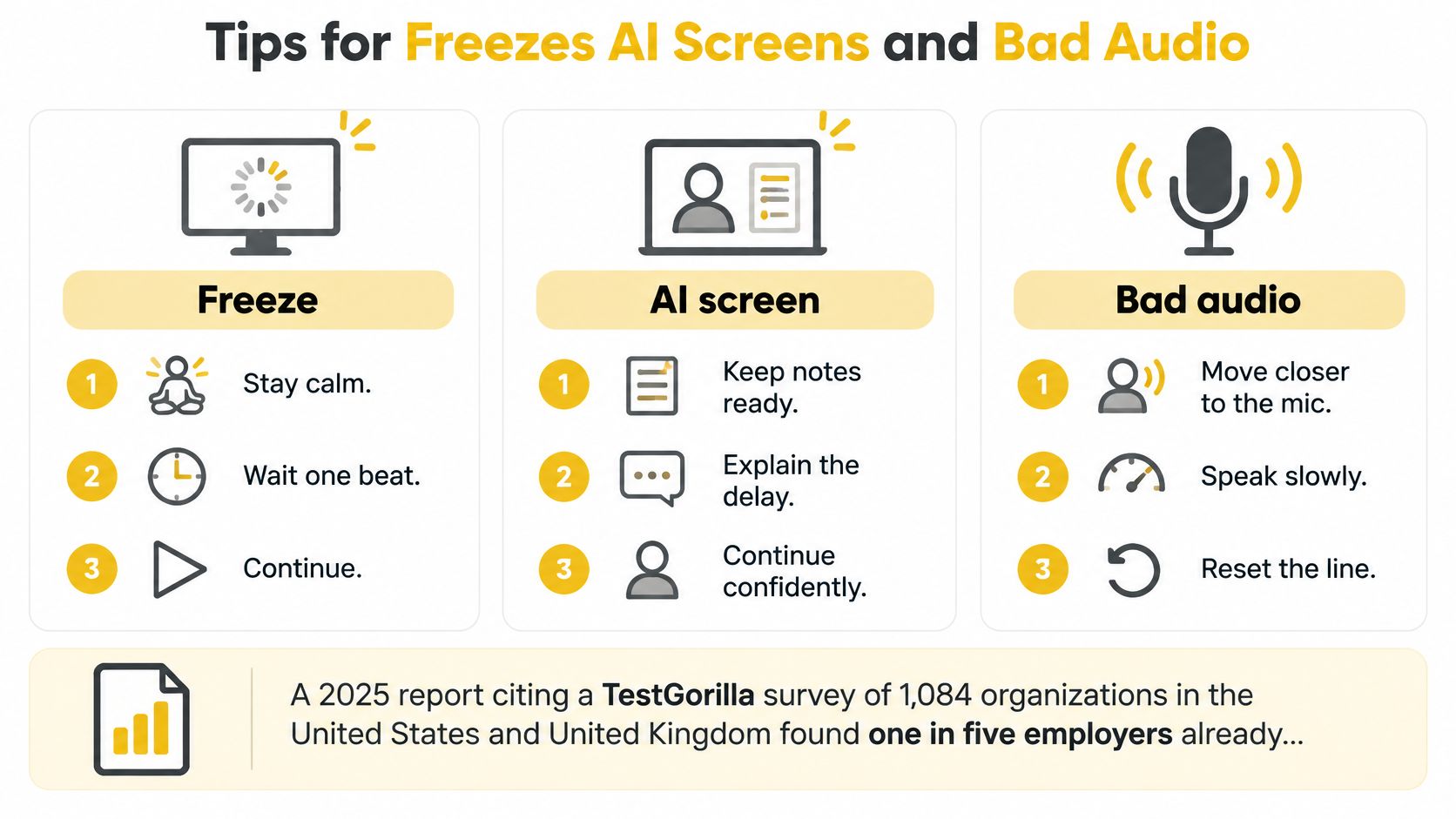
A June 2025 report covered by Computerworld's article on employers using AI to interview candidates cited a TestGorilla survey of 1,084 organizations in the United States and United Kingdom and found one in five employers were already using generative AI tools for initial candidate interviews. That changes phone interview preparation. You may be answering a person, speaking into a recorded system, or talking with a human who later reviews a transcript.
Start by reducing uncertainty. Ask whether a person or a system is evaluating the call, whether it's recorded, and whether AI-generated assistance is permitted. If you want a structured way to think through that distinction before the call, this guide on how to prepare for an AI interview covers the preparation side. Don't assume the rules from one employer apply to another.
These quick repairs cover the failures you're most likely to meet live.
What to say when the call goes sideways
| What happens | Risk | Say this |
|---|---|---|
| You go blank | Silence feels longer without a face | I need a moment to choose a clear example |
| You are unsure who is scoring | Over-scripted answers sound inauthentic | Is a person reviewing this call, and is it being recorded |
| An accent or word is misheard | The notes capture the wrong claim | Let me say that again in one shorter sentence |
| You need a communication accommodation | Speed is judged instead of the work | Could we slow the questions, or use the backup channel we agreed |
Short structured answers help both a human listener and a transcript. Reading generated text aloud usually does the opposite. It flattens your pace, makes follow-ups harder, and can sound inauthentic or raise concerns about undisclosed help. Prepare evidence in bullets, then speak naturally from them.
If an automated recruiter mishears your accent or asks a follow-up that doesn't fit your answer, correct the record once in shorter words. Say: "To clarify, I led the migration. I did not only support it." Then give the result in one sentence. Talking longer often creates a second transcription problem.
Confirm name pronunciation at the start, both yours and the interviewer's. "I'm Priya Nair, pronounced PREE-yah NYE-er. Did I say your name correctly?" That small exchange prevents repeated errors and gives you a natural moment to settle your pace.
Handle freezes and access needs directly
Prepare two recovery moves before anxiety hits. Ask for a moment to think, or ask which part of a multi-part question to answer first. Both buy time without filling the silence with apologies. A controlled pause is recoverable. A rushed, unrelated story is harder to repair.
If you have hearing, speech, processing, or anxiety-related needs, act before the day. Email the recruiter at least a day ahead to request captioning, a relay service, written questions, extra time to answer, or another agreed channel. Write down the backup method you confirm together.
Polished doesn't mean hiding an accent or masking a disability. It means removing avoidable friction so your work can be judged.
During the call, keep the request to one sentence. "Could we slow the questions, or use the backup channel we agreed?" is enough. You don't owe a long explanation while you're trying to listen.
Technology adds uncertainty about the evaluator, the recording, and acceptable help. Manage that uncertainty openly. Ask who reviews the call, correct transcription errors promptly, and keep your answers understandable to both a person and a system. The goal isn't to perform for software at the expense of honesty. It's to make accurate evidence easy to capture.
Rehearse Once More Before You Pick Up
Do one full rehearsal as a decision check, not another research session. Run it the morning before, or in the final hour if your screen was booked quickly. Sit or stand exactly as you will on the call.
Say your introduction, two stories from bullets, your pay range, and two questions for the interviewer. If you need ideas for that final pair, borrow from these questions to ask in a phone interview and keep only the ones that fit the person you're meeting. Time the full pass. If it only works when you read it, cut the line or reduce it to a prompt.
Fix only what fails
Use simple rules. If a story rambles, shorten the Situation. If the Result has no number, technical outcome, or learning, repair that one story and leave the others alone. If your pay answer sounds defensive, say the range once, connect it to scope, and stop.
Confirm notifications are off, your headset is connected, and the backup channel is visible. Before a first interview, our help center suggests a 5-minute checklist, and that final sweep belongs at the end of your rehearsal. Our AI mock interviews are available with an evaluation of your answers if you want scored spoken practice, and the copilot supports technical questions, live coding, behavioral questions, phone interviews, online assessments, recorded interviews, group interviews, and case studies.
Use that kind of support before the call, for rehearsal in your own words. Keep AI tools out of the live screen. Don't read generated text, and don't use live assistance unless the employer has said it's allowed. No practice tool can guarantee an offer, and you shouldn't assume any practice question will be the one you're asked.
Book the rehearsal now, even if it's only a short block today. Put the one-page matrix beside the phone. Then trust the strongest phone skill you've built: give the headline, give the evidence, and be ready to stop talking.
Book one timed spoken rehearsal today, score it against your matrix, and fix the weakest story before your screen. Interview Pilot offers AI mock interviews with an evaluation of your answers and structured practice for phone interviews, so you can hear how your introduction, examples, and closing questions sound. Visit Interview Pilot, run a practice session in your own words, and pick up the call with your bullets ready and your lines tested.
Topics
phone interview preparation
phone screen
STAR method
interview scripts
call setup
Continue reading

Interviews
How to Ace Behavioral Interview with STAR
See how to ace behavioral interview rounds with 6-8 scored stories, a timed STAR answer, follow-up practice, and a rehearsal that stays credible.
October 31, 2026
16 min read
Interviews
Integrity Interview Questions: 8 Examples and Red Flags
Use these 8 integrity interview questions to assess ethics, accountability, and courage. Includes STAR answer frameworks and red flags to watch for.
October 28, 2026
17 min read

Interviews
8 Interpersonal Skills Questions and How to Score Them
Eight interpersonal skills questions with STAR answer tips, scoring guidance, and what interviewers listen for in each response.
October 27, 2026
17 min read