












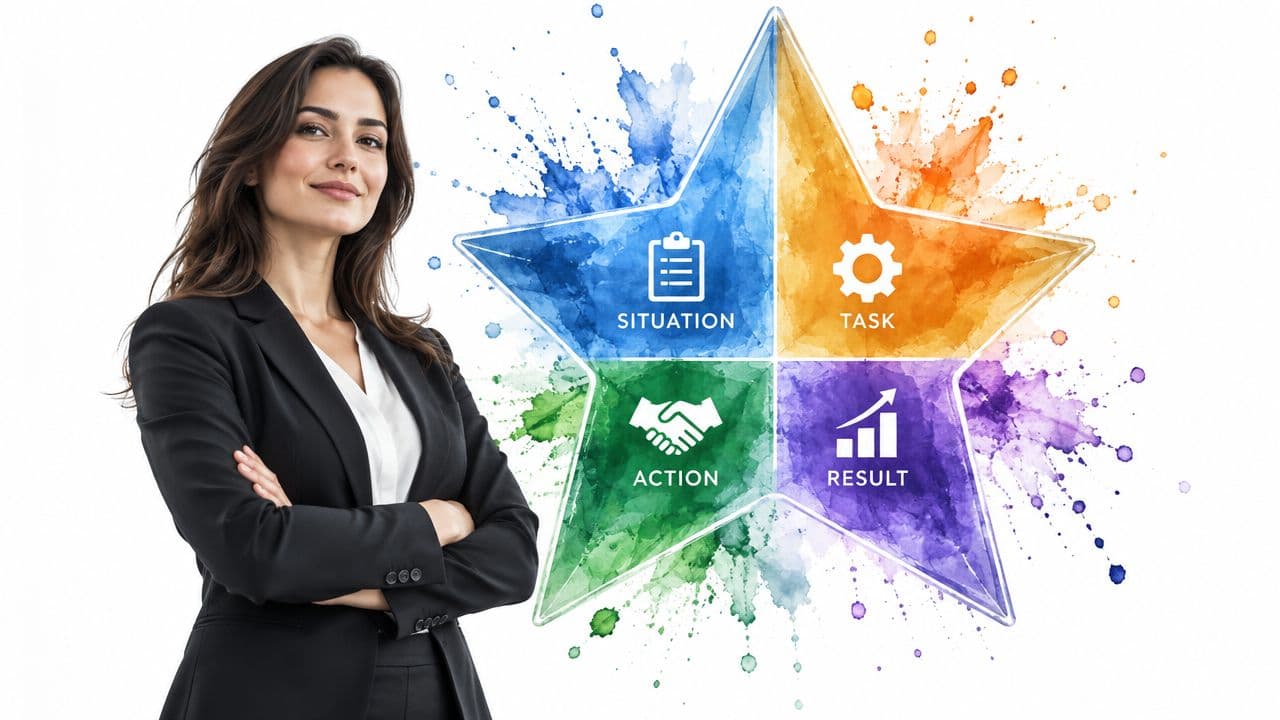
8 Star Method Examples for Behavioral Interviews
Updated September 17, 2026
25 min read
Interview Pilot Editorial Team
You know the story. A production issue appeared before a release, a stakeholder challenged your recommendation, or a team project went off track. Under interview pressure, however, the details arrive in the wrong order. You explain the background for too long, describe what “we” did, and reach the outcome only after the interviewer has started searching for the evidence.
Strong star method examples solve that communication problem by connecting a meaningful situation to a specific task, making your individual decisions visible, and ending with a credible result. STAR stands for Situation, Task, Action, and Result. MIT's career guidance recommends a practical balance of 20% Situation, 10% Task, 60% Action, and 10% Result, with the largest share devoted to what you personally did and the result kept concise but measurable (MIT's STAR guidance).
The eight examples below use a compact annotation system. Context explains why the story mattered, ownership identifies your responsibility, decisions show judgment, outcomes provide evidence, and lessons demonstrate growth. Use Interview Pilot's Question Bank, AI Mock Interview sessions, or live copilot as optional rehearsal aids. They can help you practise structure and follow-up questions, but your answer still needs to come from your real experience.
1. Handling High-Pressure Situations and Deadline Management
Prompt: “Tell me about a time you had to deliver under an extremely tight deadline.”
Situation: During a software engineering internship, our team discovered a serious checkout bug shortly before a scheduled release. The issue could have blocked customers from completing purchases, and the release window left little room for a full investigation.
Task: I was responsible for identifying the cause, proposing a safe fix, and giving the release manager enough information to decide whether we could proceed.
Action: I first reproduced the bug locally and narrowed it to a validation change introduced in the latest branch. I paused lower-priority work, wrote a small test that captured the failure, and compared the new behavior with the previous release. I then paired with another engineer to review the patch, asked the release manager to hold deployment while we completed verification, and posted short updates in the incident channel so support and product knew what to expect. Before recommending the fix, I tested the affected checkout paths and the adjacent validation cases.
Result: We deployed the reviewed fix within the release window, and the bug didn't reach customers. I learned that pressure is easier to manage when I separate diagnosis, mitigation, review, and communication instead of trying to solve everything at once.
Why this answer works
The Situation gives stakes without turning into a technical incident report. The Task defines ownership clearly. In the Action, the candidate shows prioritization, testing, collaboration, and communication, rather than saying only, “I worked hard.” The Result is positive and truthful without inventing a performance figure.
Practical rule: Under pressure, explain the order of your decisions. Interviewers want to hear how you controlled risk, not just that you finished quickly.
A technical candidate can add the relevant debugging method, test strategy, or deployment control. A non-technical candidate can use the same structure for an urgent report, client presentation, operational problem, or event. Explain the constraint, the decision you made first, and how you kept stakeholders informed. The tight-deadline interview guide from Interview Pilot can help you rehearse this type of chronology.
Likely follow-ups include: “What did you deprioritize?”, “How did you know the fix was safe?”, and “What would you do differently?” Prepare one sentence for each. Don't claim perfect calm. It's stronger to show a repeatable process for staying effective when circumstances are demanding.
2. Demonstrating Ownership and Initiative Beyond Your Job Description
Prompt: “Tell me about a time you took initiative without being asked.”
Situation: In a customer support role, I noticed that new agents repeatedly asked the same questions about a complicated account setup process. The team answered each question individually, and customers received inconsistent explanations.
Task: Although improving internal guidance wasn't part of my assigned workload, I wanted to create a clearer process without disrupting my normal queue responsibilities.
Action: I reviewed recent support conversations to identify the most confusing steps, then asked experienced agents where they saw avoidable errors. I drafted a short internal guide using plain language, screenshots, and escalation instructions. Before sharing it broadly, I asked my team lead and two agents to test the guide against real scenarios. I revised the sections that caused confusion, uploaded the final version to our shared workspace, and suggested adding it to new-agent onboarding. I also blocked a small amount of time each week to maintain it as the product changed.
Result: New agents had a consistent reference point, and experienced teammates spent less time repeating the same explanations. My manager used the guide during onboarding and asked me to document other recurring support processes.
The strategic choices underneath
This answer starts with the business problem, not the candidate's solution. That matters because initiative should look like customer or team judgment, not a personal side project. The candidate also shows restraint. They didn't rewrite the process alone, ignore their manager, or neglect core responsibilities.
Ownership appears through specific verbs: reviewed, asked, drafted, tested, revised, uploaded, and maintained. Those verbs make the contribution observable. The result is qualitative because the candidate doesn't have a verified figure. That's better than adding an unsupported claim.
Candidates with technical backgrounds can adapt the story to a recurring defect, missing test coverage, or unclear documentation. Product, consulting, finance, and operations candidates can use a recurring customer pain point, manual report, or inconsistent handoff. The key is to explain how you identified the problem, validated that it mattered, and secured enough alignment to act.
For more practice with the ownership framing, use Interview Pilot's initiative interview guidance. Expect follow-ups such as “Why didn't you wait for your manager?”, “How did you fit this around your existing work?”, and “What happened when someone disagreed?” A strong response acknowledges boundaries and explains how you communicated before scaling the idea.
3. Overcoming Technical or Skill-Based Challenges
A new tool appears in the middle of a dashboard project, while stakeholders and the delivery date are already fixed. The strongest STAR answer shows how you learned under that constraint without treating unfamiliar technology as a personal weakness.
Prompt: “Tell me about a time you had to learn a new skill quickly.”
Situation: As a data analyst, I was asked to support a dashboard project that required querying a data warehouse I had not used before. The stakeholders and delivery date were already defined, so I needed to learn enough to contribute without slowing the team.
Task: I owned the reporting logic for two key business questions. My responsibility was to produce reliable results while learning the new environment.
Action: I began with the official documentation and mapped the warehouse tables to the business definitions the team already used. I asked a senior analyst to review my initial assumptions, then built a small proof of concept with limited data before connecting the full dashboard. When my results differed from an existing report, I traced the discrepancy to a definition mismatch instead of assuming my query was correct. I documented the assumptions, added validation checks, and scheduled a short stakeholder review so they could confirm that the measures matched the decisions they needed to make.
Result: I delivered the dashboard work on time, and the documented definitions made later reviews easier. The experience also changed my working method: I now build a narrow proof of concept, confirm definitions early, and expand only after the foundation is reliable.
What interviewers can hear
Underneath the story is a controlled learning cycle:
- Learn: Read the documentation and understand the data model.
- Test: Build a narrow proof of concept.
- Validate: Compare outputs and investigate discrepancies.
- Communicate: Confirm definitions with stakeholders.
- Scale: Expand the solution after its foundation is reliable.
Each line has a job. The Situation establishes pressure without exaggerating it. The Task identifies ownership. The Action shows judgment through review, testing, and reconciliation. The Result connects the immediate deliverable to a repeatable method.
A software engineer could substitute an unfamiliar framework, deployment platform, or testing tool. A data scientist might describe productionizing a model. A career switcher could use coursework, volunteering, or a personal project, provided the answer explains what they owned and what changed because of their work. Non-technical candidates can apply the same structure to a new reporting system, process, or regulatory requirement.
Avoid claiming, “I taught myself everything over a weekend,” unless it is accurate and relevant. Likely follow-ups include how long the learning took, which resources you used, what remained difficult, and what you would change. A credible answer includes limits. You may have needed guidance on architecture, terminology, or production standards. Explaining when you worked independently and when you requested review makes the learning process more believable.
Start rehearsal with Interview Pilot's technical interview Question Bank, then test the answer in a mock session with follow-up questions.

The learning signal becomes stronger when you connect the new skill to a lasting change in your working method.
4. Navigating Conflict or Disagreement with Colleagues or Leadership
Prompt: “Tell me about a time you disagreed with a colleague or manager.”
Situation: As a product manager, I disagreed with an engineering lead about whether a requested feature should be built immediately or postponed until the underlying workflow was improved. Product stakeholders wanted visible progress, while engineering was concerned about creating rework.
Task: I needed to advocate for the customer need without dismissing the technical concern or forcing a decision through authority.
Action: I asked the engineering lead to walk me through the main risks and constraints before presenting my own view. I then brought customer feedback and usage evidence to a private working session, separating confirmed needs from assumptions. Together, we outlined a smaller first release that addressed the most urgent user problem while leaving the deeper redesign for a later phase. I documented the trade-offs, asked design and support to review the proposed flow, and made sure the final plan identified what we would measure after release.
Result: We agreed on a phased approach and moved forward without pretending the broader problem had disappeared. The conversation also improved our working relationship because we had a shared decision record instead of a personal debate.
Read the tone carefully
Conflict answers fail when the candidate casts themselves as the rational hero and the other person as an obstacle. This response does the opposite. It gives the colleague a legitimate concern, asks questions first, and frames the disagreement around a product decision.
The Action contains four useful signals:
- Listening: The candidate sought the other person's reasoning.
- Evidence: Customer feedback and usage data informed the discussion.
- Trade-off management: The phased plan balanced immediate value and technical risk.
- Alignment: Other functions reviewed the flow before the decision was finalized.
A technical candidate can adapt this to an architectural disagreement. A finance candidate might describe a different view on analysis or deal structure. A non-technical candidate can use a disagreement about priorities, client expectations, or process design. Keep personalities out of the story.
Expect questions such as “What if the other person had still disagreed?”, “Who made the final decision?”, and “Did you ever change your position?” Don't treat changing your mind as defeat. If new evidence improved your judgment, say so. The historical STAR framework remains useful partly because it gives interviewers a consistent way to examine evidence through Situation, Task, Action, and Result, a structure Development Dimensions International says it introduced in 1974 as part of its Targeted Selection system (DDI's history of STAR).
5. Delivering Bad News or Managing Failure Professionally
Prompt: “Tell me about a time something went wrong.”
Situation: I was responsible for preparing a performance report for a senior stakeholder, and I discovered during final review that one source file had changed format. Several figures in my draft were therefore based on an incorrect transformation.
Task: I needed to correct the analysis before it influenced a decision, explain the mistake clearly, and improve the process so the same failure was less likely to recur.
Action: I stopped distribution and told my manager exactly which sections were affected. I traced the issue to the changed source format, rebuilt the calculations, and asked another analyst to independently review the corrected logic. I then sent the stakeholder a concise update explaining what had changed, what remained reliable, and when the corrected report would be available. Afterward, I added a source-format validation step, documented the assumptions behind the transformation, and created a review note for future analysts.
Result: The corrected report was delivered before the decision meeting, and the stakeholder had a clear explanation rather than an unexplained revision. I learned that reporting accuracy includes monitoring the inputs, not just checking the final numbers.
Accountability without self-destruction
A failure answer should be honest, contained, and useful. The candidate names the error quickly, explains the immediate response, and spends most of the answer on prevention. They don't blame the source system, hide behind “we,” or claim the mistake had no consequences.
When you lack a perfect success story, a partial outcome can still work. Perhaps the project missed its original target but protected an important relationship, exposed a root cause, or created a better process. The result needs to be truthful. MIT's guidance specifically recommends highlighting a positive outcome and, when possible, a metric or lesson learned (MIT career guidance on the Result section).
A technical candidate might discuss a defect, failed deployment, or incorrect assumption. A product manager might explain weak adoption and a subsequent pivot. A recent graduate can use a group project where their first approach failed, provided they can show what they changed and what they learned.
Likely follow-ups include “Who else knew about the problem?”, “What was the impact?”, “Why didn't you catch it earlier?”, and “How have you applied the lesson since?” Answer factually. Don't over-justify. Strong candidates don't need to sound flawless. They need to show that they protect trust, recover methodically, and change the system behind the mistake.
6. Leading or Influencing Without Formal Authority
Prompt: “Tell me about a time you influenced others without being their manager.”
Situation: On a cross-functional project, customer support and sales wanted a workflow change, while engineering was focused on stabilizing existing systems. No single team owned the full problem, and each group had a different priority.
Task: I needed to help the teams agree on a practical improvement without presenting the request as an instruction from someone without authority.
Action: I interviewed representatives from each group to understand the cost of the current workflow and the constraints behind their positions. I summarized the findings in a short decision document, separating evidence from proposed solutions. Rather than asking for a full commitment, I proposed a limited pilot with a clear owner, review point, and rollback option. I volunteered to coordinate the pilot, prepared the stakeholder updates, and invited engineering to define the technical safeguards. When questions surfaced, I brought the relevant people into the same discussion instead of answering on their behalf.
Result: The teams agreed to test the approach, and the pilot gave them enough evidence to decide whether broader adoption made sense. I learned that influence comes from making the decision easier and safer for other people, not from trying to win an argument.
The anatomy of credible influence
Influence stories need more than “I presented the benefits and everyone agreed.” Show the stakeholder environment first. Who had competing priorities? What did each person fear losing? Which evidence changed the conversation?
The strongest action here is the pilot. A limited experiment reduces perceived risk and gives skeptical stakeholders a way to participate without endorsing an irreversible decision. It also prevents the candidate from claiming that personal persuasion caused the entire outcome.
Technical candidates can discuss testing tools, architecture proposals, or operational improvements. Product and consulting candidates can use roadmap changes or client recommendations. Finance candidates can describe a process or analysis that required senior approval. In each case, focus on how you understood constraints and created a decision path.
Influence is not the same as winning. Your story can end with a pilot, a qualified agreement, or a decision to gather more evidence, provided you explain what you contributed and what the group learned.
Interviewers may ask, “What did you do when someone resisted?”, “What would you have done if the pilot failed?”, or “How did you measure success?” Prepare answers that preserve shared ownership. Say “we agreed on the test” when describing the group decision, then return to “I” for your specific coordination, analysis, and communication.
7. Collaborating with Diverse Perspectives and Building Cross-Functional Teams
Prompt: “Tell me about a time you worked with people who had different perspectives or working styles.”
Situation: I worked on a feature involving engineering, design, operations, and customer-facing colleagues. Each group described success differently. Engineering emphasized reliability, design focused on usability, operations cared about supportability, and customer-facing teams wanted a clear response to recurring user concerns.
Task: I was responsible for helping the group reach a shared solution without allowing the loudest viewpoint to determine the outcome.
Action: I asked each function to describe its essential requirements and its flexible preferences before we discussed implementation. I translated technical constraints into user and operational implications, then summarized customer concerns in language the engineering team could act on. I circulated a written decision summary after each working session, including unresolved questions and owners. When a remote teammate raised a concern late in the process, I paused the decision long enough to test whether it exposed a real edge case. We adjusted the workflow and clarified the handoff between teams.
Result: The final solution balanced technical, user, and operational needs more effectively than the initial proposal. The team also had a clearer collaboration pattern for future work because people knew how their input would be recorded and evaluated.
Make the differences relevant
“Diverse perspectives” shouldn't be a vague compliment. Identify the differences that affected the work: discipline, customer proximity, technical knowledge, time zone, communication style, or decision criteria. Then show how you adapted.
A data scientist might explain how they translated model findings for a commercial stakeholder. A software engineer could describe incorporating design and operations constraints before implementation. An investment banking candidate might discuss coordinating across offices and adapting updates for different audiences. A recent graduate can use a university team with different academic strengths or working styles.
The answer avoids a common problem: portraying other people as difficult. Instead, each perspective contributes a constraint or insight. That makes collaboration sound like a method for improving the work, not an exercise in tolerating disagreement.
For international interviews, explain how you adjust terminology, meeting format, written documentation, or speaking pace. Interview Pilot's publisher describes support across more than 99 languages and a range of accents in its product materials, which may be relevant to your preparation approach, but don't turn a tool feature into a personal workplace story. Your STAR answer should remain about how you worked with people.
Possible follow-ups include “How did you handle conflicting requirements?”, “Whose input did you prioritize?”, and “What did you learn about your own style?” A thoughtful answer names a change in your behavior, such as asking for input earlier or using written summaries to reduce ambiguity.

8. Achieving Measurable Results Through Systematic Improvement or Optimization
Prompt: “Tell me about a process you improved.”
Situation: In an operations role, a recurring weekly report required several manual exports, spreadsheet transformations, and approval messages. The process consumed attention that the team needed for investigating the actual business issues in the report.
Task: I was asked to make the process more reliable without removing the review controls stakeholders depended on.
Action: I mapped each step, identified where data was re-entered, and spoke with the people who used the final report. I found that the biggest risk wasn't the number of steps alone. It was that different people applied slightly different definitions during manual updates. I standardized the input fields, created a documented calculation path, and automated the repetitive transformation while keeping a human review before distribution. I tested the new workflow against earlier reporting cycles, asked users to check whether the output still supported their decisions, and recorded ownership for maintenance.
Result: The team spent less time assembling the report and had more consistent definitions across reporting cycles. The process also became easier to hand over because the logic, review point, and maintenance owner were explicit.
Show the method, not just the improvement
Optimization answers need a baseline, a diagnosis, an intervention, and validation. If you have reliable before-and-after figures, include them with context. If you don't, describe the improvement accurately through time released, errors avoided, adoption, or stakeholder use. Don't manufacture a percentage merely because the prompt expects a measurable result.
The candidate prioritizes the largest source of risk rather than listing every action chronologically. That's a subtle but important distinction. Interviewers want to see how you decided what to fix first, how you tested the change, and how you knew it would last.
Technical candidates can explain query profiling, caching, parallel processing, observability, or test automation. Non-technical candidates can discuss approval workflows, report templates, intake forms, or customer communication. Keep specialized terms tied to an outcome so a non-specialist interviewer can follow the logic.
For broader preparation, use Interview Pilot's behavioral interview questions and answers to practise shifting the same optimization story toward problem solving, ownership, teamwork, or decision-making.
The UK National Careers Service STAR examples illustrate why concrete outcomes help. Their examples include a 25% increase in newsletter sign-ups over three months and a fundraising result of £200 for equipment, showing how a result can use a percentage lift, an absolute total, or a concrete contribution. Use the type of evidence your real story supports, not a metric chosen for appearance.
STAR Method: Comparison of 8 Examples
| Example | 🔄 Implementation Complexity | ⚡ Resource / Speed Efficiency | 📊 Expected Outcomes | 💡 Ideal Use Cases | ⭐ Key Advantages |
|---|---|---|---|---|---|
| Handling High-Pressure Situations and Deadline Management | High process intensity: rapid triage and decision-making | High short-term resource commitment; optimized for speed | Fast delivery, reduced downtime, measurable time-saved metrics | Incident response, fast-paced engineering, finance deals | Demonstrates prioritization, stress management, stakeholder communication |
| Demonstrating Ownership and Initiative Beyond Job Description | Moderate: requires problem scoping and stakeholder alignment | Modest upfront time cost; low ongoing resources; high leverage later | New processes/features, operational improvements with measurable impact | Startups, PM roles, teams valuing autonomy | Signals proactivity, leadership potential, cross-functional impact |
| Overcoming Technical or Skill-Based Challenges | High: steep learning curve and technical experimentation | High learning investment (time, mentorship); variable delivery speed | Increased technical capability, successful implementations, performance gains | Engineering, data science, roles with evolving tech stacks | Shows learning agility, resourcefulness, resilience |
| Navigating Conflict or Disagreement with Colleagues or Leadership | Moderate: requires careful framing and active listening | Low material resources; time- and diplomacy-intensive | Improved alignment, stronger relationships, better decisions | Leadership roles, cross-functional teams, consulting | Demonstrates emotional intelligence, diplomacy, collaboration |
| Delivering Bad News or Managing Failure Professionally | High sensitivity: needs honest accountability and mitigation | Low material cost but high emotional/time investment; immediate transparency reduces risk | Restored trust, preventive measures, clear lessons learned | Senior technical roles, client-facing positions, incident reviews | Signals accountability, resilience, trustworthiness |
| Leading or Influencing Without Formal Authority | Moderate–high: strategic stakeholder mapping and persuasion | Low formal resources; requires time to build credibility | Voluntary alignment, adoption of initiatives, cross-team outcomes | Product, consulting, matrix organizations, senior ICs | Shows persuasion, strategic thinking, informal leadership |
| Collaborating with Diverse Perspectives and Building Cross-Functional Teams | Moderate: coordination across functions and cultures | Time- and communication-heavy; yields higher-quality outcomes over time | Inclusive solutions, better product fit, stronger team cohesion | Remote/global teams, product, consulting, DEI-focused orgs | Demonstrates cultural awareness, adaptability, inclusive communication |
| Achieving Measurable Results Through Systematic Improvement or Optimization | High: rigorous diagnosis, testing, and iteration | Requires data, tooling, and experimentation; upfront cost with high ROI | Quantifiable improvements (speed, cost, quality) with sustained impact | Operations, data engineering, product analytics, finance | Shows analytical rigor, measurable impact, continuous improvement |
Build a Reusable STAR Story Bank
Eight polished answers won't help if you memorize them as scripts and freeze when the interviewer changes the wording. Build a flexible story bank instead. Choose real experiences from employment, education, volunteering, internships, or personal projects, then map each story to Situation, Task, Action, and Result in your own notes.
Start with the experience, not the competency label. Write a short title such as “untangled a reporting discrepancy” or “aligned teams around a phased launch.” Under that title, record the setting, the problem, your responsibility, the decisions you made, the people you involved, the outcome, and the lesson. Then identify the prompts the story can answer. One collaboration story may also demonstrate conflict management, communication, or influence, but change the emphasis rather than repeating the same script.
A practical preparation workflow
Use this sequence for each story:
- Capture context: Explain where you were, what happened, and why it mattered.
- Define ownership: State what you were responsible for, even when the work involved a team.
- Select decisions: Keep the actions that demonstrate judgment, prioritization, learning, or communication.
- Add evidence: Use a verified metric, before-and-after comparison, external response, deadline, or concrete deliverable when you have one.
- Name the lesson: Explain what you changed in your approach afterward.
- Prepare a short version: Keep a compact form ready for an interviewer who wants only the headline.
- List follow-ups: Anticipate questions about trade-offs, measurement, resistance, mistakes, and what you'd do differently.
MIT's guidance places the greatest emphasis on the Action section and recommends keeping the Result concise while highlighting a quantifiable outcome where possible (MIT's behavioral interview resource). That balance helps you avoid two common problems: a long backstory and a result that sounds like “everything worked out.”
Don't discard an example because it lacks a perfect accomplishment. A partial result, shared outcome, or learning-focused ending can still be persuasive if you explain your role precisely. Recent graduates and career switchers often have strong evidence from school projects, volunteer work, customer service, or independent work. The standard is not corporate prestige. It's specificity, ownership, judgment, and truthful detail.
Final review before the interview
Read each story aloud and listen for vague verbs. Replace “helped,” “worked on,” and “communicated” with the actual actions you took. Check that the answer gives the interviewer enough context to understand the stakes, then move quickly to your decisions. Make sure the ending includes what changed and what you learned.
Run the same story through different prompts in Interview Pilot's AI Mock Interview sessions and Question Bank. Adjust the tone and depth for the role, especially when moving between a technical interviewer, recruiter, executive, or client-facing panel. Use the practice to improve recall and follow-up handling, not to replace your experience or invent a more impressive one.
Interview Pilot offers a searchable Question Bank, guided AI Mock Interview sessions, and real-time suggested answers for technical and behavioral interviews. Use Interview Pilot to rehearse these eight STAR patterns with your own experiences, test follow-up questions, and refine answers that remain natural under pressure.
Related Articles
Interviews
10 System Design Templates for Interview Prep
Compare 10 system design templates for interview prep, including diagram tools, C4 frameworks, cloud blueprints, scoring checklists, and download examples.
September 17, 2026 · 18 min read

Interviews
10 Technical Interview Questions for Mechanical Engineering
Master technical interview questions for mechanical engineering with worked answers, calculation methods, and practical problem walkthroughs.
September 16, 2026 · 23 min read

Interviews
8 Interview Questions for Software Testers
Prepare with 8 interview questions for software testers covering test design, automation, bug reports, metrics, and practical answers.
September 15, 2026 · 21 min read