












Interviews
Mock Interview Meaning: A Practical Guide to Rehearsing
Learn the mock interview meaning, how simulated interviews build confidence, the main types, and how to practice effectively before your next real interview.
Interview Pilot Editorial Team
Updated September 29, 2026
16 min read

A mock interview is a rehearsal of an actual interview used to practice answers, body language, and feedback in a low-stakes setting. It recreates the hiring conversation closely enough for you to find weak spots before the final decision is in front of you.
You may know the material on your résumé and still freeze when someone asks, “Tell me about a time you handled conflict.” Perhaps your video call background looks distracting, your answer wanders, or you speak so quickly that your strongest point gets lost. A mock interview gives you a controlled place to notice those problems, adjust, and try again.
The mock interview meaning has remained consistent across modern career guidance: it's a simulated interview that mirrors an actual interaction, whether that interaction happens in person, by phone, in a group, or online. Indeed describes a mock job interview as practice that helps candidates prepare their answers and presentation before the actual interview. The format has changed with remote hiring and digital recruitment, but the central idea hasn't.
A useful mock interview isn't a performance for its own sake. It's a structured rehearsal with realistic questions, observation, and feedback. That makes it relevant for a graduate attending a first screening, a software engineer preparing for a technical discussion, or a career changer learning to translate past experience into a new role.
What a Mock Interview Actually Means
A mock interview is a practice interview conducted under conditions that resemble the actual one. You answer questions aloud, follow an agreed format, and receive an evaluation afterward. The evaluator might be a career coach, mentor, colleague, friend, or AI tool.
The distinction matters. Reading common interview questions at your desk can help you think of examples, but it doesn't require you to retrieve those examples under pressure. A mock interview asks you to listen, interpret the question, choose relevant evidence, organize your response, and communicate it in real time.
Consider a first-time applicant who has prepared several strong projects but has never answered a behavioral question aloud. During the first rehearsal, they start describing a difficult team situation without explaining their own actions. The listener asks a follow-up question, the candidate loses the thread, and the answer ends without a clear result.
After feedback, the candidate changes the approach. They identify the situation briefly, explain the task, focus on their actions, and finish with the outcome. In a later practice round, the answer sounds more direct because the candidate has rehearsed the thinking process, not memorized a paragraph.
Why rehearsal includes more than questions
A real interview contains cues that question lists can't reproduce:
- Timing: You need to decide how much detail the question deserves.
- Pressure: A pause, follow-up, or unfamiliar wording can disrupt an untested answer.
- Presentation: Posture, eye contact, facial expression, tone, and pace influence how your message arrives.
- Adaptation: Interviewers may ask for clarification or challenge an assumption.
The point isn't to remove every pause or make you sound scripted. The point is to expose the moments when your preparation stops working. Career guidance also presents mock interviews as a way to recreate different interview formats and improve both content and presentation.
Practical rule: A mock interview is successful when it reveals something you can change, not when it merely makes you feel prepared.
A serious rehearsal therefore includes evaluation and adjustment. You might discover that your examples are relevant but too detailed, that your technical explanation skips assumptions, or that your closing statement sounds uncertain. The exact format can vary, but the cycle remains the same: simulate, observe, correct, and repeat.
The Four Building Blocks of Every Mock Interview
A real mock interview has more structure than “a friend asks me some questions.” Four elements make the rehearsal useful: a realistic format, defined questions, controlled timing, and a feedback loop.
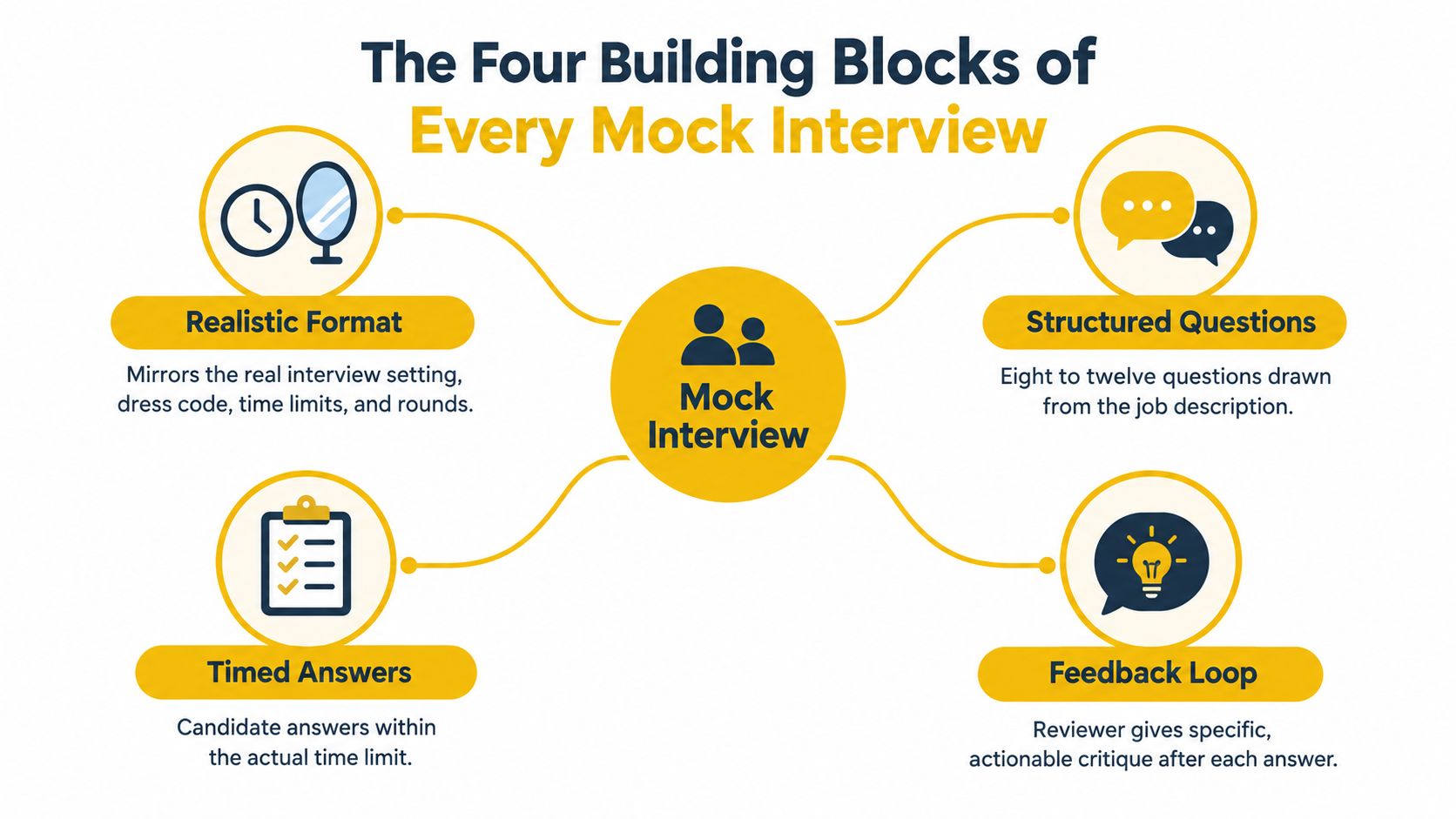
Realistic format
Start by matching the interview you expect. A phone screen requires clear verbal answers without visual support. A video interview adds camera framing, eye contact, and technical checks. A panel requires you to distribute attention, while a technical interview may require you to explain decisions as you solve a problem.
Match the setting where practical. Use the same type of device, sit at a similar distance from the camera, and follow the expected dress standard. If the real meeting will be remote, rehearsing only at a desk without opening the camera leaves a major part of the interaction untested.
Structured questions
Choose questions from the target role rather than relying only on generic prompts. A product candidate might practice prioritization and customer discovery. A data analyst might explain a model, interpret a result, or discuss how they validate data. Behavioral preparation should include questions that invite evidence about collaboration, conflict, ownership, and judgment.
A fixed question set also makes your attempts easier to compare. The guidance behind structured interview administration and mock-scenario calibration supports consistent wording and ordering because they create more reliable practice conditions.
For behavioral preparation, you can also study the difference between a general conversation and a behavioral-based interview. That distinction helps you select stories that demonstrate actions and results instead of offering broad personality claims.
Timed answers
Timing forces prioritization. Without it, candidates often give every detail they remember, burying the main point beneath background information. Set a reasonable limit for each response based on the expected interview style, then practice finishing with a clear conclusion.
Feedback and repetition
Feedback turns an experience into a training cycle. Ask the reviewer to comment on relevance, structure, accuracy, clarity, delivery, and nonverbal signals, then choose one or two changes for the next attempt. Repetition matters because a single run can reflect nerves or luck rather than a stable pattern.
Skip any one building block and the activity changes. Questions without timing become brainstorming. Timing without feedback becomes endurance practice. Feedback without repetition produces insight that never becomes behavior. Together, these elements define a mock interview across live, recorded, peer, and AI formats.
Types of Mock Interviews and When to Use Each
No single format handles every preparation need. The right choice depends on how close you are to the interview, what kind of feedback you need, and how easily you can arrange practice.
| Format | Setup Time | Feedback Depth | Cost | Flexibility | Best For |
|---|---|---|---|---|---|
| Live human | Moderate | High, especially for rapport and body language | Varies | Depends on another person's schedule | Final preparation and nuanced feedback |
| Recorded solo | Low | Self-directed, with repeated playback | Usually low | High | Reviewing delivery, pacing, and visual presence |
| Peer | Low to moderate | Useful but dependent on the peer's skill | Low or reciprocal | Moderate | Early practice and repeated role-specific reps |
| AI | Low | Immediate, structured, and consistent | Varies by tool and plan | High | Flexible scheduling and fast iteration |
Live human practice
A coach, mentor, or experienced colleague can notice what an automated score may miss. They can observe whether your answer creates rapport, whether your explanation fits the audience, and whether your follow-up questions sound natural. Live practice is especially useful near interview day, when you want an outside person to challenge weak reasoning or ask an unexpected follow-up.
The limitation is coordination. A helpful reviewer may have limited time, and a peer may not know enough about the role to judge technical accuracy.
Recorded practice
Recording creates a mirror. You can review whether you look at the camera, fidget, rush through key points, or use repeated filler words. It also lets you hear the answer as an interviewer would, rather than relying on your memory of how it felt.
Solo recording works well when you need privacy or frequent repetition. Its weakness is self-assessment. Candidates often notice visible nervousness but miss a vague claim or unsupported conclusion.
Peer practice
Peer interviews are practical when both people need rehearsal. One person answers while the other follows a prepared question list, then they switch roles. This format is particularly helpful early in preparation, when your priority is becoming comfortable answering aloud and learning to recover when a question changes direction.
Choose a peer who will give specific observations. “That was good” doesn't tell you what to keep. “Your example became clear when you explained your action, but the opening took too long” gives you a usable adjustment.
AI practice
AI mock interviews offer structured prompts without requiring another person to be available. They can be useful for candidates who want repeated sessions, standardized questions, or practice across technical and behavioral topics. An application such as Interview Pilot's AI mock interview is designed for guided rehearsal and feedback, so check that its prompts match the role and format you're preparing for.
Use AI as a practice environment, not as a substitute for judgment. Automated feedback can help identify patterns, but a human reviewer remains valuable when you need to evaluate nuance, credibility, or relationship-building. Start with a peer or AI format for regular reps, then add a live session when you need an external perspective on the complete performance.
What Good Mock Practice Looks Like in Real Life
Good practice produces observable changes. It does not merely make a candidate feel calmer for a few minutes. The change might appear in answer structure, technical precision, pacing, eye contact, or the ability to respond to a follow-up without abandoning the main point.
Mira is a data analyst preparing for a role with substantial SQL work. In her first recorded session, she gives technically relevant answers, but each explanation includes too much background before reaching the query logic. During review, she marks where the answer stops addressing the question, then rewrites her response around the problem, approach, and result.
In a later session, Mira gives shorter explanations and uses a clearer sequence when discussing joins, assumptions, and validation. She hasn't learned a script. She has practiced selecting the information that an interviewer needs first.
A behavioral example
Daniel is a marketing coordinator moving into a role with a stronger behavioral focus. He has plenty of experience, but he tends to speak quickly when describing a difficult project and fills silence with repeated phrases. A peer asks him to answer the same type of question again after identifying the exact moment where his story loses focus.
Daniel reviews the playback and listens for three things: whether the situation is understandable, whether his own actions are visible, and whether the ending shows what changed. He then practices pausing before the action section and closing with the result and lesson.
The useful question isn't “Did I sound confident?” It's “What did the interviewer hear, and what will I change next time?”
Mira and Daniel are working toward the same outcome through different material. Mira needs concise technical explanation, while Daniel needs a retrievable behavioral story and controlled delivery. Their practice works because each session produces a specific observation, a concrete revision, and another opportunity to test the revision.
That is the practical mock interview meaning. Rehearsal should create evidence of changed behavior, not a vague sense that you have “done some prep.” Record what you can, ask for focused feedback, and track the adjustment from one attempt to the next.
How to Run a Mock Interview Session That Works
You can run a useful session this week without building a complicated system. The key is to decide what you're preparing for before you start, then preserve enough consistency to compare one attempt with another.
Start with the target
Write down the exact role and level. A junior data analyst, senior product manager, and staff software engineer may all receive behavioral questions, but the expected depth and examples differ. Note the interview format if you know it, including whether the conversation is a screening call, technical exercise, panel, or video meeting.
Next, create a focused question set. Pull questions from the job description, role responsibilities, required skills, and information the recruiter has shared. A curated interview question bank can help you find role-specific prompts, but edit the list so it reflects the actual position.
Use a balanced set:
- Opening questions: Prepare a concise introduction and a clear explanation of your interest.
- Role questions: Include technical, functional, or case prompts tied to the job.
- Behavioral questions: Cover ownership, collaboration, conflict, failure, and decision-making.
- Follow-ups: Add prompts that ask why you chose an approach or what you'd do differently.
The aim isn't to predict every sentence. It's to practice the skills the role requires.
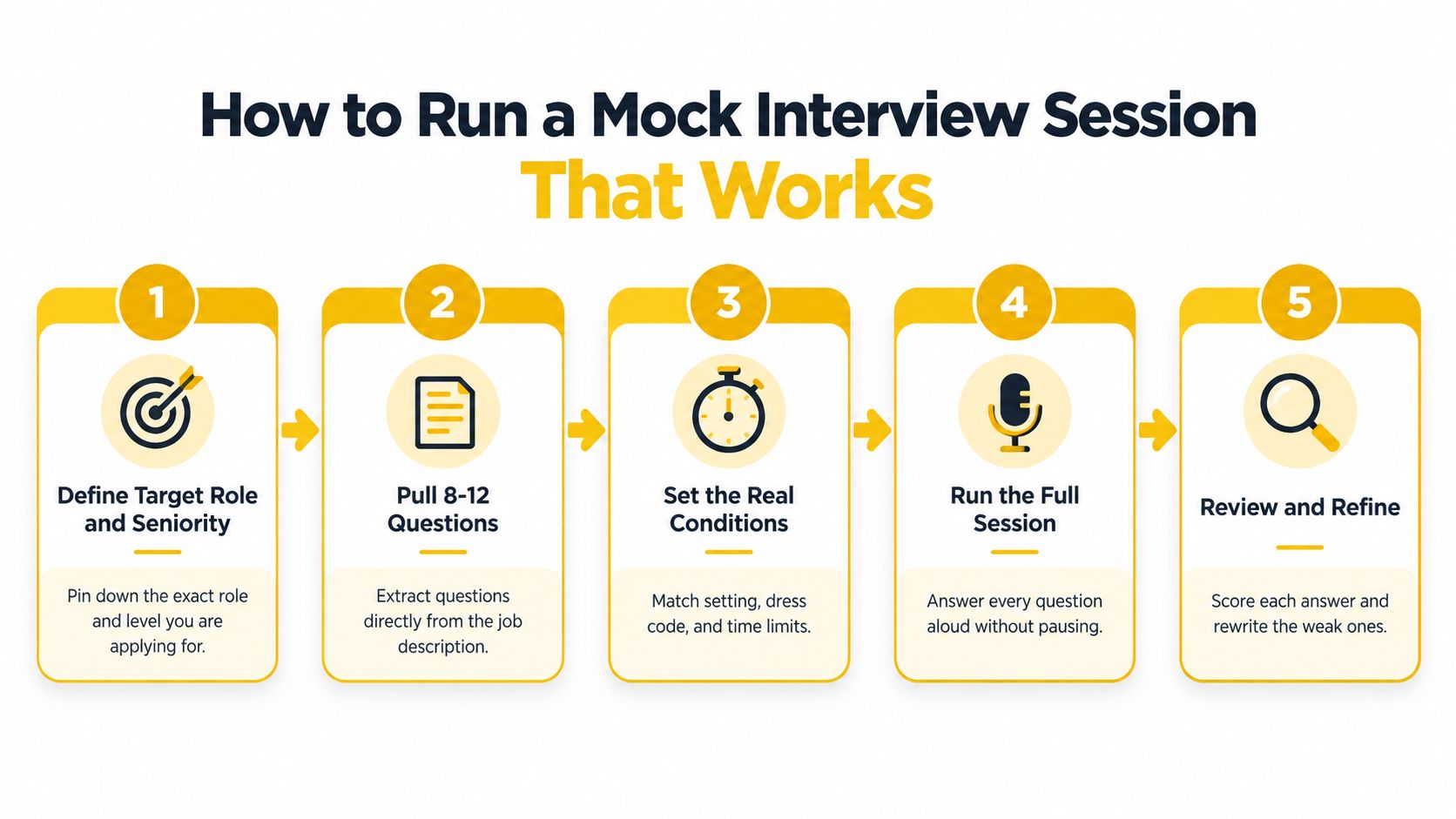
Recreate the conditions
Choose live, recorded, peer, or AI practice based on the gap you identified. Then set the physical environment: camera position, lighting, background, microphone, clothing, and notes. Keep notes limited to keywords so you practice retrieval rather than reading.
Run the full session without stopping to repair an answer. The reviewer should ask one question at a time, and you should answer aloud under the time expectations of the standard format. If you make a mistake, recover and continue. Stopping after every imperfect sentence creates a polished rehearsal that may not prepare you for an uninterrupted conversation.
Afterward, score each answer in three areas:
- Content: Did you answer the question with relevant evidence?
- Structure: Could the listener follow your reasoning or story?
- Delivery: Were your pace, tone, posture, and eye contact helping the message?
Write down the three most important fixes, then rewrite only the weak parts. Before the next session, review those fixes and test them again. A consistent question order and scenario make it easier to tell whether the change came from a better method rather than a different prompt.
For a visual walkthrough of a complete preparation routine, watch the following demonstration:
Finish by scheduling another rehearsal while the feedback is fresh. The exact number of sessions should match your time and needs, but one attempt rarely reveals every pattern. Repetition is useful only when each round has a defined correction.
Mistakes That Undermine Mock Interview Practice
A mock interview can fail even when you show up and answer every question. The problem usually isn't effort. It's practicing in a way that protects you from the conditions you need to improve.
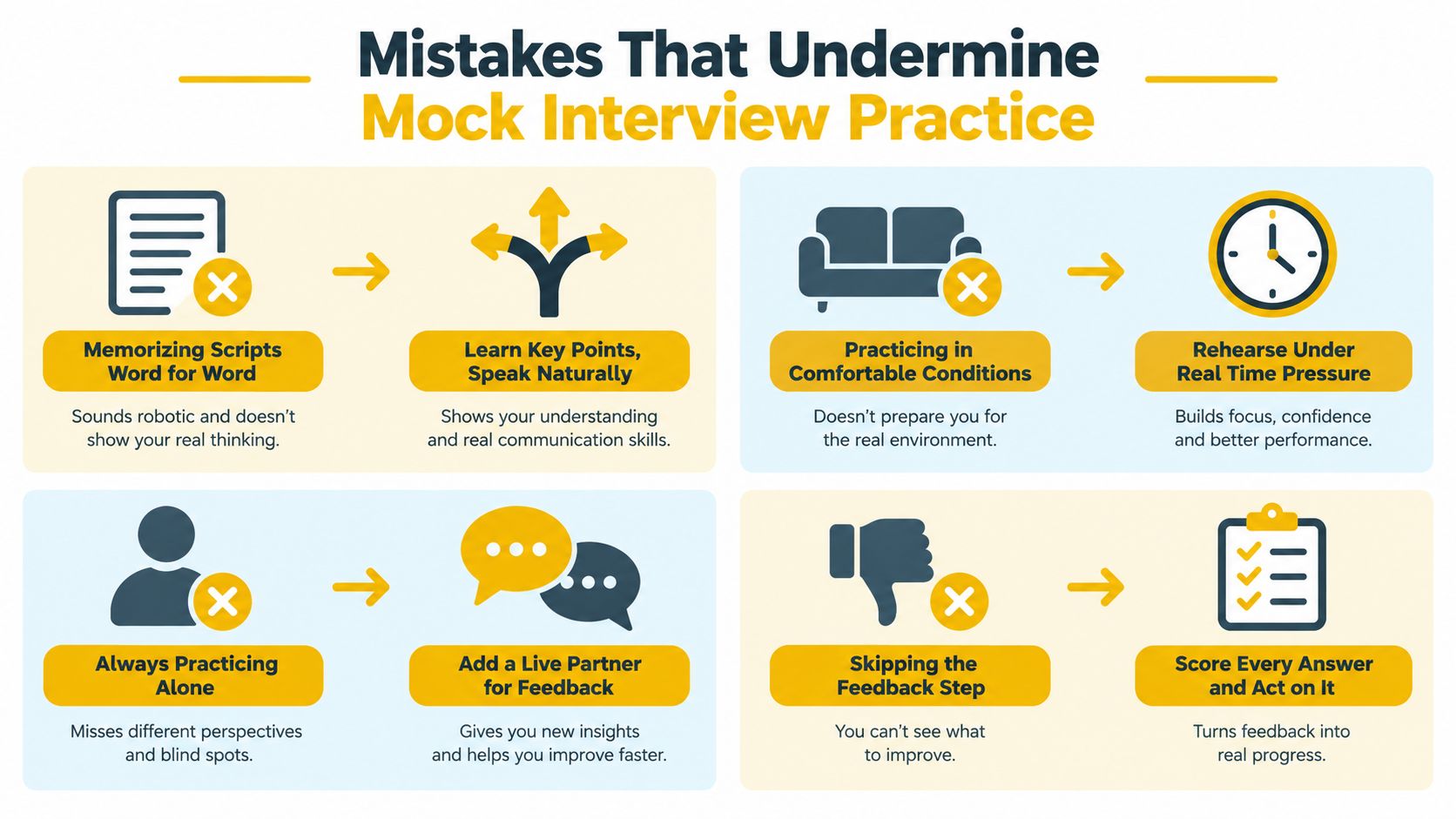
Mistake one, memorizing scripts
Word-for-word answers break when the interviewer changes the wording or asks a follow-up. Memorize anchor points instead: the situation, your responsibility, the decision you made, the result, and the lesson. This keeps the response flexible while preserving the evidence you want to communicate.
Mistake two, skipping feedback
Completing a recording isn't the same as learning from it. Use a written scorecard and choose one priority correction for the next round. If your answer lacks a result, fix the ending. If your explanation is too broad, lead with the conclusion.
Mistake three, ignoring nonverbal signals
Candidates often review the words and overlook posture, eye contact, facial expression, and pace. Watch the opening of your recording first. It shows how you enter the conversation, settle into the question, and establish presence before the content becomes complex.
Mistake four, practicing only once
One session can expose a problem, but it can't reliably turn a new behavior into a habit. Space practice across the preparation period and vary the questions slightly after your structure improves. You want to retrieve the idea naturally, not perform one recording perfectly.
A rehearsal exists to change behavior. If every session feels comfortable because nothing is measured or corrected, you're practicing confirmation rather than improvement.
Turning Rehearsal Into Real Interview Confidence
Confidence usually follows preparation. It isn't a feeling you must wait for before you begin practicing. A mock interview gives you a training ground where you can make mistakes safely, select a format that fits your needs, and convert feedback into visible changes.
Use this short checklist before the actual conversation:
- Preparation: Research the role, draft three to five adaptable stories, and organize questions by theme.
- Rehearsal cadence: Complete at least two full mock sessions, review the feedback, and schedule the last rehearsal within 48 hours of the interview.
- Mindset: Identify your top three strengths, choose two ways to release nervous energy, and rehearse a clear opening and closing statement.
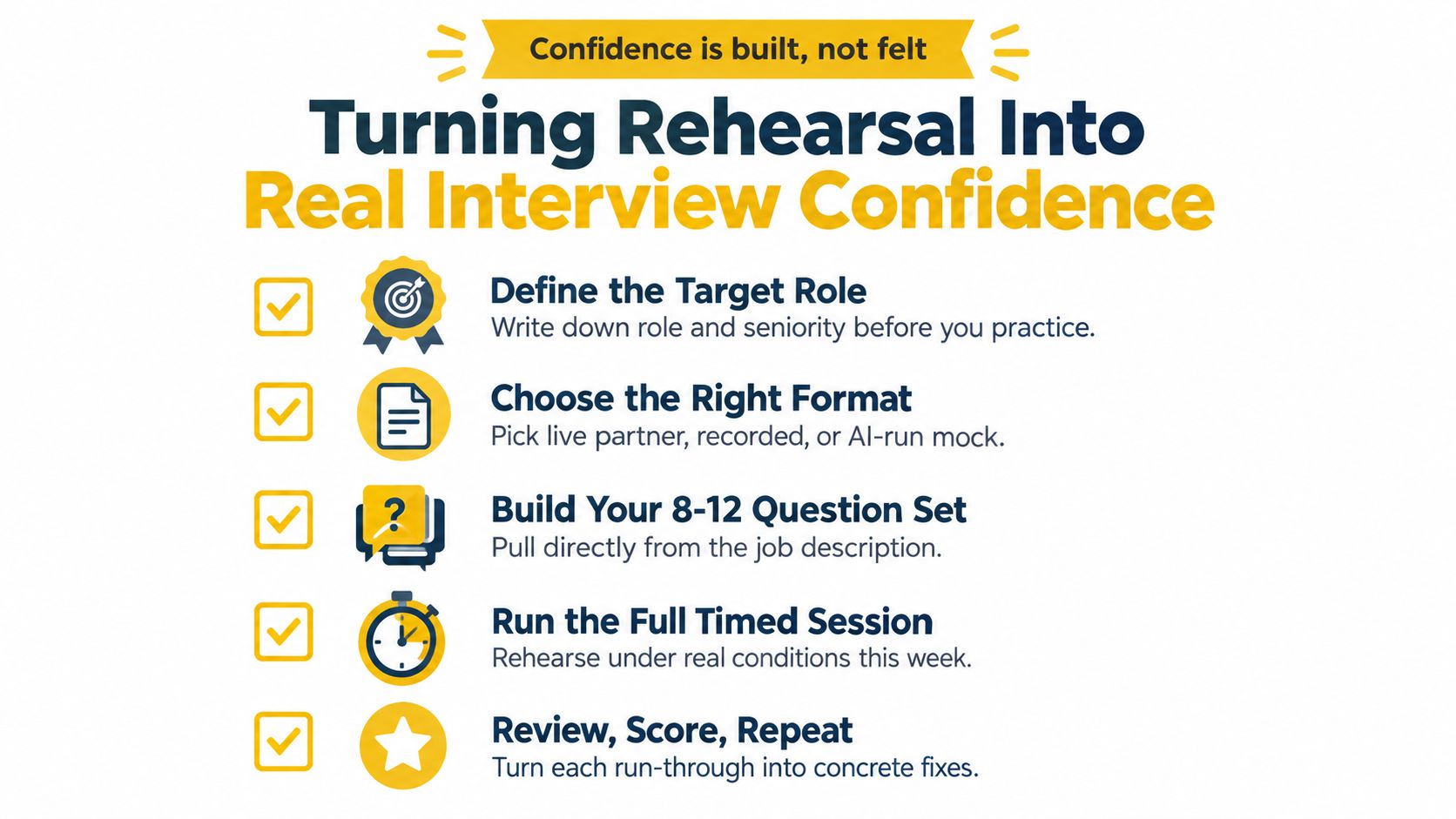
Choose a live partner when you need nuanced human feedback, a recording when presentation is the problem, a peer when you need accessible repetitions, or an AI tool when scheduling and consistency matter most. Then run the session under realistic conditions, review the evidence, and make a small number of deliberate changes.
The mock interview meaning is simple: practice the actual thing until the actual thing feels familiar.
Interview Pilot offers guided AI mock interview practice, real-time transcript support, feedback, and a searchable question bank for technical and non-technical roles. Use it to rehearse a target interview format, review your answers, and identify the next adjustment before you meet the employer. Visit Interview Pilot to begin preparing for your next conversation.
Topics
mock interview
interview prep
AI mock interview
interview practice
behavioral interview
Continue reading

Interviews
8 Target Interview Questions and Answers
Prepare for retail and corporate interviews with 8 target interview questions and answers, behavioral examples, model responses, and practical prep tips.
September 27, 2026
22 min read

Interviews
What Is Behavioral Based Interviewing and How to Master It
Learn what is behavioral based interviewing, how the STAR method works, real answer examples for candidates, scoring tips for interviewers, and proven prep
September 20, 2026
20 min read

Interviews
10 Management Interview Questions and Answers
Prepare with 10 management interview questions and answers covering leadership, conflict, prioritization, budgets, failure, feedback, and team building.
September 18, 2026
25 min read