









Interviews
Interview Best Practices That Actually Work in 2026
Master interview best practices for 2026 with research-backed prep, live tactics, AI tool ethics, and follow-up strategies that turn callbacks into offers.
Interview Pilot Editorial Team
Updated October 20, 2026
18 min read

Be yourself, build rapport, and let the conversation flow. That's the most popular interview advice in the world, and it's often the advice that leaves strong candidates wondering why a friendly chat ended in rejection. If your interviewer is scoring answers against a rubric you never see, charm won't save a vague answer. Interview best practices start from a different question. What evidence is this interviewer looking for, and have you provided it?
Why Most Interview Advice Gets the Science Backwards
Most guides treat an interview like a performance of confidence. You're told to improvise, connect personally, and tell memorable stories. A hiring panel using a structured interview, though, isn't primarily scoring whether they'd enjoy coffee with you. They're scoring whether your answers demonstrate predefined, job-related competencies.
The best-known evidence for that distinction comes from personnel selection research. In the 1998 meta-analysis by Frank Schmidt and John Hunter synthesizing about 85 years of research, structured interviews had an average validity of about 0.51 for predicting job performance, compared with about 0.38 for unstructured interviews. Validity here means the strength of the relationship between interview scores and later performance. It doesn't mean a candidate has a percentage chance of being the best hire.
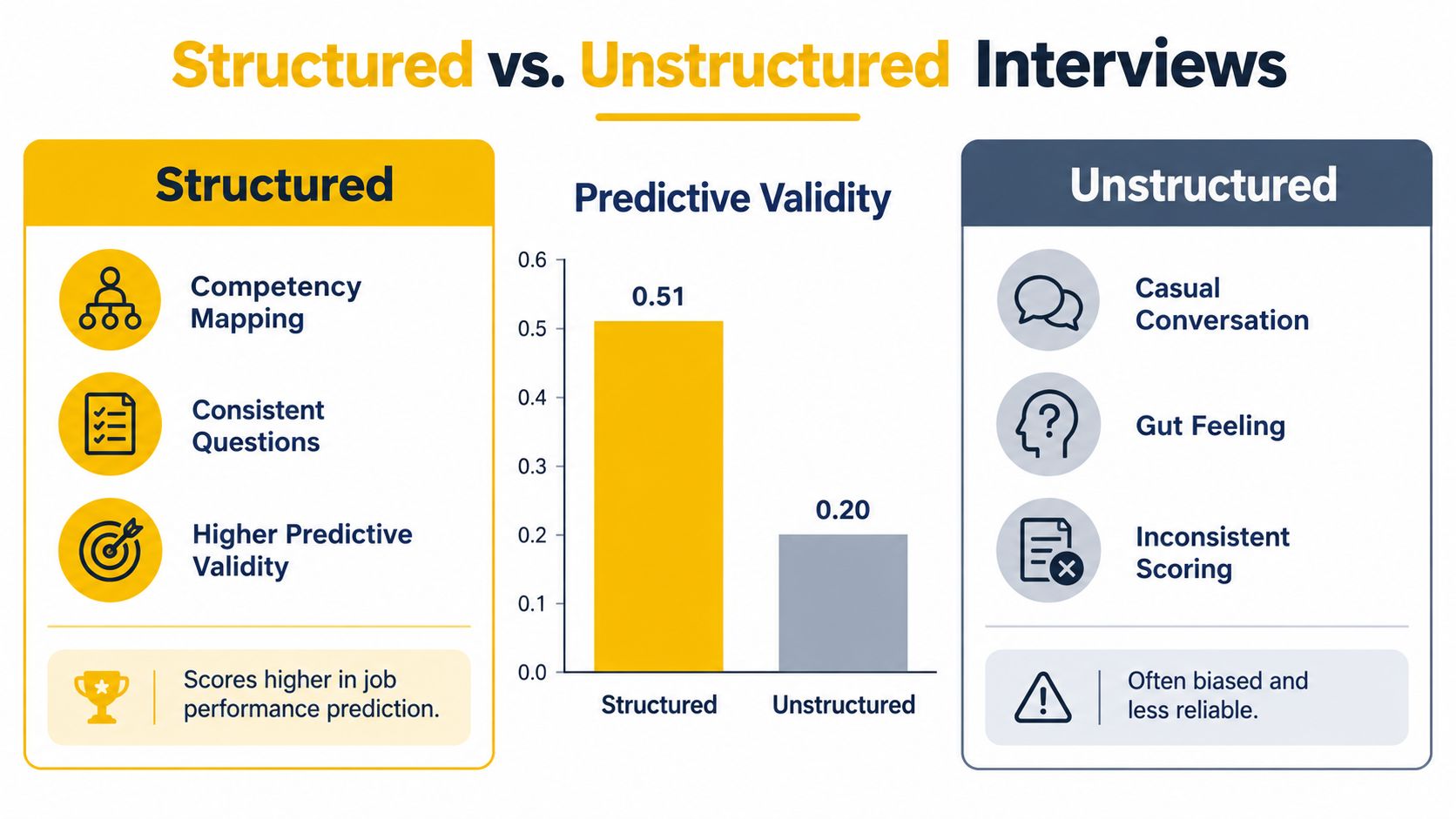
Later research makes the picture less tidy, which is useful. A 2024 review reported a mean validity of 0.42, with an 80% credibility interval from 0.18 to 0.66, showing that implementation quality and job context change the result. Structure helps, but badly designed structure is still bad design.
What structure changes for you
In a structured process, candidates usually receive the same core questions, and interviewers score against criteria set in advance. That means two candidates can sound equally polished while earning very different scores. One tells an entertaining story. The other names a problem, explains specific actions, gives an outcome, and connects it to the competency being tested.
The U.S. Office of Personnel Management similarly notes that higher structure improves validity, rater reliability, interviewer agreement, and adverse impact outcomes in its guidance on structured interviews and job analysis based questions. For candidates, the implication is direct. Don't fight the rubric by performing spontaneity. Learn to recognize it and supply evidence in a form interviewers can score.
Stop asking how you can sound impressive. Start asking which competency is being scored and what proof would satisfy it.
That doesn't require robotic answers. It requires preparation organized around competencies, live answers that stay relevant, ethical decisions about tools, accessibility planning, and follow-up that improves your next attempt. Treat the interview as an assessment with a human conversation wrapped around it, not the other way around.
Preparing Like Your Offer Depends on It (Because It Does)
Preparation fails when it's a pile of company trivia and memorized answers. A better system has four parts. You decode the job, map its competencies, build evidence you can adapt, and test the setting where you'll deliver it.

Decode the job before researching trivia
Read the posting slowly and highlight repeated verbs, tools, stakeholders, and outcomes. Words like prioritize, influence, debug, forecast, or escalate often reveal the actual work. Then check product announcements, earnings commentary where relevant, team pages, and recent launches to understand why the role exists now.
Don't stop at the About page. A company value such as ownership becomes useful only when you translate it into behavior. Ask yourself what ownership would look like in this team's meetings, incidents, client work, or planning cycle. Your research should produce likely interview themes, not a speech about how much you admire the brand.
Build a competency map and evidence portfolio
List the six to eight core competencies the role appears to require. Weight them by how often they appear in the posting and how central they are to the team's problems. For a product role, that might include prioritization, analytical judgment, stakeholder management, and written communication. For a finance role, it might include modeling accuracy, commercial judgment, controls, and explaining variance clearly.
For each competency, choose two or three examples from your work. Record the context, your specific actions, the result, and any artifact that proves it, such as a dashboard, project page, model, design, or written recommendation. Keep each example as flexible notes rather than a script. You'll need to shorten, expand, or redirect it depending on the exact question.
- Job decode: Turn posting language into probable competencies and business problems.
- Competency map: Rank the capabilities you'll need to prove most convincingly.
- Evidence portfolio: Store examples, outcomes, and artifacts in one searchable document.
- Environment test: Confirm the technology and room won't create avoidable friction.
Rehearse out loud, ideally with another person who will interrupt vague answers. Silent reading hides rambling, filler words, and stories that never reach a result. A structured mock interview online can also expose whether you can retrieve the right example under time pressure instead of recognizing it on paper.
Finally, test audio, camera position, lighting, browser permissions, second monitor placement, and notifications. Close irrelevant tabs and prepare a phone hotspot or alternate device in case the platform fails. Arrive with water, a charger, and your notes positioned where looking at them won't break your eye line. Good preparation is a map, not a script.
Live Interview Tactics That Translate Prep into Performance
The first moments set the working rhythm, not your entire score. Greet the interviewer calmly, confirm you can hear each other, and settle your posture and eye line. If you're on video, look toward the camera for key opening lines, then use natural glances at the screen while listening. Notes on a second screen are fine, but don't visibly read full sentences from them.
Your most underused live tactic is clarification. When a question could mean several things, ask a short question before answering. You might say, "Would you like an example where I led the decision, or one where I influenced it?" That isn't stalling. It helps you answer the competency the interviewer intended to test.
Put the scored point early
Interviewers take notes while listening. If your main point arrives after a long preface, they may write down the background and miss your contribution. Open with the answer, then support it. For example, say, "I resolved it by separating the data problem from the staffing problem." Then explain the steps and result.
Use brief transitions to keep sequence clear. Phrases like "My specific role was" and "The outcome was" tell the interviewer where to place evidence. Avoid starting every answer the same way, but keep your signposts consistent enough that a busy note taker can follow.
Recovery rule: If you blank, name the structure out loud. "Let me think of the clearest example" buys a pause without inviting panic.
If you lose your place mid-answer, summarize what you've covered and return to the question. You can say, "I've explained the constraint. The action I took was this." That's cleaner than apologizing repeatedly or filling silence with "basically" and "I guess." A short pause usually feels longer to you than to the interviewer.
Interrupting occasionally is acceptable when the interviewer has misunderstood a premise or is asking a follow-up based on the wrong example. Wait for a breath, acknowledge the point, and correct one fact. Don't compete for airtime. On video calls, mute only when there's real background noise during a long listening stretch. Frequent muting can create awkward delays when you need to respond.
Whiteboard and shared document questions need visible reasoning. Restate the goal, list assumptions, and narrate tradeoffs as you work. Check whether the interviewer wants depth in one area before expanding everywhere. Silence makes your thinking impossible to score.
Close substantive answers with a one-line checkpoint tied to the role. "That's the approach I'd use here when a launch date and data quality conflict" connects past evidence to future work. Then stop. Extra examples after a complete answer often dilute the strongest point.
Behavioral and Technical Answer Techniques That Actually Score
The familiar STAR method is useful, but candidates often spend most of the answer describing the situation. Interviewers score your judgment and actions, not the organizational history that led to them. STAR-Plus fixes the balance by compressing context and adding reflection.
The structure below keeps each part in proportion.
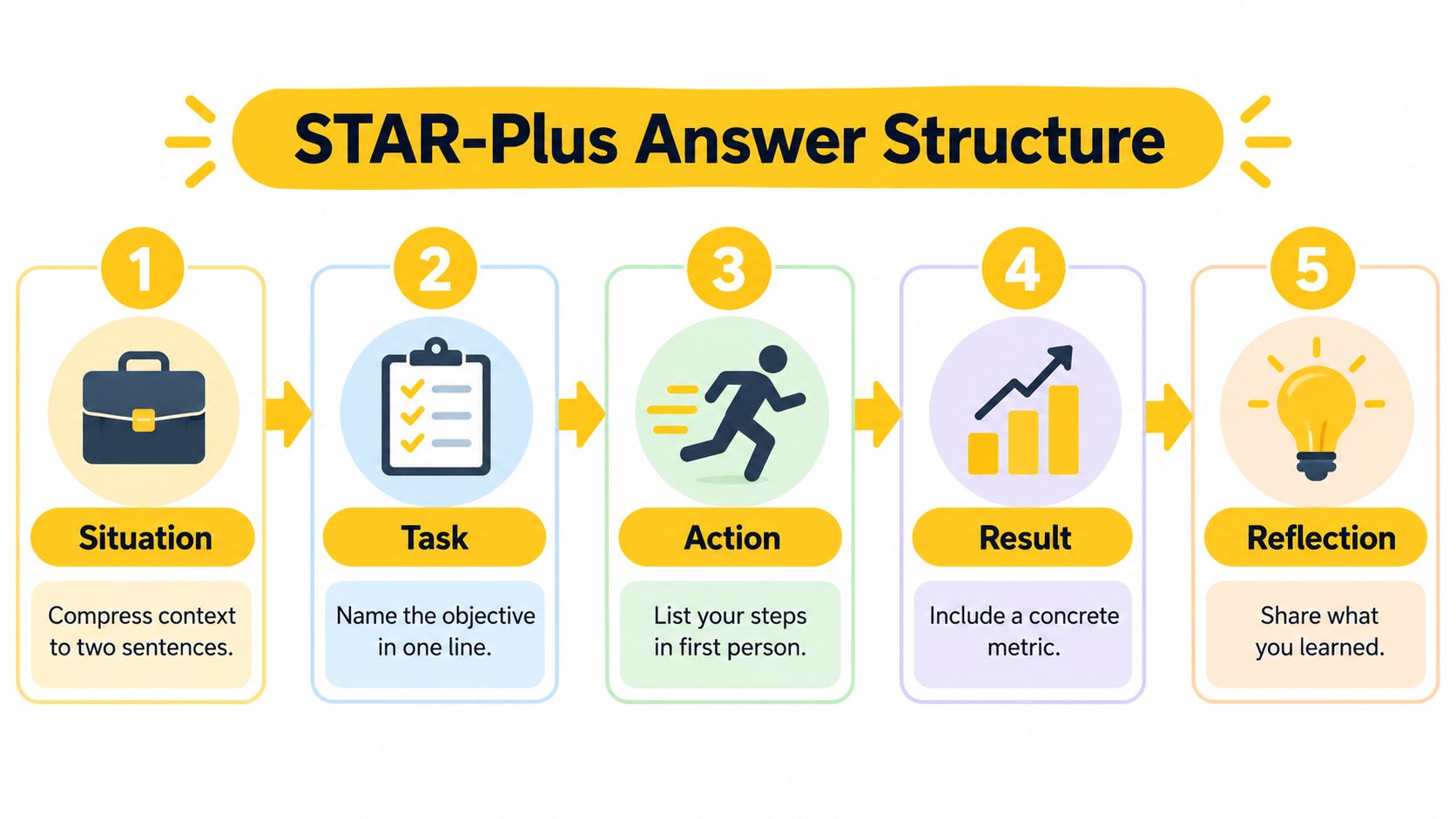
Use Situation for the minimum context, Task for your objective, and Action for sequenced first-person steps. Give the Result with a concrete outcome from your own work, then add Reflection explaining what changed in how you'd handle it next time. Reflection matters because senior roles reward learning and judgment, not just a successful ending.
Weak and strong versions of the same answer
Suppose you're asked about conflict. A weak answer says your team disagreed, everyone communicated, and the project succeeded. There's no decision to evaluate and no way to separate your contribution from the group's.
A stronger answer names the disagreement, your responsibility, and the mechanism you used. You might explain that engineering wanted to delay a release while sales had promised a date. You asked both sides to define launch blocking defects, proposed a limited release, and documented the remaining risk. Then you'd state the actual outcome from that project and note that you now agree release criteria before dates are promised. The interviewer can score conflict management, prioritization, and communication from that sequence.
Technical questions follow a similar evidence logic. For a rate limiter design, clarify traffic patterns and consistency needs before choosing an algorithm. Explain where counters live, how failures behave, and what tradeoff you're accepting. Don't race to a named solution while skipping requirements. Interviewers often give more credit for a defensible, bounded design than for a fashionable architecture recited from memory.
Case questions reward explicit assumptions. Break the estimate into components, say which figures are guesses, and sanity check the result. If the interviewer challenges an assumption, revise it visibly instead of defending your first number. That responsiveness is part of the assessment.
Length should follow evidence density. A direct factual question may need a brief answer, while a leadership story may need enough time to show decisions and consequences. Longer isn't automatically stronger. Once the action and result are clear, additional chronology usually lowers relevance.
This example-led approach builds on the same preparation behind common behavioral questions for interviews, but your portfolio should be indexed by competency rather than by the year something happened. That lets you retrieve a match quickly without forcing one memorized story into every prompt.
For another walkthrough of answer structure, watch this demonstration after drafting your own examples.
Using AI Tools Ethically, Privately, and on Your Terms
AI can help you practice, organize examples, and notice weak answers. It can also create ethical and practical problems if you use it secretly during an assessment that prohibits assistance. Decide your boundary before interview day, while you're calm enough to think clearly.
There are three broad routes. You can prepare alone using a question list and recordings. You can work with a human coach or peer who challenges your reasoning. Or you can use an AI tool for mock questions, feedback, and answer drafting. Each route has a place, and none removes your responsibility to understand and defend what you say.
Interview Pilot is one option in that third category. It offers an Interview Copilot for live online interviews, AI Mock Interview sessions, and a question bank of approximately 10,000 role-specific entries. Its live product generates responses in more than 99 languages and a range of accents, while profile and document inputs can tailor practice material to your background.
That feature list doesn't settle whether live use is appropriate for a particular interview. Many employers explicitly prohibit unsanctioned assistance. Some use proctoring or follow-up questions designed to test whether an answer reflects your own knowledge. If you can't explain, adapt, or reproduce the reasoning, a polished generated response can quickly become evidence against you.
A practical decision rule
Use AI freely for preparation when you're generating likely questions, comparing answer drafts, or translating your own ideas more clearly. Treat live assistance as a disclosure and policy question, not a clever workaround. If the employer prohibits it, don't use it. If you're unsure, ask the recruiter what tools are allowed.
Privacy deserves the same scrutiny as features. Check what audio, documents, transcripts, and profile information a tool stores, and look for stated industry-standard encryption. Public status reporting also matters when a service is part of your preparation routine. Interview Pilot lists recent 90-day availability at 99.99% uptime, which is a reliability signal, though it says nothing about whether a particular use complies with an employer's rules.
Candidates exploring an AI answer generator should review generated text the way they'd review advice from a friend. Remove claims you can't support, replace generic language with your actual actions, and rehearse the answer without reading. The goal is better retrieval of your own experience, not a borrowed identity.
If a tool makes you less able to answer a follow-up, it isn't preparation. It's dependency.
Accessibility, Accents, and Inclusive Interview Preparation
Accessibility planning belongs beside company research, not in an anxious email sent the night before. If you use captions, a screen reader, a sign-language interpreter, alternative input, scheduled breaks, or another accommodation, tell the recruiter early and in writing. Early notice gives the employer time to change the format instead of improvising while you're already being assessed.
Automated interviews can create barriers that have little to do with the job. In a 2025 survey of 362 job candidates on AI and accessibility in hiring, 42% had undergone an automated interview or test, while disabled candidates reported difficulty completing automated assessments at 15% versus 5% for nondisabled candidates. The report also identified barriers involving assistive technology and tasks such as turning the face or analyzing images that may not be essential job functions.
That distinction matters. A task required by the assessment platform isn't automatically a task required by the job. If gaze, facial movement, rapid mouse input, or image recognition creates a barrier, ask whether it measures an essential function and whether an alternative format or human review is available.
Prepare a candidate-controlled accessibility paragraph
Write one concise paragraph you can reuse. Name the platform feature you need, the accommodation requested, and any setup you want to verify. You don't need to disclose more medical detail than the process requires. Ask who owns the arrangement and confirm the plan before the interview begins.
- Verify the format: Ask whether recording, automated scoring, proctoring, or timed tasks will be used.
- Test access tools: Check captions, audio routing, keyboard navigation, interpreter placement, and screen reader compatibility.
- Document the agreement: Keep the recruiter's confirmation and the contact for day-of problems.
- Explain relevant differences: State briefly when a communication difference is disability-related and shouldn't be read as weak job evidence.
Non-native speakers and candidates with regional accents face a related problem. Automated transcription or an interviewer's unfamiliarity can turn pronunciation into an unfair proxy for competence. Prepare key terms in writing, slow down for names and numbers from your own examples, and ask whether you can clarify an answer in the chat or shared document if speech recognition fails.
Neurodivergent candidates may benefit from requesting questions one at a time, written prompts, or a short pause before answering. You can also state your processing style directly. "I give better answers after a brief pause to organize them" is clear, professional, and easier for an interviewer to accommodate than silence they have to interpret.
Interview best practices should measure the work, not force every candidate through identical sensory and communication demands. Documented accommodations protect both your performance and the quality of the employer's decision.
Post-Interview Follow-Up That Compounds Across Your Search
Send a thank-you message the same day while the conversation is still specific in your mind. Thank the interviewer, mention one concrete point they raised, and connect it briefly to your evidence. Skip flattery and don't use the note to deliver a second, longer answer to a question you think you missed.
A useful callback sounds like this. "Your point about support data arriving too late for roadmap decisions matches the reporting problem I described. I'd enjoy working on that feedback loop." That reinforces relevance without pretending the interview changed your life. Send separate notes when panel members explored different topics.
Debrief before you chase the recruiter
Within a day, write down every question you remember and score your answer against the competency it probably tested. Mark where you gave context without action, used the wrong example, or failed to state a result. Update your evidence portfolio immediately, while the weak transition or missing detail is still obvious.
This turns even a disappointing interview into preparation data. If the same gap appears twice, it becomes a practice priority. If an example repeatedly confuses interviewers, retire it or rebuild its opening. Don't rely on your mood as the debrief. Anxiety is a poor scoring rubric.
Follow the timeline the recruiter gave you. If that date passes, send one short message asking whether they need anything else and whether the timing has changed. Repeated check-ins rarely create urgency, and they can make a normal approval delay feel adversarial.
If you're rejected, thank the recruiter and ask whether there's one capability they'd advise you to strengthen for similar roles. Some employers won't share detailed feedback, especially where decisions involve several interviewers. Accept a brief answer gracefully. Your own structured debrief remains useful either way.
When an offer arrives, separate gratitude from negotiation. Confirm the full package in writing, identify your priorities, and ask for time to review. Negotiate from role scope and market information you've independently checked, not from urgency or a competing claim you can't support. Keep the tone collaborative, because the people across the table are likely to become your colleagues.
Your 30-Day Interview Preparation Calendar
Use the next month to build a repeatable cycle, not to collect more advice. Compress the schedule if an interview is sooner, but keep the order. Decoding comes before stories, stories before mocks, and mocks before final rehearsal.
| Week | Focus | Key Outputs | Linked Section |
|---|---|---|---|
| 1 | Job decoding | Ranked competency map and company themes | Preparing Like Your Offer Depends on It |
| 2 | Evidence portfolio | STAR-Plus examples and two mock sessions | Behavioral and Technical Answer Techniques |
| 3 | Live delivery | Recovery phrases, accessibility plan, edge-case practice | Live Interview Tactics and Accessibility |
| 4 | Dress rehearsal | Tested environment, concise answers, live interview | Preparing and Post-Interview Follow-Up |
During week three, practice blanking, ambiguous questions, pushback, and a technical problem that starts badly. Those edge cases teach recovery, which polished rehearsal often hides. In week four, reduce new material. Your job is retrieval, pacing, and confidence in the setup.
After every live interview, restart at the debrief rather than discarding the system. Interview best practices are habits you repeat until the offer lands.
Turn your competency map into scored practice before the actual call by using Interview Pilot for guided mock interviews, role-specific questions, and structured rehearsal across technical and non-technical roles. Build your evidence portfolio, practice retrieving it under pressure, and walk into your next interview ready to answer the rubric in your own voice.
Topics
interview prep
interview best practices
behavioral interview
AI interview tools
job interview tips
Continue reading
Interviews
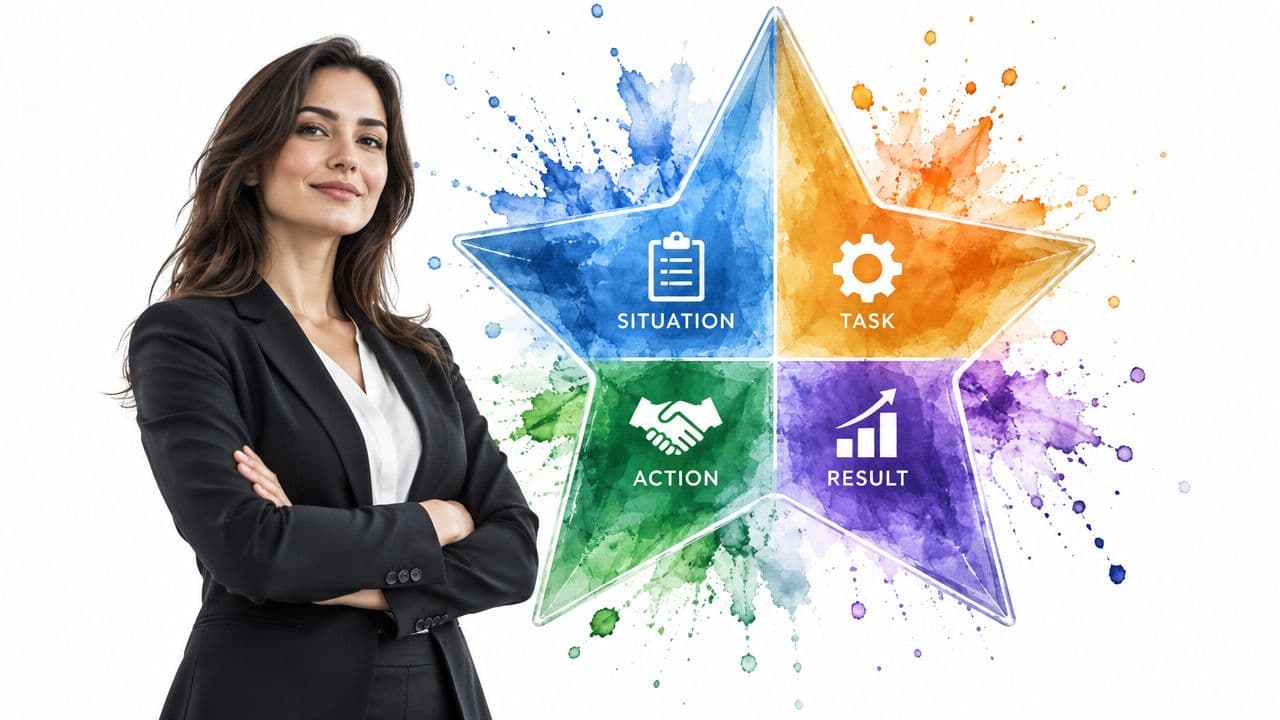
8 Star Method Examples for Behavioral Interviews
Explore 8 star method examples for behavioral interviews, with annotated Situation, Task, Action, Result answers and tips to adapt each story.
September 17, 2026
25 min read
Interviews
Who Are Your Heroes: How to Answer in Any Interview
Learn how to answer "who are your heroes" in interviews with confidence. Get practical examples, a simple structure, and tips to stand out in 2026.
September 6, 2026
12 min read
Interviews
What Is Situational Interview: Complete Guide for 2026
Learn what is situational interview, how it differs from behavioral interviews, common question types, scoring criteria, and expert preparation tips
September 4, 2026
14 min read