












Interviews
10 Best Data Science Interview Prep Resources for 2026
Compare the best data science interview prep options: SQL question banks, peer mock interviews, ML system design courses, and study plans with honest limits.
Interview Pilot Editorial Team
Updated October 10, 2026
23 min read

You've reviewed probability, can explain bias and variance, and still stall when a timed SQL screen puts a blank editor in front of you. Then the product case starts, the interviewer changes the objective, and a technically correct answer suddenly feels incomplete. That's normal. Data science loops test several skills in sequence, from concept recall and coding to experimentation, business judgment, communication, and sometimes machine learning system design.
This list organizes the best data science interview prep resources by the interview round they train. The order isn't a popularity ranking. It's a practical stack: build vocabulary, drill SQL and Python, practice product reasoning, complete take-home style work, then rehearse live communication. You'll see where each tool helps, where it falls short, and which candidate benefits most. For broader study support, keep these best exam preparation materials in your planning toolkit.
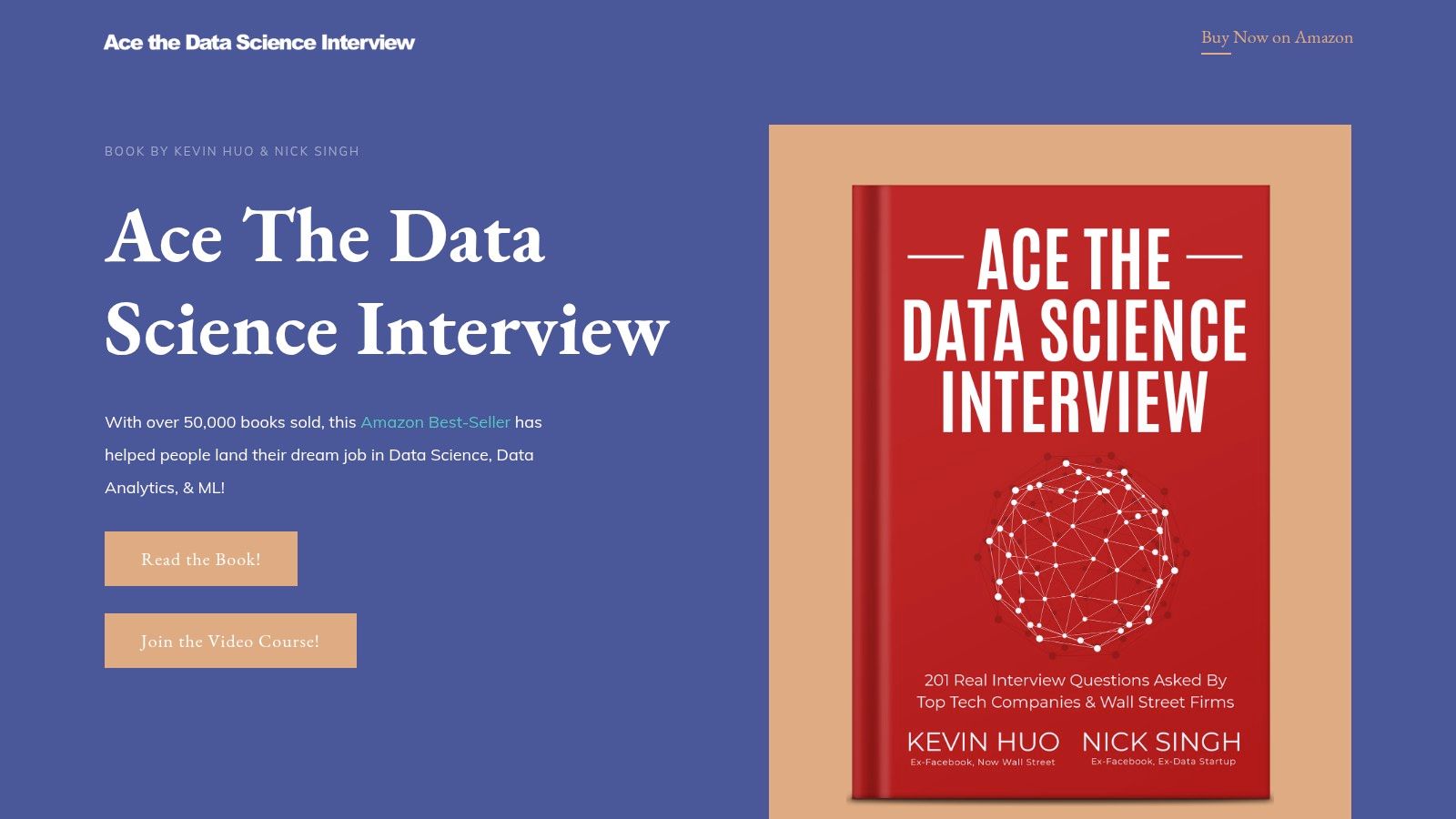
1. Ace the Data Science Interview
Best for concept recall and building a complete syllabus
A strong preparation plan needs a map before it needs more questions. Ace the Data Science Interview provides that map across SQL, statistics, probability, machine learning, product sense, and case studies. Its roughly 201-question structure gives candidates a practical way to identify weak areas instead of jumping between disconnected tutorials.
The book works particularly well at the start of preparation. Read a topic, explain the idea aloud, then solve a related problem without looking at the answer. That sequence exposes whether you understand a method or only recognize its definition. It also gives candidates a durable reference they can revisit during a focused study cycle.
Where the book works best
Use it for statistics and probability refreshers, ML vocabulary, product-case prompts, and project discussion structure. It's also useful for candidates switching from analytics, software engineering, economics, or mathematics into data science because it makes the boundaries between adjacent roles easier to see.
The book won't give you a timed SQL environment or realistic interviewer interruptions. It also can't replace a live mock, a notebook exercise, or feedback on how you communicate. Interactive versions of some questions are available through companion platforms, so access and subscription requirements can vary.
Practical rule: Use the book to decide what to practice, not as proof that you've practiced it.
Pair each chapter with hands-on work. Candidates who want another source of data scientist interview questions can use a searchable question bank after reading, then record a concise explanation of the solution.
For a first pass, this is the most useful resource for answering, “What could they ask me?” It isn't the strongest standalone answer to, “Can I solve it under pressure?”
2. DataLemur
Best for SQL drills and core data science questions
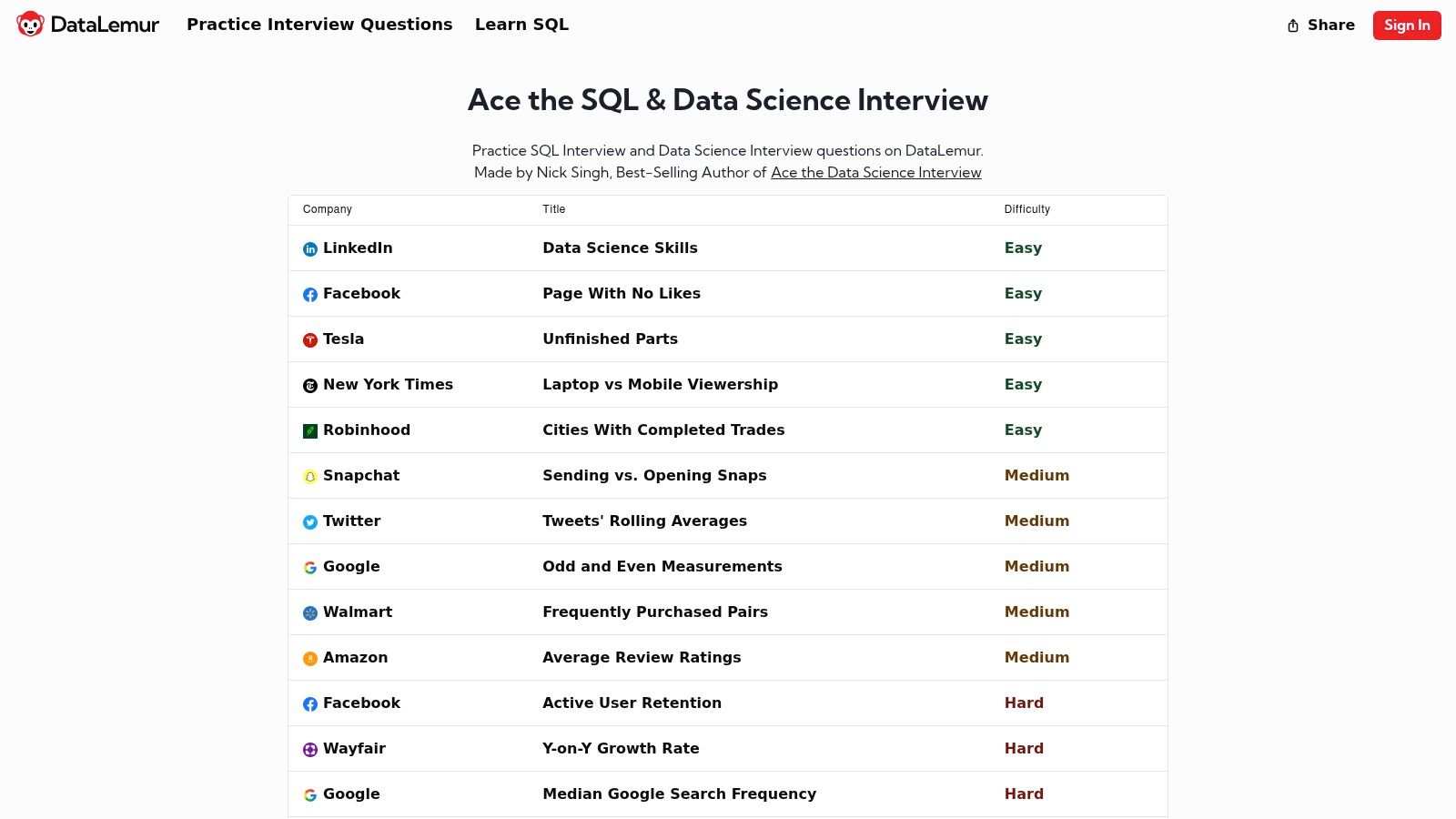
DataLemur is where candidates turn the book's SQL concepts into repetitions. The platform offers 100+ SQL interview questions and 70+ statistics and machine learning questions, with hints and solutions built into the practice flow. Its questions target data science and analytics interviews rather than treating every learner like a general software engineering candidate.
The interface supports a useful progression. Try the problem without help, inspect the hint only when you're stuck, then rewrite the solution while explaining joins, grouping, window functions, and edge cases. Reading a correct query isn't enough. You need to know why it works and what would break it.
The trade-off
DataLemur is a strong fit for candidates preparing for SQL screens, especially those who want a clean path through joins, aggregations, ranking, cohort analysis, and common analytics patterns. The connection to Ace the Data Science Interview makes it easier to move from explanation to execution.
Its weakness is breadth at the senior end. It's less focused on ML system design, production monitoring, or long-form take-home analysis. Optional coaching and bundle details can also vary by promotion and may only become clear at checkout. Candidates who need a broader data analyst technical interview question set should supplement it rather than treating it as a complete loop simulator.
Use DataLemur when SQL is your bottleneck. Don't spend most of your time on easy questions. Build a timed rotation that includes window functions, CTEs, deduplication, date logic, and ambiguous business prompts.
SQL deserves early attention because the 2025 Stack Overflow Developer Survey reports SQL usage among 58.6% of all respondents and Python usage among 57.9%, while Python rose by 7 percentage points year over year. Those figures support prioritizing broadly used tools before niche frameworks, but your practice still needs reasoning, validation, and business interpretation.
3. StrataScratch
Best for realistic technical breadth and take-home style work
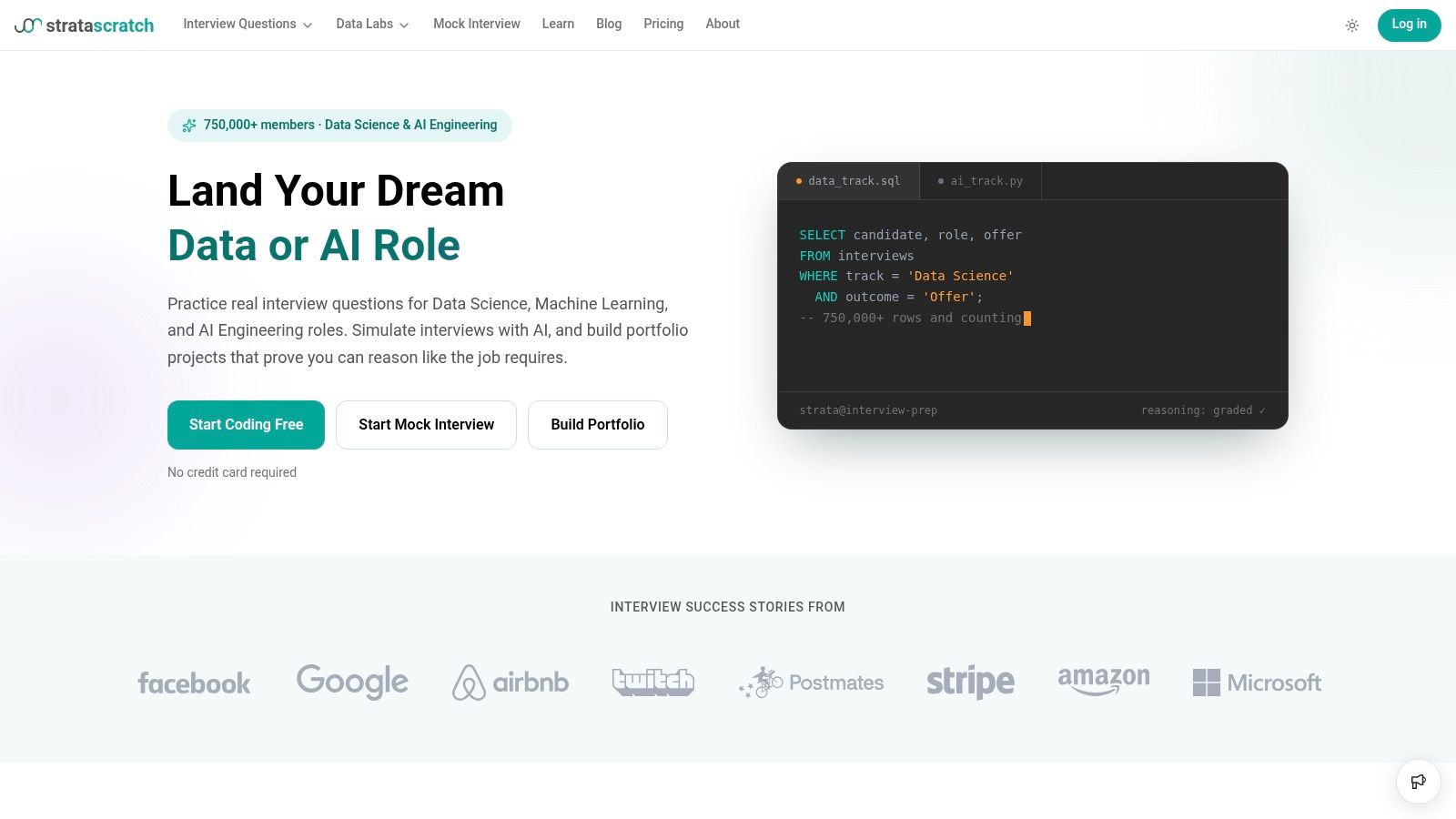
StrataScratch is a better fit when your preparation has moved beyond isolated questions. Its library includes 1,000+ real interview questions across SQL, Python, statistics, machine learning, ML system design, and concept rounds. The platform also includes cloud-hosted Data Labs, mini-analysis work, and AI-powered mock interviews.
The strongest feature is the end-to-end workflow. Start with a raw dataset, inspect its schema, clean the data, explore distributions, build a baseline, select an evaluation metric, analyze errors, and state a recommendation. That process resembles the work interviewers want to hear described, especially for candidates moving toward mid-level or senior roles.
What makes it different
StrataScratch combines question practice with notebook-based work. Its structured SQL and Python paths include six modules each and 160+ questions, giving candidates a guided route before they move into harder, less scripted problems. The cloud environment also makes it easier to produce a shareable artifact from a take-home style exercise.
The trade-off is intensity. Some SQL problems can feel harder than an initial screen, so don't use your first low score as evidence that you're unprepared. Review the data model, identify the question pattern, and retry from a blank workspace.
- For data scientists: Use the Data Labs to practice exploratory analysis and model evaluation.
- For analytics candidates: Focus on SQL, metric definitions, and concise recommendations.
- For ML engineers: Add ML system design and deployment-oriented prompts.
- For portfolio builders: Turn selected notebook exercises into clean, reproducible work, but clearly label practice projects as such.
Exact pricing is presented through the platform's account or checkout flow, so verify the current offer before subscribing. StrataScratch is strongest when you need realistic breadth. It's less efficient if you only need a quick statistics refresher or a small set of beginner SQL drills.
4. Interview Query
Best for product analytics, experimentation, and company-targeted preparation
Interview Query earns its place by treating product analytics as a core interview skill rather than a behavioral add-on. Its material covers SQL, machine learning, product sense, A/B testing, and company-specific interview guides. That combination suits candidates who can code but struggle to decide which metric matters or how to frame an ambiguous product question.
A typical product case asks you to clarify the decision, define the user, choose a primary metric, identify guardrails, consider seasonality and confounding, and recommend an action. Interview Query gives candidates a place to rehearse that chain instead of jumping straight to a calculation.
Who should use it
Choose Interview Query if you're targeting product data science, growth analytics, experimentation, marketplace analytics, or roles where stakeholder decisions matter as much as model selection. The company guides can also help you adapt preparation to a target employer's likely interview style.
Its weakness is uneven depth. Some company or topic pages are more useful than others, and the platform isn't a replacement for a serious SQL editor or notebook workflow. Full pricing visibility may occur at checkout, and terms can include auto-renewal, so review the purchase details carefully.
The business-context emphasis reflects a real hiring pattern. One 2026 analysis found that 69.3% of sampled U.S. data-analyst postings sought domain specialists rather than broadly versatile candidates, with employers asking candidates to apply SQL, statistics, dashboards, and communication to concrete problems such as fraud, pricing, loyalty, or marketing measurement. Read that figure in context, but take the practical lesson seriously: prepare to discuss the company's business model, not just generic methods.
Interview Query works best after you've built basic SQL fluency. Use it to practice saying, “I'd first clarify the decision,” before writing a query or proposing an experiment.
5. DataInterview
Two days before a target-company screen, broad study plans stop helping. You need a tight set of prompts that look like the round you are about to face. DataInterview fits that moment. It gives you a large bank of company-tagged practice across data science, machine learning, data engineering, and adjacent roles, so you can rehearse the same underlying ideas in different interview formats.
The value is not the raw count. It is the filtering.
If you are preparing for concept recall, use the topic tags to pull statistics, modeling, or ML theory questions and answer them out loud. If the next round is SQL or analytics, collect a short set of prompts that force joins, aggregation, experiment readouts, and metric definitions. For mixed loops, company tags help you build a realistic set instead of bouncing between random practice sites.
This works best for candidates who already have a base. Otherwise, the library can become a backlog you keep extending instead of a plan you complete.
A better way to use DataInterview is to cap the session. Pick one company, one round type, and a small batch of questions. Mark each one in three buckets: solved cleanly, solved with help, or still shaky. Then revisit only the shaky set and explain your reasoning under time pressure. That exposes whether you understand the pattern or just remember the answer.
There are trade-offs. Company tags are useful signals, not promises about what a hiring team will ask. Breadth also creates overlap, so doing more questions is not always better prep. Repeated prompts help only if you track the mistake: missing edge cases, weak assumptions, slow query structure, or vague communication.
Pricing and coaching details may require sign-up to confirm, so check the current terms before paying. DataInterview is a good fit for targeted prep weeks and later-stage polishing. It is a weaker fit for beginners who need a guided sequence from fundamentals to mock interviews.
6. HackerRank
A common screen goes like this. You get a SQL or Python prompt, a stripped-down editor, a timer, and no room to fumble with the interface. HackerRank is useful because it trains that exact round. It is one of the better picks for employer-style screens, coding assessments, and notebook tasks that use a Jupyter Notebook IDE.
The value is not the question library alone. It is the constraint. Candidates who know the material often lose time on setup, syntax slips, weak validation, or messy explanations. HackerRank lets you rehearse those mechanics under pressure.
Use it by round type, not as a giant practice bucket. If your next step is a SQL screen, stay inside timed SQL sets and grade yourself on query structure, edge-case handling, and result checks. If you have a notebook assessment coming, practice data cleaning, joins, aggregation, missing-value handling, basic plotting, and short written interpretation inside the notebook flow.
My preferred drill is simple:
- Set a hard timer and finish in one sitting.
- Work without autocomplete or outside help.
- State assumptions before coding, especially nulls, duplicates, time windows, and the unit of analysis.
- Test the output. Check row counts, keys, and whether the result answers the prompt you were given.
- After submission, rewrite the solution cleanly and record what slowed you down.
That last step matters. A missed join condition and a vague metric explanation are different problems. Treat them differently in the next session.
HackerRank fits candidates who already have concept recall and need execution reps. It is weaker for product analytics discussion, stakeholder communication, and ML system design. The catalog is broad, but you still need to choose the order yourself.
In a study sequence, place HackerRank after concept review and before live mocks. Use it to sharpen timed execution, then move to mock interviews that force you to explain decisions out loud. Passing test cases is useful. It does not prove you can defend the work in an interview.
7. Grokking the Machine Learning Interview
A lot of candidates can explain how they trained a model. The round gets harder when the interviewer asks what happens a week after launch. Grokking the Machine Learning Interview, delivered through Educative, is built for that part of the process: ML system design.
That makes it a better fit for senior data scientists, ML engineers, and candidates moving toward applied AI work than for someone still grinding through SQL screens or basic modeling questions. If the interview loop includes architecture, production trade-offs, and operating a model after release, this course matches the round well.
What you need to rehearse here is decision-making under constraints. A solid answer usually covers the full path from problem framing to deployment, then into monitoring and failure handling. That means defining the business goal, choosing metrics, describing data and feature design, selecting a model, and explaining how predictions are served at scale.
The useful practice is in the follow-up questions:
- Drift detection: how you would spot data drift or concept drift
- Monitoring: which quality, latency, availability, and business metrics you would track
- Evaluation: how offline evaluation differs from production measurement
- Operations: what would trigger rollback or retraining
- Trade-offs: when lower model performance is acceptable because cost or latency matters more
The format helps. Because the lessons are text-based and interactive, it is easy to revisit an answer, tighten the structure, and compare design choices without setting up a coding environment.
The limits are clear too. It will not train SQL speed, Python fluency, or notebook workflow. It also cannot replace a live mock where someone pushes back on vague assumptions.
Use it late in the sequence. Start with fundamentals first. Then use Grokking when you are preparing for ML system design rounds specifically. Otherwise, production vocabulary can cover up weak spots in statistics, SQL, or model evaluation.
8. Pramp
Best for repeated peer mocks
Pramp trains the skill most question banks miss: speaking while another person is listening. Its peer-to-peer model matches candidates for structured mock interviews, including a data science track. You practice as both candidate and interviewer, which teaches you how evaluators listen for assumptions, structure, correctness, and communication.
The two-sided format is useful. When you interview someone else, you notice where answers become vague, where candidates skip clarification, and where a technically valid response fails to address the business question. That insight improves your own performance.
Make peer practice reliable
Peer quality and scheduling can vary across time zones. Treat each session as a rehearsal, not a definitive evaluation. Prepare a short prompt, agree on the time limit, and ask for feedback on three things: structure, technical accuracy, and clarity.
Pramp has historically offered free monthly mocks, but the exact allowance and feature set may change, particularly as the service integrates with or evolves alongside Exponent. Verify current limits before planning your entire schedule around it.
Use Pramp when you've already solved enough problems to discuss them aloud. A peer can't always diagnose subtle statistical errors, and the session may be less consistent than a specialist coach. Still, repeated low-cost practice can reduce the shock of the first real screen.
Candidates who freeze during live interviews can add an AI mock interview between peer sessions. Use it to repeat a prompt, tighten the first response, and then bring the improved version into a human mock.
“A mock interview isn't finished when you reach an answer. It's finished when you can explain the assumptions, handle a follow-up, and state the decision.”
9. Exponent
Best for intensive live-mock preparation
Exponent combines a dedicated data science interview course with a large peer mock-interview network. Its membership connects curated practice sets, course material, community resources, and peer sessions. That makes it appealing to candidates who want one environment for content and repeated live practice.
The strongest use case is the final stretch before interviews. By then, you should know the core concepts and have solved representative SQL and Python tasks. Exponent helps you rehearse the transitions that make interviews difficult: clarifying an ambiguous prompt, thinking aloud, responding to a follow-up, and recovering when your first approach fails.
The value depends on repetition
Peer mocks reduce first-repetition anxiety because you can practice the full interaction before a hiring manager evaluates you. Availability may be frequent, and a membership can make repeated practice more convenient than booking individual coaching sessions.
The course itself may not fit every candidate equally well. Some users value the structure, while others may find the content less targeted than a specialist platform. Exact pricing appears at checkout and can change with promotions, so compare the current terms with the number of mocks you'll realistically complete.
Exponent is a good choice for candidates who need accountability. It's less compelling if you're still learning basic SQL syntax or can't yet explain your projects. Live practice magnifies foundational gaps, so fix those gaps first.
A useful session format is simple. Spend the first mock on a technical problem, the second on a product case, and the third on project or behavioral discussion. Ask your partner to interrupt with changed assumptions. That mirrors the ambiguity employers use to test analytical thinking.
The World Economic Forum's Future of Jobs Report 2025 identifies analytical thinking as an essential core skill for seven out of ten companies surveyed in 2025. The report also says 94% of surveyed employers expect AI and big-data skills to increase in importance by 2030. Your mock should test both. Don't only practice getting the technical answer. Practice defending why you chose it.
10. Interview Pilot
Best for personalized rehearsal and real-time interview support
You join a late-stage interview, the interviewer changes the metric halfway through, and your answer loses shape. That is the problem Interview Pilot is built to train. It combines AI mock interviews, a role-specific question bank, profile and document inputs, and an Interview Copilot that can surface context-aware prompts during live online interviews. For data science candidates, the coverage spans statistics, experimentation, SQL, Python, machine learning, product metrics, model evaluation, and behavioral communication.
The question bank contains approximately 10,000 role-specific prompts, with full access on paid plans. That breadth matters most in the rounds where range beats depth, early concept recall, mixed analytics screens, and fast behavioral follow-ups. For context on how hiring platforms categorize skills and evaluation, see this Fetchin talent intelligence overview. Interview Pilot also lets you adjust copilot tone, depth, and focus, which helps when one round rewards concise business framing and another rewards technical precision.
Where it fits in a serious plan
Use it after you already have baseline SQL, stats, and project knowledge. Interview Pilot is better for rehearsal than for first-pass learning. Feed in your resume or supporting documents, practice project explanations, and ask for follow-ups on assumptions, metrics, leakage, missing data, or model limitations. The value is answer structure under pressure. Candidates who already know the material but freeze in live conversation tend to get more from it than candidates still learning core concepts.
Interview Pilot supports macOS, Windows, iOS, and Android, with compatibility across common meeting environments such as Zoom, Google Meet, Microsoft Teams, and Webex. It also supports 99+ languages and accents, which makes it useful for multilingual applicants who want to rehearse technical explanations in the exact language and speaking style they will use in the interview.
The live-assistance feature needs careful judgment. Employer policies may prohibit outside assistance during an interview, and generated suggestions can be incomplete or wrong. Use it for practice, for permitted accessibility support, or where an employer explicitly allows assistance. Do not treat it as a substitute for understanding.
The service offers Free, Weekly, Monthly, and Yearly plans. Paid tiers add features such as full question-bank access and priority support, but current fees should be checked on the site. Interview Pilot also cites adoption by 450,000+ users. Treat that as a product claim and verify current details before relying on it.
As part of a study sequence, this tool belongs near the end. Use books and drill platforms for concept recall and SQL reps. Use take-home style tools for notebook work. Then use Interview Pilot to pressure-test delivery, especially your opening, your recovery when challenged, and your ability to connect a metric to a decision. The strongest candidates sound clear before they sound polished.
Top 10 Data Science Interview Prep Comparison
| Product | Core focus & unique features | UX & quality | Pricing / value | Best for |
|---|---|---|---|---|
| Ace the Data Science Interview (book) | ✨ Structured syllabus + 201 DS/ML/SQL questions; durable ref | ★★★★ | 💰 One‑time (book/ebook) | 👥 Early–mid DS/DA candidates; pairs with hands‑on practice |
| DataLemur | ✨ Interactive SQL/DS questions + hints; book integration & optional 1:1 coaching | ★★★★ | 💰 Annual / lifetime tiers | 👥 Candidates focused on SQL and book-aligned study |
| StrataScratch | ✨ 1,000+ real interview Qs, cloud notebooks & AI‑graded feedback | ★★★★ | 💰 Subscription (project-focused) | 👥 Mid/senior DS, ML engineers needing take‑home practice |
| Interview Query | ✨ Company guides + A/B testing & product-analytics focus | ★★★★ | 💰 Subscription (checkout) | 👥 Product/analytics-oriented DS & candidates targeting specific companies |
| DataInterview | ✨ 4,500+ company‑tagged questions across DS/ML/DE roles | ★★★ | 💰 Membership / coaching add‑ons | 👥 Candidates wanting broad company‑tagged coverage |
| HackerRank | ✨ High‑fidelity projects with Jupyter‑style IDE + SQL/Python practice | ★★★★ | 💰 Freemium; paid certs & enterprise features | 👥 Candidates needing employer-like tooling and take‑home sims |
| Grokking the ML Interview (Educative) | ✨ Deep ML system‑design modules: metrics, features, serving at scale | ★★★★ | 💰 Educative subscription access | 👥 Senior DS/MLE preparing ML design rounds |
| Pramp | ✨ Auto‑matched peer mock interviews; practice both interviewer/candidate | ★★★ | 💰 Free / low‑cost | 👥 Candidates wanting recurring, low‑cost live mocks |
| Exponent (Aced) | ✨ Course + large peer mock network; unlimited mocks with membership | ★★★★ | 💰 Membership subscription | 👥 Candidates who want extensive live practice + community |
| 🏆 Interview Pilot | ✨ Real‑time in‑interview AI copilot, ~10,000 Q bank, guided AI mocks, 99+ languages, cross‑platform, encryption & public uptime | ★★★★★ | 💰 Free + Weekly/Monthly/Yearly (paid unlocks full bank & priority support) | 👥 Wide: technical & non‑technical roles, multilingual/international applicants, those needing in‑interview support |
Turn the List Into a Study Sequence
The resources work better as a sequence than as ten simultaneous subscriptions. Start with Ace the Data Science Interview or a concept course to build vocabulary. You need a working grasp of probability, statistics, experimentation, machine learning, SQL, Python, product metrics, and project discussion before advanced practice becomes efficient.
Then move into drills. Use DataLemur for focused SQL and core data science questions. Use HackerRank when you need realistic editor and assessment practice. Add StrataScratch when you're ready to work through notebook-based analysis, take-home style tasks, and broader technical workflows.
Product analytics deserves its own phase. Interview Query is useful for A/B testing, metric selection, product sense, and company-targeted preparation. DataInterview can add company-tagged volume, but don't confuse a large question bank with a plan. Select prompts that match the job description and record which ones you can solve without hints.
For senior data science and ML engineering roles, add Grokking the Machine Learning Interview after your fundamentals are stable. Practice designing systems that include data collection, feature generation, offline evaluation, serving, monitoring, drift detection, rollback, and cost or latency trade-offs. Employers increasingly care about what happened after deployment, not only how you trained the model. A 2026 hiring analysis reports Python in 82% of postings, SQL in 55%, and cloud platforms in 35%, while recommending that interviewers ask what broke after deployment, how the team detected it, and what changed.
Reserve live mocks for the final stretch, but don't wait until the last day. Pramp gives you repeated peer practice, while Exponent offers a more integrated course and mock environment. Use Interview Pilot's guided mock interviews for additional repetitions, especially when you need to refine project explanations or practice in another language.
A compact sequence looks like this:
- Build the map: Read the book or complete a concept course.
- Train the screen: Drill SQL and Python under time pressure.
- Practice decisions: Work through product analytics and experimentation cases.
- Simulate take-homes: Complete notebook-based analysis from raw data to recommendation.
- Prepare for production: Study ML system design, monitoring, and failure recovery.
- Rehearse the loop: Use peer mocks, structured mocks, and permitted support.
Analytical thinking should remain visible in every phase. The World Economic Forum's employer survey identifies it as the most widely sought core capability, while AI and big data lead its fastest-growing skill category. Explain assumptions, identify confounders, choose metrics deliberately, assess data quality, and communicate uncertainty rather than reciting definitions.
Check current pricing, renewal terms, promotions, and platform limits at checkout. Product details change. If you're considering any live-assist tool, check the employer's policy first. Preparation should improve your own judgment and communication, not create a compliance problem during the interview.
Finally, measure readiness by performance, not by resources collected. Can you solve a SQL problem without autocomplete, explain why the query is correct, defend a metric in a product case, describe a model's failure after deployment, and communicate a recommendation to a nontechnical stakeholder? If not, choose the round that exposed the weakness and practice that round again.
Interview Pilot can support this preparation with guided AI mock interviews, personalized data science prompts, and real-time suggested answers across technical and behavioral questions. Visit Interview Pilot to rehearse the rounds that cause you to freeze, then use the feedback to make your own explanations sharper and more reliable.
Topics
data science interview
DS interview prep
SQL interview practice
data science mocks
DS study plan
Continue reading

Interviews
Interview with Target: A Practical Guide to Getting Hired
Prepare for an interview with Target as a candidate. Learn the hiring process, formats, and targeted strategies to succeed at every stage.
October 10, 2026
14 min read

Interviews
Top 8 Behavioral Questions for Consulting Interviews
Explore 8 behavioral questions for consulting interviews with STAR sample answers, interviewer intent, and tips for tailoring responses to consulting cases.
October 9, 2026
20 min read

Interviews
8 Interview Questions for Bank Branch Manager in 2026
Practice interview questions for bank branch manager roles on operations, sales targets, compliance, and team leadership, with strong sample answers.
October 9, 2026
20 min read