
















Interviews
10 Logical Questions in Interviews: Answers and Strategies
Master the most common logical questions in interviews, from brain teasers to Monty Hall. Get worked answers and solving strategies for each one.
Interview Pilot Editorial Team
Updated November 24, 2026
21 min read
You're in an online interview, notebook open, when the interviewer asks how many golf balls would fit inside a school bus. You freeze, not because division is difficult, but because you're waiting for a formula you were supposed to memorize. There isn't one. Your first job is to decide what you need to assume and make that reasoning visible.
Logical questions in interviews are most useful when they reveal how you handle constraints, uncertainty, and evidence. A strong answer makes clear what you know, what you're assuming, and how you'll check your conclusion. Getting the answer right still matters, but an unexplained guess gives an interviewer little to evaluate.
That doesn't mean every puzzle deserves equal preparation time. Job-related estimation, conditional reasoning, and optimization exercises deserve more attention than arbitrary riddles unless your target employer specifically includes puzzle questions.
Practical rule: Prepare to explain a method you can adapt, not an answer you can recite.
The question types below exercise different habits. Estimation requires defensible assumptions, grid puzzles require disciplined elimination, and probability questions require careful attention to how information is revealed. For each, practice a short spoken explanation alongside the written solution.
Before starting, ask whether you may take notes and whether speed is part of the assessment. Then restate the task, identify the governing constraint, and choose a method. Those opening moves give you something productive to do even when the answer isn't obvious.
1. Lateral-Thinking Brain Teasers
Preparation priority: lower for arbitrary riddles, higher for explaining unfamiliar problems. In June 2013, Google publicly described abandoning brainteasers after its internal analysis found they didn't predict subsequent employee performance, according to ABC News's report on Google's interview changes.
That distinction matters. An interviewer can listen for sensible reasoning, but solving a clever riddle isn't automatically evidence that you'll perform well at work.
A familiar example gives you room to demonstrate that distinction.

A strong spoken answer
For the manhole-cover question, explain the mechanical advantage first:
I'd start with safety. A circular cover, properly sized for its supporting opening, can't fall through when rotated. It also fits without aligning corners, and workers can roll it rather than carry it.
For the golf-ball question, don't hunt for a remembered total. Define usable interior volume, account for fixed obstacles, and allow empty space between balls before dividing by ball volume.
- What the interviewer evaluates: Whether you identify relevant assumptions rather than produce disconnected possibilities.
- Where candidates lose points: Treating a plausible benefit as the only possible reason, or giving an estimate without showing its inputs.
- Useful practice: Try the brain teaser picks from Chronos One as verbal reasoning drills, not predictions of what an employer will ask.
Ask a clarifying question that changes your approach. For the bus, whether the seats remain installed matters more than its paint color.
2. Logic Grid and Zebra Puzzles
Start with the most restrictive clue, not the first clue on the page. The interviewer is evaluating constraint tracking: can you preserve every condition while eliminating impossible combinations?
Treat elaborate zebra puzzles as optional practice unless the assessment instructions mention them. Their useful transferable skill is systematic deduction, not familiarity with a famous solution.
Consider this simplified scenario. Ava, Ben, and Chen each have a different job: analyst, designer, or engineer. Ava is the designer, and Ben isn't the analyst.
Work from fixed assignments
Write each person against the possible jobs. Ava's assignment removes designer from everyone else; Ben must therefore be the engineer, leaving Chen as the analyst.
Your spoken answer can be brief:
I'll place the fixed assignment first. Ava is the designer, so Ben and Chen must split analyst and engineer. Since Ben isn't the analyst, he's the engineer, and Chen is the analyst.
- Mark exclusions: Record impossible combinations rather than trying to remember them.
- Separate deductions from guesses: A tentative branch isn't an established fact.
- Verify every clue: A completed grid is only valid if it satisfies the original conditions.
Candidates lose points when they add assumptions, especially about adjacency, ordering, or whether attributes can repeat. Ask what next to means if the arrangement could be circular rather than linear.
The same habit applies to critical-thinking interview questions: distinguish what the evidence requires from what merely seems likely. If several assignments remain possible, explain that the clues don't establish a unique answer.
3. Fermi Estimation Questions
Preparation priority: high when the role involves market sizing, capacity planning, or rough commercial estimates. Unlike a trick riddle, an estimation exercise can closely resemble a decision you'd need to make with incomplete information.
The interviewer should be evaluating decomposition, assumptions, arithmetic, and verification separately. A meta-analysis of employment interviews published by Wiley found that structured interviews produced mean validity coefficients approximately twice those of unstructured interviews, supporting consistent questions and predefined scoring rather than improvisation.
Use the piano-tuner prompt to practice building a demand-and-capacity model.

Build the equation before estimating
For a city's piano tuners, calculate:
Households × share owning pianos × annual tunings per piano ÷ annual tunings per tuner.
Then add institutional demand if the scope includes schools, studios, and performance venues.
A strong spoken opening is:
I'll estimate annual demand for tunings, then divide by a tuner's annual capacity. I'll separate household demand from institutions and treat the result as full-time-equivalent workload, not necessarily the number of individual practitioners.
- What works: Label each input as an assumption and explain which one most affects the result.
- What doesn't: Presenting remembered population figures as established facts or mixing monthly demand with annual capacity.
Practice transferring the method to problem-solving scenarios. For alternative ways to examine assumptions, use the eight critical thinking methods explained as prompts for reviewing your model, not substitutes for doing the calculation.
4. Number and Pattern Sequence Questions
For the practice sequence 2, 6, 12, 20, the gaps are 4, 6, 8. Continuing that pattern gives a gap of 10, producing 30.
That answer demonstrates more than recognition when you explain the check. The terms also fit the rule n × (n + 1), which reproduces every supplied value.
What the interviewer evaluates: whether you can propose a simple rule, test it, and communicate the result without overclaiming certainty. Prioritize this format when an invitation explicitly mentions numerical or abstract reasoning rather than assuming every live interviewer will use it.
Test the whole sequence
A strong spoken response would be:
The differences increase by two each time, so I'd add ten to twenty and answer thirty. That rule fits every transition, although a finite sequence can support other constructed rules.
Use a consistent search order:
- Differences first: Check changes between neighboring terms.
- Ratios next: Look for multiplication or division.
- Alternating subsequences: Test odd and even positions separately.
- Final verification: Apply your proposed rule to all supplied terms.
For a hypothetical alternating example, 3, 6, 5, 10, 8, 16, the visible rule is doubling, then subtracting successively larger amounts. Continuing that rule means subtracting 3, giving 13.
Candidates lose points by spotting a pattern that explains only the last transition. Don't force an answer when the intended rule remains ambiguous; state the simplest consistent interpretation and acknowledge the uncertainty.
5. Counterfeit Coin and Balance-Scale Weighing Problems
Treat balance-scale puzzles as supplementary preparation unless they're explicitly part of the assessment. They're useful for practicing information gain, but memorizing a complicated solution can conceal whether you understand the decisions.
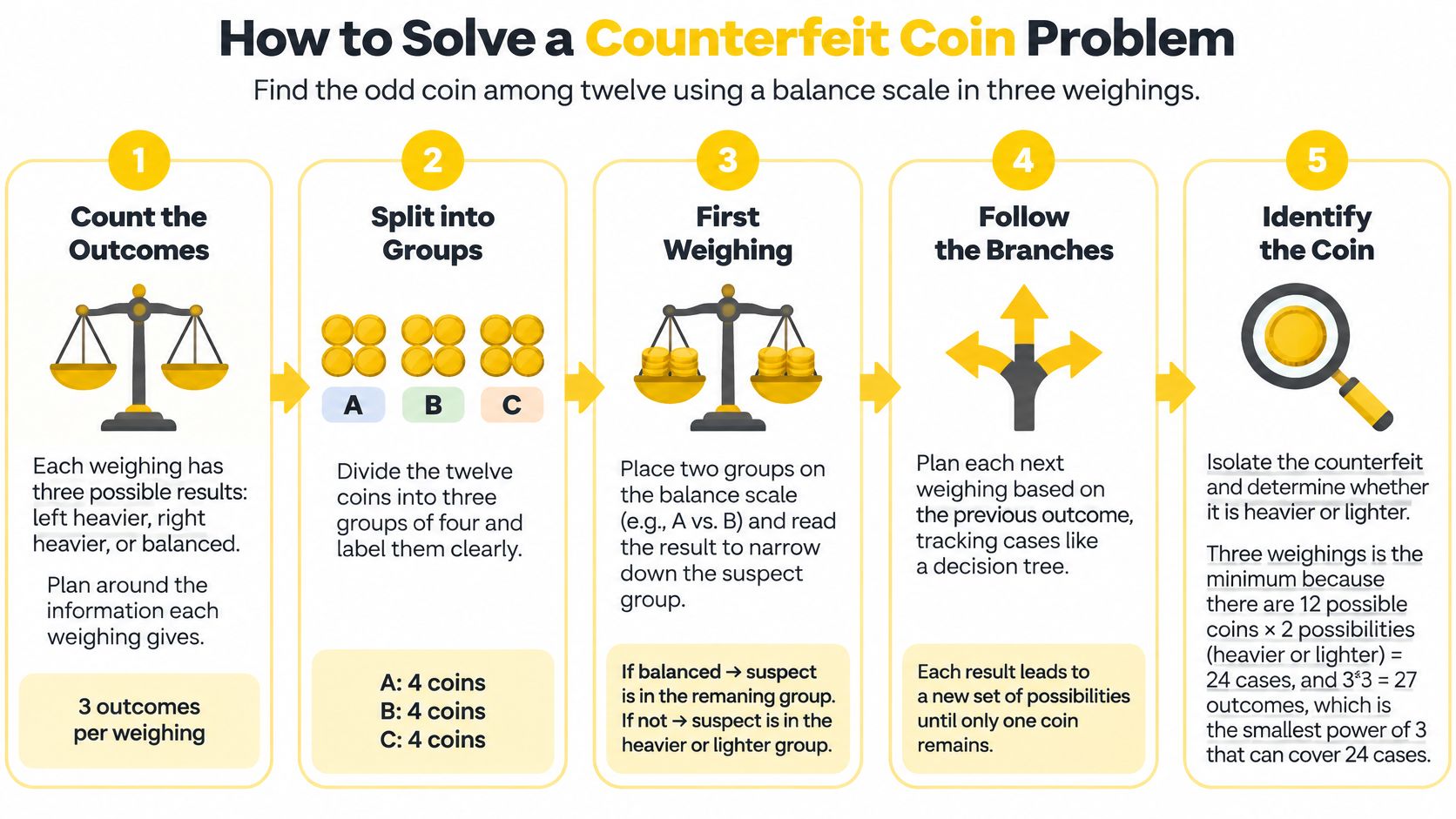
The interviewer is evaluating how you divide possibilities and handle every outcome, including a balanced scale.
This visual can help you organize branches before attempting a full counterfeit-coin puzzle.
Solve the known-heavier version first
Suppose there are eight balls, exactly one is heavier, and you may use a balance scale.
- First weighing: Compare groups of three.
- If they balance: Weigh the two untested balls against each other.
- If they don't: Take the heavier group and compare any two balls from it. The heavier ball is the answer; if they balance, the unweighed ball is heavier.
A strong spoken explanation starts with the uncertainty:
Because I know the odd ball is heavier, each result identifies which group to investigate. I'll design the first comparison so every outcome leaves a group I can resolve with another weighing.
A single weighing can't distinguish among all eight possible heavy balls, so the demonstrated two-weighing solution is minimal.
Where candidates lose points: Applying this method unchanged when the odd coin might be lighter. That variation requires tracking both identity and weight direction.
Use a walkthrough to study branch management, then redraw the reasoning without it.
6. Water Jug Measurement Problems
A water-jug question is a small planning problem. The interviewer is evaluating state tracking, legal actions, and whether you recognize an impossible target.
Before solving, establish the rules: unmarked jugs, unlimited water, permission to empty either jug, and pouring until the source is empty or the destination is full. If partial measured pours are allowed, you're solving a different problem.
For a practice task using a three-liter jug and a five-liter jug to measure four liters, record states as (small jug, large jug).
A worked sequence
- Fill the large jug: State becomes (0, 5).
- Pour into the small jug: State becomes (3, 2).
- Empty the small jug: State becomes (0, 2).
- Transfer the remainder: State becomes (2, 0).
- Refill the large jug: State becomes (2, 5).
- Top up the small jug: State becomes (3, 4).
Your explanation should connect the moves:
I'm creating a known empty space in the smaller jug. Once it contains two liters, it can accept only one more, so topping it up leaves four liters in the larger jug.
Where candidates lose points: Saying pour some out without a legal way to measure the amount, or repeating states without noticing the loop.
A useful impossibility check uses the greatest common divisor of the jug capacities. Under these rules, a two-liter and a four-liter jug can't produce one liter: the reachable measured amounts remain multiples of two. Explaining impossibility is stronger than inventing an invalid pour.
7. The Monty Hall Probability Problem
The first thing to clarify isn't your choice of door. It's the host's policy.
In the standard hypothetical setup, you choose among three doors containing a car and goats. The host knows where the car is, always opens an unchosen goat door, and always offers you the chance to switch.
The interviewer is evaluating conditional reasoning and whether you notice that the host's action follows a rule.
Use the scene to keep the original choice separate from the host's information.

Explain the cases, not just the fraction
Switching loses when your first choice was the car. Switching wins when your first choice was either goat, because the host must reveal the other goat.
Under those stated rules, switching therefore wins in two of the three equally likely starting cases.
A strong spoken answer is:
I'd switch. Staying wins only when I chose the car initially. Switching wins whenever I initially chose a goat, because the informed host removes the other goat.
The remaining doors aren't automatically equally likely just because only two remain. You must account for how the host selected the door to open.
Where candidates lose points: Memorizing always switch without checking the rules. If the host sometimes offers a switch selectively, or opens a door without knowing its contents, you need to analyze that different procedure.
For a coding follow-up, simulate the stated host policy explicitly. Don't use a simulation that accidentally allows the host to reveal the car.
8. Syllogisms and Conditional Logic Questions
All managers attend the meeting. Some meeting attendees are engineers. Does it follow that some managers are engineers?
No. The engineering attendees could all be non-managers, so the proposed conclusion cannot be determined from those premises.
The interviewer is evaluating whether you distinguish a necessary conclusion from a plausible one. This format deserves attention when the role involves interpreting requirements, eligibility rules, policies, or arguments.
Build a counterexample
A useful spoken answer is:
The conclusion doesn't necessarily follow. Managers and engineers both belong within the attendee group, but the premises don't establish any overlap between them.
You can disprove necessity by describing a meeting where managers and engineers are separate groups. That arrangement satisfies both premises while making the proposed conclusion false.
Conditional questions need the same precision:
- Valid contraposition: If premium status guarantees priority support, someone without priority support cannot have premium status under that rule.
- Invalid reversal: Receiving priority support doesn't establish premium status unless the premise says only premium customers receive it.
- Unsupported assumption: Don't add real-world exceptions when the exercise asks you to reason strictly from its stated premises.
Use verbal-reasoning test examples to practice separating must be true, could be true, and cannot be determined.
Where candidates lose points: Interpreting some as most, assuming an implication works in both directions, or answering from business intuition rather than the supplied rules. Read negations aloud in practice; missing not can reverse the entire argument.
9. Knights and Knaves Truth-Teller Puzzles
These puzzles reward case analysis, not intuition. In the stipulated world, knights always tell the truth and knaves always lie.
Preparation priority: supplementary. The transferable habit is testing assumptions for contradictions; the island setting itself is less relevant than a realistic debugging or requirements problem.
Suppose A and B belong to those categories, and A states that at least one of them is a knave.
Test the false-statement branch
Assume A is a knave. A's statement must then be false, meaning neither person is a knave, which contradicts the assumption about A.
Therefore A is a knight. A's statement is true, so B must be the knave.
A clear spoken answer is:
I'll test whether A could be lying. If the statement were false, both people would be knights, contradicting A being a knave. A must therefore be truthful, which makes B the knave.
- What the interviewer evaluates: Whether you keep a person's type consistent with the truth value of their statement.
- Where candidates lose points: Deciding that a suspicious-sounding person must be lying, without testing the consequences.
- How to verify: Substitute the final identities back into every statement.
A statement asserting that the speaker is a knave has no valid assignment under these strict rules. A knight couldn't truthfully make it, and a knave would be telling the truth by making it.
Recognizing an inconsistent setup is part of reasoning well. Don't force a solution merely because the question appears to promise one.
10. The Bridge and Torch Crossing Problem
The interviewer is evaluating optimization, not merely whether everyone reaches the other side. A valid sequence proves feasibility; a comparison of alternatives is needed to support optimality.
For the hypothetical task, crossing times are one, two, five, and ten minutes. At most two people cross together, they move at the slower person's pace, and the torch must accompany every crossing.
A worked crossing plan
- Send the fastest pair: One and two cross, costing two minutes.
- Return the fastest: One returns, costing one minute.
- Send the slowest pair: Five and ten cross, costing ten minutes.
- Return the other fast person: Two returns, costing two minutes.
- Finish together: One and two cross again, costing two minutes.
The total is seventeen minutes.
Your spoken explanation should identify the trade-off:
Sending the fastest person back every time looks attractive, but it makes the slower people cross separately. I'll compare that with moving the slowest pair together and using the faster pair to manage the torch.
The fastest-person shuttle plan costs nineteen minutes for this instance. Pairing the slowest travelers saves crossing time despite requiring a slower return trip.
Where candidates lose points: Forgetting where the torch is, adding travelers' times instead of taking the slower time, or calling a solution optimal without comparing strategies.
Don't generalize that the slowest pair should always cross together. Compare the cost of that approach against separate crossings for the actual times given; the best choice depends on the inputs. For a rigorous algorithmic follow-up, model legal states and search for the least-cost route.
How the 10 logical interview questions compare by format, time, and skill tested
| Item | Answer Format | Typical Time | Skill Tested | What the interviewer is scoring |
|---|---|---|---|---|
| Lateral-Thinking Brain Teasers | Verbal, open-ended reasoning | 1–5 minutes | Creativity, communication, and reasoning under ambiguity | Whether you clarify the puzzle, test assumptions, and keep the story coherent |
| Logic Grid and Zebra Puzzles | Written or verbal grid-based deductions | About 5–15 minutes | Systematic reasoning and attention to detail | Whether you track constraints cleanly and update the grid after each deduction |
| Fermi Estimation Questions | Verbal estimates with stated assumptions | About 3–10 minutes | Quantitative reasoning and structured decomposition | Whether you break an unknown into useful parts, label assumptions, and keep arithmetic controlled |
| Number and Pattern Sequence Questions | Identify the rule and next term | Usually timed | Pattern recognition and algebraic thinking | Whether you test more than one rule before committing and explain why the rule fits |
| Counterfeit Coin and Balance-Scale Weighing Problems | Explain a weighing strategy or decision tree | About 5 minutes | Divide-and-conquer reasoning and case tracking | Whether every branch of the strategy reduces uncertainty and still works after each result |
| Water Jug Measurement Problems | Describe a sequence of fills, pours, and empties | About 5 minutes | State-space reasoning and step-by-step planning | Whether your sequence obeys the jug limits and moves deliberately toward the target |
| The Monty Hall Probability Problem | Explain whether to switch and why | About 2–5 minutes | Conditional probability and careful reasoning | Whether you update the probability after new information instead of relying on intuition |
| Syllogisms and Conditional Logic Questions | Select whether a conclusion follows, does not follow, or is undetermined | Often timed | Formal logic and precision with language | Whether you separate valid inference from statements that merely sound plausible |
| Knights and Knaves Truth-Teller Puzzles | Assign character types through logical deduction | About 5–10 minutes | Deduction, case analysis, and contradiction checking | Whether you test each character type consistently and reject cases that collapse |
| The Bridge and Torch Crossing Problem | Give and justify a minimum-time crossing sequence | About 5–10 minutes | Optimization and proof of optimality | Whether you compare strategies, track the torch, and defend why no cheaper route was missed |
Use the table as a prep map, not a ranking. Interviewers are usually scoring the reasoning trail: how you define the problem, constrain the search, handle uncertainty, and verify the result. A short answer can still be strong if each step is visible. A long answer can fail if it hides a weak assumption.
For a spoken answer, give the structure first, then the arithmetic or deductions. A strong Fermi answer names the decomposition before calculating. A strong weighing answer explains the decision tree before walking every branch. A strong probability answer states what information changed and how the odds update. That order lets the interviewer follow the decision points, which is often more useful than hearing the final value early.
Candidates usually lose points in predictable ways. They jump to an answer before clarifying the rules, treat one plausible pattern as proven, forget to check edge cases, or keep talking after the logic has broken. When time is short, slow down at the point where the structure is chosen. That is where most of the score is won.
Turning Logic Drills into Interview-Ready Reasoning
Recognizing a puzzle isn't the same as being ready to explain it under pressure. Pick a few formats that match the work you're pursuing: estimation for commercial cases, probability and conditional reasoning for analytical work, or constraints and optimization for algorithmic discussions. Give arbitrary riddles less time unless the employer's assessment guidance makes them relevant.
Practice aloud with a timer, but score the process separately from speed. In the 2024 Criteria Candidate Experience Report, seven in ten respondents in a global survey of 2,516 candidates preferred structured interviews where peers are asked the same questions. Build that consistency into practice by keeping the prompt, permitted clarifications, and evaluation criteria stable.
Review the behavior that caused the error
After each attempt, record a specific diagnosis rather than marking the answer wrong.
- Framing: Did you answer the question asked?
- Assumptions: Did you label uncertain inputs and clarify consequential ambiguity?
- Execution: Did your calculations or deductions follow the rules?
- Verification: Did you test the result against every condition?
- Communication: Could someone follow your explanation without seeing your private notes?
Then change an input and solve the variation. Change a crossing time, reverse a conditional statement, or alter the jug capacities. If your method survives the change, you're learning the reasoning rather than memorizing the performance.
Prepare for the assessment medium as well. The Institute of Student Employers' evidence to the UK Parliament reported that 57% of numerical-reasoning assessments were fully automated in its 2025 survey of large UK employers, according to the written parliamentary evidence. That finding concerns numerical assessments, not every interview, but it makes checking the format worthwhile.
For recorded interviews, review the Dassh AI interview prep guide alongside the employer's instructions. Confirm whether notes, calculators, preparation time, and external assistance are permitted before you rehearse with them.
Make your reasoning easy to follow. You don't need to imitate a particular accent or deliver a memorized speech.
If language, disability, or processing needs affect the exercise, request clarification or an appropriate accommodation in advance. Don't assume an automated evaluator cleanly measures reasoning independently of presentation: academic work on automated video-interview evaluation reports mixed findings around measurement quality and bias.
Revisit your weakest format each week, focusing on the missed behavior. The aim is a repeatable response: define the task, expose your assumptions, work through the constraints, and check the conclusion before committing.
Our AI mock interviews offer guided practice and an evaluation of your answers, while our question bank helps you find relevant prompts. Visit Interview Pilot to rehearse logical questions aloud, review your reasoning, and practice explaining the steps you're most likely to skip.



Topics
logical interview questions
interview puzzles
brain teasers
reasoning questions
Fermi estimation
Continue reading
Interviews
Behavioral Questions for Nursing Interviews: STAR Answers
Practice the most common behavioral questions for nursing interviews with STAR-based sample answers, scoring tips, and red flags to avoid.
November 24, 2026
21 min read

Interviews
Difficult Interview Questions and How to Answer Them
The hardest interview questions, why interviewers ask them, and how to answer each with a clear structure, plus live support if nerves or language slow you down.
November 24, 2026

Interviews
Interview Questions Vice Principal: 10 Q&A Tips
Ace your next interview with the top 10 interview questions vice principal candidates face, plus sample answers and practical preparation advice.
November 23, 2026
25 min read