
















Interviews
8 Verbal Reasoning Test Examples with Worked Answers
Explore 8 verbal reasoning test examples with worked answers and tips for synonyms, analogies, syllogisms, and critical reasoning items.
Interview Pilot Editorial Team
Updated November 7, 2026
18 min read
You know every word in the passage, but the timer keeps moving while you debate whether the statement is false or merely unproven. You reread the paragraph, change your answer, and reach the next question with less time and no clearer method. The problem isn't necessarily your vocabulary. It may be the rule you're using to decide.
Useful verbal reasoning test examples teach a repeatable routine, not just the correct option. The patterns below are generalized practice scenarios relevant to graduate, civil service, and employer assessments. They aren't confirmed questions from any particular test, company, or interviewer, and your assessment may use only some of these formats.
Each worked example includes the reasoning behind the answer, a routine you can reuse, and the main trap to avoid. Vocabulary questions require precision; passage questions require evidence; logical questions require conclusions that follow necessarily. Treating them all as word puzzles wastes effort.
For broader context on candidate assessments, the Five Star Placements testing guide provides a useful starting point. For practice, keep your attention on a narrower question: What exactly makes this answer correct, and what makes the tempting alternative wrong?
1. Synonym and Antonym Questions
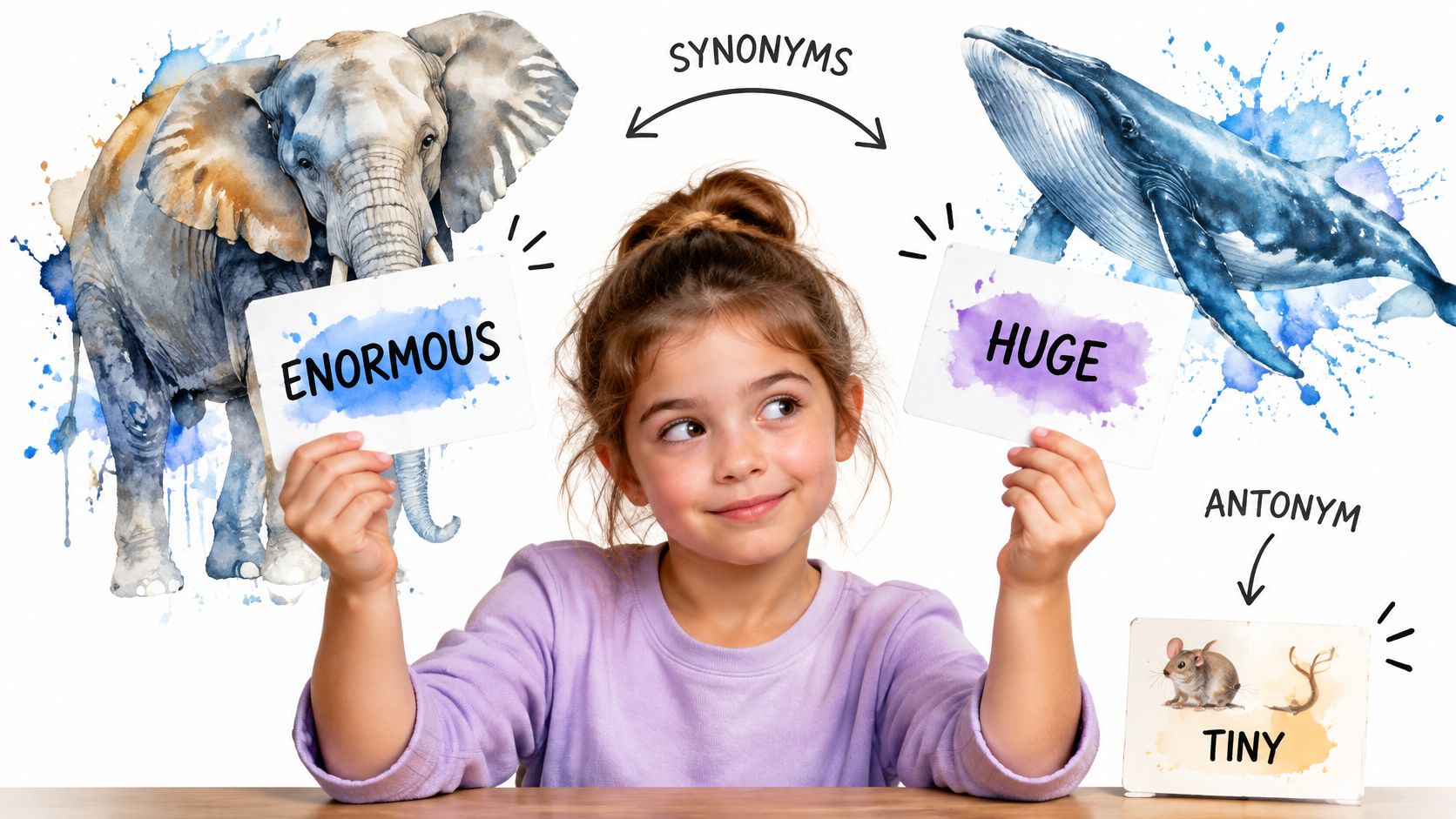
Choose the synonym of ENORMOUS from these options: tiny, huge, average, narrow, faint. The answer is huge, because both words describe something exceptionally large.
That looks straightforward, but the useful habit is checking the exact dimension of meaning. Narrow describes width, faint describes weak intensity, and average describes something ordinary rather than exceptionally large.
Use a sentence to check meaning
Put the target word into a plain sentence: The warehouse is enormous. Substitute each option without changing the intended meaning, and huge survives the check.
For an antonym question, reverse the meaning rather than finding something merely different. The opposite of scarce is abundant, because the contrast concerns availability, not value, usefulness, or size.
- Identify the instruction: Check whether you need a synonym or an antonym before considering the options.
- Match the meaning: Preserve the relevant dimension, such as size, confidence, frequency, or intensity.
- Check the strength: Annoyed and furious both express anger, but they aren't interchangeable in intensity.
The main trap is choosing a related word instead of an equivalent word. Cautious and fearful overlap, but a cautious person isn't necessarily afraid.
The same precision matters with job titles. Our guide to a synonym for cashier explores alternatives whose suitability depends on the actual duties, not just their surface similarity.
Solving tip: Predict a simple meaning before looking at the options. That keeps an impressive-sounding distractor from changing your interpretation of a word you already understand.
2. Verbal Analogies
Hospital is a plausible answer to Hammer : Carpenter :: Scalpel : ?, but it describes a place associated with the tool, not its user. Work backward from the first pair: A carpenter uses a hammer. The matching answer is Surgeon, because a surgeon uses a scalpel.

Write a verbal bridge
A short sentence makes the relationship testable. Keep the order of the words: A carpenter uses a hammer. Then apply the same sentence to the second pair: A surgeon uses a scalpel.
For Bird : Feathers :: Dog : Fur, the bridge is animal to body covering. Kennel is associated with a dog, but it does not reproduce that relationship.
Practical rule: A correct analogy preserves both the relationship and its direction.
Try the same routine with Cold : Freezing :: Warm : Hot. Freezing is a stronger degree of cold, just as hot is a stronger degree of warm. An option such as heat : warm shifts the relationship and reverses the order.
The common trap is picking words that belong together while ignoring how they relate. Before settling on an answer, apply one clear sentence to both pairs. If the second sentence needs extra qualifications, the match is probably only an association.
Choose the narrowest bridge that fits. Tool used by a professional rules out more distractors than objects connected with work while still describing the original pair accurately.
3. Odd One Out (Word Classification)
Apple, Banana, Carrot, Orange
The intended answer is Carrot. In ordinary food classification, the other words name fruits, while carrot names a vegetable.
The useful reasoning step isn't spotting carrot immediately. It's naming the category that keeps the remaining words together, then checking that the proposed outlier falls outside it.
Choose a consistent category
A reliable routine is to propose a category, test every word against it, and reject explanations that depend on special circumstances. Things I eat at breakfast is subjective; fruits in ordinary food classification is clear and consistent.
- Check meaning: Look for categories such as materials, occupations, instruments, or actions.
- Check function: Objects may belong together because people use them for the same purpose.
- Check word form: Grammar or spelling may matter when the meaning doesn't produce a clear grouping.
Consider Run, Walk, Jump, Table. The likely intended answer is Table, because the others describe bodily movement.
Calling table the only noun would be a weak explanation. Run, walk, and jump can also function as nouns, and table can function as a verb. A good explanation should survive ordinary alternative uses of the words.
The main trap is inventing an elaborate category to defend your first choice. If your explanation requires an unusual meaning or a personal association, compare it with a simpler interpretation.
Solving tip: Finish the sentence The others are all... before committing. If you can't complete it precisely, your answer needs another check.
Some practice questions are ambiguous. During review, distinguish an unclear item from a reasoning mistake rather than memorizing a fragile answer key.
4. Reading Comprehension with True, False, or Cannot Say
Passage: A company's revenue increased during the reporting period. Its operating costs also increased. The passage provides no information about profit.
Statement: The company was profitable during the reporting period.
The answer is Cannot Say. The passage gives no figures or relationship between revenue and costs, so the profit statement remains unresolved.
Separate contradiction from missing evidence
Assessment-Training's aptitude-test guide describes a standard passage-based format: decide using the supplied text. Outside knowledge can clarify a sentence, but it cannot establish a fact the passage leaves out.
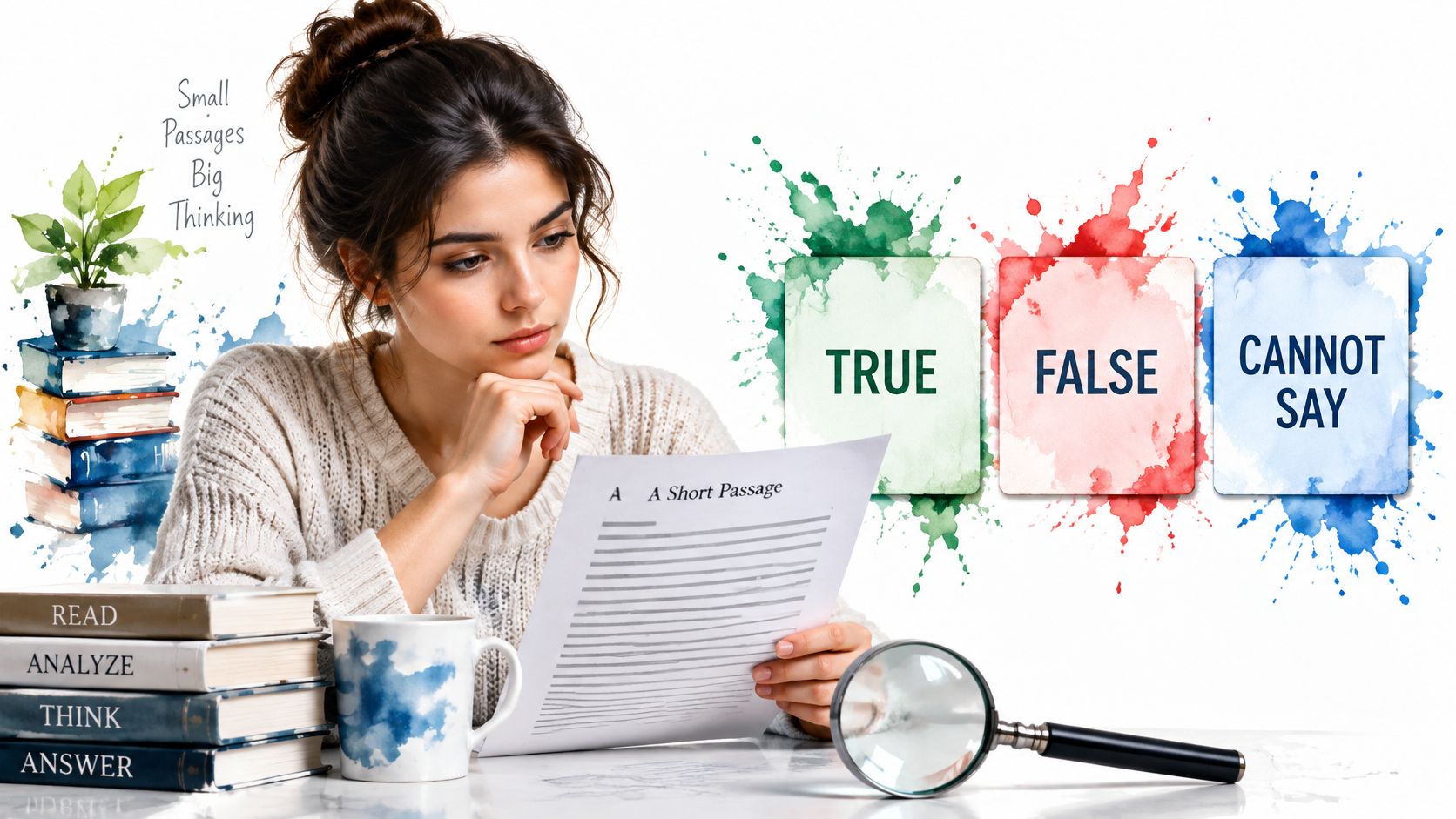
- True: The passage supports the statement, either directly or through a necessary inference.
- False: The passage provides evidence that contradicts the statement.
- Cannot Say: The passage does not settle whether the statement is true or false.
For example, if the passage says every current employee completed induction, the claim that a current employee has not completed induction is false. If the passage says employees must complete induction, that states a requirement, not whether employees complied.
Use this sequence to check scope:
- Locate the sentence that bears on the claim.
- Compare who or what it covers with the statement.
- Check whether the wording changes quantity, certainty, or timing, such as some to all, may to will, or required to completed.
- Choose False only when the passage directly conflicts with the claim. If it leaves the claim unsettled, choose Cannot Say.
Absolute wording deserves close checking, but it does not decide the answer on its own. The evidence does.
5. Logical Deduction and Syllogisms
Syllogisms ask whether a conclusion must follow, not whether it sounds reasonable. Treat the premises as the complete rules of a small imaginary world.
A simple diagram can help keep group membership separate from everyday assumptions.

Premises: All managers attend meetings. Some engineers are managers.
Conclusion: Some engineers attend meetings.
The conclusion follows because the engineers identified as managers belong to the group that attends meetings. You don't need to establish anything about the remaining engineers.
Track groups without reversing them
Write the first premise as managers → meeting attendees. Then place the engineers mentioned in the second premise inside the manager group.
The main trap is reversing an all statement. All managers attending meetings doesn't mean all meeting attendees are managers. The meeting group could also contain engineers, suppliers, or other people.
For another example, suppose some analysts are certified, and no intern is certified. It follows that some analysts aren't interns, because the certified analysts can't belong to the intern group.
Use the video as a separate reasoning exercise, then return to the premises and check each conclusion yourself.
Solving tip: Read some as at least one, not some but not all. Also, don't assume that an all statement establishes that the group exists.
A useful final check is to try constructing a situation where every premise is true but the conclusion is false. If you can, the conclusion doesn't necessarily follow.
6. Sentence Completion and Text Completion
Read the connecting word before hunting for an impressive vocabulary choice.
Example: The policy was intended to be temporary; however, its effects proved ______.
Options: fleeting, lasting, minor.
The answer is lasting. However signals a contrast, and lasting effects contrast with the policy's intended temporary nature.
Predict before comparing options
Cover the options and supply a plain phrase such as continued for a long time. Then choose the option that preserves that meaning.
Fleeting repeats the idea of temporary rather than contrasting with it. Minor describes importance or scale, so it doesn't complete the intended contrast about duration.
- Contrast signals: Although, however, and despite indicate a reversal or qualification.
- Cause signals: Because and therefore connect a reason with an outcome.
- Continuation signals: Similarly and also generally extend the same direction of thought.
A second practice sentence makes the contrast clearer: Although the candidate was usually cautious, she made an unexpectedly ______ decision. Between deliberate, impulsive, and routine, impulsive provides the strongest opposition to cautious.
The main trap is choosing a word that sounds natural locally but breaks the sentence's overall logic. A grammatically correct phrase can still be the wrong answer.
For text completion, read the whole passage before committing to a blank. A later sentence may explain whether an apparently positive description is sincere, qualified, or critical.
Solving tip: For multiple blanks, start with the most constrained blank, then reread the completed passage as a whole. Don't treat each blank as an independent vocabulary question. Every choice must fit the surrounding argument as well as its immediate sentence.
7. Word Connections and Hidden Words
A connecting word must create a natural expression with every clue, not merely most of them.
Example: Find a word that can follow sun, flash, and moon.
The answer is light, producing sunlight, flashlight, and moonlight. The position stays consistent, and each result is an established word.
Verify the whole set
Start by generating candidates from the most restrictive clue. Then test each candidate against the other clues without changing the required order.
- Check position: If the instruction says the answer follows each clue, don't move it before a difficult clue.
- Check usage: Prefer established compounds and phrases over combinations that merely sound possible.
- Check completeness: Reject a candidate as soon as it fails any part of the set.
The main trap is forcing the final connection after finding convincing earlier matches. An invented compound doesn't become valid because the other combinations work.
Hidden-word questions require a different routine. In the instruction Find the animal hidden across the words music at sunset, ignore spaces and scan consecutive letters.
The answer is cat, formed by the final letter of music followed by at. The letters remain in their original order; you haven't rearranged them or skipped any.
Accept ordinary word connections, not expressions you have to explain into existence.
Our interview vocabulary list can support broader language practice, but these items also need direct drills in compounds and letter recognition.
Solving tip: Use a left-to-right scan for hidden words and a candidate-elimination routine for connections. Switching randomly between guessing, rearranging, and scanning makes it harder to apply the actual instruction.
8. Critical Reasoning and Argument Evaluation
Critical-reasoning questions usually ask you to identify an assumption, strengthen an argument, or weaken it. For each, map the evidence to the conclusion first. Then judge whether an answer option changes that link.
Argument: Sales increased after the company launched a campaign. Therefore, the campaign caused the increase.
The evidence establishes that the sales increase followed the campaign. The conclusion claims the campaign caused it. That gap is where the reasoning must be tested.
A seasonal rise in demand would weaken the causal claim by offering another explanation. Evidence that comparable customers who were not exposed to the campaign showed no increase could strengthen it, if the comparison is relevant.
The critical-thinking interview question guide explores how to assess arguments, assumptions, and evidence. In a test, match your reasoning to the exact task:
- Assumption: Identify a condition the argument depends on, even though it is unstated.
- Strengthen: Find evidence that makes the conclusion more credible.
- Weaken: Find evidence that makes the link between evidence and conclusion less credible.
The most common trap is choosing a true statement that does not affect the argument. A campaign's attractive design may be true, but it says nothing about whether the campaign caused additional sales.
Consider another claim: Most successful founders attended business school, so business school produces successful founders. The missing comparison is how business-school graduates generally perform relative to others. The argument also leaves open whether other factors explain the association.
For an assumption question, state the gap in plain language before checking the options. Then negate a candidate assumption: if the argument loses necessary support, the candidate may be required. For strengthen and weaken questions, ask one direct question: does this new information make the evidence-to-conclusion link stronger or weaker?
How the Eight Verbal Reasoning Question Types Compare
Use the first question in the table to choose a solving routine before you look at the answer options. The diagnostic check helps you confirm that the routine fits the item.
| Item | Typical Format | Core Skill Tested | First Question to Ask | Diagnostic Check |
|---|---|---|---|---|
| Synonym and Antonym Questions | Choose a synonym or antonym for a target word from four or five options | Vocabulary precision and word meaning | What does the target word mean in this sentence or context? | Does the option match the meaning and intensity? |
| Verbal Analogies | Complete a pair such as “A is to B as C is to ?” | Identifying relationships between concepts | How are the first two words connected, and in which direction? | Does the same relationship hold for the second pair? |
| Odd One Out (Word Classification) | Select the word that does not fit a set of four or five | Categorization and pattern recognition | What specific rule groups most of these words? | Can the rule explain every word except one? |
| Reading Comprehension with True, False, or Cannot Say | Judge statements against a passage as true, false, or not established | Close reading and evidence-based inference | Which exact statement in the passage bears on this claim? | Does the passage confirm it, contradict it, or leave it unsettled? |
| Logical Deduction and Syllogisms | Decide whether a conclusion follows from premises containing quantifiers | Formal deduction and logical relationship analysis | What do the premises guarantee, and what do they leave open? | Can the conclusion be false while all premises remain true? |
| Sentence Completion and Text Completion | Fill one or more blanks in a sentence or short passage | Contextual reasoning, tone, and vocabulary | What meaning or contrast must the blank preserve? | Do the completed sentence and surrounding passage agree? |
| Word Connections and Hidden Words | Find a word linking several clues or hidden within a letter sequence | Flexible word association and pattern recognition | What word satisfies the clues or letter pattern directly? | Does the candidate fit every clue without forcing a phrase? |
| Critical Reasoning: Argument Evaluation | Analyze a short argument for assumptions, flaws, or ways to strengthen or weaken it | Argument analysis and evidence evaluation | Which premise-to-conclusion link does the question ask you to assess? | Would the option change the argument's support for its conclusion? |
Turn These Examples Into a Daily Practice Routine
Pick two question types per session and practice them deliberately rather than jumping between unrelated puzzles. Start with a type you find manageable and another that exposes a recurring weakness, such as analogies paired with passage-based inference.
Begin untimed when you're learning a new routine. Explain the relationship, identify the supporting sentence, or mark the logical connector before checking the answer. Once the method is clear, solve a fresh set under the timing and navigation rules in your assessment invitation.
Review the decision, not just the score
For each wrong answer, record the intended rule and the trap you accepted. Keep the explanation specific enough to change your next attempt.
- Unsupported assumption: I treated a plausible explanation as a fact.
- Direction error: I reversed the analogy or group relationship.
- Scope error: I changed some into all, or a requirement into confirmed compliance.
- Context error: I chose a familiar meaning that didn't fit the sentence.
- Time-pressure error: I abandoned a sound method and guessed without eliminating options.
Review correct answers that you guessed as well. A lucky answer doesn't show that you can repeat the reasoning on unfamiliar material.
The Psytech guidelines on psychological test use distinguish reliability, meaning score consistency and precision, from validity, meaning whether an assessment measures what it claims. For preparation, that distinction is a reminder to use clear questions and consistent conditions rather than treating difficulty alone as quality.
Separate reasoning from speed and familiarity
Compare your timed and untimed work. If your explanations are sound without a timer but collapse under pressure, focus on locating evidence and shortening your routine rather than memorizing more vocabulary.
Arctic Shores' guide to verbal reasoning tests discusses how access to practice and tutoring can affect familiarity and performance. Don't interpret an unfamiliar format as proof that you lack reasoning ability.
If dyslexia, ADHD, language processing, or assistive technology affects access, request appropriate arrangements before the assessment. The Institute of Student Employers' guidance on neurodiversity in hiring discusses accommodations and accessible assessment design; practicing harder isn't a substitute for usable testing conditions.
Our Question Bank and Playground offer ways to repeat question patterns and try answers, while AI mock interviews with answer evaluation can help you examine how clearly you explain your reasoning. Use assistance for preparation and follow the assessment's rules during the actual test.
Today, choose a passage question and an analogy, solve them without checking the answers, and write a sentence explaining the evidence or relationship behind each choice.
Interview Pilot offers a Question Bank, a Playground for trying answers, and AI mock interviews with answer evaluation. Visit Interview Pilot to practice explaining your decisions, then use that feedback to target the reasoning traps you keep repeating.
Topics
verbal reasoning test examples
verbal reasoning practice
verbal reasoning questions
syllogisms practice
critical reasoning test
Continue reading
Interviews
Insurance Questions for Interview: 10 Answers That Land
The 10 most common insurance questions for interview panels across underwriting, claims, sales and actuarial roles — with answer guidance for each.
November 8, 2026
19 min read
Interviews
Interview Business Casual: What to Wear and When
Interview business casual explained: industry-by-industry outfits, piece-by-piece checklists and video-call tips so you dress one step smarter.
November 8, 2026
14 min read

Interviews
10 DBMS Interview Questions You Should Master in 2026
Ace your next interview with the 10 most common DBMS interview questions, covering ACID, normalization, indexing, joins, and recovery with sample answers.
November 8, 2026
18 min read