















Interviews
Interview Business Casual: What to Wear and When
Interview business casual explained: industry-by-industry outfits, piece-by-piece checklists and video-call tips so you dress one step smarter.
Interview Pilot Editorial Team
Updated November 8, 2026
14 min read
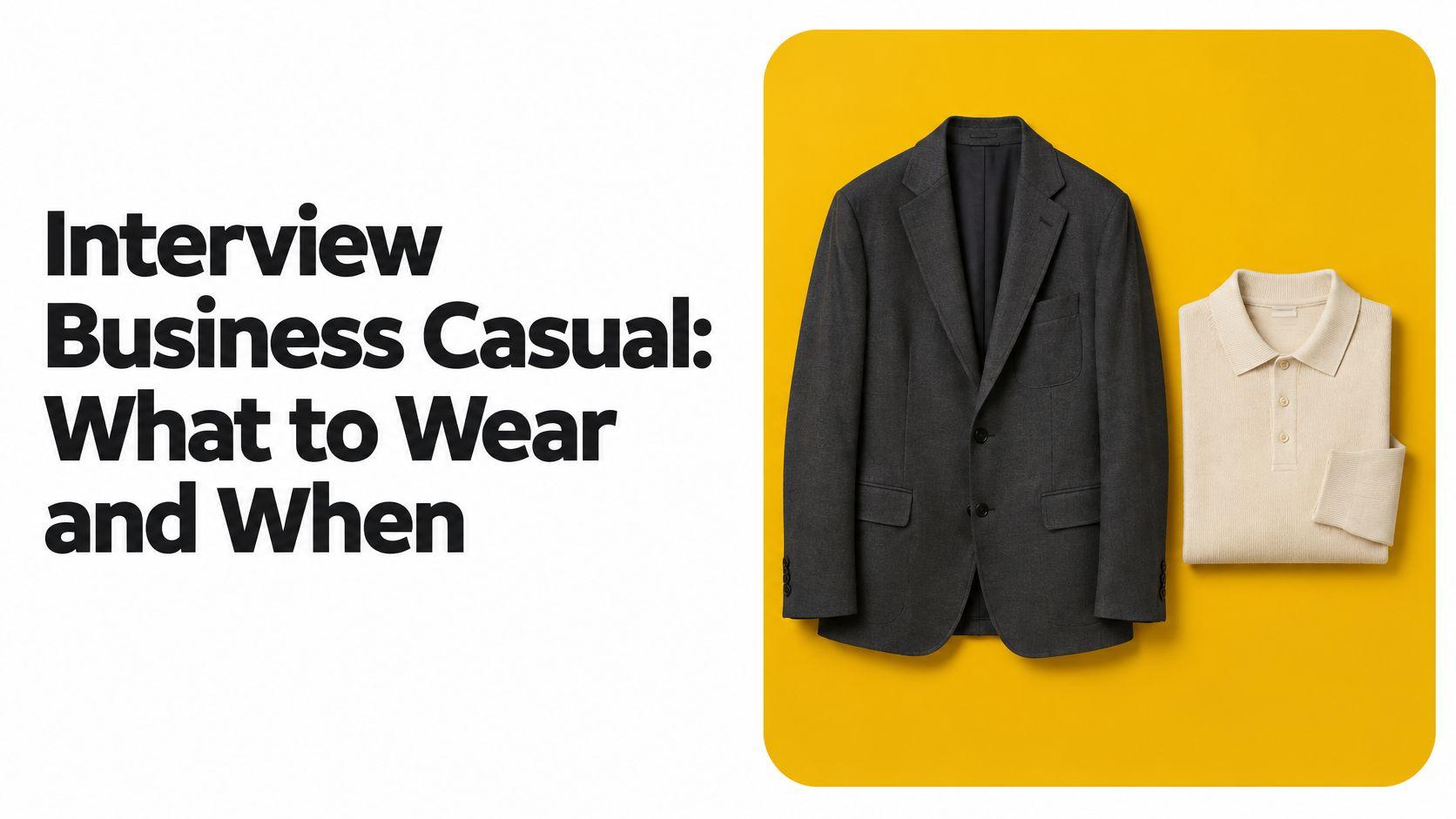
The interview is on Thursday, the calendar invite says business casual, and the closet is arguing with itself. The navy blazer feels like a bank. The dark jeans feel like a Saturday. You don't want to look like you ignored the note, and you don't want to look like you never read the company either.
Interview business casual is a calibration problem, not a universal shopping list. Match the employer's real daily norm, then sit one step above it. I would rather see a pressed knit and well-cut trousers that fit the room than a full suit that says you researched the wrong office. Hiring managers read clothes as a signal of role awareness before they score a single answer. A quiet, fitted outfit lets the conversation carry the impression.
Find Your Employer's Real Norm
Start with the employer's floor, not your favorite outfit. A 2025 Career Launch Kit summary reported that 55% of employers preferred smart-casual attire for interviews, compared with 26% preferring formal business attire and 19% having no specific dress code. The middle option is the most common read. It is not a promise.
A posting that says nothing is also common, and it goes stale fast. In a Monster dressing-for-work poll, 43% of surveyed workers said their office has no dress code, 63% of those who do have one described it as business casual, and 61% said their dress code had changed recently. Treat last year's careers-page photo as a hint, not a rule.
Four moves before you pick a row
Ask the recruiter one short question. "What do people in this role usually wear day to day?" is enough. You want the daily floor, not a slogan about culture.
Read current people, not stock art. Careers-page lifestyle shots are often staged. Employee profiles, recent event photos, and the tone of the posting are more useful. A practical pass is the same homework you'd do when you research a company before an interview: role, clients, and how formal the language already is.
Mark the exceptions before you dress up. Labs, manufacturing floors, healthcare, hospitality, and field roles often have closed-toe rules, issued clothing, or a uniform. Religious dress, climate, and disability-related clothing needs sit outside a style chart. Follow those constraints first.
Then choose one step above that daily floor. A blazer over what the team already wears is usually the interview version. A three-piece suit in a studio that lives in knits is a miss in the other direction.
The safest outfit is not always the most formal one. Overdressing can read as a misread of the culture. Underdressing undercuts credibility before you sit down.
Pick the row that matches the room you are walking into, then use that baseline. Do not average the rows.
| Setting | Typical dress level | Safe baseline | Avoid |
|---|---|---|---|
| Banking, law, client-facing consulting | Blazer level | Tailored blazer, dress trousers or skirt, collared shirt, leather shoes | Jeans, open-collar polo, sneakers |
| Corporate office, finance operations | Structured business casual | Blazer or cardigan, chinos or tailored trousers, collared shirt, loafers | Graphic tees, distressed denim |
| Technology, product, startups | Relaxed business casual | Knit polo or fine-gauge sweater, dark chinos, clean loafers or minimalist sneakers if the team is casual | Athletic wear, slogan shirts, worn footwear |
| Creative, media, marketing | Expressive but tidy | Tailored separates, subtle texture or pattern, dark jeans only if clearly accepted | Visible logos, oversized fits, heavy distressing |
| Nonprofit, education, public sector | Modest business casual | Button-down or blouse, slacks or knee-length skirt, closed-toe flats or loafers | Revealing cuts, flip-flops, sports shoes |
| Lab, field, healthcare, manufacturing | Role-specific | Work uniform or issued clothing if provided, closed-toe shoes, tidy top | Dressing above the role's daily norm without a reason |
Client-facing work pulls the outfit up even inside a casual company. An internal engineering screen at the same firm can stay on the relaxed row. If the role spans both, dress for the more formal room on the schedule and keep a layer you can take off.
What to Wear When Told to Dress Casually
"Come casual" is rarely a green light for weekend clothes. In a 2024 Rikunabi survey of 300 human-resources personnel, 77.2% expected business-casual attire when candidates were told to attend an interview in casual clothes, according to a write-up of that survey. Interviewers are usually picturing a tidy office version of casual, not athletic wear.
That reading is familiar because it is also how many people already work. A YouGov survey cited by Fit In Line found that 47% of employed U.S. adults reported wearing business-casual clothing at work in 2024. When a recruiter says casual, they are often pointing at that everyday reference, then expecting you a notch cleaner for the meeting.
Use the setting row you already chose, then drop one notch, not two.
- Take the top, bottom, and shoes down one step from that row. A collared shirt or fine-knit polo, chinos or well-cut trousers, and closed-toe shoes still hold the line. Dark jeans belong only where that setting already allows them.
- Keep one quiet structure piece. A cardigan or unstructured jacket is enough. It says you prepared without pretending the note said suit.
- Leave the weekend signals at home. Logo sneakers, athletic sets, slogan tees, and visibly worn shoes still read as a miss, even under a casual instruction.
If the note still feels slippery, send one clarifying line before the day. Ask what people in the role wear, not for a full style guide.
What Each Piece Should Look Like
Structure still does work when nobody asked for a suit. A survey summarized in a 2019 academic review found that 70% of executives perceived employees in suits as more senior-level, and 60% said people in suits were taken more seriously. You are not dressing to fake seniority. You are using the same signal in a lighter form: a defined shoulder, a clean trouser line, colors that agree.
The same review cites research with 616 business students on what counted as appropriate business casual. For women, khaki trousers with a coordinating blazer ranked first, then navy dress slacks with a gray jacket. For men, a navy sports coat with gray dress slacks, or casual slacks with a polo, sat among the strongest choices. Coordinated combinations beat "anything comfortable."
Intentional means clean lines, matched tones, and a shoulder or waist that has a shape. Comfortable-only means soft fabric with no edge, a slumped collar, and shoes that look like the commute won. Interviewers notice the second set because you keep adjusting it.
| Piece | Safe choice | Avoid |
|---|---|---|
| Shirt or blouse | Collared shirt, fine-knit polo, or silk-blend blouse | T-shirts, logo tees, sheer fabric |
| Trousers | Tailored chinos, wool-blend trousers, or dress slacks | Jeans, cargo pants, leggings |
| Skirt or dress | Knee-length or midi skirt, conservative dress with sleeves or a jacket | Mini skirts, bodycon dresses, very low necklines |
| Layer | Blazer, cardigan, or unstructured jacket | Hoodie, bomber jacket, denim jacket |
| Shoes | Leather loafers, oxfords, closed-toe flats, or boots | Sneakers with logos, sandals, worn soles |
| Accessories | Simple watch, small studs, leather belt | Oversized jewellery, novelty watches, sunglasses on the head |
Build from the table, then add one structured piece above the minimum, usually the layer. Keep every other piece quiet. A polo with a sports coat can clear a tech screen. The same polo under a hoodie does not.
Three Complete Outfits That Work
Any combination starts from the same baseline: a clean, pressed, well-fitted collared shirt, blouse, polished sweater, or turtleneck; fitted trousers, chinos, khakis, or a skirt or dress; and clean loafers, flats, boots, or other closed-toe dress shoes. A blazer, cardigan, or sports jacket raises the level without forcing a matched suit.
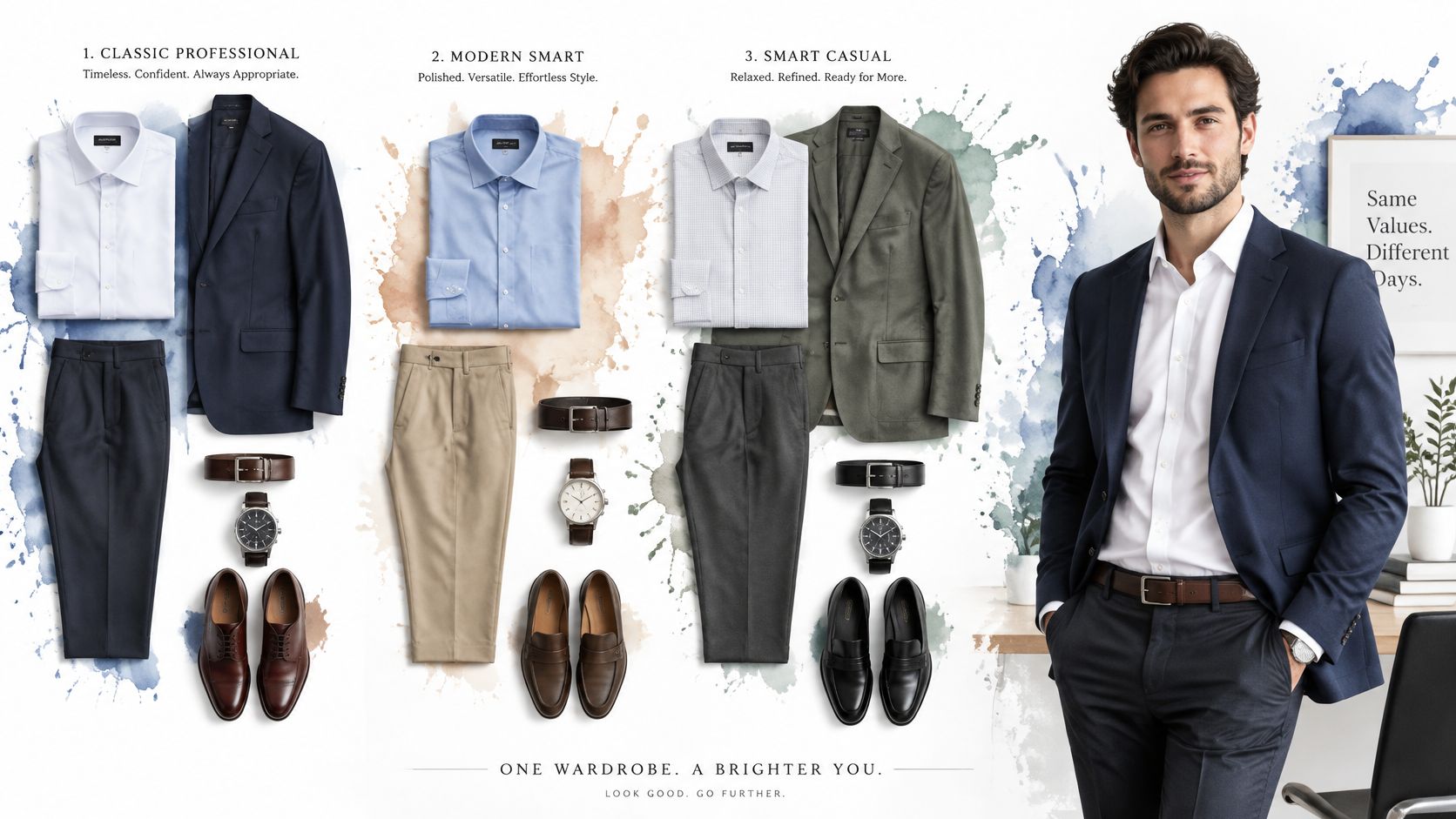
Fit changes the read more than a brand name. If standard cuts gap at the waist or pull at the shoulder, the same formulas still work in extended sizes. Office wardrobe advice from ClothME is a useful pass on proportion before you commit to a jacket.
A finance analyst walking into a corporate firm. Navy blazer, light blue oxford, charcoal chinos, brown leather loafers, a plain belt, and a simple watch. The blazer matches a client-facing floor. The chinos keep it short of a full suit, which is right if the team is business casual rather than suited every day. Shoes and belt in the same brown family stop the eye. To go more formal, swap the chinos for matching dress trousers and add a tie. To relax it, lose the blazer only if the recruiter has already described a no-jacket floor.
A product manager at a technology company. Charcoal fine-knit top, black trousers with a sharp, structured cut, a navy cardigan, minimal flats, and one small necklace. The knit is the casual note. The trousers and cardigan are the step above a hoodie-and-jeans office. Black and navy stay low-contrast on a whiteboard or a screen. To formalize, replace the knit with an oxford and the cardigan with a blazer. To relax, keep the cardigan off until you see how the panel is dressed, and put it on if the room is sharper than the photos.
A programme officer at a nonprofit. Cream blouse, olive midi skirt, tan cardigan, closed-toe flats. The palette is modest, the hem sits well when she sits, and nothing competes with a conversation about the work. The cardigan is the structure piece. To formalize, add a jacket in tan or navy and switch the skirt for slacks if the panel includes funders. To relax, the cardigan can come off after you arrive, as long as the blouse still has sleeves and a neckline that holds up on its own.
The same three skeletons travel. Change the layer and the shoe, not the whole closet.
Choosing Colors and Fit That Stay Quiet
Color and fit are risk controls, not a personal brand exercise. Navy, charcoal, gray, black, tan, and white coordinate across shirt, trouser, shoe, and jacket without a styling project. A subtle pattern is safer than a high-contrast print, neon, or a large logo. On camera, glare, moiré, and compression make busy cloth louder than it looks in a mirror, which is why dress-for-success guidance treats a low-distraction field as the point.
Run this check in front of a mirror, then sit down.
- Collar. It should sit flat, with room for two fingers, and it should not gap when you turn your head.
- Sleeves. Shirt cuffs should land at the wrist bone. Jacket sleeves should show a small margin of cuff, not swallow the hand.
- Waistband. You should sit without the button pulling or the fabric gaping at the back.
- Hem. Skirts and dresses should still cover what you intend when you cross your legs. Trousers should break lightly, not pool.
- Crease test. Sit for two minutes. If the lap, the skirt, or the knit collapses into deep wrinkles, steam it or change the cloth.
Wool blends, cotton twill, and structured knits hold a line. Thin, clingy, or shiny fabrics show every shift of light and every adjustment. Structured enough for a clean silhouette, not so tight that you tug at it.
The benchmark is behavioral. The interviewer should remember a clear answer, not your collar. For roles in another country, look at current employee images, account for religious or cultural expectations, and dress slightly more formally than the everyday office unless someone told you otherwise.
Dressing for Video Interviews
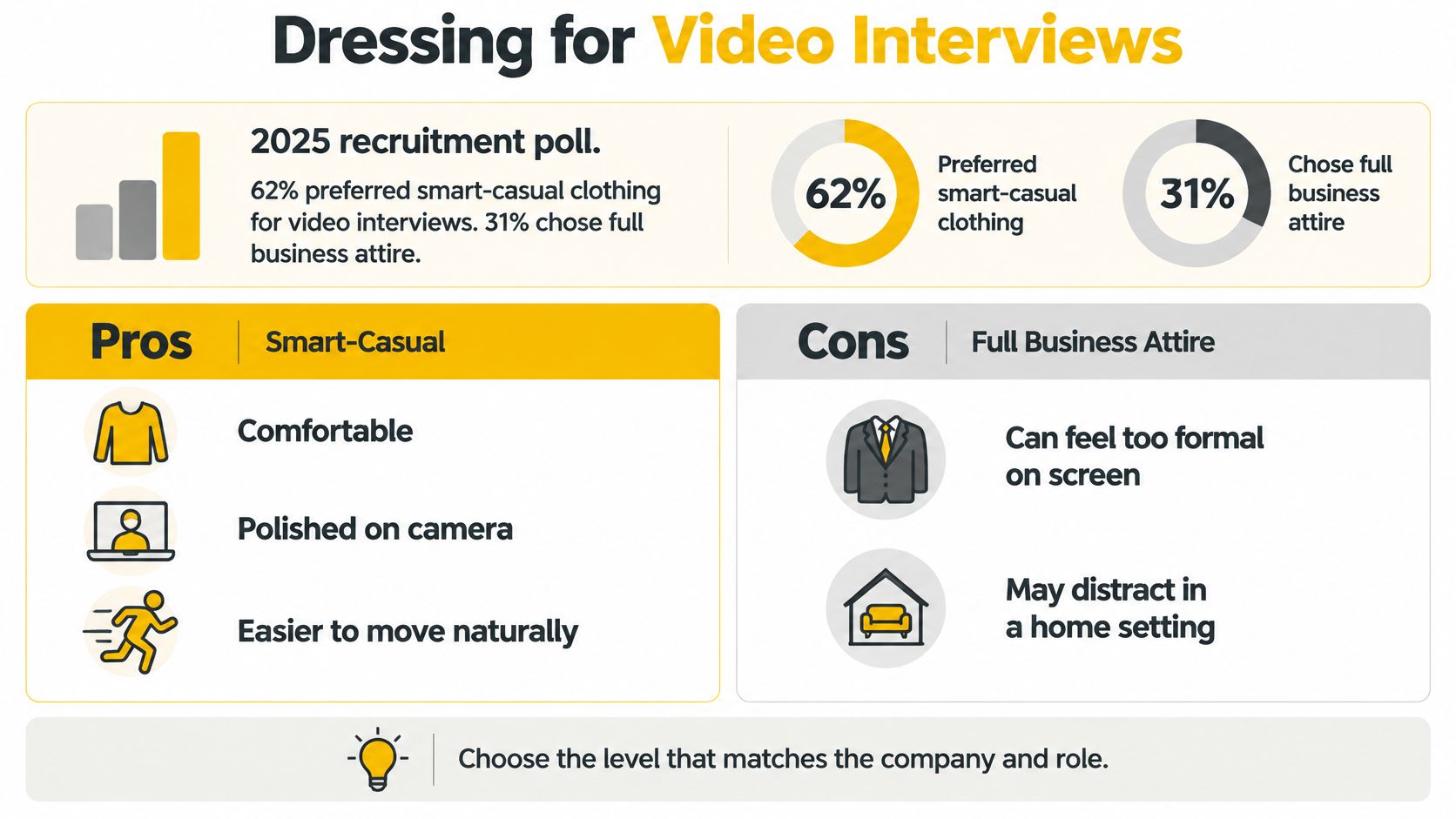
On camera, the room and the outfit become one frame. A 2025 recruitment poll found that 62% of respondents preferred smart-casual clothing for video interviews, compared with 31% who chose full business attire. That points to a useful starting point, not a universal dress code: match the employer's norm, then sit one step above it. A heavy jacket or fine check that works in a conference room may distract on screen.
Choose a solid color that separates you from the wall. Fine stripes and tight checks can shimmer or crawl under video compression. If your shirt matches the paint or a bright window, the outline of your face and shoulders can disappear into the background.
Small details become more noticeable in a close crop. Reflective jewellery can flash as you move; stiff fabric can rustle into the microphone. Check how the neckline sits from the chest up, where a full-length mirror cannot show you the final frame.
Test the outfit on camera. Set the lens at eye level, sit in the light you expect to use, and record a one-minute answer. Watch for a collar that gaps, a pattern that flickers, or a shirt that blends into the wall. The online interview dress code guide covers the same outfit choices with the camera's crop and lighting in mind.
Wear the full outfit, including trousers and shoes. You may need to stand during the call, and dressing fully helps the outfit feel consistent. If the room runs warm, choose a breathable layer you can wear comfortably rather than a blazer that leaves you flushed and adjusting throughout the interview.
Pre-Interview Checklist and Practice Run
Do this the night before, not in the lobby. Before a first interview, our help center suggests a 5-minute checklist. Use that window on the clothes, then use it again on the answers.
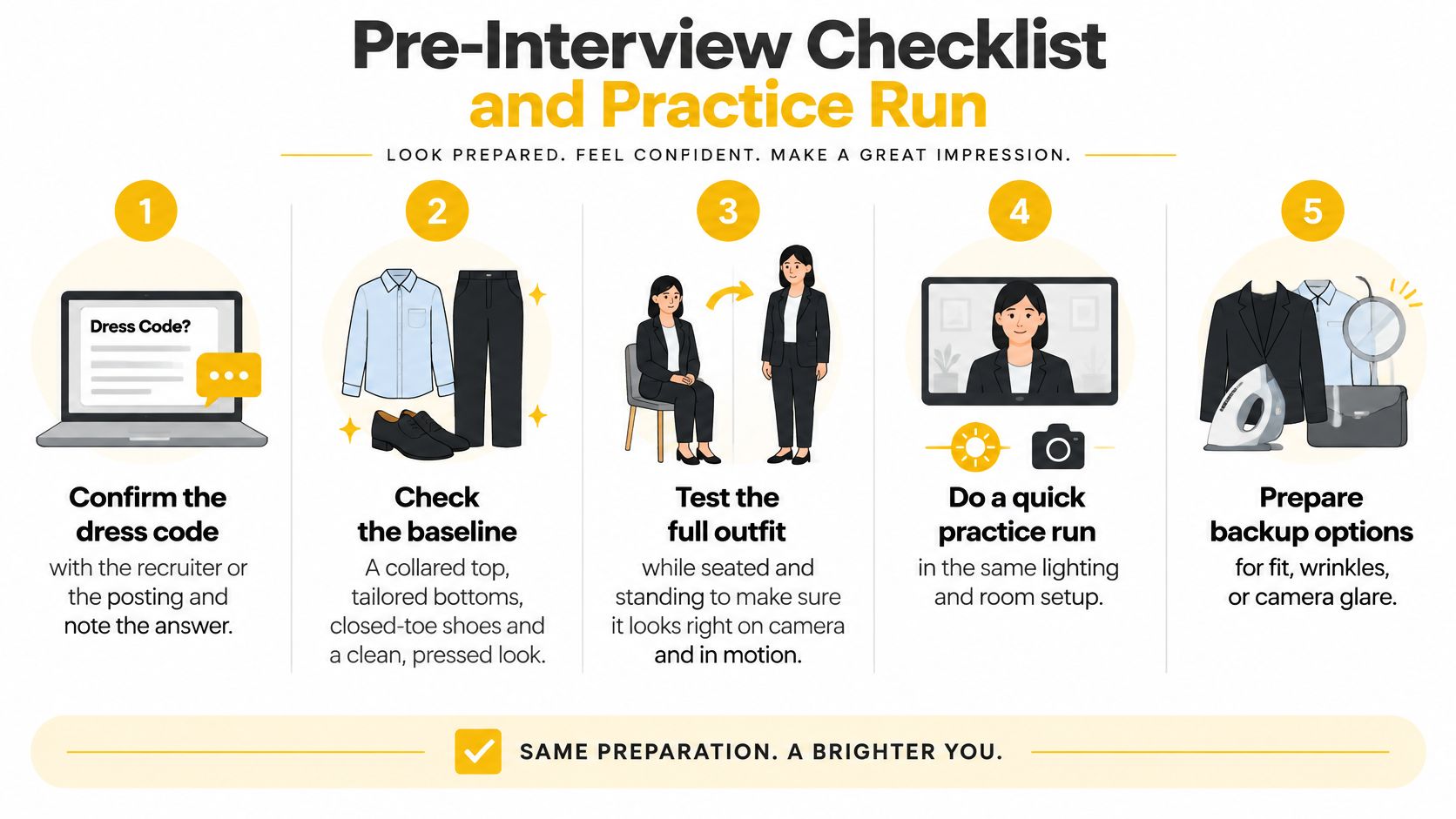
- Confirm the code. Check the recruiter's note or the posting and write down what they said.
- Check the baseline. Collared top or equivalent, fitted bottoms, closed-toe shoes, and one structured layer. Everything should already be clean and pressed.
- Scan for noise. Solids or a subtle pattern only. No logos, no slogans, no joke graphics.
- Repeat the fit test in motion. Collar, sleeves, waistband, hem, and wrinkles when seated. Then sit, reach, stand, and walk once.
- Shoes and metal. Clean uppers, sound soles, a belt that matches. Jewellery stays minimal, with nothing that flashes on camera or clicks when you gesture.
- Match the video setup to the hour. If it is on camera, test at the same time of day, on the same device, against the same background.
- Pack a small backup. A spare shirt or blouse, a lint roller, a safety pin, and a stain wipe. Add a layer you can remove if the commute or the room runs hot.
- Rehearse once in the real clothes. Sit at a desk and stand up. For video, stay in frame for five minutes. If you want a second pass on the answers, AI mock interviews are available, along with an evaluation of your answers, so the outfit practice and the answer practice are not the same hour.
- If something fails, switch now. Steam, pin, or lay out the backup. Do not discover a pulling button in the waiting room.
The clothes check is one slice of a wider interview preparation checklist. The question that closes the outfit pass is simple. Could I stand, shake hands, and sit down without thinking about my clothes? If yes, the outfit is quiet enough. The conversation can do the rest.
Once the outfit is settled, the harder work is what you say when the question lands. Interview Pilot is an AI interview assistant for live online interviews, with real-time suggested answers, guided mock practice, and a question bank you can rehearse by role. If you want that practice next to the camera test you just ran, visit Interview Pilot.
Topics
interview business casual
business casual outfit
interview outfit ideas
video interview attire
interview dress code
Continue reading
Interviews
7 Women's Interview Attire Ideas for Every Industry
Discover 7 women's interview attire options for corporate, creative, tech and finance roles, with dos, don'ts and seasonal tips for dressing with confidence.
November 7, 2026
14 min read
Interviews
Insurance Questions for Interview: 10 Answers That Land
The 10 most common insurance questions for interview panels across underwriting, claims, sales and actuarial roles — with answer guidance for each.
November 8, 2026
19 min read
Interviews
10 DBMS Interview Questions You Should Master in 2026
Ace your next interview with the 10 most common DBMS interview questions, covering ACID, normalization, indexing, joins, and recovery with sample answers.
November 8, 2026
18 min read