













Interviews
10 AI Job Interview Questions and How to Answer Them
Prepare for AI job interview questions with 10 key prompts, example answer angles, and practical tips for technical and behavioral rounds.
Interview Pilot Editorial Team
Updated November 17, 2026
21 min read
Just over half of U.S. job seekers have now been interviewed by software rather than a person. Greenhouse's 2025 AI in Hiring Report, which surveyed 1,200 American job seekers, found that 54% had experienced an AI-led interview. That figure gets quoted as a story about automation. It's more useful as a story about what gets tested.
The failure mode that sinks most candidates isn't a knowledge gap. Someone can define overfitting, sketch a confusion matrix, and still lose the round, because the follow-up is always the same. So what would you do differently, and what does it cost? Definitions are free. Trade-off reasoning is what's being priced.
The ten questions below run roughly in that order of difficulty. The first six test whether you understand how models learn and generalize: bias and variance, overfitting, precision against recall, gradient descent, backpropagation, the transformer. The last four move to how systems behave once real data and real users arrive: retrieval grounding, drift in production, matching a learning approach to a problem, and fairness. Each entry gives you an answer structure to adapt, the trap that catches many candidates, and one concrete example to anchor it.
1. Explain the Bias-Variance Tradeoff
This is a generalization question wearing the costume of a definitions question. The interviewer wants to know whether you can predict how a model will fail before anyone looks at the test set.
A workable structure has three moves. Name both failure modes, place them on a single complexity axis, then name the specific lever you'd pull.
High bias means the model is too rigid for the signal, so training and validation error stay high together. High variance means it has learned noise, so training error keeps falling while validation error turns upward. The U.S. Office of Personnel Management's guidance on structured interviews explains why this format predicts job performance better than a chat: structured questions about job-representative situations show high content validity and high criterion-related validity, meaning the reasoning you display maps to how you'd work. Trade-off talk is the signal they're scoring.
Then be concrete about the fix for each side.
- For variance: L2 regularization, more training data, bagging, or averaging decorrelated trees the way a random forest does.
- For bias: richer features, a more flexible model class, or less aggressive regularization.
Picture a degree-15 polynomial fitted to 20 points. Training error near zero, test error embarrassing. That's variance. A straight line drawn through a curve is bias. Boosting cuts bias; forests cut variance.
Think of it as a balance beam rather than a scoreboard.

Keep the answer under two minutes, then offer to go deeper. The follow-up is usually about learning curves, and the AI/ML interview questions guide covers how those get probed.
2. What Is Overfitting and How Do You Prevent It?
Most candidates define it correctly and then recite a list of techniques. That's the weak version. The strong version starts with validation design, because prevention is mostly a decision about how you measure.
Overfitting is what happens when a model captures patterns that belong to the sample rather than the population, noise included. The tell is a widening gap between training and validation performance. State that first, since it establishes how you'd detect it before you claim to prevent it.
Where candidates usually lose the point
Leakage. A time-series model that builds features from future observations will show beautiful validation accuracy and collapse in its first week live. If the dataset has a time dimension, say explicitly that you'd use time-based splits rather than a random shuffle, and that you'd check whether any feature could only be known after the outcome.
Prevention, in the order I'd apply it:
- Stop earlier: early stopping on validation loss, especially for neural networks.
- Constrain capacity: depth limits and a lower learning rate for gradient-boosted trees on tabular data.
- Regularize: weight decay, dropout, or fewer features.
- Add data: more examples, or augmentation that stays realistic for the domain.
Close with one measured before-and-after. Say a churn model's training score sits far above its validation score, and adding early stopping plus removing two leaky features narrows that gap for a small cost in training accuracy. A scenario like that beats any definition, and it invites the interviewer to ask how you'd pick the stopping point.
3. Precision vs. Recall, When Do You Optimize for Each?
The wrong answer is "it depends." The right answer is "it depends on which error is more expensive, and here's the number I'd ask the business for."
Define both through a confusion matrix instead of in the abstract. Precision is the share of predicted positives that are real. Recall is the share of real positives you caught. Accuracy hides both, which is exactly why the question exists.
Then commit to a side with a cost argument.
- Cancer screening: recall first, because a missed case is the expensive error and a false positive buys a follow-up test.
- Spam filtering: precision first, because a legitimate invoice landing in the spam folder costs you a customer.
- Fraud detection: neither extreme. You tune the threshold to where investigation cost meets expected fraud loss, and that threshold moves when the review team's capacity changes.
Threshold tuning is the lever most candidates forget. The model outputs a probability. The business decides where the cut sits, and that cut is a management decision as much as a statistical one.
Practical rule: never name a metric without the cost of both error types in the same breath. Interviewers treat that pairing as the line between someone who trains models and someone who ships them.
Metric choices are planning decisions, and the whiteboard version usually looks like this.

For the version of this question that shows up in analyst and product interviews, the data scientist interview questions breakdown walks through the follow-ups.
4. How Does Gradient Descent Work?
Open with the analogy, then earn it with the update rule. You're walking downhill in fog: you feel the slope underfoot, step in the steepest downward direction, and repeat until the ground flattens.
Formally, you compute the gradient of the loss with respect to the parameters and move them opposite to it, scaled by a learning rate. The learning rate is the whole question, so spend your time there.
- Too large: each step overshoots the valley, and the loss oscillates or diverges outright.
- Too small: convergence crawls, and you can stall in a plateau for thousands of iterations.
- Warmup then decay: raise the rate early to move through flat regions, then lower it so the final steps settle. This is standard in large language model training.
Get the batch distinction out in one breath. Full-batch uses every example per step, stochastic uses one, and mini-batch uses a slice, which is what you run. Adam adapts a rate per parameter and handles sparse gradients well, which is why transformer training leans on it. Plain SGD with momentum sometimes generalizes better on vision tasks, and saying that out loud shows you've read past the library defaults.
Worked example: logistic regression on cross-entropy. If the loss jumps upward in the first few hundred steps, your rate is too high. Divide it by ten before you touch anything else, then check whether the curve descends smoothly.
5. Explain Backpropagation in Neural Networks
Interviewers ask this to find out whether you treat training as a black box. The clean answer separates two jobs: backpropagation computes the gradients, and the optimizer decides what to do with them. Candidates who blur that line sound like they've memorized a diagram.
Walk a two-layer network in words. The forward pass produces a prediction and a loss. Going backward, the chain rule multiplies local derivatives layer by layer, so every weight receives a gradient describing how much it contributed to the error. Then one update happens, and the loop repeats.
The follow-up you should expect
Vanishing and exploding gradients. Deep stacks multiply many small derivatives together and the signal shrinks toward zero. Recurrent networks unrolled over long sequences do the opposite and blow up. Name one fix for each.
- Vanishing: residual connections, as in ResNet, or normalization layers that keep activations in a healthy range.
- Exploding: gradient clipping, standard practice in recurrent training.
- Tooling: PyTorch's autograd builds a graph during the forward pass and walks it in reverse, which is why stale gradients need clearing between steps.
Add the limitation. Backpropagation isn't how biological brains learn, and it isn't a learning rule on its own. It's an efficient way to assign credit, and it needs a differentiable path from loss to parameter.
Keep a small diagram ready. If the interview is on a shared screen, three boxes and two arrows will carry more of the answer than a paragraph.
6. Explain the Transformer Architecture and Self-Attention
The 2017 paper that introduced the transformer was written for machine translation. The architecture outgrew its origin because attention parallelizes, and that's the opening line I'd use. It shows you understand why it won, not just how it's drawn.
If the mechanics still feel fuzzy, this walkthrough is worth an hour before the interview.
Self-attention in one example. Take the sentence "the animal didn't cross the street because it was too tired." The token "it" forms a query, every token offers a key, and the match scores decide how much of each value flows into "it." Multi-head attention runs several of those lookups in parallel so one head can track syntax while another tracks coreference.
Positional encoding exists because attention has no inherent order. Without it, the model sees a bag of tokens and loses word order entirely. Then connect architecture to behaviour: decoder-only stacks generate text one token at a time, encoder-only stacks like BERT suit classification and retrieval, and encoder-decoder stacks handle translation and summarization.
Be candid about cost. Attention grows quadratically with sequence length, which is why context limits exist, why long-document work leans on retrieval, and why serving a long prompt is a budget decision.
Naming a limitation before you're asked reads as confidence, not weakness.
7. What Is Retrieval-Augmented Generation and When Would You Use It?
RAG is prompt engineering with a search engine attached. You retrieve passages relevant to the query, place them in the context window, and let the model answer from them. The value is grounding, not intelligence, and the interviewer is listening for where you'd put the failure handling.
Picture the four stages they want to hear in order.
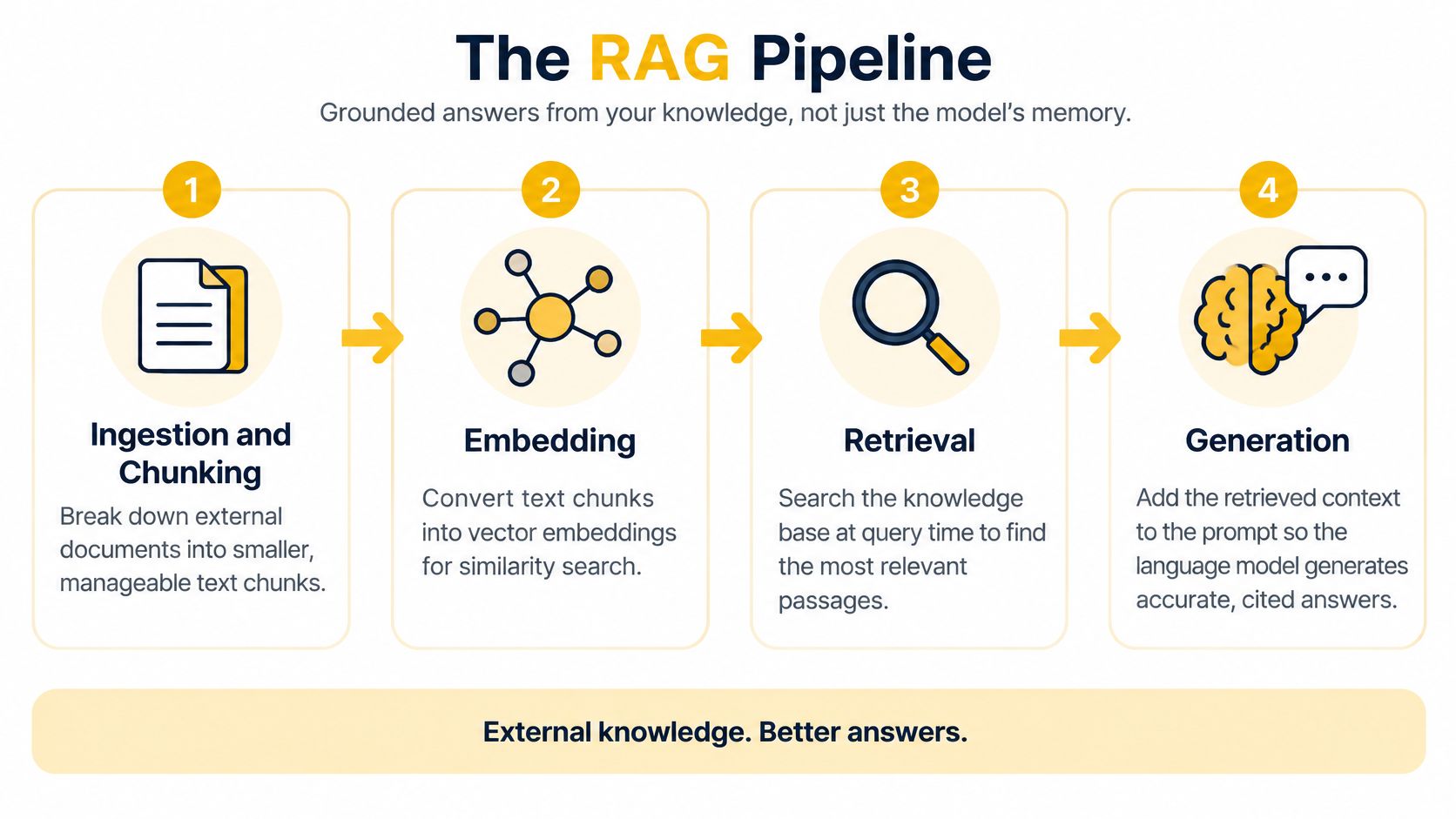
- Ingestion and chunking: parse the documents, split them at semantic boundaries rather than fixed character counts, and keep metadata such as source, date, and access level.
- Embedding and indexing: embed chunks with the same model you'll query with, and store them in a vector index that supports filters.
- Retrieval: pull candidates, rerank them, and enforce permissions before anything reaches the model.
- Generation: answer with citations and an explicit escape hatch for when the retrieved context doesn't cover the question.
Evaluate the halves separately. Retrieval is a ranking problem, measured by whether the right passage appears in the top results. Answer quality is a groundedness problem, measured by whether each claim traces back to a retrieved source. Teams that only score the final answer can't tell a bad index from a bad prompt.
Choose RAG over fine-tuning when knowledge changes, when you need citations, or when the corpus is access-controlled. Fine-tune when you need format, tone, or a skill the base model lacks. If you want to see how the retrieval half behaves for a real reader, searching documents with BromeAI shows where chunking decisions surface first.
8. How Would You Detect and Handle Model or Data Drift in Production?
Separate the two kinds in your first sentence. Data drift is a change in the inputs. Concept drift is a change in the relationship between inputs and outcomes. A model can survive the first and be destroyed by the second.
This stopped being a specialist question. HR.com's 2024 survey of 237 HR professionals found 53% of organizations used AI in recruitment, close to double the 26% in its 2023 study, and leading organizations used it for initial screening and first-round interviews three to five times more often than laggards. More models run unattended, so more interviewers ask who's watching them.
Then give a monitoring plan with named owners.
- Inputs: track each feature's distribution against a training baseline and alert on a drift score calibrated on a known-good week, not on one strange request.
- Predictions: watch the score distribution and the share of each predicted class, which move before accuracy does.
- Outcomes: when labels arrive late, use a proxy such as a downstream conversion, appeal, or dispute rate.
- Decisions: agree in advance who can roll back, who can retrain, and what threshold triggers each.
Worked example: a credit risk model after a rate shift. Default patterns move, the validation set goes stale, and retraining on recent vintages beats rolling back, because the old model is wrong about the new population rather than merely outdated. If you're interviewing for a platform team, the machine learning engineer interview questions guide covers the retraining-pipeline follow-ups.
9. Supervised, Unsupervised, and Reinforcement Learning, What Are the Differences?
Answer by data requirements, not by algorithm names. Supervised learning needs labeled examples of the outcome. Unsupervised learning needs only inputs and finds structure. Reinforcement learning needs an environment that returns a reward for actions.
Anchor each one in the role you're interviewing for.
- Supervised: predicting loan default from historical labeled outcomes, where labels are expensive and class balance drives your metric choice.
- Unsupervised: segmenting customers by purchase behaviour before anyone has defined what the segments should be.
- Reinforcement learning: training an agent that learns from points scored, which fits when you can simulate the environment cheaply and repeatedly.
The judgment question underneath
Expect "when would you not use reinforcement learning?" Have that answer ready. RL is sample-hungry, hard to debug, and easy to reward-hack, so it loses to supervised learning whenever labeled outcomes exist and to a rules engine when the decision space is small and auditable.
Mention self-supervised learning, since it's how most modern language models are trained. The labels come from the text itself, which is why it doesn't sit neatly in the three-way split and why interviewers like hearing it named.
10. How Do You Address Bias and Fairness in AI Models?
Start with where bias enters: unrepresentative training data, historical inequity baked into labels, proxy variables standing in for protected attributes, and evaluation that only reports aggregate accuracy.
Then name metrics and when each applies. Demographic parity compares selection rates across groups and fits hiring or lending decisions where equal access is the policy goal. Equalized odds compares error rates across groups and fits risk scoring, where you care that the model is equally wrong for everyone. The two can conflict, and choosing between them is a policy decision that belongs to legal and compliance, not to you alone.
Say that dropping the protected attribute is not a fix. Zip code, name patterns, and device type reconstruct it. Mitigation runs at three points: rebalance or reweight the training data, constrain or post-process the decision threshold, then monitor subgroup performance after launch. A model card documenting intended use and subgroup results is the artifact that keeps that honest.
The trust problem is the part candidates skip. Greenhouse's 2025 survey on AI in hiring found only 26% of surveyed candidates trust AI to evaluate them fairly, while 21% of U.S. organizations and 20% of UK organizations reported using generative AI for at least initial interviews in 2025. Accessibility research points the same direction: a study of 19 people with disabilities found AI hiring interviews can center normative behaviour and undermine autonomy, and among a broader group of AI-interview participants only 44% felt comfortable in the interview atmosphere, with 67% strongly rejecting choosing AI interviews over traditional ones in future (IEEE Computer Society summary).
Close practically. Ask whether nonverbal signals are scored, request extra response time or a text alternative, and document the request.
How the 10 AI Job Interview Questions Compare
| Question | What It Tests | Answer Framework | Common Pitfall | Example to Use |
|---|---|---|---|---|
| Explain the Bias-Variance Tradeoff | Understanding of generalization, underfitting, and overfitting | Define bias and variance; connect both to model complexity and test error; describe a practical remedy for each | Giving textbook definitions without an example; assuming a simple U-shaped curve always applies | A degree-15 polynomial fits training data closely but performs poorly on test data |
| What Is Overfitting and How Do You Prevent It? | Ability to diagnose poor generalization and choose prevention methods | Compare training and validation performance; identify likely causes; choose a suitable method such as regularization, early stopping, or more data | Listing methods without explaining when to use them; confusing overfitting with data leakage | Use validation loss to stop neural network training before it memorizes training data |
| Precision vs. Recall: When Do You Optimize for Each? | Understanding of classification metrics and the costs of errors | Define both metrics; identify the cost of false positives versus false negatives; choose a metric and tune the threshold accordingly | Reversing definitions or relying on accuracy for imbalanced data | Cancer screening prioritizes recall to reduce missed cases |
| How Does Gradient Descent Work? | Understanding of how model parameters are optimized | Explain the loss gradient and update rule; distinguish batch, stochastic, and mini-batch methods; discuss learning rate effects | Overloading the explanation with calculus or ignoring learning rate and batch size | Train logistic regression by repeatedly updating parameters to reduce cross-entropy loss |
| Explain Backpropagation in Neural Networks | Understanding of gradient computation through network layers | Describe the forward pass and loss; apply the chain rule in the backward pass; distinguish gradient calculation from optimizer updates | Confusing backpropagation with gradient descent | PyTorch autograd traverses the computation graph backward to calculate gradients |
| Explain the Transformer Architecture and Self-Attention | Understanding of attention, sequence processing, and transformer trade-offs | Explain queries, keys, and values; describe attention and positional information; note parallelization and sequence-length costs | Repeating slogans without explaining the mechanism or its limitations | In a sentence, self-attention can connect “it” to the earlier noun it refers to |
| What Is Retrieval-Augmented Generation (RAG) and When Would You Use It? | Practical understanding of grounding language models in external information | Outline ingestion, chunking, embedding, retrieval, and generation; evaluate retrieval and answer quality; compare with fine-tuning | Ignoring retrieval quality, latency, or access controls | A support assistant retrieves product documentation before generating a cited answer |
| How Would You Detect and Handle Model or Data Drift in Production? | Production monitoring, diagnosis, and response judgment | Distinguish data drift from concept drift; monitor input, prediction, and business metrics; set alerts and decide whether to retrain, recalibrate, or roll back | Retraining automatically without validation; overlooking delayed labels or alert fatigue | Monitor an e-commerce recommender for seasonal changes in user behavior |
| Supervised, Unsupervised, and Reinforcement Learning: What Are the Differences? | Ability to match learning paradigms to data and problems | State what feedback or data each paradigm uses; give an example; identify a suitable evaluation approach | Giving generic definitions or treating reinforcement learning as the default choice | Predict loan defaults from labeled outcomes using supervised learning |
| How Do You Address Bias and Fairness in AI Models? | Responsible AI judgment and awareness of sources of unfair outcomes | Identify possible bias sources; choose context-appropriate fairness measures; mitigate, document, and monitor with stakeholder input | Assuming removal of sensitive attributes eliminates bias; using one fairness metric for every context | Audit a hiring model's selection rates across demographic groups |
Build a Rehearsal Loop That Sticks
Adoption keeps climbing, so treat any question bank as a living document rather than a fixed syllabus. iHire's 2025 survey of 529 U.S. employers found 25.9% used AI somewhere in recruitment, up from 14.7% in 2024, and 16.1% of those AI-using employers applied it to interviewing candidates while 32.1% used it for applicant or résumé screening. Formats shift year to year, so an answer rehearsed against last year's process can miss the one you'll face.
Here's the loop I'd run in the ten days before a machine learning or data interview.
- Pick three questions, not ten. Match them to the role. A data science loop usually lands on bias and variance, precision against recall, and drift. An ML engineering loop lands on backpropagation, transformers, and drift. A generalist analytics loop gets supervised versus unsupervised, overfitting, and metric selection.
- Draft a two-minute answer using the structure, not a script. Definition, trade-off, the lever you'd pull, one example, one cost. Write the five beats in note form and speak from them, because a memorized paragraph breaks the moment the interviewer interrupts with a follow-up.
- Record yourself and watch it muted first. You'll see the vague stretches before you hear them. Then listen for missing costs and missing examples, the two things that separate a rehearsed answer from a reasoned one.
The preparation itself has measurable appeal. The Global Recruiter's summary of a March 2024 survey of 1,150 U.S. workers reported that 51% of respondents who had implemented AI in their job search said they received more interviews, while about 86% said they'd be concerned if a potential employer could tell AI had assisted their application. Read that pair carefully. The gain comes from sharper, more specific answers, not from disguising that you prepared.
Interview Pilot's AI mock interviews ask questions aloud and evaluate your answers, and its question bank covers 10 roles including data scientist, data engineer and software engineer, which gives you a place to run the loop against something other than your own notes. If you want the study-science side of spaced rehearsal, these active learning tips from TTS Pro explain why retrieval practice beats rereading.
Interview Pilot runs AI mock interviews that ask questions aloud, evaluate your answers and score your delivery, which is the fastest way to find the vague claims in your own explanations before an interviewer does. Its question bank covers ten roles, including data scientist, data engineer and software engineer, so you can rehearse the structures above against questions written for your target job. Record one answer at Interview Pilot today and watch it back before your next round.


Topics
AI job interview questions
AI interview prep
machine learning interview
data science interview
technical interview questions
Continue reading

Interviews
Interview Questions Problem Solving: Top 10 Examples 2026
Learn to ace interview questions problem solving. Discover proven techniques and example answers that impress hiring managers and land you the job in 2026.
September 25, 2026
18 min read

Interviews
How to Prepare for a Technical Interview: 2026 Guide
A practical 2026 guide to technical interview prep, including coding, system design, behavioral questions, and a study plan that actually works.
July 20, 2026
10 min read
Interviews
What Is Technical Interview Questions Explained
Learn what is technical interview questions, the main types, how interviewers score answers, and a practical 2026 prep plan.
November 1, 2026
20 min read