












Interviews
7 Technical Interview Feedback Examples
Use these technical interview feedback examples for hire, borderline, and no-hire decisions, with templates, tone guidance, and actionable structure.
Interview Pilot Editorial Team
Updated September 27, 2026
17 min read

“Good communication” isn't useful technical interview feedback. Neither is “not the right fit,” “strong engineer,” or a list of personality impressions. A verdict without evidence leaves candidates unsure what happened, gives hiring teams little basis for calibration, and makes future decisions harder to defend.
Useful feedback connects observable behavior to role expectations, then separates the hiring decision from development advice. The seven models below use that path: evidence, impact, decision signal, and next action. Each example shows how the same observation can become concise hire, borderline, or no-hire language without turning a scorecard into vague praise.
Technical interview feedback also needs structure because candidates often misread their own performance. A 2023 analysis of technical interviews reported that 43% of candidates consistently underrate their performance, while 25% believe they failed when they passed. Read the examples as editing patterns, not scripts. Replace each observed behavior with what the candidate did, tie it to the level and role, and end with a next step the person can act on.
1. Constructive Code Review Feedback
Code feedback should describe more than whether the solution works. A reviewer needs to capture the candidate's approach to correctness, complexity, readability, testing, and maintainability, then explain which of those signals matter for the role.
Suppose a candidate solves a coding problem with a nested loop. They identify the happy path, write readable variable names, and test a normal input, but they don't discuss the larger input constraints or duplicate values. The useful observation isn't “the algorithm was weak.” It's that the candidate produced a correct baseline solution, missed a relevant edge case, and didn't evaluate the time cost of the chosen approach.
Evidence first: Describe the implementation and the candidate's explanation before judging the candidate's engineering ability.
A concise scorecard could read like this:
- Hire: “The candidate produced a correct solution, identified the relevant edge cases, and explained why the selected approach met the stated complexity constraints. The code was readable and easy to test, which supports a hire recommendation for this level.”
- Borderline: “The candidate reached a correct baseline solution and explained it clearly, but needed prompting to identify duplicate inputs and discuss the cost of the nested loop. Recommend borderline because the role requires independent optimization, though the reasoning improved after prompting.”
- No-hire: “The candidate's implementation failed on a stated edge case and couldn't explain how the data structure affected runtime. Because independent debugging and complexity analysis are core requirements for this role, the evidence supports no-hire.”
Development advice should stay separate from the outcome. Suggest comparing a brute-force approach with a hash-based alternative, writing tests for empty and duplicate inputs, and explaining the time and space trade-off aloud. Use the role's actual requirements from a structured question bank rather than importing standards from famous interview brands. A missed optimization matters differently for an entry-level role than for a performance-critical backend position.
2. Problem-Solving Process Evaluation Feedback
The final answer is only one part of a technical interview. A candidate can arrive at a workable solution through a clear sequence of clarification, decomposition, hypothesis testing, and revision, or reach the same answer through guessing. Those paths carry different hiring signals.
Start by recording what happened in order. Did the candidate ask about constraints? Did they define a smaller problem? Did they state an assumption before choosing an approach? When a hint changed the direction, did they incorporate it or repeat the original strategy?
For example, a data scientist might begin with a broad model choice, then ask about the target metric, inspect class imbalance, and propose a validation approach. That process provides stronger evidence than a confident list of algorithms without a plan for testing them. A product-minded engineer might prioritize requirements before discussing implementation. The details change by role, but the evidence standard stays consistent.
A practical set of decision snippets looks like this:
- Hire: “The candidate clarified the objective, separated constraints from assumptions, and tested the proposed approach against failure cases. They revised the plan when a new requirement was introduced, supporting a hire recommendation.”
- Borderline: “The candidate found a plausible solution but began implementation before confirming constraints. They responded well to follow-up questions and improved the approach after prompting. Recommend borderline because the reasoning is teachable, but independent problem framing remains unproven.”
- No-hire: “The candidate moved between approaches without defining the problem or explaining why each change was necessary. They didn't use the additional information provided to reassess the solution, so the interview didn't establish the structured reasoning required for this role.”
Candidates improve faster when feedback names the missing step. For a useful practice plan, point them toward problem-solving interview questions, then ask them to verbalize assumptions, alternatives, and checks during mock sessions. The development action isn't “be more logical.” It's “state the constraint, propose one approach, identify its risk, and explain what evidence would change your mind.”
3. System Design and Architecture Feedback
System design feedback must evaluate decisions in context. A design that's suitable for a small internal service may be inadequate for a high-volume customer platform, while an elaborate distributed architecture may show poor judgment when the requirements don't justify it.
Listen for the candidate's sequence. Strong evidence often includes clarifying traffic and reliability needs, identifying data ownership, explaining interfaces, and discussing how the design changes as load or failure conditions increase. The interviewer should also record whether the candidate can compare alternatives instead of naming technologies as decoration.
Consider a candidate designing an event-processing service. They choose a queue, explain why asynchronous processing protects the request path, and then discuss duplicate events, retries, and observability. They don't need to choose the same tools your company uses. They do need to show that they can connect architecture choices to system behavior.
- Hire: “The candidate clarified throughput and reliability requirements, separated synchronous from asynchronous work, and explained retry and duplicate-event handling. They compared alternatives and communicated trade-offs clearly, supporting a hire recommendation at the target level.”
- Borderline: “The candidate proposed a coherent service decomposition but needed prompting to address failure recovery and data consistency. The core design was reasonable, yet the interview provides mixed evidence for independent ownership of production architecture.”
- No-hire: “The candidate named several distributed components but couldn't explain data flow, failure behavior, or why the selected architecture matched the requirements. The evidence doesn't support the system-design expectations of this role.”
For development, recommend redrawing the design around one concern at a time: request flow, storage, consistency, failure recovery, and scaling. A candidate can use system design templates to rehearse that sequence, but evaluators should still score the reasoning shown in the interview, not familiarity with a template.
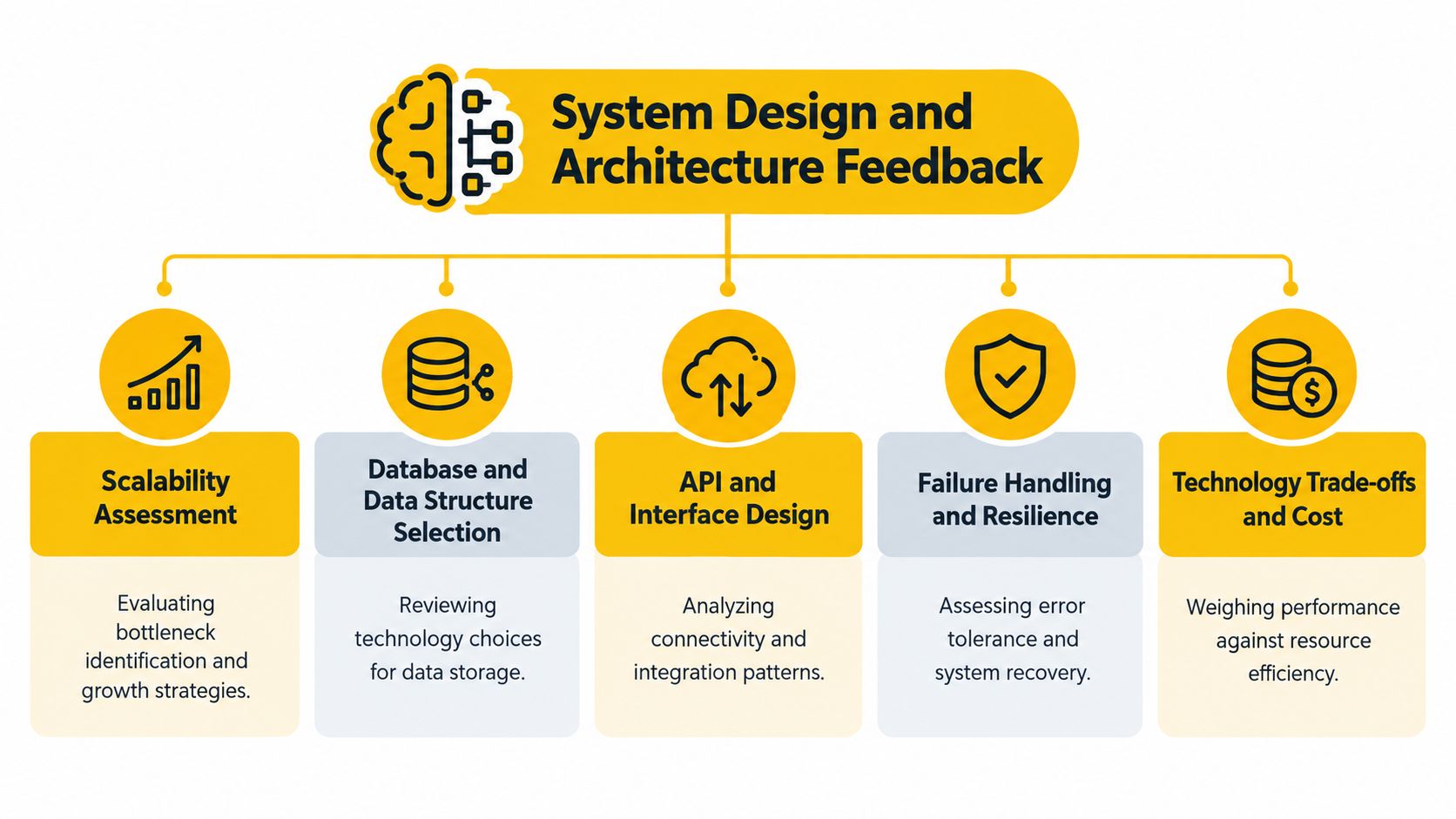
A useful review question is simple: Could the candidate explain how the design behaves when the assumptions stop being true?
4. Behavioral and Communication Skills Feedback
Communication feedback becomes fairer when it describes the interaction rather than the person. “Not confident” may reflect many different observations, including a quiet delivery, an answer that lacked structure, or a failure to respond to the question. Those are different development problems and shouldn't be collapsed into a personality judgment.
Use a concrete incident from the interview. A candidate may explain a production incident with a clear technical diagnosis but omit their own actions and the result. Another may give a detailed answer that never states the decision. A third may respond well to technical follow-ups but use unexplained jargon with a non-specialist stakeholder.
For example:
- Hire: “The candidate explained a complex debugging decision in a clear sequence, acknowledged the team's competing priorities, and adapted the explanation when asked to address a non-technical audience. Their communication supports a hire recommendation.”
- Borderline: “The candidate gave relevant examples but often described team outcomes without specifying their own actions. Follow-up questions produced useful detail, so recommend borderline and verify whether this pattern is limited to interview structure or reflects a broader communication gap.”
- No-hire: “The candidate's answers remained general when asked for a specific incident, and they didn't address the stated conflict or result. Because the role requires clear ownership and cross-functional explanation, the evidence supports no-hire.”
The behavioral-based interviewing framework can help candidates organize responses around situation, task, action, and result. Feedback should still identify the missing component. “Use STAR” is less useful than “describe the action you personally took and the measurable or observable result that followed.”
Language differences require care too. Evaluate whether the candidate conveyed the required meaning, not whether they share the interviewer's accent or preferred style. Interview Pilot states that it supports more than 99 languages, which can make multilingual rehearsal practical, but the evaluator's standard should remain job-related clarity and evidence.
5. Domain Knowledge and Depth Feedback
Domain knowledge is not a trivia contest. A strong assessment distinguishes memorized terminology from the ability to apply concepts to the decisions the role demands.
A fintech candidate might explain how transaction state affects reconciliation, identify a compliance constraint, and describe what could go wrong if an external service returns incomplete data. A healthcare software candidate might connect workflow design with privacy and clinical usability. A data scientist might explain why a model metric fits the business cost of false positives. Each example tests depth through application.
Start the feedback with the level expected. A career switcher may reasonably lack industry experience but still demonstrate strong transfer from adjacent work. A senior specialist should be able to explain consequences, alternatives, and operational trade-offs without relying on prompts.
- Hire: “The candidate connected domain concepts to practical decisions, explained the risks of the proposed approach, and answered follow-ups without falling back on terminology alone. Their depth aligns with the role's current expectations.”
- Borderline: “The candidate demonstrated broad familiarity but gave limited detail when asked how the concepts affect implementation and risk. Recommend borderline because the foundation is present, while applied depth needs verification.”
- No-hire: “The candidate recognized the relevant terms but couldn't explain their operational implications or correct a central misconception. The evidence doesn't support the domain depth required for this position.”
Development advice should name a path, not just a subject. Recommend choosing one workflow in the target industry, mapping its users and failure points, and then explaining the relevant standards or tools in that context. Ask the candidate to research a company-specific challenge and return with assumptions, risks, and questions. That exercise tests independent learning while building the practical depth the role needs.
6. Growth Potential and Learning Capacity Feedback
Growth feedback should never become a disguised judgment about age, background, polish, or personality. It should rely on what the candidate did when they encountered unfamiliar material, received a correction, or had to revise an answer.
During a coding interview, the candidate may not know a library method but can ask a precise question, infer the relevant behavior, and apply the new information. In a system-design discussion, they may accept a constraint, explain how it changes the architecture, and identify what they'd investigate next. Those behaviors provide evidence of learning capacity without requiring the interviewer to predict a career.
A useful distinction is current capability versus response to a learning opportunity:
- Hire: “The candidate lacked familiarity with one component, asked targeted questions, incorporated the explanation, and applied the concept correctly in the next scenario. Their learning behavior supports a hire recommendation for a role with the stated ramp expectations.”
- Borderline: “The candidate accepted feedback and improved the immediate answer, but the interview provided limited evidence of independent transfer to a new problem. Recommend borderline and use a work sample or follow-up assessment to test adaptability.”
- No-hire: “The candidate rejected the stated constraint and repeated the original approach after clarification. The interview didn't show the curiosity or adaptation needed for this role.”
Development guidance can be specific without overpromising. Suggest that candidates practice narrating what they know, what they don't know, and how they'd close the gap. Encourage questions that expose assumptions, such as “What failure mode matters most here?” or “Which constraint should drive the design?” Interview Pilot's mock interview sessions can help candidates rehearse follow-up questions and receive structured guidance, while hiring teams should continue to judge the evidence from their own process.
7. Specific Technical Gap and Remediation Feedback
A technical gap becomes useful only when the candidate can see its boundary and the next practice step. “Improve algorithms” is too broad. “Review graph traversal, implement breadth-first and depth-first search, then explain when each approach changes memory use” gives the person something they can do and a way to check progress.
The feedback should also distinguish a missing concept from an execution error. A candidate may understand joins but misread a schema under time pressure. Another may know the syntax but not understand why an outer join changes the result set. The remediation differs, so the note must preserve that distinction.
Use a compact format:
- Hire: “The candidate showed the required technical foundation and corrected a minor implementation error after testing. No critical gap was observed, though continued practice with failure-mode analysis would strengthen production readiness.”
- Borderline: “The candidate understood the core data-structure concept but couldn't independently select the appropriate traversal under a changed constraint. Recommend borderline, with focused practice comparing graph representations, traversal choices, and complexity.”
- No-hire: “The candidate couldn't explain the difference between the relevant graph traversals or produce a working implementation after clarification. Because this role requires independent use of these fundamentals, the evidence supports no-hire.”
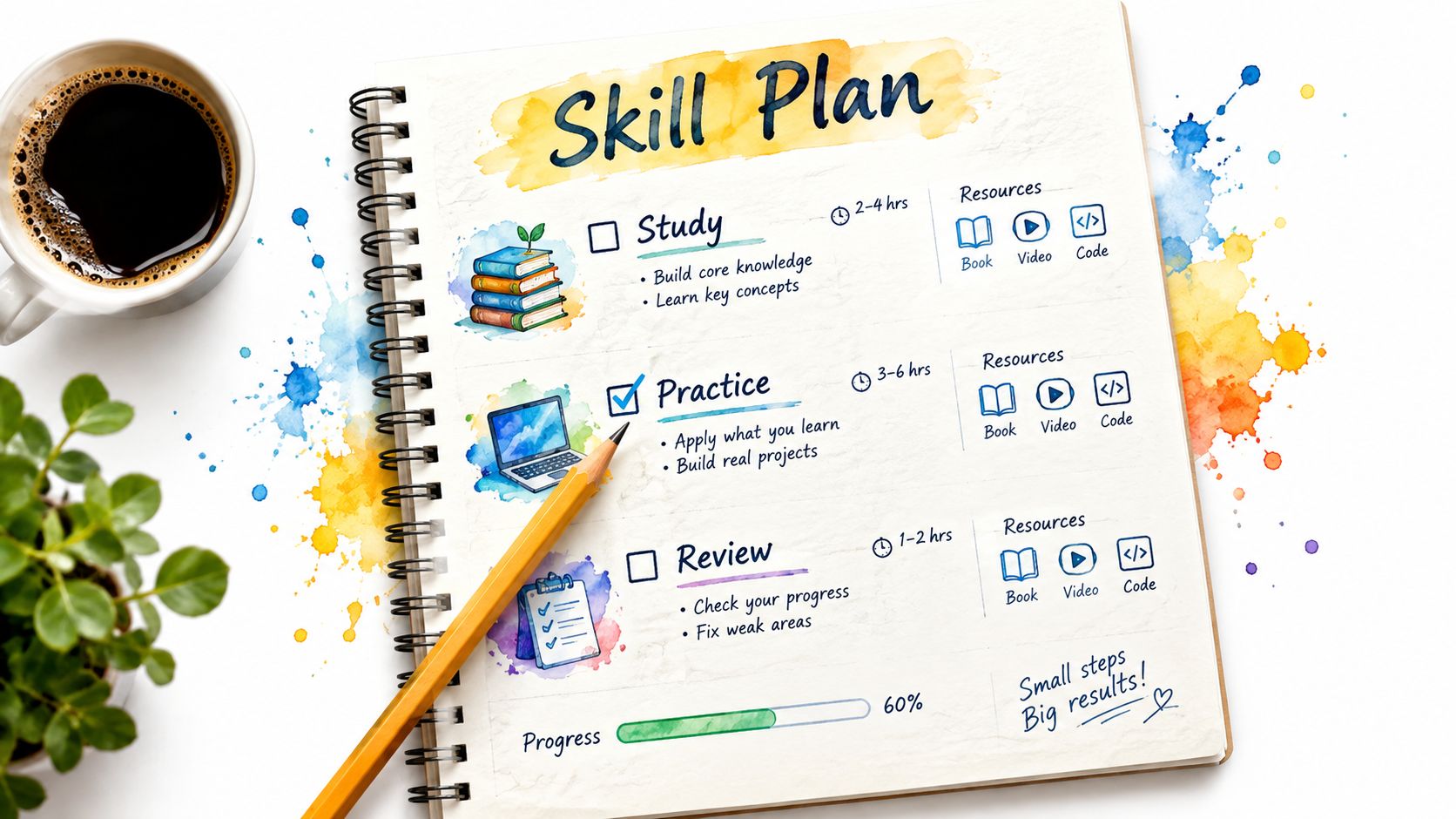
A remediation plan should prioritize the smallest meaningful unit, then combine study with application. For example, review the concept, implement it without copying, solve a related problem, and explain the trade-offs aloud. Avoid unsupported promises about how quickly a candidate will improve. The purpose of feedback is to make the next attempt more informed, not to guarantee an outcome.
For hiring teams, comments should sit beside standardized scorecard data. Useful process measures include time from interview completion to reviewer feedback, scorecard completion, stage conversion, offer acceptance, candidate withdrawal, time-to-fill, and post-hire performance or retention, as outlined in this guide to structured interviews. Those measures help teams test whether their feedback process is timely and consistent, instead of treating isolated impressions as evidence of quality.
7-Point Technical Interview Feedback Comparison
| Feedback Type | Complexity 🔄 | Resources & Time ⚡ | Expected Effectiveness ⭐ | Ideal Use Cases 📊 | Key Advantages / Tips 💡 |
|---|---|---|---|---|---|
| Constructive Code Review Feedback | 🔄 High, line-by-line technical analysis; needs senior reviewers | ⚡ Moderate–High, time‑intensive per review; requires code samples/tools | ⭐ High, clear, actionable improvements to correctness, performance, maintainability | 📊 Software Engineering, Data Engineering, Technical Leadership | 💡 Balance praise/critique; show snippets and pattern-level guidance |
| Problem-Solving Process Evaluation Feedback | 🔄 Medium, assesses reasoning, decomposition and communication | ⚡ Moderate, requires time to observe verbal reasoning; minimal tooling | ⭐ High, improves structured thinking and interview presentation | 📊 Consulting, Product Management, Data Science, Business Analysis | 💡 Encourage candidates to verbalize; teach frameworks and validation steps |
| System Design and Architecture Feedback | 🔄 Very High, deep trade-off analysis and architectural critique | ⚡ High, needs diagrams, case studies, and experienced evaluators | ⭐ High (for senior roles), reveals scalability, resilience, trade-off maturity | 📊 Senior Software, Infrastructure, Solutions Architecture | 💡 Use diagrams; tailor depth to experience; focus on trade-offs and evolution |
| Behavioral and Communication Skills Feedback | 🔄 Low–Medium, qualitative, subjective but straightforward to observe | ⚡ Low, quick to assess in conversation; low tooling overhead | ⭐ Moderate–High, boosts cultural fit and collaboration effectiveness | 📊 All roles, Cross-functional positions, Leadership tracks | 💡 Use STAR; focus on phrasing and listening; give concrete practice items |
| Domain Knowledge and Depth Feedback | 🔄 Medium–High, requires domain expertise to judge relevance | ⚡ Moderate, needs domain materials and role-specific references | ⭐ High for specialized roles, identifies critical knowledge gaps | 📊 Finance, Healthcare, FinTech, Data Science, Specialized engineering | 💡 Recommend focused resources; emphasize depth over breadth; acknowledge learning curve |
| Growth Potential and Learning Capacity Feedback | 🔄 Medium, subjective; best assessed over multiple interactions | ⚡ Low–Moderate, can be tracked across sessions with follow-up | ⭐ Moderate–High, predicts long-term adaptability and trajectory | 📊 Early-career, Career switchers, Graduate hires, Growth-focused orgs | 💡 Assess quality of questions, receptiveness to feedback, and past learning examples |
| Specific Technical Gap and Remediation Feedback | 🔄 High, root-cause diagnosis and prioritized remediation plan | ⚡ Moderate–High, requires curated resources, exercises, and timelines | ⭐ Very High, highly actionable; accelerates targeted improvement | 📊 All technical roles, Especially for reattempts and focused prep | 💡 Be specific (topics, resources, time estimates); provide practice with success criteria |
Turn Interview Notes Into a Fair, Useful Decision
Good notes don't need to be long. They need to make the reasoning visible. Before submitting feedback, edit every sentence against four questions: What did the candidate do? Why did it matter for this role? What decision signal does it provide? What should happen next?
Remove assumptions about motivation, confidence, culture, or intelligence unless the note describes a job-related behavior that supports the interpretation. Replace “weak communicator” with “the candidate gave a technically accurate answer but didn't explain the decision or respond to the stakeholder constraint.” Replace “not senior enough” with the missing evidence, such as limited ownership of trade-offs or inability to discuss operational consequences.
Calibrate the recommendation to the role level. A candidate can be a hire for an entry-level position and a no-hire for a staff role based on the same performance. The decision should reflect the job's expectations, not an abstract standard of technical excellence.
A compact final note often needs only four parts:
- Decision sentence: State hire, borderline, or no-hire and name the central reason.
- Evidence observation: Describe the strongest behavior that supports the recommendation.
- Evidence limitation: Identify the unresolved gap, if one remains.
- Development action: Give one specific practice or verification step.
Structured feedback matters because candidates want clarity, and unstructured impressions are less reliable for predicting performance. A 2024 benchmark cited in technical interview feedback guidance found that 48% of rejected applicants didn't understand why they weren't selected, while 78% wanted specific feedback. The same guidance cites predictive validity of .51 for structured interviews versus .38 for unstructured interviews, so a consistent process benefits both candidate communication and hiring judgment.
You can use Interview Pilot to rehearse role-specific questions, practice clearer explanations, and work through follow-up prompts. It can support preparation, but it isn't a substitute for evaluator judgment, calibrated scorecards, or direct evidence. For teams managing related marketing resources, manage link-in-bio with Captapi offers a separate way to organize that workflow.
Feedback also affects how candidates assess themselves after an interview. Peer-reviewed research found that interviewer feedback was positively related to interview self-efficacy after the feedback session, which reinforces the value of concrete observations and practical next steps in place of vague approval or rejection. A respectful note can still say no. It should leave the candidate knowing what happened and what to do with that information.
Interview Pilot offers AI mock interviews, role-specific question practice, and real-time response support across technical and non-technical interview scenarios. Use it to rehearse coding explanations, system-design trade-offs, and behavior-based answers, then visit Interview Pilot to prepare with a more structured practice routine.
Topics
technical interview feedback examples
interview feedback
technical hiring
feedback templates
interview evaluation
Continue reading

Interviews
10 Technical Interview Java Questions to Master
Prepare for technical interview Java questions with 10 practical problems, expected approaches, code examples, complexity analysis, and common traps.
September 29, 2026
3 min read

Interviews
Mock Interview Meaning: A Practical Guide to Rehearsing
Learn the mock interview meaning, how simulated interviews build confidence, the main types, and how to practice effectively before your next real interview.
September 29, 2026
16 min read

Interviews
10 Interview Questions Coding Patterns to Master
Master 10 interview questions coding patterns with sample solutions, complexity analysis, common mistakes, and practice strategies for technical interviews.
September 28, 2026
23 min read