
















Interviews
What Is a Technical Interview? Formats and How to Prepare
What is a technical interview? Learn the formats, what employers assess and how to prepare for coding and system design rounds.
Interview Pilot Editorial Team
Updated November 18, 2026
15 min read
A technical interview is a structured evaluation in which a candidate solves a programming or engineering problem while explaining their reasoning aloud. It's rarely a one-off event: 82.4% of 108 candidates surveyed in 2025 had completed at least one technical interview, averaging three and a median of four apiece.
Your inbox probably holds an invitation that says "60-minute technical screen" and not much else. No mention of what gets scored, whether you'll have an editor, or whether the round involves coding at all. You've solved hard problems before. What's different is doing it while someone watches and listens.
Most explanations of what a technical interview is stop at the definition and leave you to guess the rest. That leaves the biggest gap untouched, which is the distance between what the round is called on the invitation and what the interviewer writes down afterward.
This walkthrough closes that gap. Definition first, then the formats you'll meet, the signals interviewers score, where the process stays ambiguous, and a preparation sequence you can start this week.
What a Technical Interview Is and Why Employers Use It
A technical interview is a structured evaluation in which a candidate solves a programming or engineering problem while explaining their reasoning aloud. That second clause carries the weight. A conversation about your past work asks for history; a technical interview asks for live thinking on a problem you haven't seen, and it asks you to make that thinking visible while you build it.
The arXiv study of technical-interview preparation frames the format as several abilities tested simultaneously: technical knowledge, algorithmic or computational problem-solving, communication, and the capacity to work through an unfamiliar problem under observation. Any one of those is manageable alone. Stacked together under a clock, they're why a strong engineer can still have a bad round.
The driving-test comparison holds up better than most. Picture a road test where the examiner asks you to narrate every mirror check. Parking correctly gets you moving, but narrating what you saw, why you checked when you did, and what you'd do if a cyclist appeared is what goes on the score sheet. A silent, perfect park tells the examiner almost nothing about how you'll drive on a wet Tuesday.

Traditional formats deliberately strip your tools. You get a whiteboard, a shared document or a bare online editor rather than a normal development environment, which removes autocomplete, your test suite and the project you know inside out. What's left is how you build from nothing.
The word describes a process, not a single question. The same study found 108 participants, 82.4% of its sample, had completed at least one technical interview, with participants averaging three and a median of four. Multiple screens, coding exercises and onsite or virtual rounds are normal, and Facebook, Google and Microsoft all run the format, which is why it sits at the center of engineering recruitment rather than at its edges.
For you, the practical consequence is simple. Success depends on producing a valid solution and on making the approach followable. Plan for several rounds, and prepare for the specific one in front of you.
Technical Interview Formats Compared Side by Side
| Format | What You Do | Typical Length | What It Tests |
|---|---|---|---|
| Phone or screening call | Answer technical questions and talk through a small problem | 20-30 minutes | Basic knowledge and communication |
| Live coding | Write code in a shared editor while explaining each step | 45-60 minutes | Coding fluency and problem-solving under observation |
| Whiteboard | Sketch the solution on a board or document without an IDE | 30-45 minutes | Structure and reasoning without tools |
| Take-home assignment | Build a small project on your own time | 2-6 hours | Practical coding and code quality |
| Pair programming | Work through a problem alongside an interviewer | About 60 minutes | Collaboration and response to feedback |
| System design | Outline the architecture of a large system | 45-60 minutes | Trade-offs, scaling and communication |
Read that table as a warning about labels. Two companies can post the same job title and mean completely different things by "technical interview," so identify the format before you open a single practice problem.
Live coding is the most common and the most misunderstood. You're writing in a shared editor, and the interviewer is watching you type, delete, and change your mind. The code matters, but so does the running commentary that tells them why the second approach replaced the first.
Whiteboard rounds remove the environment entirely. Nothing compiles, so nobody expects perfect syntax. Interviewers are reading structure: how you decompose the problem, which cases you name out loud, whether your pseudocode survives a walkthrough.
Take-home assignments give you hours and your own tools, which sounds generous until you remember the reviewer sees only the artifact. Clean naming, a short README explaining trade-offs, and tests that run matter more than cleverness.
Pair programming is the round where being corrected is the point. When the interviewer says "what if the list is empty," they're measuring whether you absorb the hint or defend the original design.
System design usually arrives for mid-level and senior candidates. You'll be asked to sketch something large, and the scoring is almost entirely about trade-offs and communication. This guide to preparing for a system design interview covers the structure those rounds reward.
Say you're a backend engineer facing a 60-minute live round. Realistically you get one algorithmic problem with a follow-up debugging question, which means you should budget the first five minutes for clarifying questions and the last five for testing rather than coding until the buzzer.
Ask the recruiter four things before you prepare:
- Which format each round uses. Get it per round, not for the process as a whole.
- How long each round runs. A 30-minute screen rewards a different pace than a 60-minute coding session.
- Which tools are allowed. Editor, whiteboard, documentation, or an AI assistant.
- Who is interviewing. A peer engineer asks different questions than a hiring manager.
Ask early: format questions cost the recruiter two minutes and save you a week of preparing for the wrong round.
How a Technical Interview Unfolds from Start to Finish
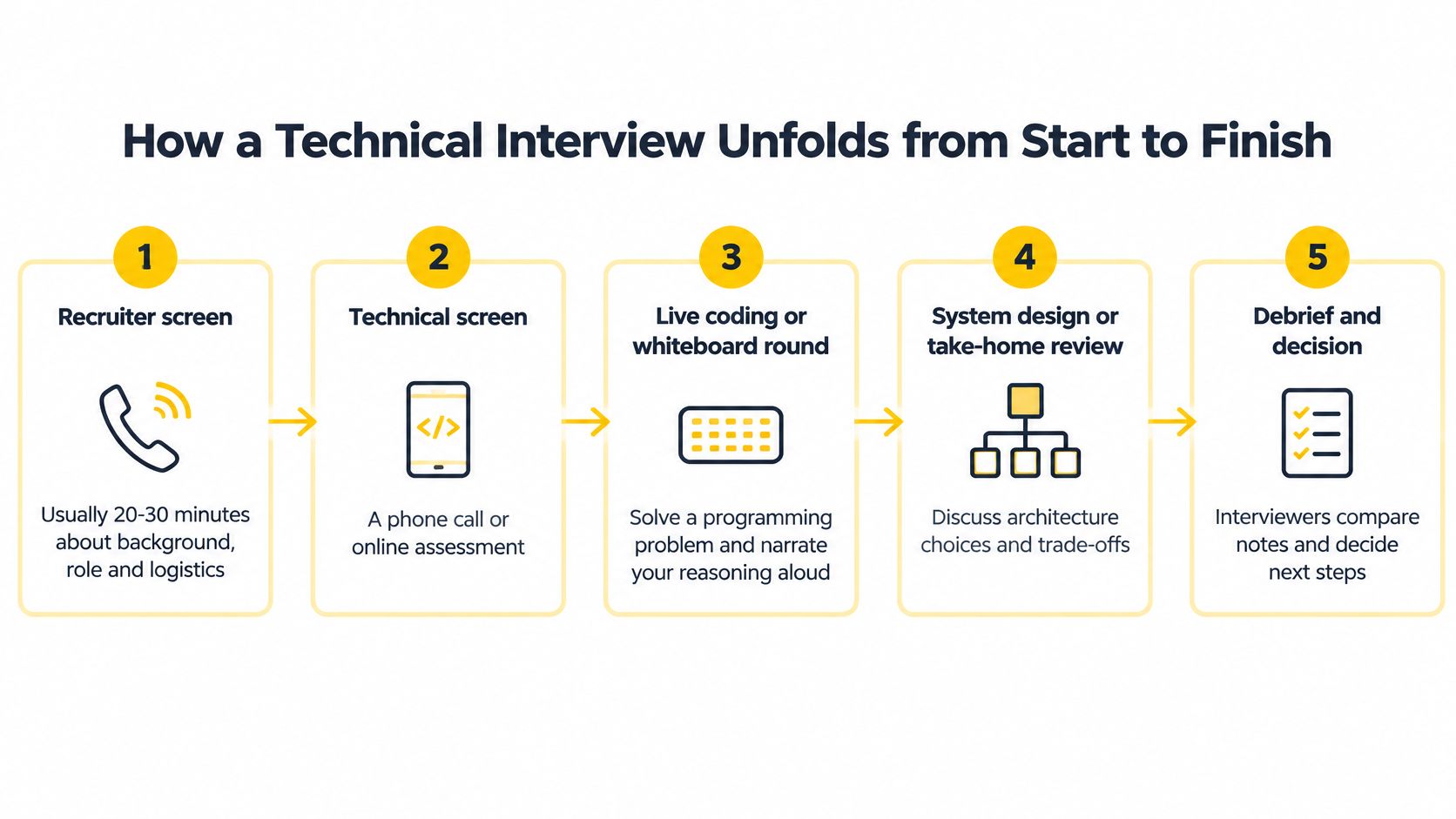
Most loops follow the same five stages, with the length of each one varying by company size and seniority.
- Recruiter screen. Usually 20-30 minutes covering your background, the role and logistics. The recruiter is checking fit and timing, not your algorithm skills, so spend the time asking your format questions.
- Technical screen. A phone call or an online assessment. This is the first real signal the company gets, and it's usually designed to be passable by a competent engineer without weeks of drilling.
- Live coding or take-home exercise. The round where code gets written and discussed.
- Onsite or virtual loop. Several interviewers back to back, often a half day. Each one usually owns a different competency.
- Debrief and decision. Interviewers compare notes and decide.
The step most candidates don't see is the debrief. Interviewers typically score their own rounds independently before the group meets, which means one brilliant round rarely rescues a weak one. Every interviewer holds a veto of sorts, and they cast it separately.
Some loops include an engineer from the team you'd join. That round is your best chance to ask what the work looks like week to week, and interviewers notice when a candidate is curious rather than merely compliant.
Then comes the wait. Gaps between rounds run from a few days to several weeks depending on how quickly the panel can be assembled. Ask the recruiter what the next step is and when you should expect to hear, then write down what they tell you. Chasing a decision politely is normal; guessing at one is not.
If you want to see the rhythm of a live round before your own, watch one play out in full.
What Employers Actually Assess in a Technical Interview
Weight is the first thing to understand. In 2025, 54% of 222 engineering leaders surveyed by CodePath ranked technical interviews among their top three signals for assessing candidate readiness, according to CodePath's survey of tech hiring. More than half the people making hiring decisions treat this format as one of their strongest pieces of evidence.
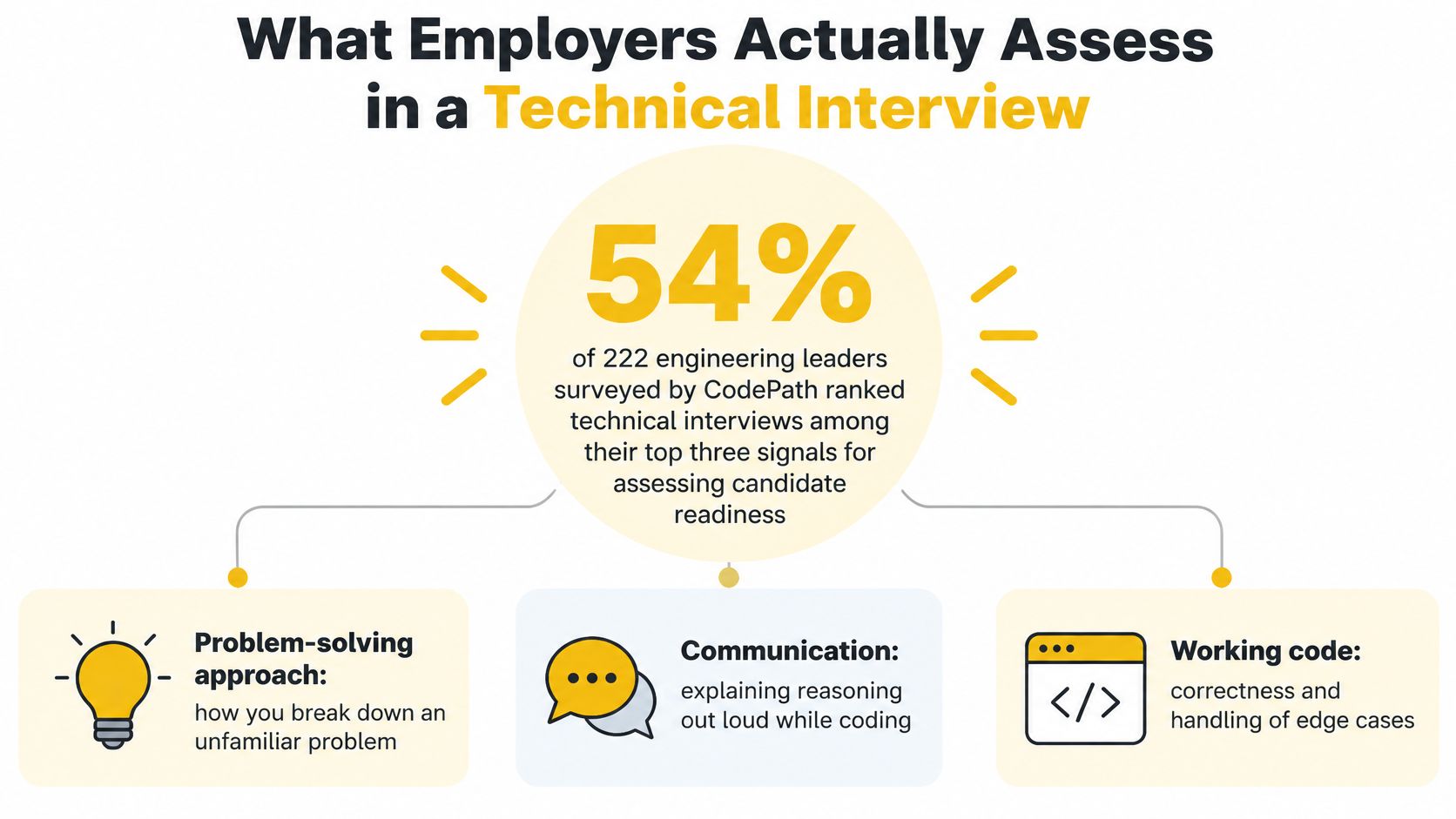
So what lands on the score sheet? Most companies use some version of these six signals:
- Problem-solving approach. Do you restate the requirements, name assumptions, and recognize a familiar pattern before typing?
- Code correctness and clarity. Does it work, and could a colleague read it without you narrating?
- Communication. Can you explain a trade-off in one sentence, or do you trail off when the design gets interesting?
- Debugging and testing habits. Do you reach for edge cases before declaring victory, or after being prompted?
- Collaboration. How do you handle a hint? The interviewer offering one has usually already decided you're stuck, and is now watching how you recover.
- Learning ability. When you're wrong, do you adjust quickly or defend the first idea?
Here's where the process stays ambiguous. Two companies can run a round called "coding" while scoring different things: one wants a working solution in 40 minutes, the other wants to hear you reason about complexity and never finish. Reading a few technical interview feedback examples makes the variance concrete, because the same candidate performance gets described in wildly different language.
Two candidates show why this matters. The first solves the problem correctly in near silence, tests nothing, and says "done" with eight minutes left. The interviewer can't reconstruct the reasoning well enough to score it, so the round comes back lukewarm. The second gets halfway, but states the assumption behind every step, tests an empty input and a duplicate, and explains what they'd do with more time. That second candidate often scores higher, because the interviewer now has evidence of judgment rather than a finished file.
Solving in silence is a gamble. You're betting the interviewer will reverse-engineer your reasoning from the diff.
Before you prepare, ask the recruiter which signals that round weighs most. The answer changes what you practice.
Common Misconceptions and the Role of AI Tools
A candidate can arrive ready to code and discover that the round is a discussion about a past project. The invitation's label tells you the format, but not necessarily what the interviewer will score. Prepare for the signals the round is designed to reveal.
- “Memorize enough algorithms and you'll pass.” Knowing common patterns helps, but the interviewer may change a constraint or ask you to explain a trade-off. Your response to that change can matter as much as recalling the pattern.
- “A technical interview is always a coding quiz.” Some rounds focus on design decisions, experiments, or past work, with no editor involved. The format can vary even when the round has a technical label.
- “More practice always means better results.” Repeating problems without reviewing your reasoning can reinforce the same habits. Practice is more useful when you notice where your explanation becomes unclear and work on that specific gap.
- “AI tools are either banned or allowed.” Rules depend on the company and may differ between interview rounds. Confirm the policy for the round you're taking.
Some interview formats may allow AI as part of the work. If it is permitted, the interviewer still needs to assess your judgment: whether you can check an answer, spot a missed requirement, and explain your decisions. Follow the stated policy rather than assuming that a tool is allowed or prohibited.
A policy checklist that keeps you safe
- Confirm whether AI is permitted in that specific round.
- Disclose its use if the policy requires it, and explain what you used it for.
- Check generated output before presenting it as your answer.
- Show your reasoning: clarify requirements, test the result, and review it for problems.
For example, a candidate pastes an AI-generated function that passes the sample input but fails on an empty list. Finding the boundary case, explaining the failure, and correcting it show more than presenting the generated function as finished.
AI practice tools can also give inaccurate feedback or struggle to reproduce the flow and timing of a conversation. Use them to rehearse, then ask a person to review how clearly you explain your reasoning. Treat automated feedback as one perspective, not a verdict.
Prepare Step by Step and Confirm the Format First
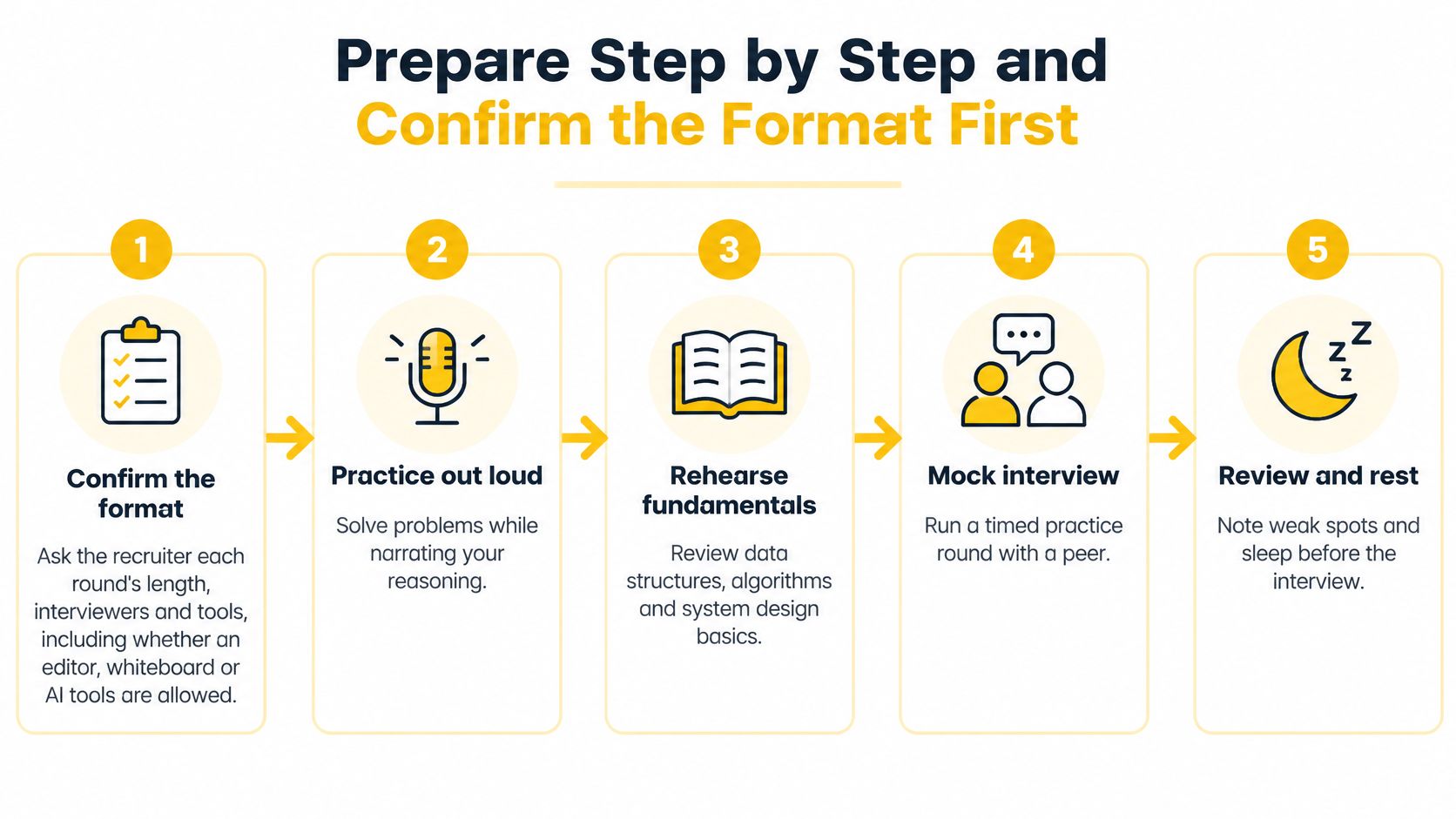
A candidate can solve the right problem in the wrong setting. If you prepare to write code alone but the interview uses a shared editor and expects you to explain each decision, the format changes what the interviewer can observe. Confirm the setup before choosing how to practise.
- Ask about each round's format, length, and tools. Check whether you will use a shared editor, whiteboard, or other platform, and whether AI tools are permitted. Keep the answers where you can review them.
- Choose 10 to 15 representative problems for the role. For software roles, practise arrays, strings, trees, and graphs. For data roles, include SQL, window functions, and statistics. Use the job description to guide your choices. This coding interview preparation guide offers a sensible order for reviewing fundamentals.
- Solve problems aloud on a 45-to-60-minute timer. Explain your plan, assumptions, and trade-offs as you work. If you get stuck, describe what you have tried and what you would check next.
- Run the code and test edge cases. Check empty input, a single element, duplicates, and the largest case you can reasonably define.
- Review your notes or recording. Look for moments when your explanation became hard to follow, especially the transition from describing an approach to writing code.
- Rehearse once in a realistic setup. Use the same editor, timer, and screen-sharing arrangement you expect in the interview.
Practising familiar question patterns can help. An analysis of approximately 3,000 technical interviews found that candidates who had previously seen the question were 16.6% more likely to be judged hirable, a statistically significant result at p < 0.001, according to interviewing.io's analysis of technical interview data. Familiarity helps you recognize a pattern, but the interviewer still needs to see how you reason through the problem in front of you.
The analysis also compared successful and unsuccessful candidates on several coding measures:
Successful versus unsuccessful candidates in roughly 3,000 technical interviews
| Measure | Successful candidates | Unsuccessful candidates |
|---|---|---|
| Final code length (characters) | 2,045 | 1,760 |
| Code ran without errors | 64% | 60% |
| Average function definitions in Python interviews | 3.29 | 2.71 |
| Average interview length (minutes) | 51.00 | 49.95 |
Interview length was similar for both groups. The reported differences included whether code ran and how it was organized into working pieces. Treat those figures as observations from the analysis, not as targets to hit: a longer solution is not automatically a better one.
Before a remote interview, use a second device for a two-minute setup check. Confirm what appears in the shared screen, whether your audio is clear, and whether your editor text is readable. Interview Pilot offers AI mock interviews with an evaluation of your answers; use that feedback as one input, then ask a person to review your reasoning as well.
Practising explanations aloud also helps you organize your thinking before you speak. The idea of structuring a response appears in other interview contexts, including answer frameworks for SDR interviews, but a technical answer needs to make its assumptions, method, and checks clear. Keep problem notes in a document you can review before the call.
Avoid memorizing solutions you cannot explain. A familiar answer may work until the interviewer changes a constraint; then you need to reason through what changes and why.
Interview Pilot cannot guarantee an offer, a stronger score, or a recruiter response. Focus on what you can control: clear explanations, careful testing, and practice that matches the format you expect.


Topics
technical interview
coding interview
interview preparation
software engineer interview
technical interview formats
Continue reading
Interviews
English Interview Practice: A Weekly Plan That Works
Learn how to do English interview practice with a weekly plan, a scoring rubric and mock drills that build fluency and clear answers.
November 14, 2026
16 min read
Interviews
One Way Video Interview: What Candidates Should Expect
One way video interview explained: how it works, why employers use it, and how to prepare and check privacy before you record in 2026.
November 14, 2026
16 min read
Interviews
8 Zoom Interview Tips for Looking Confident on Camera
Discover 8 practical Zoom interview tips on setup, lighting, audio, eye contact, screen sharing, and mock practice to sound confident on camera.
November 14, 2026
20 min read