
















Interviews
English Interview Practice: A Weekly Plan That Works
Learn how to do English interview practice with a weekly plan, a scoring rubric and mock drills that build fluency and clear answers.
Interview Pilot Editorial Team
Updated November 14, 2026
16 min read
In 2024, 80% of surveyed second-language English speakers said English proficiency was directly related to income potential, according to the Pearson survey summarized by ICEF Monitor. That is the honest frame for interview preparation. The language work is not academic, it is commercial.
The scale behind that number is larger than most candidates assume. English is used at a functional level by approximately 1.75 billion people, about one in every four people on the planet, according to the British Council's English Effect report, and non-native speakers substantially outnumber native ones. The person interviewing you is often a second-language English speaker too.
Most candidates respond to that pressure by rehearsing more answers. The answer count is rarely the problem. What fails is the loop around the answer: nobody scores it against fixed criteria, nobody separates an accent issue from a content issue, and nobody checks whether an automated system heard the words at all.
A Weekly Practice Plan You Can Start Today
Five sessions across seven days, roughly 105 minutes in total, is enough to build a working loop if every session has exactly one job. Print the plan and tick sessions off. The outputs matter more than the minutes.
| Session format | Minutes | Focus | Output |
|---|---|---|---|
| Single-question drill | 15 | One behavioral question, 2-3 minute answer | Recorded answer and one revised version |
| Rubric review | 20 | Score the recording against six criteria | Two weakest criteria noted |
| Targeted rehearsal | 15 | Rehearse only the fix from the review | Revised answer delivered in 60-120 seconds |
| Full mock interview | 45 | Five questions with follow-ups, no notes | Score compared with the baseline |
| Listening and summary | 10 | Listen to the own answer and summarize it | Key words replayed and marked clear or unclear |
The single-question drill and the rubric review carry most of the value, because the first produces evidence and the second converts it into a target. A full mock with no scoring is a rehearsal of nerves, not of skill. The meta-analysis of interview structure by McDaniel and colleagues pooled 245 validity coefficients from 86,311 individuals and found mean corrected validity of about 0.63 for structured interviews against 0.20 for unstructured ones. That gap is the strongest available argument for practicing under consistent, scored conditions instead of chatting with a fluent friend.
Treat pronunciation as an intelligibility problem inside that structure. During the listening session, replay the answer and write down the words a tired interviewer might still catch: company names, numbers, verbs of action, and the final result. If “led” comes back as “read,” or “reduced churn” comes back as “reduced turn,” mark it as a pronunciation repair. If the words are clear but the story is thin, mark it as a content repair. Before rewriting any weak answer from the mock, compare the transcript with the answer you meant to give; when a system misheard the words, fix delivery first rather than replacing good evidence.
A question bank is a starting point, not a promise. Interview Pilot's question content may come from public materials, user submissions, internal examples or generalized interview patterns, and it does not guarantee that any question has been or will be asked by a specific company or interviewer. Use a bank for question shapes, then fill them with your own evidence.
Practical rule: if a session produces no artifact, meaning a recording, a score or a revised answer, it didn't happen.
Choose the first week's focus from the question type most likely to appear in the target role, then lock the full mock on day five. Days one to four create the baseline that day five gets compared against, and without that comparison you have a feeling about your performance rather than a measurement of it. For the wider professional-development side of a job search, DELTA and professional development reads are a useful companion while you build the routine.
Scoring Each Answer With a Clear Rubric
The fastest way to waste a week is to listen to your recording, decide it sounded fine, and move on. An overall impression hides whether the problem was content or language, and those two need completely different fixes. A candidate with sharp examples and broken grammar needs sentence drills. A candidate with clean grammar and vague answers needs evidence, not pronunciation work.
| Criterion | What good looks like | Metric to track |
|---|---|---|
| Content relevance | Answer names a concrete situation and result | Relevant examples per answer |
| Logical sequencing | Structure follows situation, action, result | Signposts used per answer |
| Grammatical control | Errors do not block meaning | Grammar breakdowns per minute |
| Pronunciation intelligibility | A listener can repeat key words correctly | Number of repeat requests |
| Response fluency | Speaks without long freezes | Longest pause in seconds and uninterrupted speaking time |
| Filler words | Few um, uh or like | Filler rate per minute |
Score each criterion from 1 to 4, then apply one rule: any criterion at 2 or lower becomes the single learning goal for the next session. That rule kills the most common self-coaching mistake, which is trying to fix six things at once and finishing the week with none of them fixed.
Weight the scores by what the interviewer is buying. Content relevance outranks a small accent or a grammar slip in almost every real hiring conversation, because a hiring manager can work around an accent but cannot work around an answer with no evidence in it. Judge a behavioral answer by whether a stranger could repeat your situation, your action and your result back to you.
Count instead of guessing. Tally relevant examples per answer (one solid one beats three thin ones), signposts per answer, grammar breakdowns that made a listener lose the thread, repeat requests, the longest pause in seconds, and fillers per minute. Numbers make progress visible across sessions in a way that "that felt better" never will.
Get a second listener for two criteria only, intelligibility and content relevance. Ask them to summarize your answer, then count what they got right.
Running Each Practice Session and Mock Interview
Deliberate practice is the frame that makes this schedule work, and the research on deliberate-practice training describes the same loop in every version of it: record a performance, get individualized feedback, set a concrete goal, rehearse the behavior, repeat. Feedback plus targeted repetition does the work. Unstructured mock interviews on a loop mostly burn hours.
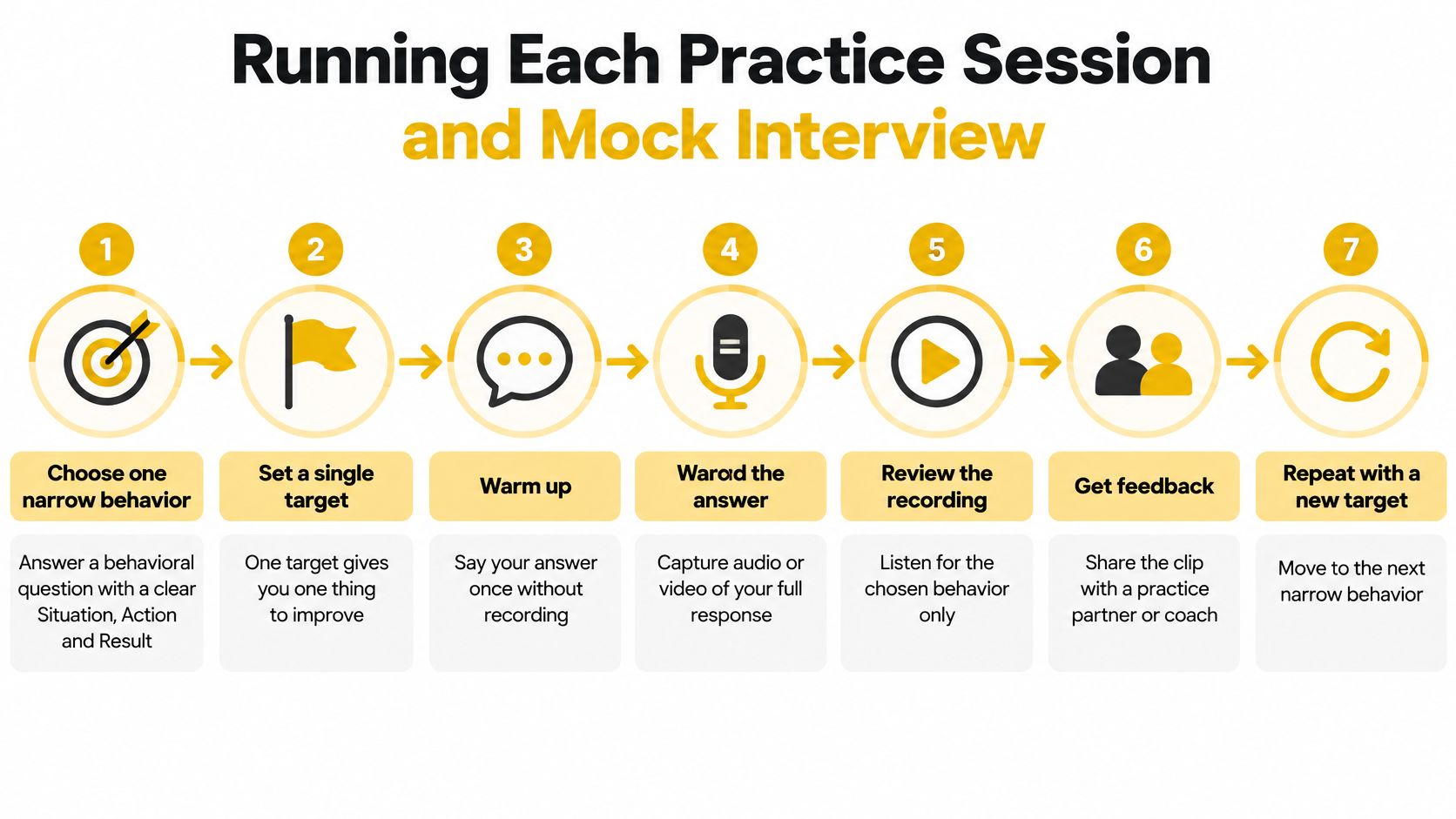
Here is the cycle as one procedure, run in a single sitting.
- Pick one narrow behavior. Answering a behavioral question with a clear situation, action and result is the default choice. One target gives you one thing to improve.
- Record a 2-3 minute answer on your phone. A timed recording stops you from relying on the version of the answer that exists only in your head.
- Score it against the six criteria. A general feeling about how the session went hides which criterion failed.
- Turn the weakest criterion into one concrete goal. "Open with the result" is a goal. "Be more confident" is a wish.
- Rehearse the revised answer aloud twice before you record it again.
- Get feedback the same day. Delayed or vague notes are the most common reason practice stalls.
- Repeat with a new target once the current one holds under an unseen question.
Rehearse for the question you have never seen
The benchmark that matters is an unseen but related question answered in 60 to 120 seconds while keeping the structure. A memorized script collapses the moment the interviewer rephrases the prompt. Four pitfalls waste most practice time: practicing only full interviews, accepting delayed or vague feedback, correcting every language error in one pass, and polishing grammar at the expense of concise evidence.
For the full mock, use a repeatable protocol taken from the mock interview study published in the Journal of University Teaching and Learning Practice: run a baseline under realistic time limits with role-specific and behavioral questions plus follow-ups, record audio or video, score every response with the same rubric, identify the two highest-impact deficiencies, rehearse corrected answers, and re-score after several sessions. If you'd rather not build the whole thing yourself, running a mock interview online with a structured set of prompts gets you a recorded baseline faster.
After each session, log the rubric score and your two weakest metrics, whether that was answer latency, filler rate or a thin example. The trend line across sessions matters more than any single recording. Then run an intelligibility check: if you practice with an automated tool or transcribe the audio, read the transcript for key words the system mangled. A misheard term marks where your pronunciation broke, and it tells you to fix delivery before you spend effort rewriting an answer the listener never received.
Stay honest about the evidence. Mock interview research leans on small educational samples, and some participants in those studies warned that simulations can lack realism. Treat confidence as a soft outcome and keep scoring every answer against the rubric, because perceived readiness and proven performance are different things.
What to judge progress by: whether a question you have never seen gets a clearer, more relevant answer than last week. Smooth delivery on a script you have said ten times proves nothing.
Common English Interview Questions to Rehearse
Ten to fifteen questions is a rehearsal bank. Forty is a hobby. Build the bank from five question shapes and match it to the target role, then rotate so the answers stop sounding pre-written.
| Question type | Example question | What it tests |
|---|---|---|
| Behavioral | Tell me about a time you resolved a conflict on a team | Concrete situation, action and result |
| Background | Tell me about yourself | Concise two-part summary of role fit |
| Motivation | Why do you want to work here | Specific knowledge of the company and role |
| Strengths and weaknesses | What is your biggest weakness | Honest weakness with a concrete fix |
| Situational | What would you do if a client disagreed with your plan | Stated steps and clear reasoning |
Each shape has its own answering logic. Behavioral questions want one story told in order, situation then action then result, in roughly a minute. Background questions need a two-part summary, your current role and why it fits this job, capped at about 90 seconds because the interviewer will ask follow-ups anyway. The full set of standard prompts and how strong answers are structured is worth working through in the common job interview questions and answers guide.
Motivation questions are where preparation shows. "I admire your culture" is filler. A specific detail about the company's product, market or recent move, tied to the work you'd do, is evidence that you read something before applying.
Weakness questions reward structure, not confession. Pick one real weakness, name the concrete step you're taking about it, and say what has changed. Situational questions want steps and reasoning, not a guaranteed outcome, so state your order of operations and what you'd check before acting.
Rephrase every question two ways in your notes, because interviewers rarely use your rehearsal wording. Keep a one-line log of the evidence attached to each prompt so you don't tell the same story three times in one interview.
Making Your Accent Understood Instead of Erased
Erasing an accent is the wrong goal, and the evidence says the effort doesn't pay off the way candidates hope. A 2025 meta-analysis of accent bias in hiring found accent bias persisted across interview formats, with no statistically significant difference between audio-only and audio-video interviews. Turning the camera on does not neutralize it.

The same body of work found that the degree of perceived accentedness didn't reliably predict the size of the hiring bias. Speaking slower, or flattening your vowels toward a generic American or British model, doesn't reliably shrink the disadvantage. What moves is intelligibility: whether a listener can extract your evidence accurately and quickly.
That reframe changes the drill. Work on signposting first, with phrases like "my answer has two parts" or "the result came from one decision". Then short sentences. Then deliberate pauses placed before the key fact, not scattered randomly. Then confirmation checks such as "do you want the technical detail or the business result?" These give the listener control and buy you thinking time.
Keep a small set of recovery phrases loaded: "let me rephrase that", "I'll say the number again", "the short version is". If an interviewer asks you to repeat something, resist apologizing twice. Say the sentence again more slowly and restate the key fact at the end. Defensiveness costs more in perceived competence than the accent does.
Accent drill: record the same answer twice, once in long sentences and once cut into short ones. Play both to a listener and count which version they can repeat back correctly. Keep the version that survives.
Word choice carries more of the load than vowel sounds, so a short, field-specific interview vocabulary list earns more interview points than an accent app. Vocabulary you can pronounce imperfectly still transmits the fact; a word you don't have at all transmits nothing.
Watching a delivered answer before your own recording helps calibrate what "clear" sounds like from the outside, which is hard to judge on your own voice.
The goal is never sounding native. It's making your evidence, your reasoning and your role fit easy to evaluate, in your own voice, with your own name attached to it.
Checking Whether an Automated Interviewer Heard You
Before you rewrite a good answer, confirm the system transcribed it. Speech recognition is not neutral across accents. A 2025 report on AI hiring and interview technology found speech-recognition error rates averaging below 10% for US English speakers, rising to approximately 12% to 22% for non-native speakers with accents. That range is wide enough to lose a number, a tool name or a result.
The diagnostic is simple and takes one sitting.
- Record the answer you intend to give and run it through a transcription tool, or use the platform transcript if the interview provides one.
- Compare transcript with recording and mark every misrecognized word.
- Sort the errors by consequence. Numbers, names, dates, tool names and results carry your evidence; articles and prepositions don't.
- Re-record in two forms, one with short sentences and one with longer ones, and repeat each key fact once. See which version transcribes correctly.
- If a human listener understands you but the transcript fails, fix delivery rather than content: slow down on key nouns, spell out names, pause before the result, avoid stringing three numbers into one clause.
- Re-record and compare transcripts again, and keep the version that survives both the human and the machine.
Keep this check separate from your rubric scoring. A transcription failure is not evidence that your answer was weak, and rewriting solid content because an automated system misheard one sentence throws away good work.
Clear English, in this context, is an interaction with imperfect recognition technology as much as a language skill. Practice both.
Start Your First Practice Session This Week
In 2025, 56% of global TOEIC Speaking test takers reported taking the test for job-application purposes, according to ETS. You are not doing something unusual by treating spoken English as a hiring asset. The only question is whether this week's practice produces evidence.
Today, do one thing. Open the question set that matches your target role, whether that's software engineer, data analyst, product manager, consulting, investment banking or one of the other sets we cover, and pick three questions of different types.
Filter by Question Type, such as Behavioral, Technical or Leadership, so the first session isn't five behavioral prompts in a row. Then run one single-question drill with a timer and a recording, score it against the six criteria, and write down your two weakest criteria as the baseline.
If you want a second opinion on that recording, our AI mock interviews come with an evaluation of your answers. Use it after your own rubric pass, not instead of it, because the point of scoring yourself first is that you learn to hear the gap.
Your decision for this week is a small one with a measurable outcome: book the full mock for day five and compare its rubric score with today's baseline. The comparison tells you whether the loop is working. Nothing else does.
Interview Pilot offers AI mock interviews with an evaluation of your answers, alongside question sets for ten roles, so you can run the drill, get a scored second opinion, and take the same six criteria into your next live call. If you're preparing in English as a second language, start with one recorded answer and one rubric, then let the tool show you where the delivery and the evidence diverge. Head to Interview Pilot to begin your first scored session this week.


Topics
English interview practice
interview preparation
speaking fluency
mock interview
job interview English
Continue reading
Interviews
One Way Video Interview: What Candidates Should Expect
One way video interview explained: how it works, why employers use it, and how to prepare and check privacy before you record in 2026.
November 14, 2026
16 min read
Interviews
8 Zoom Interview Tips for Looking Confident on Camera
Discover 8 practical Zoom interview tips on setup, lighting, audio, eye contact, screen sharing, and mock practice to sound confident on camera.
November 14, 2026
20 min read
Interviews
Follow Up Questions After Interview: 8 That Impress
The best follow up questions after interview rounds, with timing, phrasing tips and real examples to help you close strong and stand out.
November 13, 2026
16 min read