
















Interviews
How to Prepare for a System Design Interview
Learn to scope a system-design prompt, trace a concrete request, compare trade-offs, and practice failure scenarios without memorizing architecture diagrams.
Interview Pilot Editorial Team
4 min read
Prepare to explain why a design meets a particular set of requirements, not to reproduce a familiar diagram. The same components can form a sensible solution or unnecessary complexity depending on the users, scale, and failure constraints.
Amazon's system-design preparation guidance names qualities such as reliability, efficiency, and scalability. That is an employer example, not a universal rubric. Confirm whether your session focuses on high-level architecture, detailed design, an existing system, or a particular specialty.
Establish what success means
Ask who uses the system, what the essential actions are, and what is out of scope. Distinguish expected scale from invented numbers. If no figures are supplied, propose explicit assumptions and explain which decisions depend on them.
For an original practice prompt, consider a service that books seats in small workshops. Useful questions include whether customers select individual seats, whether payment happens during booking, and whether duplicate bookings must be prevented immediately.
Do not begin with a global cache and message broker before learning whether the task is a local booking service or a worldwide ticket marketplace.
Trace one request end to end
Start with a simple path: a client sends a booking request; the service checks availability and records the booking in a database; the client receives a result. Identify the core data, such as workshop, capacity, booking, and booking status.
Then state the invariant: confirmed bookings must not exceed capacity. Two requests arriving together must not both rely on an old availability count and take the last place. Explain that the capacity check and reservation need a concurrency-safe operation, for example a suitable database transaction or conditional update.
You do not need to claim one technique fits every database. Explain the guarantee you need, then discuss an implementation appropriate to the chosen storage system.
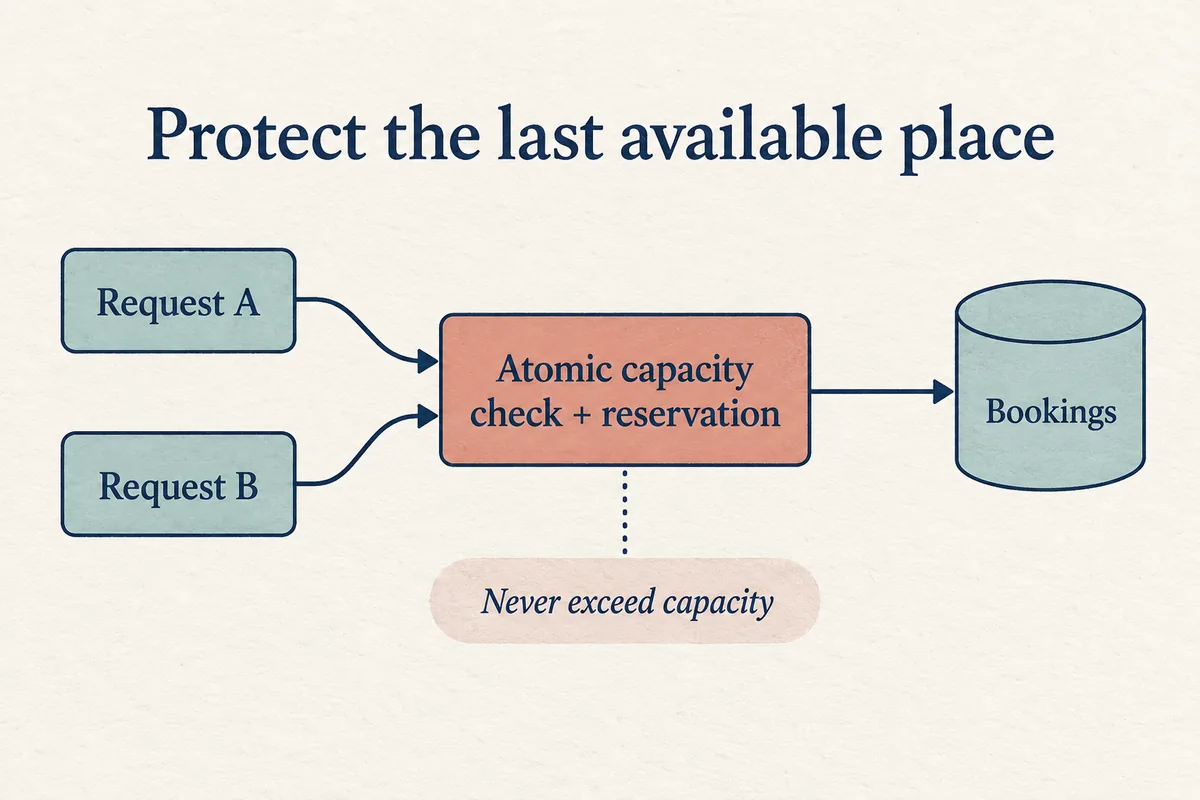
This conceptual sketch isolates the concurrency guarantee; it is not a complete deployment architecture.
Add complexity only to solve a named problem
| Concern | Possible response | Trade-off to discuss |
|---|---|---|
| Repeated requests after a timeout | Idempotency key for the booking operation | Key storage, lifetime, and matching repeated payloads |
| Slow confirmation emails | Send notifications asynchronously | Delivery retries and visibility when notification fails |
| Expensive availability reads | Cache a read view if justified | A displayed count may be stale; booking still needs authoritative validation |
| Failure partway through payment | Explicit intermediate states and reconciliation | More state transitions and recovery paths |
These are discussion options, not mandatory components. A queue does not itself prevent overselling, and a cache should not silently become the source of truth for a strict capacity rule.
Practice failure, not just the happy path
Ask what happens if the client disconnects after the booking succeeds. Can a retry create a second booking? What if a payment succeeds but the confirmation response is lost? What records would an operator need to investigate?
For each failure, name the user-visible outcome, the recovery mechanism, and any remaining uncertainty. Include observability and access controls in the design rather than treating them as decorative boxes at the end.
If the interviewer changes the assumptions, revisit the affected decision. "At the original load, one database was a reasonable starting point; with this new write volume, I would first examine..." shows adaptation more clearly than defending your first drawing at all costs.
Use a focused rehearsal
Choose one prompt and set a practice time limit that resembles the actual session. Explain the requirements, draw the simplest working design, and investigate two consequential trade-offs. Record where you used an unexplained technology name or skipped a data transition.
Afterward, redraw only the weak part and explain it without notes. For broader preparation, use the technical interview guide. The aim is not collecting diagrams; it is making decisions that another engineer can question and understand.
Topics
interviews
how to prepare for a system design interview
Continue reading

Interviews
How to Prepare for a Phone Screen
Prepare a concise role story, evidence, logistics, and questions for an early phone screen without treating it like a full final interview.
November 10, 2026
2 min read

Interviews
How to Prepare for a Recruiter Screen
Prepare for a recruiter screen by aligning your experience to the role, clarifying logistics, and asking questions the recruiter can answer.
November 10, 2026
2 min read

Interviews
How to Prepare for a Take-Home Assignment
Clarify scope, plan your time, build a reviewable submission, and explain trade-offs in a take-home interview assignment without overbuilding.
November 10, 2026
3 min read