









Interviews
7 Best Coding Interview Prep Resources for 2026
Discover the best coding interview prep platforms, mock interviews, and practice strategies for building skills, timing, and confidence in 2026.
Interview Pilot Editorial Team
Updated October 18, 2026
15 min read
Stop collecting resources and start training. The best coding interview prep isn't the platform with the largest problem collection. It's a combination of deliberate practice, useful feedback, timed simulations, and repeated exposure to patterns you can explain and implement independently.
Solving more problems won't fix every weakness. In a 2025 survey of people preparing for software-engineering interviews, fewer than 40% of 131 respondents felt positively about their preparedness, and participants rarely practiced in authentic interview settings. Treat that finding as a warning against confusing familiarity with readiness, not as proof that any particular product improves hiring outcomes.
Before buying anything, identify your target role, likely assessment format, weakest skills, and available preparation time. Choose reading or video for learning, independent coding for retrieval practice, and live interaction for explaining decisions under pressure.
Don't buy another problem library when your actual weakness is explaining a solution while someone watches.
These seven resources serve different stages of preparation. Use a small, complementary selection rather than trying to complete every platform, and spend your budget on the gap that's preventing you from performing.
1. Interview Pilot
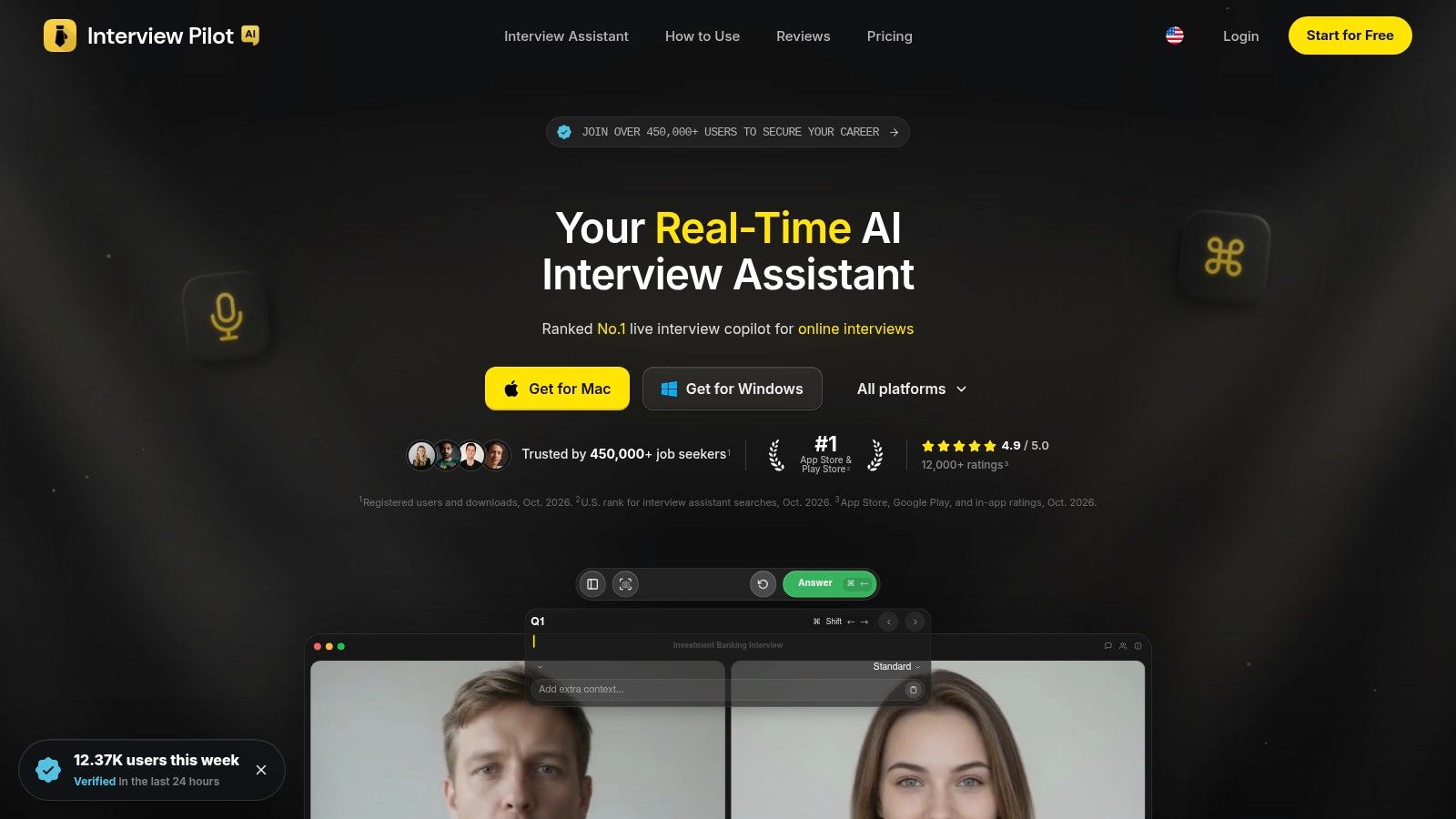
Choose Interview Pilot for guided rehearsal and role-specific interview practice, especially when you need help turning technical knowledge into clear spoken answers. Its preparation tools make sense alongside a coding platform, not instead of one.
Interview Pilot's practice suite includes AI mock interviews, automated prompts and feedback, a searchable question bank, and profile or document inputs for tailoring responses. It also provides real-time, context-aware suggested responses during online interviews, with native apps for macOS, Windows, iOS, and Android.
The distinction between those uses matters. Practice assistance helps you rehearse; live assistance requires explicit employer permission. Do not assume a tool is permitted because it works with your interview setup.
Use It to Rehearse Your Reasoning
Start with a software-engineering prompt and answer without consulting suggested responses. Explain the requirements, propose a baseline, select a data structure, and discuss complexity before checking the feedback.
Then implement the solution in your own editor. Ask follow-up questions about empty inputs, duplicate values, failure cases, and alternative approaches, and repeat the explanation without assistance.
- Strong fit: Candidates who want guided technical and behavioral rehearsal in the same tool.
- Budget flexibility: Free, weekly, monthly, and annual plans offer different commitment options; check current access limits before subscribing.
- Main trade-off: Generated guidance isn't proof that your code is correct, and an AI mock doesn't fully reproduce human observation.
For independent practice, disable suggestions during your first attempt. Use them afterward to identify omissions, then demonstrate that you can reconstruct the reasoning yourself.
Recommendation: Use Interview Pilot as a rehearsal layer. Keep executable coding practice and human feedback in your preparation system.
2. LeetCode Premium
If you understand the fundamentals but need repeated implementation practice, LeetCode Premium is the strongest fit in this roundup for targeted algorithm drills. Choose it for coding repetition and employer-focused preparation, not for a complete interview curriculum.
LeetCode provides coding problems, community discussions, company filters, related problem recommendations, and assessment-style practice. Premium's company tags and frequency insights help you narrow your practice when you're approaching a particular interview.
That targeting needs restraint. A tagged question is a practice opportunity, not a promise about what an employer will ask, so learn the underlying technique rather than memorizing the submitted answer.
Practice rule: An accepted submission isn't the finish line. Explain why the algorithm works, identify its complexity, and solve a related problem without the editorial.
Make the Library Work for You
Organize practice around weaknesses such as hash-table lookups, tree traversal, graph search, or dynamic-programming state definitions. Use this guide to coding interview questions to connect individual exercises with the concepts you need to explain.
Attempt the problem independently, inspect the editorial only after a genuine attempt, and record why you got stuck. Revisit the problem after a delay instead of immediately copying the solution into your notes.
The advantage is breadth and targeted repetition. The trade-off is that you must supply your own learning sequence, communication practice, and realistic feedback.
Check current Premium pricing and whether any additional module you want requires a separate purchase. If company filtering isn't useful yet, start with accessible practice rather than paying for targeting you won't use.
Recommendation: Buy Premium when you can name the practice gap or employer-specific focus it will address.
3. AlgoExpert
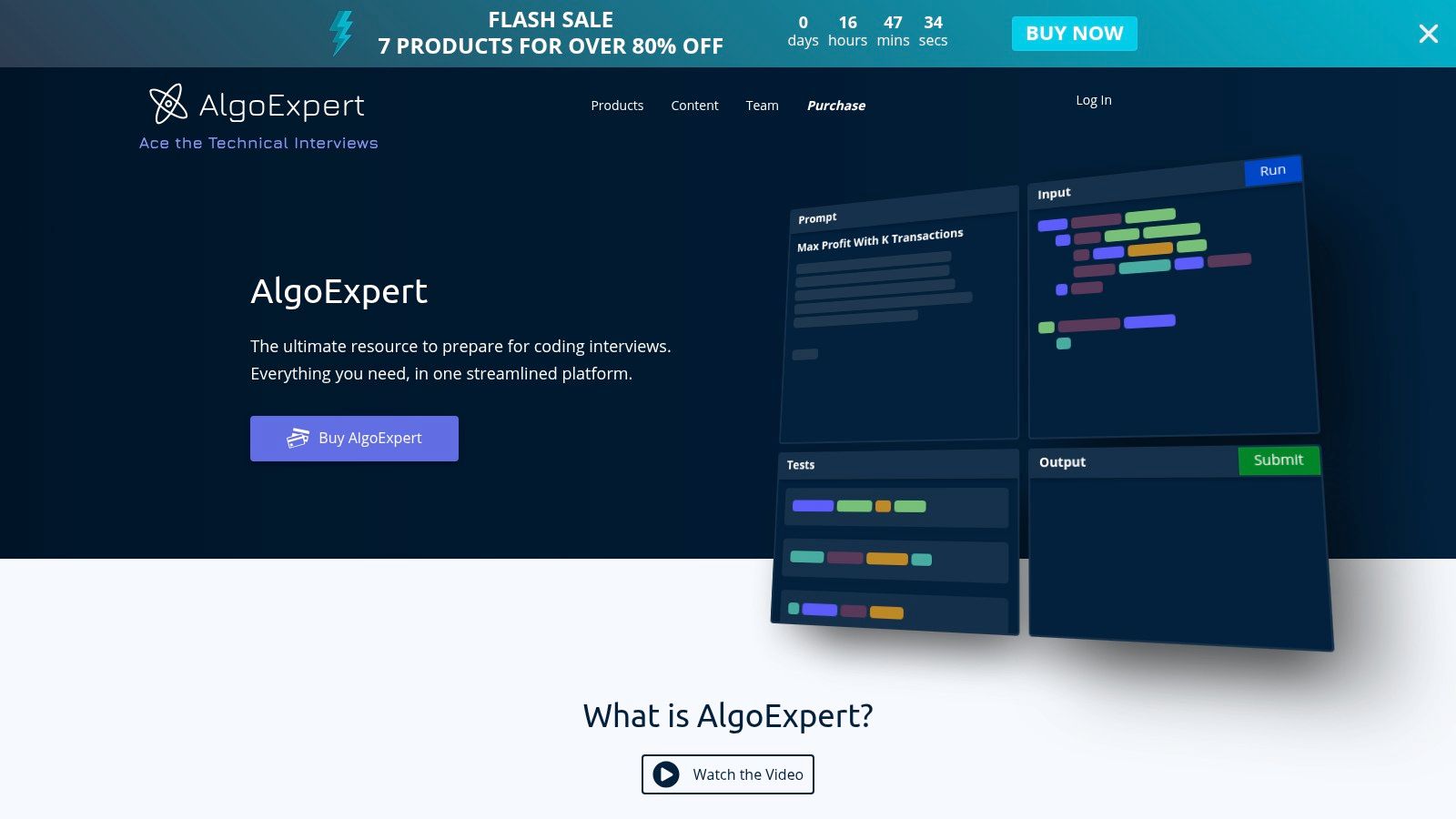
Prefer video walkthroughs to searching through discussion threads? Choose AlgoExpert. Its curated curriculum suits candidates who need a defined route through coding preparation rather than an open-ended collection.
AlgoExpert combines coding questions, video explanations, solutions in multiple programming languages, an in-browser coding environment, timed assessments, and a peer mock-interview workspace. Optional tracks include SystemsExpert, FrontendExpert, and MLExpert for candidates who need broader role-specific preparation.
Compared with LeetCode, the attraction is less choice. You spend less effort deciding what to study, but you also get a more bounded set of exercises rather than the same open-ended practice experience.
- Best learning style: Candidates who benefit from hearing an explanation and watching someone develop a solution.
- Best use of the curriculum: Study a technique, implement it independently, and revisit it through a variation.
- Main limitation: Watching a clear walkthrough can feel like mastery before you've demonstrated independent recall.
Turn Walkthroughs Into Implementation
Attempt each exercise before playing the explanation. When you get stuck, identify whether the problem is recognizing the pattern, maintaining an invariant, choosing a representation, or translating the idea into code.
After reviewing the walkthrough, close it and rebuild the solution from a blank editor. Use these software-engineer technical interview questions and answers to extend practice into debugging, testing, and technical discussion.
Check access duration and bundle coverage before paying. Don't purchase every optional track unless your target role requires it.
Recommendation: Pick AlgoExpert as your primary teaching resource if video helps you understand algorithms. Pair it with fresh problems and observed practice so familiarity with the curriculum doesn't become your only benchmark.
4. Educative.io
You can follow a solution and still struggle to recognize when to use it. Choose Educative.io when pattern recognition is your main weakness, particularly if you prefer scanning text and testing ideas in code to watching videos.
Educative.io offers interactive, text-first lessons, in-browser coding, coding-interview pattern courses, and related system-design preparation. Its broader catalog includes databases, distributed systems, cloud topics, and other subjects that can support role-specific study.
The practical advantage is a pattern-first approach. Instead of treating each exercise as unrelated, organize your notes around the signals that suggest a technique and the assumptions that make it valid.
Study the Decision, Not Just the Template
For a sliding-window exercise, write down what enters the window, what leaves it, and what condition determines whether it's valid. For graph traversal, explain how you track visited states and why your traversal order suits the task.
Then choose a problem without a pattern label and make that decision yourself. Recognizing a technique after seeing the chapter title isn't the same as selecting it during an interview.
- Choose it for: Text-based learning, reusable problem-solving approaches, and related technical courses.
- Watch out for: Subscription access and plan coverage; confirm that the course you want is included.
- Pair it with: A separate problem library and live explanation practice.
Use an existing textbook or your own technical notes for deeper explanation when a concept remains unclear. Don't add another subscription because a lesson felt difficult.
Recommendation: Make Educative your learning resource if text-first instruction matches how you study. Move from labeled lessons to mixed practice as soon as you can implement the core approaches independently.
5. HackerRank
Use HackerRank when your next hurdle is an online coding assessment. Preparation should include translating a specification into executable code, testing it, and managing the assessment environment, not just identifying an algorithm on paper.
HackerRank offers a free Interview Preparation Kit and practice libraries, alongside paid candidate plans with varying AI mock interviews, mock tests, reports, and tutor features. Confirm current plan entitlements before subscribing, especially if a particular feedback tool is the reason you're paying.
The assessment-first approach has a sound basis. SHL's technology-hiring report analyzed 1.9 million responses from more than 655,000 candidates completing coding simulations, supporting preparation that mirrors realistic programming tasks rather than relying on memorized solutions.
Practice the Entire Assessment Workflow
Read the requirements before coding, identify input constraints, and write down assumptions. Implement a straightforward correct approach, improve it when necessary, and test boundaries before submitting.
Use the guidance on how to prepare for a technical interview to connect assessment practice with verbal explanation and broader interview preparation. A silent coding test and a collaborative live interview need overlapping technical skills but different rehearsal conditions.
Practice in the environment you expect to use, but prepare to explain the same decisions aloud.
HackerRank's free resources make it a practical starting point for budget-conscious candidates. Paid features are worth considering when their reports or guided practice address a weakness you've already identified.
For a practical interview, add debugging unfamiliar code, modifying an API, and writing tests outside the question library. Recommendation: Choose HackerRank for assessment rehearsal, then add human interaction if the employer also evaluates live collaboration.
6. interviewing.io
Can you solve a problem alone but lose your train of thought when someone watches? Spend your preparation budget on observed practice before buying more content.
interviewing.io offers anonymous individual mock interviews with experienced engineers for coding or system design, plus AI practice, coaching options, and replay resources. Choose it when you need realistic interaction and specific feedback near an interview date.
The pressure gap is real, but its evidence needs context. A North Carolina State University–Microsoft study involving 48 computer-science students found that being watched reduced coding performance by more than half; that result supports rehearsing observed conditions, not predicting how much any individual candidate will improve.
- High-value use: Diagnose why a technically capable solution breaks down during live explanation.
- Feedback to request: Requirement clarification, pacing, hint handling, testing, and recovery after mistakes.
- Trade-off: Paid human sessions require more budget and scheduling effort than independent practice.
Buy Feedback You Can Act On
Arrive with a specific objective, such as improving graph-problem explanations or managing system-design scope. Ask the interviewer to distinguish technical gaps from communication gaps so you know what to practice afterward.
Review the session or replay and identify the first point where your reasoning became unclear. Repeat that part of the task, rather than immediately booking another mock and hoping repetition alone fixes it.
Don't pay for a human mock just to hear whether you passed. Pay to discover what to change and to test whether you changed it.
Recommendation: Use interviewing.io when you have enough fundamentals to benefit from a realistic diagnostic session. Follow each mock with focused remediation before scheduling the next.
7. Pramp
For live practice on a tight budget, start with Pramp. Peer sessions give you someone to explain your thinking to, and rotating roles lets you practice evaluating an answer as well as delivering one.
Pramp provides free peer-to-peer mock interviews with matching based on availability, needs, and language. Participants rotate interviewer and interviewee roles, use selected questions, and exchange feedback; sessions are hosted through Aced Practice.
Unlike a paid expert mock, the feedback depends on your partner's experience. Treat peer comments as observations to investigate, not as a definitive hiring judgment.
Give the Session a Consistent Structure
Agree to clarify requirements, discuss a baseline, improve the approach, explain complexity, code, and test. Ask your partner to introduce a follow-up question or challenge an assumption so you practice responding without abandoning your reasoning.
Historical research on interview validity and structure identified interview structure as a moderator of validity. That's a reason to make practice consistent, not evidence that using Pramp guarantees a hiring outcome.
- As the candidate: Explain decisions concisely and test your code before declaring completion.
- As the interviewer: Ask for the reasoning behind a choice rather than immediately revealing the solution.
- During feedback: Name the moment that caused confusion and suggest an observable change.
For example, point out that the candidate never explained how duplicate values affect the algorithm. That's more useful than saying their communication needs work.
Recommendation: Use Pramp regularly for human interaction, especially alongside free coding practice. Add an experienced interviewer when you need deeper calibration, but don't postpone observed rehearsal while waiting for the perfect partner.
Best Coding Interview Prep: Top 7 Comparison
| Platform | 🔄 Format and complexity | ⚡ Resource requirements | 📊 Expected outcomes | ⭐ Ideal use and key advantage |
|---|---|---|---|---|
| Interview Pilot | AI-guided mock interviews and real-time suggestions; low setup effort | Free and paid plans; desktop and mobile apps; 99+ languages | Practice feedback and interview-day support | Candidates wanting preparation and live assistance in one tool; check employer rules before using live assistance |
| LeetCode Premium | Independent coding challenges, timed assessments, and discussions; self-directed | Paid Premium; 2,000+ company-sourced questions | Stronger coding problem-solving and company-targeted practice | Candidates focused on coding interviews and a broad problem library |
| AlgoExpert | Curated curriculum with video walkthroughs and timed assessments; structured | Typically annual access; 200 questions and 100+ hours of explanations | Guided learning in algorithms and data structures | Learners who prefer a finite, video-led curriculum over open-ended practice |
| Educative.io | Interactive, text-based courses and coding exercises; pattern-focused | Subscription access; includes interview and broader technical courses | Improved recognition of recurring problem patterns | Learners who prefer scannable text lessons and a multi-course catalog |
| HackerRank | Practice kits, mock tests, and AI mock interviews; assessment-oriented | Free resources; paid features vary by plan and region | Practice aligned with employer-style assessments, with performance reports | Candidates preparing for coding assessments and structured practice tests |
| interviewing.io | One-to-one human mocks, AI interviews, and coaching; scheduling required | Paid human sessions; public FAQ pricing starts at $179; some free options | Realistic practice and targeted feedback from experienced interviewers | Candidates seeking calibrated feedback before technical interviews |
| Pramp | Peer-to-peer live mock interviews with rotating roles; partner-dependent | Free and unlimited; requires a practice partner and session time | Builds communication, interview stamina, and feedback skills | Budget-conscious candidates seeking live practice with other engineers |
Build a Preparation System That Compounds
Choose a primary learning resource, a repeated-practice platform, and a live mock-interview format. AlgoExpert or Educative can teach concepts, LeetCode or HackerRank can support implementation practice, and Pramp or interviewing.io can expose communication weaknesses. Interview Pilot can add guided rehearsal without replacing independent coding.
Buy according to your bottleneck, not the number of features on a pricing page. If you can't explain recursion, prioritize instruction; if you understand it but can't implement it reliably, prioritize practice; if you perform well alone but struggle under observation, prioritize mocks.
Make the Schedule About Retrieval and Feedback
Begin with pattern-focused lessons and related problems. Reserve recurring time for failed attempts, add timed practice once you can produce a correct untimed solution, and increase live rehearsal as your interview approaches.
- Track correctness: Record whether the implementation handles the stated requirements and edge cases.
- Track independence: Note whether you needed an editorial, hint, or generated suggestion.
- Track reasoning: Assess whether you explained complexity, assumptions, and trade-offs clearly.
- Track recovery: Record how you responded when a test failed or the interviewer challenged your approach.
Use those observations to choose the next task. A failure to identify a pattern calls for different practice than an off-by-one bug or an explanation that never reaches a clear conclusion.
Prepare for the actual role, not just abstract puzzles. In HackerRank's discussion of real-world technical evaluation, 66% of developers wanted evaluation based on real-world skills rather than theoretical tests. Add debugging, API changes, test writing, and code review when those tasks match the interview.
If AI tools are explicitly allowed, practice reviewing their output, finding errors, and explaining what you accepted or rejected. If they aren't allowed, rehearse without them.
Before using real-time interview assistance, obtain explicit employer permission. Your preparation should leave you able to solve, test, and explain independently, because that's the capability you need to demonstrate when the interview begins.
Interview Pilot offers guided AI mock interviews, a searchable question bank, and custom prompts for technical interview rehearsal. Visit Interview Pilot to practice explaining your approach and handling follow-up questions, and use live suggested responses only when the employer explicitly permits them.
Topics
best coding interview prep
coding interview practice
coding interview platforms
data structures practice
technical interview prep
Continue reading

Interviews
10 Interview Questions Network Engineer Candidates Face
Prepare for interview questions network engineer candidates face with answer outlines, follow-up prompts, and practical scenarios for technical interviews.
October 8, 2026
23 min read

Interviews
10 Operating System Interview Questions
Prepare with 10 operating system interview questions covering processes, memory, concurrency, file systems, model answers, and study resources.
September 24, 2026
24 min read

Interviews
10 Technical Interview Questions for Mechanical Engineering
Master technical interview questions for mechanical engineering with worked answers, calculation methods, and practical problem walkthroughs.
September 16, 2026
23 min read