












Interviews
10 Interview Questions Coding Patterns to Master
Master 10 interview questions coding patterns with sample solutions, complexity analysis, common mistakes, and practice strategies for technical interviews.
Interview Pilot Editorial Team
Updated September 28, 2026
23 min read
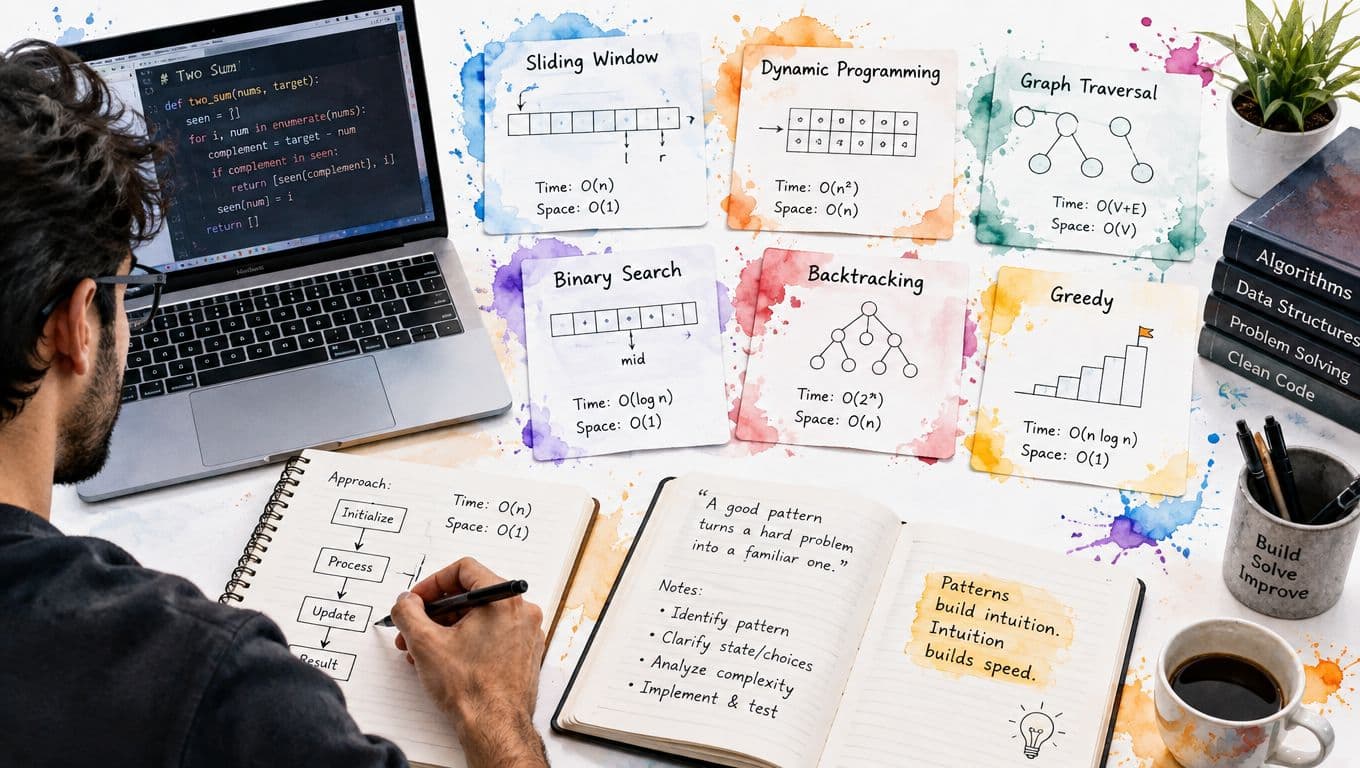
You recognize the pattern, but the clock keeps moving. The prompt looks like a familiar array problem, yet you spend several minutes deciding between a hash map, sorting, or a two-pointer scan. Then the interviewer asks about complexity, duplicate values, or an edge case, and your explanation becomes less clear than your code.
Strong preparation for interview questions coding isn't about memorizing isolated solutions. It's about building a map from the surface clues in a prompt to a reliable approach. The progression below starts with foundational data manipulation, then moves through traversal, optimization, search, and senior-level design. Each category includes a representative problem, a solution outline, complexity analysis, a common mistake, and a focused practice routine.
Use every item the same way: study the pattern, implement one representative problem, state time and space complexity, review the likely failure point, and explain the solution aloud before looking at an answer. Short, repeated practice usually beats passive reading. Interview Pilot's mock interviews, question bank, and customizable coaching can provide optional support when you want varied prompts or feedback, but your independent reasoning still needs to lead the session.
1. Array and String Manipulation
Arrays and strings are where many candidates first learn to translate a prompt into operations on data. A question such as Two Sum asks for two values that add to a target. A direct nested-loop solution checks every pair in O(n²) time and O(1) extra space. A hash map stores values already seen, turning the lookup into average O(1) and reducing the overall scan to O(n) time, with O(n) additional space.
For Longest Substring Without Repeating Characters, a sliding window keeps a valid range while a set or map records the characters inside it. When a duplicate appears, move the left boundary until the window is valid again. The same reasoning appears in log parsing, where a service may scan events for the longest period without a repeated error type, and in database query optimization, where reducing repeated work matters more than merely producing a correct result.
Practical rule: Clarify empty input, duplicates, one-element inputs, and whether the interviewer expects the original order to remain unchanged before you write code.
Container With Most Water adds a useful optimization pattern. Start with pointers at both ends, calculate the area, and move the pointer at the shorter boundary. Moving the taller boundary can't improve the limiting height while it reduces the width, so the two-pointer scan runs in O(n) time and O(1) space.
Practice one problem with a brute-force approach, then replace it with a hash map or pointer-based solution. Explain why the faster method uses more or less memory, test tiny and large inputs, and record your reasoning. For more language-specific examples, review these Java interview programming questions.
2. Hash Tables and Hash-Based Problems
A hash table is often the right first thought when the prompt asks you to find, count, group, or detect duplicates. In Two Sum, the key can be the number and the value its index. For Group Anagrams, you can create a canonical key by sorting each word's characters, or by storing a frequency tuple. Sorting each word makes the key construction depend on word length, while a fixed character-frequency representation can be more efficient when the alphabet is known.
The important interview decision isn't just “use a map.” It's deciding what belongs in the key and what information the value should preserve. For duplicate detection, the value may be a boolean. For frequency counting, it may be an integer. For a composite relationship, such as a user and date pair, a tuple or encoded object can serve as the key.
LRU Cache demonstrates why one data structure often isn't enough. A hash map provides fast access to cache entries, while a doubly linked list tracks recency. On every read or update, move the entry to the front. When capacity is exceeded, remove the least recently used node from the back. With careful pointer updates, both operations can run in average O(1) time, while the map and list together require O(n) space.
Common mistakes include forgetting that hash-table performance is average-case, mishandling collisions conceptually, and updating a count without considering whether a key already exists. Candidates also lose time by using a map without explaining the space trade-off.
Practice frequency maps, duplicate detection, grouping, and one map-plus-structure problem. Before coding, say aloud: “My key represents this identity, and my value stores this information.” Then explain why sorting, a balanced tree, or an array might be preferable under different constraints.

3. Binary Search and Sorted Array Problems
Binary search is less about memorizing a loop than defining a shrinking search space. In the classic sorted-array problem, compare the target with the middle value. If the target is larger, discard the left half. If it's smaller, discard the right half. The resulting complexity is O(log n) time and O(1) space.
The interview challenge appears in variants. In Search in Rotated Sorted Array, one half remains sorted even after rotation. Identify that half, determine whether the target falls within its bounds, and discard the appropriate side. In Find Minimum in Rotated Sorted Array, compare the middle value with the right boundary to decide which region contains the minimum.
Choose one interval convention and keep it consistent. With inclusive boundaries, a typical update is left = mid + 1 or right = mid - 1. With a half-open interval, the updates differ. Mixing conventions creates infinite loops, skipped values, or incorrect handling of a single-element input.
Boundary questions to answer aloud
- What does the interval contain? State whether both boundaries are included.
- What does
midprove? Explain whether it can still contain the answer. - Which side is discarded? Name the condition, not just the assignment.
- What happens with two values? Walk through the final iteration manually.
Database indexes and file-system searches rely on the same broad idea of narrowing an ordered search. The interviewer may also ask for a first or last occurrence, a boundary in a matrix, or a search over an answer range rather than a literal array.
Draw the search interval before implementing. Practice classic search, lower and upper bounds, rotated arrays, and “minimum feasible value” problems. After each solution, test an empty array, a single element, two elements, repeated values, and a target outside the range.

4. Linked Lists and Pointer Manipulation
A reversal prompt tests whether you can change references without losing the remaining list. In Reverse Linked List, track previous, current, and next. Save current.next first, redirect the link to previous, then advance both active references. The iterative method visits each node once, taking O(n) time and O(1) extra space.
For operations that may replace the head, begin with a dummy node. In Add Two Numbers, walk through both input lists, add the current digits and carry, then append the result digit. Continue while either list or the carry remains. The work is linear in the combined input lengths, and the output list requires corresponding space.
A short pointer trace often reveals more than an immediate implementation. Draw each node and arrow, then mark which reference changes at every step. Saving next too late can detach the unvisited portion. Other common errors include returning the old head after reversal, dropping a final carry, or mishandling an empty or one-node list.
For Linked List Cycle, use two traversal speeds. The slow pointer advances one node, while the fast pointer advances two. A meeting proves that the pointers entered the same cycle, while fast reaching null proves termination. The algorithm takes O(n) time and O(1) space. To find the cycle's entry, reset one pointer to the head and advance both one node at a time after the meeting.
Practice in an order that exposes each risk:
- Reverse a three-node list on paper.
- Code iterative and recursive reversal.
- Use a dummy node for deletion or merging.
- Trace cycle detection on cyclic and terminating lists.
- Explain every assignment aloud.
The same references support an LRU cache, where list order records recency, and undo or redo navigation between states. Interview Pilot's mock practice can rehearse the explanation, while a paper trace quickly exposes pointer mistakes.
5. Trees and Graph Traversal
A room map, folder system, or social network can turn a simple-looking prompt into a traversal problem. First identify the structure: trees have one direction from parent to child, while graphs may contain cycles and multiple routes. That distinction determines whether recursion alone is safe or whether you need explicit visited state.
For Symmetric Tree, the task is to compare two mirrored subtrees, not to scan the tree in ordinary left-to-right order. A recursive DFS receives a pair of nodes, rejects unequal values or mismatched nulls, then compares the left node with the right node and the right node with the left. It visits each node once, using O(n) time and O(h) space for recursion, where h is the tree height. A common mistake is comparing children in the same order, which checks equality rather than reflection.

For Number of Islands, each unvisited land cell starts a component search. DFS follows connected land through the grid, while BFS expands it layer by layer. Mark cells when you discover them, or the same island may be counted repeatedly. The time is O(rows × columns). Extra space depends on the recursion stack or queue, and on whether you mark the grid in place. Boundary checks and revisiting cells are frequent failure points.
BFS fits level order, nearest distance, and shortest paths in an unweighted graph. DFS fits nested structure, components, and path exploration. Permutations adds another idea: choose an item, recurse, undo the choice, and try the next item. Its branching search can grow rapidly, so careful state management and pruning matter.
Practice with this focused routine:
- Trace mirrored pairs for a small tree.
- Solve island counting with DFS, then BFS.
- Add a visited set to a cyclic graph.
- Generate permutations and explain each undo step.
- State time, space, and the likely failure case aloud.
6. Greedy Algorithms
Greedy solutions make the best-looking local choice and commit to it. That can produce an optimal answer, but only when the problem has the right structure. The interview isn't complete when you describe the choice. You need to explain why the choice can't prevent an optimal solution later.
In Jump Game, track the furthest reachable position while scanning from left to right. If the current index lies beyond that reach, the answer is false. Otherwise, extend the reach using the current jump. The scan uses O(n) time and O(1) space.
Non-overlapping Intervals uses a different greedy choice. Sort intervals by finishing time, keep the interval that ends earliest, and accept the next interval only when it doesn't overlap. An early finish leaves more room for future intervals. That exchange argument is the reasoning an interviewer wants to hear, not just the sorting code.
A naive greedy strategy can fail in problems where a locally cheap choice creates an expensive remainder. Compare greedy with dynamic programming on a small counterexample. If you can't state the safe-choice argument, don't claim correctness prematurely.
Sort first when ordering reveals the choice you need to make, then state why the chosen item preserves the most useful future options.
Practice Jump Game, interval scheduling, and a problem where greedy fails. For each one, write a short proof in plain language, identify the counterexample to the tempting wrong strategy, and implement the solution without relying on unexplained intuition. In real systems, similar choices can appear in packet scheduling, query planning, and compression, although production constraints may require a broader design than the interview version.
7. Heap and Priority Queue Problems
Suppose an interviewer asks for the kth largest value while the input arrives one item at a time. Sorting the entire collection works, but it stores and orders more data than necessary. A min-heap of size k keeps the current top k values: insert each value, then remove the smallest when the heap grows too large. Its root is the kth largest value, with O(n log k) time and O(k) space.
The same “next best available item” rule supports Merge K Sorted Lists. Place the first node from each list in a min-heap. Remove the smallest node, append it, and insert that node's successor. With n total nodes and k lists, each heap operation costs O(log k), so the full process takes O(n log k) time and O(k) heap space.
A streaming median needs two views of the data. Store the lower half in a max-heap and the upper half in a min-heap. After each insertion, move a root if the sizes become unbalanced. The median then comes from one root or from both roots, depending on the count. State which heap owns each half before writing the balancing logic.
Choose the heap from the operation
- Top-K: Keep a heap of size
kwhen retaining every element is unnecessary. - Repeated minimum: Use a min-heap when the next event or value must be the smallest available.
- Repeated maximum: Use a max-heap, or reverse priorities when the library offers only a min-heap.
- Alternative: Compare sorting or quickselect when their time, space, or mutation trade-offs fit the constraints better.
A reversed heap can return plausible values while producing a wrong answer. Also distinguish O(log k) from O(log n) when the heap is deliberately bounded. Practice a top-k task, a k-way merge, and a two-heap streaming task. Explain each operation in PriorityQueue or heapq, then connect the pattern to process scheduling, event prioritization, or Dijkstra's algorithm.
8. Backtracking and Combinatorial Search
Backtracking suits interview problems that ask for every valid arrangement, path, or assignment. It builds one candidate at a time, then reverses the latest choice before testing another. In Permutations, the path records selected values and a boolean structure tracks which values remain. Each complete path is an output, so runtime must account for the number of permutations. The recursion and tracking state add space, while the returned results require separate output space.
For N-Queens, place one queen per row and reject a position if its column or either diagonal is occupied. Column and diagonal sets make checks constant time. The main optimization is pruning: a partial board that already conflicts cannot produce a valid solution. A common mistake is checking only columns, which allows diagonal attacks.
Word Search uses a board position, the current word index, and visited status as its state. Mark a cell before exploring neighbors, then restore it after the recursive call. Restoration matters because a cell may be used by a different path. Without visited tracking, the search can cycle through the same position.
A reliable interview explanation follows the decision tree:
- State: Define the path, index, position, and remaining choices.
- Choice: List the options available at the current call.
- Base case: Return when a complete candidate is formed or no move remains.
- Pruning: Reject constraints immediately.
- Undo: Reverse every mutation before trying the next option.
Describe complexity in terms of branching and depth, and state whether output storage dominates. Practice a small permutation, N-Queens, and Word Search input. Draw one recursion branch, then explain how each pruning rule removes work. Sudoku, game search, and satisfiability problems use the same decision-and-undo pattern.
9. Dynamic Programming and Memoization
Dynamic programming becomes useful when a problem contains overlapping subproblems and an optimal answer can be built from smaller answers. Climbing Stairs is the simplest example: the number of ways to reach step n depends on the values for n - 1 and n - 2. Memoization avoids recomputing those values, reducing an exponential recursive pattern to O(n) time. A bottom-up version can use O(1) space by retaining only the previous two results.
For Coin Change, define the state as the minimum coins needed to make a particular amount. The recurrence tries each coin and reuses previously solved amounts. If there are n coin denominations and target amount A, the common bottom-up approach takes O(nA) time and O(A) space.
Longest Common Subsequence uses a two-dimensional state based on positions in two strings. When the current characters match, extend the prior diagonal result. Otherwise, take the better result from skipping one character on either side. State definition matters more than memorizing the table.
Use Python technical interview questions to find language-specific practice, then write the recurrence before the code.
Explain the state before the transition
A frequent mistake is starting with a table without knowing what each cell represents. Another is using incorrect base cases, which causes every later value to be wrong. Candidates also confuse a problem that asks for a count with one that asks for a minimum, maximum, or reconstruction of the actual choices.
Practice one-dimensional, two-dimensional, and string-based DP. Begin with top-down memoization, convert it to bottom-up, and then look for space compression. During the explanation, say why brute force repeats work, define the state in one sentence, write the transition, and identify the base case.
10. System Design and Behavioral / Situational Questions
Senior interviews test more than whether you can implement a function. In a URL-shortening service, you might clarify the API, choose an identifier strategy, decide how redirects are stored, and discuss caching, abuse prevention, observability, and failure recovery. In a news feed, ranking, fan-out, freshness, and cache invalidation create different trade-offs. In a ride-sharing system, geospatial indexing and real-time matching shape the architecture.
Start with functional requirements and non-functional requirements. Sketch the main data entities and API contracts, then identify the bottleneck most likely to appear as usage grows. Don't name PostgreSQL, Redis, Kafka, or a CDN as decoration. Explain why each component fits the workload and what happens when it fails.
System design also tests communication. A behavioral prompt such as “Tell me about a technical disagreement” needs a specific situation, your action, the result, and what you learned. A debugging story should show how you formed hypotheses, tested them, communicated risk, and prevented recurrence. Avoid presenting yourself as flawless. Senior candidates demonstrate judgment by showing how they changed their approach.
Senior-level answer: Make the trade-off visible. State what you optimize, what you give up, and which signal would tell you to revisit the decision.
Practice one architecture prompt and one behavioral story in the same session. For design, rehearse requirements, data flow, scaling bottlenecks, consistency, latency, monitoring, and recovery. For behavioral answers, prepare distinct stories about conflict, feedback, failure, ownership, prioritization, and collaboration. These system design templates can help you organize rehearsal without replacing your own design reasoning.
Top 10 Coding Interview Topics Comparison
| Item | Implementation Complexity 🔄 | Resource Requirements ⚡ | Expected Outcomes 📊 | Ideal Use Cases 💡 | Key Advantages ⭐ |
|---|---|---|---|---|---|
| Array and String Manipulation | Low, standard patterns (two-pointer, sliding window) 🔄 | Low, O(1)–O(n) time, small memory ⚡ | High interview relevance; practical problem-solving gains 📊 | Parsing, data cleaning, entry/mid-level interviews 💡 | Builds fundamentals; easy to implement and debug ⭐ |
| Hash Tables and Hash-Based Problems | Low–Medium, conceptually simple, edge cases in hashing 🔄 | Medium, extra space for maps/sets; O(1) avg ops ⚡ | Very effective for lookup/deduplication; high interview ROI 📊 | Fast lookup, grouping, frequency counts, Two-Sum variants 💡 | O(1) average lookups; straightforward mapping solutions ⭐ |
| Binary Search and Sorted Array Problems | Medium, careful boundary handling; off-by-one risks 🔄 | Low, requires sorted data or preprocessing O(n log n) ⚡ | Strong asymptotic improvement (O(log n)); fewer comparisons 📊 | Large sorted datasets, search-in-rotated arrays, optimization-by-search 💡 | Logarithmic performance; scalable for large inputs ⭐ |
| Linked Lists and Pointer Manipulation | Medium, pointer logic and edge cases; verbose 🔄 | Low–Medium, constant extra memory but careful handling ⚡ | Demonstrates systems-level thinking; moderate interview impact 📊 | Memory/pointer manipulation tasks, LRU implementations, systems roles 💡 | Reveals memory/pointer mastery; non-reliance on built-ins ⭐ |
| Trees and Graph Traversal | Medium–High, recursion/backtracking complexity; cycle handling 🔄 | Medium, recursion stack or explicit queue/stack memory ⚡ | High impact; models hierarchical/graph problems well 📊 | DOM, social graphs, connected components, shortest paths 💡 | Teaches recursion and traversal patterns; broad applicability ⭐ |
| Greedy Algorithms | Low–Medium, simple to implement but correctness proof required 🔄 | Low, typically sorting + linear pass; efficient ⚡ | Efficient practical solutions when applicable; moderate interview frequency 📊 | Scheduling, interval problems, compression, MST variants 💡 | Fast and intuitive solutions; concise implementations ⭐ |
| Heap and Priority Queue Problems | Medium, requires understanding heap ops and tradeoffs 🔄 | Medium, O(log n) ops; extra memory for heap structure ⚡ | Effective for Top-K/streaming; strong practical value 📊 | K-way merge, streaming median, prioritized scheduling 💡 | Elegant Top-K/streaming solutions; well-suited to online problems ⭐ |
| Backtracking and Combinatorial Search | High, exponential search, careful pruning needed 🔄 | High, heavy CPU and recursion stack for large search spaces ⚡ | Solves constrained combinatorial problems; high correctness scrutiny 📊 | Permutations, N‑Queens, Sudoku, exhaustive search problems 💡 | Finds all valid solutions; natural for constraints and SAT-like tasks ⭐ |
| Dynamic Programming and Memoization | High, requires state design and recurrence formulation 🔄 | Medium–High, table/memo memory; polynomial time gains ⚡ | Transforms exponential to polynomial; differentiator in interviews 📊 | Optimization, sequences, grid/tree DP, resource allocation 💡 | Powerful optimization tool; essential for complex problems ⭐ |
| System Design and Behavioral / Situational Questions | High, open-ended, breadth of tradeoffs and communication 🔄 | High, domain knowledge, system metrics, tools and examples ⚡ | Assesses real-world engineering judgment and collaboration 📊 | Senior roles: scalability, reliability, API and DB design; behavioral storytelling 💡 | Evaluates architecture thinking and soft skills; predicts job performance ⭐ |
Turn Patterns Into Interview-Ready Performance
Pattern knowledge only becomes useful when you can retrieve it under pressure and communicate it while solving. In a large analysis of technical interviews, successful candidates' final-interview code averaged 2,045 characters, compared with 1,760 characters for unsuccessful candidates, and successful Python users defined an average of 3.29 functions, compared with 2.71 for unsuccessful candidates. The same analysis reported successful code compiled or ran 64% of the time, compared with 60% for unsuccessful candidates. These findings don't mean longer code guarantees success. They show that observable coding behavior, structure, and execution can correlate with interview outcomes, so practice should include both implementation and explanation. Read the technical interview analysis for the study context.
Use a repeatable loop for every pattern:
- Choose one representative problem: Start with the category you're currently studying, not a random hard question.
- Solve without assistance: Give yourself a clear stopping point, then write the simplest correct approach you can defend.
- Explain before coding: Name the data structure, invariant, or recurrence and clarify assumptions.
- State complexity: Include both time and auxiliary space, and explain what contributes to each.
- Test deliberately: Use an empty input, the smallest valid input, duplicates, boundary values, and a case designed to break your first idea.
- Review one mistake: Write down the exact failure, such as a wrong boundary, stale pointer, missing base case, or unjustified greedy choice.
Sequence your preparation from arrays and strings into hash tables, binary search, linked lists, trees and graphs, heaps, greedy methods, backtracking, and dynamic programming. Finish with system design and behavioral rehearsal, because senior conversations require you to connect technical choices with product needs, team decisions, and operational risk.
Your schedule should also reflect how candidates prepare. An NSF-hosted study found that 47% of students began technical interview preparation one week or less before the interview, while 42% started two weeks to one month before it in the study's reported preparation pattern. If you're preparing late, don't attempt to cover every problem. Use short cycles: one pattern, one implementation, one spoken explanation, and one review of edge cases. A question bank can reduce search time, while mock interviews can add the pressure of retrieving a method and explaining it without a pause.
The format itself has also changed. HackerRank describes a shift from brain teasers toward algorithms, whiteboarding, and data structures, with a clearer move toward algorithm and data-structure questions emerging in the mid-2010s in its history of technical interviews. That history reinforces a practical point: knowing a solution isn't enough. You must show how you choose it, validate it, and adapt it when the interviewer adds a constraint.
Keep one page for each pattern. Write the trigger words, the representative problem, the invariant, the complexity, the failure mode, and a plain-language explanation. Then close your notes and solve again. Interview Pilot's question bank and mock interview sessions can provide optional variation, while independent practice ensures you can reason even when the prompt doesn't resemble a problem you've seen before.
Interview Pilot offers a searchable interview question bank, guided mock interview practice, and real-time suggested answers for technical and behavioral questions. Use it to rehearse coding patterns, vary your prompts, and practice explaining trade-offs before your next interview with Interview Pilot.
Topics
interview questions coding
coding interview questions
algorithm interview prep
technical interview preparation
coding patterns
Continue reading

Interviews
10 Technical Interview Questions Electrical Engineering
Master technical interview questions electrical engineering with model-answer guidance across circuits, power, control, semiconductors, and PCB design.
September 14, 2026
22 min read

Interviews
25 Common Technical Interview Questions and Answers (2026)
A practical 2026 guide to technical interview questions and answers, with sample responses for coding, systems, data, and IT screens.
August 10, 2026
14 min read

Interviews
10 Technical Interview Java Questions to Master
Prepare for technical interview Java questions with 10 practical problems, expected approaches, code examples, complexity analysis, and common traps.
September 29, 2026
3 min read