












Interviews
Interview Programming Questions in Java: 2026 Guide
Master interview programming questions in Java with 10 topic-based sets, solution strategies, and tips for algorithms, OOP, concurrency, and JVM.
Interview Pilot Editorial Team
Updated September 21, 2026
31 min read
Most advice about interview programming questions in Java is too narrow. It tells you to memorize answers, grind random LeetCode problems, and rehearse definitions for HashMap, inheritance, and threads. That approach breaks down as soon as an interviewer changes the prompt, asks why your solution is safe in production, or follows up with “what would you change if this had to run under load?”
Strong Java preparation has to scale across three layers at once. You need reusable problem-solving patterns for coding rounds, Java-specific understanding for collections and language behavior, and runtime judgment for concurrency, memory, and JVM debugging. That's also why Java remains a durable interview language. It stayed near the top of language popularity rankings in 2026, including No. 4 in August at 8.25%, No. 4 in July at 8.03%, and No. 3 in January at 8.71%, according to TechRepublic's summary of the TIOBE Index.
Use the progression below like a preparation path, not a trivia list. Start with algorithmic patterns, move into object modeling and collections, then practice modern Java features, concurrency, and JVM behavior the way interviewers increasingly ask about them. A broad Java screen often includes higher-order topics such as OOP, data structures, Java 8+ features, multithreading, exception handling, REST APIs, and system design, and one pre-employment assessment format highlighted by Mercer uses a 60-minute structure with 18 MCQs plus 1 coding task, as described by Mercer Mettl's Java assessment overview.
For each topic, treat every prompt in two passes. First, explain your reasoning aloud under time pressure. Second, write code that you can defend line by line. That habit turns a question bank into interview fluency.
1. Data Structures and Algorithms
If you freeze in coding interviews, the problem usually isn't syntax. It's that you don't recognize the pattern quickly enough. In Java interviews, that often means arrays, strings, hash-based lookup, sliding windows, binary search, tree traversal, and graph search.
A common prompt sounds simple: “Find the first non-repeating character” or “Return two indices whose values sum to a target.” The interviewer isn't just checking correctness. They want to hear how you compare brute force against a HashMap-based approach, what trade-off you're making, and whether you can spot edge cases before coding.
How to reason aloud
Start with the smallest working idea, then improve it. For Two Sum, say that a nested loop is easy to verify but repeats work. Then explain that a map lets you store seen values and check complements as you scan once.
- Lead with constraints: Ask whether inputs can be null, empty, duplicated, or already sorted.
- Name the pattern: Say “this is a hash lookup problem” or “this smells like sliding window.”
- End with complexity: State time and space clearly, even if you're giving only qualitative justification.
Use real prompts from role-focused banks such as these software engineer interview questions, then compare your explanations against broader scoring rubrics for tech roles.
Focused practice actions
Don't jump randomly between trees, heaps, and dynamic programming. Practice in bands.
- Week one: Arrays, strings, HashMap, HashSet, two pointers.
- Week two: Stack, queue, linked list, recursion, binary tree traversal.
- Week three: Graph traversal, heap usage with PriorityQueue, interval problems.
Practical rule: If you can't explain why your data structure fits the access pattern, you don't know the problem yet.
One realistic Java example: a rate limiter that must reject repeated API calls within a short window. You can model that with a map of user IDs to timestamps, then discuss when a queue or deque becomes necessary for eviction logic.

2. Object-Oriented Programming Concepts
A lot of candidates answer OOP questions as if they're sitting for a vocabulary test. Interviewers usually want design judgment instead. “What is polymorphism?” is less important than “how would you model a payment system that supports cards, wallets, and bank transfer?”
Take a parking lot prompt. You might create Vehicle, ParkingSpot, Ticket, and ParkingFloor classes. That's the easy part. The stronger answer explains why pricing logic belongs in a separate strategy, why spot allocation should not live inside Vehicle, and how you'd keep the model open for electric charging spots or reserved access.
Representative prompts
- Shape hierarchy: Implement Circle and Rectangle with a shared area contract.
- Notification service: Support email, SMS, and push without stuffing if-else logic into one class.
- Product catalog: Separate domain entities from filtering, pricing, and inventory concerns.
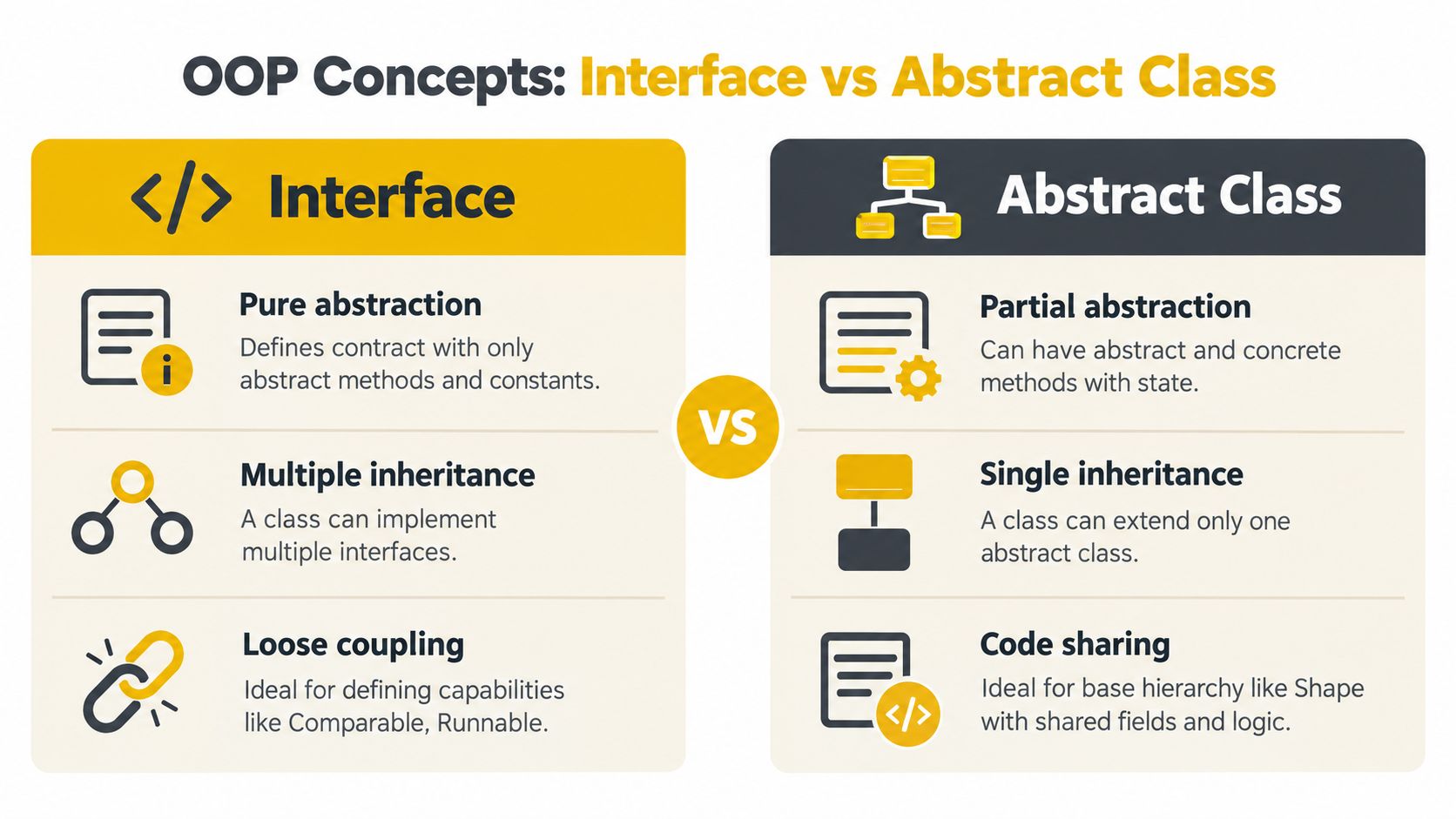
Java makes these questions concrete because its class model is so explicit. Use interfaces for behavior contracts. Use abstract classes when you want shared state or partial implementation. Mention composition when inheritance would create awkward coupling.
What strong answers sound like
Good OOP answers aren't abstract. They reference maintenance costs.
- Encapsulation: “I'd keep fields private so invalid states can't leak across the codebase.”
- Abstraction: “The caller shouldn't care whether this notification is delivered by SMTP or Firebase.”
- Polymorphism: “New channel types shouldn't force edits in every switch statement.”
“Design the objects so the next requirement changes one area, not five.”
A real interview variant: “Design an order status workflow.” If you say “I'd use an enum,” you're fine for a simple case. If you add that a State pattern may help when transitions carry side effects, retries, or audit behavior, you're showing senior-level thinking without overengineering.
3. Java Collections Framework
Collections questions look basic until the interviewer asks one follow-up: “Why this one?” That is usually where Java candidates reveal whether they memorized names or can reason from workload, memory behavior, ordering rules, and thread safety.
A useful way to prepare is to treat collections as a ladder.
Start with selection questions. Move to internals. End with trade-offs under concurrency and scale. That progression matches how many interviews unfold.
The early prompts are usually concrete:
“Your code checks whether a user ID has appeared before.”
“Your service shows the newest items in insertion order.”
“You need the smallest task first.”
“A function removes duplicates but must keep sorted output.”
Each prompt maps to a small family of choices. A HashSet fits fast membership checks. A LinkedHashMap or LinkedHashSet preserves insertion order. A PriorityQueue gives you priority-based removal, not full sorted iteration. A TreeSet maintains sorted uniqueness, but you pay for ordering on every insert and lookup.
That is the first interview habit to build. Translate requirements into collection properties before naming a class.
A better way to answer collection questions aloud
Suppose the interviewer asks, “Why use ArrayList instead of LinkedList for most app code?”
A strong answer has a clear path:
- Identify the dominant operations.
- Compare the actual cost model.
- Mention memory and CPU effects.
- State the trade-off.
You might say: “If reads and appends dominate, ArrayList is usually the better default. It gives fast indexed access, stores elements compactly, and tends to work better with CPU caches. LinkedList helps only in narrower cases, because inserting in the middle still requires traversal before the link change becomes useful.”
That answer sounds grounded because it connects API choice to runtime behavior.
A similar prompt appears often: “Why not use Stack?”
The practical answer is that ArrayDeque is usually preferred for stack and queue behavior because it avoids older Stack design choices and fits modern Java code better.
The questions that separate surface knowledge from working knowledge
Interviewers often probe the places where bugs hide.
- HashMap: What happens if
equals()andhashCode()disagree? - TreeSet: What if the comparator is inconsistent with equality?
- ConcurrentHashMap: Why use it instead of wrapping a
HashMapwith synchronization? - Iterator behavior: What does fail-fast mean, and why is it not the same as thread safety?
These are not trivia prompts. They test whether you understand the contract behind the collection.
For example, HashMap works like a filing system that first chooses a drawer by hash value and then checks labels with equals(). If two equal objects land in places that the map cannot reconcile, lookups and updates become unreliable. You do not need to explain every internal detail in an interview. You do need to say that the hash narrows the search and equality confirms identity.
The same pattern applies to sorted collections. If a TreeSet uses a comparator that says two distinct values are “the same” for ordering purposes, one of them may disappear from the set's point of view. That catches many candidates because they know sorted collections by name but have not practiced the behavioral contract.
A compact comparison drill
Use this as a speaking exercise, not just a reading list.
| Prompt | Likely choice | Reason to say out loud |
|---|---|---|
| Fast random reads and frequent appends | ArrayList |
Good default for contiguous storage and indexed access |
| Fast membership checks, no ordering need | HashSet |
Lookup speed matters more than iteration order |
| Preserve insertion order | LinkedHashMap / LinkedHashSet |
Order is part of the requirement |
| Keep data sorted | TreeMap / TreeSet |
You are paying for maintained order |
| Repeated min or max access | PriorityQueue |
Best when priority removal matters more than full sorting |
| Stack or queue behavior | ArrayDeque |
Better modern default than legacy Stack for many cases |
That table is useful because it changes your prep rhythm. Instead of trying to memorize every type, you practice matching a problem shape to a collection shape.
Java remains common in professional codebases, which helps explain why these choices still show up regularly in interviews. Keyhole Software's summary of recent Java survey data points to that continued usage across working developers. See Keyhole Software's Java trends summary.
Focused practice that actually improves interview performance
Pick five common coding problems you already know. For each one, force yourself to answer two extra questions after the solution:
- “Why is this collection a fit for the access pattern?”
- “What would make me switch to another one?”
Here are good practice pairings:
- Top K frequent elements: explain why
HashMapplusPriorityQueuefits. - LRU cache sketch: explain why
LinkedHashMapis attractive for ordered eviction behavior. - Remove duplicates from a stream of values: compare
HashSetwithTreeSetbased on ordering needs. - Task scheduler: explain why a queue and a priority queue solve different problems.
- Visited nodes in graph traversal: justify
HashSetfor membership andArrayDequefor BFS or DFS support.
That last step matters. Interviewers hear many correct solutions. Fewer candidates can explain why the collection choice stays good when the workload changes, when ordering becomes a requirement, or when contention enters the picture. That is the transition from basic preparation to interview-ready fluency.
4. Multithreading and Concurrency
Many candidates prepare concurrency by memorizing terms. Interviews usually reward a different skill. They reward the ability to predict what code does when several threads touch the same state at the same time.

A useful way to study this topic is to climb it in stages. Start with race conditions. Then move to coordination tools, thread pools, and finally JVM-level visibility and scheduling questions. That sequence matches how interview difficulty often rises.
Begin with the kind of prompt that sounds small but exposes weak mental models: “Why is count++ not thread-safe?”
A good spoken answer is short and concrete. count++ looks like one step in Java code, but it becomes read, modify, write at runtime. Two threads can read the same old value and both write back the same incremented result. The fix depends on context. Use synchronized for compound state changes, AtomicInteger for single-variable updates, or redesign to reduce shared mutable state.
Then expect the interviewer to raise the difficulty with a follow-up such as “When is volatile enough?”volatile solves a visibility problem, not a general atomicity problem. A shutdown flag is the classic example. One thread writes running = false, another keeps reading running. Without volatile, the reader may keep seeing a stale value. With volatile, the update becomes visible across threads. It still does not make running++ safe.
That distinction is where many answers improve from acceptable to strong.
A mini interview ladder
Level 1. Shared state basics
Prompt: “What is a race condition?”
Reason aloud: define it in terms of interleaving operations on shared mutable data that produce inconsistent results.
Practice action: write one unsafe counter example and then fix it three ways.
Level 2. Locking trade-offs
Prompt: “Why not just put synchronized everywhere?”
Reason aloud: locking can serialize work, increase contention, and reduce throughput if the protected section is large or heavily contested.
Practice action: compare a coarse-grained lock with a smaller critical section and explain the throughput difference.
Level 3. Coordination
Prompt: “How do threads communicate completion?”
Reason aloud: separate mutual exclusion from coordination. synchronized protects state. CountDownLatch, CyclicBarrier, CompletableFuture, and join() coordinate progress.
Practice action: solve one problem with raw wait and notify, then solve the same problem with a higher-level utility. Explain why the second version is easier to reason about.
Level 4. Executor behavior
Prompt: “Why does a service slow down after adding more worker threads?”
Reason aloud: more threads can increase context switching, queueing, lock contention, and pressure on downstream resources such as database connections.
Practice action: sketch a fixed thread pool, bounded queue, and rejection policy. Explain what happens under load.
Level 5. JVM reasoning
Prompt: “Why can double-checked locking break without volatile?”
Reason aloud: object publication can be observed out of order by another thread, so a reference may appear non-null before construction is fully visible.
Practice action: rehearse this explanation until you can say it without relying on the phrase “JVM magic.”
Modern interviews may also ask about virtual threads. The key point is not syntax. It is fit. Virtual threads help when work spends time waiting on I/O, because blocking becomes cheaper than with platform threads. They do not automatically speed up CPU-bound work, and they do not remove data races or bad locking decisions.
A practical scenario often works better than definitions:
Prompt: “An API endpoint becomes slow during peak traffic. CPU is moderate. No deadlock appears in the thread dump. What do you inspect first?”
A strong answer moves through the system like a mechanic tracing a jammed conveyor belt. Check thread pool saturation, queue growth, blocked states, lock contention, slow external calls, and connection pool exhaustion. Then explain the consequence. Requests wait longer, threads stay occupied longer, queues grow, and latency spreads through the service.
That style of answer shows operational judgment, not just textbook recall.
For practice, build a small set of concurrency drills and rehearse your spoken reasoning after each one. A structured routine like this guide on how to prepare for a technical interview works well if you adapt it to race conditions, deadlocks, visibility bugs, and executor tuning.
One final rule helps in interviews. Name the bug, name the Java mechanism, then name the trade-off. For example: “This is a visibility bug. volatile fixes the flag read. If multiple fields must change together, I would switch to locking because visibility alone is not enough.”
A quick visual refresher can help when you're rehearsing these concepts aloud.
5. Exception Handling and Java Error Management
Exception questions sound basic until the interviewer turns them into design trade-offs. “Checked or unchecked?” is rarely about remembering the hierarchy. It's about whether callers can recover, what context should be preserved, and how failures surface in logs and APIs.
Imagine a file import service. A parsing failure caused by malformed user input should probably be handled differently from a database outage. If you wrap everything in RuntimeException, the code may be shorter, but the behavior becomes harder to reason about.
Interview-style prompts
- Custom exception design: When should you create OrderValidationException instead of reusing IllegalArgumentException?
- finally behavior: What happens if code returns inside try and also throws in finally?
- Resource cleanup: Why does try-with-resources exist, and what kinds of bugs does it avoid?
- Thread pool handling: Where do task exceptions go when work runs asynchronously?
One employer-focused question bank also shows how broad Java interview sets have become, spanning code reading, algorithm explanation, tools, team process, and project troubleshooting. That's a useful signal from Indeed's Java interview question guide for employers. Exception handling belongs in that practical category because interviewers often care about failure analysis as much as syntax.
Better answers use intent
When you explain exception choices, tie them to caller responsibility.
- Checked exceptions: Useful when the caller can reasonably recover or retry.
- Unchecked exceptions: Often fit programming errors, invalid states, or invariant violations.
- Custom exceptions: Helpful when the domain meaning matters more than the low-level cause.
Don't say “I'd catch Exception.” Say what you want to recover from, what you want to propagate, and what context the next layer needs.
A strong Java answer also mentions preserving causes. If you catch SQLException and rethrow DomainStorageException, include the original cause so debugging stays possible.
6. Java Memory Management and Garbage Collection
Many candidates can say “heap stores objects and stack stores method frames,” then struggle when asked to diagnose a memory issue. Interviews reward the second skill more.
A realistic prompt is: “The service slows down over time and eventually crashes with an out-of-memory error. How would you investigate?” That question isn't asking for one magic flag. It's asking whether you can reason about object lifetime, retention paths, and the difference between garbage collection eligibility and actual reclamation.
What interviewers want to hear
Start with symptoms and narrow the field. Is memory growth caused by a leak, a traffic spike, oversized caches, class metadata growth, or a load pattern that creates too much short-lived garbage?
Then discuss likely suspects:
- Long-lived references: Static maps, listeners, or caches with no eviction.
- Resource retention: Streams or connections not closed properly.
- Classloader issues: Common in plugin-heavy or redeploy-heavy environments.
- Poor object churn: Excessive temporary allocation in hot paths.
Practice with scenarios
Use small examples. Suppose a service stores user sessions in a plain HashMap and never removes expired entries. That's a simple explanation of retention. Another example is registering listeners on application startup and never deregistering them during module unload.
Observation to practice: An object going out of scope doesn't guarantee immediate collection. It only becomes eligible if nothing reachable still points to it.
If the interviewer mentions metaspace, don't panic. Distinguish it from heap. If they mention weak references, explain them with a cache example where entries should disappear when nothing else strongly references the key or value.
For stronger answers, speak in a debugging order: inspect heap usage trend, identify what keeps growing, find the references that keep objects alive, then change code or policies. That sequence sounds much more credible than reciting garbage collector names.
7. Generics and Type System
Generics are where many Java interviews stop being about syntax and start becoming about trust. Can this API promise the caller the right thing, and can the compiler enforce that promise?
A strong answer usually begins with a small tension: flexibility versus safety. Interviewers often hand you two method signatures that look similar and ask which one they would ship to production. Your job is to explain what each signature allows, what it prevents, and what kind of bug it blocks before runtime.
Take the prompt: “What is the difference between List<? extends Number> and List<? super Integer>?”
Treat it like an interview conversation, not a vocabulary quiz.
? extends Number describes a source. You can read values out as Number, because every element is at least a Number. You usually should not add values in, because the actual list might be List<Integer> or List<Double>, and the compiler cannot prove your insert is safe.
? super Integer describes a destination. You can add Integer values safely, because the list could be List<Integer>, List<Number>, or List<Object>. Reading is weaker. What comes back is only guaranteed to be Object.
PECS helps, but say more than the acronym. A producer extends. A consumer super. Then tie that rule to what you can read and write.
Here is the kind of method interviewers like because it tests whether you understand variance instead of memorizing it:
public static void copyIntegers(List<? extends Integer> source, List<? super Integer> target) {
    for (Integer value : source) {
        target.add(value);
    }
}
Why is this signature good? The source only needs to produce Integer values. The target only needs to accept them. If you used plain List<Integer> for both parameters, the method would be less useful for no safety gain.
Another common prompt sounds simple but reveals a lot: “When should I use a type parameter like <T> instead of a wildcard?”
Use a type parameter when the method needs a relationship between multiple inputs or between input and output. Wildcards are better when a type is present only once and you only care about variance.
For example:
public static <T> T first(List<T> items) {
    return items.get(0);
}
<T> matters here because the return type must match the list element type. A wildcard would lose that relationship.
Now for the part that often confuses candidates. Generics in Java are mostly a compile-time feature. At runtime, type arguments are erased. The compiler uses generic information to check your code, then produces bytecode that usually works with raw types and inserted casts.
That single fact explains several interview questions at once:
- Why
new T()does not compile. The runtime does not know whatTis. - Why
new List<String>[10]is illegal. Arrays keep runtime type information, generics mostly do not, and those rules clash. - Why raw types are dangerous. They turn off compile-time checks and let bad values sneak in until a cast fails later.
A useful way to reason aloud is to compare arrays and generics. Arrays know and enforce their element type at runtime, so new Integer[3] remembers it is an Integer[]. Generics trade that runtime knowledge for backward compatibility with older Java code. Interviewers like candidates who can connect type erasure to language design trade-offs rather than reciting “Java uses erasure.”
Some interviews push one level deeper with inheritance. List<Integer> is not a subtype of List<Number>. That surprises people because Integer is a subtype of Number. Collections are invariant because allowing that conversion would let someone add a Double into a List<Integer> through a List<Number> reference.
If you want a quick practice ladder, move through these in order:
- Explain invariance with
List<Integer>andList<Number>. - Write one method with
extendsand one withsuper. - Refactor a rigid
<T>signature into a clearer wildcard form, or the reverse. - Explain one type-erasure restriction and why Java accepts it as a design trade-off.
- Spot a raw type in old code and describe the failure it could hide.
Modern interview prep often reflects that broader expectation. GitGood's 2026 Java interview guide includes newer language features, but the same interview standard applies here. Explain the production reason behind the type choice. The best generics answers sound like API design reviews, not flashcards.
8. Functional Programming and Lambda Expressions
Streams and lambdas appear in many Java interviews because they reveal both language comfort and design taste. The trap is writing stream-heavy code that's clever but unreadable.
A common prompt is: “Convert this loop into a stream pipeline.” Don't assume that a stream is automatically better. Explain the trade-off. A pipeline can be concise for filter-map-collect logic, but a plain loop may be clearer when the operation needs branching, mutation, or early exit with custom control flow.
Prompts worth practicing
- Aggregation: Use
reduce()or collectors to compute totals, counts, or grouped results. - Transformation: Convert a list of orders into a map keyed by customer.
- Filtering chain: Keep only active users from a certain region, then map to emails.
- Parallelism judgment: When would parallel streams help, and when could they hurt?
One realistic example is processing an order list:
- Filter paid orders.
- Map to customer IDs.
- Remove duplicates.
- Collect into a list.
That's a fine stream example because each operation is a clear transformation. By contrast, updating multiple external structures inside forEach usually deserves a normal loop.
What to say in the interview
Talk about readability and behavior, not just syntax.
- Intermediate operations:
map,filter,sorted. - Terminal operations:
collect,forEach,reduce,count. - Functional interfaces:
Predicate,Function,Consumer,Supplier.
A stronger answer also mentions Optional carefully. It can improve API intent for possibly absent return values, but it isn't a universal field type or a substitute for thoughtful domain modeling.
Stream pipelines should read like data flow. If the interviewer has to mentally simulate side effects, rewrite it.
9. String Handling and Regular Expressions
Strings show up everywhere, and Java interviews use them to test both correctness and performance awareness. You might get a straightforward prompt like “reverse words in a sentence,” or a subtle one like “why is String immutable?”
Immutability matters because it supports safer sharing, predictable hashing, and cleaner behavior in APIs. You don't need to overstate it. Just explain that many parts of Java rely on strings behaving consistently after creation.
Common prompts
- StringBuilder vs StringBuffer: Which one do you choose, and why?
- Equality: Why does
==differ fromequals()for strings? - String pool: What does interning do?
- Regex validation: How would you validate a simple identifier or extract tokens from logs?
A practical coding question is “compress repeating characters,” such as turning "aaabb" into "a3b2" under chosen rules. The interviewer often wants to see whether you use StringBuilder instead of repeated concatenation inside a loop.
Regex judgment matters
Regex can solve a lot quickly, but overusing it can make code hard to debug. If asked to validate email-like input, say you'd use a simple business-appropriate pattern when the rules are limited, and avoid pretending one regex perfectly models every real-world email address.
A nice production example: log parsing. You might use regex to extract an order ID, latency token, or status code from semi-structured text. Then mention that once parsing rules grow complex, a tokenizer or structured format may be easier to maintain.
- Use StringBuilder: Best default for repeated mutation in one thread.
- Use StringBuffer rarely: Reach for it only when synchronized mutable string operations are needed.
- Prefer clarity: Small string tasks can often be solved faster with split, substring, and index methods than with dense regex.
10. Behavioral and System Design for Software Engineers
Java interviews often end where many candidates are least prepared. The interviewer asks you to design a backend service, explain a difficult production bug, or describe a decision you'd defend under pressure. This isn't separate from coding skill. It tests whether you can turn local correctness into system-level judgment.
A system design prompt like “design a URL shortener” usually starts broad, then narrows. You should ask about expected traffic pattern, read-write balance, persistence needs, expiry behavior, and failure tolerance before choosing storage or cache strategy.
How to structure your answer
Keep the response layered:
- Clarify requirements: Core features, constraints, consistency expectations.
- Sketch the happy path: Request flow, storage, lookup.
- Name pressure points: Hot keys, cache invalidation, database scaling, abuse control.
- Discuss trade-offs: Simplicity first, then operational upgrades.
If the interviewer asks a behavioral variant such as “tell me about a bug you owned,” use the same structure. State the symptom, your investigation path, the competing hypotheses, the fix, and what changed afterward. Concise, evidence-based narratives are stronger than dramatic stories.
Tie design back to Java
Keep it grounded in the language you'll be hired to use. If you mention a cache, you can discuss ConcurrentHashMap for local prototypes, then explain why a distributed cache changes the consistency story. If you mention async processing, connect it to executors, back-pressure concerns, and exception handling in background tasks.
System design prep benefits from reusable templates, especially if you tend to ramble. This set of system design templates is useful for organizing a first-pass answer, then refining trade-offs afterward.
One final point matters here. Interview programming questions in Java increasingly reward explanation quality. A correct answer that you can't defend won't travel far in a real loop.
10-Topic Java Interview Comparison
| Topic | 🔄 Implementation Complexity | ⚡ Resource Requirements | ⭐📊 Expected Outcomes | 📊 Ideal Use Cases | 💡 Key Advantages |
|---|---|---|---|---|---|
| Data Structures and Algorithms | High, deep theory, varied problem patterns | High, 8–12 weeks, practice platforms, mock interviews | ⭐⭐⭐⭐⭐, strong problem-solving, measurable performance gains | FAANG interviews, algorithm-heavy roles | Builds core coding intuition; objective evaluation |
| Object-Oriented Programming (OOP) Concepts | Medium‑High, design trade-offs, UML & patterns | Medium, 4–6 weeks, Java design practice | ⭐⭐⭐⭐, improved design reasoning and architecture skills | Java backend, design-focused roles | Demonstrates real-world design thinking; directly applicable to production code |
| Java Collections Framework | Medium, API details and performance nuances | Medium, 3–4 weeks, hands-on profiling | ⭐⭐⭐, practical performance awareness; fewer runtime bugs | Daily Java development, performance-sensitive code | Clear selection rules; reduces common collection-related bugs |
| Multithreading and Concurrency | Very High, subtle bugs, memory-model intricacies | High, 6–8 weeks, debugging tools, concurrency labs | ⭐⭐⭐⭐, essential for scalable, thread-safe systems | High-concurrency systems, senior backend roles | Prevents race conditions; enables robust scalable designs |
| Exception Handling & Java Error Management | Medium, nuanced semantics and best practices | Low‑Medium, 2–3 weeks, examples and patterns | ⭐⭐⭐, more robust error handling and clearer diagnostics | Production code quality, API/SDK design | Improves maintainability; enforces clearer error contracts |
| Java Memory Management & Garbage Collection | High, JVM internals and GC tuning | Medium‑High, 4–5 weeks, profilers, JVM study | ⭐⭐⭐⭐, better performance tuning; fewer memory incidents | Performance-sensitive systems, large-scale services | Enables GC tuning and memory-leak diagnosis |
| Generics and Type System | High, type erasure, wildcards, complex signatures | Medium, 3–4 weeks, reading & practice | ⭐⭐⭐, stronger compile-time safety; fewer casts | Library/API development, typed codebases | Promotes reusable, type-safe APIs; prevents runtime errors |
| Functional Programming & Lambda Expressions | Medium, paradigm shift; stream semantics | Medium, 3–4 weeks, stream and lambda practice | ⭐⭐⭐, concise code and better parallelization options | Modern Java 8+ projects, data pipelines | Improves readability; enables functional pipelines and parallel ops |
| String Handling & Regular Expressions | Easy‑Medium, core API + regex learning curve | Low, 2–3 weeks, pattern practice | ⭐⭐⭐, efficient text processing; fewer validation bugs | Data parsing, validation, text-processing tasks | Quick practical wins; measurable performance improvements |
| Behavioral & System Design for Software Engineers | Very High, breadth, trade-offs, communication | High, 8–12 weeks, mock interviews, system studies | ⭐⭐⭐⭐⭐, distinguishes senior candidates; real-world readiness | Senior / architect roles, large-scale system design | Evaluates holistic engineering judgment; closely mirrors job responsibilities |
Turn Questions Into Interview-Ready Fluency
The best way to prepare isn't to collect more questions. It's to build a review loop that makes your thinking visible.
Start by selecting questions by target role and difficulty. If you're interviewing for a junior backend role, spend more time on arrays, collections, OOP, strings, exceptions, and basic SQL-adjacent API scenarios. If you're interviewing for a senior Java backend role, add deeper work on concurrency, JVM memory behavior, diagnostics, modern Java features, and system design trade-offs.
Then solve without notes. That part matters. Many candidates feel prepared because they recognize a solution pattern when they see it. Recognition is weaker than recall. In an interview, you need to reconstruct the approach, defend it aloud, and adapt it when requirements shift.
After each solution, explain it as if the interviewer is skeptical. Why did you choose HashMap instead of TreeMap? Why is a loop clearer than a stream here? Why is a custom exception worth the extra type? Why is synchronized enough in this case, but not ideal in another? That habit trains the exact skill that broad Java screens increasingly test. They're not only checking syntax. They're checking whether you can reason under constraints and communicate trade-offs clearly.
A good review cycle has four passes:
- First pass: Solve for correctness.
- Second pass: State complexity and edge cases aloud.
- Third pass: Compare an alternative solution and say when you'd prefer it.
- Fourth pass: Revisit weak spots on a spaced schedule until your explanation feels natural.
Keep your practice artifacts small and searchable. Save a few representative prompts per topic, not hundreds of near-duplicates. For algorithms, store one or two examples for each pattern. For Java-specific topics, keep a short set of prompts that force real judgment, such as choosing between collections, designing exception boundaries, diagnosing contention, or explaining heap versus metaspace symptoms.
This is also where guided tools can help, if you use them correctly. Interview Pilot is one option for organizing repetition. Its question bank covers many roles, its mock interview features can help you rehearse spoken explanations, and its live interview copilot is designed to generate real-time suggested answers during online interviews. It also supports more than 99 languages, offers native apps across desktop and mobile platforms, and publicly states 99.99% uptime over a recent 90-day window on its site. Those features can support consistency, but they shouldn't replace understanding. You still need to own the solution and explain it in your own words.
For candidates balancing multiple interview tracks, a structured system matters even more. If you're preparing for software engineering while also facing behavioral, product, or operations-style rounds, keep one study rhythm and vary only the prompt set. That makes your prep more sustainable and reduces the feeling that every interview format requires a different brain.
If you want a broader non-technical framing for consistency and follow-through, this interview success guide for veterans has useful mindset reminders that also apply to technical preparation. The same principle holds in Java interviews. Clear thinking beats memorized fragments.
The end goal isn't to have seen every interview programming question in Java. It's to become the candidate who can hear a prompt, find the pattern, write the code, and explain why it works.
Interview Pilot gives you a searchable bank of common questions, guided mock interviews, and real-time answer support for live online interviews, which fits well with Java prep that depends on repeated explanation and timed practice. If you want one place to rehearse coding reasoning, system design trade-offs, and behavioral answers with more structure, visit Interview Pilot.
Topics
interview programming questions in java
Java interview questions
Java algorithms
Java concurrency
JVM interview
Continue reading

Interviews
10 Interview Questions DevOps Candidates Should Know
Prepare for interview questions DevOps candidates face, with example answers and exercises on CI/CD, IaC, reliability, monitoring, culture, and troubleshooting.
September 20, 2026
37 min read

Interviews
What Is Behavioral Based Interviewing and How to Master It
Learn what is behavioral based interviewing, how the STAR method works, real answer examples for candidates, scoring tips for interviewers, and proven prep
September 20, 2026
20 min read

Interviews
10 Interview Question on Linux Topics to Master
Prepare for an interview question on Linux with 10 essential topics, commands, examples, and troubleshooting scenarios for technical roles.
September 19, 2026
23 min read