



Interviews
Cybersecurity Questions and Answers: 10 Interview Must-Knows
Master the top cybersecurity questions and answers with model responses, follow-up tips, and frameworks for junior to senior security interviews.
Interview Pilot Editorial Team
Updated November 5, 2026
21 min read
Cybersecurity interviews feel unpredictable until you notice the scorecard barely changes. A SOC seat, a pentest seat, and an incident-response seat all open on the same handful of ideas, then split on how far you can take them. The surprise is how few organizations are ready for the incidents those interviews describe. PwC's 2025 Global Digital Trust Insights survey of 4,042 executives in 77 countries and territories found that in 2024 only 2% of companies surveyed had implemented cyber resilience across their organization. Panels are hiring people who can talk about that gap in controls, not people who recite glossary lines.
These cybersecurity questions and answers follow the pattern that earns points. Define the idea, apply it to one concrete incident, then name the trade-off. That third beat is where juniors stall and seniors get hired. The same rehearsal habit shows up in common startup software engineer interview questions, where fundamentals are scored on application, not vocabulary.
Read each item for three things. The model structure is the answer you should be able to say in about ninety seconds. The red flags are what makes an interviewer stop writing. The follow-ups are how the same question stretches from junior to senior across SOC, pentest, and incident response. Practice out loud. A tight answer with one trade-off beats a long one that never leaves the definition.
1. CIA Triad (Confidentiality, Integrity, Availability)
A ransomware crew encrypts a clinic's imaging share overnight. Before you name tools, say which property failed. Availability is gone because clinicians can't open studies. Integrity is in doubt if the attacker also altered records. Confidentiality may still hold if nothing was copied out. That ordering is the answer.

Confidentiality means only authorized people see the data. A public cloud bucket of customer records fails it, and the control is private buckets plus access logging. Integrity means the data wasn't changed without authorization. Tampered ledger rows fail it, and the control is hashing, change control, and restricted write paths. Availability means the system is there when the business needs it. Tested offline backups and segmentation are the controls, not a promise that antivirus will catch the payload.
Score the answer this way: Name the violated property first, then the business impact, then one control that would have reduced it.
Red flags: Defining all three words and stopping. Treating ransomware as “only confidentiality.” Claiming you can maximize all three with no cost.
Follow-ups: A junior should map one control to one property. A SOC candidate should say which alert proves which failure. A pentester should say which finding they'd write against which property. A senior incident responder should say which property you restore first when legal, ops, and the business disagree, and why you'd accept temporary exposure to get a clinical system back.
2. Authentication vs. Authorization
A badge proves you work in the building. It doesn't open the server room. Authentication is the badge. Authorization is the door list.
Say that order out loud, because interviewers listen for it. You can't authorize a person you haven't identified. Logging into a banking app with a password plus a one-time code is authentication. Seeing only your own accounts is authorization. In a hospital, role-based access that limits a nurse to records on their ward is the same split. OAuth 2.0 scopes that let a calendar app read events, and nothing else, are authorization after the identity check.
Multi-factor authentication strengthens the first step. It does nothing if the second step grants admin to everyone who passes it. That's where least privilege belongs in this answer. Tie the identity to the smallest set of actions, then review it. Service accounts and human accounts both rot if nobody looks.
Red flags: Using the two words as synonyms. Saying “MFA solves access control.” Describing authorization as “whatever the user clicks.”
Follow-ups: Juniors get a file-share example and should separate login from permissions. SOC candidates should explain how a valid login can still be malicious if the authorized action is wrong. Pentesters should walk an insecure direct object reference, where the session is real and the object check is missing. Seniors should discuss broken object-level checks in APIs, step-up auth for payments, and why group sprawl makes yesterday's correct role today's over-privilege.
3. Symmetric vs. Asymmetric Encryption
The hard problem isn't the math. It's getting a secret to someone you've never met without an attacker reading it on the way.

Symmetric encryption uses one shared key to encrypt and decrypt. It's fast, so it carries bulk data. Disk encryption with AES is the usual example. The cost is distribution. If you send the key in the same channel as the ciphertext, you didn't protect anything.
Asymmetric encryption uses a public and private pair. Anyone can encrypt to your public key. Only you decrypt with the private key. The same pair supports signatures, which is how PGP proves a message came from a holder of the private key. It's slower, so you don't use it for gigabytes of traffic.
Real systems are hybrid. TLS uses asymmetric cryptography to agree a session, then a symmetric cipher such as AES or ChaCha20 for the bytes. Say that and you've shown you know production, not a textbook diagram.
Red flags: Claiming one type “is more secure” with no context. Offering to write a custom cipher. Confusing signing with encryption.
Follow-ups: Juniors should name one use for each. SOC staff should say what a TLS inspection proxy changes. Pentesters should discuss certificate pinning and weak key exchange. Seniors should explain key custody, rotation, and why “never roll your own crypto” still leaves you responsible for choosing libraries, modes, and who holds the private key.
4. OWASP Top 10 Web Application Risks
Interviewers don't want all ten categories recited. They want three you can attack and defend without notes, tied to the current OWASP Top 10, and they notice if you treat the list as frozen.
Three risks worth knowing cold
Broken access control is still the one I weight highest in a web interview. Changing an invoice ID in the URL and reading someone else's bill is an insecure direct object reference. The fix is a server-side check on every object, not a hidden link.
Injection, including SQL injection, is the login form that concatenates the password into a query so ' OR 1=1 walks in. Prevention is parameterized queries, least-privilege database accounts, and input handled as data.
Cross-site scripting is a comment that stores a script and runs it in the next reader's browser. Output encoding for the right context, plus a tight Content Security Policy, is the control. Sanitizing “bad characters” on the way in is the answer that fails the follow-up.
Cryptographic failures and security misconfiguration are the stretch topics. Default admin pages, verbose errors, and secrets in the repo all count.
Red flags: Naming XSS and then describing SQL injection. Saying “we use a WAF, so we're fine.” Quoting an old list and insisting the order never moves.
Follow-ups: Juniors explain one bug and one fix. SOC candidates map the bug to a log or WAF event. Pentesters give a safe proof step and the impact line they'd put in a report. Seniors talk about how you'd stop the same class in a design review, including authorization in APIs and dependency risk, without pretending a scanner replaces that review.
5. Phishing, Spear Phishing, and Social Engineering
Phishing is a deceptive message aimed at credentials or a payload. Spear phishing uses details about one person. Whaling aims at executives. Business email compromise often skips malware and just asks finance to move money.
A 12-month study of 20 organizations, more than 1,300 employees, and over 13,000 simulated phishing emails found that an interactive model with immediate feedback produced a 52% reduction in phishing susceptibility over six to eight months, with final-quarter susceptibility averaging 4.2%, according to the study write-up on arXiv. In an interview, that means you treat training as a measured behavior change, not a completion checkbox.
The reporting script is what panels want next. Don't click. Don't forward the attachment around the team. Report it to security, then verify any payment or credential request on a separate channel you already know, such as a known phone number. Technical controls sit beside that habit. SPF, DKIM, and DMARC cut easy spoofing of your domain. Email filtering and phishing-resistant MFA, such as a hardware key, limit the blast if someone still types a password into a fake single sign-on page.
This short walkthrough is worth one viewing before you practice the answer out loud.
Red flags: “Users should just be more careful.” Ignoring payment fraud because there's no malware. Recommending SMS codes as if they stop a real-time proxy phish.
Follow-ups: Juniors spot urgency, odd domains, and mismatched display names. SOC candidates describe the mailbox rule, the impossible travel login, and who you call. Pentesters scope a social-engineering engagement and the out-of-bounds rules. Seniors argue where awareness spend loses to control design, especially when workload or language makes the “safe” path slower than the risky one.
6. Incident Response Lifecycle
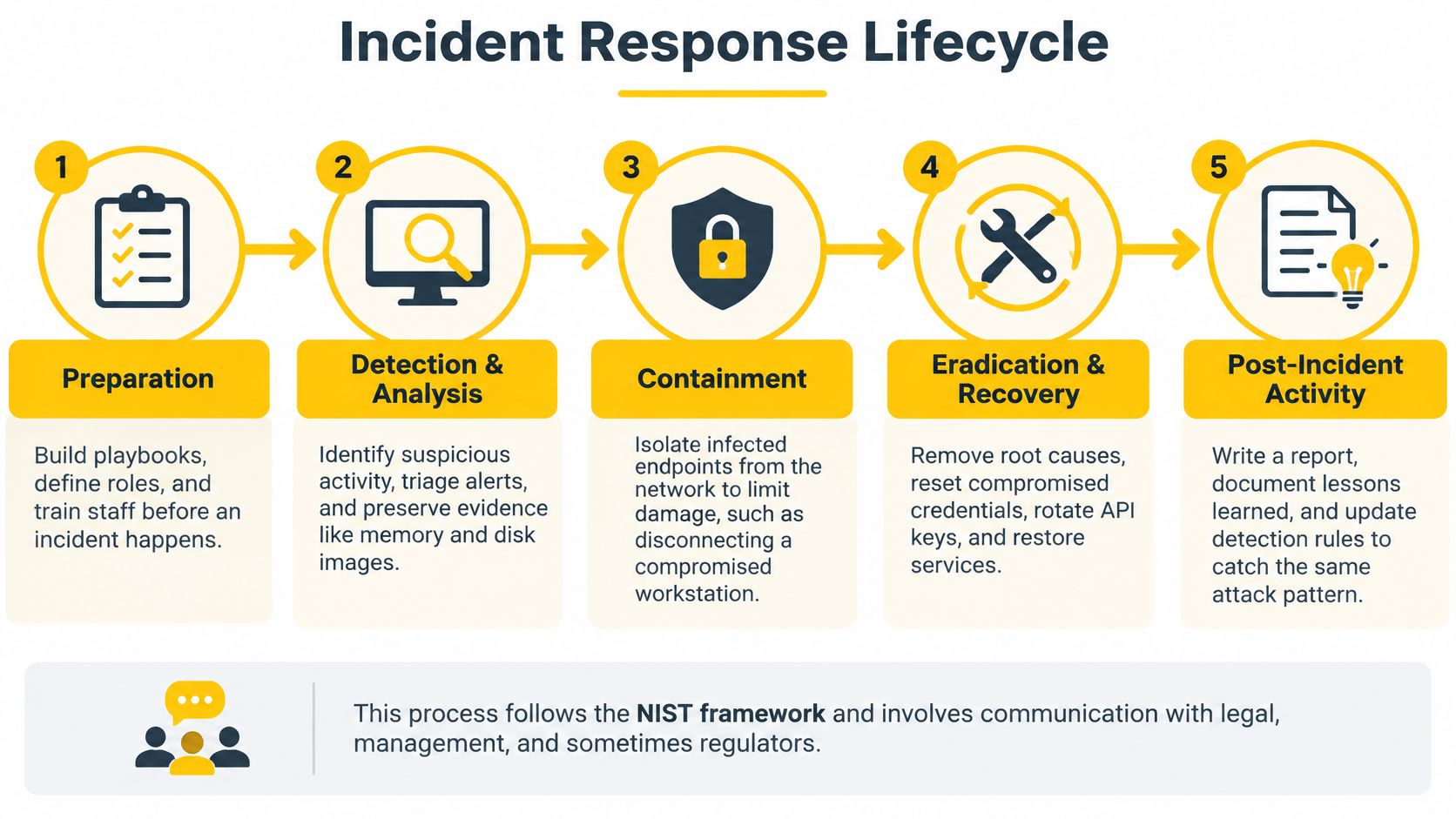
The order you act in is the answer interviewers score. NIST's incident response lifecycle runs preparation, detection and analysis, containment, eradication and recovery, post-incident activity. Reciting those names earns nothing. Preparation is where you earn the right to be calm: tested backups, a current contact tree, and a runbook someone has read. Detection and analysis is triage: scope, timeline, patient zero, and whether data left the building.
Ransomware is the scenario panels reach for. Verizon's 2025 Data Breach Investigations Report tracks ransomware as a recurring breach pattern, which is why payment belongs in the legal and operational cost column, not the recovery plan. A candidate who says "pay and move on" has skipped containment, scoping, and notification duties.
What you do first
Contain the host without destroying it. Pull the network cable or change the security group, but leave memory and disk intact; eradication without evidence is how the same foothold returns in two weeks. That is the key trade-off: every minute a host stays connected increases spread, and every reboot you rush destroys volatile evidence. Reset stolen credentials and rotate keys after a cloud takeover. Restore from backups you have tested, not backups you assume work. Write the lesson into a detection rule before the ticket closes. Stakeholder updates belong on the same timeline as the technical steps, or the business invents its own story and legal hears about it late.
A strong answer names four things: the first action, the evidence you preserve, the person you notify, and the condition that moves you to eradication. Practice that first-five-minutes version with these cybersecurity interview questions, not just the phase names.
Red flags: “I'd reimage immediately.” No comms plan. Treating the ransom note as the whole incident. Reciting NIST phases with no decision attached.
Follow-ups: Juniors order the phases and justify the first action. SOC candidates separate detection from containment and name the alert that started the clock. Pentesters describe an evidence-preserving handoff, including logs, timestamps, and what they did not touch. Seniors cover legal hold, customer notice, and when keeping a system online is safer than pulling it because the operational harm outweighs the malware.
7. Defense in Depth and Least Privilege
One control will fail. Defense in depth means the next layer still has a job. Least privilege means that layer doesn't hand out more access than the task needs.
Say a public web app holds invoices. A WAF filters obvious attacks. Network segmentation keeps the app tier from talking to the finance VLAN. The database account used by the app can't read the whole server. Storage is encrypted. None of those saves you alone. Together they turn a single bug into a contained one.
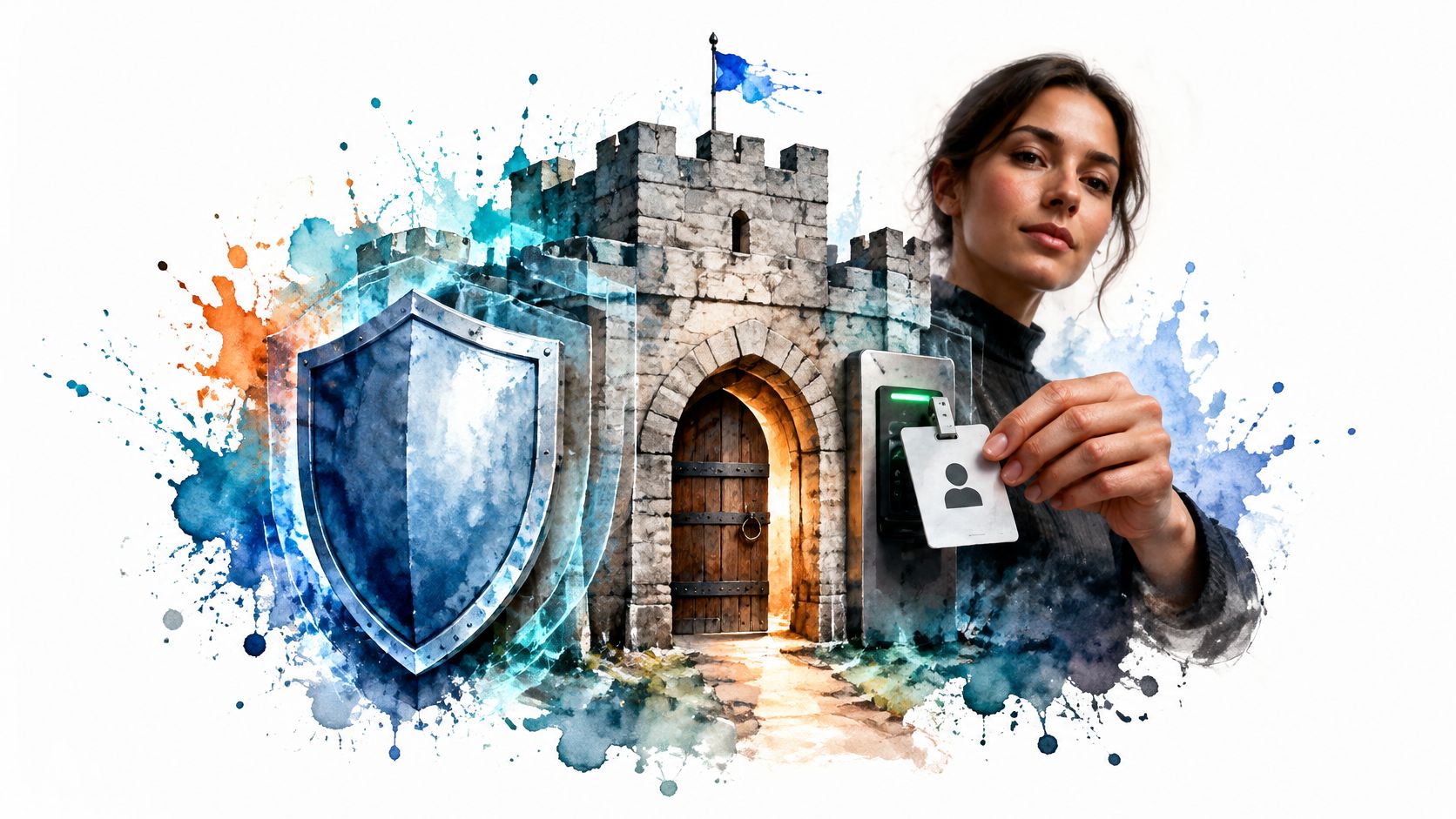
Least privilege needs a concrete picture or it sounds like a slogan. A reporting tool gets a read-only database user, not the app's write account. A service account gets the three API calls it makes, not *. Admins keep a daily account and a separate privileged one. Access reviews exist because privilege creeps one ticket at a time.
Red flags: Listing ten tools with no failure story. Equating least privilege with “no one is an admin.” Ignoring break-glass access, then having no way to recover at 2 a.m.
Follow-ups: Juniors name three layers and one control each. SOC candidates say which layer produced the alert and which layer should have stopped lateral movement. Pentesters describe how they chain a low finding into domain impact when layers are missing. Seniors talk about the cost of extra layers, including latency, exception processes, and the human who will bypass a control that blocks real work.
8. Firewalls, IDS, and IPS
A firewall allows or denies traffic against rules. An IDS watches and alerts. An IPS sits inline and can drop the packet. If you can't say which box is passive and which one can take the network down, the rest of the answer doesn't land.
Place them in a sentence you could sketch. The perimeter firewall blocks inbound traffic to ports you don't use. A switch span feeds an IDS that alerts on command-and-control beaconing without touching the flow. An IPS in front of a fragile app drops packets that match a known exploit signature. Detection and prevention are different jobs. Don't merge them to sound thorough.
Tuning beats tool names
A financial-institution implementation of an integrated cybersecurity framework reported false-positive alerts falling from 250 to 170 per day, a 32% reduction, and mean time to detect falling from 96 hours to 18 hours, in a write-up in the Malaysian Journal of Computing. Those are the outcomes a senior should connect to tuning and automation. Measure detection, containment, and analyst throughput separately. A single “security score” hides which part shifted.
An IPS that blocks payroll because nobody tuned the signature is a worse outage than the attack you feared.
Encrypted traffic is the trade-off to volunteer. Inspection can see threats inside TLS and can also break privacy expectations, add latency, and require careful certificate handling. Say what you would not decrypt.
Red flags: “IPS is just a better IDS.” Ignoring false positives. Promising to decrypt everything.
Follow-ups: Juniors define the three and place one. SOC candidates explain a suppression you'd approve and one you wouldn't. Pentesters talk about how encryption and segmentation change what they can see. Seniors defend a false-negative you'd accept to keep a business process alive.
9. Hashing vs. Encryption vs. Encoding
These three get swapped in weak answers, and the swap is an automatic flag.
Encoding, such as Base64, changes representation so a channel can carry the bytes. It's reversible with no key. A Base64 email attachment is not confidential. Say that sentence plainly.
Encryption hides content and is reversible with the right key. Use it for data in transit and at rest when you still need the original back. TLS and disk encryption are the examples. Lose the key and you lose the data, which is the availability trade-off people forget.
Hashing is one-way. You use it to check integrity, as in comparing a download to its SHA-256 checksum, and to store passwords. Passwords need a slow, salted password hash such as Argon2, bcrypt, or scrypt. Plain SHA-256 is too fast, and unsalted MD5 is how identical passwords become one crack.
The line interviewers draw
Give one definition and one use, then stop. Extra algorithms don't raise the score if you called Base64 encryption.
Red flags: “We encrypt passwords with SHA-256.” Treating encoding as a control. Recommending reversible encryption for password storage so support can “recover” them.
Follow-ups: Juniors sort three examples into the right bucket. SOC candidates explain why a hash match isn't proof of who sent a file. Pentesters describe passing a hash versus cracking one, at a high level and without a recipe. Seniors discuss salt storage, pepper versus salt, and why you'd still add MFA instead of trusting the hash alone.
10. Zero Trust Architecture
Zero trust means no user, device, or network location is trusted just because it is “inside.” Every request is checked for identity, device health, and the smallest permission that fits, and that check doesn't stop after login.
The old model trusted the office LAN and put a VPN around remote staff. Google's BeyondCorp is the example to cite. Employee access moved from a perimeter VPN toward identity and device checks. You don't need their architecture diagram. You need the contrast. Location stopped being the control.
I recommend a phased rollout, because a big-bang zero trust program stalls. Start with identity, strong authentication, and least privilege on the apps that matter. Add device compliance so a laptop missing disk encryption doesn't reach payroll. Then micro-segment so a compromised workstation can't route straight to finance systems. Continuous monitoring is part of the model, not a product SKU you buy at the end.
ISACA's 2026 global survey of more than 1,800 cybersecurity professionals found that 64% of organizations had conducted no AI-related incident-response exercises, while only 8% conducted them regularly. A senior zero trust answer should admit that new access paths, including unsanctioned AI tools, need owners, logs, and exercises. The model is a strategy. It isn't a single gateway.
Architecture panels push harder on this than SOC screens do. These architect interview questions are a useful second pass once you can state the phased plan without slides.
Red flags: “We bought zero trust.” Trusting the VPN as if it were the strategy. Ignoring contractors, service accounts, and legacy apps that can't do modern auth.
Follow-ups: Juniors contrast perimeter trust with per-request checks. SOC candidates say which signals they'd alert on, such as a healthy user on an unhealthy device. Pentesters describe what still works if identity is solid but segmentation isn't. Seniors lay out a 12-month sequence, the exceptions you'll allow, and how you'd know the program reduced reachable paths instead of adding login friction.
10 Cybersecurity Interview Questions at a Glance
| Question Topic | Difficulty Level | Core Concept Tested | Key Tip | Best Visual |
|---|---|---|---|---|
| CIA Triad (Confidentiality, Integrity, Availability) | Foundational | Three core information security objectives | Name the affected property, explain the impact, and give a relevant control | Three-part concept map |
| Authentication vs. Authorization | Foundational | Verifying identity versus deciding access | Use the badge-and-rooms analogy and mention least privilege | Side-by-side comparison |
| Symmetric vs. Asymmetric Encryption | Intermediate | Shared-key encryption versus public-private key cryptography | Explain the key-distribution problem and use TLS as a hybrid example | Encryption process flow |
| OWASP Top 10 Web Application Risks | Intermediate | Common web application risks and their prevention | Pair each risk with a prevention technique | Risk hierarchy diagram |
| Phishing, Spear Phishing, and Social Engineering | Foundational | Human-focused attacks and defenses | Explain how to report suspicious messages and verify requests separately | Phishing detection and response illustration |
| Incident Response Lifecycle | Intermediate | Phased handling of security incidents | Structure the response by phase and preserve evidence before wiping systems | Incident response process flow |
| Defense in Depth and Least Privilege | Intermediate | Layered security controls and minimal access | Give examples of controls across multiple layers and explain least privilege | Layered security hierarchy diagram |
| Firewalls, IDS, and IPS | Intermediate | Traffic filtering, passive detection, and active prevention | Contrast alerting with inline blocking and mention tuning for false positives | Side-by-side comparison |
| Hashing vs. Encryption vs. Encoding | Foundational | Reversible transformations versus one-way hashing | State clearly that Base64 is not encryption and name a password hashing algorithm | Side-by-side comparison |
| Zero Trust Architecture | Advanced | Continuous verification and context-based access | Contrast it with perimeter security and describe a phased implementation | Zero Trust architecture illustration |
| --- | --- | --- | --- | --- |
Turn These Answers Into Offers
The pass line on these cybersecurity questions and answers is lower than candidates think, and the offer line is more specific. A passing answer defines the term. A memorable one applies it to an incident the interviewer can picture, then names what you'd give up. Confidentiality versus getting a clinic back online. Inline blocking versus a false positive that stops payroll. Slow password hashing versus login latency. If you never say the trade-off, you sound like you memorized a glossary.
Rehearse the ten prompts out loud in that three-step order. Record yourself. If you can't land the application and the trade-off in under ninety seconds, you're still explaining, not answering. Cut the second example. Keep the one that shows impact.
I use a simple self-score after each take. Did I name the concept in the first sentence? Did I use a concrete system, not “the company”? Did I say what I would do first, and what I would not do? Did I leave a door open for a senior follow-up instead of pretending the topic is finished? That last point matters. Panels upgrade candidates who can go deeper, and they downgrade candidates who bluff past the edge of what they've done.
Pick three questions today, not all ten. CIA, authentication versus authorization, and the incident response lifecycle cover the most panel time. Run them once as a junior, in plain language. Run them again as the role you want, with the follow-up from that section. If you're aiming at pentest, add the OWASP item and talk impact without turning the answer into an exploit demo. If you're aiming at a SOC, add firewalls, IDS, and IPS, and talk about what you'd page on. If you're aiming at incident response, stay with evidence, containment, and who you tell.
Interview Pilot fits that rehearsal. AI mock interviews give you an evaluation of your answers before a live panel, and the Interview Copilot can support you during live online interviews. It covers technical and behavioral questions in more than 99 languages, the full question bank contains 10,000 questions on paid plans, and there are native apps for macOS, Windows, iOS, and Android. All data uses industry-standard encryption. Use the mock round to hear where you skip the trade-off. Then shorten the answer until it sounds like something you'd say to a teammate, not something you'd submit as an essay.
Interview Pilot gives you AI mock interviews with an evaluation of your answers, plus a real-time Interview Copilot for live online interviews, so you can practice these cybersecurity questions and answers before a SOC, pentest, or incident-response panel. The question bank and role guides let you rehearse the follow-ups that separate a definition from a hire. Visit Interview Pilot and run three of these prompts out loud before your next screen.
Topics
cybersecurity questions and answers
cybersecurity interview
security analyst interview
SOC interview questions
incident response interview
Continue reading

Interviews
Interview Preparation Checklist: What to Do Before Any Interview
A practical interview preparation checklist: research, STAR stories, questions to ask, online setup, the final 15 minutes, and a last-minute plan if time is short.
November 4, 2026

Interviews
What Makes You Unique Sample Answers: 8 Proven Examples
8 what makes you unique sample answers for technical, finance, product, and junior roles, with analysis and tips to tailor each one to your interview.
November 4, 2026
17 min read

Interviews
Interview Question to Ask: 10 Questions by Stage and Role
Use the best interview question to ask at every stage, from screening to final rounds, and see why each matters for engineering, product, and finance roles.
November 4, 2026
19 min read