









Interviews
Top 10 Technical Engineering Interview Questions in 2026
Explore 10 technical engineering interview questions across coding, SQL, systems, and ML, with difficulty levels, answer guidance, and mock practice tips.
Interview Pilot Editorial Team
Updated October 14, 2026
24 min read

You know the material. You've practiced arrays, SQL joins, system design, and concurrency. Then the interviewer adds one follow-up, changes a requirement, or asks what happens when the database fails, and your answer loses its structure.
That reaction is common because technical engineering interview questions rarely test recall alone. Interviewers reuse a relatively small set of prompts because each one exposes a specific engineering habit: how you manage state, choose a data structure, clarify requirements, reason about failure, or communicate trade-offs. A correct answer is only the starting point.
The list below groups ten questions by topic and difficulty, moving from foundational coding and SQL to operating systems, web infrastructure, system design, production debugging, machine learning, and distributed systems. Each question includes the role it fits, the trap an interviewer may set, and the signals that separate a memorized response from sound engineering judgment. For broader preparation and hiring support, explore Hire Developers.
1. Reverse a Singly Linked List
Best fit: Junior software engineering and general coding interviews.
Difficulty: Foundational.
You're given the head of a singly linked list and asked to reverse it. The expected result changes every node's next pointer so the list points in the opposite direction. A strong candidate doesn't rush into syntax. They name the state they must preserve first: the next node, the current node, and the previous node.
The iterative solution is usually the clearest. Start with previous = null and current = head. On each pass, save current.next, point current.next backward to previous, then advance both pointers. The key risk is overwriting the only reference to the unprocessed remainder of the list.
What the interviewer is testing
The trap is treating this as a memorization exercise. Interviewers often interrupt with an empty list, a single node, or a request to implement the recursive version. They want to see whether you understand pointer state rather than whether you can reproduce a familiar function.
A good answer should explicitly cover:
- Edge cases: An empty list returns
null; a one-node list remains unchanged. - Complexity: The iterative method runs in linear time and uses constant auxiliary space.
- Verification: Walk through
1 → 2 → 3, showing the links after each iteration. - Alternative reasoning: The recursive approach can work, but it consumes call-stack space and is easier to get wrong around the base case.
Practical rule: Draw the arrows before you write the loop. If you can explain which reference protects the remaining list, your implementation usually follows naturally.
The strongest signal is controlled narration. Say what changes, what must remain reachable, and how you'll test the result. A short question can reveal whether you reason about mutable state safely under pressure.

2. Two Sum
Best fit: Junior software engineering, backend, and general coding roles.
Difficulty: Foundational to intermediate.
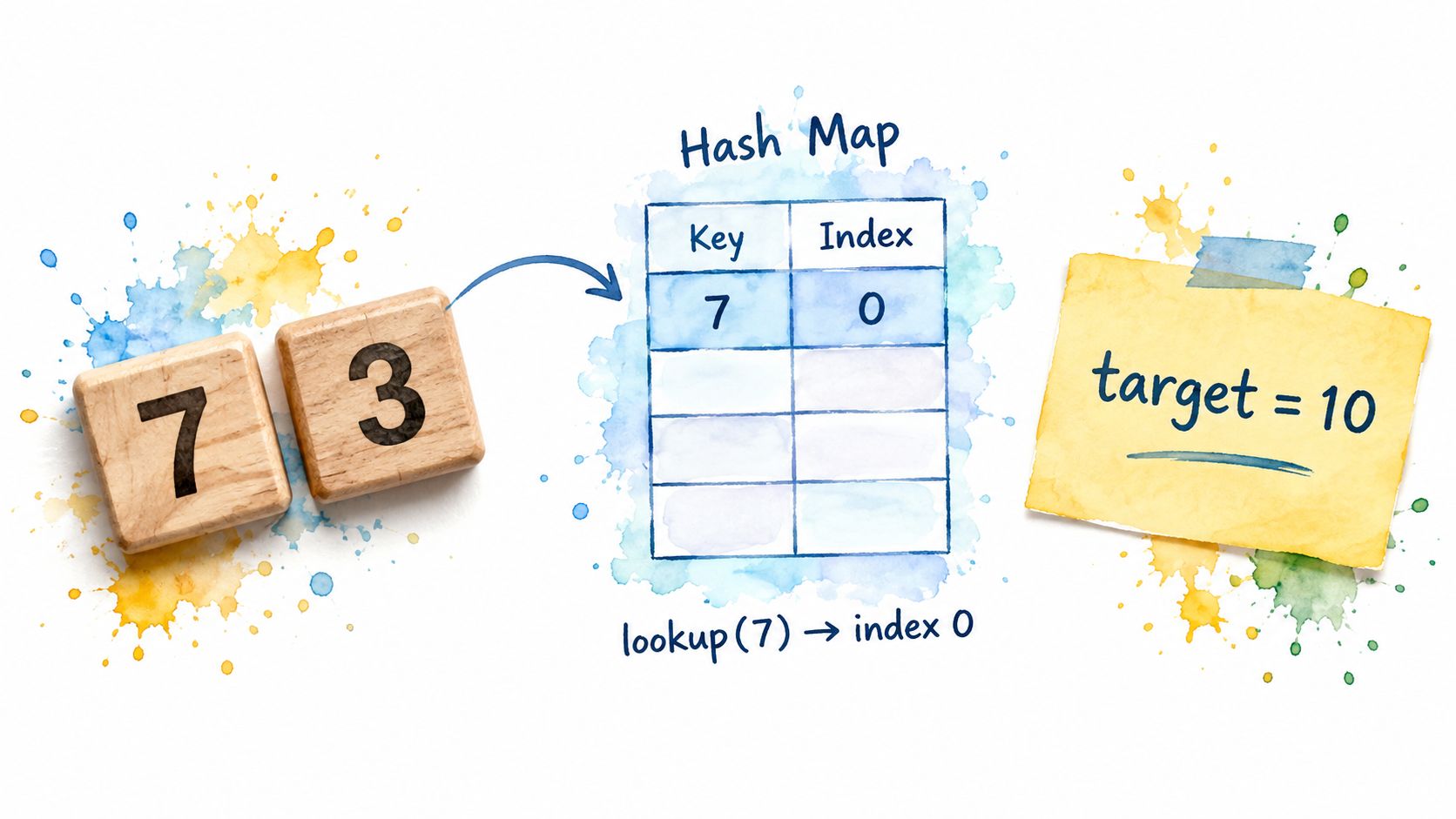
Given an array of integers and a target, return the indices of two values whose sum equals that target. The obvious nested-loop solution checks every pair. That's a valid starting point, but the useful interview discussion begins when you improve it with a hash map.
As you scan the array, calculate the complement of the current value. If that complement is already in the map, you've found the pair. Otherwise, store the current value and its index for a future lookup. This trades additional memory for faster membership checks.
The trap is skipping the contract
Before coding, clarify whether negative values and duplicates are allowed, whether the array always contains a solution, and whether returning any valid pair is acceptable. These details change how you handle repeated values and failure cases.
A strong explanation should include:
- Baseline: A pairwise scan is simple and uses little extra memory, but it repeats work.
- Optimized approach: A single pass with a hash map provides constant-time average lookups.
- Ordering detail: Check for the complement before inserting the current value, so one element can't incorrectly pair with itself.
- Validation: Test an ordinary pair, duplicate values, negative numbers, and an input with no solution.
Interviewers aren't only asking whether you know hash maps. They're watching whether you can explain why the data structure fits the operation. This same reasoning appears in production features such as deduplication, membership checks, and lookup-heavy request handling.
What a strong answer sounds like
State the brute-force approach first, then explain why it's insufficient for a large input. Describe the invariant in plain language: every value already scanned is available for a complement lookup. Finish with time and space complexity, plus the assumptions you made.
The weak response jumps directly to the optimized code and treats complexity as an afterthought. The strong response makes the trade-off visible before implementation begins.
3. Second Highest Salary in SQL
Best fit: Data analyst, data engineering, backend, and analytics-focused roles.
Difficulty: Foundational SQL with useful edge cases.
Start by defining the requirement: return the second-highest distinct salary from an Employee table. A sort followed by a second-row filter can return the wrong value when several employees share the highest salary. The query must reflect the business meaning, not merely the row order.
The simplest explanation uses a subquery and aggregate: find the largest salary below the overall maximum. This handles repeated top salaries when the condition is written correctly. A window-function solution applies DENSE_RANK to distinct salary values, then filters for the desired rank. It requires more SQL knowledge but extends naturally to the Nth-highest salary and rankings within each department.
Match the answer to the role
For a data analyst or analytics engineer, explain how the same pattern supports ranking sales representatives or ordering product revenue. The interviewer is testing whether you can translate an ambiguous reporting request into a precise query. A backend candidate should also discuss the expected result when only one distinct salary exists, such as NULL or an empty result, and clarify that choice before implementation.
Use a small test dataset with a repeated highest salary, a repeated second salary, and no qualifying second value. State the output for each case. This exposes whether the query ranks distinct values or counts rows instead.
A correct query expresses the business definition, not just the sort order.
The common trap is defending one syntax instead of explaining the trade-off. The aggregate approach is compact and easy to read. The window-function approach is more adaptable for grouped rankings and later changes, but may be unnecessary for a narrowly scoped query. Mention both, then choose the form that fits the requirement and database version.
A strong answer finishes with assumptions: whether salary can be NULL, whether duplicate salaries count once, and how the no-result case should be represented. That clarity signals production judgment, not just familiarity with SQL keywords.
4. Explain the Difference Between a Process and a Thread
Best fit: Backend, systems, infrastructure, and software engineering roles.
Difficulty: Foundational operating systems knowledge.
A service crashes during a deployment, and the interviewer asks whether separate processes or additional threads would limit the impact. That scenario tests more than vocabulary. It tests whether you can connect execution models to isolation, communication, performance, and failure handling.
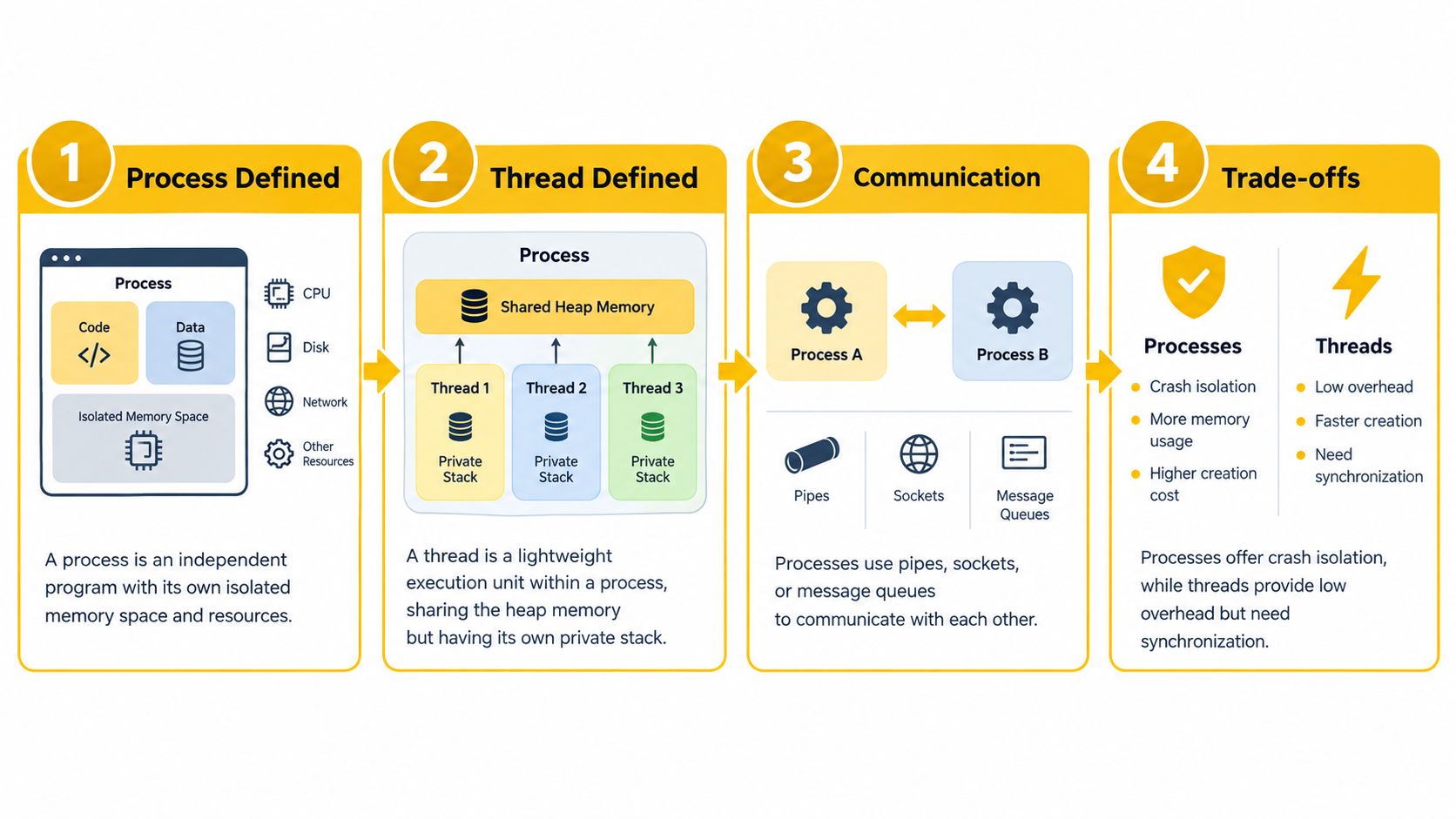
A process is a running program with its own address space and operating-system resources. A thread is an execution path within a process. Threads share that process's memory, so they can exchange data efficiently, while also introducing races, synchronization problems, and accidental shared-state bugs.
Answer through the trade-off
Processes usually provide stronger isolation and crash containment. Communication between them requires explicit mechanisms, such as pipes, sockets, or other interprocess communication methods. Threads generally have lower overhead and can access shared data directly, but that access requires careful reasoning about locks, atomicity, memory visibility, and deadlocks.
A strong answer should connect each distinction to a consequence:
- Isolation: A process failure is less likely to corrupt another process's memory.
- Coordination: Shared memory makes thread communication convenient, while synchronization becomes a responsibility.
- Scheduling: Both processes and threads can be scheduled independently, although the details depend on the operating system and language runtime.
- Language behavior: Name the concurrency model you use. In Python, for example, the Global Interpreter Lock affects how CPU-bound threaded work behaves.
The interviewer may set a trap by asking which option is faster. Avoid a universal claim. A web server might choose processes for stronger failure boundaries, threads for shared resources and lower overhead, or a different model based on its runtime and workload. The answer should state the expected bottleneck, the isolation boundary, and the operational cost.
For adjacent operating-system topics, review these operating system interview questions. A strong candidate explains what the application gains and which failure modes the choice introduces.
5. What Happens When You Type a URL Into a Browser
Best fit: Frontend, backend, web, infrastructure, and platform roles.
Difficulty: Intermediate systems fundamentals.
This question tests breadth and sequencing. A strong answer starts with a high-level path, then expands only where the interviewer shows interest.
The browser parses the URL, checks relevant caches, resolves the hostname through DNS when necessary, establishes a connection, negotiates security, sends an HTTP request, receives a response, and begins rendering the page. The server may perform application work, query storage, call other services, and return HTML, JavaScript, CSS, images, or API data.
Build the answer in layers
Name the protocols accurately without turning the response into a protocol catalogue. Depending on the connection, HTTP may use HTTP/2 or HTTP/3, with HTTP/3 running over QUIC. TLS protects the secure connection, and the handshake establishes the cryptographic parameters before application data flows.
Caching is a practical differentiator. Discuss browser caching, DNS caching, HTTP caching, and CDN caching. A candidate who mentions only DNS and TCP sounds rehearsed. A candidate who explains how a stale cache, expired certificate, slow origin, or blocked JavaScript can affect the user shows operational awareness.
The rendering stage also matters. The browser parses the response, builds internal representations of the document and styles, creates a layout, paints pixels, and executes scripts that may trigger additional network requests or layout work.
Start with the request path, then follow the interviewer's depth. Don't bury the sequence under details they haven't asked for.
This is also an opportunity to explain observability. If the page is slow, separate DNS time, connection time, TLS negotiation, server time, transfer time, and client rendering time. That breakdown turns a broad conceptual answer into a debugging method.
For deeper browser behavior, this headless browsing guide from Clearcote Labs provides useful context around automated browser environments.
6. Design a URL Shortener
Best fit: Mid-level and senior backend, platform, and distributed-systems roles.
Difficulty: Intermediate system design.
A URL shortener seems simple until an interviewer asks what it must guarantee. Users submit long URLs, receive compact aliases, and expect reliable redirects. The design depends on the workload and the product rules you establish first.
Ask about traffic shape, redirect latency, durability, custom aliases, expiration, abuse prevention, analytics, and edit or deletion behavior. One useful assumption is 100 million redirects per month with a 100:1 read/write ratio. That estimate supports adding a caching layer before drawing the rest of the system. It also clarifies whether the service is read-heavy, geographically distributed, or subject to strict retention requirements.
Design the core path
For writes, generate an identifier with a counter encoded in base62, or derive one from a hash. A counter limits collision concerns but requires coordination and produces predictable keys. Hashing can use the original URL, yet collisions still need handling. Product rules may also require different aliases for identical URLs.
Reads usually have tighter latency expectations. Cache popular aliases, keep the mapping in durable storage, and define behavior for expired or deleted links. Decide whether redirects return 301 or 302 responses. Permanent redirects support aggressive caching, while temporary redirects preserve control when destinations or analytics behavior may change.
Cover the design through decisions rather than a fixed component diagram:
- API shape: An endpoint creates an alias, and another resolves it.
- Storage model: Store the short key, destination, ownership metadata, and expiration.
- Abuse controls: Validate URLs, screen for malware, and apply rate limits.
- Failure handling: Define responses for cache outages, database lag, and missing keys.
- Operations: Track creation errors, redirect latency, cache-hit behavior, and invalid destinations.
A common failure is designing a global platform before defining the minimum viable service. Start with one reliable mapping service, then identify the bottlenecks that justify replication, partitioning, or regional routing. A strong answer shows why each component appears and what trade-off it introduces.
7. Design a Rate Limiter
Best fit: Backend, platform, infrastructure, and API engineering roles.
Difficulty: Intermediate system design.
A rate limiter protects an API from accidental overload, abusive clients, and unbounded retries. The question isn't only “how many requests are allowed?” It's also where enforcement occurs, what identity is limited, how bursts behave, and what happens when coordination fails.
Compare algorithms instead of naming one by habit. A fixed window is simple but can allow bursts at a window boundary. A sliding-window approach gives a more precise view of recent traffic but costs more state. A token bucket permits controlled bursts while maintaining an average rate, which often fits public APIs well.
Make the failure policy explicit
A limiter may run at an API gateway, in middleware, or inside the service. Gateway enforcement applies consistently across services, while application-level enforcement can use business context that the gateway doesn't know. Distributed deployments usually need shared state, often through a system such as Redis, with atomic updates to prevent concurrent requests from bypassing the limit.
The interviewer may ask what happens when the shared store is unavailable. Failing open preserves availability but can expose the service to overload. Failing closed protects the service but may reject legitimate traffic. The answer should depend on the endpoint. A low-risk read API and a sensitive authentication endpoint may justify different policies.
Include client behavior in the design. Return HTTP 429 when a request is rejected, provide useful retry guidance, and expose headers such as remaining quota where appropriate. Consider clock consistency, key cardinality, eviction, and whether limits apply per user, token, IP address, organization, or route.
The weak answer says “put Redis in front of the API.” The strong answer defines the algorithm, state transitions, atomicity requirement, failure mode, and operational signals. It also explains how product requirements shape each choice.
8. Walk Through Debugging a Slow API Endpoint in Production
Best fit: Backend, DevOps, site reliability, and platform roles.
Difficulty: Intermediate to advanced, with behavioral elements.
Suppose an endpoint has become slow in production. Don't begin by guessing that the database is responsible. Begin by scoping the incident: which endpoint, which clients, which regions, which deployment version, and which latency percentile are affected?
A reliable investigation follows a sequence: measure, form a hypothesis, isolate the component, mitigate the impact, fix the cause, and verify the result. Use request metrics, logs, traces, database timings, dependency health, resource saturation, and recent-change history to replace assumptions with evidence.
Show how you protect users first
Rollback or disable a recent feature when it's a safe mitigation. You can investigate the root cause after stabilizing the service. This demonstrates judgment under pressure and avoids treating perfect diagnosis as a prerequisite for reducing harm.
Potential causes include a slow query, a missing index, connection-pool exhaustion, downstream latency, lock contention, a cache miss pattern, serialization overhead, or a traffic change. Distributed tracing can show where the request spends time, while dashboards from tools such as Datadog, Prometheus, Grafana, or OpenTelemetry-based systems help establish scope and recurrence.
A production debugging answer should separate mitigation from diagnosis. The fastest safe action may not be the final fix.
The interviewer also wants prevention. Describe a follow-up such as query review, a regression test, a load test, a new alert, a timeout policy, a circuit breaker, or clearer dependency budgets. Don't promise an improvement figure unless you have real evidence from your own experience.
For a practical discussion of finding the limiting component in a system, see Applied's guide to bottleneck identification. A strong answer stays calm, communicates impact clearly, and verifies that the fix improved the right metric rather than merely moving work elsewhere.
9. Explain the Bias-Variance Trade-Off
Best fit: Data science, machine learning engineering, and applied research roles.
Difficulty: Intermediate machine learning fundamentals.
Bias is error from an overly restrictive model or set of assumptions. Variance is sensitivity to the particular training sample. A high-bias model underfits, while a high-variance model fits training data closely and may perform poorly on unseen data. Irreducible noise remains even when the model is appropriate.
A polynomial example makes the concept concrete. A model that is too simple misses the underlying pattern. A model that is too flexible follows noise in the training set. The useful answer connects that picture to measurements and decisions.
Diagnose before prescribing
Compare training and validation error. High error on both can indicate underfitting, while a large gap between low training error and worse validation error can indicate overfitting. Then choose a response based on the diagnosis.
For high bias, consider richer features, a more expressive model, weaker regularization, or better problem formulation. For high variance, consider regularization, more representative data, simpler features, early stopping, or cross-validation. More data can help variance, but it won't fix a badly specified target or systematically missing feature.
Ensemble methods offer another practical connection. Random forests average decorrelated trees, which can reduce variance rather than relying on one highly complex tree. Explain the intuition, but avoid claiming that any method guarantees a particular outcome.
The trap is reciting the definitions without describing how you'd recognize either problem in an experiment. A strong candidate talks about train and validation curves, data leakage, distribution shifts, and the business cost of each error type.
For additional prompts in this area, use these AI and machine learning interview questions. Practice the explanation until you can make the distinction clearly without relying on a diagram.
10. Explain the CAP Theorem and Its Practical Implications
Best fit: Senior backend, data engineering, infrastructure, and distributed-systems roles.
Difficulty: Advanced.
The CAP theorem concerns a distributed system facing a network partition. Under that condition, the system must choose between consistency and availability. Consistency means a read receives the most recent write or an error. Availability means each request receives a non-error response, even when the system can't guarantee the newest value.
The trap is suggesting that a database chooses any two of consistency, availability, and partition tolerance. In a distributed system, partitions are a failure condition you must tolerate. The meaningful design decision is how the system behaves when communication between nodes breaks.
Connect the theorem to product risk
A banking balance usually needs stronger consistency because stale values can create serious business consequences. A social-media like count may tolerate temporary disagreement if the product values continued writes and responsive reads. The right choice depends on what stale or rejected data means to users.
Go beyond the slogan by discussing PACELC. It asks what a system chooses when there is a partition and what trade-off it makes when the system is operating normally, often between latency and consistency. That framing helps explain why two systems can behave differently even without an active partition.
Know how to discuss database examples carefully. Apache Cassandra and Amazon DynamoDB are commonly described as availability-oriented systems with tunable consistency options. Apache HBase and Google Spanner emphasize stronger consistency guarantees, with Spanner using TrueTime-related mechanisms to support coordination across regions. Explain that actual behavior depends on configuration, operation type, topology, and failure conditions.
Don't answer CAP as a database label. Answer it as a product decision under failure.
Tie the discussion to retries, quorum behavior, conflict resolution, read-after-write expectations, and user-visible errors. For related distributed-service practice, review these microservices interview questions. Senior interviewers are looking for trade-off discipline, not a single preferred architecture.
10 Technical Interview Questions Comparison
| Title | 🔄 Complexity | ⚡ Resources / Efficiency | ⭐ Expected Outcomes | 📊 Ideal Use Cases | 💡 Key Advantages / Tips |
|---|---|---|---|---|---|
| Reverse a Singly Linked List | Low, iterative simple; recursive adds call-stack complexity | O(n) time; O(1) extra space (iterative); O(n) stack (recursive) | Demonstrates pointer manipulation and edge-case handling | Entry-level software/backend interview warm-up | Say approach aloud, draw pointers, handle null/single-node cases |
| Two Sum | Low, straightforward hashing vs brute-force | O(n) time and O(n) space (hash); O(n²) time baseline | Shows time-space trade-off and hash-map reasoning | Early-stage interviews; data roles; algorithm fundamentals | Present brute-force then optimize; ask clarifying questions about duplicates |
| Second Highest Salary (SQL) | Low–Medium, multiple SQL idioms (subquery, window funcs) | DB-dependent; window functions may be heavier than simple aggregates | Tests DISTINCT, edge-case handling, and ranking functions | Data analyst/engineer/BI interviews | Clarify NULL vs empty result; know subquery and window approaches |
| Process vs Thread (OS) | Medium, conceptual with practical implications | Processes heavier (isolated memory); threads lighter but need sync | Assesses concurrency fundamentals, isolation vs shared state | Systems, embedded, backend roles | Use concrete analogies; mention language/runtime specifics (e.g., GIL) |
| What Happens When You Type a URL into a Browser? | High, broad end-to-end sequence across layers | Requires knowledge of DNS, TCP/TLS, HTTP, browser rendering | Evaluates breadth across networking, security, and rendering pipelines | Web, backend, SRE, network engineering interviews | Start with layered overview, then drill into layer interviewer cares about; mention caching/protocol versions |
| Design a URL Shortener | Medium–High, system design trade-offs and scaling | Storage, caching, key-generation strategy; read-heavy caching recommended | Tests distributed design, capacity estimation, and API choices | Mid-to-senior backend and platform interviews | Begin with requirements and capacity math; justify key-generation and caching choices |
| Design a Rate Limiter | Medium–High, algorithmic + distributed concerns | Memory and coordination costs vary (token bucket vs sliding log); often requires Redis/atomic ops | Evaluates algorithm selection and distributed coordination | API platform, SRE, senior backend roles | Compare algorithms, specify placement (gateway vs app), handle failures and headers (429, X-RateLimit-*) |
| Debugging a Slow API Endpoint in Production | Medium, investigative process with tooling | Relies on observability: metrics, logs, traces, profiling tools | Assesses troubleshooting, prioritization, and incident communication | Backend, DevOps, SRE, full-stack roles | Use a clear framework (scope → measure → hypothesize → isolate → fix → verify); prepare real examples and mitigations (rollback) |
| Bias–Variance Tradeoff | Medium, conceptual with diagnostic steps | Needs experiments/validation curves and possibly more data | Demonstrates ML model diagnosis and remedy choices (regularization, ensembling) | Data science and ML engineering interviews | Use simple examples (polynomial fits), show training vs validation errors, name concrete fixes for bias vs variance |
| CAP Theorem and Practical Implications | Medium–High, conceptual with system examples | Requires understanding of consistency models and DB behavior (latency vs consistency trade-offs) | Tests distributed-systems reasoning and architecture choices; knowledge of PACELC | Senior backend, infra, and distributed systems roles | Define terms precisely, mention PACELC, and cite concrete database behaviors (e.g., Cassandra vs Spanner) |
Turn These Questions Into a Weekly Practice Routine
Reading technical engineering interview questions creates recognition, not fluency. You recognize the linked-list prompt, the rate-limiter diagram, or the CAP definition, but recognition disappears when the interviewer changes one assumption. Practice must reproduce the pressure of explaining a decision while someone evaluates your reasoning.
Use two questions per session from different categories. Pair a coding problem with a systems question, or SQL with production debugging. That prevents your preparation from becoming a narrow algorithm routine and reflects how real interview loops move between implementation, architecture, and communication.
Answer aloud with a timer. Start by restating the problem and identifying assumptions. Then describe the simplest viable approach, name its complexity or operational cost, and explain what would make you change the design. For coding questions, narrate state changes and test edge cases. For design questions, clarify requirements before drawing components. For behavioral-technical prompts, separate immediate mitigation from long-term prevention.
After each answer, write down where your explanation broke down. Did you skip a requirement? Did you choose a tool before defining the workload? Did you know the solution but fail to explain why it worked? These gaps are more valuable than another passive review of a question bank.
A useful weekly rhythm looks like this:
- Session one: Reverse a linked list and explain process versus thread.
- Session two: Solve a SQL ranking problem and trace a URL request.
- Session three: Design a URL shortener and compare rate-limiting algorithms.
- Session four: Debug a slow endpoint and explain a machine learning trade-off.
- Session five: Discuss CAP with a concrete product example, then revisit the answer that felt least clear.
Use real constraints from the role you want. A frontend candidate should emphasize browser behavior, rendering, accessibility, and client performance. A backend candidate should spend more time on data consistency, failure modes, APIs, and observability. A data engineer should turn SQL answers into questions about data quality, modeling, and pipeline reliability.
The evidence behind modern hiring also supports structured preparation. Technical interviews often include multiple evaluation stages, and candidates may be assessed on coding, debugging, system design, communication, and behavior rather than one isolated exercise. Structured interviews can improve consistency when interviewers use standardized questions and observable scoring criteria, but structure only helps when the criteria measure job-relevant reasoning.
That distinction matters because algorithm practice alone doesn't represent all engineering work. Developers have raised concerns about assessments that fail to resemble production tasks, so prepare to review unfamiliar code, test assumptions, diagnose failures, explain maintainability, and make trade-offs under constraints. In AI-assisted environments, be ready to explain how you verify generated code, detect security or correctness problems, and decide what still requires human review.
For the next seven days, schedule five short sessions, choose the pairs above, and record one spoken answer for each. On the final day, replay the weakest recording, answer the same question again without notes, and compare your structure. The goal isn't perfect wording. It's making your reasoning visible, repeatable, and adaptable when the follow-up arrives.
Interview Pilot offers a searchable question bank, guided AI mock interviews, and practice coverage for coding, algorithms, system design, debugging, testing, and production judgment. Use its role-focused practice to rehearse your answers aloud, then visit Interview Pilot to build your next technical interview routine.
Topics
technical interview questions
engineering interview questions
coding interview questions
system design interview
interview practice
Continue reading

Interviews
Software Engineer Technical Interview Questions and Answers
Master software engineer technical interview questions and answers with worked approaches, practice tips, and resources for algorithms, systems, and design.
October 4, 2026
19 min read

Interviews
10 Technical Interview Questions Software Engineer
Master technical interview questions software engineer candidates face, from algorithms and data structures to system design, with practical answer tips.
October 3, 2026
20 min read

Interviews
Mock Interview Meaning: A Practical Guide to Rehearsing
Learn the mock interview meaning, how simulated interviews build confidence, the main types, and how to practice effectively before your next real interview.
September 29, 2026
16 min read