












Interviews
10 Technical Interview Questions Software Engineer
Master technical interview questions software engineer candidates face, from algorithms and data structures to system design, with practical answer tips.
Interview Pilot Editorial Team
Updated October 3, 2026
20 min read

You recognize the pattern. The array is sorted, the graph has a clear starting node, or the problem resembles something you've solved before. Then the clock starts, and you lose time choosing an approach, explaining why it works, or handling an edge case you didn't test. Strong preparation for technical interview questions for software engineers combines pattern recognition with complexity analysis, deliberate testing, and clear communication.
Modern loops test more than coding recall. A typical process can include an initial screen, live technical rounds, system design, and behavioral evaluation, while AI literacy questions are becoming more common in technical interviews, according to HackerRank's 2026 technical interview guide. You'll need to explain your assumptions, compare alternatives, and show how your solution behaves under production constraints.
The patterns below progress from arrays and strings to trees, graphs, dynamic programming, hash tables, and system design. Each question type includes common implementation traps, the reasoning interviewers evaluate, and a practical way to rehearse. Junior candidates can focus on correctness and fundamentals. Mid-level candidates should add complexity trade-offs and system thinking, while senior candidates should connect algorithms to reliability, scale, and architecture.
1. Two Pointer Technique and Array Manipulation
A sorted array can turn a pair-search problem into a controlled walk from both ends. In Two Sum II, place one pointer at the beginning and another at the end. If their sum is too small, advance the left pointer to increase it. If the sum is too large, move the right pointer inward to decrease it. Sorting makes each move safe because it identifies possibilities that cannot produce the answer.
The same pattern appears in Container With Most Water, Remove Duplicates from Sorted Array, and merging sorted arrays. These introductory problems test whether you can identify an ordering invariant. Harder variations may combine pointer movement with duplicate handling, in-place updates, or linked-list traversal. State the pattern before choosing a template.

Explain the invariant before you code
Describe what each pointer represents, which condition moves it, and which candidates that movement eliminates. Confirm whether the input is sorted, whether duplicates are allowed, and whether the function may mutate the array. These details expose implementation pitfalls before they become bugs.
Test an empty array, a single element, duplicate values, and an input with no valid pair. Draw the pointers on paper when their movement is difficult to justify. During practice, Interview Pilot's AI Mock Interview can help you rehearse explaining pointer logic aloud, while you independently verify that the explanation matches the code.
Practical rule: Every pointer move needs a reason. If you cannot explain which possibilities it removes, the implementation is not ready.
After testing, state the time and space complexity. Connect both to the input structure, and explain why coordinated movement avoids repeated scanning.
2. Binary Search and Search Space Optimization
A sorted array can turn a long scan into a sequence of focused decisions. Binary search works when the search space has an ordered or monotonic condition, so each midpoint lets you discard a known portion. Search in Rotated Sorted Array tests whether one half remains ordered. First Bad Version searches for the first point where a condition becomes true. Peak Element uses neighboring slopes, even though the full array is not sorted.
Start with the standard template, then adapt it to the problem's boundaries. Specify whether left and right are inclusive, how the midpoint is calculated, and which update preserves every possible answer. Mixing inclusive and exclusive rules often creates an infinite loop or skips the boundary.
Make the decision rule explicit
At each iteration, state what the midpoint reveals and why one side can be discarded. In Find K Closest Elements to a Target, the goal may be the best window rather than the target itself. Define what each candidate window means before writing the condition.
Search-space questions become harder when the answer is implicit. Explain the predicate you are testing, the point where it changes, and how the algorithm preserves that transition. This explanation shows whether you understand the pattern or are recalling a template.
Practice with repeated values, a single element, and a target outside the range. Use Interview Pilot's real-time interview practice to verbalize boundary handling, then compare the explanation with the code.
If the search space is unclear, binary search becomes a memorized loop.
Finish by stating the assumptions: sortedness, monotonicity, and a valid boundary. Then give the time and space complexity and explain why repeated halving produces the improvement.
3. String Manipulation and Pattern Matching
String questions test whether you can turn characters into a useful representation before processing them. Longest Substring Without Repeating Characters combines a moving boundary with a set or frequency map. Minimum Window Substring requires you to track which character requirements are satisfied. Implement strStr asks how you'd search for a pattern efficiently, while Regular Expression Matching introduces recursion and dynamic programming.
Begin by clarifying the character model. Ask whether input can contain spaces, punctuation, uppercase letters, or Unicode characters. The correct data structure depends on that answer, and a candidate who raises it demonstrates practical engineering judgment.
Separate transformation from matching
For a palindrome, compare characters from both ends. For frequency-based tasks, build a map and update it as the window changes. For repeated pattern search, discuss whether a straightforward scan is sufficient or whether a technique such as KMP is appropriate for the constraints.
Use technical interview questions in Python to compare language-specific string behavior with the underlying algorithm. Don't let built-in methods hide the reasoning. Explain what the operation costs and whether it creates a new string.
Try an empty string, a single character, repeated characters, and a pattern longer than the input. State whether your solution uses extra memory proportional to the input or to the character set. That distinction shows that you understand the implementation rather than only the output.
4. Sliding Window and Two-Pointer Techniques for Subproblems
A sliding window is useful when a contiguous range must satisfy a changing condition. In Longest Substring Without Repeating Characters, the right pointer expands the range and the left pointer contracts it when a duplicate appears. In Maximum Consecutive Ones III, the window can contain a limited number of modifications. Fruit Into Baskets turns the same idea into a constraint on distinct values.
The pattern looks simple, but the state management is where candidates often make mistakes. You need a clear record of what the current window contains and exactly when the window becomes valid or invalid.
Narrate expansion and contraction
Use a set when you only need membership. Use a frequency map when duplicate counts affect removal. Explain whether you update the best answer before or after restoring validity. That ordering can change the result.
Draw the window over a short input and move the boundaries one step at a time. Practice with an empty input, one character, a fully valid input, and an impossible constraint. Coding interview questions for structured practice can provide more variations, but don't solve them by pattern name alone.
Say this clearly: “I expand to explore new candidates, then contract only until the invariant is restored.”
The interviewer is looking for an argument that each element enters and leaves the window in a controlled way. Compare this with brute force, which repeatedly examines overlapping ranges. That comparison makes the optimization understandable.
5. Hash Tables and Collision Resolution
Hash tables appear in questions such as Two Sum, Group Anagrams, and Happy Number, but interviewers may also ask you to design a hash map or hash set from scratch. The basic idea is to transform a key into an index, store the entry, and resolve cases where different keys map to the same location.
Explain collision resolution rather than treating the structure as magic. Separate chaining stores multiple entries in a bucket. Open addressing searches for another available position. Then discuss what happens as the table fills, including resizing, rehashing, and the effect of the load factor.
Connect the structure to the use case
A hash map is useful when fast key lookup matters and sorted iteration isn't required. A tree map is preferable when ordered keys or range queries matter. In Python, you can discuss dict; in Java, you can compare HashMap with ordered alternatives. The language example should support the data-structure explanation, not replace it.
For a custom object, explain which fields participate in equality and hashing. If those rules disagree, lookups can fail in confusing ways. In Group Anagrams, choose a canonical key, such as a sorted character sequence or a frequency signature, and discuss its construction cost.
A good answer also mentions adversarial or poor hash functions. The interviewer wants to know that average lookup behavior depends on distribution and implementation choices, not on a guaranteed promise in every situation.
6. Tree Data Structures and Traversal Patterns
Tree questions reward candidates who read the structure before choosing recursion. Validate Binary Search Tree requires range constraints, not merely checking whether each node is larger than its immediate left child. Lowest Common Ancestor depends on the tree's properties. Binary Tree Maximum Path Sum requires separating the value returned to a parent from the best path found anywhere in the tree.
Start by asking whether the tree is a binary search tree, balanced, complete, or arbitrary. Ask whether duplicate values are allowed. These assumptions determine both the algorithm and the correctness argument.
Choose traversal by the information you need
In-order traversal produces sorted output for a valid binary search tree. Pre-order traversal is useful when a parent must be processed before its children. Post-order traversal works well when a node's result depends on completed child calculations, as in height or maximum-path problems.
Practice recursive and iterative versions. Recursion is concise, but an iterative solution makes the stack explicit and can avoid problems on a very deep tree. Check null roots, leaf nodes, one-sided trees, and invalid ordering.
Use a small diagram while explaining Serialize and Deserialize Binary Tree. Describe how null markers preserve structure, rather than only listing the traversal order. Interviewers evaluate whether you understand the tree's shape, not just whether you can type a recursive function.
7. Breadth-First Search and Level-Order Traversal
Breadth-first search explores a graph or tree layer by layer. It fits Binary Tree Level Order Traversal, shortest-path problems in an unweighted grid, and prompts such as Word Ladder, where each transformation has the same cost. The queue holds the frontier, and each step moves outward from the starting state.
For Shortest Path in Binary Matrix, define what a neighbor is, how obstacles are handled, and what counts as reaching the destination. For a tree, the queue naturally groups nodes by depth. For a graph, the same mechanism tracks reachable states.
Protect the visited invariant
Mark a node visited when you enqueue it, not only after you dequeue it. Otherwise, several parents may add the same node to the queue. That creates duplicate work and can produce incorrect distance calculations.
Use a deque in Python and explain whether the queue stores only nodes or nodes plus distance information. You can also process one level at a time by recording the current queue length. Test an isolated start, a blocked path, a cycle, and a destination that can't be reached.
BFS is the right default when every edge has equal cost and the question asks for the fewest steps.
Don't apply BFS mechanically. If edges have different weights, ordinary BFS may no longer produce the shortest path. State that limitation and identify what additional technique the constraints would require.
8. Depth-First Search and Graph Traversal
Depth-first search follows one branch as far as possible before backtracking. It supports Number of Islands, connected-component detection, tree exploration, and topological problems such as Course Schedule II. It also powers backtracking questions involving Permutations and Combinations.
The central distinction is between traversal and backtracking. In ordinary graph traversal, a visited set prevents repeated work and infinite cycles. In backtracking, the current path or choice state changes as the recursion descends, then must be restored before exploring the next choice.
Make the call state visible
For Course Schedule II, model prerequisites as directed edges and explain how your visited state distinguishes an unvisited node, a node currently in the recursion path, and a fully processed node. That distinction exposes cycles.
For permutations, add a candidate, recurse, remove it, and continue. If you omit the removal, later branches inherit the wrong state. Draw the recursion tree for a small input and identify the stack depth. Then consider whether an iterative approach would make the state clearer.
A graph with cycles, disconnected components, duplicate values, or an empty input will reveal weak assumptions quickly. Discuss time and space in terms of vertices, edges, and recursion depth. The interviewer is testing whether your traversal model matches the data structure.
9. Dynamic Programming and Memoization
Dynamic programming becomes useful when a problem contains overlapping subproblems and optimal substructure. Climbing Stairs introduces a recurrence. Coin Change asks for an optimal result over repeated choices. Longest Increasing Subsequence requires a state describing progress, and Edit Distance tracks transformations between prefixes of two strings.
Don't begin with a table. Begin with a brute-force definition. Ask what information a subproblem needs, write the recurrence, and identify the base cases. Memoization then stores results for states that would otherwise be recomputed.
Define the state in plain language
For Edit Distance, a state might represent the minimum operations needed to transform one prefix into another. For Coin Change, it might represent the best result for a particular remaining amount. If you can't explain a state without referring to code, it probably isn't precise enough.
Compare top-down memoization with bottom-up tabulation. Top-down can follow only reachable states, while bottom-up can make iteration order and memory reduction easier to see. Explain why a greedy choice isn't always safe before claiming dynamic programming is necessary.
Test zero values, impossible targets, repeated choices, and the smallest valid input. Draw a small state graph or table during the interview. That visual makes redundant computation and the effect of caching easier to communicate.
10. System Design and Architecture Fundamentals
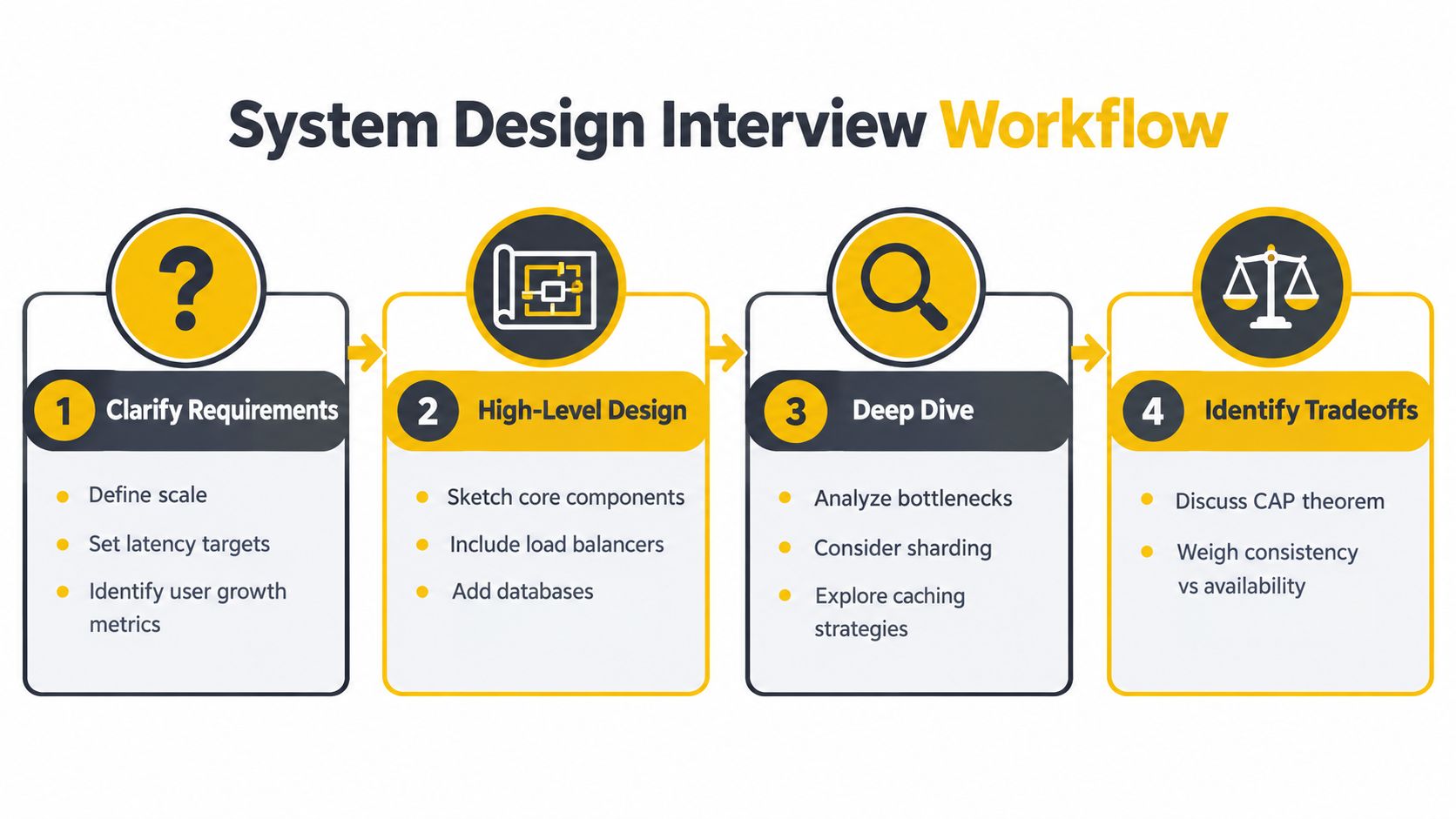
A system design interview asks you to turn a product request into a service that remains useful under competing requirements. Common prompts include a URL shortener, social feed, distributed rate limiter, or cache. The reusable pattern is consistent: clarify the goal, estimate constraints, sketch the simplest architecture, then examine bottlenecks. Interviewers assess your reasoning and how clearly you defend trade-offs, not only the components you name.
Begin with user-facing operations. Ask about traffic, latency, data growth, consistency, availability, and failure behavior. Then draw an API, application service, database, cache, and load balancer. Add a queue or distributed store only when a stated requirement supports it. Treat the first design like a map, then zoom in on the area most likely to fail.
Turn trade-offs into decisions
For a URL shortener, explain code generation, collision handling, and redirects. For a feed, separate write and read paths, then discuss freshness. For a rate limiter, choose an algorithm and locate its state. For a cache, cover eviction, invalidation, and stale data. Name the failure each decision addresses.
System design now appears in some mid-level and senior interview processes, alongside coding and communication, according to 2026 industry analysis from HackerRank. Use system design interview templates to rehearse the sequence, then redraw each design without prompts. Practice explaining one decision at a time: requirement, choice, trade-off, and fallback.
10-Topic Technical Interview Comparison
| Technique | 🔄 Implementation Complexity | ⚡ Resource Requirements | ⭐ Expected Outcomes | 💡 Ideal Use Cases | 📊 Key Advantages |
|---|---|---|---|---|---|
| Two Pointer Technique / Array Manipulation | 🔄 Medium, pointer logic & edge cases | ⚡ Low extra space; O(n) time | ⭐⭐⭐⭐, efficient linear solutions | 💡 Sorted arrays, in-place reversal, pair finding | 📊 Reduces O(n²) → O(n); minimal memory |
| Binary Search and Search Space Optimization | 🔄 Low–Medium, template + edge handling | ⚡ Very low memory; O(log n) time | ⭐⭐⭐⭐⭐, excellent for large sorted data | 💡 Sorted lookups, rotated arrays, answer-space search | 📊 Logarithmic time; scalable lookups |
| String Manipulation and Pattern Matching | 🔄 Medium, basic easy, advanced algos steep | ⚡ Varied: low to medium (KMP/rolling hash costs) | ⭐⭐⭐⭐, highly versatile for text tasks | 💡 Substring search, regex, text processing | 📊 Multiple algorithm choices; practical in text systems |
| Sliding Window and Two-Pointer for Subproblems | 🔄 Medium, expansion/ contraction logic | ⚡ Low extra space; may use hashmap O(1)–O(k) | ⭐⭐⭐⭐, linear-time for many subarray problems | 💡 Longest/shortest substring, constrained subarrays | 📊 Converts brute-force O(n²) → O(n); clear correctness tests |
| Hash Tables and Collision Resolution | 🔄 Medium, hashing & collision strategies | ⚡ Medium memory; average O(1) ops | ⭐⭐⭐⭐, fast average-case performance | 💡 Fast lookup, grouping, caching, deduplication | 📊 Amortized O(1) insert/search; flexible design choices |
| Tree Data Structures and Traversal Patterns | 🔄 Medium, recursion & null handling | ⚡ Medium (stack/recursion memory) | ⭐⭐⭐⭐, essential for hierarchical problems | 💡 BST operations, traversal-based algorithms | 📊 Foundation for many structures (heaps, tries) |
| Breadth-First Search (BFS) and Level-Order Traversal | 🔄 Medium, queue-based implementation | ⚡ Higher space (O(V) queue) | ⭐⭐⭐⭐, optimal for shortest unweighted paths | 💡 Shortest path, level-order tree problems, grids | 📊 Guarantees shortest path; clear iterative flow |
| Depth-First Search (DFS) and Graph Traversal | 🔄 Medium–Hard, recursion/backtracking care | ⚡ Moderate memory; recursion depth risk | ⭐⭐⭐⭐, good for connectivity & ordering tasks | 💡 Backtracking, cycle detection, topological sort | 📊 Efficient traversal; supports backtracking solutions |
| Dynamic Programming and Memoization | 🔄 High, state definition & transitions | ⚡ High space/time (depends on state) | ⭐⭐⭐⭐⭐, solves otherwise exponential problems | 💡 Optimization, knapsack, edit distance, LIS | 📊 Converts exponential → polynomial; powerful technique |
| System Design and Architecture Fundamentals | 🔄 Very High, broad, multi-domain reasoning | ⚡ Very high (knowledge + infra/resources) | ⭐⭐⭐⭐, designs scalable, reliable systems | 💡 High-scale services, caching, distributed systems | 📊 Tradeoff-driven, applies to senior/architect roles |
Turn Questions Into a Repeatable Practice Loop
A question bank becomes useful only when each problem teaches a reusable decision. Start by classifying the prompt. Is the input sorted? Does the problem ask for a contiguous range, shortest path, connected component, optimal result, or scalable service? Naming the pattern reduces the time you spend searching randomly for a solution.
Next, state assumptions before coding. Ask about input size, duplicates, ordering, empty values, error behavior, and whether mutation is allowed. Then outline a brute-force baseline, even if you know it's too slow. The baseline gives you something to improve and helps the interviewer follow the reason for your final approach.
Improve the design in visible steps:
- Define the invariant: State what remains true after each pointer move, queue operation, recursion step, or dynamic-programming transition.
- Compare complexity: Explain the time and space cost of the baseline and the optimized approach.
- Code in small pieces: Implement the core operation, test it mentally, then add boundary handling.
- Test aloud: Use an empty input, a minimal input, duplicates, impossible constraints, and a case that exercises the main branch.
- Review the trade-off: Say what your solution gives up, such as memory for speed, simplicity for flexibility, or consistency for availability.
Modern interview loops often include multiple checkpoints. One 2026 analysis of 585,100 interview sessions found that behavioral and general questions represented 70.1% of formats, while pure coding represented 1.1% and technical system design represented 3.0%, as reported by Final Round AI's Big Tech interview analysis. Prepare your explanation of motivation, background, and project decisions with the same technical specificity you bring to algorithms. Another analysis of live software-engineer interview questions found that motivation and background prompts were frequent and that candidates performed worse on them than on behavioral project questions, according to Final Round AI's live interview data.
Role level should change your practice mix. Entry-level candidates need reliable array, string, hash-table, tree, and graph fundamentals. Mid-level candidates should add debugging, production judgment, and system design. Senior candidates should practice requirements discovery, failure modes, observability, migration strategy, and the consequences of architectural choices.
Don't prepare only with puzzles. A developer-skills survey cited in a 2026 technical interview analysis found that 78% of developers believed hiring assessments didn't align with real-world work, while 56% considered algorithm-based questions irrelevant to their jobs. Those findings support a balanced routine that includes realistic coding, debugging, system design, and collaboration scenarios.
Rotate medium and hard problems instead of repeating one comfortable pattern. Record yourself explaining a solution without looking at notes. Then repeat the problem the next day and check whether you can identify the pattern, justify the optimization, and test the edge cases independently. For a broader practice set, review these coding interview questions for 2026, but adapt every prompt to the role and language you're targeting.
Interview Pilot can be an optional practice aid through its AI Mock Interview and Question Bank. Use it to rehearse role-focused questions and communication, not to replace your own reasoning. You should be able to close the tool, derive the approach, and explain why the solution works.
Interview Pilot offers AI Mock Interviews, a searchable Question Bank, and real-time interview assistance for technical and behavioral preparation. Use it to rehearse the patterns, trade-offs, and explanations in this guide, then visit Interview Pilot to build a practice routine for your next software engineering interview.
Topics
technical interview questions software engineer
software engineering interviews
coding interview questions
system design interviews
algorithm practice
Continue reading
Interviews
10 Interview Questions Coding Patterns to Master
Master 10 interview questions coding patterns with sample solutions, complexity analysis, common mistakes, and practice strategies for technical interviews.
September 28, 2026
23 min read
Interviews
10 System Design Templates for Interview Prep
Compare 10 system design templates for interview prep, including diagram tools, C4 frameworks, cloud blueprints, scoring checklists, and download examples.
September 17, 2026
18 min read

Interviews
25 Common Technical Interview Questions and Answers (2026)
A practical 2026 guide to technical interview questions and answers, with sample responses for coding, systems, data, and IT screens.
August 10, 2026
14 min read