
















Interviews
System Design Interview Preparation Guide for 2026
System design interview preparation with a 45-minute answer budget, a six-week plan, a scoring rubric, and recovery drills.
Interview Pilot Editorial Team
Updated November 21, 2026
17 min read

Memorizing architecture diagrams is the most popular system design interview preparation advice, and it's a poor primary strategy. A diagram can help you recognize components, but it won't explain why your cache is safe, how retries affect payments, or what you'll change when the interviewer rejects stale reads.
Prepare to design out loud, against a clock, while someone challenges your assumptions. A defensible answer connects requirements to capacity, capacity to components, and components to explicit compromises. The polished picture matters less than whether you can explain what breaks and recover without starting over.
A 45-Minute Answer Budget You Can Rehearse
Practice the clock out loud before collecting another solution. Thita's guide to system design interview mistakes recommends 5–8 minutes for requirements, 3–5 for estimates, 1–2 for MVP scope, and 8–10 for the high-level design, followed by the remaining time for component deep dives; it also recommends at least one or two capacity calculations per mock.
Treat those ranges as a rehearsal budget, not a script that overrides the interviewer. If they want to explore storage early, acknowledge the change and protect enough time to explain the complete request path.
Minute budget for a 45-minute system design answer
| Phase | Minutes | What you produce | Done when |
|---|---|---|---|
| Clarify requirements | 5–8 | Users, functions, traffic, freshness, reliability | Interviewer agrees on scope |
| Estimate scale | 3–5 | Peak read/write QPS, storage growth, bandwidth | At least one or two calculations |
| Scope the MVP | 1–2 | In-scope features and explicit deferrals | Deferred work is named, not implied |
| High-level design | 8–10 | Request path and data path | A listener can trace one request |
| Component deep dives | Remaining time | APIs, data model, storage, cache, consistency, failures | One or two components, not the whole catalog |
Produce decisions, not a questionnaire
Ask questions that could change the architecture. Does a successful write need to appear immediately? Can the service reject traffic during overload? Is the payload a small record or a large media object? Stop collecting requirements once you and the interviewer have an actionable scope.
Write estimates with units and distinguish average demand from peak demand. Useful relationships include requests per period divided by the period's duration, retained records multiplied by record size, and responses per second multiplied by response size. State whether replication, indexes, and media are included rather than hiding them inside a storage total.
Then name what you're not building. For a URL shortener, custom aliases and analytics might be deferred while creation, redirection, expiration, and abuse controls remain in scope.
Spend depth where the workload demands it
Suppose a practice prompt specifies 10,000 short-link writes per second. That hypothetical workload deserves discussion of key generation, uniqueness enforcement, write distribution, and what happens when creation succeeds but the response is lost.
A read-heavy news feed calls for different depth: fan-out strategy, hot publishers, cache freshness, pagination, and the cost of assembling a timeline. Don't force both prompts into the same deep dive just because you know a database well.
Trace the request and data paths before exploring internals. Define the API contract, explain the data model, and connect failure handling, security, and observability to the component you're discussing.
Before changing your notes, time a silent outline using this sequence. Then repeat it aloud: silent recognition is easier than explaining a decision while someone is listening.
How Often System Design Appears and Why Rounds Run Long
Question frequency and interview frequency answer different questions. In a 2026 analysis of 4,008 live sessions and 816,927 question records, Final Round AI reported that system-design questions represented 2.1% of software-engineer interview questions in 2025, compared with 1.0% in 2024 within its dataset.
Separately, uHired AI's interview guide publishes a figure attributed to a 2025 LeetCode developer survey stating that 54% of technical interviews included a system-design question. That's an interview-share measure, not a question-share measure; the figures aren't interchangeable.
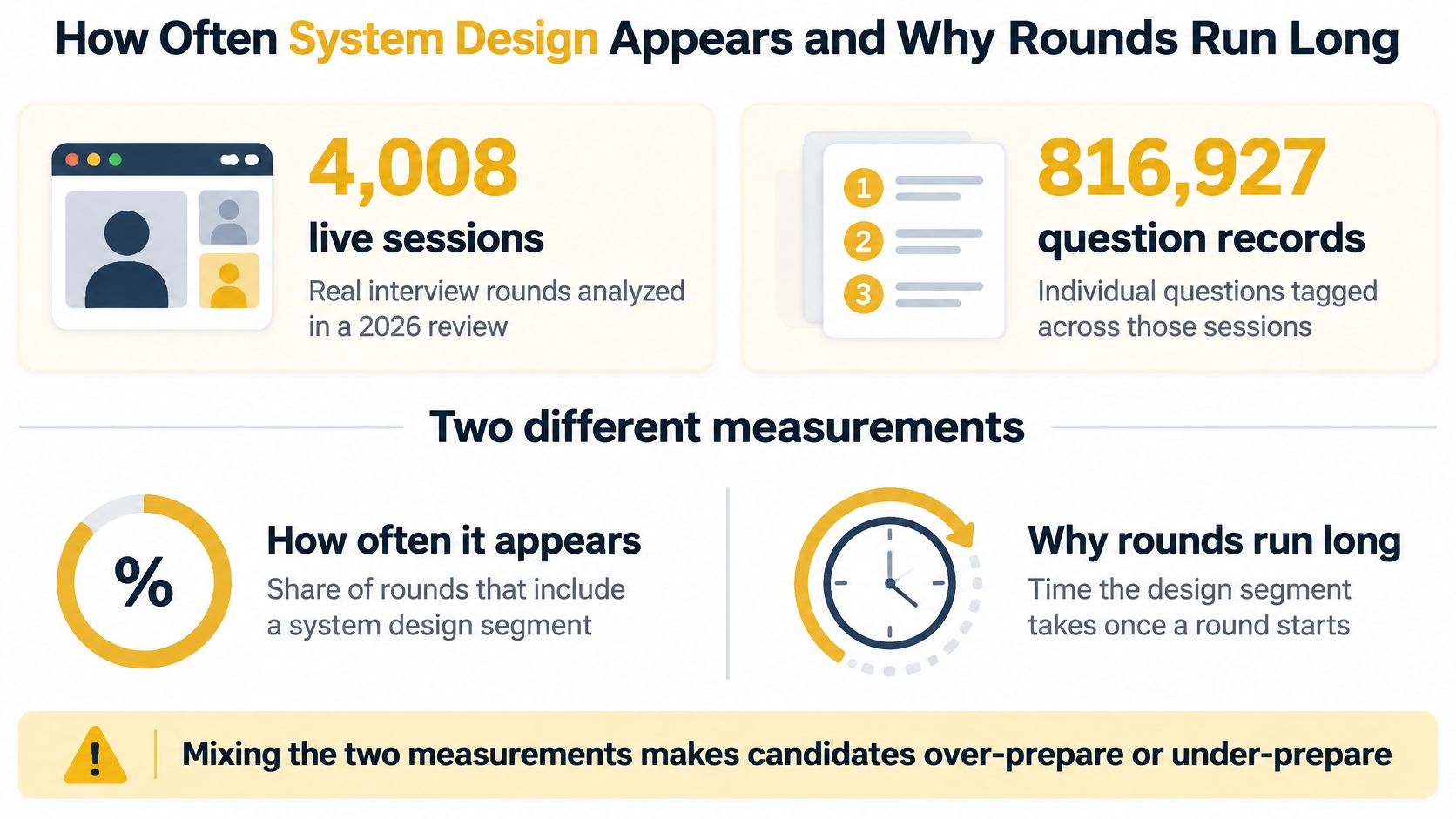
Separate prevalence from preparation effort
Neither measure tells you the odds at a particular employer. Ask the recruiter about the actual format, expected depth, and whether the exercise concerns product architecture, infrastructure, or an existing system.
Duration deserves its own interpretation. A retrospective academic study of interview practices, surveying 911 respondents across eras spanning 2005 through 2026, reported mean live-interview duration increasing from 1.34 hours to 5.47 hours and mean interview rounds increasing from 2.50 to 4.64.
Those are overall interview-process measures, not the duration of a system-design segment. The authors reconstruct professional memory rather than provide an employer-by-employer administrative census, so don't read them as a universal hiring schedule.
Prepare for sustained reasoning, not merely a convincing opening.
Match practice to the actual round
Longer processes make isolated recall an incomplete preparation target. You need to explain a design clearly after other demanding conversations, hear a challenge accurately, and revise a decision without becoming defensive.
Use technical interview questions and answers to keep architecture practice alongside coding, debugging, and behavioral preparation rather than letting it consume the whole schedule.
For system design specifically, rehearse a complete argument: identify the constraint, choose a proportionate solution, expose its weakness, and respond when the interviewer changes the constraint. That's more useful than treating a frequency percentage as permission to skip architecture or as a reason to study nothing else.
A Scorecard That Tracks Consistency
An academic review of software-engineering interview preparation cites findings that approximately 54% of candidates pass interviews, while only about 20% perform consistently across interviews. Passing a familiar prompt once isn't the same as producing reliable performance.
Score only sessions that were spoken and timed. A written solution edited at leisure can be technically useful, but it doesn't test pacing, interaction, or whether your explanation survives interruption.
System design mock scorecard
| Dimension | Score 4 or 5 | Common miss |
|---|---|---|
| Requirements coverage | Users, functions, freshness, and reliability agreed | Solution starts before scope |
| Quantitative estimates | Peak QPS, storage, and bandwidth with units | Single-server design with no scale |
| Architectural completeness | Request path and data path both traceable | Boxes named but no path |
| Trade-off explanation | Choice tied to workload, consistency, and cost | Technology name without fit |
| Communication | Pauses for challenges and revises an assumption | Monologue or freeze when corrected |
Make the rating reproducible
Use a coaching scale from 1 to 5: missing, heavily prompted, workable with gaps, independently defensible, and clear under challenge. These are practice labels, not a claim about any employer's grading system.
Record the session and score it the same day. Beside each rating, write evidence: an omitted bandwidth estimate, an unexplained replication choice, or a clear correction after a challenge. Avoid comments such as “need more confidence,” which don't identify an action.
Keep one priority weakness for the next attempt. A useful promotion rule is to require a score of 4 or better on requirements and estimates in two consecutive sessions before adding another prompt. Treat this as a training rule, not a validated hiring cutoff.
Check operational completeness
Every scored design should address the following, even if the answers are brief:
- Overload and dependency failure: Explain admission control, bounded retries, and degraded service.
- Stale data and duplicate messages: State acceptable freshness and where idempotency is enforced.
- Regional loss and schema evolution: Describe recovery boundaries and compatibility during change.
Use system design templates as coverage checks after the recording, not as text to recite during it.
Also diagnose the right problem. If applications aren't reaching interviews, DashApply's discussion of why you're not getting interview callbacks can help separate application-stage issues from interview execution. A stronger architecture answer won't fix unclear positioning on a resume.
Print the scorecard before the next mock. Improvement should appear in observable behavior across attempts, not just in how familiar the prompt feels.
How to Prepare Across Six Weeks
Build a schedule you can maintain beside work and applications. Reserve practice appointments before choosing resources, and give each appointment an artifact: an estimate sheet, a recording, a corrected schema, or a scored design.
A 2024 technical-interview statistics report published by OneHour Digital stated that structured practice and mock interviews increased candidates' pass rates by approximately 30% compared with self-directed study alone. Treat that reported comparison as a reason to schedule feedback, not a promise about your outcome.
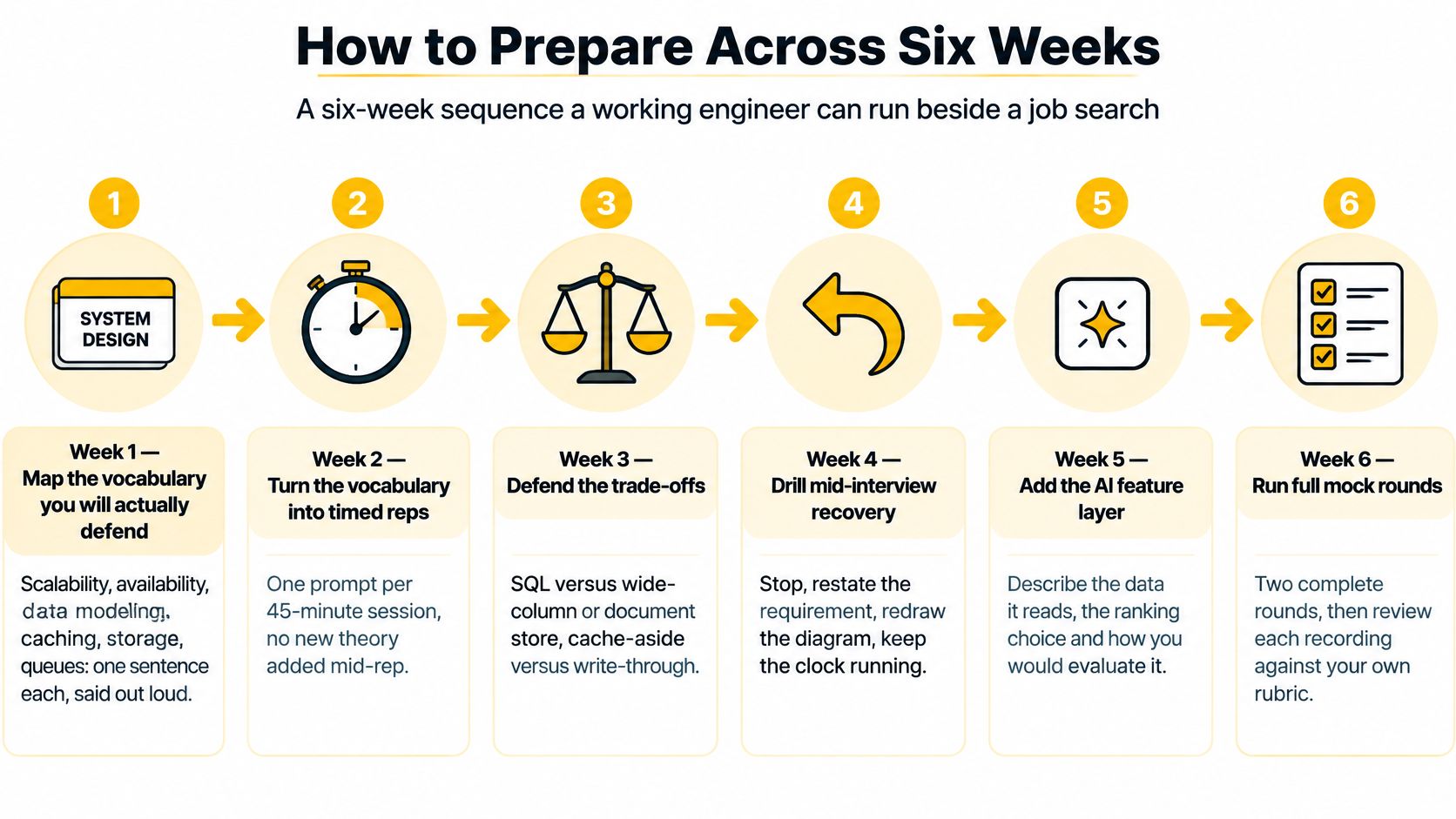
Give every week a deliverable
Six-week system design preparation schedule
| Week | Focus | Artifact |
|---|---|---|
| 1 | Vocabulary you will defend | A sentence on when scalability, availability, data modeling, caching, storage, queues, APIs, and observability hurt |
| 2 | Back-of-the-envelope math | Handwritten QPS, storage, and bandwidth for a URL shortener, chat inbox, and payment ledger |
| 3 | High-level path only, stop at 10 minutes | Rate limiter and news feed diagrams |
| 4 | One deep dive per session | Schema and indexes, cache invalidation, or queue duplicates |
| 5 | Two full timed mocks | Same-day score on the five scorecard dimensions |
| 6 | Weakest prompt under a new constraint | Revised design rather than a seventh new system |
Week 1 starts with consequences. Don't define caching only as faster access. Explain that it introduces invalidation work and potentially stale results. For queues, explain that decoupling producers and consumers creates backlog, retry, ordering, and duplicate-delivery questions.
For availability, identify which user operation must remain usable during failure. For observability, name the signals you'd inspect: latency distributions, error rates, saturation, queue age, and replication lag. Your vocabulary sheet should sound like operational reasoning, not a glossary.
Week 2 turns assumptions into arithmetic. For the shortener, separate link creation from redirects. For chat, distinguish messages persisted from messages delivered to connected devices. For a payment ledger, account for durable entries and reconciliation rather than assuming a successful API response completes the business process.
Write assumptions before calculating. Keep logical storage separate from replicated physical storage, and distinguish payload traffic from protocol overhead.
Add depth without expanding the syllabus
During week 3, draw the rate limiter's decision path and state what happens if its shared counter store becomes unavailable. For the feed, trace both publishing and reading. Stop at the planned cutoff even if the drawing feels unfinished; identify what you failed to communicate.
In week 4, inspect a narrow mechanism. Sketch a composite index and explain which query it serves. Walk through a cache invalidation race. Show how a consumer avoids applying the same payment-related event repeatedly.
For week 5, ask a friend to challenge an assumption rather than watch. If you practice alone, record the full answer without pausing to consult notes, then review the recording before reading a reference design.
Use week 6 to stress the weakest design. Restrict the budget, remove a dependency, or change the freshness requirement. Preserve working decisions and explain the necessary changes.
Scheduling rule: Aim for two timed, 45-minute spoken sessions and one written estimate sheet each week.
The focused exercises fit around those sessions. Don't postpone speaking until you feel finished studying; explaining an incomplete design exposes exactly what needs work.
Trade-Offs and AI Features to Defend
A technology name isn't a justification. Describe the workload property that makes a choice fit, then name the cost you accept.
| Decision | A defensible interview argument |
|---|---|
| SQL versus wide-column or document store | Relational constraints and transactions favor SQL; predictable partitioned access or document-shaped aggregates may favor alternatives. |
| Cache-aside versus write-through | Cache-aside simplifies selective caching but permits misses and invalidation races; write-through adds write-path work and requires clear failure semantics. |
| Strong versus eventual consistency | Coordinate when stale results violate correctness; permit lag when the product can tolerate it and reconciliation is defined. |
| Synchronous call versus queue | Wait when the caller needs the result; queue deferrable work while accepting backlog and delivery semantics. |
| Single region versus multi-region | Add regional complexity only when recovery, residency, or user latency requirements justify it. |
Database category alone doesn't guarantee a consistency model, and write-through caching doesn't automatically eliminate stale reads. Explain the actual replication, update, and read behavior.
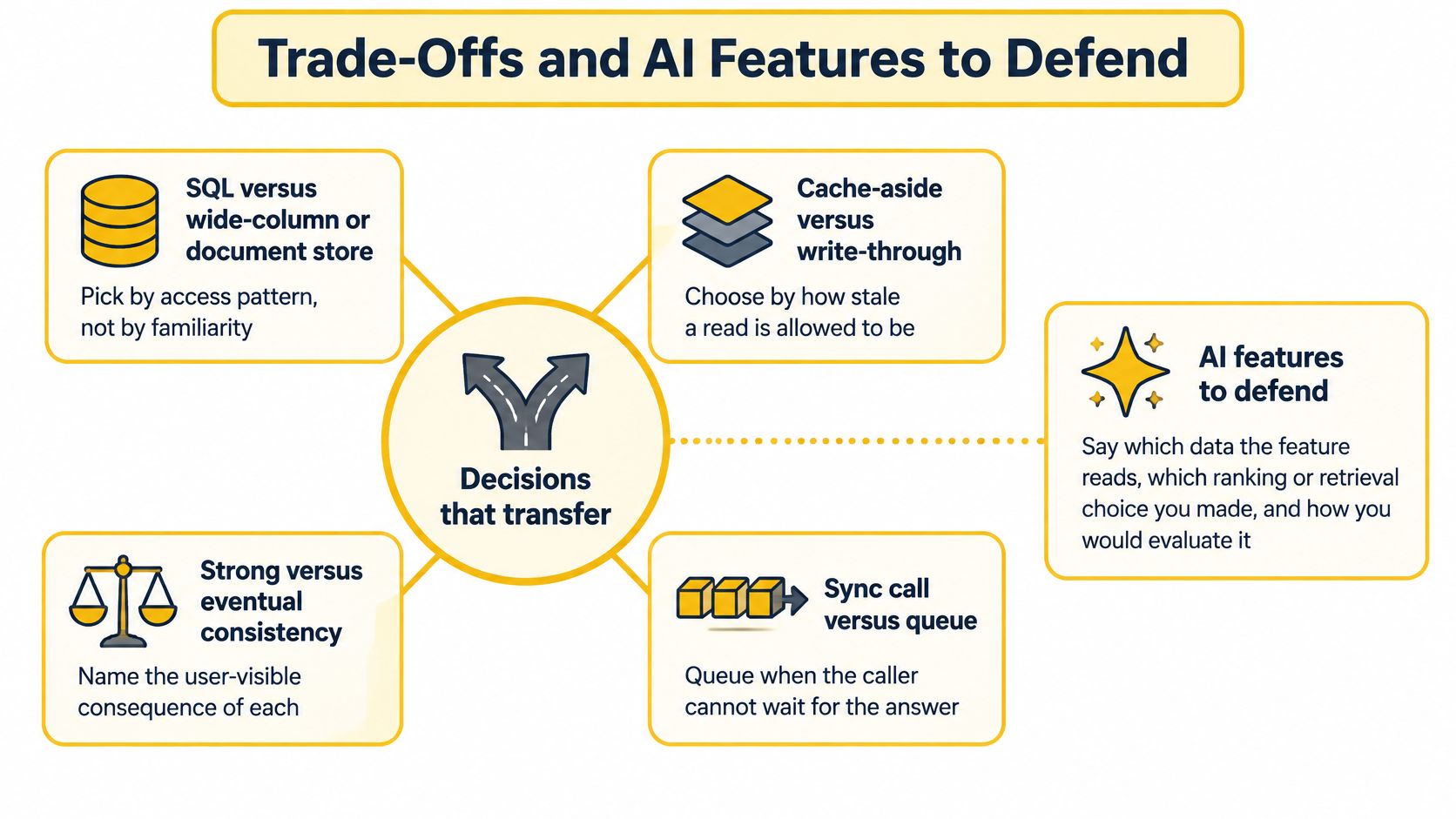
Evaluate the workflow before the model
Business Insider's coverage of AI integration in engineering hiring describes interview questions about where AI belongs in existing workflows, how to evaluate its value, and how to balance automation with human oversight. Apply that standard to a support-ticket classifier inside a help desk.
The feature reads ticket text and permitted account context, proposes a category, and routes uncertain or high-risk cases to a human queue. Don't assume a model's self-reported confidence is calibrated; validate routing thresholds against labeled examples and observed mistakes.
Define the evaluation before selecting retrieval or an LLM:
- Offline quality: Measure per-category precision and recall, especially for urgent tickets and underrepresented categories.
- Online value: Track agent overrides, misroutes, resolution time, and human-review workload.
- Error budget: Set acceptable harmful-routing and service-failure limits with the product owner.
- Cost comparison: Compare inference, retrieval, retries, and review labor against rules or a smaller classifier.
Make unsafe behavior containable
Treat ticket text and retrieved documents as untrusted input. Prompt injection must not grant tool permissions, reveal another tenant's records, or override routing policy. Enforce tenant isolation in authorization and retrieval filters, not merely in a prompt.
Hallucinated categories require schema validation and an abstention path. Provider outages should send tickets to the human queue rather than block intake; confidently wrong classifications require audits and outcome-based monitoring.
If retrieval is needed, version embeddings and watch for degraded retrieval quality after corpus or model changes. Gate releases on evaluation, migrate gradually, and retain rollback paths. When deterministic routing rules satisfy the requirement more safely and cheaply, defend the conventional solution.
Prompts Drills and Mid-Interview Recovery
Use familiar prompts such as URL shorteners, chat, feeds, rate limiters, and payments as starting vocabulary. Then make the practice uncomfortable: have someone introduce a constraint after you've committed to a design.
Masai's system design preparation guide provides a foundation for working through requirements and architecture. Extend that preparation by rehearsing visible recovery, not just a polished first answer.
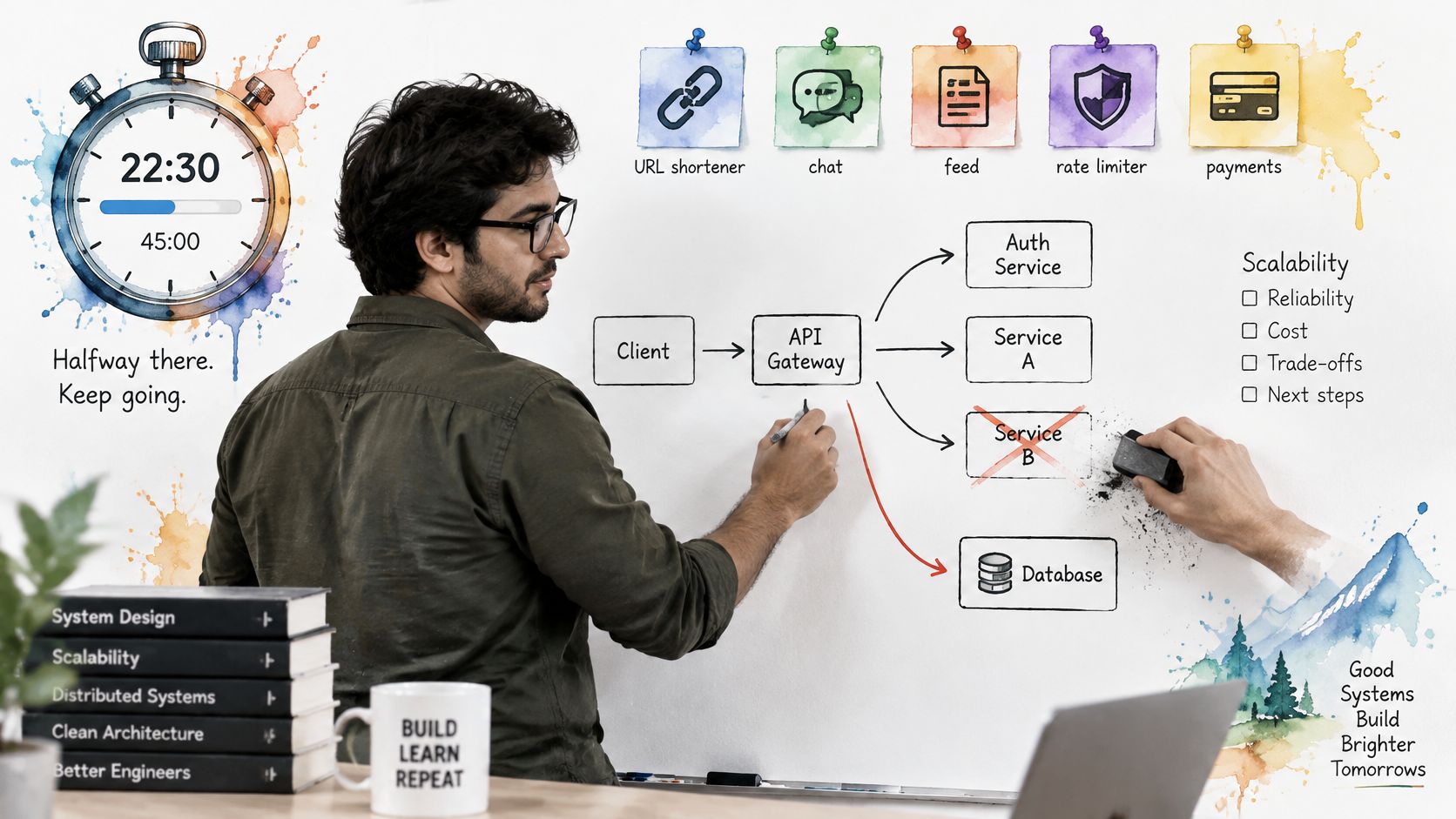
Repair the broken guarantee
Suppose you propose an eventually consistent news feed with asynchronous fan-out and cached timelines. The interviewer says stale reads are no longer acceptable.
Don't immediately promise strong consistency everywhere. Ask whether the requirement means authors must immediately see their own posts, or every reader must see every committed change. Those are materially different guarantees.
Use this recovery sequence:
- Restate the change. Freshness is now a correctness requirement rather than a preference.
- Identify the break. Cached timelines and asynchronous fan-out can return an incomplete view.
- Preserve what fits. Keep durable post storage, authentication, and the user graph.
- Revise the priority. Spend the remaining deep dive on the required visibility guarantee rather than redrawing unrelated services.
If the interviewer confirms read-your-writes for authors, merge the author's acknowledged posts into their timeline or use a version-aware read path until propagation catches up. Explain deletion and duplicate handling in that merge.
If they require globally fresh feeds for everyone, say explicitly that the author-only fix is insufficient. Discuss authoritative reads, coordinated visibility, and the latency or availability cost. You may need to simplify ranking or reduce scope to meet the requirement.
Acknowledge the target, identify its cost, and offer a concrete compromise. Don't quietly weaken the requirement.
Change the constraint, not the entire board
Use different interruptions to train different decisions:
- Regional residency: Identify which records, replicas, backups, and processing paths must stay within the permitted boundary.
- Traffic spike: Locate the first saturated resource before adding servers indiscriminately.
- Dependency outage: Bound waiting, stop retry amplification, and choose the user-visible fallback.
- Smaller budget: Remove optional processing or reduce retention before weakening durability.
- Stricter freshness: Find every place that can serve an older version, including replicas and client caches.
Explain only the failure triggered by the interruption before returning to the design. A cache-freshness challenge doesn't require an unrelated tour of disaster recovery.
Alternate a clean prompt, an interrupted prompt, and a redo of a design you know was wrong. A mock interview online is useful when it gives you an external challenge; during peer practice, ask your partner to withhold the changed constraint until you've made a meaningful commitment.
Run One Timed Design This Week
Book a complete session on your calendar, choose a prompt you haven't memorized, and keep the timer visible. Speak through the design without opening a reference answer. If you get stuck, state the uncertainty and make a provisional decision instead of stopping the recording.
Score the session that day using the five dimensions, then choose one weakness to repair. Don't convert the review into another reading list. If the missing piece was duplicate-message handling, draw the consumer's state transition and explain it aloud before attempting the design again.
Make the next attempt harder in the right way
Bring in another person when solo practice keeps producing unchallenged diagrams. Ask them to question a storage choice, change a reliability requirement, or remove a dependency. The useful test is whether you can revise your reasoning while keeping the conversation understandable.
For software-engineering candidates, our Interview Pilot question list covers programming, data structures, algorithms, system design, debugging, testing, production, and collaboration. We also provide AI mock interviews with answer evaluation, structured question sets, and role-specific guides. Question content can draw on public material, user submissions, internal examples, and generalized interview patterns, so use it as rehearsal fuel, not a prediction of a particular interviewer.
Make the scheduling decision now. If your interview is close, repeat the same prompt under a new constraint rather than racing through unfamiliar systems. If you have more runway, begin the vocabulary-and-consequences exercise tomorrow and follow the weekly sequence.
Your next useful artifact isn't a prettier diagram. It's a recording in which you make a justified choice, hear a challenge, and improve the design without losing the thread.
Our AI mock interviews, answer evaluations, and structured question sets can support your next system design rehearsal. Visit Interview Pilot, choose a software-engineering practice prompt, and use your recording to identify the decision you need to defend more clearly next time.


Topics
system design interview preparation
system design interview
interview prep
architecture interview
mock interviews
Continue reading

Interviews
Interview Tips for College Students: 8 Strategies for 2026
Use these 8 interview tips for college students to prepare smarter, answer behavioral questions clearly, and send follow-ups that stand out in 2026.
November 19, 2026
17 min read
Interviews
What Is Technical Interview Questions Explained
Learn what is technical interview questions, the main types, how interviewers score answers, and a practical 2026 prep plan.
November 1, 2026
20 min read

Interviews
10 Career Development Tools to Grow Faster in 2026
Compare 10 career development tools for 2026: interview prep, courses, assessments, skills mapping, resumes, and live AI interview support.
October 23, 2026
16 min read