
















Interviews
Interview Tips for College Students: 8 Strategies for 2026
Use these 8 interview tips for college students to prepare smarter, answer behavioral questions clearly, and send follow-ups that stand out in 2026.
Interview Pilot Editorial Team
Updated November 19, 2026
17 min read
A computer science senior with a 3.8 GPA and a summer internship walks out of a final-round interview convinced she got it. The rejection arrives four days later, no feedback, just a template. She didn't lose that job on technical ability. She lost it in the first ninety seconds, when "tell me about yourself" turned into a chronological tour of her coursework, then again at the close, when she was asked if she had questions and said no.
That pattern repeats across majors and industries. Offers go to the candidate who prepared structure, not the one with the highest GPA. Grades earn the interview. Preparation earns the offer.
The eight strategies below follow one student through the full cycle, from building stories and researching the employer to the video setup, the closing questions and the note sent the next morning. Each one names the mistake that costs offers and the specific fix.
1. Master the STAR Method for Behavioral Questions
The question sounds open-ended. "Tell me about a time you handled a disagreement on a team" isn't. The interviewer is scoring four things at once, whether you can describe a situation clearly, whether you personally owned an action, whether you understand why the result mattered, and whether you can finish before their attention drifts.
Those competencies decide more hires than coursework does. In NACE's Job Outlook 2025 survey, nearly 90% of responding employers said they sought evidence of problem-solving ability when reviewing students' résumés, and nearly 80% sought strong teamwork skills, while at least 70% also valued written communication, initiative, work ethic and technical skills (NACE).
Structure Carries the Answer
STAR gives you four moves. One sentence of Situation, one of Task, three or four of Action, one or two of Result. Candidates collapse in the Action section because they describe the team instead of themselves. Say "I rebuilt the handoff sheet," not "we figured out the handoff."

A retail worker applying for an operations role can turn an ordinary shift into a real answer. Situation, handoffs between shifts at a busy store were causing long checkout waits. Task, as shift lead, reduce the backlog. Action, they rewrote the handoff checklist, timed the register reset and trained two coworkers on it. Result, the next shift opened with registers ready instead of twenty minutes behind.
- Prepare 6 to 8 stories: cover teamwork, leadership, conflict, failure, a tight deadline and taking initiative. Almost every question maps to one of them.
- Time each answer at 90 seconds: record on your phone. Past two minutes, cut the setup, never the result.
- Quantify where you can: a grade, a percentage, a headcount, a deadline hit early.
- Practice aloud: reading a story builds false confidence.
The test that matters: can you tell it out loud, no notes, under 90 seconds, and still land a result?
Work through behavioral and situational interview questions in sets rather than one at a time, so you notice which stories keep repeating.
2. Research the Company, Role, and Interviewers
Generic reasons for applying sink more offers than weak answers do. "You're a leader in the industry" tells an interviewer you read the homepage and stopped.
The bar has moved. NACE's 2026 Job Outlook survey found that 70% of participating employers reported using skills-based hiring for entry-level recruitment, up from 65% the previous year, applied most often during screening and interviewing (NACE). More than 80% of employers highlight required skills in the job description, yet fewer than 40% of graduating seniors were familiar with the term "skills-based hiring" at all.
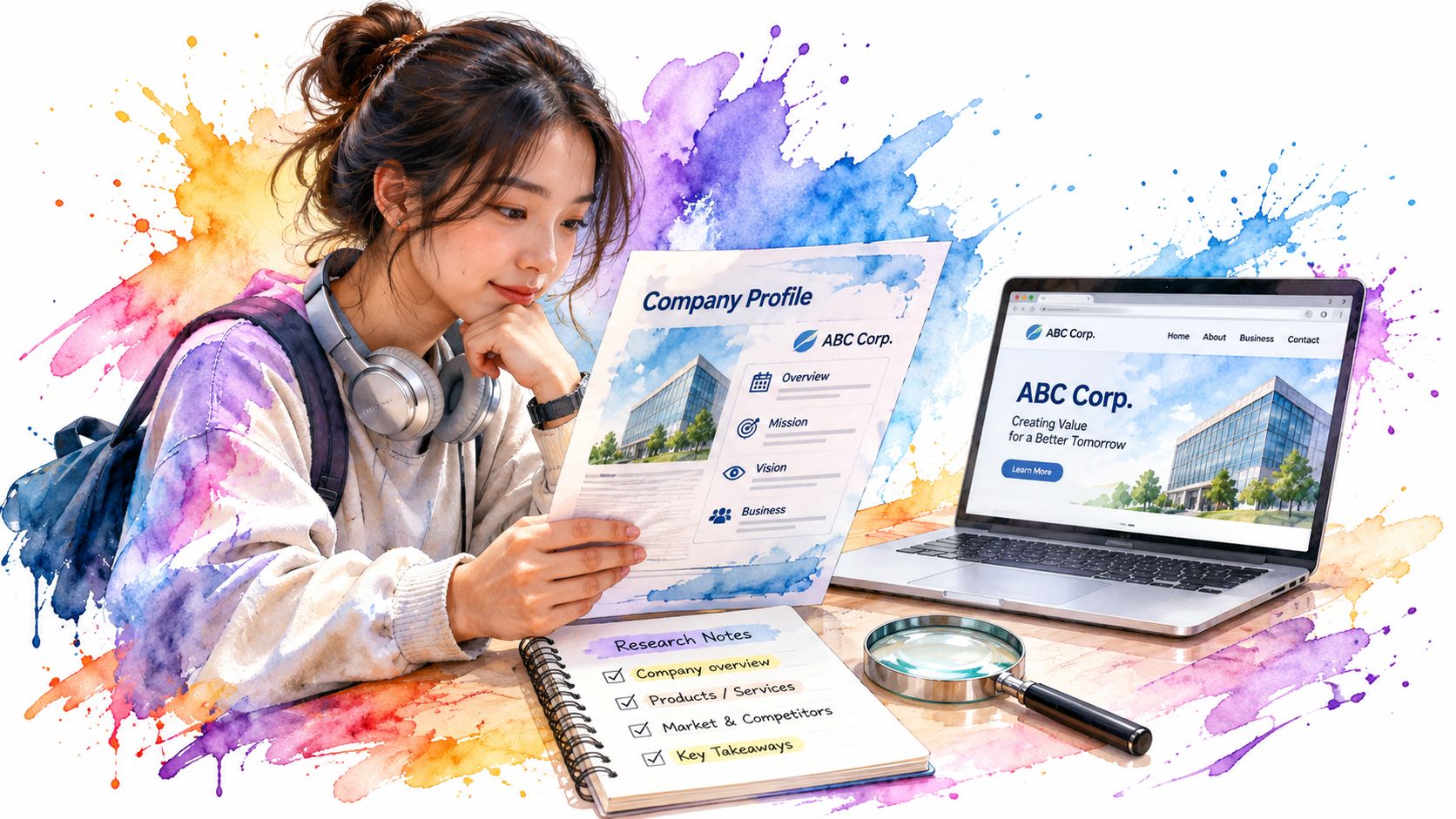
Build a One-Page Brief
Keep it to a single sheet you can reread in the waiting room.
- One mission line: the company's own words, not your paraphrase.
- Three recent developments: a product launch, funding round, leadership change or published engineering post.
- Five role requirements from the posting: each mapped to a specific project, job or lab you've held.
- Two facts per interviewer: where they worked before, what they've written or spoken about.
A finance applicant who learns a regional bank is expanding into small-business lending can ask how the credit team is staffing for it. A software candidate who finds an engineering blog post about a database migration can ask what broke during cutover. Both questions prove you read something specific.
Verify against the company newsroom and the interviewer's own posts, not a third-party summary that may be years stale. Then rehearse one honest sentence on why this role, at this company, now.
3. Rehearse with Mock Interviews and Build Communication Confidence
Nobody discovers a filler-word habit by thinking about it. You find it in a recording, usually around the second minute, right when the answer should have ended.
The gap you're closing is measurable. NACE's 2024 Student Survey and Job Outlook 2025 data show 96.1% of employers rate communication as important, but only 53.5% rate new graduates as proficient in it (NACE). That is the widest employer-student perception gap in the competency set, which makes delivery one of the few places a candidate can beat an equally qualified rival.
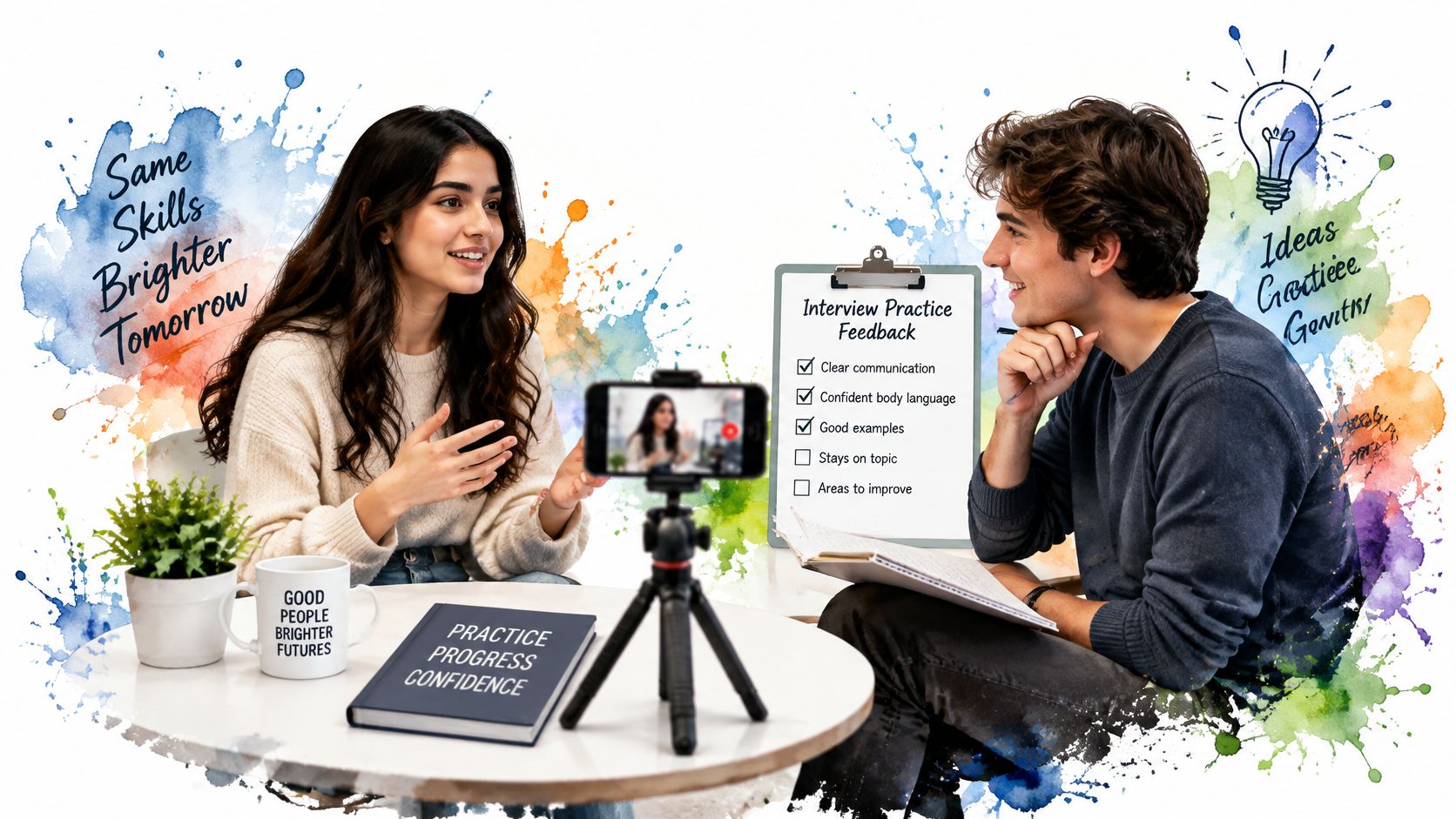
Run Three Mocks, Not One
The first mock diagnoses. The second fixes pacing. The third simulates conditions, real clothes, no notes, camera on. A marketing student who runs four minutes on question one in mock one is usually at 90 seconds with a clean result by mock three. That's compression, not memorization.
- Schedule at least three full mocks: include one recorded session and one with someone who'll interrupt with follow-ups.
- Ask for feedback on one or two skills: "Was my structure clear?" beats "How did I do?"
- Practice clarifying: when a prompt is vague, ask one question before answering.
- Signpost out loud: "There are three parts to my answer" buys you thinking time and gives the listener a map.
Treat a question bank the way you'd treat active recall techniques for lectures: retrieve the answer out loud first, then check a model response. For repetition without a partner, free online mock interview practice covers volume, and Interview Pilot's AI mock sessions evaluate your answers afterward so you can see exactly where one stalled.
4. Prepare a Concise, Tailored "Tell Me About Yourself" Pitch
Most students hear this as an invitation to narrate a résumé. Interviewers hear it as a preview of how you think under mild pressure, and they form a judgment fast.
The evidence says the close of that answer is where candidates lose. An analysis of 4,391 student mock interviews across 98 colleges found company knowledge and motivation averaged just 2.8 out of 10, with 85% of students scoring below 5 (VirtualSpeech). That number reflects the final sentence of your pitch, the one explaining why this role, at this company, right now.
Present, Past, Future
Write it in three beats. Where you are and what you're focused on. One experience that proves the relevant skill. Why their specific role is the logical next step. That structure lands in 60 to 90 seconds and avoids the freshman-year-to-senior-year timeline nobody asked for.
A computer science senior can say she's focused on distributed systems, spent last summer building an internal tool that cut a reporting task from hours to minutes, and is now drawn to the company's developer platform because her team rebuilt that tool twice for reliability. Same facts as a résumé line, far better delivery.
- Write it long, then cut: draft 200 words, then delete to 90 seconds of speech.
- Tailor the last sentence: swap it for every company. That sentence does the work.
- Don't recite the résumé: the interviewer already has it. Add context the document can't hold.
- Practice until it sounds conversational: if it sounds memorized, you've rehearsed the words instead of the point.
A quick honesty check: if you can't explain why you applied without mentioning the company's size or reputation, your research isn't finished.
5. Prepare for Role-Specific and Technical Questions
Technical interviews don't test whether you've already seen the exact problem. They test whether the interviewer would want to debug alongside you at 11pm.
What you bring as evidence matters more than your transcript. NACE reports that fewer than 40% of surveyed employers screen candidates by GPA, while more than half use skills-based practices when interviewing and screening (NACE). The practical translation is simple. Turn coursework into a project with a requirement, a decision and a deliverable.
Narrate the Reasoning, Not Just the Answer
For a technical round, prepare a two-minute project explanation covering your methodology or architecture, the trade-offs you chose, how you tested or validated it, and what you'd improve in a second iteration. That last part is the one most students skip and the one that signals judgment.
A software candidate solving a coding problem talks through edge cases and complexity as they go, rather than going silent for eight minutes and producing working code from nowhere. A consulting candidate running a market-sizing case states assumptions out loud, checks them against the interviewer, and moves to a number. The structure travels. If you're outside the usual finance and tech tracks, browse environmental science interview frameworks and you'll recognize the same skeleton.
- Identify the top 10 to 15 question types for your target role: practice each once before drilling any of them twice.
- Narrate every practice problem: silence reads as confusion, even when you're thinking well.
- Clarify, then assume: state assumptions explicitly so the interviewer can correct you early.
- Review fundamentals the night before: cramming a new topic the morning of rarely pays.
6. Set Up for a Successful Live Online Interview
Video interviews fail on logistics far more often than on answers. A dropped connection, a backlit face or a phone buzzing mid-sentence undoes a strong first ten minutes.
Employers are watching how you handle the format, and they're wary of tools. A 2025 employer survey from Ulster University found that only 4% had integrated AI into recruitment, while 50% suspected candidates were using AI and 31% believed AI created risks such as exaggerated or misrepresented skills, with face-to-face interviews still the most popular selection method (Ulster University). Assume you may be asked to defend any claim on your résumé without help.

Test the Whole Chain, Not Just the Camera
- Run a test call 24 hours ahead: same platform, same device, same room. Not a different laptop.
- Join five to ten minutes early: early is polite, five minutes early is professional.
- Keep the recruiter's number on paper: if the platform dies, you call, you don't email and wait.
- Close everything else: notifications, background apps, browser tabs you don't need.
- Check the employer's policy on AI or real-time assistance: if it isn't stated, ask the coordinator before the interview, not during it.
- Fix the physical setup: laptop on books to eye level, lamp in front of you, door behind you closed.
If your audio dies mid-answer, work through fix a microphone that stopped working before the next round instead of hoping it was a one-off. These Zoom interview tips cover the platform settings worth checking in advance.
7. Ask Thoughtful Questions at the End
"Any questions for us?" is scored even when the interviewer says it isn't. This is the section where curiosity shows up as preparation or its absence.
Prepare three to five questions and choose two or three based on what came up in conversation. Strong ones focus on success measures, team priorities, how feedback works and what the interviewer finds hard about the role. A student who asks what success looks like after six months, then references that answer in a follow-up note, has built a continuous thread the interviewer remembers.
- Take notes during the answers: visible note-taking signals you're treating the conversation as work, not performance.
- Skip anything a 30-second search answers: founding date, headcount, office locations.
- Ask about team dynamics and growth: these tell you whether you want the job, which is half the purpose.
- Ask one question about the interviewer: how they joined, what's changed since. People remember being asked.
Practical rule: if none of your prepared questions survived the interview, ask what the team's biggest constraint is right now. It works in every industry.
8. Send a Prompt, Personalized Thank-You Note
Most candidates send nothing, or send identical three-line notes to everyone they met. Neither helps, and the generic version can hurt.
Send an individual note to each interviewer within 24 hours, under 150 words. Reference one specific point from the conversation, restate fit in a sentence, and close with thanks. It's also your last chance to repair a weak moment. If you fumbled a technical question, add the clearer explanation you've since worked out. That single paragraph can be worth more than the rest of the message.
A marketing candidate thanks the hiring manager for discussing a new campaign and shares one related idea, two sentences, clearly marked as a thought rather than a campaign plan. Specific, brief, easy to forward to a colleague.
- Keep it under 150 words: anything longer reads as a second application.
- Send one per interviewer: no group threads, no "Dear team."
- Mention one specific moment: it proves you listened rather than copied a template.
- Proofread names, titles and the company name: a misspelled company name undoes the courtesy.
Send it the same evening or the next morning. By day three, the decision conversation has usually already happened.
How each interview tip compares in preparation effort, best use case, and main risk
| Item | Best For | Practice Format | Main Risk |
|---|---|---|---|
| Master the STAR Method for Behavioral Questions | Structuring behavioral answers | Prepare and rehearse concise Situation, Task, Action, and Result stories | Answers can sound robotic or run long |
| Research the Company, Role, and Interviewers | Tailoring answers and showing employer interest | Review company news, role requirements, and interviewer backgrounds | Research may be time-consuming or outdated |
| Rehearse with Mock Interviews and Build Communication Confidence | Improving fluency and reducing interview anxiety | Practice live or with recordings and AI-guided sessions | Feedback may be limited or fail to recreate live pressure |
| Prepare a Concise, Tailored “Tell Me About Yourself” Pitch | Making a focused first impression | Rehearse a tailored present-past-future pitch | Generic or lengthy answers can lose attention |
| Prepare for Role-Specific and Technical Questions | Demonstrating job-specific knowledge and problem-solving | Solve timed role-based problems while explaining reasoning aloud | Broad topics can overwhelm, and unguided practice can reinforce mistakes |
| Set Up for a Successful Live Online Interview | Avoiding preventable video interview disruptions | Test the platform, equipment, connection, lighting, and backup plan | Technical failures or distractions can still occur |
| Ask Thoughtful Questions at the End | Showing curiosity and assessing role fit | Prepare several questions about expectations, teamwork, and growth | Generic or already-answered questions can hurt credibility |
| Send a Prompt, Personalized Thank-You Note | Reinforcing interest after an interview | Send each interviewer a brief, specific note within 24 hours | Generic, lengthy, or late notes may weaken the impression |
Turn These Eight Habits Into a Two-Week Plan
Two weeks is enough if you sequence it right. Start with the two assets everything else depends on: your stories and your pitch. Both are drafts until you've said them aloud to another person.
Days 1 and 2 go to writing. Six to eight STAR stories at 90 seconds each, covering teamwork, leadership, conflict, failure, deadlines and initiative. Then the pitch, drafted long, cut to 90 seconds, with the final sentence written specifically for the role you're chasing.
Day 3 is research. One page, mission line, three recent developments, five role requirements, two facts per interviewer. Map at least five job-description skills to real evidence and say each mapping out loud in 60 to 120 seconds.
Days 4 through 6 are mocks. Three of them, one recorded, one with someone who interrupts. Watch the recording with the sound off to catch fidgeting, then with sound on to count filler words. Then and now, the fix is the same, shorter setup and a stated result.
Day 7 handles technical or role-specific rounds. Name the top 10 to 15 question types for your target job and narrate your reasoning on each. A recruiting session is not the place to discover whether you can think aloud.
Days 8 through 11 tighten the details that get ignored. Draft three to five closing questions. Run a full tech check on the same device 24 hours before any live session, and keep the coordinator's number where you can reach it. Prepare a two-line answer for how you use AI to prepare, since employers are cautious and a straightforward answer works better than a vague one.
Days 12 and 13 are a full simulation, opening pitch through closing questions, in real clothes, with no notes. Day 14 is rest and light review. Send the thank-you note within a day of the actual interview, one per interviewer, specific and under 150 words.
The habits behind interview tips for college students don't reset between recruiters. Stories, research, mocks, setup, questions and follow-up form one repeatable loop you can run for an internship, a first job or a career change. Build it once and you'll use it for a decade.
Interview Pilot gives you a way to run the practice half of this plan on demand: AI mock interviews that ask questions aloud, follow up, and evaluate your answers afterward, so the compression from four minutes to ninety seconds happens on your schedule rather than a career adviser's. Upload a résumé and job description to tailor the scenarios to the exact role, then review the transcript of each session to see where an answer drifted. Start with your next interview at Interview Pilot.


Topics
college interview tips
interview prep
behavioral questions
STAR method
interview thank-you note
Continue reading

Interviews
What Is Behavioral Based Interviewing and How to Master It
Learn what is behavioral based interviewing, how the STAR method works, real answer examples for candidates, scoring tips for interviewers, and proven prep
September 20, 2026
20 min read

Interviews
How to Prepare for a Competency-Based Interview
Learn how to answer competency based interview questions and answers with STAR examples, a prep framework, and practice questions that map to scoring rubrics.
July 26, 2026
10 min read

Interviews
How to Answer Behavioral Questions (2026 Guide)
Master how to answer behavioral questions using the STAR method, with role-specific examples and practice exercises for software engineering, product
October 9, 2026
12 min read