
















Interviews
Mock Interview Practice Online Free: 10 Tools for 2026
Compare 10 mock interview practice online free options, from AI voice simulators to peer sessions, with real limits and tips for getting the most from each.
Interview Pilot Editorial Team
Updated November 12, 2026
19 min read
You've rehearsed the answer to "tell me about yourself" a hundred times in your head. Then the video call opens, the recruiter asks it, and the sentences you had assembled dissolve somewhere between your brain and your mouth.
That gap between knowing your material and performing it out loud is what mock interview practice online free is for. Demand isn't the problem: in 2025, 37.7% of surveyed U.S. job seekers planned to practice with AI-generated mock interviews, according to TopResume's jobseeker trends report.
The harder question is which free tool to open first. Most solve one narrow problem and do nothing for the rest, so this list sorts them by the practice gap they close: speaking answers aloud, performing under human pressure, rehearsing for a named job, cleaning up delivery, and getting support during the live call itself.
Each entry states what the free tier really includes and what the feedback cannot tell you, because the fine print is where candidates lose weeks. Structure beats volume too. Twenty minutes of speaking aloud, three times a week, will change how you sound far more than a weekend of reading interview advice.
1. Interview Pilot
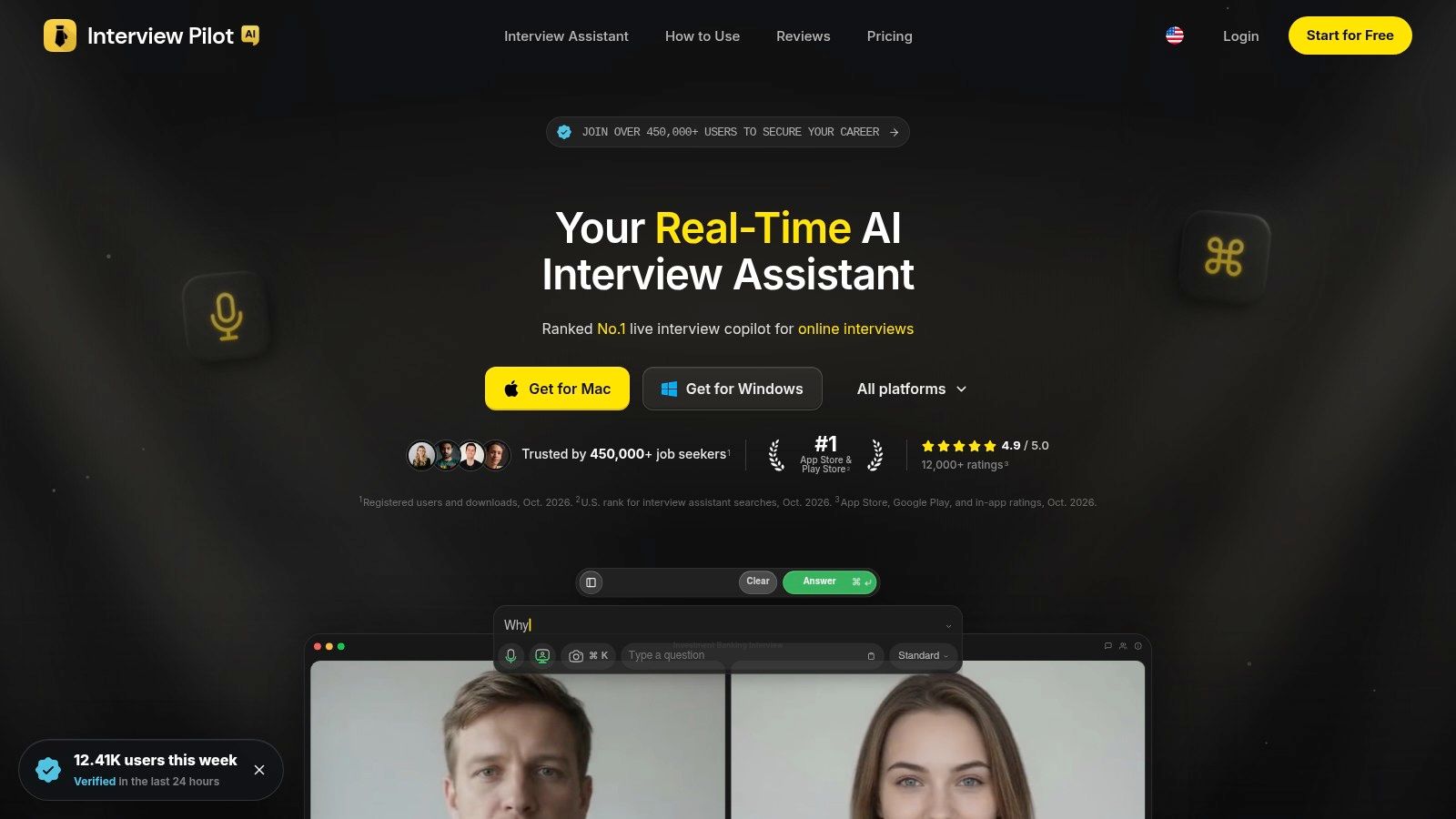
A candidate who can explain an answer in practice may still freeze when a live interviewer asks a follow-up. Interview Pilot covers both preparation and live support: its Interview Copilot suggests answers to technical and behavioral questions, adapted to a candidate's background, materials, target role, and preferred response style.
For spoken practice, AI mock interviews prompt candidates to rehearse answers and provide an evaluation, including a Delivery Score judged from the answer recording. That recording is made whether or not “Record Interview Audio” is switched on. The Question Bank contains 10,000 questions across roles including software engineering, data, investment banking, product management, consulting, and project management. Full access to the bank is included in paid plans.
The trade-offs worth knowing before you install it
- Live support requires judgment. Check the employer's rules before using an interview copilot. Outside assistance may be prohibited, and using it against those rules can put your credibility at risk.
- Free access is available. The free plan requires no payment and lets users try all Interview Pilot features. Paid plans offer full access to the question bank.
- Choose the practice gap you need to close. AI mock interviews help rehearse spoken answers; the question bank supports role-specific preparation; Interview Copilot provides real-time suggestions during live online interviews. Automated feedback can assess your recorded delivery, but it cannot tell you exactly how a particular interviewer will judge your answer.
- Check device fit. Interview Pilot runs on macOS, Windows, iOS, Android, and the web, and supports more than 99 languages. The site cites adoption by 450,000+ users; that figure indicates reach, not whether the tools suit your interview.
For a focused rehearsal, follow this guide to conducting an online mock interview, then use the evaluation to identify which answers need more work. Interview Pilot is available through its official site.
2. Huru
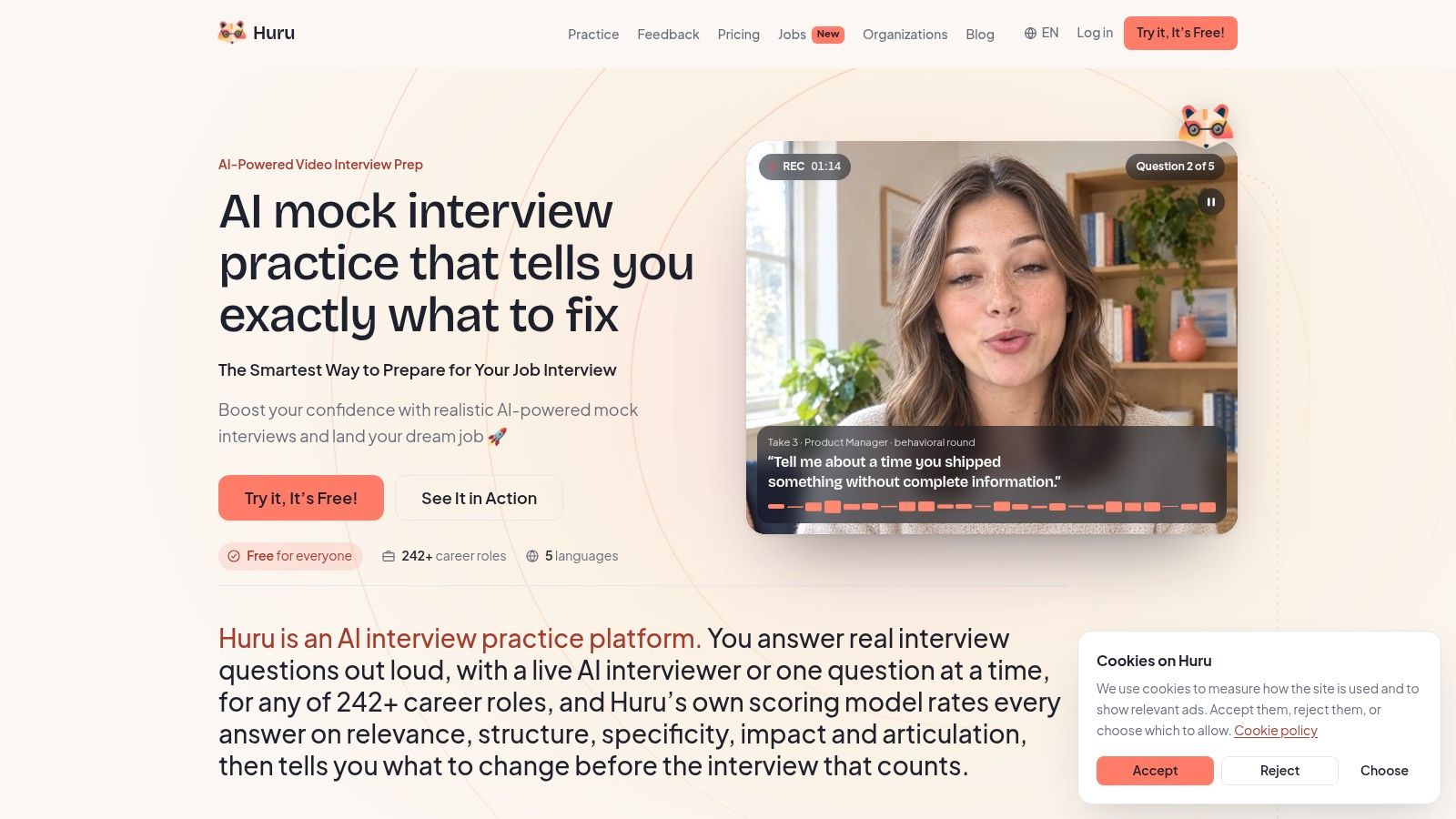
Speaking an answer is a different skill from composing one, and Huru is built around that distinction. You record a spoken response on camera or microphone and the tool scores how relevant, structured, specific, and clear it sounds, then pairs that with a question library and a Chrome extension that turns a pasted job posting into a customized practice set.
The provider says mock interviews, the question library, the extension, and feedback reports are free for job seekers with no subscription. That matters, because several tools on this list charge for the part that helps.
What the feedback can and cannot measure
Structured practice moves confidence and communication, and the numbers are consistent across formats. In a course-based mock interview assignment, 76% of respondents agreed or strongly agreed their interview skills improved, 87% said the activity helped them identify areas to improve, and 84% said it increased their understanding of questions likely to arise, according to this mock interview study.
What automated scoring can't do is tell you whether your example was impressive to someone who has heard forty versions of it. Relevance and structure are measurable. Judgment and taste are not.
- Best for: candidates who freeze when speaking and need reps on camera.
- Watch for: recording yourself is uncomfortable for the first three sessions and useful from the fourth.
- Skip if: you need live pushback from another person rather than a report.
It runs on the web with an iOS app. Start at Huru.
3. Aced
No employer will tell you why your system design answer lost the room. In 2024, 61% of job seekers reported being ghosted after a job interview, according to Greenhouse's State of Job Hunting report, which is exactly why peer feedback covers something AI tools can't.
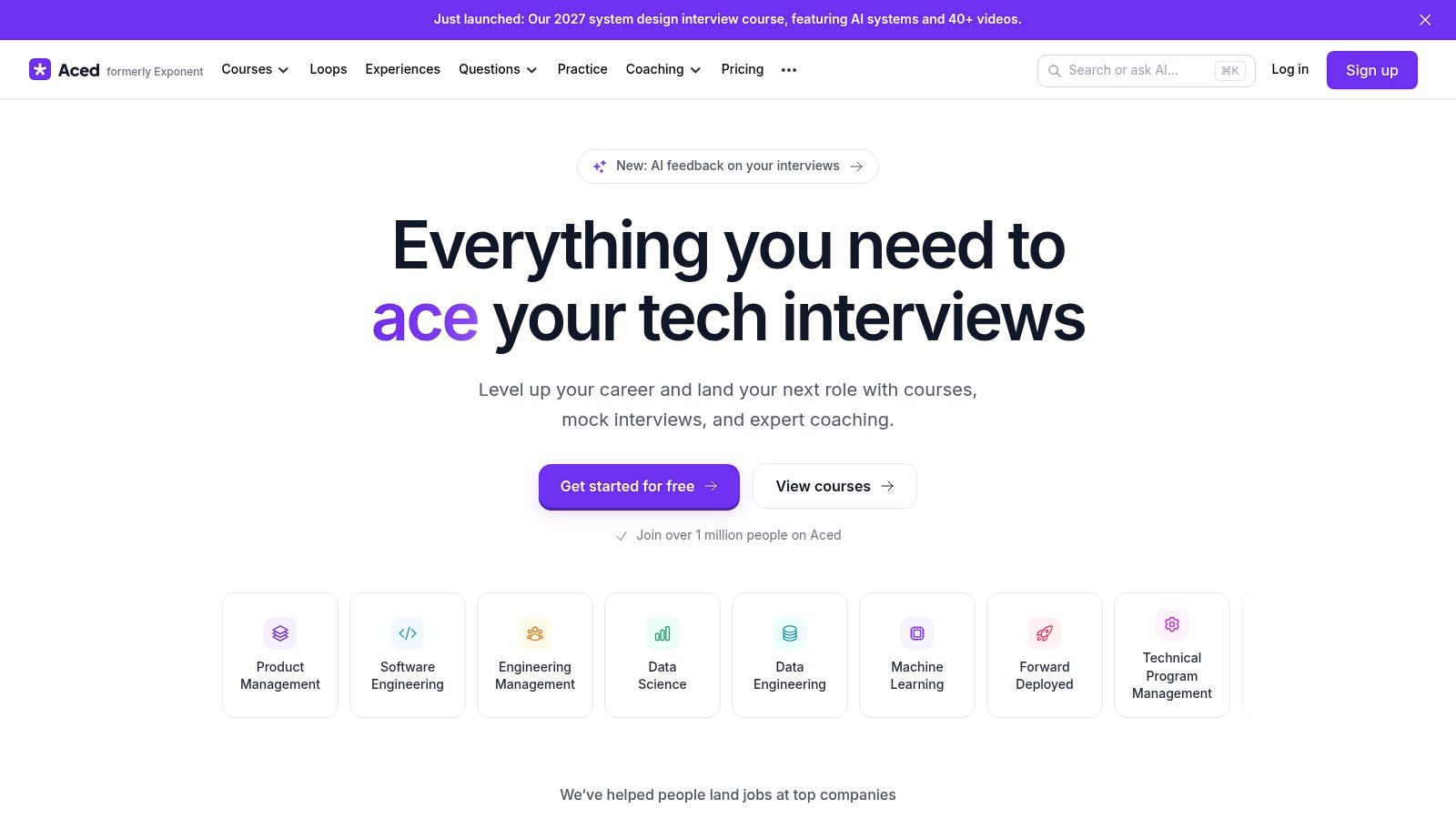
Aced, formerly Exponent and Pramp, runs peer-to-peer mock interviews over video, weighted toward software engineering, data, product management, and other technical loops. You take turns: half the session you answer, half you interview. That swap is the feature most candidates undervalue, since watching someone else fumble a follow-up shows you what your own fumble looked like from the outside.
Where the free credits run out
Free accounts receive a limited number of practice credits each month, and unlimited practice belongs to paid membership. The second constraint is logistics. You're matching calendars with a stranger, and the quality of your session tracks the quality of the peer you're paired with.
Practical rule: spend your first free credit interviewing someone else. Thirty minutes of watching another candidate handle follow-ups teaches you more about question sequencing than three solo sessions.
Scheduled sessions also create accountability that a browser tab never will. A calendar invite with a real person on the other end is harder to postpone. The trade-off is real: you'll spend half your practice time asking questions rather than answering them. Book Aced when your bottleneck is pressure, not content.
4. Yoodli
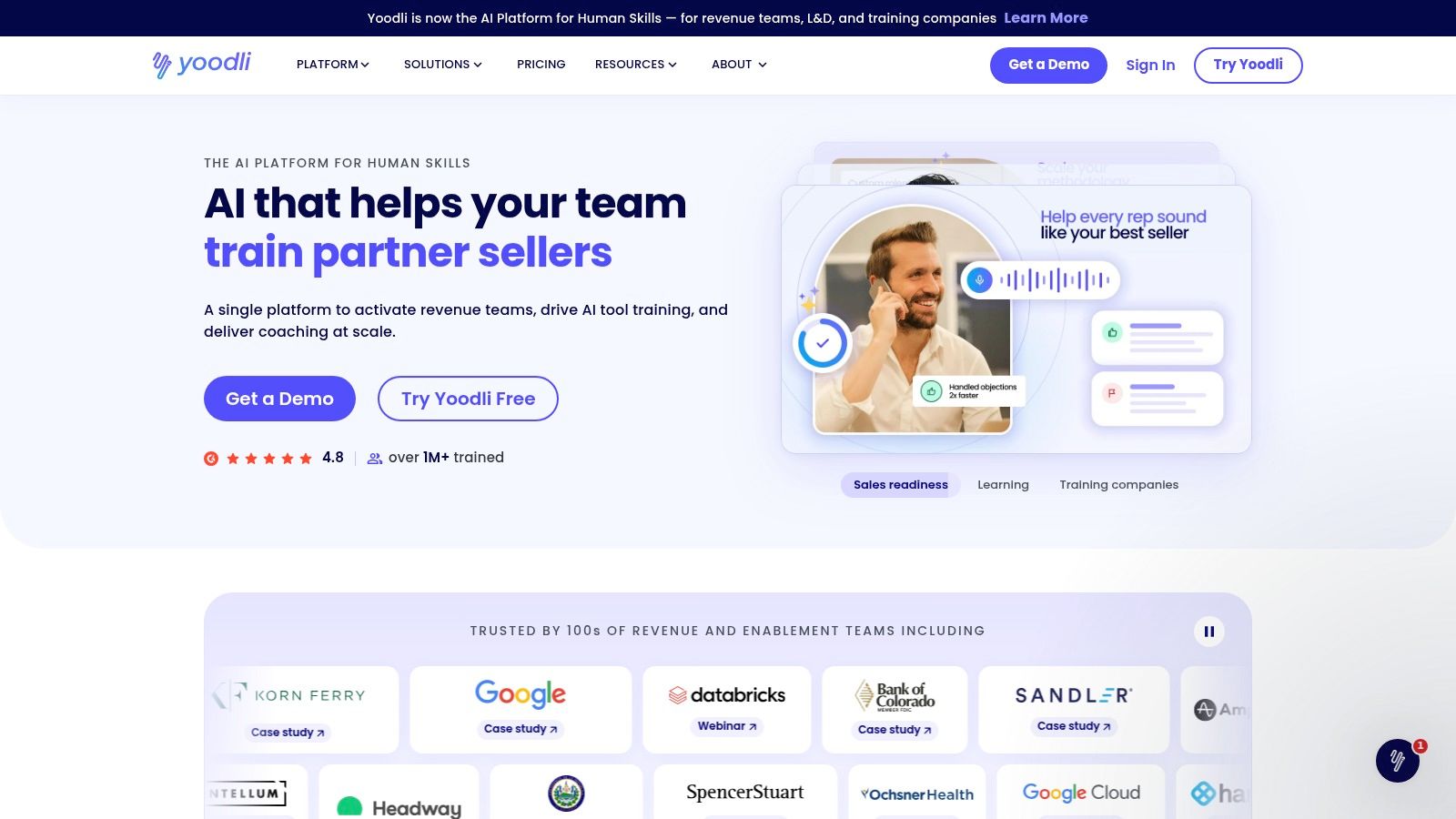
A polished answer can fall apart when an interviewer asks for a specific result or challenges an assumption. Yoodli's AI roleplays ask follow-up questions based on your response, making the tool useful for practicing how to recover when a prepared script stops fitting.
The InterviewBench evaluation tested AI interviewers across 5,500 classification questions, 3,000 generative questions, and 184 dynamic scenarios. It found that language models can produce fluent dialogue but remain weaker at eliciting evidence, choosing strategies, managing longer interactions, and recovering when answers go sideways. That limitation matters in practice: a follow-up asking for a measurable result can expose a vague answer, while a fluent exchange alone does not show whether your response is convincing.
Use free sessions to find the weak point
Yoodli offers free practice, but the available allowance may limit how often you can rehearse. Check the current terms before building a routine around it. Treat each session as a diagnostic: note which follow-up exposes a gap, then practice a clearer response.
- Choose different answer types, such as a behavioral example and a difficult role-specific question.
- Review whether you gave evidence and a concrete result, rather than relying only on the AI's conversational tone.
- Rehearse the improved answer aloud afterward. The guide to using AI for interview practice explains how to turn feedback into repeatable preparation.
Yoodli can help you practice responding to probes, but an AI roleplay cannot tell you exactly how a particular interviewer will react. For the current product details, visit Yoodli.
5. InterviewWare
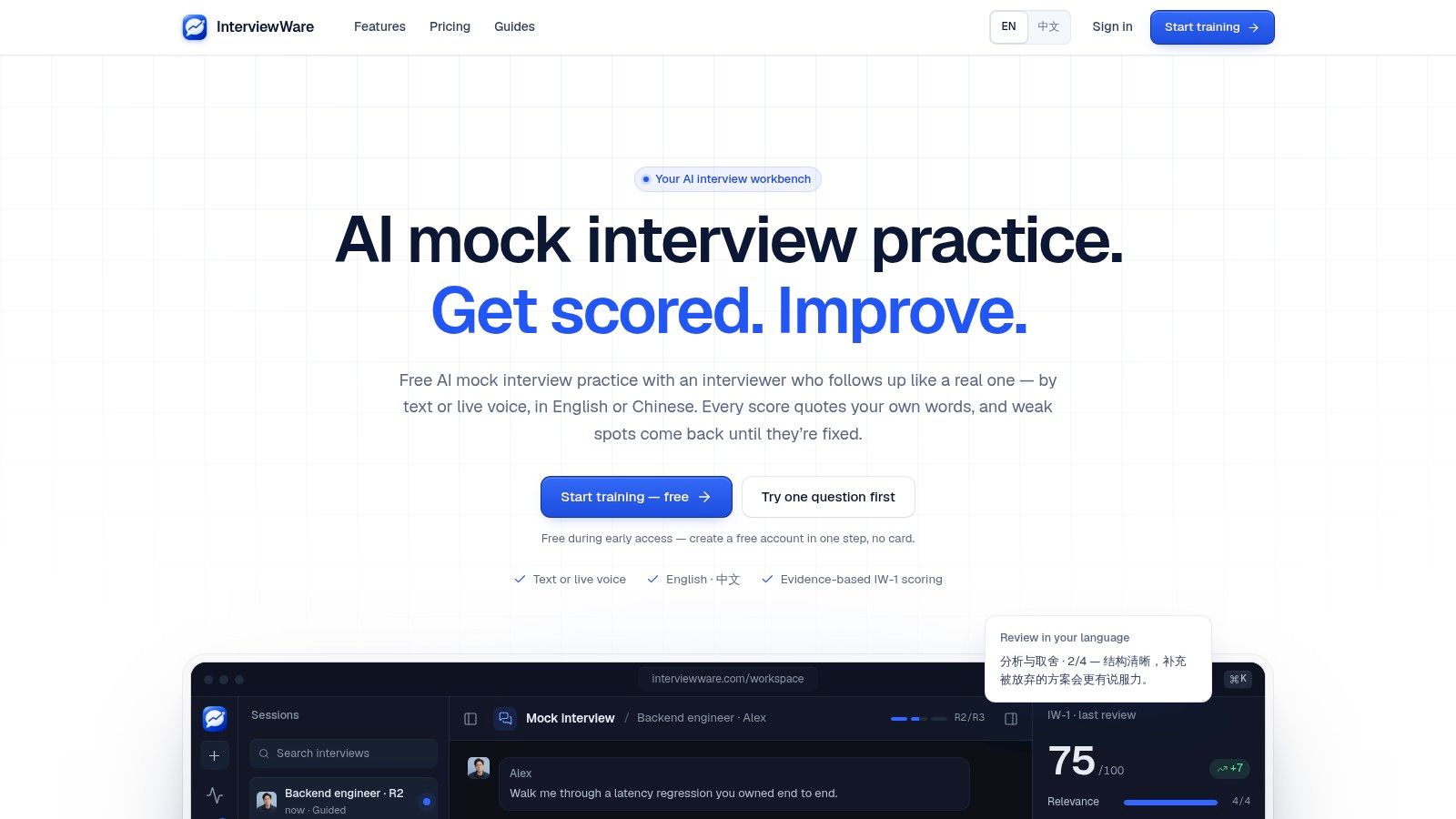
InterviewWare keeps its scope narrow and useful: text or live-voice practice with an AI interviewer that asks follow-ups, organized into role tracks such as software engineering, product management, and data science. It also offers interview and feedback options in English and Chinese, which matters if your loops happen in either language.
The free terms are unusually generous on paper. The provider says the service is free during early access, with a stated limit of 30 new interviews per rolling 24 hours. Thirty is not a real constraint for a human being. It does tell you the tool expects volume testing rather than a two-week prep plan.
The uncomfortable question about AI verdicts
An AI interviewer is still an AI judge, and candidates are skeptical of those for good reason. Gartner's 2025 survey of 2,918 job candidates found that only 26% trusted AI to evaluate applicants fairly, 32% worried AI could cause their application to fail, and 25% said AI-based evaluation reduced their trust in employers, per Gartner's survey release.
Use the same skepticism on your own practice. InterviewWare's score reflects its rubric, not your hiring manager's. Read the feedback as a first pass, then ask a human.
- Strength: instant, unlimited-feeling reps with follow-ups in two languages.
- Limit: early-access terms and daily caps can change without notice.
- Limit: a narrower language list than services claiming 99+.
Try a single session at InterviewWare before you build a routine around it.
6. BiasZero Practice
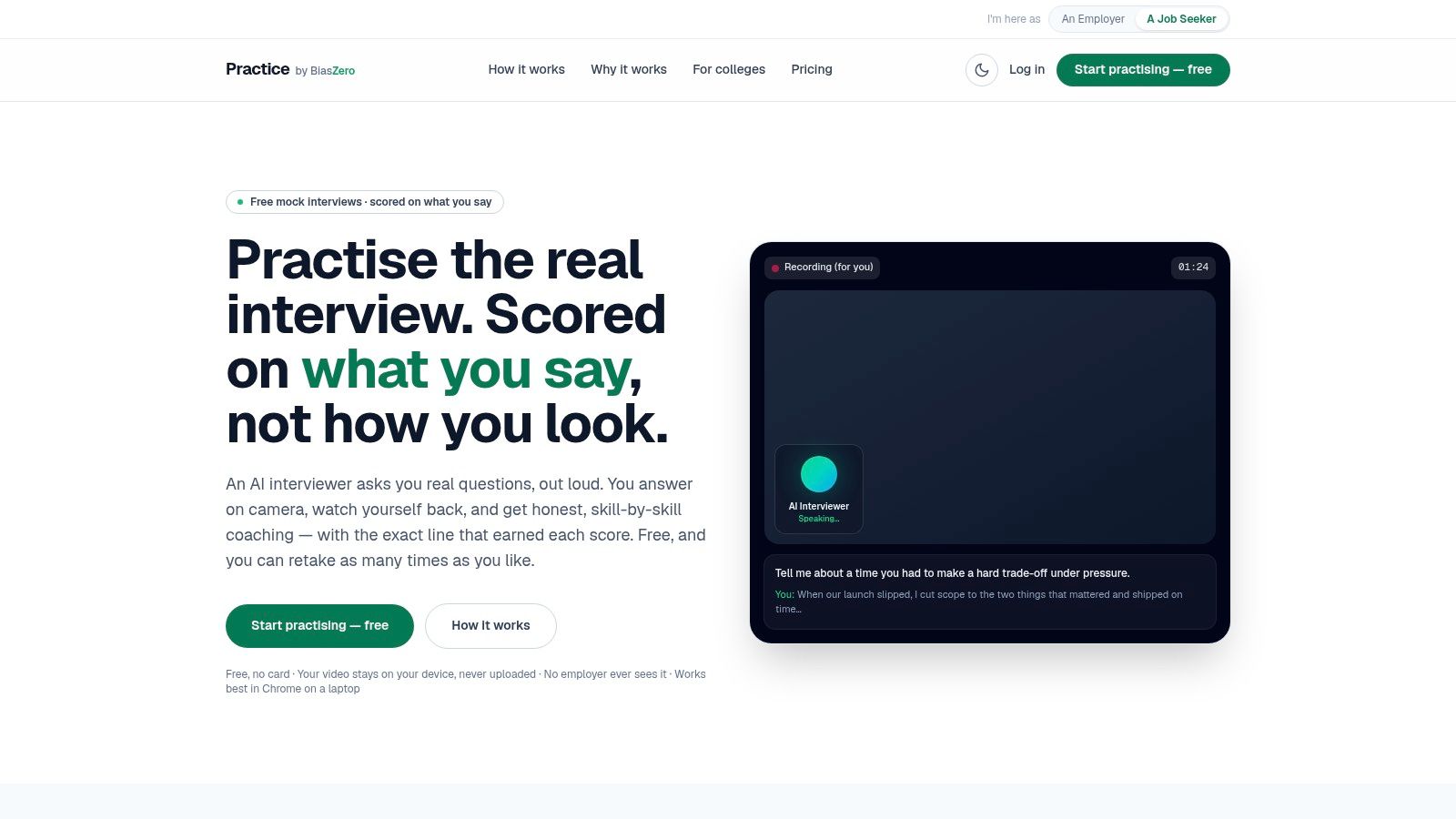
Most free interview tools treat eye contact and facial expression as the scoreboard. BiasZero Practice is worth a slot here precisely because it doesn't. It runs spoken AI interviews with adaptive follow-ups, scores answer skills rather than appearance, and keeps video on your own device. The provider recommends Chrome on a laptop for best results.
That design decision lines up with a real problem. The American Foundation for the Blind reported in 2025 that 42% of surveyed job candidates had been required to complete an automated interview or test, with another 14% unsure, and concluded that automated assessments can disadvantage qualified candidates with disabilities by interfering with assistive technology or demanding nonessential actions like turning toward a camera or analyzing images, per AFB's working-with-AI research.
If a practice tool scores your smile, you're rehearsing for an exam nobody should be setting.
Practical adaptation matters more than realism for its own sake. If you use captions, a screen reader, a speech device, or a text alternative, decide in advance how you'll ask an employer for accommodations, and rehearse that request out loud until it sounds routine rather than apologetic.
- Strength: repeat practice without a stated session cap, and local video handling for privacy-conscious users.
- Limit: best compatibility is Chrome on a laptop, so mobile rehearsal is out.
- Limit: provider privacy and feature claims should be checked against current terms.
Practice is at BiasZero Practice.
7. Interview Drills
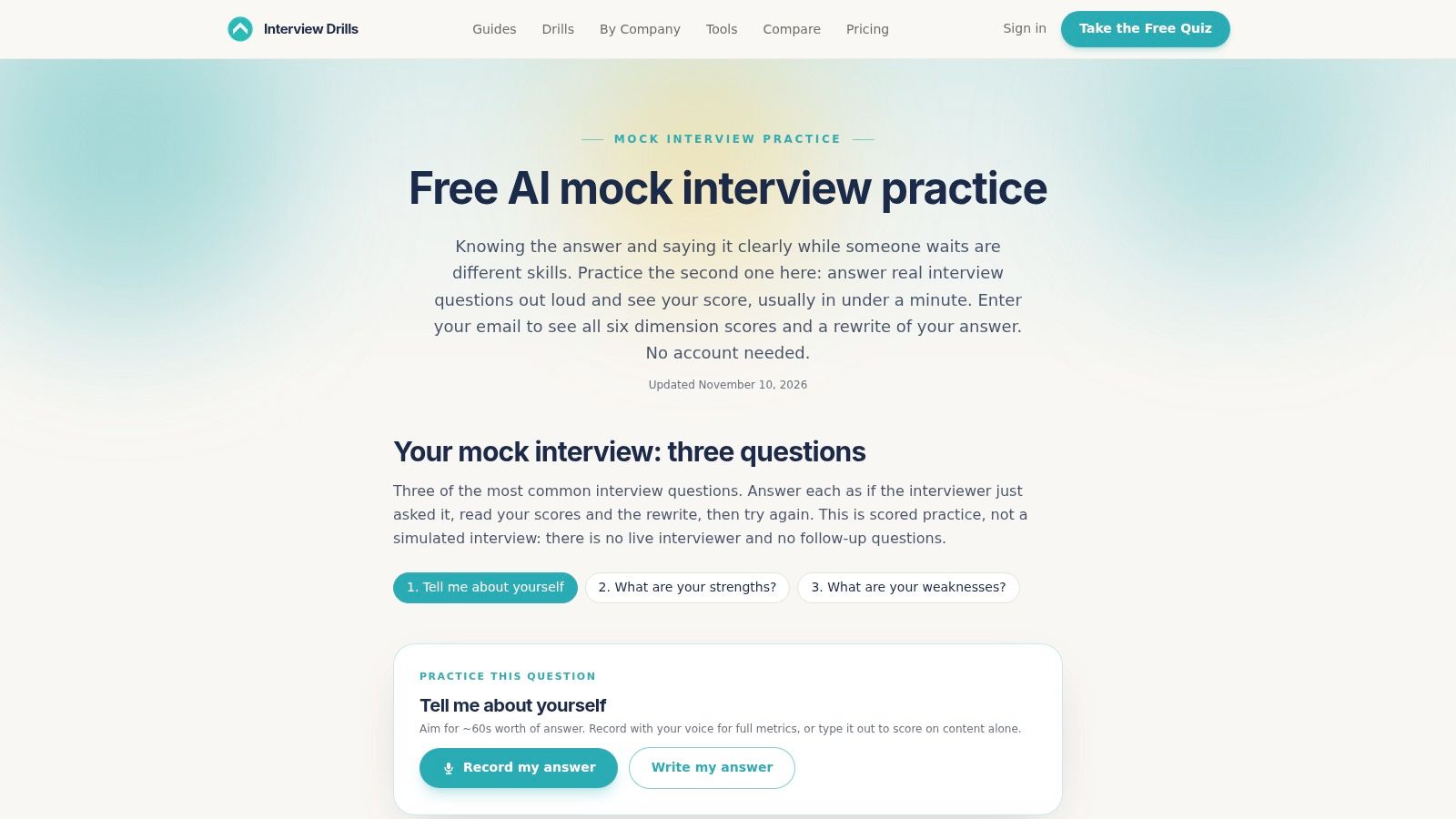
You have twenty minutes before a call and you want to know whether your answer to "why this role" is still mush. That's the situation Interview Drills is built for, and it doesn't pretend to be a conversation.
The format is a three-question scored exercise, answered by voice or text, with an answer rewrite you can compare against what you said. There's no interviewer, no follow-up, and no account needed to begin. The full score breakdown and rewrite require an email address, which is the cost of the free tier.
The drill is the point
Scored practice without a partner has one clear use: converting vague discomfort into a specific fix. An answer rewrite is concrete. A score out of ten is not, unless you can see which sentence lost the points.
Borrow the discipline of a study group if you practice with friends. Applying timing controls for classroom quizzes keeps a three-question drill to ten minutes instead of forty, which is the difference between practice you repeat and practice you abandon.
- Best for: a quick diagnostic when time is short.
- Watch for: email gating on the useful part of the report.
- Skip if: you need follow-up questions, because there aren't any.
Where it fits in a longer plan depends on how many sessions you can realistically sustain, which how many mock interviews you should do breaks down by interview stage. Start drilling at Interview Drills.
8. NailedIt.ai
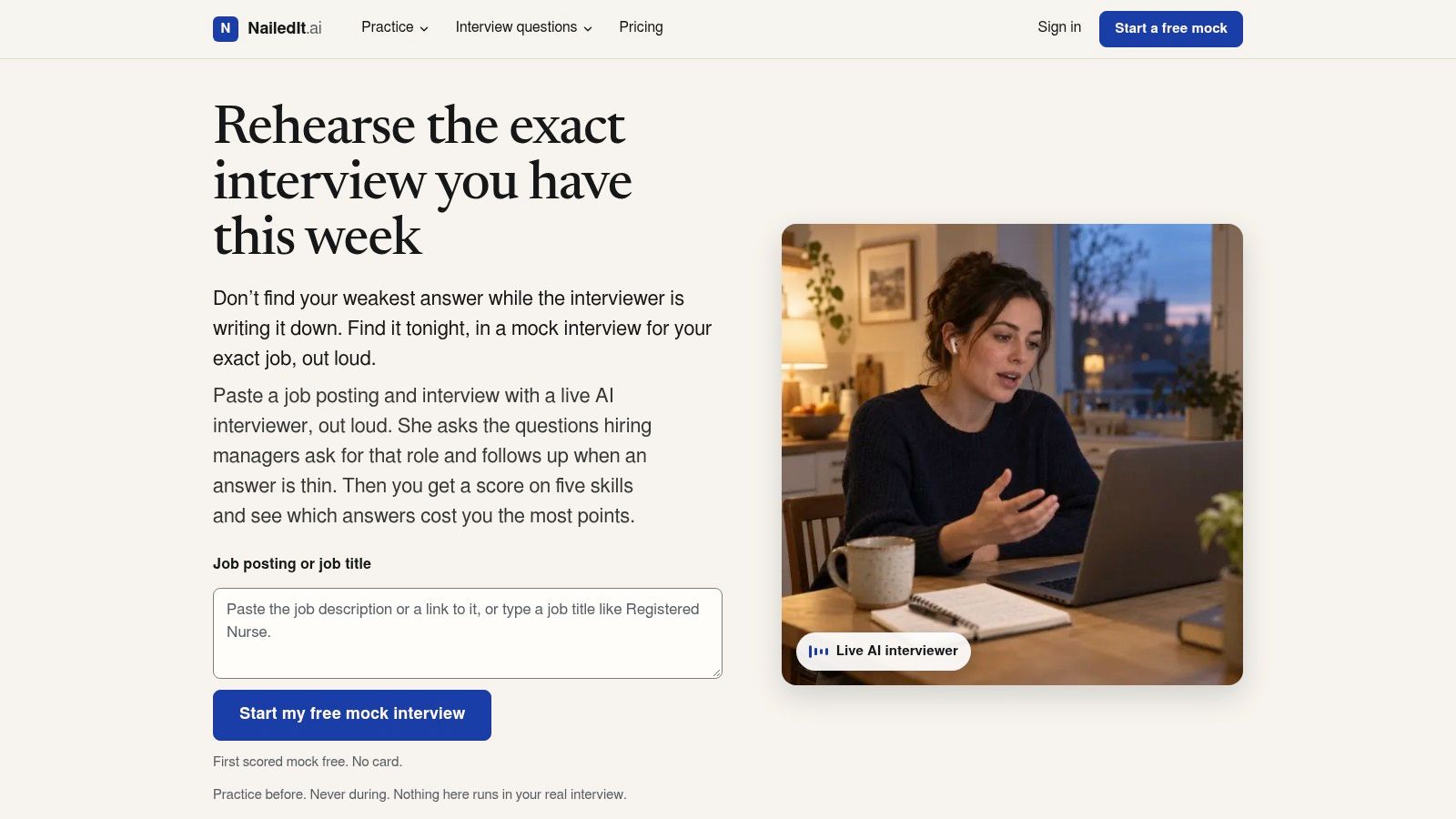
NailedIt.ai sits in the middle of the market and doesn't apologize for it: AI-generated questions, spoken answers, an optional video interviewer, and scores built from your answer transcript. You can start with a free account, and the signup flow is where the actual limits surface, since they aren't documented clearly up front.
That opacity is the main reason to treat it as a second or third tool rather than a first. Open it when you already know what you're working on. Open it cold and you'll spend your first session learning the interface.
Why video rehearsal is now table stakes
The environment you'll interview in has settled. 78.2% of candidates in the United Kingdom, 77.8% in North America, and 72.7% in South Africa had experienced a live online interview, according to Greenhouse's State of Job Hunting findings compiled by Emapta. Video is not a niche format any more, and camera comfort is a trainable skill.
- Strength: spoken rehearsal without a human partner, in a flexible format.
- Limit: transcript-based scoring misses tone, pacing, and hesitation.
- Limit: speech recognition can penalize accents it doesn't handle well.
That last point deserves attention. If your transcript comes back garbled, the score is measuring the recognizer, not you. Test once, then move on. See what the signup flow offers at NailedIt.ai.
9. Fluently Mock Interview Practice
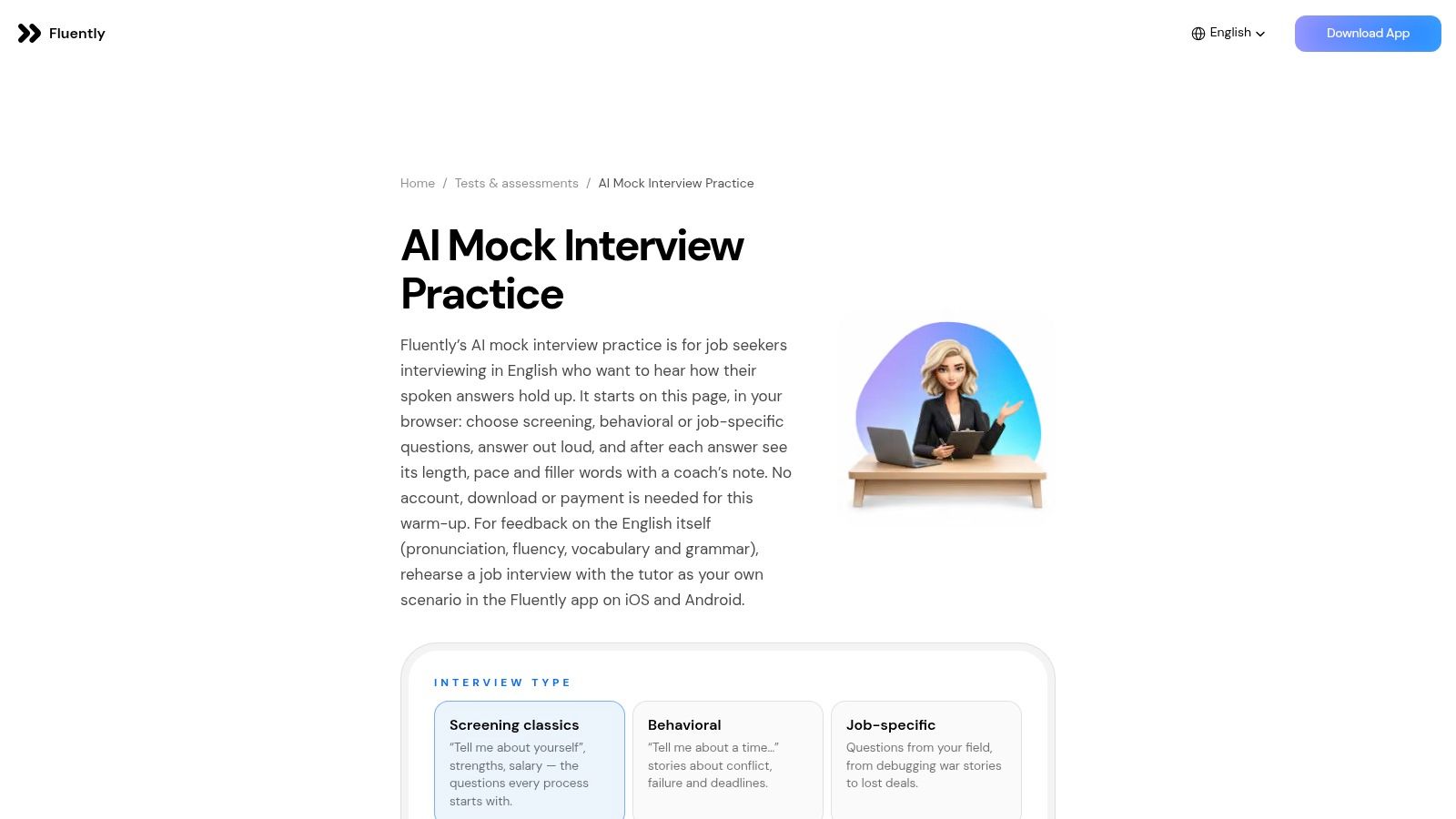
Fluently is the least precious tool on this list, and that's a compliment. Its web page runs five-question mock interviews with follow-ups and reports on speaking pace, answer length, filler words, and word count. The provider says it's free, unlimited, and needs no account or download.
What you're buying with a session is delivery feedback, not content feedback. Nobody there is grading whether your trade-off analysis was correct. The trade-off is clearly stated by the provider itself, which is rarer than it should be.
Use it as a warm-up, not a verdict
For non-native speakers, this is the highest-value free tool in the list, because the failure mode it fixes is mechanical. Answer length collapses, filler words multiply, pace races. None of that needs a human.
Where it stops: a clean 90-second answer with three "um"s and a vague ending is still a weak answer. Fix delivery here, then take the content somewhere that grades content.
- Strength: zero friction, unlimited reps, no signup wall.
- Limit: advanced tutor-led interview practice sits in the paid app plan.
- Limit: browser speech recognition quality varies by device and browser.
Use four five-question rounds back to back and you'll hear your own filler habit without anyone pointing it out. Open it at Fluently Mock Interview Practice.
10. Coril
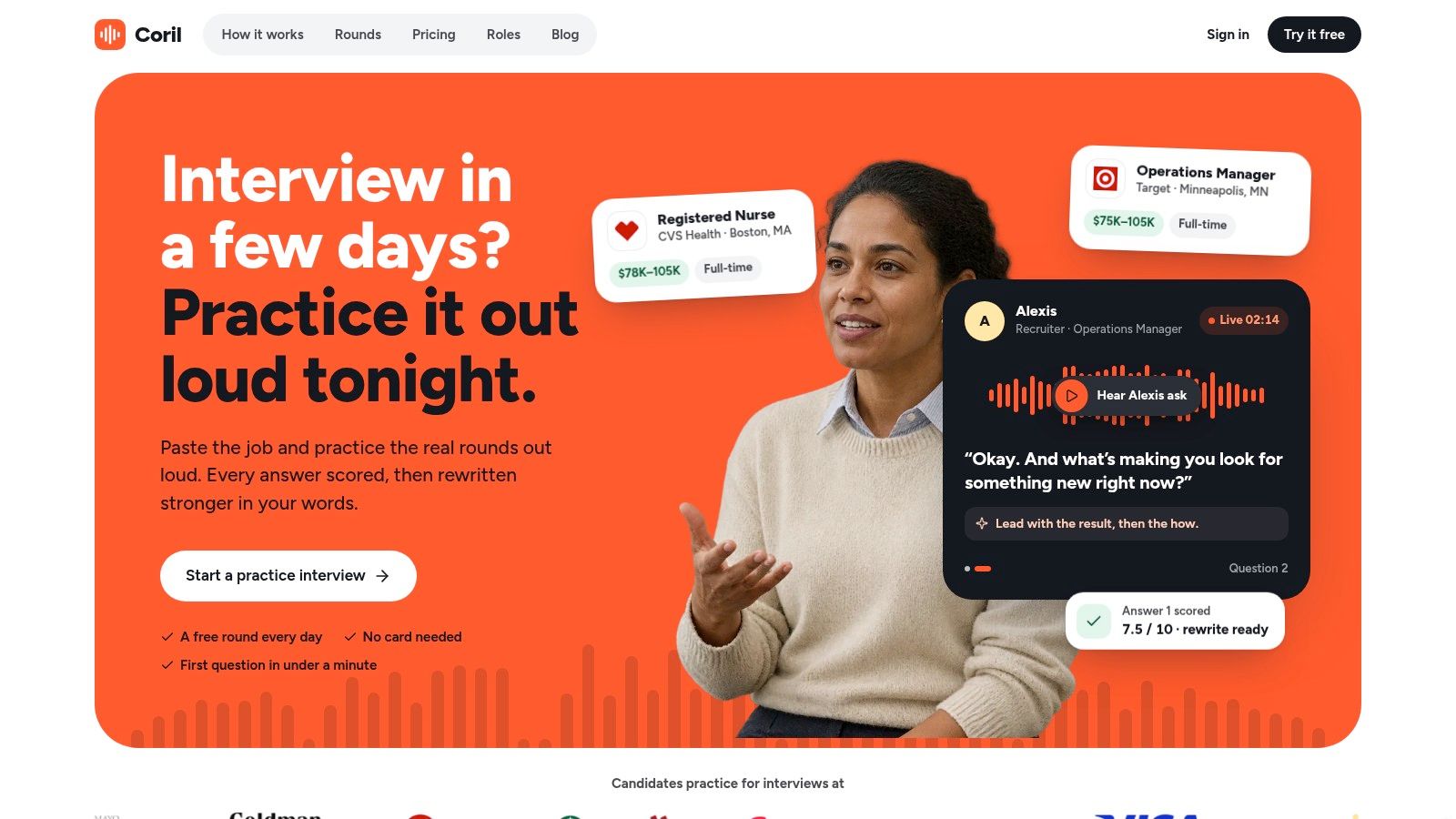
Coril does the thing most free tools skip: it builds the practice around one named job. Paste a job link or description, pick a round (recruiter screen, behavioral, or skills), and you get a voice-based AI interview with answer scores and suggested rewrites.
Round selection is the underrated part. A recruiter screen rewards a compact story about fit and motivation. A skills round rewards specificity and numbers. Candidates who rehearse one generic set of answers perform badly in both, because the two rounds want different shapes.
Three sessions, spent well
The provider says free access includes three sessions with no credit card required. That's a diagnostic budget, not a training plan, so don't spend it on a job you don't care about.
- Session one: the job you want, recruiting screen round. Fix the story and the motivation.
- Session two: the same job, behavioral round. Identify the one story with no measurable outcome.
- Session three: rewrite and rerun that single answer.
Automated scores and rewrites are suggestions from a model, not verdicts from a hiring manager. Read the rewrite for structure, then put it in your own words, because a rewritten answer delivered verbatim sounds like someone else talking.
One practical caution: you're handing a third party your target job information. That's normal for this category, but use a public posting rather than an internal document. Begin at Coril.
Free mock interview tools compared by access, format, and best use
| Item | Free access | Practice format | Feedback type | Best for |
|---|---|---|---|---|
| Interview Pilot (recommended) | Free option; tier details not specified | Guided AI mock interviews, question bank, and live interview assistance | Tailored real-time suggestions | Candidates seeking multilingual practice and live interview support |
| Huru | Free mock interviews and reports; no subscription | Spoken, camera-based AI mock interviews | Feedback on relevance, structure, specificity, impact, and delivery | Practicing answers aloud and reviewing job-specific responses |
| Aced (formerly Exponent/Pramp) | Limited practice credits each month | Live peer-to-peer video interviews, including coding and system design | Human peer interaction | Tech candidates who want realistic practice with another person |
| Yoodli | Up to five lifetime practice sessions | AI roleplays with spoken answers and follow-up questions | Speech and delivery analysis | Practicing conversational answers without a partner |
| InterviewWare | Free during early access; up to 30 new interviews per rolling 24 hours | Text or live-voice AI interviews | AI feedback with follow-up questions | Trying role-focused practice in English or Chinese |
| BiasZero Practice | Repeated free practice; no stated session cap | Spoken AI interviews with adaptive follow-ups | Skills-oriented feedback and self-review recording | Candidates seeking repeat practice with a focus on answer skills |
| Interview Drills | Free three-question exercise; email needed for full report | Short voice or text exercise; no live interviewer | Scores and answer rewrites | Quick practice when time is limited |
| NailedIt.ai | Free account option; limits unclear | Spoken AI questions with a video interviewer option | Transcript-based scores | Candidates wanting spoken practice and camera rehearsal |
| Fluently Mock Interview Practice | Free and unlimited; no account required | Browser-based spoken practice with follow-ups | Speaking pace, fillers, answer length, and word count | Candidates practicing spoken English and delivery mechanics |
| Coril | Three free sessions; no credit card required | Voice AI interviews tailored to a job posting and interview round | Answer scores and suggested rewrites | Preparing for a specific opening and multiple interview stages |
Building a Free Practice Routine That Holds Up on Interview Day
The most common mistake isn't picking a weak tool. It's picking five and finishing none. Two or three tools, each tied to a different gap, in a repeatable weekly loop will outperform a folder of bookmarks every time.
Here's a routine that fits around a job and doesn't require a subscription anywhere.
- Monday, 20 minutes, delivery. Four five-question rounds in Fluently with no preparation, so you hear your untreated answers. Write down the filler word and the answer that ran long.
- Wednesday, 45 minutes, human pressure. Book an Aced peer session for a technical loop, or run one BiasZero Practice interview if scheduling a stranger is unrealistic this week. Speak to a person or to a system that pushes back, not to your own notes.
- Friday, 30 minutes, role-specific. One Interview Pilot mock interview against your actual target role, or one Coril session built from the job description if you haven't started that round yet. Score it, then pick a single sentence to rewrite.
- Sunday, 15 minutes, review. Compare this week's weakest answer with last week's. If it's the same answer, you're not practicing, you're rehearsing your comfort zone.
The order matters more than the tools. Delivery work first, because a rambling answer hides the content problem underneath it. Human or adaptive feedback second, because it surfaces what you can't hear yourself. Role-specific work last, because that's where you spend the energy you've saved.
Track one number across the whole cycle: how many seconds your answer takes before you reach the result. Candidates who tighten that single metric usually fix the rest of the answer on the way.
The week-one action: pick one tool from this list, run a single timed session in the next seven days, and write down the one answer you'd still rewrite before a real interview. That answer is your entire prep plan until it's fixed.
Interview Pilot can be started free for mock interview practice, and its free plan requires no payment, which makes it the lowest-friction place to begin the role-specific half of the routine. If you want a wider shortlist of rehearsal options before committing, interview rehearsal tools by Coachful is a useful cross-check.
Interview Pilot gives you guided AI mock interviews that record your spoken answers and return a scored evaluation, alongside a searchable bank of role-specific questions covering technical, finance, product, and consulting loops. Run one timed session this week, see exactly where your structure collapses, and fix it before the live call rather than after it. Visit Interview Pilot to start free, with no payment required.
Topics
mock interview practice
free mock interviews
AI interview practice
interview preparation
practice interview questions
Continue reading

Interviews
How to Beat Job Interview Anxiety and Perform with Calm
Learn how to beat job interview anxiety with proven breathing, rehearsal, and recovery techniques that keep you calm and confident before and during real
October 21, 2026
14 min read
Interviews
Behavioral and Situational Interview Questions: 10 Examples
Compare behavioral and situational interview questions with 10 real examples, answer frameworks like STAR, and role-specific tips for job interviews.
November 12, 2026
14 min read
Interviews
8 Situational Interview Questions Examples: Model Answers
Explore 8 situational interview questions examples with model answers, annotated tactics, and variations to practice for any role or industry in 2026.
November 11, 2026
20 min read