









Interviews
How to Beat Job Interview Anxiety and Perform with Calm
Learn how to beat job interview anxiety with proven breathing, rehearsal, and recovery techniques that keep you calm and confident before and during real
Interview Pilot Editorial Team
Updated October 21, 2026
14 min read

You open your laptop before the interview, check the camera, and suddenly can't remember how to introduce yourself. Your stomach tightens. You reread the job description, hoping another pass will make you feel ready, but now you're wondering whether to cancel.
You don't need to win an argument with your nerves before you can interview well. You need a practical order of operations: settle the physical spike, rehearse within limits, and know how to recover when an answer goes sideways.
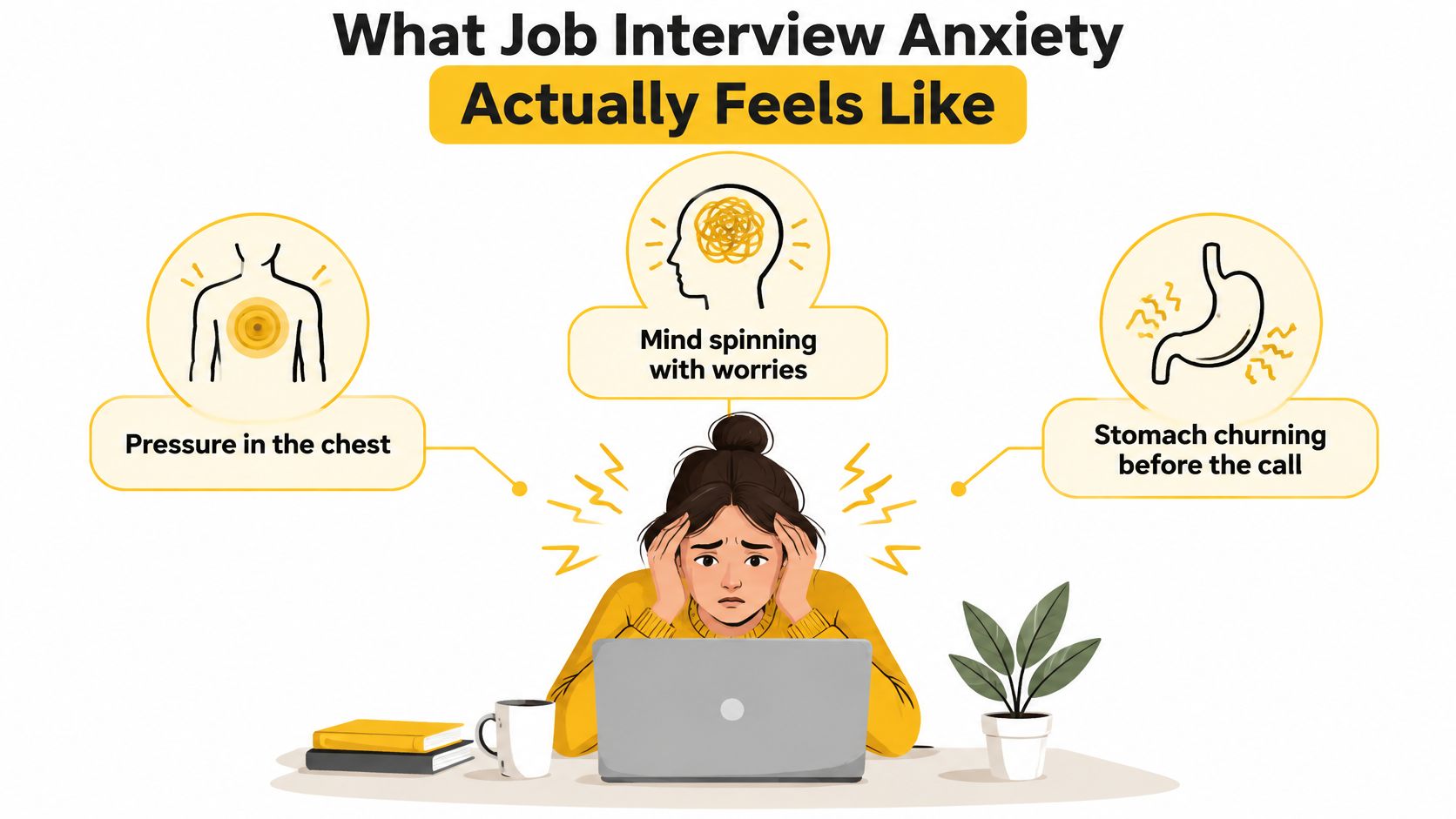
What Job Interview Anxiety Actually Feels Like
Job interview anxiety can feel like a tight chest, a churning stomach, racing thoughts, or an urge to escape the call before it starts. You might know your experience thoroughly and still struggle to retrieve an example when someone asks for it.
Then comes the second problem: judging yourself for being nervous. Instead of listening to the interviewer, you start monitoring whether your voice sounds shaky or your face looks tense.
Nervousness isn't a verdict on your ability
A peer-reviewed study cited survey evidence that 92% of Americans feel nervous about at least one aspect of a job interview, while its applicant research found a near-zero correlation between interview anxiety and subsequent job performance (research on interview anxiety and workplace performance). Those findings don't make an interview easy, but they challenge the assumption that feeling anxious means you'd struggle in the job.
Separate what you're experiencing from what you're concluding:
- Sensation: Your stomach is churning. That's something you're experiencing, not an assessment of your qualifications.
- Prediction: You think you'll forget everything. That's a forecast, not something that has happened.
- Evidence: You've completed relevant work and can explain specific examples. That deserves more weight than the forecast.
Practical rule: Don't use how calm you feel as your readiness test. Use whether you can explain relevant work and recover when you lose your place.
Treat anxiety as a state to work with, not a character flaw to overcome through willpower. If your interview is imminent, prioritize the breathing options and recovery language below. If you have preparation time, spend it on flexible answers rather than memorized speeches.
You don't have to feel fearless to participate. You need a way to stay engaged while you're uncomfortable.
Why Anxiety Hits So Hard Before Interviews
An interview puts you in an uncomfortable position: strangers are evaluating you, the outcome matters, and you don't control the questions. On video, you may also be watching your own face while trying to interpret someone else's expression.
A useful working model is body alarm, inward attention, disrupted delivery. You notice a physical sensation, start checking yourself, and find it harder to stay with the question. Treat that as a description to investigate, not a diagnosis.

Separate your answer from its delivery
You can have a sound answer and still deliver it in a way that makes your competence harder to see. In an experiment involving 823 U.S. adults with management experience, actors delivered identical scripted answers, but videos showing more anxious nonverbal behavior received lower interview-performance ratings (experiment on anxious nonverbal behavior).
That's a reason to practice delivery, not a reason to police every movement. The experiment doesn't establish that every gaze shift or pause harms a real interview.
Use these distinctions to choose your intervention:
| What you notice | What to target |
|---|---|
| Physical discomfort before the call | A comfortable breathing or grounding exercise |
| Repeated predictions of failure | A written separation of predictions from observable evidence |
| Rushed speech or losing the thread | Delivery practice and a prepared recovery phrase |
Don't turn this into another performance checklist you must execute perfectly. Pick the problem that most interferes with the conversation.
If you're scanning your face for signs of nervousness, redirect your attention to the interviewer's actual question. If you're racing through an answer, finish the current sentence and pause. Respond to an observable behavior rather than trying to manufacture confidence.
Breathing and Mindfulness Exercises You Can Use Today
Start with the simplest exercise you can perform comfortably. Don't make complicated breath counting another test you're afraid to fail.
These are practical options to try, not a promise that a particular breathing pattern will eliminate interview anxiety. Choose by comfort and usefulness, rather than assuming the most elaborate technique must be the strongest.
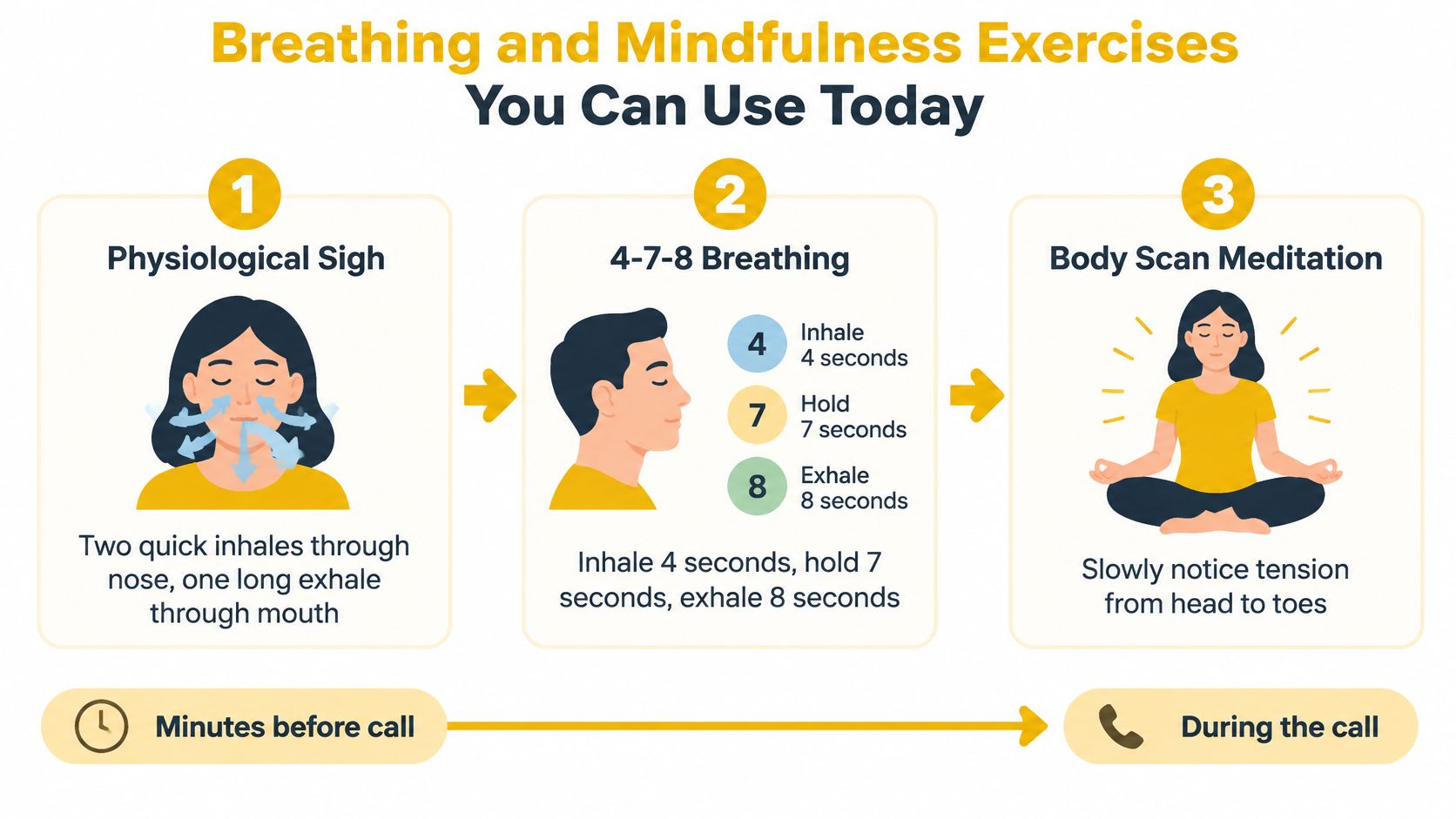
Use this visual as a reminder of the movements:
Choose an exercise that fits the moment
- Physiological sigh for a sudden spike: Take a gentle inhale through your nose, followed by a smaller second inhale. Let the breath out slowly through your mouth. Avoid gulping air or forcing the exhale, then return to ordinary breathing and notice whether you're more comfortable.
- 4-7-8 breathing for an unhurried evening: The pattern is an inhale for four counts, a hold for seven, and an exhale for eight. Treat those counts as instructions, not a target you must endure. Skip the hold or choose ordinary breathing if it feels uncomfortable.
- Body scan while waiting to speak: Notice your forehead, jaw, shoulders, hands, and feet in sequence. Let your jaw loosen and your hands rest. Keep your eyes open if that helps you remain engaged with the call.
My first recommendation is the least demanding option: comfortable breathing with an unforced exhale. Try the named patterns during preparation before relying on them under pressure.
Stop trying to breathe perfectly
If counting makes you more anxious, drop the count. If deliberate breathing causes dizziness or discomfort, stop and breathe normally. You can instead notice the chair beneath you, your feet on the floor, or an object on your desk.
For an optional guided demonstration, use the video during preparation rather than opening it as the interview starts:
The useful question isn't whether you completed an exercise correctly. It's whether you can return your attention to the conversation.
Rehearsal Strategies That Build Confidence Instead of Burnout
More practice isn't automatically better preparation. Repeating an answer until you hate every word isn't discipline. It's a reason to change how you're practicing.
Research developing the State Interview Anxiety Scale found a positive correlation between preparation and interview anxiety, not the expected negative relationship (study of preparation and state interview anxiety). That doesn't show preparation causes anxiety. It does undermine the easy promise that accumulating more rehearsal will necessarily make you calm.
Rehearse a structure, not a speech
Use claim, evidence, result, relevance as a flexible answer structure:
- Claim: State the point you want the interviewer to understand.
- Evidence: Describe a specific situation and what you personally did.
- Result: Explain what happened, without inventing metrics.
- Relevance: Connect the example to the role you're discussing.
For a question about handling ambiguity, you might describe how you clarified an unclear request, checked assumptions with colleagues, and delivered something the requester could use. Keep the facts stable while allowing the wording to change.
Then ask a differently phrased question that could use the same experience. If you can adapt the example without restarting a memorized script, you're practicing retrieval rather than recitation.
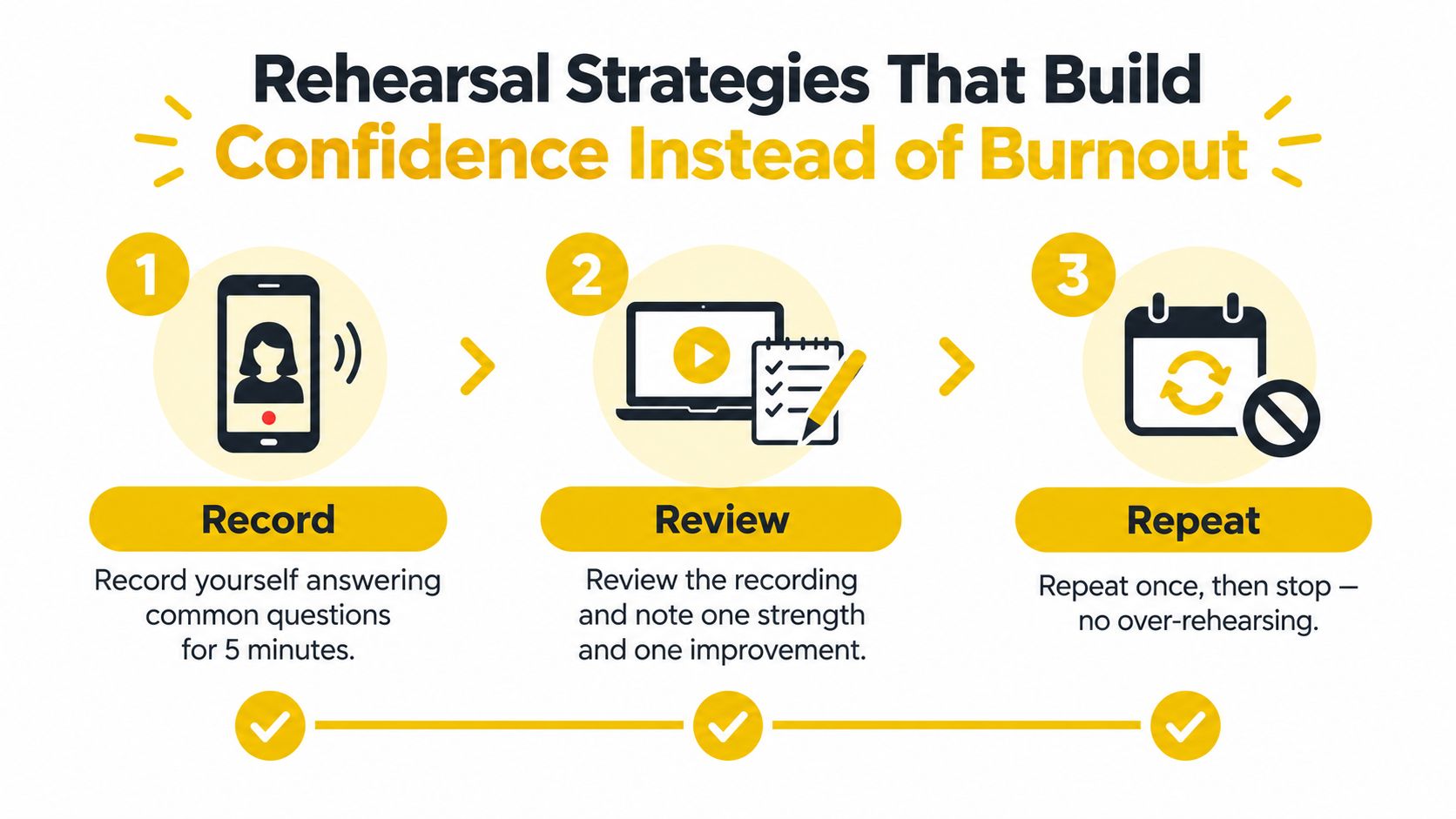
Use a bounded review loop
Record a mock answer with your phone or laptop camera. Review the content separately from the delivery, then select only two observable behaviors to adjust, such as rushed endings and rigid posture.
Ask a trusted reviewer whether your point was clear, not whether you looked perfectly confident. For a fuller setup, use this guide to practicing for an interview by yourself.
Stop when you can answer the question, support your point, and recover from a stumble. Don't keep rehearsing solely because you still feel nervous.
Watch for the difference between revision and rumination. Revision produces a specific change; rumination sends you through the same recording without a useful decision.
If you're rewriting every sentence, stop recording and practice an interruption instead. Have someone change the question or ask for clarification. Readiness includes handling a conversation that doesn't follow your script.
Your Pre-Interview Routine From Morning to First Minute
Build your interview-day routine around removing decisions, not adding rituals. You shouldn't need a perfect breakfast, perfect sleep, or perfect mood to begin.
Use the schedule below as a practical template. The timings organize your preparation; they aren't claims about an ideal scientific window.
A checklist you can screenshot
| When | Named action | What to do |
|---|---|---|
| The night before | Close the loop | Set out clothes, confirm the meeting details, and test your camera, microphone, and connection. Write down any unresolved logistical question. |
| Morning | Keep it familiar | Choose food and drink you already tolerate comfortably. Skip experiments with supplements, unfamiliar foods, or extra caffeine to compensate for nerves. |
| Thirty minutes before | Clear the workspace | Silence notifications, close unrelated tabs, place water nearby, and put your résumé and brief example notes within reach. |
| Ten minutes before | Switch to conversation mode | Stop consuming new interview advice. Review your reason for wanting the role and the questions you want to ask. |
| First minute after joining | Listen outward | Greet the interviewer, check that you can hear each other, and focus on their words rather than your self-view. |
If you discover a genuine preparation gap, address that specific gap. Don't restart your entire preparation process because you've remembered a question you haven't rehearsed.
For a focused final review, use this last-minute interview preparation guide rather than opening an endless collection of question lists.
Prepare your reset stack
Write a compact reminder beside your screen:
- Release: Let your shoulders drop and your hands rest.
- Orient: Identify what the interviewer is asking now.
- Continue: Give the next useful sentence instead of reviewing your previous mistake.
During small talk, use a simple anchor: feel your feet against the floor, then listen for something you can respond to. You don't need an impressive opening anecdote.
If anxiety regularly leads you to avoid interviews or disrupts daily life, consider speaking with a qualified mental health professional. If the first appointment itself feels intimidating, Uptown Psychology's resource on easing anxiety before therapy is relevant preparation for that separate conversation.
Keep interview preparation and clinical support distinct. A checklist can organize the morning; it isn't a substitute for care when you need it.
Quick In-Interview Coping Tips When Your Mind Goes Blank
“Fake it till you make it,” “power through,” and “never admit you need a moment” are poor instructions when you've lost the thread. They give you another performance to maintain instead of a way back into the conversation.
Choose a recovery behavior based on what's missing: time, clarity, structure, or knowledge. You don't have to pretend those are the same problem.
Match the response to the problem
| What happened | What you can say |
|---|---|
| You need time to retrieve an example | “Let me think of the example that best answers that.” |
| The question is ambiguous | “Would you like me to focus on the technical decision or how I worked with the team?” |
| You've started rambling | “Let me restart with the main point.” |
| You lost your place | “I lost my train of thought. The key decision was…” |
| You don't know the technical answer | “I haven't used that directly. I can explain how I'd investigate it and what I'd verify before choosing an approach.” |
These are example scripts, not lines you must repeat verbatim. Choose language that sounds natural in your voice.
Don't bluff through a knowledge gap
For a technical question, separate what you know from what you're assuming. Ask about missing constraints, describe a relevant principle, and explain what you'd check next.
If you can't offer a useful approach, say so plainly. A confident-sounding invention won't improve the substance of your answer.
Recovery standard: Make your next sentence useful. You don't need to erase the awkward moment before continuing.
When you need more recovery practice, rehearse variations rather than collecting polished phrases. These exercises for thinking on your feet during interviews can help you organize that practice.
After a stumble, avoid repeatedly apologizing or asking whether you've ruined the answer. Correct a material mistake if needed, then listen to the next question.
You're still participating in a professional conversation. Give the interviewer something they can evaluate: your reasoning, relevant experience, or an honest explanation of your limits.
Building a Lasting Calm Practice You Can Trust
Use a simple decision rule: match your next action to the obstacle, not to how badly you want reassurance. Physical discomfort calls for a comfortable reset. An unclear answer calls for bounded rehearsal. A disrupted conversation calls for recovery language.
A controlled online experiment found that socially anxious applicants were less willing to complete a live video interview, while those who participated performed no worse and received no different evaluations (working paper on social anxiety and interview participation). It's a useful distinction: wanting to avoid an interview isn't proof that you can't handle it.
When practice goes well but the night before doesn't
Don't automatically reopen your question bank. Write down the specific feared event, then ask whether you've discovered missing knowledge or just become less comfortable with uncertainty.
If there's a real gap, make a focused correction and close your materials. If there isn't, keep your planned stopping point. You don't need to rehearse again to earn permission to rest.
Use this compact plan:
- Tonight: Finish logistics, choose your example notes, and write a recovery phrase you're willing to use.
- Tomorrow morning: Follow the familiar routine you've already chosen rather than redesigning it around your mood.
- At the start of the call: Attend to the greeting and opening question. Let the conversation begin before deciding how it's going.
If the format itself creates a barrier, ask the recruiter what options are available. You can request written instructions, clarification of the interview structure, or information about the accommodation process without opening with a detailed account of your health.
Judge progress by what you can do while nervous: attend, listen, answer, clarify, and continue. Calm doesn't have to mean feeling nothing. A more useful aim is trusting yourself to take the next action when discomfort shows up.
Interview Pilot offers guided mock interviews and a searchable question bank as options for structured preparation. Visit Interview Pilot, choose a question relevant to your next role, and practice answering with a flexible structure and a clear stopping point.
Topics
job interview anxiety
interview nerves
calm before interview
mock interview practice
interview preparation
Continue reading

Interviews
10 Questions for an Executive Interview: A Practical Guide
Use these questions for an executive interview to assess judgment, leadership, strategic thinking, culture fit, and results—plus practical follow-ups.
October 18, 2026
21 min read

Interviews
10 Common Job Interview Questions and Answers for 2026
Prepare with 10 common job interview questions and answers, including model responses for different experience levels and job types, plus formatting tips.
October 17, 2026
20 min read

Interviews
10 Interview Questions You Can Ask: Stage-by-Stage Guide
Discover 10 interview questions you can ask by stage and role, with rationale, examples, and tips for different company types to show genuine interest.
October 16, 2026
18 min read