
















Interviews
Behavioral and Situational Interview Questions: 10 Examples
Compare behavioral and situational interview questions with 10 real examples, answer frameworks like STAR, and role-specific tips for job interviews.
Interview Pilot Editorial Team
Updated November 12, 2026
14 min read
You walk into the interview ready. The hiring manager asks about a conflict with a coworker, and your mind goes blank. The next candidate, thinner on the resume, gets a hypothetical about a late launch and tells a confident story they never lived. Both answers miss the test.
Behavioral questions ask what you have done. Situational questions ask what you would do. Interviewers use the first for evidence and the second for judgment. A Journal of Applied Psychology study of structured behavioral interviews at eight telecommunications companies reported an interrater reliability estimate of 0.64 based on 37 ratings and a mean criterion-related validity of 0.22 based on about 500 participants. Accuracy tracked how much relevant past behavior the questions pulled out.
A vague line like "I am a strong team player" gives them nothing to score. A situation, your actions, and a result does. That still holds if you are a new graduate, a career changer, or someone trying to find startup roles in Dubai without a long corporate file. You don't need ten speeches. You need a few true stories you can retell as past events or as reasoning for a future dilemma.
These ten behavioral and situational interview questions each name the task, a fill-in structure, and a role tilt.
1. Tell Me About a Time You Faced a Conflict with a Coworker

This is a recall question. They want a real disagreement, not a personality sketch. A Harris Poll survey with Express Employment Professionals found that in 2024, 68% of hiring managers said rudeness would cause them not to hire a candidate. Professional friction is fine. Contempt is not.
Say you and a teammate split on an API. You wanted the simpler one. They wanted the flexible one. You wrote the trade-off on one page, took it to design review, and shipped the simpler version two days sooner.
Practical rule: Spend most of the answer on what you did, and describe their view fairly.
Fill-in: "In [setting], we disagreed about [work issue]. I [data, a private talk, or a prototype]. We chose [decision]. The result was [observable outcome]."
Role tilt: Engineers name the technical trade-off. Consultants keep the client in the story. Product managers show how the spec changed, not who won the room.
2. Describe a Time You Failed

They are testing ownership, not drama. "We learned a lot," with no personal part, reads as a dodge.
The 2025 Employ Job Seeker Nation Report treats behavioral interviewing as a way to validate required skills. In 2025, 47.3% of surveyed hiring teams reported updating techniques to use deeper probing. Made-up metrics fall apart on the follow-up. Coursework, caregiving logistics, volunteer work, or a freelance project is fair game if you don't claim sole credit.
Pick a moderate miss you owned. Say the process you changed afterward. This guide to answering behavioral questions is worth using so the story stays on your part, the fix, and later proof.
For finance and data, lead with the miss and the control you added. For students, a class or campus example is enough when the lesson is specific. Skip the apology tour.
3. Tell Me About a Time You Led a Team Without Formal Authority
Apollo Technical, citing Adaface, reported that in 2024, 74% of HR professionals used structured interviews and 73% used behavioral interviews. Influence gets scored against a rubric, not your title.
You didn't manage the group. You still had to move them. A launch needed design, data, and support, and nobody reported to you. You ran short one-on-ones, showed a prototype, and asked what each person would drop if the date held.

Fill-in: "The goal was [outcome]. I had no authority over [who]. I built buy-in with [data, a prototype, or private asks]. We delivered [result]. [Names] owned [their part]."
If your stories keep sounding like you did it alone, the notes on how to ace a behavioral interview help you separate your move from the group's.
Tilt: Product and consulting lead with stakeholder alignment. Engineering shows a dependency you unblocked. Project managers name the decision you refused to make for everyone else.
4. Describe a Time You Met a Tight Deadline Under Pressure
Two managers, one week, two deliverables. That is the scene. They aren't scoring how late you stayed. They're scoring the trade-off you said out loud.
Split the work into pieces you can finish in a day. Tell the owner what slips if both dates stay fixed. Protect the item with the harder consequence, and say why. Close with the habit you kept, such as a shared board or a written priority.
What fails: "I stayed late and got it all done," with no choice. What works: one sentence on what you refused to do.
Fill-in: "The date moved to [when] because [cause]. I split the work into [milestones], told [stakeholder] that [item] would slip, and protected [quality bar]. We hit [result]."
Consulting and finance should name client or close risk. Software should name scope you cut, not nights you worked.
5. Tell Me About a Time You Disagreed with Your Manager
This checks upward communication. They want a work disagreement, evidence, and a clean commit once the call is made.
Raise the point once, with a specific alternative, then carry out the decision you didn't get.
"I thought the rollout skipped a reconciliation step" beats "my manager was wrong." Show the risk. If they kept their path, say how you executed it without a second campaign.
Fill-in: "I disagreed with [decision] because [evidence]. I proposed [alternative]. The call was [outcome]. I then [how you committed]."
Engineers can use a technical approach. Analysts should show the number that changed the talk. An internship supervisor counts. Don't invent a heroic standoff, and don't claim you never disagree. That sounds unaware, not loyal.
6. Describe a Time You Handled Ambiguity
Here they ask whether you can define the problem before you solve it. Product, data science, and consulting live in that gap.
Say a pilot's goal shifted and success wasn't written down. You listed assumptions, asked which two mattered this month, and set a metric you could check in two weeks. You updated people when scope moved, instead of rebuilding the deck.
- Context: what was unclear, in one sentence.
- Move: the facts you gathered and the assumption you stated.
- Alignment: who you updated, and how often.
- Result: the metric or decision that came out.
Data roles should show a metric you refused to fake. Product roles should show the bet you made explicit. Consulting should show how you stopped the client from treating every open question as urgent.
7. Tell Me About a Mistake You Made and How You Fixed It
This is narrower than a general failure. Something broke for a customer, a model, or a release, and you repaired it.
Own it in the first sentence. Skip the long apology. Name who you told, how fast, and the control that stops a repeat.
Say you shipped a query that double-counted a segment. You flagged it that morning, corrected the dashboard, and added a row-count check before publish.
Fill-in: "I [error]. It affected [who]. I told [them] by [channel] and fixed it by [action]. I added [preventive step]."
Finance and data engineering should emphasize the control. Software should name the bug and the test. Client roles should show the repair the customer felt. Don't narrate a teammate's mistake as yours. Probing makes that obvious.
8. Describe a Time You Went Above and Beyond
Extra effort only counts with a result, and only if your core job didn't fall over.
InterviewPal's analysis of 20,918 interview questions submitted by candidates from January through October 2025 reported that behavioral questions dominated the top 20. This prompt is common because motivation is hard to see on a resume. It is still a recall question. A speech about how generous you are doesn't answer it.
Pick a process you improved without being asked, or a task outside the description with a clear beneficiary. Say why you took it, what you paused, and who benefited.
Fill-in: "Outside my core work, I [action] because [reason]. I protected [main duty] by [how]. The result was [team or customer outcome]."
Support roles should show the customer effect. Product should show a gap you closed between teams. If the story is only "I worked weekends," drop it.
9. Situational Question: What Would You Do If a Project Was Behind Schedule Two Weeks Before Launch?
The prompt flips. You aren't recalling. You're reasoning in order. A comparison of matched questions found situational interviews had higher mean job-performance validity than behavioral-description interviews, about r = .23 versus r = .18, in a review in the International Journal of Selection and Assessment. The two formats aren't substitutes. One shows what you did. The other shows how you'd choose.
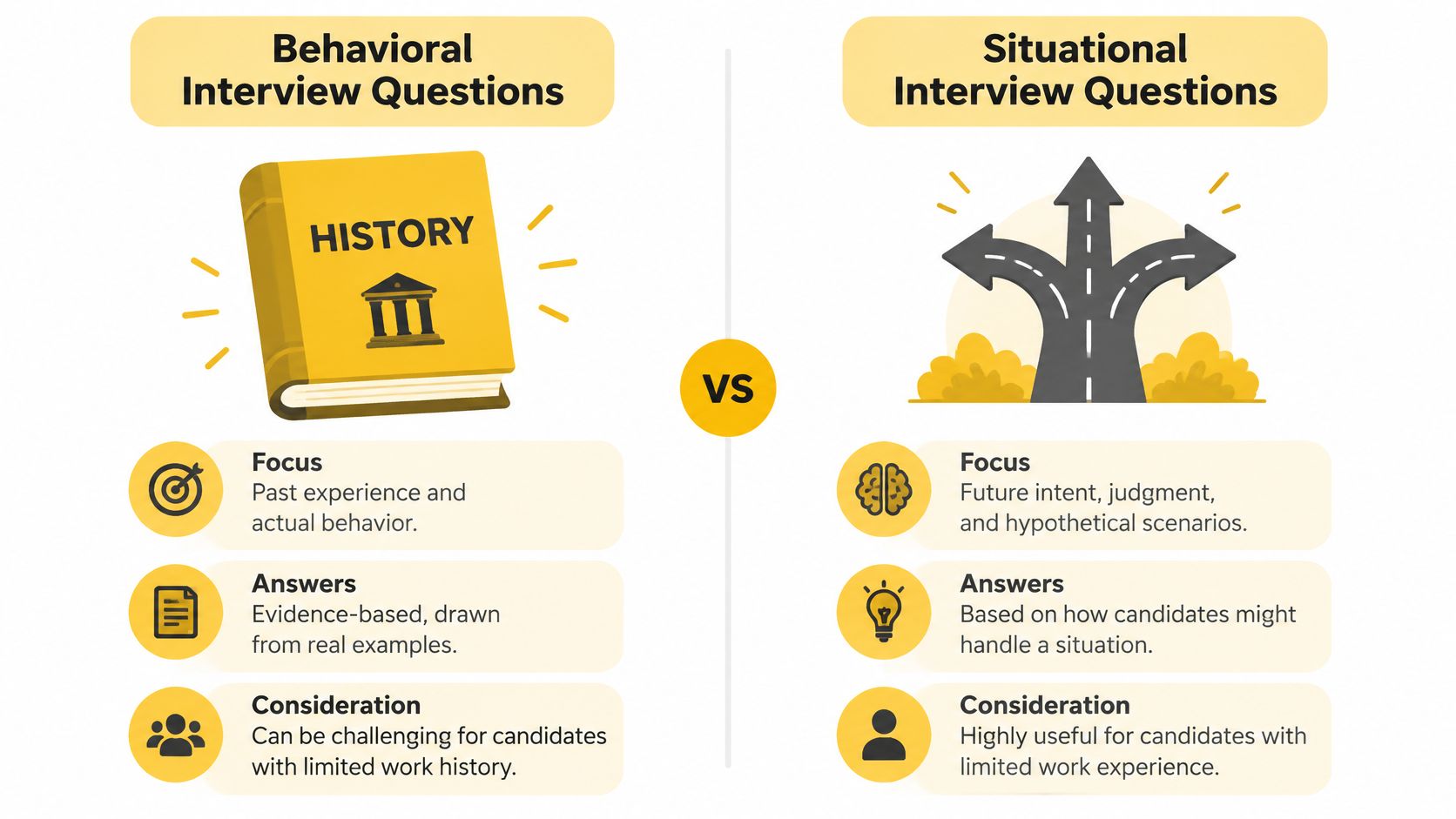
State one assumption, then a plan. Name the likely cause, what you cut, who you tell today, and the quality bar you won't drop. A fuller contrast is in this explanation of situational interviews.
Fill-in: "I'd assume [cause]. I'd protect [must-ship scope], move [item] past launch, and tell [stakeholder] the risk by [when]. Success is [measure]."
Product and engineering talk scope. Project managers talk when they escalate. Don't answer with a past war story unless they ask. That dodge is obvious.
10. Situational Question: How Would You Handle a Difficult Customer or Stakeholder?
A meta-analysis of situational judgment research covering 102 validity coefficients and 10,640 participants, summarized in the OPM assessment guide, reported criterion-related validity of about r = .34 for job performance, with a moderate link to cognitive ability of about r = .46. The prompt is scoring judgment, not charm.
Watch a short walk-through of how a calm sequence sounds before you rehearse your own.
Say a client wants a feature you can't ship, or an internal stakeholder keeps changing the brief. Acknowledge the concern, find the constraint, offer two options, and write down what you agreed. Escalate when the ask breaks policy, capacity, or a promise you already made. Teams that live on stakeholder calls, including firms that use a Best place to hire SDRs, still need the same de-escalation, not a script full of slogans.
Fill-in: "I'd restate [their concern], ask [one root-cause question], offer [option A] and [option B], and confirm it in writing. I'd escalate if [boundary]."
Consulting and finance should show expectation-setting. Operations should show the documented agreement. Don't open with "I'd just stay positive."
How the 10 behavioral and situational interview questions compare
| Item | Question Type | Core Skills Assessed | Best For Roles |
|---|---|---|---|
| Tell Me About a Time You Faced a Conflict with a Coworker | Behavioral | Empathy, listening, diplomacy, conflict resolution | Cross-functional roles, engineering, consulting |
| Describe a Time You Failed | Behavioral | Accountability, self-reflection, resilience, learning agility | Early-career, leadership, technology, consulting |
| Tell Me About a Time You Led a Team Without Formal Authority | Behavioral | Influence, stakeholder management, communication, initiative | Product management, consulting, project management |
| Describe a Time You Met a Tight Deadline Under Pressure | Behavioral | Prioritization, planning, stress management, communication | Consulting, finance, software engineering |
| Tell Me About a Time You Disagreed with Your Manager | Behavioral | Upward communication, integrity, judgment, respect | Management, graduate, and hierarchical roles |
| Describe a Time You Handled Ambiguity | Behavioral | Problem framing, structured thinking, initiative, adaptability | Product management, data science, consulting |
| Tell Me About a Mistake You Made and How You Fixed It | Behavioral | Accountability, incident communication, remediation, prevention | Finance, data engineering, software development |
| Describe a Time You Went Above and Beyond | Behavioral | Initiative, motivation, ownership, business impact | Customer service, early-career, team-oriented roles |
| Situational Question: What Would You Do If a Project Was Behind Schedule Two Weeks Before Launch? | Situational | Risk assessment, prioritization, scope management, escalation | Project management, product, engineering |
| Situational Question: How Would You Handle a Difficult Customer or Stakeholder? | Situational | Empathy, de-escalation, boundary-setting, problem-solving | Consulting, finance, product management, operations |
Turn Ten Questions Into Stories You Can Reuse
List five or six true episodes from work, school, freelance, or community roles. Tag each as behavioral material, meaning what you did, or as raw material you can reason from in a situational prompt. Map every episode to two or three questions above. A deadline story can cover pressure, a mistake, and a late-launch hypothetical if you change the tense and the emphasis.
I recommend you lead with influence and stakeholders for product and consulting, and with accuracy and root cause for finance and data. Engineering should keep one conflict story, one bug story, and one scope cut. Early-career candidates should not stretch a group project into solo heroics.
Situational prompts earn their place because they test judgment before anyone watches you on the job. Comparative figures in the personnel selection literature put mean validity at 0.50 for situational interviews, 0.39 for job-related interviews, and 0.29 for psychologically oriented interviews. Those aren't a promise for one hiring decision. Question quality, scoring, and job relevance still decide whether the number means anything for you. Answer by naming the priority, the action, and how you'd measure success.
In tech hiring, the CoderPad and CodinGame State of Tech Hiring report found that in 2025, real-world scenario simulations were used by 33.90% of respondents and role-playing by 9.34%. Practice the spoken order. One assumption, then a sequence, then a result you'd accept.
AI sits in the middle of this now. A TestGorilla survey of 1,084 organizations in the United States and United Kingdom found that one in five employers used generative AI to interview candidates. Gartner data reported in 2025 found that 13% of candidates had used generative AI in real time during an interview, rising to 18% in Asia-Pacific, and 41% of those users used it to generate answers. Ask whether assistance is allowed. If it isn't, covert answer generation breaks trust. If it is, talk about how you'd check an output, protect confidential data, and still own the decision. Rehearse each answer aloud until the structure holds without a script in front of you.
Our question bank lets you filter by question type, including Behavioral, and our mock interviews score the answer you give. Use that rehearsal on these ten prompts before the live call, then keep the stories short enough to survive a follow-up.
Interview Pilot gives you real-time, customized answers for behavioral and situational questions, plus mock interviews and role-specific question sets you can practice before the live round. Filter practice by question type, rehearse the fill-in structures above, and get an evaluation of what you said. Visit Interview Pilot and run these ten prompts before your next interview.
Topics
behavioral interview questions
situational interview questions
STAR method
interview answer frameworks
interview preparation
Continue reading
Interviews
8 Situational Interview Questions Examples: Model Answers
Explore 8 situational interview questions examples with model answers, annotated tactics, and variations to practice for any role or industry in 2026.
November 11, 2026
20 min read

Interviews
How to Answer Behavioral Questions (2026 Guide)
Master how to answer behavioral questions using the STAR method, with role-specific examples and practice exercises for software engineering, product
October 9, 2026
12 min read
Interviews
Integrity Interview Questions: 8 Examples and Red Flags
Use these 8 integrity interview questions to assess ethics, accountability, and courage. Includes STAR answer frameworks and red flags to watch for.
October 28, 2026
17 min read