












Career
7 Skills Synonym Resume Headers for Every Career Stage
Explore 7 skills synonym resume headers, with examples and practical guidance for students, career changers, specialists, and senior professionals.
Interview Pilot Editorial Team
Updated September 30, 2026
16 min read

The best resume heading depends on what you need to signal, not on which synonym sounds most impressive. Core Competencies, Technical Skills, and Expertise & Specializations suggest different levels of focus, while Key Skills & Strengths creates a more accessible, personal impression. Your experience level and target role should determine the choice.
The popular advice to replace “Skills” with a fancier word misses the underlying issue. Recruiters and applicant tracking systems still need recognizable job-related terms, and employers need evidence that you can use those capabilities in practice. Current resume guidance recommends alternatives such as abilities, competencies, capabilities, expertise, and strengths, but it also makes clear that wording alone can't establish credibility. Indeed's resume guidance on skills synonyms describes this as a keyword and proof strategy, not a vocabulary exercise.
Choose one of the seven headings below based on the hiring context it signals, then place concrete examples elsewhere on the page. Be ready to defend every listed capability in an interview. Interview Pilot can help you rehearse technical and behavioral questions, while professional headshot tips from AiHeadshots can help you present a polished application package.
1. Core Competencies
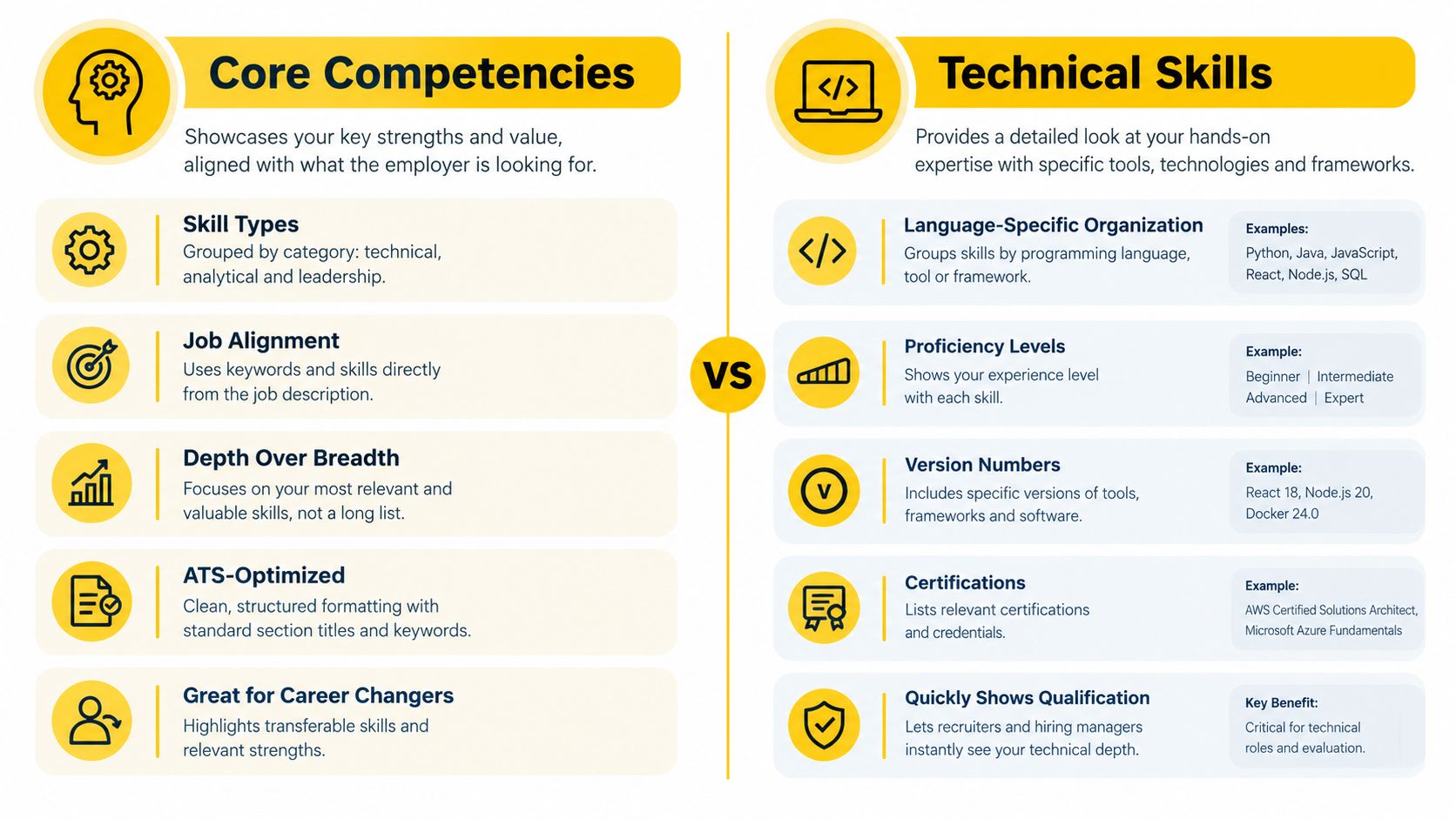
Core Competencies works best when you want to frame your abilities as the central capabilities required for a specific role. The heading sounds focused and role-oriented, so it suits mid-career candidates, career changers, and professionals applying for positions where employers evaluate a defined set of functional requirements.
A software engineer might list Python, Java, AWS, system design, and API development. A data scientist could highlight machine learning, SQL, statistical analysis, Python, and Tableau. For a product manager, relevant entries might include Agile delivery, product strategy, data analysis, and stakeholder management.
Use this heading when the job description emphasizes capabilities rather than a particular software stack. Group related terms so the section communicates scope without becoming a keyword pile.
- Cloud infrastructure: AWS, Google Cloud, Kubernetes
- Data analysis: SQL, statistical modeling, Tableau
- Product delivery: Agile, Scrum, roadmap prioritization
Match the employer's terminology
Exact wording matters. ATS and recruiter guidance recommends using the language from the job posting across the headline, summary, experience, education, and skills sections, rather than assuming a near-synonym will receive the same treatment. Jobseeker's resume keyword guidance recommends mirroring repeated technical terms naturally throughout the document.
Don't label a capability “service-oriented architecture” if the posting repeatedly says “microservices” and you have microservices experience. Use the employer's phrase, then prove it in an accomplishment bullet. Before an interview, prepare a technical or behavioral question for each competency. If you list system design, expect to explain a design decision, tradeoff, or project constraint rather than define the term.
Practical rule: Use “Core Competencies” when your list describes the job's essential capabilities, not every task you've encountered.
2. Technical Skills
Choose Technical Skills when the employer needs a fast, literal inventory of tools, platforms, programming languages, databases, or technical methods. This is the clearest heading for software engineering, data science, data engineering, IT, cloud infrastructure, engineering, and technical finance roles.
A software engineer can organize the section under Languages, Frameworks, Databases, and Platforms. A data engineer might list Spark, Hadoop, Airflow, Kafka, Snowflake, dbt, Scala, SQL, Python, and Google Cloud. An investment banking candidate could include advanced Excel, Python, VBA, Bloomberg Terminal, FactSet, SAP, and financial modeling, provided each item reflects genuine experience.
The directness is the advantage. A recruiter searching for Python or Snowflake doesn't have to interpret a broad label such as “professional abilities.” The risk is overclaiming. A long list of tools can invite detailed questions about architecture, troubleshooting, implementation, and tradeoffs.
Treat the section as an interview promise
Only list a technology you can discuss with confidence. Your resume should distinguish between a tool you've used in production, one you've applied in a substantial project, and one you've encountered briefly through training. You can show that distinction through honest context in your experience bullets instead of relying on inflated labels.
- Languages: Name the languages you've used to build, automate, or analyze.
- Frameworks and platforms: Connect each tool to a project or delivered result.
- Methods: Include practices such as financial modeling, statistical analysis, or system design when the role requires them.
Place the most relevant technologies first, especially when the job description names them directly. Include a version only when it helps clarify current knowledge and you can explain the differences that matter to the role. Guidance on talent acquisition software reflects the broader hiring need for structured candidate information, but the resume still has to make your technical depth understandable to a human reviewer.

3. Expertise & Specializations
Expertise & Specializations signals concentrated knowledge. It's stronger than a general skills list because it implies that you've developed depth in selected domains through focused work, study, or repeated application. Use it for senior professionals, consultants, subject-matter specialists, and career changers who need to translate previous experience into a new professional context.
A consulting candidate might present strategy and operations, change management, and Agile transformation. A finance professional could highlight M&A advisory, valuation, and private equity. A machine learning candidate might identify natural language processing, computer vision, and reinforcement learning.
The heading creates a credibility requirement. Don't use “expertise” for a tool you've only encountered in coursework or a broad quality such as “hardworking.” The entries should describe a domain you can explain at several levels, from a concise overview to a detailed discussion of decisions, methods, and results.
Connect specialization to evidence
Support each specialization with projects, certifications, publications, portfolio work, or experience bullets. A candidate transitioning from logistics into consulting might translate “resource scheduling” into a broader operations capability, but the resume still needs to show where that capability produced a useful outcome.
Use the section to answer three questions:
- What is the domain? Name a clear discipline, market, method, or technical area.
- Where did you apply it? Point to a role, project, client engagement, or formal learning experience.
- What can you explain? Prepare to discuss your process, judgment, limitations, and contribution.
Interview Pilot's role-specific preparation can help candidates practice deep questions for investment banking, consulting, or software engineering interviews. Prepare a concise explanation of each specialization, then a longer example that shows how you applied it. If you can't explain the difference between adjacent concepts in your list, choose a narrower and more accurate heading.
Expertise earns credibility through depth. A specialization without evidence reads like positioning without substance.
4. Professional Abilities
Professional Abilities suits resumes that need to emphasize transferable capabilities, business judgment, and interpersonal performance. It works particularly well for product managers, business analysts, operations managers, team leads, and candidates whose success depends on influencing people as well as completing technical work.
A product manager might list strategic planning, cross-functional leadership, data-informed decision-making, stakeholder communication, and roadmap prioritization. A business analyst could use requirements gathering, process improvement, stakeholder management, critical thinking, and presentation. An operations manager might emphasize process optimization, team leadership, risk assessment, and vendor relations.
This heading feels less technical than “Technical Skills” and less specialized than “Expertise.” That makes it useful when the target role combines functional knowledge with collaboration and judgment. It also creates a risk: broad soft-skill labels can sound generic unless the resume shows the behavior behind them.
Turn abilities into observable behavior
Replace “teamwork” with the specific form of teamwork the role requires, such as cross-functional collaboration, conflict resolution, or stakeholder alignment. Replace “communication” with executive presentation, requirements documentation, or client advisory, if those phrases accurately describe your work.
The Interview Pilot guide to another phrase for people skills can help you identify more precise language, but the stronger wording still needs proof. A bullet might describe how you aligned engineering, design, and sales around a product decision, handled competing requirements, or presented an operational recommendation to leadership.
Use the STAR structure when preparing for follow-up questions. Explain the situation, the responsibility you carried, the action you took, and the result. This keeps your resume language consistent with your interview answers and stops “professional abilities” from becoming a list of attractive but unverifiable claims.

5. Competencies
Use Competencies when you're applying to an organization that evaluates candidates through a formal competency framework. The term is common in multinational companies, government, consulting, financial services, and other environments where hiring teams assess both technical performance and workplace behavior against defined standards.
The heading can include hard and soft capabilities together. A corporate framework might value customer focus, teamwork, technical excellence, accountability, and growth mindset. A consulting firm may assess problem solving, leadership, analytical thinking, communication, and business acumen. A financial services employer could look for risk management, compliance knowledge, analytical rigor, client relationship management, and ethical standards.
Research the framework before you write
Look for the employer's stated values, leadership principles, job-family requirements, or interview competencies. If the posting uses “client relationship management,” don't substitute “customer service” just because it sounds familiar. Match the formal phrase when it accurately describes your experience, then demonstrate it through an accomplishment.
This heading is especially credible for candidates who have worked in structured organizations or are applying to employers with standardized interviews. It can be less effective for a creative startup that uses informal, portfolio-led evaluation. In that setting, “Key Skills & Strengths” may communicate your value more naturally.
Prepare one story for every competency you list. A story about resolving a client issue can support client focus, communication, and judgment, but don't claim all three unless the example demonstrates them. Interview Pilot's company-specific guides and mock interview practice can help you rehearse competency-based questions and identify where your examples lack detail.
Use “Competencies” only when the employer's hiring language supports it. The heading should clarify the evaluation system, not add corporate phrasing for its own sake.
6. Key Skills & Strengths
Key Skills & Strengths is a strong heading when you need to show both job capabilities and the qualities behind your results. Use it for startups, creative organizations, and modern technology companies, especially if you are early or mid-career and want a confident, approachable tone. Avoid it for highly formal employers that define candidates through competency frameworks. Match the heading to the hiring context.
A product manager could list full-stack product thinking, rapid prototyping, quantitative analysis, user empathy, and cross-team influence. A software engineer might choose systems design, clean code architecture, mentoring, technical writing, and performance optimization. A data scientist could combine statistical rigor, business translation, model deployment, Python, and data storytelling. Each choice signals a capability, so each one needs evidence from projects, decisions, or measurable outcomes.
The word “key” limits the section to capabilities that distinguish you for the target role. A startup may value someone who can move from user research to prototype to analysis. A regulated employer may expect explicit compliance or documentation experience instead. Understanding how skills-based hiring works explains why employers test each listed strength against evidence rather than labels.
Make strengths specific enough to test
Replace vague claims such as “excellent communicator” and “team player” with observable behaviors: translating technical findings for nontechnical stakeholders, facilitating decisions across product and engineering, or mentoring junior developers through code reviews. These phrases show what you do and give an interviewer a clear prompt for follow-up questions.
The guidance on synonyms for work ethic can help you describe personal strengths without worn-out adjectives. Choose wording you can defend with a difficult decision, a project constraint, or a result you helped create.
Keep the list focused. Prepare an example for every entry and explain why it belongs on your resume. Interview Pilot can help you practice the behavioral question, “Why is this one of your strengths?” A credible answer covers the situation, your contribution, and what you learned or improved.
7. Qualifications Summary
Qualifications Summary is a fit argument, not a keyword list. Use it near the top when you have substantial experience, are changing careers, or combine capabilities that the target role specifically requires. It suits senior candidates who need to frame a broad record, and career changers who must connect earlier experience to a new function.
Choose claims that match the hiring context. A financial technology engineer might highlight scalable systems, Python, distributed systems, and cloud architecture. A product manager could foreground product strategy, user research, data analysis, and cross-functional leadership. Each claim needs evidence in an employment bullet, project, portfolio item, or certification. If you cannot explain where the capability was used, remove it.
Write it for one role
Tailor the summary to the job description. Lead with cloud architecture for an infrastructure role. Put client advisory and valuation first for a finance position. Use the employer's wording where it accurately describes your background, then repeat those terms naturally in achievement bullets so recruiters and ATS tools can connect the heading to proof.
Keep the section short. Select a few high-value bullets or write one compact paragraph. Delete qualifications that do not answer a stated requirement. Reserve “expert” for a capability demonstrated through substantial ownership and results. Use a narrower description for working knowledge, formal training, or developing experience.
The heading also sets interview expectations. Prepare a specific project, decision, or accomplishment for every bullet. The guide to self-descriptive words for resumes can help you select accurate wording, but your experience must support each descriptor. Interview Pilot can help you practice explaining why a listed qualification belongs in the summary.
Use a conventional structure even if the wording is distinctive. A 2026 parsing benchmark found that 16.5% of 218 resumes did not produce a usable candidate record (The ATS parsing benchmark). Clear placement and familiar section labels reduce parsing risk, especially when a recruiter needs to identify your fit quickly.
7 Resume Skill Heading Comparison
| Section | Implementation Complexity 🔄 | Resource Requirements ⚡ | Expected Outcomes 📊 | Ideal Use Cases 💡 | Key Advantages ⭐ |
|---|---|---|---|---|---|
| Core Competencies | Medium, tailor to JD | Low, list & keywords | High relevance; ATS-friendly | Career changers, technical roles | ⭐⭐⭐, Emphasizes role-fit quickly |
| Technical Skills | Low, list technologies | Medium, keep versions/certs | Strong technical credibility | Software, data, engineering hires | ⭐⭐⭐⭐, Signals deep technical fit |
| Expertise & Specializations | High, prove depth | High, projects/certs/portfolio | Differentiation for niche roles | Senior, consulting, finance, ML roles | ⭐⭐⭐⭐, Positions as subject-matter expert |
| Professional Abilities | Medium, requires examples | Low–Medium, behavioral stories | Improves behavioral interview scores | Management, PM, cross-functional roles | ⭐⭐⭐, Highlights leadership & communication |
| Competencies | Medium–High, align frameworks | Medium, org-specific research | Resonates with structured HR processes | Large firms, gov't, competency-based hiring | ⭐⭐⭐, Standardized, assessment-friendly |
| Key Skills & Strengths | Low–Medium, curation needed | Low, selective evidence | Distinctive, culture-fit appeal | Startups, creative, product roles | ⭐⭐⭐, Personalized and differentiating |
| Qualifications Summary | Medium, concise tailoring | Medium, metrics & achievements | Immediate screening impact | Senior hires, career pivots, executive roles | ⭐⭐⭐⭐, High-impact resume opener |
Choose the Heading You Can Prove
Start with the employer's language. Read the job description for repeated terms, formal competency names, technical tools, and the capabilities attached to responsibilities. Use the exact phrase when it accurately reflects your background. A synonym that sounds more refined can be weaker if the employer consistently uses a different, more recognizable term.
Next, match the heading to your scope and career stage. Technical Skills is the clearest choice for tools and platforms. Core Competencies fits a focused mix of technical and functional capabilities. Expertise & Specializations requires genuine depth. Professional Abilities works for transferable business and interpersonal performance. Competencies belongs in a structured hiring environment. Key Skills & Strengths suits a more personal and differentiated presentation. Qualifications Summary works when you need to present an overall case for fit near the top of the page.
Then remove anything you can't support. A 2026 analysis of 33,746 resumes found that 80.9% listed skills where fewer than half were supported elsewhere on the page. The resume analysis summarized by Indeed reinforces the central lesson: a heading can improve framing, but evidence establishes trust.
Check your technical alignment separately. A 2025 analysis of more than 125,000 resumes found that candidates included about 60% of the hard skills and 28% of the soft skills requested in target job descriptions. The resume data summarized by Cultivated Culture shows why candidates need to compare their wording with the posting instead of relying on familiar generic labels.
Finally, rehearse the likely follow-up questions. For every technical capability, prepare to explain how you used the tool, method, or system. For every behavioral capability, prepare a specific situation that demonstrates your judgment and contribution. Interview Pilot can provide mock interviews and role-specific question practice, so your resume wording and interview answers remain aligned.
Choose the heading that tells the truth about your evidence. Use the employer's terms, keep the scope appropriate to your experience, prioritize relevant capabilities, and place proof in the experience section. That approach makes your skills synonym resume more searchable, more credible, and easier to defend.
Interview Pilot offers AI mock interviews, a searchable question bank, and resume-guided preparation for technical and behavioral interviews. Use it to rehearse the capabilities on your resume and practice role-specific follow-up questions, then visit Interview Pilot to prepare with your target role in mind.
Topics
skills synonym resume
resume sections
resume writing
ATS resume
career advice
Continue reading

Career
8 Synonyms Work Ethic: Resume and Interview Examples
Explore 8 synonyms work ethic alternatives with resume wording, interview examples, strengths, trade-offs, and tips for choosing the right phrase.
September 21, 2026
19 min read

Career
8 Administrative Experience Example Templates
Use these administrative experience example templates for resumes and interviews, with metrics, bullet points, analysis, and practical tips.
September 28, 2026
20 min read

Career
Average Salary Crime Scene Investigator: Full Breakdown
See the real average salary crime scene investigator roles pay in 2026, with breakdowns by region, experience, employer type, and career progression paths.
September 14, 2026
17 min read