












Career
8 Synonyms for Qualifications for Resumes
Explore 8 synonyms for qualifications, with clear examples for resumes, cover letters, and job applications.
Interview Pilot Editorial Team
Updated October 8, 2026
18 min read

“Qualifications” isn't a synonym you should replace with the first polished word you find. On a resume, it might mean a degree, certification, technical skill, work history, measurable achievement, or a broader pattern of reliable performance. The strongest alternative depends on the proof you can provide.
This guide explains eight synonyms for qualifications by the evidence they describe: formal validation, practical ability, specialized depth, measurable results, and consistent performance. You'll see when to use credentials, experience, competencies, expertise, achievements, certifications, skills, and track record, with examples for resumes, applications, and interviews. The practical rule is simple: choose the term that matches your evidence, then support it with a specific example.
Interview Pilot can help you rehearse that explanation through profile inputs, guided mock interviews, and a searchable question bank. It's useful when you know what you've done but need to express it clearly in technical and behavioral interviews. For a related approach to connecting evidence with roles, see this guide to ICT contract to role mapping.
1. Credentials
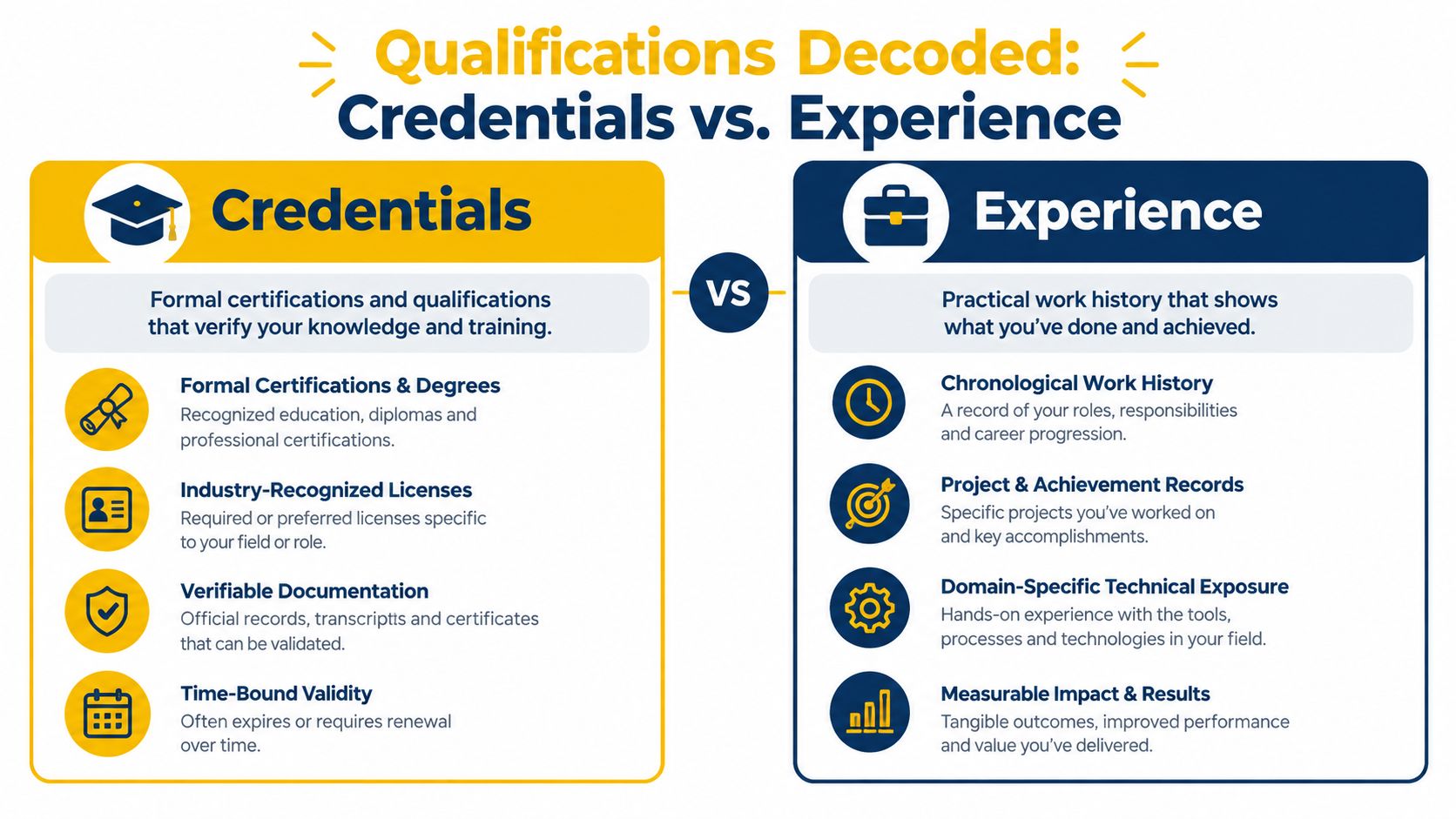
Credentials are formal records that verify education, training, licensing, or professional standing. A degree, license, academic award, or issued certificate can all function as credentials. The word emphasizes documented proof, not necessarily how effectively you perform a task today.
That distinction matters on a resume. “Credentials” fits a section that lists your Bachelor of Science, professional license, or recognized award. It's less precise if you're describing an ability developed through work but not formally assessed. The OECD distinguishes qualifications, which indicate completed education or training, from skills and competencies, which describe what people can do in practice. That difference makes “credentials” a useful term when verification is central.
For example, a software engineer might write:
Credentials: AWS Solutions Architect certification, Bachelor of Science in Computer Science
A finance candidate could list a CFA charter, while a career switcher might include the Google Data Analytics Certificate. A project manager could present the PMP as formal evidence relevant to a target role. The wording should reflect exactly what the issuing body awarded.

Where credentials fit
Use credentials in:
- A resume heading: “Academic Credentials” or “Professional Credentials”
- An application sentence: “My credentials include a PMP and formal training in agile delivery.”
- An interview answer: “That credential gave me structured training in cloud architecture, which I later applied when designing…”
Include the issuer, exact title, and current status. If a credential expires or requires renewal, add the date or renewal status. You can also add relevant credentials to Interview Pilot's profile inputs so its personalized suggestions reflect the evidence you're likely to discuss. Its mock interviews can help you explain what a credential taught you without presenting the document as a substitute for practical results. For context on how accreditation can support formal validation, review Premiere Education's accreditation information.
2. Experience
Experience describes capability developed through actual work, projects, placements, or sustained practice. Unlike credentials, it doesn't primarily answer, “What was formally awarded to you?” It answers, “Where have you applied your knowledge, and what responsibilities have you handled?”
That makes experience one of the most useful alternatives to “qualifications” when a job description emphasizes delivery. A software engineer might describe experience shipping products and maintaining production systems. An investment banking analyst could point to M&A work. A product manager might mention launching features, while a data scientist could describe building machine-learning models for production use.
On a resume, experience belongs in the employment and project sections, not only in a summary of qualifications. Write about the setting, responsibility, action, and outcome:
- Software engineering: “Built and shipped three customer-facing products across a five-year engineering career.”
- Investment banking: “Supported M&A analysis, valuation, and transaction execution as an investment banking analyst.”
- Product management: “Led feature discovery, prioritization, and launch planning for a high-growth digital product.”
- Data science: “Developed and deployed machine-learning models with engineering and analytics teams.”
The strongest experience statements show application rather than merely naming a job title. “Product manager with experience” is broad. “Product manager experienced in translating customer research into roadmaps and coordinating engineering launches” gives the reader something to assess.
Where experience fits
Use experience in:
- A resume heading: “Professional Experience” or “Relevant Experience”
- A cover letter: “My experience in financial modeling aligns with the analyst role.”
- An interview response: “In my previous role, I used that experience when…”
Prepare several stories from your work history before an interview. Include a challenge, your actions, and the result. Interview Pilot's profile inputs can help generate responses grounded in your background, while its Question Bank can help you practice behavioral prompts at the level of the role. If a technical example requires more or less detail, Copilot customization can help you adjust the explanation.
3. Competencies
Competencies describe the capabilities a person can apply consistently in a work setting. The term is broader than a single skill because it can combine knowledge, judgment, behaviors, and execution. “Python” is a skill. “Data pipeline development” can be a competency because it involves technical knowledge, problem-solving, testing, and reliable delivery.
The OECD defines skills or competencies as combinations of knowledge, attributes, and capacities that enable people to perform tasks successfully. That makes “competencies” useful when a role requires both what you know and how you use it. A product manager's competency might be product strategy. A finance candidate's could be financial modeling and valuation. A software engineer's could be system design, not just familiarity with a programming language.
Turn competencies into evidence
Avoid listing competencies as abstract traits. Pair each one with a behavior or result:
- System design: “Designed service boundaries, data flows, and failure handling for a distributed application.”
- Financial modeling: “Built integrated operating models and tested assumptions for transaction analysis.”
- Statistical analysis: “Selected appropriate statistical methods and translated findings for business stakeholders.”
- Stakeholder communication: “Aligned engineering, sales, and operations teams around launch priorities.”
This approach also helps candidates distinguish competencies from credentials. A certification verifies that you completed an assessment or program. A competency shows how you perform in a real context.
Practical rule: Use “competencies” when the employer cares about repeatable performance across related tasks, then name the behavior that proves it.
In a resume, use “Core Competencies” only if the entries are specific and relevant to the vacancy. In an application, write “My core competency is…” before giving a concise example. For targeted practice, Interview Pilot's competency-based interview questions and answers can help you prepare examples for technical and behavioral prompts. Add your main competencies to your profile so suggested responses reflect your actual strengths rather than generic descriptions.
4. Expertise
Expertise signals advanced, specialized knowledge. It's stronger than “familiarity” and usually implies that you've solved complex problems, made informed judgments, or guided others in a particular domain. Because the word carries weight, you should use it only when your evidence supports the claim.
A senior engineer might claim expertise in machine-learning systems architecture if they've designed, operated, and improved such systems. An investment banker could describe M&A expertise when transaction work has involved recurring responsibility across analysis and execution. A data scientist might highlight computer vision expertise, while a product manager could focus on B2B SaaS go-to-market expertise.
The best place for expertise is near the top of a resume, in a professional summary or a focused specialization section. It should then be demonstrated in the experience section. For example:
“Data scientist specializing in computer vision and production model development.”
That sentence identifies a field. The bullets below must show the work that justifies it, such as model deployment, evaluation, experimentation, or cross-functional implementation. Don't label every familiar tool as expertise. If you've used a platform briefly, “working knowledge” or “experience with” may be more accurate.
Explain depth without jargon
Expertise also needs audience awareness. A hiring manager may want the business significance, while a technical interviewer may ask about architecture, trade-offs, or failure modes. Prepare both versions of the same example:
- Concise: “My expertise is in designing machine-learning systems that can be monitored and maintained in production.”
- Technical: “I focus on feature pipelines, model serving, monitoring, and retraining controls.”
- Business-oriented: “I help teams move models from experimentation into dependable products.”
Use “expertise” in a summary, cover letter, LinkedIn profile, or interview answer when you can point to deep work. Interview Pilot's customization controls can help you adjust technical depth, and mock interviews can help you practice explaining specialist knowledge to different audiences. A strong expert answer teaches the listener what you know without assuming they already share your vocabulary.
5. Achievements
Achievements are completed outcomes that show the value of your work. This term shifts attention away from what you were assigned and toward what changed because of your contribution. It's one of the clearest alternatives to “qualifications” when you have measurable proof.
Engineering achievements might include reducing latency, improving reliability, or completing a system redesign. Sales achievements could include closing business or expanding an account. Product achievements may involve adoption or successful delivery. Data science achievements can include improving model performance, provided the comparison is accurate and supported by your records.
Write achievements with the STAR structure, meaning Situation, Task, Action, and Result. The result should be specific whenever you can verify it. For example:
- “Redesigned a service architecture, reducing latency by 40%.”
- “Closed $10 million in deals during the first year.”
- “Shipped a product feature adopted by more than 500,000 users.”
- “Improved model accuracy from 78% to 92%.”
These examples come from the supplied role scenarios, but you should use your own documented outcomes. Never add a percentage, revenue figure, user count, or comparison just to make a bullet sound stronger. An unsupported number weakens credibility.

Where achievements fit
Use achievements in:
- Resume bullets: Begin with a strong action verb and describe the result.
- A cover letter: Select one outcome that connects directly to the vacancy.
- Interview answers: Explain the context, your contribution, and what improved.
An achievement is not the same as a duty. “Managed a data pipeline” describes responsibility. “Reduced pipeline runtime by 35% by redesigning the processing workflow” describes an outcome, if you can substantiate it. Interview Pilot's STAR interview answer examples can help you turn resume evidence into structured responses. Add your strongest outcomes to your profile and practice saying them naturally, without reciting a list of wins.
6. Certifications
Certifications are credentials awarded by an external organization after defined training, assessment, or eligibility requirements. The word is narrower than “credentials.” Every certification is a credential, but not every credential is a certification. A university degree, for example, is generally described as an academic credential rather than a professional certification.
Use this term when an issuing body formally validates specialized knowledge. Examples include the AWS Certified Solutions Architect for cloud engineers, the CFA designation for investment professionals, the Google Cloud Professional Data Engineer certification, the Certified Kubernetes Administrator, and the PMI Project Management Professional certification.
On a resume, create a dedicated Certifications section when these awards matter to the role. List the exact name, issuer, and completion or renewal details. If the certification is active only for a defined period, show its current status rather than implying it remains valid indefinitely.
A certification can support a candidacy, but it doesn't automatically prove mastery in every work situation. Pair it with evidence of application:
“Certified Kubernetes Administrator. Used Kubernetes to deploy, monitor, and troubleshoot containerized services.”
That sentence separates formal validation from practical capability. It also gives an interviewer a natural direction for follow-up questions.
Choose certifications selectively
Don't list every course completion under “Certifications.” A short course, badge, or workshop may belong in “Professional Development” unless it represents a recognized certification with clear assessment or issuing authority. Read the job description carefully, especially in technical, financial, and regulated fields.
In an interview, explain why the certification matters to the position. “I completed the certification” is weaker than “The certification strengthened my understanding of cloud security, and I applied that knowledge when reviewing deployment permissions.” Interview Pilot can help you rehearse that connection through mock interviews and role-specific prompts. Add current certifications to your profile, and check renewal status before you apply.
7. Skills
Skills are practical abilities used to complete tasks, operate tools, or solve problems. They're usually the clearest word for a resume because employers and applicant tracking systems often look for specific terms such as programming languages, platforms, methods, degrees, job titles, and certifications. Indeed explains that ATS platforms commonly extract and compare these categories against job-description language in its ATS resume guidance.
Skills can be technical, functional, or interpersonal. Examples include Python, SQL, system design, Excel modeling, financial statement analysis, machine learning, statistical analysis, product roadmapping, stakeholder management, communication, and problem-solving. The right wording depends on the vacancy. “Data analysis” is broad, while “SQL querying, Tableau dashboard development, and statistical testing” gives a clearer signal.
A skills section helps with scanning, but it shouldn't carry the whole resume. Show where and how you used each important skill in your experience or project bullets. A useful pattern is:
- Skill: Python
- Context: Data pipeline development
- Evidence: Automated a recurring data transformation workflow and validated its outputs
“Skills” tells the reader what you can do. Your project and experience bullets show whether you can do it in a relevant setting.
Use proficiency labels carefully. “Expert” can overstate your ability if you can't explain trade-offs or demonstrate independent work. “Proficient” works best when you can define the level through projects, assessments, or sustained use.
For more guidance on selecting language, see this resource on skills as a resume synonym for qualifications. Interview Pilot can help you practice skill-based questions from its question bank, adjust response depth with Copilot customization, and prepare explanations for technical interviews. If you include the supplied video in your page layout, place it after the explanatory content rather than directly beside another image.
8. Track Record
A track record describes a repeated pattern of results, reliability, or successful delivery over time. It's broader than a single achievement. One successful launch is an achievement. Several successful launches with dependable delivery may form a track record.
This term works especially well in a resume summary, cover letter, executive profile, sales application, or interview answer. A product manager might write about a track record of delivering launches on schedule. A sales professional could describe sustained client retention or pipeline development. An engineer might focus on dependable systems work, incident reduction, or repeated delivery across products.
Use evidence that shows both consistency and relevance:
- “Track record of delivering product launches on schedule across cross-functional teams.”
- “Track record of retaining clients through structured account planning and responsive support.”
- “Track record of building production data systems with clear monitoring and documentation.”
- “Track record of leading transaction work from analysis through completion.”
If you have verified metrics, include them. A candidate might cite successful launches, promotions, retention, satisfaction ratings, pipeline value, or system availability. Don't borrow a metric from a company's product page and present it as your personal result. The proof must relate to your contribution and be explainable in an interview.
Show the pattern
A track record becomes credible when you give more than one connected example. Select examples from different projects or periods that demonstrate the same strength. For instance, a product manager could discuss one launch, one recovery from a delivery risk, and one process improvement. Together, those stories show a pattern more effectively than a single claim of reliability.
Use behavioral questions to reveal the pattern naturally. Interview Pilot's mock interview practice and profile-based suggestions can help you prepare concise proof stories without sounding boastful. The aim isn't to repeat “I have a strong track record.” It's to let the interviewer recognize the pattern from specific evidence.
8-Term Qualifications Comparison
| Item | 🔄 Implementation complexity | ⚡ Resource requirements | 📊 Expected outcomes | 💡 Ideal use cases | ⭐ Key advantages |
|---|---|---|---|---|---|
| Credentials | Moderate, formal processes, verifiable records | High time/cost (education, exams, renewals) | Verifiable proof of qualification for hiring filters | Regulated roles, baseline screening, profile foundations | Objective, widely recognized, easily verifiable |
| Experience | Variable, easy to document, hard to accumulate | High time investment (years, projects) | Demonstrates applied skills, growth, and context for stories | Behavioral interviews, role fit, mid–senior hiring | Authentic, context-rich, shows progression |
| Competencies | Low–moderate, listable but validation varies | Moderate (training, assessments) | Job-aligned skills and ATS keyword fit | Skill-based screening, technical assessments | Actionable, directly tied to job requirements |
| Expertise | High, deep specialization and mastery | Very high (years, focused practice, advanced projects) | Differentiation for senior/complex roles, thought leadership | Senior hires, technical leadership, niche roles | Commands premium opportunities and credibility |
| Achievements | Moderate, requires measurable outcomes and attribution | Moderate (project effort, measurable metrics) | Concrete evidence of impact suitable for STAR stories | Behavioral interviews, promotions, impact-focused roles | Quantifiable proof of value and results |
| Certifications | Moderate, exam-based and time-bound processes | High (study time, fees, renewal cycles) | Third-party validation of current domain knowledge | Certification-required roles, compliance-heavy jobs | Standardized, externally verified proof of competence |
| Skills | Low, straightforward to list; proving may require demos | Low–moderate (practice, short courses, tools) | Testable abilities tied to job tasks and performance | Technical interviews, practical assessments, entry roles | Easily demonstrable and rapidly developable |
| Track Record | High, built over sustained periods with consistent outcomes | Very high (long-term performance, endorsements) | Predictive of future reliability and sustained impact | Executive hires, high-stakes roles, client-facing positions | Strongest evidence of consistent success and low hiring risk |
Use the Most Precise Alternative
The best synonyms for qualifications aren't interchangeable labels. Each one points to a different kind of evidence.
Use credentials when you're referring to documented academic or professional proof. Choose certifications when an external body has assessed or formally issued the credential. Use skills for practical abilities with tools, methods, or tasks. Choose competencies when the role requires a broader combination of knowledge, judgment, behavior, and execution.
Use experience for applied work and responsibilities. Choose expertise when your knowledge is deep and specialized. Use achievements for specific outcomes, particularly when you can verify the result. Choose track record when several examples show consistent performance over time.
The OECD data supports treating these terms as related but distinct. Its Skills for Jobs framework assesses more than 150 job-specific knowledge, skills, and abilities across 40 OECD and emerging economies, while separately examining qualification mismatch. Its analysis finds that approximately 35% of workers are mismatched by qualification, including about 17% who are overqualified and 19% who are underqualified. That distinction reinforces the practical point: a formal qualification doesn't always describe the capability a job requires. Use wording that helps the employer understand both the evidence you hold and the work you can perform. OECD's Skills for Jobs framework3/en/pdf) provides the broader context for separating qualifications from skills and competencies.
A simple application checklist
Before submitting a resume or application, check four things:
- Match the job description: Mirror the employer's category when it accurately describes your evidence.
- Use a natural location: Put skills in a skills section, certifications in a certification section, and achievements in experience bullets.
- Add proof: Follow every broad claim with a project, responsibility, result, issuer, date, or work sample.
- Rehearse the explanation: Prepare a concise answer for how each important term connects to your actual work.
Interview Pilot can serve as an optional preparation aid. Its profile and document inputs help shape responses around your resume, while mock interviews and personalized suggestions help you turn formal proof, practical ability, and measurable results into clear answers. The wording on your resume gets attention, but the explanation you give in the interview establishes whether that wording is credible.
Interview Pilot offers profile-based response suggestions, guided mock interviews, and a searchable question bank for technical and behavioral preparation. Visit Interview Pilot to practice explaining your credentials, skills, achievements, and experience with answers customized to your target role.
Topics
synonyms for qualifications
resume writing
job applications
resume keywords
career development
Continue reading

Career
7 Skills Synonym Resume Headers for Every Career Stage
Explore 7 skills synonym resume headers, with examples and practical guidance for students, career changers, specialists, and senior professionals.
September 30, 2026
16 min read

Career
How Many Jobs Should You Apply to Per Day?
Set a realistic application target based on suitable openings, available time, and application effort instead of following a universal daily quota.
October 4, 2026
3 min read

Career
How to Track Job Applications With a Simple Spreadsheet
Build a useful application tracker with clear statuses, next actions, document versions, and a weekly review that does not become busywork.
October 4, 2026
4 min read