









Career
Experienced Nurse Resume: How to Write It
Write an experienced nurse resume with a clear section order, quantified clinical bullets, specialty keywords, and ATS-safe formatting for 2026.
Interview Pilot Editorial Team
Updated November 3, 2026
16 min read
An experienced nurse isn't competing with new graduates on potential. You're competing with other seasoned nurses on proof. A hiring manager needs to see, in seconds, what kind of patients you've handled, at what acuity, under what license, and what changed because you were there. If your experienced nurse resume reads like a duty list, it won't do that work, no matter how strong your shifts were.
Why an Experienced Nurse Resume Is Read Differently
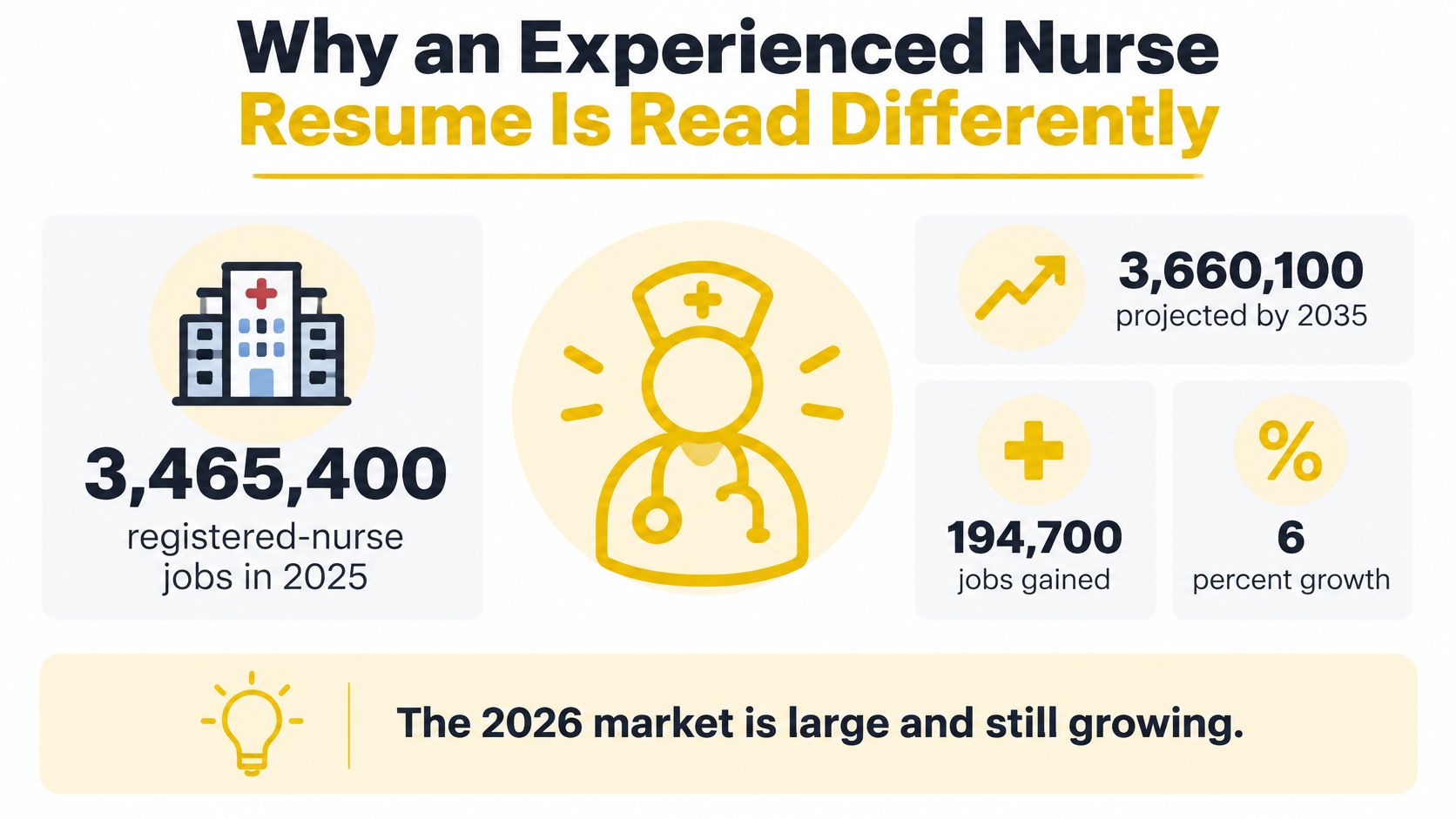
The U.S. Bureau of Labor Statistics reported 3,465,400 registered-nurse jobs in 2025, projected 3,660,100 by 2035 for a gain of 194,700 jobs, or 6%, with approximately 180,800 registered-nurse openings per year during 2025 to 2035 from growth and workers leaving the occupation. That is a large, replacement-heavy market. Many openings exist because experienced staff leave, so managers compare experienced candidates against each other, not against a generic idea of a nurse.
Four signals have to be obvious on the first screen.
- Years and setting: Nine years in adult ICU is different from nine years split across clinic, float pool, and long-term care.
- Population and acuity: Ventilated post-surgical patients, telemetry step-down, or stable rehab residents tell a manager what you can safely take on day one.
- Current license and certifications: Your RN license, jurisdiction, and credentials such as CCRN or CEN confirm you're eligible before anyone reads your bullets.
- One measurable result: A falls trend, medication discrepancy reduction, audit score, or orientation time improvement separates experience from tenure.
The Line That Proves Nothing
"Provided patient care on a busy unit" could belong to almost anyone. It names no census, no ratio, no technology, and no outcome. Contrast that with a line naming a 32-bed medical-surgical unit, night charge responsibility, the EHR used, and a medication or falls result. The second line gives a manager scale and risk. The first gives them a shrug.
Setting matters too. The same nurse should emphasize discharge throughput for a hospital role, visit volume and autonomy for home health, resident acuity for long-term care, and population-level follow-up for public health. If you're applying internationally, state credentials, licensure status, and competencies in terms a foreign employer can interpret without guessing at your system. Nurses who want to think more broadly about how their experience signals value can strengthen your UK nursing career by treating professional value as something documented, not assumed.
Don't polish sentences yet. Get the section order right first, because a well-written bullet buried on page two rarely rescues a vague first screen.
The Section Order That Gets Read First
Draft the headings before you write a single bullet. For most experienced nurses, one to two pages is enough. Move toward two pages only when leadership, precepting, multiple specialties, or committee work needs the room. A longer resume that repeats bedside tasks doesn't look senior. It looks unedited.
Licensure belongs near the top because it's a legal gate, not a detail. The National Council of State Boards of Nursing licensure statistics counted 5,328,873 active registered-nurse licenses as of December 31, 2022, including 386,331 in New York and 380,867 in Texas, compiled through its national database and Nursys system. In a pool that large, precise presentation matters. List license type, jurisdiction, active status, and expiration or renewal information, and keep certifications on a separate line so nobody confuses CCRN with the license itself. Don't imply portability across states or countries unless you've confirmed it, and distinguish active, compact, inactive, provisional, and expired credentials clearly.
| Block | What belongs there | Space | Placement |
|---|---|---|---|
| Contact header | Name, phone, city and state, email, optional LinkedIn | One line; no photo or full address | Top |
| License line | RN, jurisdiction, active status, expiration; compact only if true | Two lines | Directly under contact |
| Certifications | BLS, ACLS, PALS, CCRN, CEN or other current credentials, with year | Two to four lines, separate from the license | Under the license line |
| Professional summary | Years, specialty, patient population, one outcome | Three to four lines | Before skills |
| Clinical skills | Eight to twelve truthful specialty and EHR terms | Short scannable list | After the summary |
| Experience | Reverse-chronological roles; two to four outcome bullets on recent jobs | Most of pages one and two | Core of the resume |
| Education | Degree, school, year; omit high school | A few lines | After experience |
| Optional evidence | Precepting totals, QI committee, publications, languages | Only when the posting values them | Inside roles or at the end |
What Goes in Each Block
Your header needs name, phone, city and state, email, and a simple LinkedIn URL if you use one. Leave off your photo, full street address, and date of birth. They add risk and no clinical information.
The professional summary is three or four lines, not a biography. Name your years, specialty, population, and one result. For example, a senior ICU nurse might write that she's an RN, CCRN with 9 years in a 24-bed adult ICU, manages ventilated patients on vasoactive drips, and co-led a sepsis bundle project that moved completion from the recorded baseline to the unit target. If you can't verify a figure, label it as a baseline or range instead of inventing a percentage.
Keep clinical skills to eight to twelve truthful terms tied to the target role. A wall of every task you've ever performed makes screening harder, not easier. In experience, work reverse-chronologically, put your strongest two or three outcomes first under recent roles, and cut older jobs down to title, dates, unit, and one line. Education is degree, school, and year. Add committees, publications, or languages only when the posting values them.
Type the headings first and fill them in order. If the license line and summary aren't finished, bullet polishing is premature.
How to Write Outcome Bullets from Real Shifts
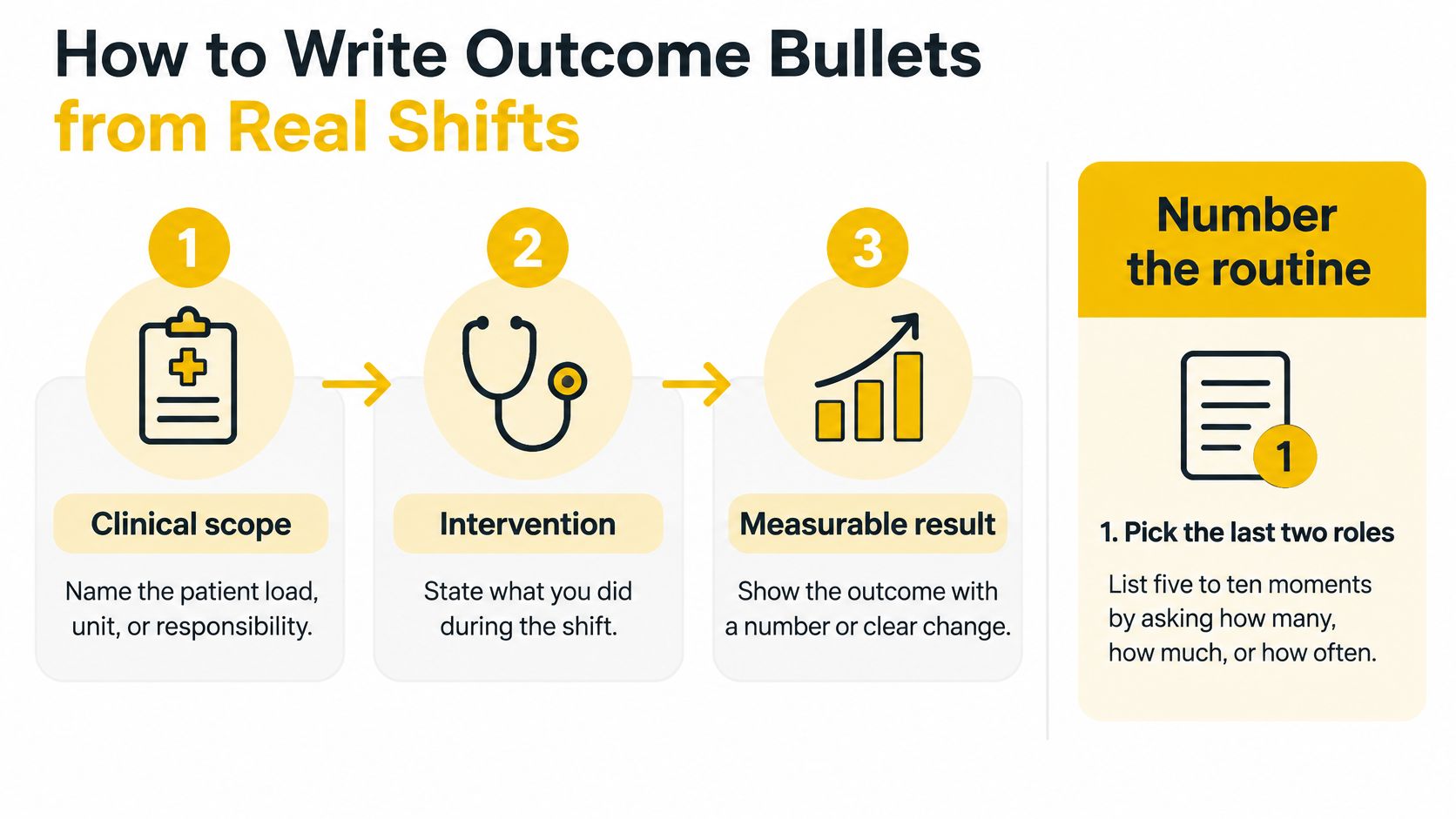
Every strong bullet follows one evidence chain: clinical scope, intervention, measurable result. Scope tells the reader the size and acuity of the work. Intervention tells them what you did. Result tells them why it mattered. Without scope, a result floats. Without a result, a task is just a task.
The diagram below breaks that chain into its three parts before you start rewriting.
A Five-Step Routine for Real Shifts
- Pick your last two roles: List five to ten moments by asking how many, how much, how long, and how often. Admissions per shift, patients per assignment, new nurses precepted, audits completed.
- Cut to the target specialty: Keep only items that speak to the unit you're applying to. Telemetry evidence doesn't lead an ICU application.
- Write the formula: Use Action plus clinical context plus scale plus outcome. Start with a verb you can defend, such as led, co-led, precepted, audited, or revised.
- Order by strength: Put the best two or three bullets first under each recent role. Shorten anything older than about ten years.
- Label uncertainty: If the exact figure is gone, use a range or a clearly labeled baseline. Never include a patient name, room number, or case detail that could identify someone.
The Yale School of Nursing resume guide recommends accomplishment statements that explain what was done, why it was done, and what happened as a result, with statistics, percentages, and quantities wherever possible. That's the same chain. It also matches how charge nurses talk about a good shift, in terms of census, acuity, and what got fixed.
Adapt these models with your own numbers. Don't copy them blindly.
- Medication safety: Led a medication-reconciliation redesign on a 32-bed medical-surgical unit, reducing discharge discrepancies by 28% over six months.
- Precepting: Precepted 6 new graduate nurses on a telemetry floor and shortened average orientation by two weeks against the unit baseline.
- Audit work: Co-led a barcode-medication audit across two units; compliance moved from the recorded baseline to the unit target.
Defensible measures include typical census, nurse-to-patient assignment, admissions per shift, conditions managed, devices such as ventilators or telemetry, the EHR name, audit scores, fall or readmission trends, and discharge-cycle time. If you want more phrasing patterns before you draft, work through these resume bullet examples for outcome-led writing and then replace every placeholder with your unit's real scale.
Watch this walkthrough on turning shift work into bullet evidence, then apply the check below to your own draft.
One caution matters. Don't claim a hospital-wide HCAHPS or infection-rate win you didn't own. If you contributed to a team result, say co-led or contributed and name your piece. A candid bullet about your actual intervention beats a sweeping claim a manager will probe in the first interview question.
End with a simple check for each recent role. Does it show acuity, tools, and one result? If a role shows only tasks, it's not finished.
Match Specialty Language Without Keyword Stuffing
Tailor your resume by matching the vacancy's requirements to evidence you can support. Sort the posting into four fields: required license, required certifications, clinical specialty, and technical or workflow terms. Use accurate terms in your summary, skills list, and selected bullets. If a qualification or tool does not reflect your experience, leave it out, even if the posting repeats it.
The Four-Field Pass on Three Postings
An ICU posting may ask for RN, CCRN, ventilator care, titration, arterial lines, and Epic. Include the terms that match your credentials and practice, then connect them to the scope of your work and the interventions or results you can document. An emergency posting may emphasize triage, trauma stabilization, CEN, and patients per hour. A home-health or long-term-care role may instead call for OASIS or MDS documentation, wound care, and visit or resident volume.
For an outpatient clinic application, bring care coordination and medication safety forward. Critical-care language that does not fit the clinic role can obscure your relevant experience. A resume should show both specialty fit and the evidence behind it, not just repeat the posting's vocabulary.
The SUNY Empire nursing resume guidance recommends reverse-chronological experience, role-specific skills, job-description keywords, bullet formatting, tailoring for each application, and careful proofreading. Use those practices to make your relevant qualifications easy to find without stuffing the page with repeated terms.
Formatting That Survives Screening
Use a single column, standard headings such as Experience, Education, Licenses, and Skills, consistent month and year dates, and exact license names. Keep tables, text boxes, icons, and graphics out of the submitted file because they can interfere with parsing without adding clinical evidence. A clean layout helps the resume communicate its evidence chain: your scope, what you did, and the result.
Credentials need the same precision. Name the certifying body and year when the posting requests verification. Leave expired credentials off unless you clearly label a renewal in progress. For completed training, make the education entry clear enough for an employer to check, and consider how verifiable credentials for training programs are structured.
After the software pass, read the resume as a hiring manager would. Remove duplicated keywords, claims unsupported by your experience, and details that do not match the application form. If a line sounds written for a parser rather than a nurse manager, revise it to show a specific qualification or piece of evidence.
Practical rule: Keep one master resume with your full experience, then duplicate and tailor it for each posting. A single generic file can bury the specialty evidence that makes you a fit.
Show a Career Break or Charge Role Honestly
A manager reviewing a return-to-practice resume is asking one question: can this nurse practice safely now? An unbroken chronology doesn't answer that. Recent, verified competence does.
Re-entry isn't rare. The NCSBN nursing workforce recovery report notes that experienced nurses have re-entered the workforce while warning the improvement may be temporary as many baby-boomer nurses approach retirement in 2027, and it describes a labor market where more than one million U.S. RNs held active licenses but were not employed as RNs in May 2025. You're not an exception that needs hiding. You're a large, known part of the workforce.

Build a Skills-Refresh Block Instead of Squeezing Dates
Add a short block near your certifications with the evidence that answers the safety question: a recent refresher or simulation course, license reactivation, current BLS or ACLS status, supervised clinical hours, updated EHR training, and the date of your most recent hands-on patient care. That block connects prior experience to present readiness far better than compressed dates that imply uninterrupted practice.
Name the type of break only as far as the dates require. A family-care break, nonclinical healthcare work, and time away after burnout are different paths, and a single neutral line can distinguish them. Don't disclose diagnoses, don't share protected personal detail, and don't blame a former employer. If your break involved parental leave and you're planning the sequence of return, reviewing timelines for returning from parental leave can help you set realistic dates for refresher training and applications. For the interview conversation itself, prepare a short, matter-of-fact explanation using this guidance on what to say about a gap in your resume, so your spoken account matches the page.
Quantify Charge and Senior Bedside Influence
Charge work is workforce value, and hospitals feel its absence. The AACN nursing shortage fact sheet cites 2026 NSI figures listing an acute-care RN vacancy rate of 8.6%, hospital RN turnover of 17.6%, and 56 to 102 days to recruit an experienced RN. A nurse who precepts well, runs reliable handoffs, covers charge shifts, or co-leads a falls project reduces that pressure. Say so with evidence.
Write the intervention, the scope, who else was involved, and the measured change. Label a team result as a team result. If no approved percentage exists, use defensible scale instead: unit size, charge shift frequency, committee scope, or number of trainees. "Charge nurse two shifts weekly for a 24-bed step-down unit, coordinating admissions and staffing assignments" is credible. A borrowed hospital-wide metric isn't.
Proofreading Checks Before You Hit Submit
Do this pass after the content is finished, not while you're still drafting. You're checking accuracy now, not style.
Start with dates. Read your license expiration, certification dates, and employment months against the application form so both documents match exactly. A resume that says ACLS is current while the form shows an expired date creates a problem you didn't need.
Next, audit every number. Each figure should be a real count, a labeled range, or a clearly marked baseline. Delete any patient name, room number, or case detail that could identify someone, even if it makes a bullet more vivid. Confidentiality isn't negotiable for the sake of a stronger sentence.
The Top-Half Test
Check that recent roles carry the outcome bullets and older roles stay short. Then scan your verbs. If every bullet starts with the same word, swap in led, precepted, audited, coordinated, or revised, but only where that verb is true. Inflated verbs get tested in interviews.
Name the file with your name and the role, and follow the portal's requested file type instead of assuming PDF is always wanted. Finally, hand the top half to one clinician outside your unit and ask them to say back your specialty, your license, and one result. If they can't, your first screen is still too vague.
A clean experienced resume is specific, current, and no longer than the evidence supports.
Rehearse the Stories Behind Your Best Bullets
Pick one live posting, duplicate your master resume, and run the four-field tailor on that copy before you send it. Then stop editing and start talking. A resume gets you the conversation. It doesn't survive it for you.
Choose your three strongest bullets and practice each one aloud in about a minute. Cover the situation, what you personally did, the scale, and the result, including what was a team effort. That structure is exactly what a charge nurse or manager will probe, because they're testing whether the bullet reflects your judgment or just your unit's good quarter. Working through common nursing job interview questions alongside your bullets helps you hear where a story sounds thin before an interviewer does.
If you want structured practice, one practical next step is to build a profile by importing your resume or the job posting and attaching your documents, then use the available resume and interview guides to rehearse against that specific role. You still own every claim. A practice tool can sharpen wording and timing, but it can't invent outcomes you didn't produce, and it shouldn't.
Do one thing today. Finish the license line, write your top three bullets using scope, intervention, and result, and rehearse those three stories out loud once. That's a stronger application than a week spent reformatting a duty list.
Your bullets are only as convincing as the stories you can tell behind them, so use Interview Pilot to import your finished resume and target posting, attach your documents, and rehearse answers suited to that role before the live interview. Its Interview Copilot can suggest answers during a live online interview based on your resume, target role, and job description, while its guides help you keep practicing in your own words. Bring your three strongest nursing outcomes, practice them until they sound natural, and walk in ready to defend every line.
Topics
experienced nurse resume
RN resume
nursing resume tips
ATS resume
nurse career
Continue reading

Career
7 Skills Synonym Resume Headers for Every Career Stage
Explore 7 skills synonym resume headers, with examples and practical guidance for students, career changers, specialists, and senior professionals.
September 30, 2026
16 min read
Career
Resume Systems Administrator Guide for 2026
Build a resume systems administrator hiring managers trust with skill domains, proof bullets, seniority examples, and 2026 formatting tips.
November 3, 2026
16 min read

Career
Teamwork Example for Interviews: Sample Answers and a Simple Structure
Need a teamwork example for your interview? See how to pick a story, structure it with STAR, and use sample answers for students, career changers and pros.
November 3, 2026