









Career
Resume Systems Administrator Guide for 2026
Build a resume systems administrator hiring managers trust with skill domains, proof bullets, seniority examples, and 2026 formatting tips.
Interview Pilot Editorial Team
Updated November 3, 2026
16 min read
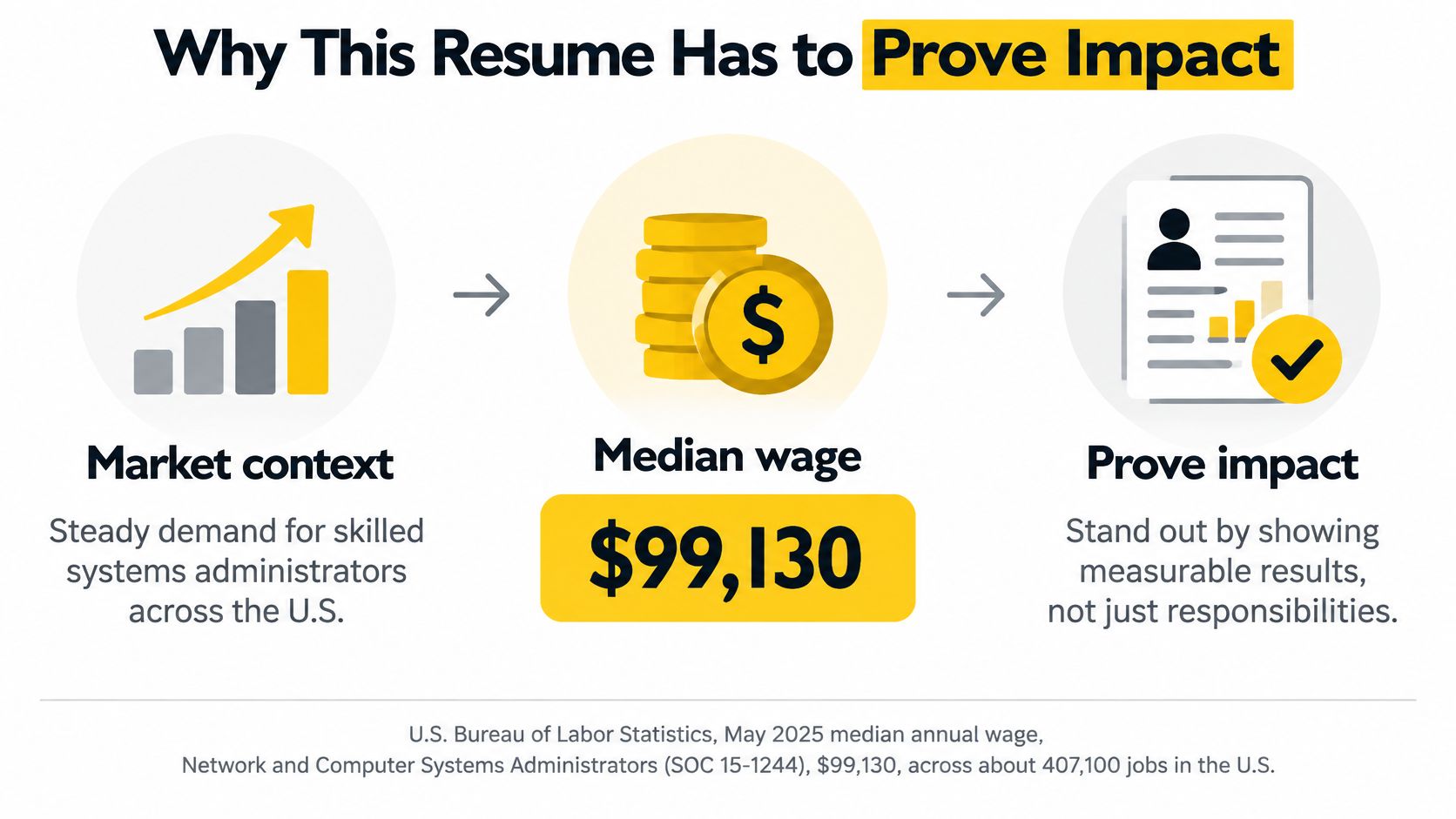
$99,130 was the May 2025 median annual wage for network and computer systems administrators, according to the U.S. Bureau of Labor Statistics. That's compensation for keeping an organization operational, not for recognizing a long list of infrastructure products. Your systems administrator resume needs to show what you controlled, what could have failed, and what changed because of your work.
Why This Resume Has to Prove Impact
The U.S. Bureau of Labor Statistics occupational outlook places this occupation at approximately 323,600 U.S. jobs in 2025 and projects a 4% employment decline between 2025 and 2035, while still projecting approximately 13,400 openings annually, primarily through replacement hiring. Those openings represent a substantial opportunity, but candidates must explain their contribution as infrastructure responsibilities evolve.
A hiring lead needs evidence of both classic administration and current operational practice. Active Directory, patching, backups, and networking still matter. So do automation, security controls, cloud operations, and monitoring, provided you can connect them to something you delivered.
The BLS technology occupations overview lists a bachelor's degree as the typical entry-level education for network and computer systems administrators. If you followed another route, make your practical qualifications easy to evaluate through relevant certifications, increasing responsibility, and defensible achievements. Don't spend the summary apologizing for your education.
Hiring-side test: Can a reviewer identify the environment you supported, the control you changed, and the operational consequence without asking you to translate the bullet?
Build your evidence before choosing a template:
- Map the domains. Identify where you can prove infrastructure, identity, automation, and resilience work.
- Translate the posting. Match its recurring requirements to actual responsibilities and outcomes.
- Show your level. Distinguish assistance, independent execution, design decisions, and accountability.
- Calibrate modern skills. Separate operating a cloud service from automating or designing it.
Your first job isn't selecting a layout. It's deciding which operational outcomes you can prove.
Four Domains Hiring Posts Actually Score
| Domain | Posting signal | List only if used | Proof to attach |
|---|---|---|---|
| Infrastructure and operating systems | Linux administration | Named Linux distribution and Windows Server version | Server, site, or endpoint count plus a patch or availability result |
| Identity and access | Active Directory administration | Directory, least privilege, Group Policy, or federation | Accounts provisioned, reviews closed, or standing access reduced |
| Virtualization | VMware administration | Hypervisor and cluster actually operated | Host or VM count and a maintenance outcome |
| Troubleshooting and incidents | Diagnostic ownership | Ticketing tool and severity ownership | Recovery-time change and your incident responsibility |
| Communication and documentation | Clear handoffs and operational records | Runbooks, change notes, stakeholder updates | Repeat incidents reduced or handoffs standardized |
| Problem-solving | Recurring-fault resolution | Root-cause method actually used | Ticket class eliminated or investigation time saved |
Read these rows as evidence categories, not separate skills inventories. In CoderSalary's analysis of sampled systems-administrator postings, Linux appeared in 27%, Active Directory in 26%, VMware in 16%, troubleshooting in 33%, and communication in 39%. Those are observations about the sampled postings, not universal screening thresholds.
The practical distinction is between platform recognition and operational control. Someone can recognize VMware terminology without having planned host maintenance, checked capacity, or handled a failed migration. A credible resume makes that difference visible.
Group the evidence into operational domains
Infrastructure and operating systems covers the systems themselves, including virtualization. Name the distribution, server release, or hypervisor you administered, then establish scope. A mixed environment deserves more explanation than an undifferentiated Windows/Linux label.
Identity and access concerns who can reach those systems and under what conditions. Account creation is legitimate administration work, but it doesn't automatically establish least-privilege expertise. Evidence might involve access reviews, approval workflows, group membership changes, or federation troubleshooting.
Automation and configuration management concerns repeatability. A script becomes stronger resume evidence when you explain its input, validation, failure handling, and operational use. Don't bury this work inside a general infrastructure row if the employer repeatedly requests scripting or configuration management.
Monitoring, incident response, and resilience combines detection, diagnosis, recovery, and verification. Troubleshooting and communication belong here when they helped restore service or coordinate a safe change. A status update becomes meaningful infrastructure work when it helped application owners make a decision.
Prioritize requirements rather than product names
Mark each important requirement as direct evidence, adjacent evidence, or no evidence. Put direct matches near the top of the relevant role. Keep adjacent experience accurately labeled, and remove unsupported tools rather than trying to compensate with more keywords.
The guide to listing skills on a resume can help organize that skills block, but the experience section must carry the proof.
An unsupported availability percentage is weaker than a specific explanation of how you tested recovery and handled failed backups.
Use environment scale, action, measurable result as the default proof pattern. Where a formal performance metric doesn't exist, describe a verifiable operational state: a tested restore, an approved access review, a deployed runbook, or a completed maintenance cycle. Avoid vague responsibility for uptime when you can name the control you operated.
How to Turn a Job Post Into Bullets
A job post listing Windows Server, Linux, Active Directory, VMware, DNS and DHCP, PowerShell, and backup verification is asking for evidence of operational control across several domains. Start by matching those requirements to work you can support. The goal is to show what you controlled, at what scale, and with what result, not to copy the posting into a summary.
Use this workflow to connect the posting to your experience.
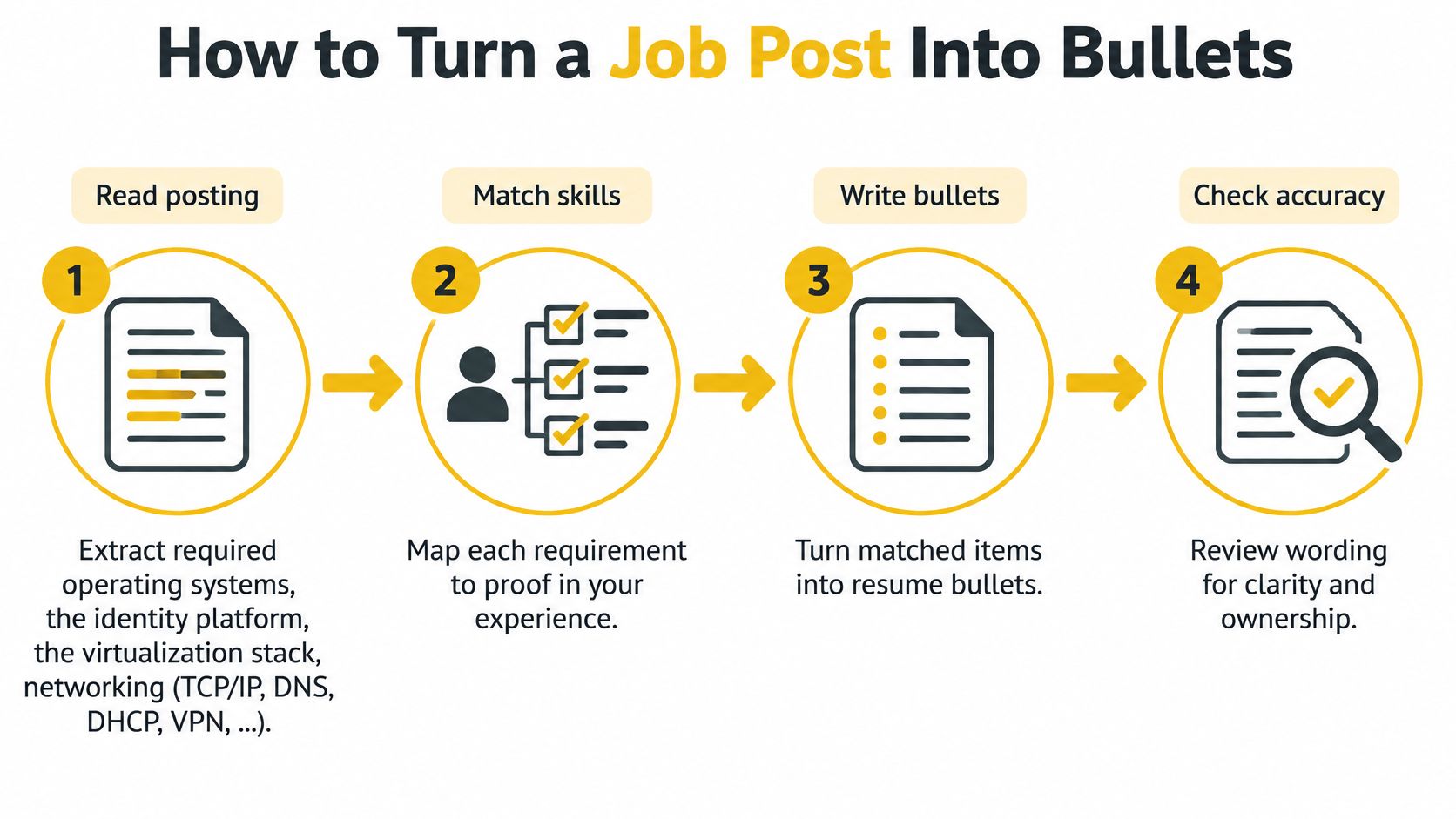
Extract and match before drafting
Separate the technical requirements. Sort operating systems, identity services, virtualization, networking, automation, and reliability duties into distinct groups. In the example posting, DNS and DHCP belong under networking, while backup verification belongs under resilience. Mark which requirements are mandatory and which are desirable.
Build a matching skills block. Use the posting's terminology only when it describes your experience. You might group Windows Server and Ubuntu under infrastructure, Active Directory and Group Policy under identity, and PowerShell under automation. If the posting names Ansible but you have only used PowerShell, leave Ansible out. A keyword without supporting work can raise doubts rather than improve a match.
Pair each major match with evidence. A tool list identifies exposure; a bullet shows how you used it. For example, suppose you patched a mixed Windows and Linux estate using PowerShell validation. Report how many servers the work covered and how failed maintenance windows changed over a defined period, if you can substantiate both. The system-administration guidance from iMocha can help identify relevant skills, but your bullet should describe your own work and evidence.
Use records you can explain, such as maintenance logs, ticket reports, monitoring dashboards, or backup reports. Someone else's measurements do not become yours because they appear in a strong sentence.
Choose measurements you can defend
Define the measurement. For patching, state what counted as a failed maintenance window and the period compared. For incident response, separate acknowledgement time from restoration time. For backups, distinguish completed jobs from successful restore tests. These distinctions show whether the result reflects a real improvement or only a change in reporting.
Use scope to explain experience. If a posting asks for more tenure than you have, keep dates accurate and exclude unrelated work from your systems-administration experience. Show which systems you handled independently, what you escalated, and how your responsibilities developed. The resume bullet examples can guide sentence structure; replace their substance with evidence from your own work.
Check coverage, then remove weak claims. Review security, storage, virtualization, networking, command-line administration, troubleshooting, SELinux where relevant, and automation. Treat these as prompts to find missing proof, not permission to claim unfamiliar skills. For cloud work, name the service and the task you performed. For automation, distinguish a script you ran from one you built, maintained, or deployed.
Before keeping a bullet, check that it identifies the task, environment, and your contribution. A supported operational result is stronger than a broad claim about uptime. If you have no defensible measure, describe a verifiable control instead, such as a tested restore, documented change, or completed maintenance cycle.
For another perspective on presenting the resume, use the video alongside your evidence worksheet.
Finish with a posting-specific skills block and experience bullets that prove the relevant work. Avoid repeating the same keywords in the summary. If a frequently requested requirement has no supporting evidence, treat it as a preparation gap or a role-fit decision, not a wording problem.
Bullets That Fit Junior Mid and Senior
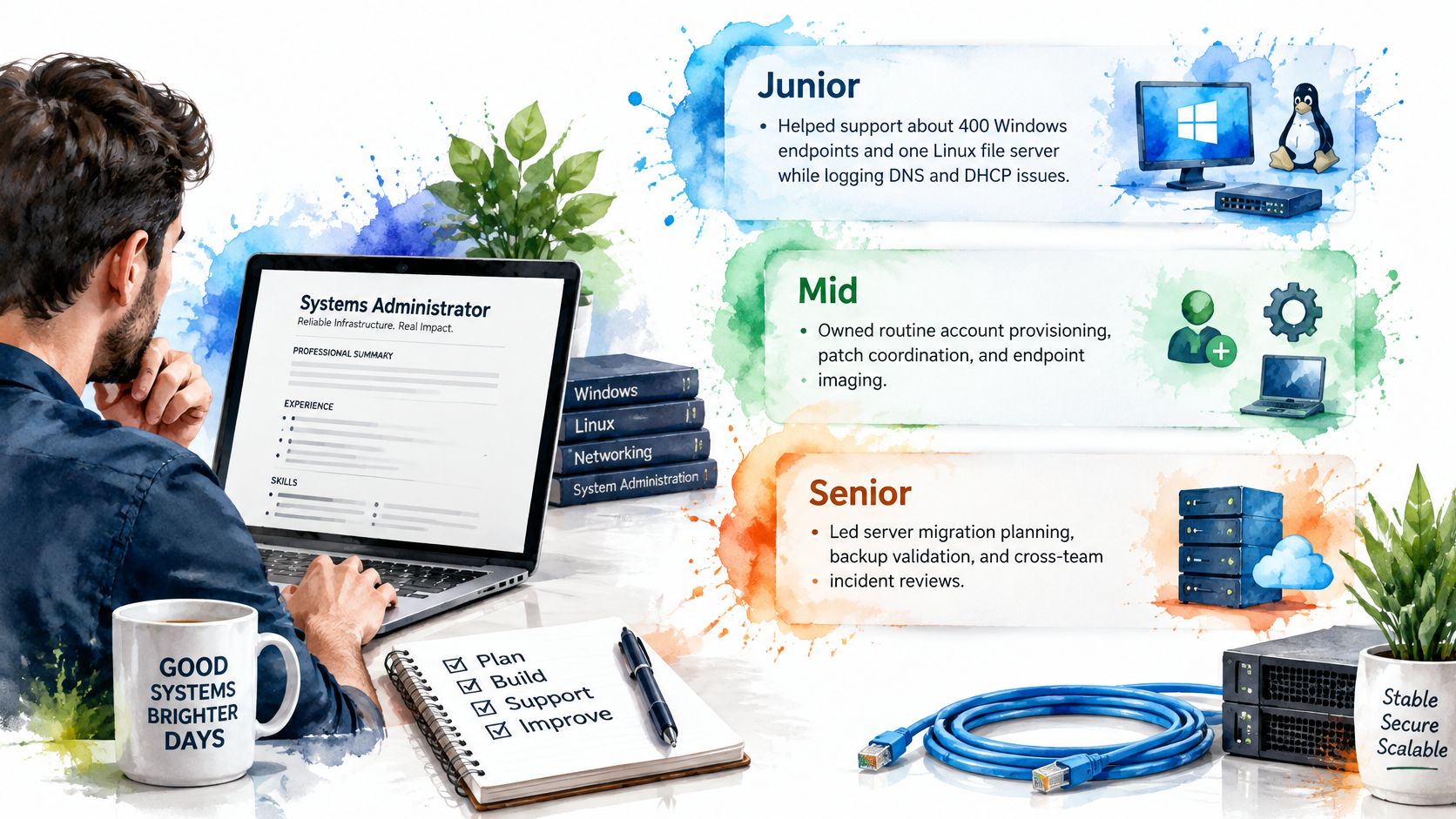
- Junior example. Supported Windows endpoints and a Linux file server, documented DNS and DHCP changes, and resolved routine access requests while escalating directory-policy faults.
- Mid-level example. Administered a mixed Windows and Linux environment, automated patch validation with Ansible, and escalated backup failures using documented recovery priorities.
- Senior example. Owned hybrid identity and on-call response, redesigned incident escalation, and coordinated failover exercises with application owners.
These are hypothetical starting points, not complete accomplishments. Add your own verified scale and results. Their difference is ownership, not a progression from hardworking to highly experienced to visionary.
| Level | Typical signal | Ownership | Sample outcome |
|---|---|---|---|
| Junior | Help desk transition or early administration work | Assisted, executed, and documented | Access requests resolved and infrastructure changes recorded |
| Mid-level | Independent administration of a defined environment | Automated a repeatable control | Patch validation standardized and backup failures escalated consistently |
| Senior | Cross-system decisions and on-call accountability | Designed or owned the result | Escalation and failover procedures coordinated across teams |
Years help explain chronology, but they don't establish operational authority. A long-serving administrator may still share design decisions, while an earlier-career candidate may independently own a well-defined service. State the actual dates and let the work establish the level.
Replace activity with a changed control
The distinction between routine work and operational impact is central to Huntr's systems-administrator resume guidance. For your own resume, identify what became more reliable, repeatable, recoverable, or auditable.
- Patching rewrite. Replace a bare statement about maintaining servers with: Automated pre-patch checks and post-reboot service validation in Ansible, with failed checks routed for review before maintenance closure.
- Onboarding rewrite. Replace a bare statement about creating accounts with: Built PowerShell provisioning from approved onboarding requests, applied role-based group membership, and recorded exceptions for identity-team review.
Neither rewrite requires an invented percentage. Both identify a control that an interviewer can investigate. Add an outcome only if you can establish it, such as reduced manual steps or fewer reopened requests.
Active voice helps keep that ownership clear. Lumi Humanizer's advice on how to give academic writing a more natural flow offers a useful editing principle here: make the actor and action explicit. Keep technical terms precise rather than simplifying away what you did.
Substitute defensible evidence for confidential details
Remove customer names, hostnames, internal addresses, and sensitive architecture details. Where disclosure is permitted, use approved aggregate scope, the system class, and the control you changed. Don't assume an approximate count is safe merely because it's rounded.
If your employer didn't track a formal metric, describe the observable result instead. A completed recovery exercise, accepted runbook, or documented approval process can demonstrate competence without claiming an unmeasured performance improvement.
Credibility rule: Shared work is still valuable. Name your part instead of claiming the entire team's result.
Documentation and stakeholder communication belong in the experience section when they changed execution. Explain who used the runbook, what decision the change notes enabled, or how the handoff worked. Keep the bullets that address repeated requirements in the target posting, not every task you remember.
Formatting Certifications and Honest Cloud Claims
Choose a layout that makes evidence easy to find. Decorative complexity creates more opportunities for misplaced dates, broken reading order, and overlooked qualifications.
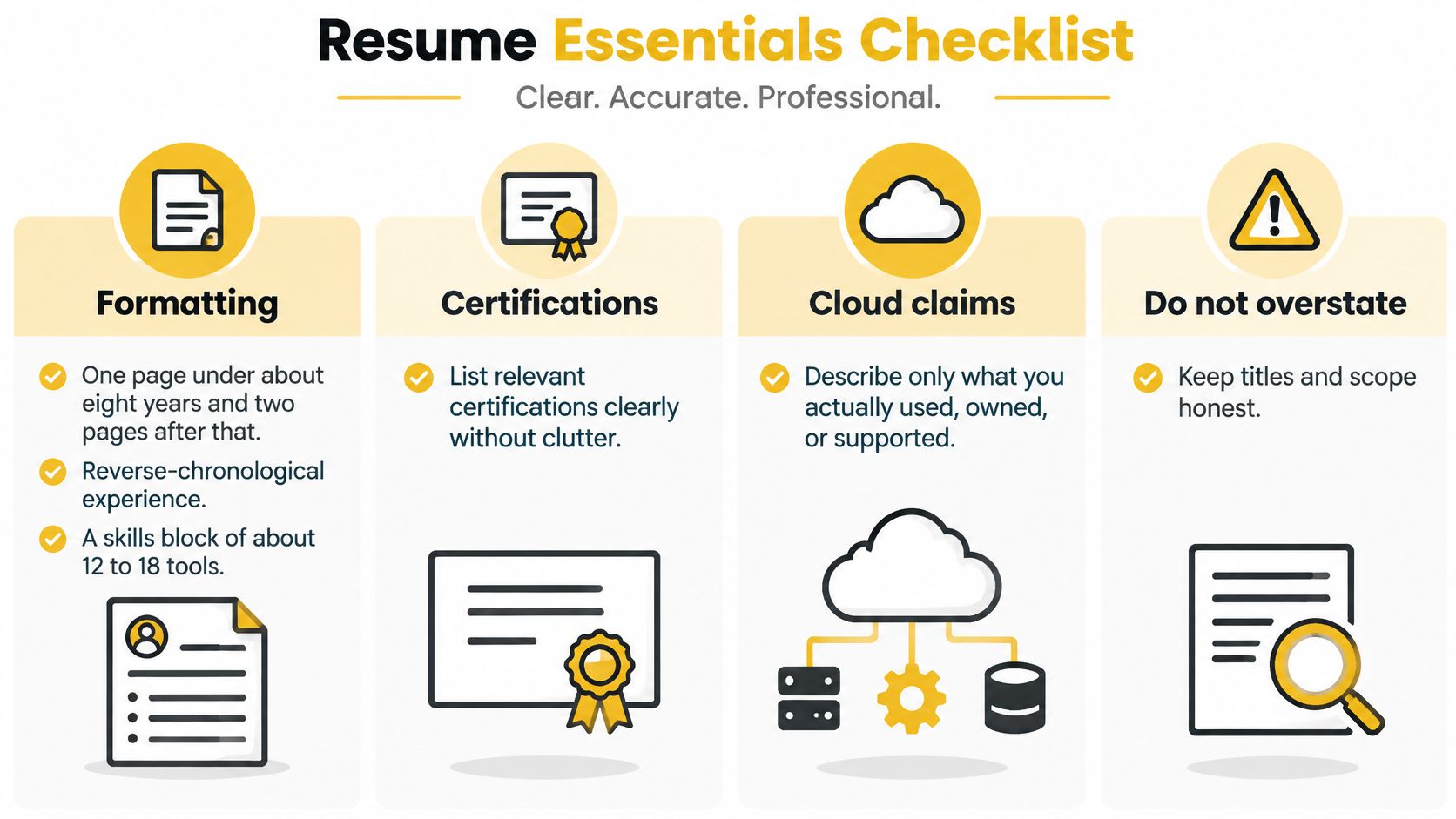
- Use a straightforward structure. Put experience in reverse chronological order with standard headings such as Experience, Skills, Education, and Certifications.
- Keep important text in the document body. Avoid placing contact details or qualifications inside headers, footers, graphics, or text boxes.
- Make the summary specific. Name your environment, strongest operational contribution, and relevant specialization. Skip the objective statement and photo.
- Choose length by relevance. Keep enough space to establish recent scope and achievements, then compress older or repetitive work.
- Follow submission instructions. Use the requested file format. If none is specified, export a readable PDF and check that its text copies in the correct order.
Make certifications verifiable
List the exact credential you hold, its issuer, and its status. Relevant examples might include CompTIA Linux+, Security+, Red Hat RHCSA, an Azure administration credential, or Cisco CCNA for a network-heavy position. Don't substitute a course title for an earned certification.
StoryCV's guidance on making credentials easy for recruiters to verify is useful for presenting those details consistently. A certification supports your preparation; it doesn't prove that you administered a production environment.
Calibrate cloud and automation claims
A systems-administration posting from Accenture Federal Services illustrates the overlap between traditional administration, automation, and security-oriented operations. That combination creates a credibility problem when candidates turn limited exposure into broad claims of cloud or DevOps ownership.
Use these proficiency tiers to state what you did.
| Tier | What it means | Resume line that fits |
|---|---|---|
| Operated | Ran an existing system someone else designed | Administered Windows servers on an established patch calendar |
| Automated | Scripted a repeatable task | Automated PowerShell provisioning from approved onboarding requests |
| Designed | Chose the approach, review, or secrets handling | Wrote reusable Terraform modules with peer review |
| Owned | Was accountable for the operational result | Held backup verification and incident response against an agreed SLA |
Operated is a legitimate level. If you maintained existing Azure virtual machines, say so, then identify the work: patching, access administration, monitoring, or restore testing. Don't imply that you designed the subscription architecture.
Automated means more than running someone else's script. Explain what you implemented or changed, how it handled exceptions, and where a person still reviewed the result.
For designed work, prepare to explain alternatives and constraints. Module boundaries, state handling, peer review, and secrets management are more revealing than a bare Terraform keyword.
Owned requires accountability beyond completing tasks. Identify the service boundary, escalation authority, and result you were responsible for maintaining.
Translate on-premises experience carefully. Patching becomes vulnerability-management evidence when you tracked findings through remediation and verification. Access administration supports a least-privilege claim when you reduced unnecessary rights. Familiar terminology won't rescue an inaccurate description.
Practice the Incidents Before You Apply
Stop adjusting margins when the document is readable. Test whether you can explain every significant claim without hiding behind the tool list.
Choose the achievements most likely to attract scrutiny: an availability result, an incident-recovery improvement, and an automation project. Prepare the environment, constraint, personal action, and evidence for each. If the measurement came from a team dashboard, identify it as a team measurement and explain your contribution.
Challenge the claim before an interviewer does
- Establish the boundary. Which service, users, systems, or locations did the result cover?
- Explain the method. What started and stopped the measurement, and where was it recorded?
- Separate contributions. What did you implement, what did colleagues handle, and who approved the change?
- Name the limitation. What remained manual, excluded, or unresolved?
Use these systems administrator interview questions to turn resume claims into troubleshooting prompts. Practice explaining why you checked a dependency, rolled back a change, or escalated an incident, not just which command you ran.
For broader preparation and interview-stage expectations, Humantext interview tips and templates can help organize your answers. Keep the technical story in your own language rather than memorizing a polished script.
A defensible answer includes the uncertainty you faced and the reason you chose the next action.
Rehearse an outage story with a colleague who challenges your diagnosis. Describe the symptom, competing explanations, containment decision, recovery verification, and follow-up control.
Then rehearse a patching or identity-change story. Explain approvals, validation, rollback conditions, and how you confirmed that users or services still worked afterward.
For Interview Pilot practice, create a profile by importing your resume or target job posting, then attach the other document so your preparation uses the claims you intend to defend.
Interview Pilot offers AI mock interviews and a real-time Interview Copilot with answers customized to your resume, target role, job description, and preferred response style. Visit Interview Pilot to prepare your systems-administrator profile and rehearse the outage, automation, and access-control decisions behind your strongest bullets before you apply.
Topics
resume systems administrator
sysadmin resume
ATS skills
achievement bullets
IT certifications
Continue reading
Career
Experienced Nurse Resume: How to Write It
Write an experienced nurse resume with a clear section order, quantified clinical bullets, specialty keywords, and ATS-safe formatting for 2026.
November 3, 2026
16 min read

Career
Teamwork Example for Interviews: Sample Answers and a Simple Structure
Need a teamwork example for your interview? See how to pick a story, structure it with STAR, and use sample answers for students, career changers and pros.
November 3, 2026

Career
Transferable Skills Examples: 20+ Skills and How to Prove Them
A practical transferable skills list with real examples, resume wording and interview stories, so you can show employers what you bring to any new role.
November 2, 2026