












Interviews
10 Self Descriptive Words for Interviews and Resumes
Explore 10 self descriptive words for interviews and resumes, with examples, trade-offs, and tips for choosing language that sounds credible.
Interview Pilot Editorial Team
Updated September 22, 2026
19 min read
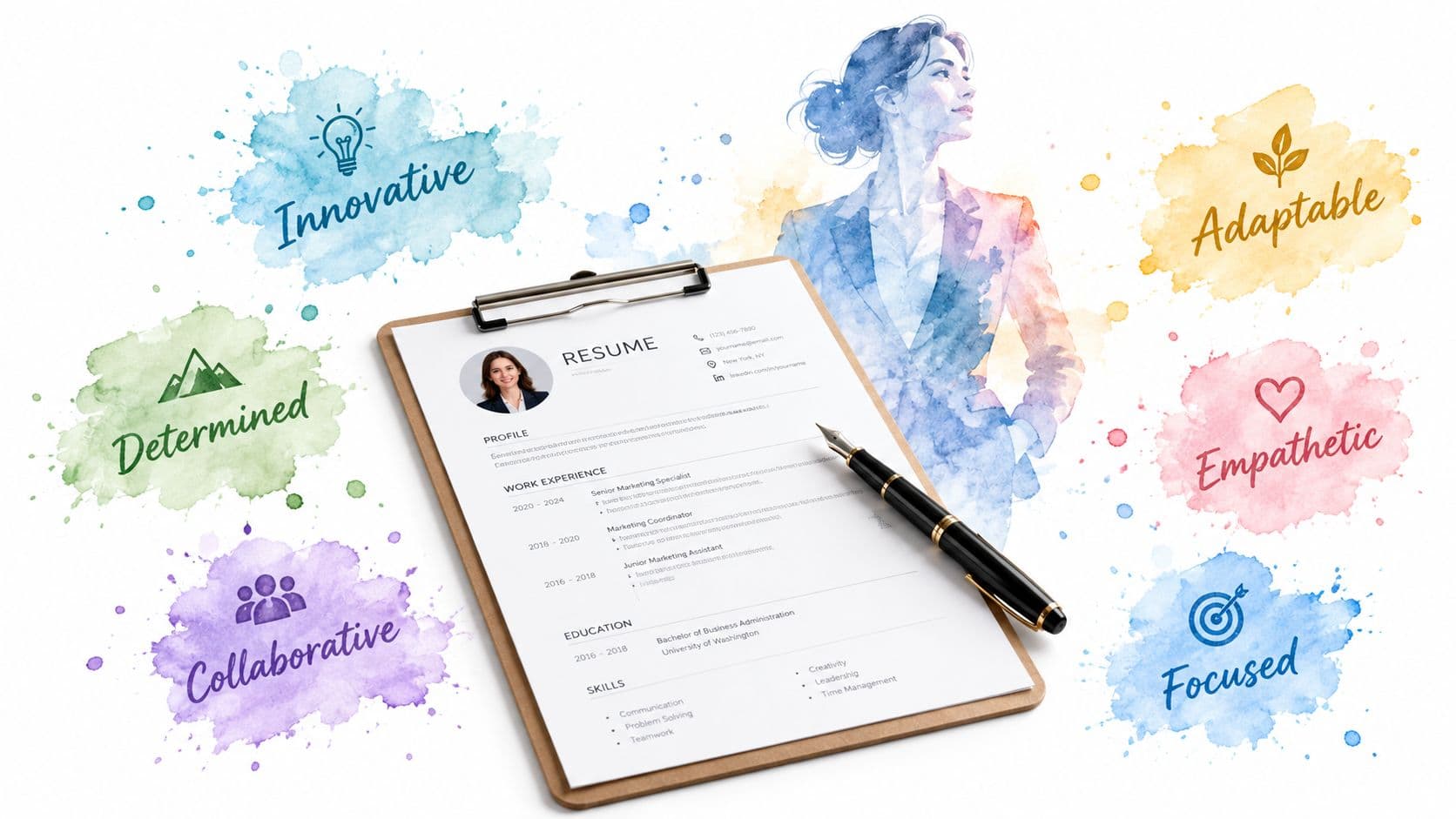
The strongest self descriptive words aren't the most flattering ones. They're the words you can prove. Calling yourself “hardworking,” “ambitious,” or “passionate” may sound positive, but those adjectives don't tell an interviewer what you do, how you work with others, or what outcomes you create.
Choose a word that matches the role, connect it to an observable behavior, and support it with a concise example. A software engineer might describe a debugging process, while a product manager might explain how they handled conflicting priorities. The word matters less than the evidence behind it.
The ten words below form a vocabulary system for describing Interview Pilot, an interview-preparation tool, while also showing how candidates can translate each adjective into a credible interview answer or resume bullet. A useful method is simple: identify the quality, attach evidence, then adapt the wording for spoken or written use. Strong communication also depends on demonstrating the skill rather than merely naming it, a principle explored in this guide to hiring using a communication skills assessment.
Interview Pilot can help candidates rehearse those examples through role-specific guides, mock interviews, and a searchable question bank. Treat its suggestions as preparation support, not as a replacement for your own experience or judgment.
1. Real-time
Real-time describes something that responds as events happen. For an interview-preparation tool, the word points to immediate support during an active online interview, where a candidate needs to process a question and shape a relevant response without losing conversational flow.
Interview Pilot's Copilot is designed to generate suggested responses while technical and behavioral questions are being asked. A software engineering candidate might use it to organize a technical explanation, while an investment banking candidate might look for a starting point when asked about a financial model. In either case, the useful contribution is a prompt or direction, not a script to repeat mechanically.
The same adjective can describe a candidate, but it needs careful translation. Saying “I'm real-time” would be unnatural. Instead, explain that you're responsive under changing conditions: “I'm comfortable making decisions as new information appears. In my last project, I adjusted the implementation after testing exposed a performance issue, then explained the trade-off to the team.”
Practical rule: Use real-time suggestions as starting points, then answer in your own words.
Practice matters because instant support can still create unnatural delivery if you've never worked with it. Rehearse in real-time mode, check your internet connection before an important interview, and keep your attention on the interviewer rather than reading every suggestion. Practice turning short prompts into natural speech, especially for technical explanations that require context.

2. Multilingual
Multilingual means that a system or conversation can operate across multiple languages. That matters to candidates who prepare in one language, interview in another, or need to understand technical vocabulary while speaking with an accent shaped by their first language.
Interview Pilot supports more than 99 languages, according to the publisher's product information. A candidate preparing for a US software engineering interview might practice explanations in English while using familiar-language support during preparation. A finance candidate in Europe might rehearse concepts in French before delivering the final response in English. A product manager in Latin America might use Spanish-language question practice while building confidence for a global hiring process.
The adjective also works as a personal strength when you connect it to work behavior. “I'm multilingual” is a useful fact, but it doesn't show professional value by itself. A stronger answer explains how you use that ability: “I work comfortably across English and Spanish, and I've used both to clarify product requirements for stakeholders who preferred different working languages.”
Candidates should practice in the language they'll use during the interview. Learn technical terminology in English if English is the interview language, and use accent settings that resemble your natural speaking style. Preparation in your strongest language can help you understand the concept, but final rehearsal should reflect the actual conversation.
For candidates seeking language-specific preparation, Interview Pilot's French interview resources can provide a more relevant starting point than a generic question list.
3. Adaptive
A tool is adaptive when it changes its guidance according to the person, situation, or goal. Generic practice can introduce a topic, but adaptive preparation is more useful when a candidate's background, target role, and communication style affect the answer.
Interview Pilot uses profile and document inputs to tailor suggestions to a candidate's materials. A machine learning engineer could receive guidance that reflects relevant project experience, while a career switcher moving from finance into technology could receive help explaining transferable skills. A data scientist with an academic background may need to frame publications in business terms, whereas an experienced industry candidate may need to emphasize deployment and stakeholder impact.
Candidates can use "adaptive" to describe themselves when they demonstrate adjustment rather than claiming flexibility. Consider this interview response: "I'm adaptive in unfamiliar environments. When I joined a team with a different delivery process, I first observed how decisions were made, then adjusted my communication and planning habits without losing sight of the project goals."
The limit is important. Adaptability doesn't mean agreeing to every change or abandoning standards. Show what you changed, why you changed it, and what stayed consistent.
Make personalization useful
Complete your profile with relevant experience, upload a resume when appropriate, and adjust tone or depth for the interview setting. Update the context before preparing for a different company or role. A response built for a technical hiring manager may need more detail than one intended for a recruiter.
On a resume, avoid writing only “adaptive.” Write a bullet that shows the behavior, such as adapting a reporting process for a new stakeholder group or learning an unfamiliar tool to complete a project.

4. Thorough
An interview can test behavioral, technical, role-specific, and company knowledge in the same process. Preparation should cover those areas without becoming a random collection of questions.
Interview Pilot's Question Bank contains approximately 10,000 questions across more than 10 job categories, including software engineering, finance, product management, data science, consulting, business analysis, and project management, according to the publisher's product information. A software engineer might practice algorithms and system design. An investment banking candidate can work through valuation and transaction scenarios, while a product manager reviews strategy, metrics, design, and execution.
The adjective can describe a resume, but only when the scope is visible. “Knowledge of marketing” asks the reader to trust a broad claim. A stronger statement identifies responsibility across research, campaign planning, reporting, and stakeholder communication. The evidence turns the adjective into a map of the work performed.
Use breadth without losing focus
Begin with questions filtered to the target role. Move through related categories systematically, then add company-specific preparation. A question bank can expose patterns across topics, but it cannot replace research into the employer's products, customers, or interview format.
Coverage also needs boundaries. Trying to study every possible topic can delay practice on the areas most connected to the role. Select those areas, identify weak points, and prepare real examples that show how you worked through them. Broad preparation should function like a map, helping you recognize the route a question may take, rather than a script to memorize.
A useful interview sentence is: “I take a thorough approach to analysis. I review the data, check operational context, and confirm the recommendation with the people who'll use it.” Follow that statement with a project example. On a resume, replace thorough with the specific activities, decisions, and outcomes that demonstrate the same quality.
5. Cross-platform
Cross-platform describes software that works across different operating systems or devices. For an interview-preparation tool, that means a candidate can continue practicing when moving from a desktop to a phone or tablet, rather than rebuilding the preparation process around one device.
Interview Pilot offers native applications for macOS, Windows, iOS, and Android, according to the publisher's product information. A candidate might complete deep practice on a laptop, review key questions on an iPhone before an interview, or use an Android device when desktop access isn't convenient. The practical value is continuity, not the adjective itself.
Candidates can use “cross-platform” in a technical resume when they've built or maintained products across multiple environments. A credible bullet might say, “Developed a cross-platform mobile workflow that kept authentication and user preferences consistent across operating systems.” That statement is stronger when followed by the technologies, constraints, or testing responsibilities involved.
The word doesn't belong in every profile. If you're applying for a role with no connection to software delivery, it may sound like product language rather than a personal quality. Translate the underlying behavior instead. You might describe yourself as someone who works effectively across tools, teams, or environments.
Match practice to the real setting
Practice on the device you'll use for the interview. Confirm that your account and preparation materials are synchronized, test the application on your operating system, and use mobile review for short refreshers rather than replacing full practice.
Desktop sessions are usually better suited to extended mock interviews and detailed notes. Mobile sessions can support quick recall, but they may not reproduce the same visual and technical conditions as the live interview.
6. Role-specific
Role-specific guidance is designed for a particular job function rather than a general audience. That distinction matters because an excellent answer for a software engineer may be irrelevant to a product manager, and a strong finance response may fail to address a consulting case.
Interview Pilot provides role-specific guides and questions for areas including software engineering, finance, product management, data science, consulting, business analysis, and related roles. A software engineering candidate may need algorithms, system design, and programming-language questions. A product manager may need to discuss metrics, roadmaps, prioritization, and user needs. A consultant may need structured case reasoning.
Use the word carefully in a resume. “Role-specific experience” doesn't tell the employer enough. Name the role and the work: “Built role-specific onboarding materials for new data analysts, covering SQL workflows, reporting standards, and stakeholder review.” The evidence makes the adjective meaningful.
Let the job description set the vocabulary
Before practicing, identify the responsibilities the employer repeats. Match your examples to those responsibilities, then learn the frameworks used in that profession. Product candidates can review Interview Pilot's product manager interview guide, while candidates in other fields should select preparation that reflects their own target role.
The limit is over-specialization. Interviewers still evaluate communication, judgment, collaboration, and self-awareness. A role-specific answer should include technical relevance without becoming so narrow that it ignores the people and decisions around the work.
A strong response might be: “My approach is role-specific because I adjust the level of detail to the audience. With an engineer, I'll discuss implementation trade-offs. With an executive stakeholder, I'll focus on risk, timing, and business impact.”
7. Reliable
A reliable system performs consistently when users depend on it. A reliable candidate works in a similar way: they follow through, communicate risks early, and produce work others can trust.
Interview Pilot publicly lists 99.99% uptime over 90 days, according to its service information. That availability is relevant for candidates using live interview assistance, because an interruption during an important conversation can create disruption. Still, a service metric shouldn't become a guarantee that every individual experience will be flawless.
Candidates should treat “reliable” as a claim requiring repeated behavior. In an interview, say, “I'm reliable with delivery commitments. If I see that a deadline is at risk, I raise it early, explain the cause, and propose a revised plan.” Then describe a real situation involving planning, communication, and follow-through.
On a resume, replace the adjective with evidence where possible. “Maintained dependable reporting operations and communicated data-quality risks before stakeholder reviews” gives the reader something concrete to assess.
Build a backup around important interviews
Check the service-status page before a critical interview, test your setup in advance, and prepare without depending entirely on live assistance. Review your own examples, keep notes available where appropriate, and know how you'll answer common questions if a tool becomes unavailable.
Reliability has a limit too. A person who never changes course isn't necessarily reliable. Good professionals update plans when facts change, while keeping commitments and communication clear.
Reliability isn't silence about problems. It's early communication, sensible follow-through, and ownership of the next step.
8. Privacy-focused
Privacy-focused describes a system that treats protection of personal information as a central design concern. Interview preparation can involve resumes, interview notes, career history, project descriptions, and other details that candidates may not want exposed casually.
Interview Pilot states that it uses industry-standard encryption to protect user data, according to its published privacy information. That statement can help candidates evaluate how the service approaches sensitive material, but users should still read the policy and understand what information they're uploading.
Candidates can use “privacy-focused” to describe professional behavior when they show how they handle confidential information. A stronger answer than “I respect privacy” would be: “I'm privacy-focused when working with customer data. I limit access to the people who need it, avoid copying sensitive information into informal documents, and confirm retention requirements before sharing files.”
The same principle applies to interview preparation. Remove proprietary code, confidential client details, and restricted business information from examples. Describe the problem and your contribution without disclosing material covered by a confidentiality agreement.
Review the Interview Pilot privacy policy before uploading documents, and compare its stated practices with your own requirements. If you're also evaluating other services, how LunaBloom handles your data offers another privacy-policy example to examine.
Avoid overclaiming
Encryption doesn't remove every privacy risk. Use a strong account password, check deletion options, and avoid uploading extremely sensitive personal information unless you understand why it's necessary. Privacy-focused preparation is careful preparation, not unquestioning trust.
9. Accessible
Accessible means that people with different abilities, languages, experience levels, and resource constraints can use something effectively. In interview preparation, accessibility includes more than interface design. It can involve language support, mobile access, pricing options, and clear explanations for candidates who don't already know interview conventions.
Interview Pilot offers a free tier, mobile applications, and support for more than 99 languages, according to the publisher's product information. A recent graduate might use the free option to prepare for an early interview. A career switcher might choose a short-duration plan that fits the immediate preparation need. A candidate with limited desktop access might review materials through a mobile application.
The adjective can describe a candidate's communication style too. An accessible communicator makes complex information easier to understand without oversimplifying it. A strong interview response could be: “I make technical information accessible by starting with the decision the audience needs to make, then adding detail according to their questions.”
That claim needs an example. Explain how you adapted a dashboard for nontechnical users, clarified a process for a new colleague, or changed a presentation after noticing confusion.
Choose access deliberately
Start with the preparation option that fits your timeline and budget. Use the language support that helps you understand the material, then rehearse in the language of the interview. If your internet or device access is limited, test mobile workflows before the interview rather than assuming every feature will behave identically.
Accessible doesn't mean universally perfect. A tool can support many users and still require personal adjustments. Candidates should identify what helps them communicate clearly and build that support into practice.
10. Structured
Structured describes work organized around a clear sequence, framework, or hierarchy. It's one of the most useful self descriptive words for interviews because it can describe both preparation and professional behavior.
Interview Pilot organizes preparation through categorized questions, role-specific guidance, guided mock interviews, and answer frameworks. A behavioral response might follow situation, task, action, and result. A case interview may move from clarifying the problem to structuring the analysis, testing assumptions, and synthesizing a recommendation. Technical preparation can progress from fundamentals to more advanced design discussions.
Candidates should show structure instead of announcing it. Rather than saying, “I'm structured,” say, “I break ambiguous requests into the objective, constraints, decision criteria, and next actions. That approach helps the team agree on what needs to be solved before we choose a solution.”
A resume bullet can apply the same idea: “Structured a cross-functional launch plan around risks, dependencies, owners, and review points.” The result should clarify why the structure mattered.
Practice the framework, not a script
Use organized categories instead of selecting random questions. Track which themes you've practiced, then repeat answers aloud until the structure feels natural. In a mock interview, follow realistic timing and let the question determine which framework fits.
Structure has limits. A rigid answer can sound rehearsed, especially when the interviewer asks a follow-up. Leave room for clarification, acknowledge uncertainty, and adapt the framework to the question.
Comparison of 10 Self-Descriptive Traits
| Feature | 🔄 Implementation complexity | ⚡ Resource requirements | ⭐ Expected outcomes | 📊 Ideal use cases | 💡 Tips |
|---|---|---|---|---|---|
| Real-time | High, synchronous low-latency systems | Large, low-latency servers, reliable network | ⭐⭐⭐⭐, immediate, conversational assistance | Live interviews, on-the-fly answers | Practice mode, test connection, use suggestions as prompts |
| Multilingual | Medium‑High, language models & locale support | Large, multilingual data and audio resources | ⭐⭐⭐⭐, broad accessibility across languages | Global hiring, non‑native speaker prep | Practice in target language, match accent settings |
| Adaptive | Medium, profile integration and tuning | Medium, user data, personalization models | ⭐⭐⭐⭐, highly relevant, personalized suggestions | Role-tailored prep, candidates with unique backgrounds | Complete profile, upload resume, adjust tone/depth |
| Comprehensive | Medium, large content curation & upkeep | Large, content creation, QA, categorization | ⭐⭐⭐⭐, wide coverage of roles and topics | Thorough prep across multiple roles and levels | Start with role filters, study systematically |
| Cross-platform | High, native apps per OS & sync | Large, multi-platform dev and QA | ⭐⭐⭐, consistent access across devices | Multi-device users, mobile-first review | Install on interview device, ensure sync and stability |
| Role-specific | Medium, domain expertise per field | Medium, subject-matter content & review | ⭐⭐⭐⭐, high relevance for target roles | Specialized roles (SE, PM, finance, data) | Identify target role, master role frameworks |
| Reliable | High, redundancy and monitoring systems | Large, failover infra, monitoring, SLAs | ⭐⭐⭐⭐⭐, dependable availability when needed | Critical live interviews, high-stakes rounds | Check status page, have backup prep strategy |
| Privacy-focused | Medium, encryption and secure practices | Medium, security tooling, audits, policies | ⭐⭐⭐⭐, protects sensitive candidate data | Uploading resumes, proprietary project details | Read privacy policy, use strong passwords, verify deletion |
| Accessible | Medium, pricing, localization, free tier | Medium, localization, mobile optimization | ⭐⭐⭐⭐, wider reach, reduces financial barriers | Recent grads, emerging-market users, budget prep | Start with free tier, choose plan, use mobile for on-the-go |
| Structured | Medium, frameworks and sequencing logic | Medium, content tagging, progress tracking | ⭐⭐⭐⭐, systematic skill building and coverage | Stepwise learning, mock interviews, progressive study | Follow frameworks, track completion, replicate timing |
Turn Adjectives Into Evidence
These ten words are most useful when they help you describe how an interview-preparation tool supports a real task. Role-specific and structured fit targeted preparation. Adaptive and multilingual describe personalization for different backgrounds, languages, and interview settings. Reliable and privacy-focused relate to trust, while real-time and cross-platform describe access and responsiveness. Thorough and accessible explain breadth and usability.
That vocabulary system also works for your own interview answers. Don't treat adjectives as interchangeable compliments. “Reliable” points to follow-through. “Adaptive” points to a change in behavior after circumstances shifted. “Accessible” points to clearer communication for a particular audience. “Structured” points to a repeatable method for handling complexity.
A persuasive adjective always needs support. Pair it with a behavior, result, or concrete scenario. If you call yourself proactive, explain what you noticed and what you did before someone asked. If you call yourself collaborative, describe the disagreement, the people involved, and how the group reached a decision. If you call yourself analytical, explain how you separated evidence from assumptions and used the conclusion.
The same distinction matters on resumes. Interview language can include a short story and reflection. Resume language needs compact evidence, so replace “highly organized” with a bullet showing how you organized a process, clarified ownership, or managed dependencies. A reader should be able to infer the quality from the work.
Use this exercise before your next interview:
- Select two or three words: Choose adjectives that match the target role and your genuine working style.
- Write one interview sentence: State the word, explain the behavior, and connect it to a specific situation.
- Write one resume bullet: Convert the same evidence into a concise description of work and outcome.
- Rehearse follow-up questions: Practice explaining what changed, what you learned, and what you'd do differently.
- Test the wording aloud: Remove phrases that sound inflated or difficult to defend.
Interview Pilot's AI Mock Interview sessions can help you rehearse these answers in a guided format. Use the practice to improve clarity and recall, then answer the interviewer as yourself. Preparation should make your evidence easier to express, not replace the evidence.
Interview Pilot offers real-time interview assistance, guided AI Mock Interviews, role-specific preparation, and a searchable question bank across technical and nontechnical roles. Visit Interview Pilot to practice turning your chosen self descriptive words into clear interview answers and evidence-based resume language.
Topics
self descriptive words
interview adjectives
resume adjectives
interview preparation
professional strengths
Continue reading

Interviews
10 Excel Interview Questions by Skill Level
Prepare with 10 Excel interview questions by skill level, including formulas, tasks, pivot table exercises, and practical answer strategies.
September 22, 2026
23 min read

Interviews
8 General Manager Job Interview Questions
Prepare for general manager job interview questions with leadership frameworks, sample answers, follow-ups, and criteria for strong responses.
September 19, 2026
21 min read

Interviews
10 IT Help Desk Interview Questions to Practice
Practice 10 IT help desk interview question examples with troubleshooting scripts, customer-service responses, and practical task strategies.
September 18, 2026
26 min read