









Interviews
10 Tax Interview Questions You Should Prepare For
Master the 10 most common tax interview questions with sample answers, key topics to review, and tips for entry-level to senior tax roles.
Interview Pilot Editorial Team
Updated October 31, 2026
17 min read

What if the candidate who knows the most tax rules isn't the one a hiring manager trusts with a client file? That mismatch explains why many well qualified people underperform in tax interviews. They prepare definitions, while interviewers score something broader.
Interviewers listen for three things at once. Can you get the technical answer right, can you spot risk before it becomes a filing problem, and can you explain your reasoning to someone who doesn't live in the Code? The scale matters here, because in the Government Accountability Office summary of IRS data, more than 85 million individual taxpayers, 57% of all individual taxpayers, used a paid preparer during fiscal year 2024. That's a mass market service, not a narrow specialty.
Use one repeatable structure for almost every prompt. Define the concept in one clean sentence, anchor it with a worked example, then state how you'd verify the position or escalate if the facts get uncomfortable. I call it definition, example, escalation. A hiring manager can score each beat separately, and you get credit even when a question reaches beyond your current experience.
The ten tax interview questions below recur from entry level preparer roles to senior advisory seats. For each one, you'll see what a strong answer must contain, where candidates commonly lose points, and phrasing you can adapt without sounding scripted.
1. Explain the Difference Between Tax Avoidance and Tax Evasion
Start with two one sentence definitions. Tax avoidance is legally arranging your affairs within the law to reduce tax. Tax evasion is illegally concealing income or misrepresenting facts to reduce tax owed, and it's a crime.
How the Interviewer Scores It
Give a clean example of each. Contributing to a traditional 401(k) to reduce taxable income is avoidance, because Congress created that incentive on purpose. Paying cash wages and leaving them off payroll filings is evasion, because the facts themselves are hidden.
Strong candidates also name the gray area in between. Mention statutory intent, disclosure, and substance over form, and note that anti avoidance doctrines can recharacterize a transaction that follows the letter of a rule while defeating its purpose. Don't imply that all tax planning is suspicious, because that reads as naive.
Practical rule: If you'd be comfortable disclosing the full facts on the return and defending the statutory basis, you're usually describing avoidance. If the plan depends on nobody finding out, stop and escalate.
Close with professional standards. For U.S. practitioners, reference Circular 230 and say you'd refuse to sign a position you know is based on false facts, document your advice, and escalate to a partner or ethics resource. That final escalation sentence is often where the points are.
2. What Is the Difference Between a Tax Deduction and a Tax Credit
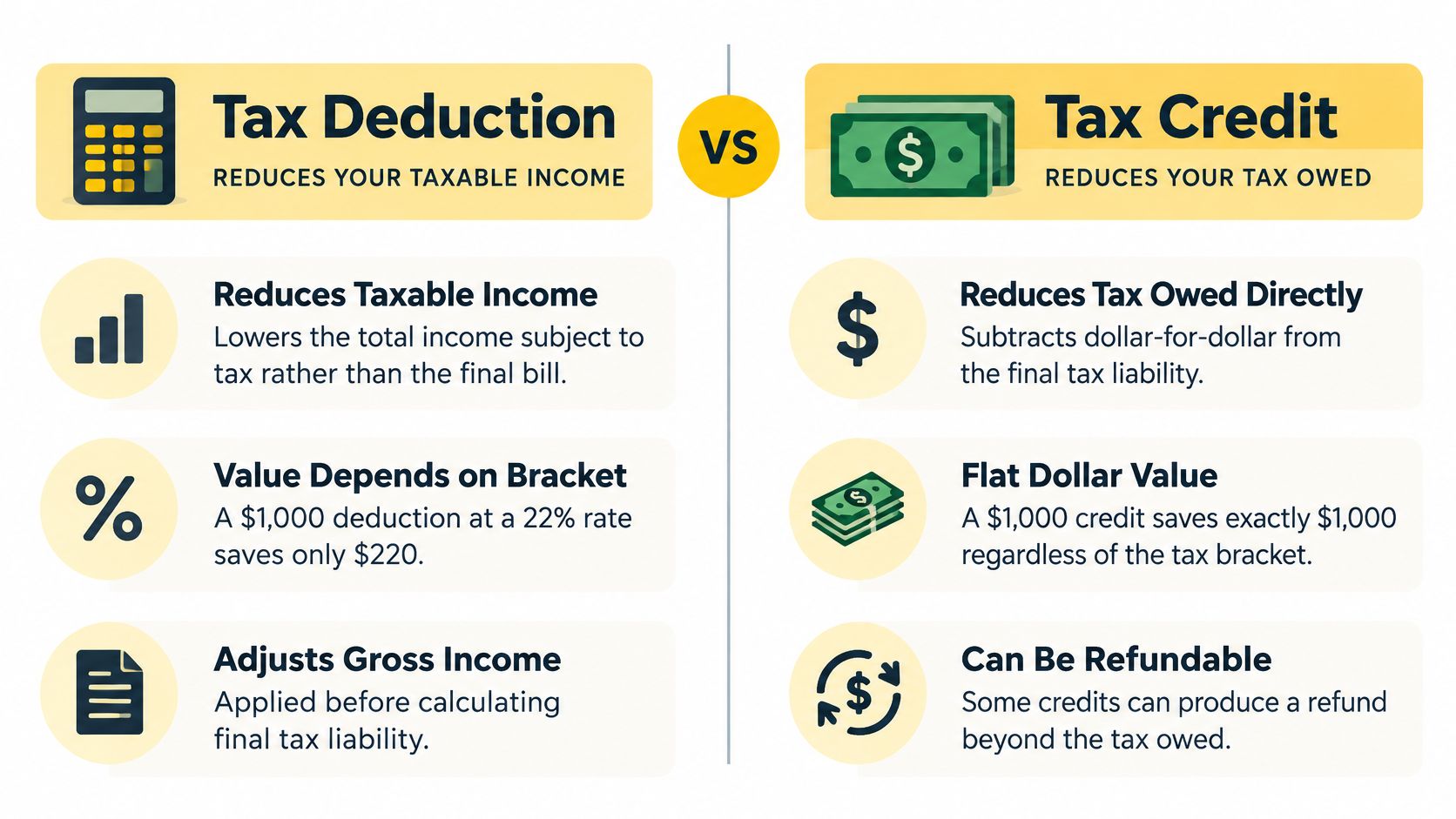
Answer with arithmetic, not adjectives. A deduction reduces taxable income, so its value depends on the taxpayer's marginal rate. A credit reduces tax owed dollar for dollar.
Use the same amount twice. At a 22% marginal rate, a $1,000 deduction saves $220 in tax. A $1,000 credit saves $1,000 in tax, regardless of bracket. Then show the bracket sensitivity by noting that the same deduction saves less for a lower bracket taxpayer and more for a higher bracket taxpayer, while the credit's face value doesn't change.
Where Candidates Lose Points
Most weak answers stop at the definitions. Add the distinction between refundable and nonrefundable credits. A nonrefundable credit can't reduce tax below zero, while a refundable credit can generate a refund beyond tax liability. The Child Tax Credit is partly refundable under current U.S. rules, which makes it a useful, recognizable example.
Add a verification habit. Say you'd confirm current limits, phase outs, and refundability from IRS guidance before quoting figures to a client. That one sentence tells the interviewer you won't rely on last year's memory.
3. Describe How Marginal Tax Brackets Work
The interviewer is testing whether you can correct a common client misconception without sounding condescending. Under a marginal bracket system, only the income inside each bracket is taxed at that bracket's rate. Crossing into a higher bracket doesn't raise the rate on all your income.
Use three illustrative layers and say clearly that they're hypothetical. Say the first layer is taxed at the lowest rate, the next layer at a middle rate, and only income above the top threshold at the highest rate. A single filer in the top bracket pays that top rate only on income above the threshold, not from dollar one.
The Client Conversation Test
Connect it to a raise or bonus, because that's where you'll use it. A taxpayer whose raise pushes part of their income into a higher bracket keeps more total after tax income than before. The effective rate, which is total tax divided by total income, will sit below their marginal rate.
Candidates lose points when they quote precise current thresholds from memory and get them wrong. Label your figures as illustrative, explain the mechanics, and say you'd pull current brackets from official IRS tables for actual planning.
4. Explain Nexus and How It Affects State Sales and Income Tax Obligations
Define nexus as a sufficient connection between a business and a state that allows the state to impose a tax obligation. Without nexus, the state generally can't require collection or filing. With it, registration, collection, remittance, and return duties can follow.

Explain both tests. Physical presence, such as an office, employees, or inventory in a state, was historically the main test. Economic nexus is based on sales activity alone, and it became common after the 2018 Supreme Court decision in South Dakota v. Wayfair, which allowed states to require remote sellers above economic thresholds to collect sales tax.
Make it concrete. Say an online retailer ships heavily into a state where it has no office. Once its sales cross that state's threshold, it may need to register, collect tax at the correct rate, and file returns there. Note that income tax nexus and sales tax nexus don't always use identical standards.
Finish with process. You'd track sales by state on a rolling basis, verify thresholds on official state revenue department sites rather than blogs, and escalate before registering so prior period exposure gets assessed first.
5. What Is the Difference Between a C Corporation and an S Corporation for Tax Purposes
Name the central tradeoff in your first breath. A C corporation is taxed as a separate entity, and shareholders may be taxed again on dividends, which is double taxation. An S corporation is generally a pass through for federal income tax, with income flowing to shareholders who report it personally.
Tie the forms to the entities. C corporations file Form 1120, while S corporations file Form 1120-S and issue schedules to shareholders. Mentioning the forms signals you've seen the compliance side, not just a textbook diagram.
Tradeoffs Interviewers Want Named
- S corporation fit: A small consulting firm elects S status so profits pass to owners without entity level federal tax, but it must respect eligibility rules such as shareholder limits and a single class of stock.
- C corporation fit: A venture backed startup chooses C status to accommodate multiple share classes and outside investors, accepting double taxation as the cost of that flexibility.
Add two cautions. State tax treatment can differ from federal treatment, and S shareholders still need reasonable compensation and basis tracking. If you're also preparing broader finance screens, the entity reasoning here overlaps with technical interview questions in finance, so rehearse both with numbers attached.
6. Explain the Difference Between Temporary and Permanent Book-Tax Differences
This question separates return preparers from corporate tax and provision candidates. A temporary difference arises when income or expense is recognized in different periods for book and tax purposes, and it reverses over time. A permanent difference never reverses.
Watch a short walkthrough of deferred tax mechanics, then be ready to explain it back in your own words.
Use depreciation for the temporary example. A company uses accelerated depreciation for tax and straight line depreciation for books, so taxable income is lower now and higher later, creating a deferred tax liability that unwinds as the timing reverses. For the permanent example, use nondeductible penalties paid to a government agency or tax exempt municipal bond interest. Those items affect the effective tax rate but create no deferred tax.
Reference ASC 740 for U.S. GAAP income tax accounting and describe a simple two column comparison of book versus tax treatment across several years. Candidates preparing adjacent accounting roles will find this pairs naturally with accountant interview questions, where the same reversal logic appears in provision workpapers.
7. Walk Me Through How You Would Research an Unfamiliar Tax Issue
Don't start by naming a search engine. Interviewers score the sequence. State the facts, identify the issue, find the governing authority, analyze alternatives, then document and escalate where needed.
A Four Step Sequence You Can Say Aloud
- Facts first: Confirm who, what, when, amounts, and what's missing before you research anything.
- Authority next: Work from primary sources, meaning the Internal Revenue Code, Treasury Regulations, rulings, and court cases, then check secondary commentary.
- Analysis: Apply the authority to your facts, compare plausible positions, and quantify the consequence of each.
- Documentation and escalation: Write a short memo with assumptions and citations, and escalate aggressive or unsupported positions before filing.
That staged approach matches the structured case method in the FirstHR tax accountant interview template, which scores issue spotting, authority selection, factual analysis, numerical accuracy, communication, and ethical judgment separately rather than grading only the final conclusion.
Give a small example. For a new credit, you'd read the Code section first, then the regulations, then IRS guidance. For a state nexus question, you'd document the analysis in a memo for a senior reviewer. Candidates lose points when they never name an escalation point.
8. How Do You Stay Current With Changes in Tax Law
A vague answer about reading articles won't score. Describe a repeatable system, name specific sources, and show how an update changes actual work product. Tax law moves through legislation, regulations, court decisions, and agency guidance, so your system has to catch more than headlines.
Name two or three sources you use. That can include IRS email updates and news releases, state revenue department announcements, reputable professional publications, and structured continuing professional education. Then explain the workflow. Say a tax associate logs relevant updates, a team lead circulates a short quarterly memo on new filing requirements, and affected client files or checklists get updated before the next deadline.
Credential awareness strengthens this answer. On its choosing a tax professional guidance, the IRS notes that enrolled agents must pass a three part Special Enrollment Examination and complete 72 hours of continuing education every three years, while anyone with a current PTIN may prepare federal returns for pay. Explaining that gap shows you understand why firms can't assume every preparer has the same training.
Prepare one recent change you've studied, verify its details before the interview, and explain how it affected a return type or client question.
9. Tell Me About a Time You Identified a Tax Error or Compliance Risk
This is a behavioral question, so use STAR. Name the Situation, your Task, the Action you took, and the Result. Interviewers score whether you verified before accusing, communicated to the right person, and fixed the process rather than only the number.
Say a preparer notices a mismatch between a W-2 and payroll records while tying out wages before filing. The strong version of that story is specific. You stopped the return, traced the difference to source documents, confirmed which figure was correct, told your reviewer what you'd found, and documented the correction so the file explains itself later.
Never use real client names, exact identifying amounts, or details a listener could trace back to a taxpayer. Generalize the industry and round the story to the issue, because confidentiality judgment is part of what's being scored.
Prepare two or three stories covering accuracy, deadlines, and teamwork, such as catching a sales tax rate error in a billing system before a quarterly return. If you're interviewing across finance roles, the same STAR discipline applies to the financial analyst interview questions candidates face on variance and error detection. End with the control you added afterward, not just the save.
10. How Would You Manage Multiple Deadlines During Busy Season
Interviewers aren't asking whether you'll work hard. They're asking whether quality survives when everything is due at once. Describe a system, a communication rhythm, and a safeguard, in that order.
A System That Sounds Real
Describe a tracker with columns for client, return type, statutory deadline, extension status, document completeness, reviewer, and next action. A preparer sorts returns each week by extension status and document completeness, so work that's ready moves first and blocked files get chased early. A shared tracker lets the whole team flag returns awaiting client documents instead of burying that status in individual inboxes.
Explain escalation before it becomes a crisis. If two deadlines conflict, you tell your manager as soon as the math doesn't work, propose which file moves or gets extended, and confirm the decision in writing. Silent heroics followed by a missed deadline score badly.
Close with quality safeguards under pressure. Checklists, self review against prior year returns, and peer review on higher risk items stay in place during busy season, even if they're shortened. Saying you'd skip review to save time is the fastest way to lose this question.
10 Tax Interview Questions at a Glance
| Question Focus | Question Type | Difficulty Level | Key Topic to Review | What Interviewers Assess |
|---|---|---|---|---|
| Tax avoidance vs. tax evasion | Technical and ethical | Foundational | Legal tax planning, evasion, and anti-avoidance rules | Ethical judgment, legal precision, and awareness of professional responsibility |
| Tax deduction vs. tax credit | Technical | Foundational | Effects on taxable income and tax owed; refundable credits | Conceptual understanding and ability to explain with a calculation |
| Marginal tax brackets | Technical | Foundational | Progressive taxation, marginal rates, and effective rates | Clear explanations and ability to correct common misconceptions |
| Nexus and state tax obligations | Technical | Intermediate | Physical and economic nexus; registration, collection, and filing | Knowledge of state tax triggers and ability to research varying rules |
| C corporation vs. S corporation | Technical | Intermediate | Entity-level taxation, pass-through treatment, and S corporation eligibility | Understanding of entity tax tradeoffs and relevant filing requirements |
| Temporary vs. permanent book-tax differences | Technical | Advanced | Deferred taxes, reversals, and effective tax rate impacts | Ability to connect tax treatment with financial accounting |
| Researching an unfamiliar tax issue | Process-based | Intermediate | Facts, primary authority, analysis, documentation, and escalation | Structured research skills, judgment, and attention to authority |
| Staying current with tax law | Professional development | Intermediate | Official guidance, legislation, court decisions, and continuing education | Reliability, initiative, and ability to apply updates |
| Identifying a tax error or compliance risk | Behavioral | Intermediate | STAR examples, verification, communication, and resolution | Attention to detail, judgment, and constructive problem-solving |
| Managing multiple busy-season deadlines | Situational and behavioral | Intermediate | Prioritization, workload tracking, communication, and quality controls | Organization, composure, and accuracy under pressure |
Turn These Answers Into Offers
Look back across all ten tax interview questions and you'll see the same scoring logic. Interviewers reward a clear definition, a concrete example, and a credible verification or escalation step. They penalize memorized thresholds quoted with false confidence, examples with no numbers, and stories where the candidate never checked anything or told anyone.
That pattern matters even more as tax work changes. In PwC's 2025 survey of 1,205 senior executives across 47 countries, 95% reported a tax function skills gap, with AI knowledge, data analytics, and specialized tax expertise among the top capabilities needed. So when an interviewer asks what software you've used, don't stop at product names. Explain how you'd validate an AI flagged transaction, check the underlying data, document your reasoning, and decide whether to escalate. Using a tool to speed up research is different from letting it reach an unsupported tax conclusion.
Cross border and cross functional questions are also becoming the norm rather than the exception. In the Deloitte tax transformation trends report, 86% of surveyed organizations outsourced at least one tax process, citing cost reduction, access to tax technology, and operational flexibility. Be ready to explain how you'd handle incomplete data from an outsourced provider, reconcile conflicting requirements across two jurisdictions, or explain a tax risk to a non tax executive in plain language. State your assumptions, name when you'd need local advice, and keep the documentation trail intact.
Rehearse out loud, not in your head. Record a two minute answer for each question, check whether all three beats are present, and cut anything you can't support if you're challenged on it. That discipline served plenty of professionals on the long path from accountant to business owner, and it's the same discipline that wins junior roles. The candidates who get offers aren't the ones with the longest answers. They're the ones whose reasoning a reviewer could follow, check, and sign.
Practice these ten tax interview questions in guided mock sessions and use a searchable question bank to drill weaker topics until the definition, example, escalation structure feels automatic. Visit Interview Pilot to rehearse with real-time, personalized answer feedback across desktop and mobile before your next live interview.
Topics
tax interview questions
tax job interview
tax accountant interview
interview preparation
tax careers
Continue reading

Interviews
10 Interview Questions for Quality Engineer in 2026
Ten interview questions for quality engineer roles covering QA vs QC, PDCA, SPC, FMEA, CAPA, and test strategy, with sample answers and prep tips.
October 26, 2026
20 min read

Interviews
10 Questions to Ask in an HR Interview: Why Each Matters
Discover the best questions to ask in an HR interview, covering culture, benefits, growth, and logistics, plus why each one helps you decide.
October 26, 2026
17 min read

Interviews
10 Interview Practice Software Tools Compared for 2026
Compare 10 interview practice software tools by features, pricing, and strengths. See which AI mock, peer, or coaching platform fits your job search.
October 25, 2026
16 min read