









Interviews
Technical Interview Questions Finance: Top 10 for 2026
The top technical interview questions finance candidates face, with sample answers, difficulty tiers, and practical tips for modeling, valuation, and M&A.
Interview Pilot Editorial Team
Updated October 30, 2026
20 min read

A finance interview can be a full-day test of consistency, not a single clever calculation. The Vanderbilt University investment-banking guide describes Superdays containing as many as 8–12 interviews, with sessions typically lasting 30–45 minutes.
That changes how you should prepare. Memorizing a polished DCF definition won't help much if the next interviewer changes a tax assumption or asks why your balance sheet doesn't balance. You need a repeatable way to explain the mechanics, defend assumptions, and check the result.
The technical interview questions finance candidates should prioritize come from a recognizable pool: valuation, accounting links, capital structure, fixed income, derivatives, and deal analysis. Banking screens emphasize accounting and valuation; private equity adds debt capacity and investment returns; corporate finance connects those calculations to budgets, forecasts, and investment decisions. Markets roles require deeper preparation on bonds and options.
Use the same underlying answer structure throughout:
- Define the output: Explain what you're calculating and whose perspective matters.
- Walk through the mechanics: Give the formula or sequence, then explain why it works.
- State assumptions: Identify the conditions that could change your answer.
- Check the conclusion: Reconcile the statements, test valuation consistency, or explain the business implication.
These are preparation prompts, not guaranteed questions from a particular employer. Rehearse concise answers aloud, then practice the follow-ups without relying on a script.
1. Walk me through a Discounted Cash Flow (DCF) valuation
Domain and difficulty: Valuation, foundational walkthrough with intermediate follow-ups. Relevant to banking, equity research, and corporate finance.
Start with the output: a DCF estimates value from future cash generation. For an enterprise DCF, project unlevered free cash flow, discount it at WACC, and bridge from enterprise value to equity value.
A DCF model should make the forecast drivers visible, not bury them beneath formulas.

Answer in modeling order
Project revenue, operating costs, taxes, capital expenditure, depreciation, and operating working capital. Calculate unlevered free cash flow as after-tax operating profit plus noncash charges, less capital expenditure and increases in operating working capital.
Estimate terminal value using perpetual growth or an exit multiple. Discount both the explicit cash flows and terminal value, then adjust for debt, cash, and other relevant claims to reach equity value.
For a mature consumer business, explain whether growth comes from pricing, volume, or distribution. A forecast built around those drivers is easier to defend than an unexplained revenue-growth assumption.
- Likely follow-ups: Why add back depreciation? Why exclude interest? What happens when WACC rises?
- Sanity check: Compare the terminal value's implied multiple with plausible market valuations.
- Common mistake: Discounting equity cash flows at WACC or subtracting debt twice.
For a modeling refresher, value companies with Finzer's DCF guide, then practice explaining the assumptions without looking at the spreadsheet.
2. Walk me through the three financial statements and how they link
Domain and difficulty: Accounting, foundational. Essential for banking and corporate finance; a prerequisite for credible deal modeling.
The income statement measures performance over a period. The balance sheet shows assets, liabilities, and equity at a point in time, while the cash-flow statement explains movements in cash.
Keep the statement links visible as you speak.

Follow the accounting flow
Begin with net income. It feeds the cash-flow statement under the indirect method and contributes to retained earnings after distributions and other relevant adjustments.
Adjust net income for noncash expenses and operating working-capital changes. Add investing and financing cash flows to determine the cash movement, then connect ending cash to the balance sheet.
Say a manufacturer purchases equipment with cash. The purchase reduces cash and increases PP&E, appears as an investing outflow, and doesn't immediately become an income-statement expense; depreciation affects earnings over the asset's useful life.
Don't finish with “everything links.” Explain which accounts change and demonstrate that assets still equal liabilities plus equity.
Expect follow-ups on why rising accounts receivable reduces operating cash flow, how issuing debt affects the statements, and whether dividends reduce net income. Debt issuance belongs in financing cash flow; dividends reduce retained earnings rather than operating profit.
The common mistake is treating revenue as cash receipts. Explain when the company earns revenue separately from when the customer pays.
3. What is the difference between enterprise value and equity value?
Domain and difficulty: Valuation and capital structure, foundational with adjustment-heavy follow-ups.
Equity value belongs to common shareholders. Enterprise value measures the operating business on a basis that includes the relevant capital providers.
For a listed company, calculate equity value using the share price and an appropriately diluted share count. The standard enterprise-value bridge adds debt, preferred equity, and non-controlling interests, then subtracts cash and relevant non-operating assets.
Match the value to the earnings measure
Use EV/EBITDA when comparing operating earnings before financing costs. Use P/E when comparing earnings attributable to common shareholders.
Say you're comparing airlines with similar operations but different debt loads. EV/EBITDA helps separate operating valuation from financing choices, although you still need consistent lease treatment and a view on capital expenditure.
- Explain cash: Subtract it because enterprise value isolates operating value, subject to the treatment of required operating cash and restricted balances.
- Explain non-controlling interests: Add them when the earnings denominator includes consolidated subsidiary earnings not wholly attributable to the parent.
- Explain dilution: Discuss options, restricted shares, and convertible securities using a consistent valuation convention.
Interviewers may ask whether borrowing cash changes enterprise value. Immediately after a straightforward borrowing, debt and cash rise together, so the mechanical bridge is unchanged before fees or other effects.
Don't describe enterprise value as the cheque paid to shareholders. In an acquisition, the equity purchase price and total transaction funding requirements aren't interchangeable.
4. How does an increase in depreciation affect the three financial statements?
Domain and difficulty: Accounting, foundational mechanics with intermediate tax follow-ups.
State the tax assumption before doing arithmetic. The standard answer assumes the additional depreciation is tax-deductible and reduces current cash taxes, with no other changes.
A Testlify investment-banking assessment example uses a $10 increase in depreciation to test the linked effects on earnings, cash flow, retained earnings, and the balance sheet.
Trace the change and reconcile it
Let the additional depreciation be D and the applicable tax rate be t. Pre-tax income falls by D, tax expense falls by D × t, and net income falls by D × (1 − t).
On the cash-flow statement, start with lower net income and add back the additional depreciation. Operating cash flow rises by the usable cash-tax saving, D × t.
On the balance sheet, cash increases by that saving, net PP&E falls by D, and retained earnings falls by the reduction in net income. The net asset reduction matches the equity reduction.
Tax assumption: A noncash expense doesn't create cash by itself. The cash benefit comes from paying less tax.
The deeper probe is what happens if the company has tax losses or book depreciation differs from tax depreciation. Don't promise immediate cash savings when the deduction isn't currently usable.
Use the financial analyst practice questions to extend this drill to working capital, forecasts, and other statement changes. Always finish by checking the balance sheet.
5. Explain the relationship between bond prices and yields
Domain and difficulty: Fixed income, foundational for treasury and markets roles, with intermediate risk analysis.
For a conventional fixed-rate bond, price and required yield move in opposite directions. Investors discount the promised coupons and principal at the required yield, so a higher discount rate means a lower present value.
The inverse relationship is easiest to explain through competing investment opportunities.

Say market yields rise after a company issues a fixed-coupon bond. Its existing coupons become less attractive relative to newly issued debt, so its trading price must fall to offer a competitive yield.
Separate income from sensitivity
- Current yield: Annual coupon income divided by the bond's current price.
- Yield to maturity: The discount rate equating the price with promised cash flows, subject to the calculation's assumptions.
- Modified duration: An approximation of price sensitivity to a small yield change.
- Convexity: An adjustment for the curvature that duration alone doesn't capture.
A treasury interviewer may ask how you'd hedge a bond portfolio. Explain matching interest-rate exposure, not merely matching face values or final maturities.
The main trap is attributing every price movement to benchmark rates. Credit spreads, liquidity, embedded options, and changing expected recoveries also matter.
Longer maturity often means greater rate sensitivity, all else equal, but coupon structure and optionality can change the comparison. Callable bonds need more careful treatment when falling yields make early redemption more likely.
6. How do you calculate WACC and what does it represent?
Domain and difficulty: Valuation and corporate finance, intermediate. Expect questions about inputs rather than formula recall alone.
WACC is the blended required return for the providers of a company's capital. For a debt-and-common-equity structure:
WACC = (E/V × Re) + (D/V × Rd × (1 − Tc))
E and D represent market values of equity and debt, V is their sum, Re is the cost of equity, Rd is the pre-tax cost of debt, and Tc is the applicable corporate tax rate.
Defend the inputs
Use market-value weights because you're estimating investors' current required returns, not the historical amounts recorded on the balance sheet. Estimate the cost of debt from current borrowing economics rather than automatically using an old coupon.
Cost of equity is often estimated using CAPM: the risk-free rate plus beta multiplied by the equity risk premium. Explain how comparable-company betas and a target capital structure inform your estimate.
For a corporate investment decision, ask whether the project resembles the existing business. A risky overseas expansion shouldn't automatically inherit the discount rate used for stable domestic operations.
- Likely follow-ups: Why is debt tax-adjusted? How do you relever beta? Does more debt always lower WACC?
- Common mistake: Assuming the interest tax shield is fully available regardless of tax constraints.
- Consistency check: Match cash-flow currency, inflation treatment, and business risk to the discount rate.
Use the bank interview question guide for broader rehearsal, but be ready to justify each WACC input independently.
7. Explain put-call parity and the Black-Scholes model
Domain and difficulty: Derivatives, intermediate to advanced. Most relevant to markets, structuring, and quantitative roles.
Put-call parity is a no-arbitrage relationship, not a forecasting model. For European options on a non-dividend-paying stock with matching strike and expiry:
Call price − Put price = Stock price − Present value of strike
Explain it through equivalent terminal payoffs. A stock plus a put produces the same expiry payoff as a call plus cash sufficient to pay the strike.
Distinguish replication from model pricing
If equivalent portfolios trade at inconsistent prices, a trader can examine a synthetic position. Actual execution still depends on transaction costs, financing, short-sale access, and contract details.
Black-Scholes prices European options under restrictive assumptions using stock price, strike, time to expiry, volatility, and the risk-free rate. Dividend-paying assets require an appropriate adjustment.
- Volatility follow-up: Higher volatility increases the value of standard European calls and puts under the model, holding other inputs constant.
- Greek follow-up: Delta describes local sensitivity to the underlying price; gamma describes how delta changes.
- Model-risk follow-up: Constant volatility, continuous hedging, and frictionless trading don't describe actual trading perfectly.
For an options-market-making scenario, explain that observed option prices imply different volatilities across strikes and maturities. Don't claim that inserting a single historical volatility estimate settles the pricing question.
A strong answer distinguishes a pricing model from a risk-management process. Traders still need hedging, stress testing, liquidity judgment, and controls for model limitations.
8. How do you perform an accretion/dilution analysis in an M&A transaction?
Domain and difficulty: M&A, intermediate. Central to banking and corporate development screens.
Accretion/dilution analysis asks whether an acquisition increases or decreases the buyer's earnings per share relative to a consistent standalone case. It doesn't, by itself, tell you whether the acquisition creates economic value.
Start with purchase consideration and funding. Then build pro forma earnings and the diluted share count.
Build the earnings bridge
- Combine earnings: Add buyer and target net income for consistent periods.
- Adjust operations: Include defensible synergies and distinguish them from integration costs.
- Adjust acquisition accounting: Reflect relevant depreciation, amortization, and other purchase-accounting effects.
- Adjust financing: Subtract incremental interest and foregone interest income, with appropriate tax treatment.
- Adjust shares: Include newly issued stock and calculate pro forma EPS.
Say the buyer funds a profitable target with debt rather than shares. Avoiding new shares can support accretion, but higher interest costs and increased borrowing can weaken the result and increase risk.
EPS accretion isn't evidence that the buyer paid a sensible price. Test value creation separately against cash flows, investment requirements, and risk.
Expect the P/E follow-up: In a simplified all-stock deal, buying a lower-P/E target can be accretive before adjustments. Explain the simplifying assumptions rather than treating that relationship as a universal rule.
Interviewers may also challenge synergy timing. Distinguish recurring benefits from implementation costs, and don't assume management captures every projected saving immediately.
9. Walk me through an LBO model and how returns are calculated
Domain and difficulty: LBO and private equity, intermediate walkthrough with advanced debt and downside follow-ups.
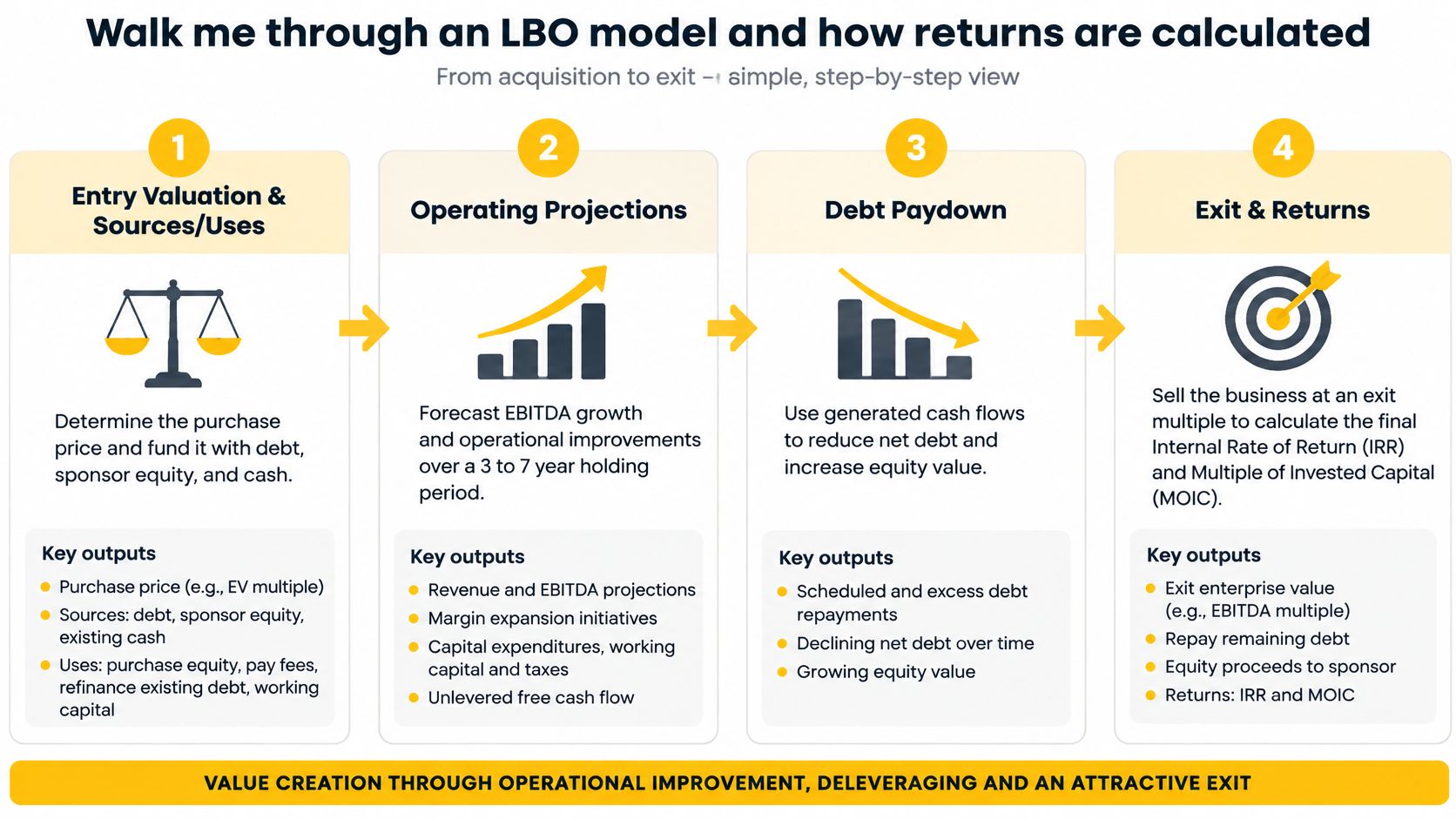
An LBO model estimates sponsor equity returns from acquiring a business with debt and equity, operating it, and eventually realizing value. Organize the explanation around the cash invested, cash generated, and cash received.
Use this process diagram to rehearse the transaction sequence.
Connect operations to sponsor proceeds
Establish entry enterprise value and build sources and uses, including refinancing, fees, and required cash. Project operating performance, cash generation, interest expense, mandatory amortization, and optional debt repayment.
Estimate exit enterprise value, subtract remaining net debt and relevant claims, and calculate sponsor proceeds. MOIC compares total equity proceeds with invested equity; IRR also reflects when contributions and distributions occur.
For a recurring-revenue business, test customer retention and cash conversion before assuming it can support aggressive debt repayment. EBITDA growth doesn't automatically provide cash for lenders.
Use the accompanying walkthrough to practice narrating the model.
Likely probes include lower exit multiples, higher interest costs, slower growth, and earlier distributions. Explain each effect through cash flows rather than memorized return shortcuts.
The investment-banking interview guide provides related preparation. The key mistake to avoid is describing debt financing as free return enhancement without discussing refinancing risk, covenant pressure, and potential equity loss.
10. What is the difference between comparable company analysis and precedent transaction analysis?
Domain and difficulty: Relative valuation, foundational with intermediate comparability judgments.
Trading comparables use current public-company valuation multiples. Precedent transactions use valuations paid in acquisitions, reflecting deal-specific conditions as well as the target's financial performance.
Both methods apply observed multiples to a relevant financial metric. Neither works well if the underlying businesses or accounting periods aren't comparable.
Explain selection before calculation
For trading comps, screen peers by business model, geography, growth, profitability, risk, and capital intensity. Align valuation dates and financial periods, and normalize material accounting differences.
For precedents, examine strategic rationale, buyer type, consideration, market conditions, and available deal disclosures. Control and expected synergies can support higher acquisition multiples, but precedents don't invariably produce higher valuations.
Say you're valuing an industrial distributor. Compare its margins, customer concentration, working-capital needs, and acquisition strategy with peers before deciding whether a discount is justified.
- Multiple selection: Use EV-based multiples with operating metrics and equity-based multiples with shareholder metrics.
- Sector judgment: For banks, P/E and price-to-book can be more informative than industrial-company EV/EBITDA conventions.
- Outlier treatment: Investigate differences before excluding inconvenient observations.
Interviewers may ask why a company deserves a premium. Connect your answer to stronger cash generation, durable growth, or lower risk rather than naming a higher-quality business.
Finish with a range and explain its drivers. Averaging every available multiple creates apparent precision without resolving the differences between the companies.
Top Finance Technical Interview Questions at a Glance
Use the difficulty tiers to set the depth of your first answer, not to predict how far an interviewer will probe. A moderate question can turn advanced when the interviewer changes an assumption or asks you to connect the result to a transaction decision.
| Question | Topic Area | Most Common In | Difficulty Tier |
|---|---|---|---|
| Walk me through a Discounted Cash Flow (DCF) valuation | Valuation | Investment banking, equity research, corporate finance | Moderate |
| Walk me through the three financial statements and how they link | Accounting and financial modeling | Investment banking, corporate finance, financial analyst roles | Moderate |
| What is the difference between enterprise value and equity value? | Valuation | Investment banking, equity research, corporate finance | Moderate |
| How does an increase in depreciation affect the three financial statements? | Accounting and financial statements | Investment banking, private equity, financial analyst roles | Moderate |
| Explain the relationship between bond prices and yields | Fixed income | Fixed income sales and trading, research, treasury | Moderate |
| How do you calculate WACC and what does it represent? | Corporate finance and valuation | Investment banking, equity research, corporate finance | Moderate |
| Explain put-call parity and the Black-Scholes model | Derivatives and options pricing | Derivatives trading, quantitative research, structured products | Advanced |
| How do you perform an accretion/dilution analysis in an M&A transaction? | M&A and financial modeling | Investment banking, corporate development | Moderate |
| Walk me through an LBO model and how returns are calculated | Leveraged buyouts and private equity | Private equity, investment banking, leveraged finance | Advanced |
| What is the difference between comparable company analysis and precedent transaction analysis? | Relative valuation | Investment banking, corporate finance | Moderate |
A reliable answer structure works across these domains: define the concept, lay out the mechanics, state the key assumptions, then explain what could change the result. In a DCF, expect follow-ups on cash flow, terminal value, and discount rate. In accounting, be ready to trace an item through all three statements. In fixed income and derivatives, explain how a change in an input affects value. In M&A and LBO questions, connect the model output to the buyer's or investor's returns.
Difficulty depends on the follow-up. A basic WACC calculation may be moderate; defending the capital structure or explaining how a change in rates affects valuation takes more judgment. The same applies to an LBO: outline the sources and uses, debt paydown, and exit assumptions before discussing MOIC and IRR.
Turn These Questions Into Offers With a Practice Plan
Knowing an answer and delivering it under interruption are different skills. Build a two-week practice routine around retrieval, calculation, and explanation rather than rereading model answers.
During the opening stretch, answer each prompt aloud without notes. Record yourself, then check whether you defined the output, explained the mechanics, stated assumptions, and verified the conclusion.
Diagnose the error before repeating the drill
Keep an error log with distinct categories. A formula mistake needs a different fix from an unsupported assumption or a correct answer delivered so slowly that the interviewer can't follow it.
- Mechanics errors: Rebuild the calculation in Excel and trace the affected accounts.
- Assumption errors: Write down when the standard answer stops working.
- Communication errors: Lead with the conclusion, then explain the supporting steps.
- Judgment errors: Connect the output to a decision, a risk, or the next piece of information you'd request.
For depreciation, reconcile the balance sheet rather than stopping at net income. For an LBO, calculate dated sponsor cash flows and compare MOIC with IRR; for valuation, change an operating driver and explain why the result moves.
During the later stretch, mix domains and add interruptions. Ask a practice partner to change the financing mix halfway through an acquisition answer or remove the immediate tax benefit from an accounting case.
Practice checking automated work
Don't limit preparation to producing answers. Practice auditing an AI-generated forecast for unsupported assumptions, inconsistent periods, broken formulas, and cash-flow errors.
An AICPA/CIMA survey of 1,446 finance and accounting professionals identified generative AI as the most prominent skills gap, cited by 46% of respondents. That supports practicing tool validation alongside finance fundamentals, not replacing the fundamentals with automated output.
Say an automated model forecasts rising sales while holding receivables flat without explanation. Identify the implied collection assumption, test whether it makes commercial sense, and show how correcting it affects cash generation.
Our AI Mock Interview sessions provide answer evaluation, and our role-specific guides support banking and financial analyst preparation. Use feedback to identify weak reasoning, then verify the financial mechanics yourself.
Before a live online interview, test your microphone, calculator, spreadsheet setup, and permitted reference materials. Follow the employer's rules on outside assistance, including AI tools, and rehearse explaining a calculation without depending on them.
Select your weakest topics and schedule focused practice. You're ready when you can handle a changed assumption, reconcile the result, and explain what it means to someone who doesn't build financial models.
Our question bank and guided mock interviews help you rehearse accounting, valuation, M&A, and LBO answers with follow-up practice. Visit Interview Pilot to choose a role-specific preparation path and turn your weakest finance topics into answers you can explain confidently.
Topics
technical interview questions finance
finance interview prep
DCF valuation
investment banking interview
M&A interview questions
Continue reading

Interviews
10 Tax Interview Questions You Should Prepare For
Master the 10 most common tax interview questions with sample answers, key topics to review, and tips for entry-level to senior tax roles.
October 31, 2026
17 min read

Interviews
How to Ace Behavioral Interview with STAR
See how to ace behavioral interview rounds with 6-8 scored stories, a timed STAR answer, follow-up practice, and a rehearsal that stays credible.
October 31, 2026
16 min read

Interviews
Interview Vocabulary List: Words and Phrases That Work
A practical interview vocabulary list: strong words, ready-to-use phrases, sample answers and recovery lines for English job interviews, sorted by what you need to say.
October 31, 2026