









Interviews
10 Interview Questions for Quality Engineer in 2026
Ten interview questions for quality engineer roles covering QA vs QC, PDCA, SPC, FMEA, CAPA, and test strategy, with sample answers and prep tips.
Interview Pilot Editorial Team
Updated October 26, 2026
20 min read

You've reviewed the job description, refreshed your quality terminology, and opened your notes beside the interview window. You can explain QA versus QC without hesitation. Then the interviewer asks how you'd handle a recurring defect when production wants to ship, and your polished definition suddenly isn't enough.
Quality engineer interviews go deeper than definitions because employers need someone who can make defensible decisions with incomplete evidence. They want to know what you'd contain, which measurements you'd trust, who you'd involve, and how you'd prove that a corrective action worked. Naming a tool is the opening, not the answer.
When preparing interview questions for quality engineer roles, connect every method to a decision. SPC should lead to a sensible response to variation. FMEA should lead to stronger controls. A test strategy should explain which risks you'll investigate before release and which uncertainties you'll escalate.
The technical language changes across manufacturing, software, and regulated products, but the underlying discipline transfers: establish the requirement, verify the evidence, assess the risk, and document the decision.
Use the questions below to rehearse beyond the opening definition. Prepare your answer structure, then tackle the follow-up without reading your notes. If you don't have professional experience yet, use a clearly identified laboratory, coursework, internship, or personal project rather than inventing ownership.
1. What is the difference between Quality Assurance (QA) and Quality Control (QC)?
QA concerns how people design and manage processes to prevent defects. QC concerns how people inspect, measure, and test outputs to detect nonconformance. Interviewers want to hear how you've connected those activities, not just memorized the distinction.
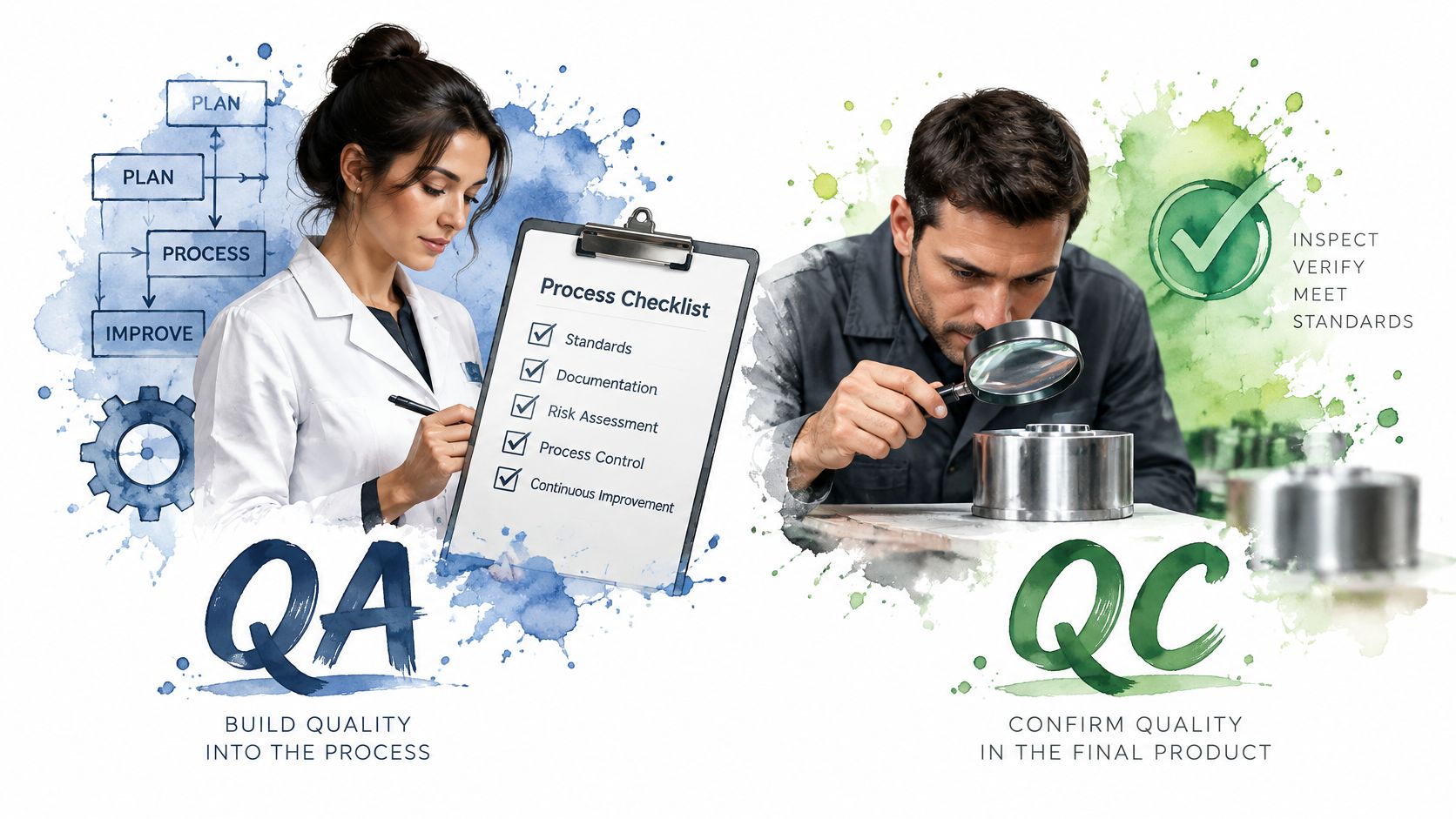
On a machining line, revising setup instructions and qualifying operators are assurance activities. Measuring finished bores against drawing requirements is control. In software, improving code-review criteria supports QA, while executing regression tests evaluates the product.
Connect prevention to detection
Build your answer around the requirement, the preventive process, the output check, and the feedback between them. Explain how inspection findings should improve upstream controls rather than become a permanent sorting operation.
- Follow-up probe: Which activities did you personally own, and what changed because of your work? Separate your contribution from the team's responsibilities.
- Sample answer structure: Describe a recurring dimensional defect, the inspection that detected it, the setup control you improved, and the evidence used to assess recurrence.
- Prep drill: Rehearse a concise explanation using a plant example, then translate it into software terminology. The testing interview questions guide can help you practice that distinction.
Don't promise that better QA eliminates QC. Strong prevention can reduce inspection burden, but product risk, customer requirements, and process uncertainty still determine the checks you need.
2. Explain the PDCA (Plan-Do-Check-Act) cycle and how you have applied it.
Suppose a regression suite takes too long because tests compete for shared accounts. Buying more execution capacity might help, but it won't necessarily fix the bottleneck. PDCA gives you a disciplined way to test the explanation before expanding the change.
Plan defines the problem, hypothesis, target, and measurement method. Do implements a bounded trial. Check compares the outcome with the intended result, including unwanted effects. Act standardizes a successful change or revises the approach.
Show what you learned from the trial
A strong answer describes piloting isolated test accounts and parallel execution on a representative module. Explain how you'd compare execution duration and failure reliability, then decide whether the approach deserves wider adoption.
The manufacturing equivalent might involve testing a revised molding parameter within an approved process window. You'd check scrap, dimensional conformity, and downstream performance rather than celebrating a faster cycle alone.
A successful trial improves the intended outcome without quietly transferring the problem to another operation.
Follow-up probe: How did you know the improvement came from your change rather than a different product mix, operator, or environment?
Sample answer structure: Problem and baseline → testable hypothesis → controlled trial → comparison → standardization or revision.
Prep drill: Prepare a successful improvement and an unsuccessful trial. For each, explain the evidence that justified your next decision. Use genuine project measurements when available, but don't manufacture precision to make a modest improvement sound impressive.
3. How do you perform root cause analysis? Walk me through a tool such as 5 Whys or a fishbone diagram.
A fishbone diagram organizes possible causes. It doesn't establish which cause is true. That distinction is often what the interviewer probes after you explain the tool.
Start by confirming the defect and containing the immediate risk. Define what failed, where it occurred, when it appeared, and which products or environments weren't affected.

Move from hypotheses to evidence
For a medical-device packaging failure, a fishbone might include sealing equipment, material variation, setup methods, measurement, and environmental conditions. Compare affected and unaffected packages, check measurement reliability, and test suspected mechanisms under controlled conditions.
Use 5 Whys to explore the causal chain, but don't force every investigation into a single linear explanation. Interacting causes may require separate tests.
- Follow-up probe: What evidence would have disproved your preferred explanation? Be ready to describe a competing hypothesis and how you evaluated it.
- Sample answer structure: Verified problem → containment → candidate causes → discriminating tests → confirmed mechanism → corrective action and effectiveness review.
- Prep drill: Explain a fishbone without a whiteboard, then practice defending your investigation using these problem-solving scenarios.
Avoid ending with human error. If an operator selected the wrong recipe, investigate access controls, recipe identification, changeover verification, and whether the interface made a predictable mistake easy. Training may help, but it isn't automatically the strongest corrective action.
4. What is Statistical Process Control (SPC), and how do you interpret a control chart?
SPC compares current process measurements with historical behavior to identify evidence of change, as the NIST engineering statistics handbook explains. Interviewers want to know whether you can distinguish routine common-cause variation from special-cause signals and respond without making the process worse.
Begin with the measurement method, chart selection, and subgrouping. A chart is only useful if the observations represent the process you intend to monitor.
Separate stability from conformance
Control limits describe expected process behavior. Specification limits describe acceptable product characteristics. A stable process can consistently produce unacceptable output, while an unstable process can temporarily produce conforming parts.
For example, film-thickness measurements may remain within specification while showing a sustained shift after equipment maintenance. Investigate the shift under the approved response plan rather than waiting for defective output.
Follow-up probe: Would you adjust the machine after an ordinary fluctuation? Explain why unnecessary adjustment can introduce additional variation.
Sample answer structure: Characteristic and measurement confidence → chart and subgroup rationale → observed signal → containment or investigation → documented response.
This video provides another way to rehearse chart interpretation.
Prep drill: Explain a chart aloud to a production supervisor. State what you know, what you suspect, and what evidence you need before changing a setting. Don't recite capability thresholds without checking stability, distribution assumptions, measurement adequacy, and the governing customer requirement.
5. What is Failure Mode and Effects Analysis (FMEA), and how do you run one?
Start with a failure chain, not a scoring spreadsheet. For a bolted assembly, insufficient clamp load is a failure mode, joint separation is a possible effect, and an incorrect tightening program is a possible cause.
FMEA brings design, manufacturing, quality, and other relevant specialists together to identify failures and strengthen prevention or detection before release. Interviewers assess whether you can facilitate that reasoning and turn it into accountable action.

Make the controls credible
Explain how the team defines scope, agrees on rating criteria, evaluates existing controls, and assigns actions. Distinguish prevention from detection: interlocking the assembly recipe can prevent an incorrect selection, while reviewing a torque trace can detect certain tightening abnormalities.
- Follow-up probe: Would a favorable overall score justify leaving a severe hazard untreated? Explain why aggregate rankings must not obscure consequential failure effects.
- Sample answer structure: Process function → failure mode, effect, and cause → existing controls → prioritized action → owner → verification and document updates.
- Prep drill: Build a short FMEA for a connector installation or payment workflow. Defend the relationship between each cause and its proposed control.
Practical rule: A completed FMEA isn't evidence that a control works. Verify the control under realistic failure conditions.
Connect actions to the control plan, work instructions, or verification tests. Otherwise, the team has documented concern without changing operational risk.
6. Explain the DMAIC methodology in Six Sigma. When would you use it?
Use DMAIC when an existing process has a persistent performance problem that needs reliable measurement and structured analysis. Don't present it as the mandatory response to every isolated defect or straightforward correction.
Define establishes the problem and boundaries. Measure establishes trustworthy baseline performance. Analyze tests causes. Improve evaluates solutions. Control establishes ownership and monitoring so the gains persist.
Explain the project gates
Consider recurring machining scrap attributed to tool wear. Before changing replacement intervals, verify the defect classification and measurement system, then examine scrap by tool age, machine, material, and operating conditions.
Your analysis should explain why tool wear is causal rather than merely associated with a difficult product mix. The improvement trial should also assess tool cost, downtime, and unintended quality effects.
Follow-up probe: Why did this require DMAIC instead of a short PDCA trial? Discuss the complexity, uncertainty, and analytical work involved rather than claiming that one framework is better by nature.
Sample answer structure: Business problem → operational defect definition → baseline and measurement confidence → analysis → validated improvement → control plan and response owner.
Prep drill: Take a project from your background and identify the evidence needed to advance between phases. If you used a statistical test, explain its assumptions and why it suited the question.
Name your personal contribution precisely. Preparing the dataset, validating the inspection method, and leading the trial are different responsibilities. Don't claim a whole project because you attended its review meetings.
7. How do you design a sampling inspection plan? What is AQL?
Sampling inspection supports a lot-acceptance decision without inspecting every unit. AQL, or acceptance quality limit, is a reference quality level used in acceptance-sampling schemes, not a promise about the defect content of an accepted shipment.
The interviewer is testing whether you understand the risks behind the table lookup. You need a defined lot, defect classification, suitable inspection method, representative selection, and an approved acceptance plan.
Explain the decision before choosing the sample
Suppose incoming connectors have intermittent plating defects. Check whether the lot combines different production batches and whether the inspection can reliably detect the defect. Sampling a convenient box from the top of a pallet won't necessarily represent the shipment.
- Follow-up probe: Can a bad lot pass sampling inspection? Yes. Explain consumer's risk, then contrast it with the producer's risk of rejecting acceptable output.
- Sample answer structure: Product risk and governing requirements → lot definition → inspection method → sampling scheme → random selection → acceptance decision and escalation.
- Prep drill: Explain why an accepted lot isn't a defect-free lot, then describe what changes when the characteristic has serious safety consequences.
Don't invent a sample size from memory. Explain how you'd select it using the applicable approved standard and contractual requirements.
If a lot fails, contain it and follow the authorized disposition process. Repeatedly taking fresh samples until one passes undermines the original decision rule and can conceal supplier problems.
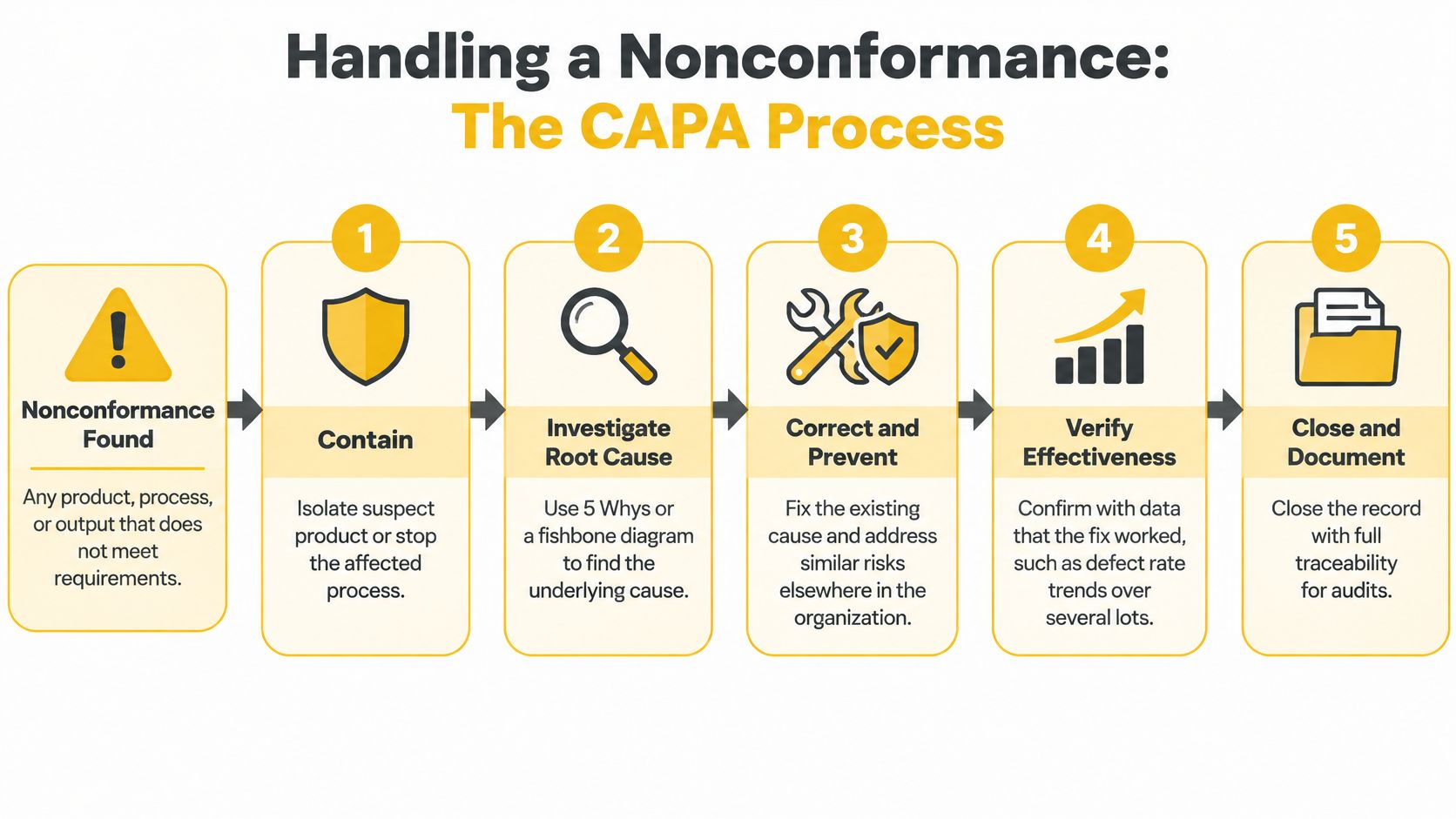
8. Describe how you handle a nonconformance and run a CAPA process.
Your opening action should address exposure, not paperwork. If an aerospace supplier discovers an out-of-tolerance drilled feature, identify affected work, stop inappropriate release, preserve traceability, and establish who has disposition authority.
Correction addresses the detected problem. Corrective action addresses its cause so it doesn't recur. Broader preventive or risk-reduction work examines where similar weaknesses could exist.
Define effectiveness before closure
A strong CAPA answer includes containment, investigation, action selection, implementation evidence, and an effectiveness review. Not every nonconformance needs a full CAPA, so explain how recurrence, systemic weakness, and risk influence escalation.
For the drilling example, replacing a worn tool corrects the immediate condition. Validating a tool-life control and checking representative subsequent production addresses recurrence.
Follow-up probe: What if the action is complete but you don't yet have enough production evidence? Distinguish implementation completion from demonstrated effectiveness.
Sample answer structure: Requirement and deviation → affected population → containment and communication → verified cause → implemented action → predefined effectiveness assessment → authorized closure.
Prep drill: Rehearse your CAPA summary, then answer who could release held material and what would trigger reopening the investigation.
Don't close a CAPA because the due date arrived. Close it when the required evidence supports the decision.
In software, rollback or feature isolation may provide containment. For physical products, assess inventory, work in progress, shipped units, and customer exposure.
9. Which quality management standards have you worked with, and how do they shape your daily work?
Naming standards is easy. Explaining how they changed a release decision, supplier approval, or document revision demonstrates working knowledge.
ISO's overview of ISO 9001 describes a quality-management framework rather than a guarantee that every product is defect-free. Make that distinction clear when discussing certification and audit evidence.
Translate requirements into daily controls
For a medical-device role, describe how an approved design change connects to risk review, verification evidence, controlled documentation, and release authorization. For automotive supplier quality, explain how customer-specific requirements affect process approval and change notification.
Only claim familiarity with standards you've actually used. If your experience is adjacent, identify the transferable discipline and the requirements you still need to learn.
- Follow-up probe: Show how you'd audit a process rather than check whether a procedure exists. Trace a requirement through an actual record, an operator's activity, and objective evidence.
- Sample answer structure: Applicable framework → relevant requirement → operational control → record or observation → finding and follow-up.
- Prep drill: Choose a process such as calibration or document control. Explain how you'd distinguish an isolated missing record from a systemic control failure.
For regulated products, confirm the current governing requirements for the product and market. Don't rely on an outdated interview guide's regulatory shorthand.
Your strongest example may be a small, defensible finding. Explain the requirement, evidence, and gap without turning the audit into a hunt for mistakes.
10. How do you design a software test strategy, and what quality metrics do you track?
Start with customer and operational risk, not Selenium, Cypress, or a coverage percentage. For checkout, investigate incorrect charges, duplicate transactions, authorization failures, and recovery from interrupted requests before polishing low-impact visual checks.
In Katalon's 2025 survey of more than 1,400 QA professionals, 82% reported using manual testing in day-to-day work. Explain how exploratory testing complements repeatable automated checks rather than treating either approach as sufficient.
Connect execution to decisions
Sample answer structure: Critical risks → test levels and environments → automation choices → release gates → monitoring and response.
Place fast unit and API checks early in CI, then use targeted UI tests for critical journeys. Isolate test data, retain diagnostic artifacts, and give quarantined flaky tests an owner and a repair plan.
Only 25% of respondents measured test effectiveness in the 2025 State of Testing report. Go beyond pass rate: explain how escaped defects, flaky-test frequency, diagnostic time, and critical-journey coverage would change engineering priorities.
Follow-up probes: When should a failed test block release? How would you review AI-generated tests? Distinguish product failures from infrastructure faults, and validate generated cases against requirements, traceability, and sensitive-data controls.
Prep drill: Design a checkout strategy, then defend what you'd omit under deadline pressure. Use the software tester interview questions to challenge your automation and defect-triage choices.
How the 10 Quality Engineer Interview Questions Compare
| Item | Focus Area | Core Tool or Method | Typical Industries | What Interviewers Test |
|---|---|---|---|---|
| What is the difference between Quality Assurance (QA) and Quality Control (QC)? | Prevention versus defect detection | Process standards and audits; inspection and testing | Manufacturing, software | Understanding of proactive QA and reactive QC, with relevant examples |
| Explain the PDCA (Plan-Do-Check-Act) cycle and how you have applied it. | Continuous improvement | Plan-Do-Check-Act cycle | Manufacturing, software, Lean operations | Ability to run a measurable improvement experiment and standardize results |
| How do you perform root cause analysis? Walk me through a tool such as 5 Whys or a fishbone diagram. | Identifying systemic causes of failures | 5 Whys, fishbone diagram, data verification | Manufacturing, medical devices, operations | Structured analysis, evidence-based cause verification, and prevention of recurrence |
| What is Statistical Process Control (SPC), and how do you interpret a control chart? | Monitoring process stability and variation | Control charts, UCL/LCL, capability indices | Manufacturing, semiconductors, service operations | Ability to distinguish common- and special-cause variation and interpret chart signals |
| What is Failure Mode and Effects Analysis (FMEA), and how do you run one? | Proactive risk identification and prioritization | DFMEA or PFMEA; severity, occurrence, detection, and action priority | Automotive, aerospace, medical devices | Risk-based thinking, consistent scoring, and linking actions to controls |
| Explain the DMAIC methodology in Six Sigma. When would you use it? | Data-driven process improvement | Define, Measure, Analyze, Improve, Control | Manufacturing, healthcare, finance, services | Ability to manage a project through measurable phases and sustain improvements |
| How do you design a sampling inspection plan? What is AQL? | Lot acceptance and inspection risk | AQL sampling plans, ANSI/ASQ Z1.4 or ISO 2859-1 | Manufacturing, consumer electronics, food | Understanding of sample selection, acceptance criteria, and producer and consumer risk |
| Describe how you handle a nonconformance and run a CAPA (Corrective and Preventive Action) process. | Containment, corrective action, and recurrence prevention | CAPA workflow: contain, investigate, act, verify, document | Aerospace, medical devices, automotive | Ownership, root-cause discipline, effectiveness checks, and traceable documentation |
| Which quality management standards have you worked with, and how do they shape your daily work? | Quality systems and regulatory compliance | ISO 9001, IATF 16949, AS9100, ISO 13485 | Automotive, aerospace, medical devices, general industry | Practical application of standards in audits, documentation, suppliers, and design controls |
| How do you design a software test strategy, and what quality metrics do you track? | Risk-based software testing and release readiness | Test pyramid, automation, CI/CD, defect and coverage metrics | Software, fintech, SaaS | Test prioritization, automation judgment, useful metrics, and collaboration |
Turning These Questions Into a Practice Plan That Works
Pick a foundational question, a technical question, and an ownership question for your next practice session. QA versus QC, SPC or FMEA, and a CAPA you contributed to make a useful combination. Draft a brief answer for each using a real problem, your responsibility, the evidence you evaluated, and the outcome.
Include a baseline, target, and result when your records support them. Keep the denominator and measurement period clear, and distinguish first-pass improvement from recovered output or rework. If you don't have reliable financial results, don't attach speculative savings to a sound technical achievement.
Rehearse the interruption, not just the speech
Ask a practice partner to interrupt after your opening explanation. They should challenge your assumptions, question the measurement method, or add pressure to ship. That forces you to reason rather than recite.
Use these prompts to expose weak points:
- Evidence challenge: What would make you reject your preferred explanation?
- Authority challenge: Who could approve release, disposition, or a controlled change?
- Transfer challenge: How would the decision differ for a cloud application and a regulated physical product?
- Ownership challenge: What did you personally do, and what did another specialist approve?
Record your practice and listen for missing decisions. Candidates often explain the investigation in detail but never state what they recommended, why it was proportionate to the risk, or how they verified the result. Remove background detail that doesn't help the interviewer understand those decisions.
Build answers you can defend
Keep a compact evidence sheet for each project. Capture the requirement, defect definition, measurement method, containment, tested causes, action, and effectiveness criterion. Anonymize sensitive details and don't bring confidential company records into an interview.
For hiring-side perspectives alongside technical preparation, the Hire Sense hiring blog offers another place to explore recruitment topics. Keep your rehearsal anchored to the target role's responsibilities rather than collecting increasingly long lists of possible questions.
If you lack direct experience, say so plainly and work through a labeled scenario. A graduate who checks measurement reliability, recognizes uncertainty, and respects release authority can give a stronger answer than an experienced candidate who guesses confidently.
You're ready when you can explain the method, defend the decision, and identify the evidence that would change your mind. That's more useful than delivering a flawless definition.
Our AI mock interviews provide guided practice and evaluations of your answers, while our question bank helps you review technical and behavioral prompts. Visit Interview Pilot to rehearse these quality-engineering questions and strengthen the follow-up answers you find hardest.
Topics
quality engineer interview
QA interview questions
quality assurance
FMEA and SPC
interview preparation
Continue reading

Interviews
10 Questions to Ask in an HR Interview: Why Each Matters
Discover the best questions to ask in an HR interview, covering culture, benefits, growth, and logistics, plus why each one helps you decide.
October 26, 2026
17 min read

Interviews
10 Interview Practice Software Tools Compared for 2026
Compare 10 interview practice software tools by features, pricing, and strengths. See which AI mock, peer, or coaching platform fits your job search.
October 25, 2026
16 min read

Interviews
10 Job Interview Tips and Tricks for Better Results
Discover 10 practical job interview tips and tricks for research, answers, remote interviews, mock practice, and a memorable follow-up.
October 22, 2026
19 min read