









Career
8 Interview Questions Testing: Answers and Scenarios
Master interview questions testing with practical answers, scenarios, expert tips, and proven frameworks for QA, automation, performance, and strategy roles.
Interview Pilot Editorial Team
Updated October 21, 2026
17 min read

You're staring at a job description, a half finished resume, and a browser full of definitions you could recite but couldn't defend under follow up questions. That's the gap most candidates hit with interview questions testing judgment, not vocabulary. Interviewers aren't checking whether you've memorized a glossary. They're checking whether you'd make a sound decision when time, risk, and incomplete information collide.
A strong answer names the technique, explains what it's for, and connects your choice to user risk, product quality, or delivery speed. That decision first framing matters in other technical hiring too, as this offensive security skills-first guide shows for hands on roles. Structure also matters on the interviewer's side. A major 1993 meta-analysis combined 31 investigations and found structure was the only characteristic that consistently moderated validity, with estimated true validity rising to 0.38 after correcting for statistical artifacts, as reported in the 1993 meta-analysis of employment interview validity.
The eight questions below work the same way. For each one, lead with the decision, show the evidence you considered, and close with the outcome. You'll sound like someone who shapes strategy, not someone who only executes tasks.
1. What Is the Difference Between Verification and Validation?
Verification asks whether you built the product right, according to specifications, designs, and requirements. Validation asks whether you built the right product, one that meets the user's actual need and intended use. That framing is commonly attributed to Barry Boehm, and it's still the cleanest way to keep the two straight in an interview.

Reviewing a requirements document against a design spec to confirm consistency is verification. You haven't run the product with a real user yet, you're checking artifacts against each other. A user acceptance test where business users confirm a checkout flow solves their problem is validation, because the evidence comes from intended use.
How to Answer It Well
Don't stop at definitions. Give one concrete example from your own work for each term, then state the uncomfortable implication interviewers want to hear.
A product can pass verification and still fail validation. If the spec was wrong, building it perfectly doesn't help the user.
Practice a concise 60 second answer out loud, not just in your head. Interview Pilot's Question Bank and AI Mock Interview can help you rehearse this kind of foundational QA question until the distinction sounds natural, with an example ready instead of a textbook sentence you hope you remember.
2. Black-Box, White-Box, and Grey-Box Testing
These three approaches differ by how much internal implementation you can see. Black-box testing evaluates functionality through inputs and outputs without knowledge of the code. White-box testing examines internal logic, paths, branches, and data structures. Grey-box testing uses partial knowledge, such as architecture diagrams or database schemas, to design more targeted tests.

Testing a login form with valid and invalid credentials and checking the result is black-box work. Writing unit tests that force each branch of a pricing function's if else logic is white-box. Sending REST API requests while checking database state afterward is typically grey-box, because you're using internal knowledge to verify external behavior more precisely.
Choosing Between Them in an Interview
Interviewers don't want a ranking, they want a reasoned trade-off for a given scenario. Explain what you'd choose for a payment API versus a UI form, and what each approach can and can't detect. Black-box can't tell you an untested branch is hiding. White-box can miss a requirement nobody implemented.
Mention coverage tools such as JaCoCo for Java or Istanbul and nyc for JavaScript to show you know how white-box evidence is measured. Then close with the limitation, coverage shows what executed, not whether the behavior was right.
3. Regression Testing vs. Retesting
Candidates confuse these constantly, and interviewers know it. Retesting, also called confirmation testing, verifies that a specific defect is fixed by rerunning the test that originally failed. Regression testing checks that a change, a bug fix or a new feature, hasn't unintentionally broken functionality that previously worked.
After a fix for a coupon field that rejected valid codes, retesting confirms valid codes now work. Regression testing then checks checkout totals, tax calculation, and order confirmation emails, because that's where a side effect would hurt users. One is narrow and targeted, the other is broader and usually automated for efficiency.
Frame Your Answer Around Impact Analysis
- Start with dependencies: Name which modules depend on the changed code before you name test cases.
- Select by risk: Prioritize areas most affected by the change and most critical to the business, not everything equally.
- Use quick gates first: Run smoke and sanity checks before deeper regression so a broken build doesn't waste a full run.
The 2012 Knight Capital trading incident, where a faulty deployment caused significant losses, is widely cited as a lesson in thorough regression and deployment verification. If you want broader practice applying this reasoning, review these technical interview questions for software engineers and adapt the impact analysis habit to QA scenarios.
4. Equivalence Partitioning and Boundary Value Analysis
You can't test every possible input, so you sample intelligently. Equivalence partitioning divides inputs into groups the system should treat the same way, so you test one representative from each group. Boundary value analysis then focuses on the edges of those partitions, where defects are more likely to appear.
This visual helps you picture how a single field's valid range creates edges worth probing.

For an age field accepting 18 to 65, your valid partition is 18 to 65, with invalid partitions below and above. Boundary tests sit at 17, 18, 65, and 66. For a password requiring 8 to 16 characters, you'd test lengths of 7, 8, 16, and 17, plus a representative valid and invalid case inside each partition.
A Structure Interviewers Recognize
Answer in order, partitions first, then boundaries, then a few invalid and special cases. That sequence signals method, not random case generation, and it's the approach Glenford Myers popularized in The Art of Software Testing.
Watch this walkthrough, then practice extending the same logic to dates, prices, and text lengths before your interview.
Be ready for the follow up with two inputs. Mention pairwise testing for combinations when exhaustive coverage would explode, and explain what risk you're accepting by sampling pairs instead of every combination.
5. Test Levels and the Testing Pyramid
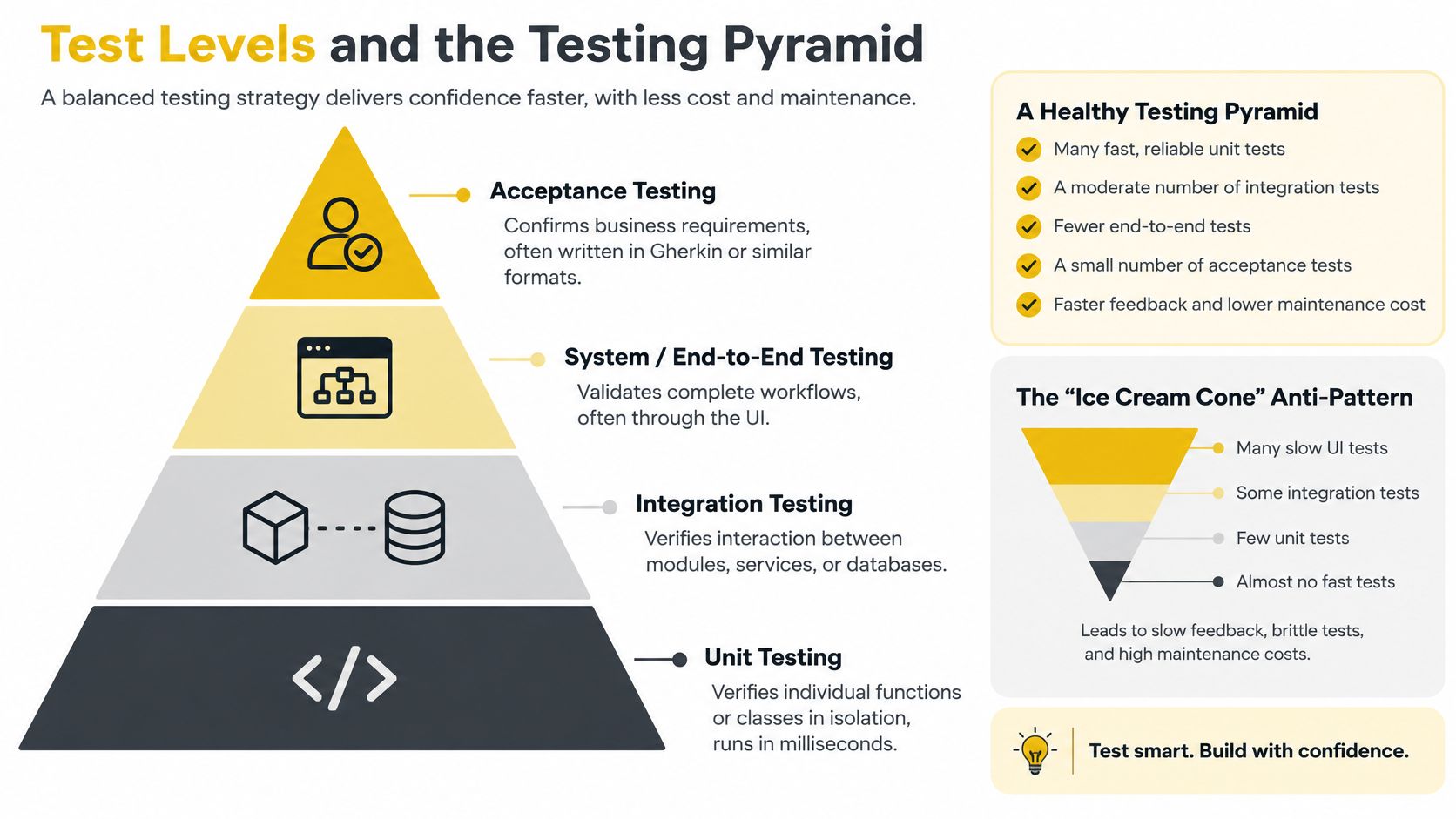
Testing is organized into levels, unit, integration, system, and acceptance, each answering a different question. The testing pyramid suggests most tests should be fast, low level unit tests, with fewer integration tests and a small number of slow end to end UI tests. It's a strategy for feedback speed and maintenance cost, not a diagram to memorize.
A payment feature makes this concrete. Unit tests verify tax calculation logic in isolation. Integration tests verify the payment gateway API behaves as expected. End to end tests verify the full checkout flow a user completes. Each level catches failures the others can't see as cheaply.
Adapting the Pyramid Instead of Reciting It
Teams commonly reflect this layering with Jest, JUnit, or pytest for unit tests, Postman or REST Assured for API tests, and Selenium, Cypress, or Playwright for UI tests. In a microservices architecture you might weight integration and contract tests more heavily, because service boundaries become the risky part.
Practical rule: Fast unit tests run on commit. Slower suites gate a merge or a release, so feedback arrives while the change is still cheap to fix.
Mention the test ice cream cone anti-pattern, too many slow UI tests and too few unit tests, to show you recognize the failure mode. For practice explaining trade-offs like this under pressure, work through these interview questions on problem solving and narrate your reasoning out loud.
6. Writing an Effective Bug Report
A bug report isn't paperwork, it's a communication tool that determines how fast a developer can reproduce, diagnose, and fix a defect. Interviewers ask this to evaluate your precision and empathy for the person receiving the report. A strong report includes a clear summary, environment details, reproduction steps, expected and actual results, severity and priority, and evidence such as logs or screenshots.
Weak reports force developers to guess. Compare these two titles for the same failure and you'll see why specificity matters.
- Weak title: Checkout doesn't work.
- Strong title: Checkout fails with HTTP 500 when applying a 10% coupon to an order over $100 in Chrome 125 on Windows 11. Expected a discounted total, actual result was an error banner and a cleared cart.
Use a Repeatable Structure Every Time
Keep the same order, title, steps, expected, actual, environment, evidence, so readers always know where to look. Make titles specific by naming the component, the action, and the failure. Mozilla's public Bugzilla is a widely studied example of structured defect reporting at scale, and it rewards exactly this kind of discipline.
This hierarchy diagram also shows why clear structure beats volume, whether you're organizing tests or organizing a report.
In the interview, narrate how you'd confirm the bug is reproducible before filing it. That one habit separates careful testers from people who forward every anomaly they see.
7. Manual Testing vs. Automated Testing When Should You Automate?
This question tests return on investment thinking, not tool loyalty. Automated testing uses scripts and frameworks to execute tests repeatedly and quickly. Manual testing relies on human judgment, exploration, and usability assessment. A strong answer explains which work belongs where, and why.
A typical team automates login, checkout, and API regression tests in a CI pipeline, because those flows are stable, repetitive, and business critical. The same testers run exploratory sessions on new features, where requirements are still moving and a human notices confusing behavior a script would accept. Selenium, created by Jason Huggins in 2004 at ThoughtWorks, popularized browser automation, but popularity isn't a justification by itself.
Criteria That Make Your Decision Defensible
- Frequency of execution: Tests you run on every commit repay automation cost faster than tests you run once.
- Stability of the feature: Rapidly changing UI makes automation brittle and expensive to maintain.
- Business criticality and setup cost: High risk flows justify investment, low risk flows often don't.
Automate at the API or unit level where you can, it's faster and more stable than UI automation. Automation complements manual testing, it doesn't replace it. If you're preparing specifically for tester roles, these interview questions for software testers will help you practice justifying those choices with evidence.
8. Smoke Testing vs. Sanity Testing
Both are quick checks, but they answer different questions at different moments. Smoke testing is a shallow, broad set of checks on a new build to confirm core functionality works well enough for further testing. Sanity testing is a narrow, focused check after a minor change or bug fix to verify specific functionality behaves as expected.
After a new build reaches staging, a smoke test confirms the application starts, users can log in, and the dashboard loads before QA invests in detailed testing. After a hotfix for a currency formatting bug, a sanity test verifies prices display correctly across the affected pages, and only those pages need that focused attention.
How to Keep the Distinction Clear
Describe smoke testing as a build acceptance gate and sanity testing as focused verification after a change. That language tells the interviewer you understand test scoping, not just terminology. It also explains your decision when a build fails smoke testing, you reject it quickly instead of burning hours on deeper testing.
Name the critical user journeys you'd put in a smoke suite for the product in front of you, an e-commerce checkout or a banking login and transfer flow. Specific journeys beat generic lists.
Acknowledge that some teams use the terms interchangeably, then state your definitions clearly anyway. Interviewers reward candidates who clarify meaning instead of pretending the industry is perfectly consistent.
8 Essential Software Testing Interview Questions Comparison
| Topic | Approach | 🔄 Complexity & Resources | 📊 Expected Outcome | Ideal Use Case | ⭐ Key Advantage |
|---|---|---|---|---|---|
| Verification vs. validation | Verification checks work against specifications; validation checks whether the product meets user needs. | Verification is often static and earlier; validation usually involves execution and later testing. | Confirms both conformance to specifications and fitness for purpose. | Reviews and inspections for verification; system or acceptance testing for validation. | 💡 Together, they reveal whether the product is built correctly and is the right product. |
| Black-box, white-box, and grey-box testing | Tests behavior without code access, examines internal logic, or combines both with partial internal knowledge. | Black-box needs no code access; white-box needs code knowledge and coverage tools; grey-box needs some system insight. | Finds user-facing defects, internal logic issues, or integration problems, respectively. | Black-box for user workflows; white-box for unit logic; grey-box for APIs and integrations. | ⭐ Offers different levels of visibility to match the testing goal. |
| Regression testing vs. retesting | Retesting checks a specific fix; regression testing checks for unintended effects of changes. | Retesting is narrow and quick; regression can be broad and resource-intensive, often automated. | Confirms a defect is fixed and helps ensure existing features still work. | Retest the failed scenario after a fix; run risk-based regression after changes. | ⚡ Targeted retesting is fast, while regression protects wider functionality. |
| Equivalence partitioning and boundary value analysis | Groups inputs expected to behave alike, then tests representative values and boundary edges. | 🔄 Low-to-moderate effort; reduces test cases but depends on clear requirements. | Efficiently covers valid and invalid classes and catches edge-related defects. | Input fields with ranges, such as age, password length, or price limits. | ⚡ Provides meaningful coverage with relatively few test cases. |
| Test levels and the testing pyramid | Combines unit, integration, system/end-to-end, and acceptance tests, typically with more low-level tests. | Fast unit tests use fewer resources; end-to-end tests are slower and costlier to maintain. | Provides layered feedback, from isolated logic checks to complete workflow validation. | Building a maintainable test strategy and integrating checks into CI/CD. | ⭐ Finds defects at the earliest practical level for faster feedback. |
| Writing an effective bug report | Records reproduction steps, environment, expected and actual results, impact, and evidence. | 🔄 Requires careful, concise documentation and enough detail to reproduce the issue. | Helps developers reproduce, prioritize, diagnose, and fix defects. | Reporting defects in issue trackers such as Jira, Bugzilla, or GitHub Issues. | 💡 Clear reports reduce triage delays and back-and-forth. |
| Manual vs. automated testing | Manual testing uses human judgment; automation runs scripted checks repeatedly. | Automation has upfront setup and maintenance costs; manual effort grows with repeated runs. | Automation provides repeatability and scale; manual testing supports exploration and usability assessment. | Automate stable, frequent regression checks; manually explore new or changing features. | ⚡ A balanced approach combines repeatable coverage with human insight. |
| Smoke testing vs. sanity testing | Smoke testing broadly checks whether a build is testable; sanity testing narrowly checks a specific change. | Both are usually quick; smoke covers core paths, while sanity focuses on the affected area. | Supports build acceptance or provides focused confidence after a change. | Smoke after a new build; sanity after a targeted fix or minor change. | ⚡ Quickly identifies builds or changes that need immediate attention. |
Turn Every Answer into a Clear Decision
Prepare each topic the same way, a 60 second definition, a concrete example, the trade-off you considered, and the outcome you achieved. That structure works because it mirrors how strong interviewers already evaluate answers. Personnel assessment research summarized by the U.S. Office of Personnel Management reported unstructured interview scores typically explained about 4% of the variance in future job performance, whereas structured scores explained about 32%, in its review of structured interview methods. You're preparing for structure, so give structured evidence.
Recent personnel selection research reports mean predictive validity of approximately 0.42 for structured interviews compared with approximately 0.19 for unstructured interviews, while noting substantial variation around the structured estimate, in a Cambridge review of selection interview effectiveness. That variation is your opportunity. Poorly prepared candidates treat interview questions testing concepts as a memorization problem. Strong candidates show they can audit a question, identify the competency, check whether the scenario resembles the job, and define what a strong answer proves.
Adapt the Same Material to the Role
- Manual QA: Emphasize exploratory judgment, bug report clarity, and how you decide where risk lives.
- Automation roles: Emphasize maintainability, test level choices, and why you automate below the UI when possible.
- Performance engineering: Emphasize risk modeling, realistic scenarios, and what evidence would change your decision.
- Test strategy and leadership: Emphasize coverage strategy, regression selection, and feedback speed across the pipeline.
Don't script full paragraphs, you'll sound rehearsed the moment a follow up changes direction. Instead, rehearse short decision stories you can reshape, a boundary case you caught, a regression suite you trimmed by risk, a bug report that cut diagnosis time because the steps were precise. Practice pivoting each story to a different question, since interviewers often probe the same experience from another angle.
Before the interview, rehearse with Interview Pilot's AI Mock Interview sessions and use its Question Bank to test your explanations across different scenarios. During a live interview, Interview Copilot can provide real time response prompts across 99+ languages. That's support for your preparation, not a substitute for judgment. The goal isn't to memorize definitions from this list. It's to sound, consistently, like a tester who understands what each technique is for, when it fails, and how to apply it responsibly when a real release is on the line.
Rehearse these eight testing decisions out loud with role specific mock sessions, a searchable question bank, and real time prompts that help you stay structured when follow up questions get specific. Visit Interview Pilot to practice your verification, regression, and automation answers before your next QA interview and turn memorized definitions into clear, evidence based decisions.
Topics
interview questions testing
QA interview questions
software testing interview
test automation interview
quality assurance career
Continue reading

Interviews
8 Interview Questions for Software Testers
Prepare with 8 interview questions for software testers covering test design, automation, bug reports, metrics, and practical answers.
September 15, 2026
21 min read

Career
How to Find Jobs at Startups
Build a startup job shortlist around the work, company stage, and available support, then verify openings and ask useful questions before joining.
October 20, 2026
3 min read

Career
How to Network for a Job Without Asking Everyone for a Favor
Build a focused job-search network through useful conversations, specific questions, and respectful follow-through rather than mass referral requests.
October 20, 2026
3 min read