










Career
8 Synonyms Work Ethic: Resume and Interview Examples
Explore 8 synonyms work ethic alternatives with resume wording, interview examples, strengths, trade-offs, and tips for choosing the right phrase.
Interview Pilot Editorial Team
Updated September 21, 2026
19 min read

The best synonyms for work ethic aren't interchangeable. Candidates typically spend 5 to 10 hours preparing for interviews, 54% research the company, and 42% use AI tools during prep, so the most useful alternative is the one that proves a specific behavior, such as diligence for thoroughness, dedication for long-term commitment, or discipline for consistency.
A lot of advice on synonyms work ethic gets one thing wrong. It treats every replacement as if it means the same thing. It doesn't. If you say you're dedicated, that sounds different from saying you're accountable. If you say you're professional, that signals something different from proactive.
That distinction matters because “work ethic” is a broad label. Historically, the modern idea grew from the Protestant Reformation and was later systematized in Max Weber's 1905 The Protestant Ethic and the Spirit of Capitalism, then became especially important as wage labor expanded during industrialization, according to this historical overview of work ethic. In modern hiring, the phrase still carries weight, but it often needs translation into clearer, more believable language.
Use this article as a matching guide, not a word bank. Each option below shows what the term really means, when it fits, when it sounds too vague, and how to use it on a resume or in an interview without leaning on buzzwords. If you're also improving your daily routines, these practical working habits 2026 ideas pair well with the language choices below.
1. Diligence
Diligence works when you want to stress careful effort. It suggests thoroughness, patience, and attention to detail, not just raw effort. If your strength is double-checking work, preparing thoroughly, or catching issues others miss, this is often a better choice than “hard-working.”
That makes diligence especially useful for roles where quality matters as much as speed. A data analyst validating a report, a software engineer testing edge cases, or a finance candidate checking assumptions before a model walkthrough all signal diligence more clearly than a broad claim about work ethic.

When diligence fits best
Use diligence when your example shows that you prepared carefully or executed methodically.
- Resume fit: “Applied diligent review to quarterly reporting materials and flagged inconsistencies before submission.”
- Interview fit: “I'm diligent about preparation, so before technical interviews I review likely question types, refine my explanations, and test weak spots instead of only practicing my strengths.”
- Best tone: Confident and detail-oriented.
Interview prep is a natural place to use this term well. Candidates often split preparation into disconnected tasks, but one set of interview statistics found that candidates commonly spend 5 to 10 hours preparing, while many also research the company and use AI tools, which supports a more integrated prep workflow rather than random practice sessions, as described in these interview preparation statistics.
Practical rule: Use “diligent” when you can describe what you checked, reviewed, refined, or verified.
Where it can go wrong
Diligence can sound passive if you use it without proof. “Diligent professional with strong work ethic” tells a hiring manager almost nothing. A better version shows the behavior itself.
For example, a software engineer could say, “I prepared for system design interviews by rehearsing tradeoff explanations and revising unclear answers after each mock session.” A finance candidate could say, “I built a checklist for valuation questions so I didn't skip core assumptions under pressure.”
If your real strength is persistence over time, dedication will probably fit better. If your strength is consistency and self-control, discipline is stronger.
2. Dedication
Dedication signals sustained commitment. It doesn't just mean you worked hard once. It means you kept showing up, improving, and staying engaged over time. That makes it stronger for long projects, demanding transitions, or preparation that requires patience.
This word often fits career switchers, recent graduates, or anyone building new skills under pressure. If you want to show that you committed to growth instead of dabbling, dedication is a credible choice.
What dedication communicates
Dedication sounds more personal than diligence. It suggests loyalty to a goal, a craft, or a standard.
Consider the difference:
- Diligence: “I prepared carefully.”
- Dedication: “I stayed committed to improving until my answers became sharper.”
- Work ethic: broad and undefined.
A good resume line might read, “Demonstrated dedication to mastering unfamiliar tools during a role transition.” In an interview, you might say, “I was dedicated to becoming credible in the field, so I built a weekly routine for technical practice and kept it going until I could explain the material clearly.”
Best use cases and limits
Dedication works well when the story spans time. A product manager preparing for multiple interview rounds, a graduate working steadily toward a finance role, or a data scientist repeatedly refining project explanations can all use this term naturally.
But it can also sound too noble if overused. “I'm dedicated to excellence” often feels inflated unless the rest of the answer stays concrete.
Try these simpler formulations instead:
- Resume wording: “Brought sustained dedication to cross-functional project delivery during shifting priorities.”
- Interview wording: “What I think people notice is dedication. I don't drop preparation after one good session. I keep working until the answer is reliable.”
If your example emphasizes routine and self-control more than commitment, move to discipline.
3. Discipline
Discipline is about structure. It means you follow a plan, manage distractions, and do the necessary work even when it isn't exciting. In interview language, discipline often sounds sharper and more modern than “strong work ethic” because it points to a visible habit.
This is a strong synonym for work ethic in technical, finance, and operations roles. Those jobs often reward consistency, process, and follow-through.
Why discipline sounds different
A disciplined candidate doesn't just intend to prepare. They create a schedule, practice regularly, review weak areas, and keep going. That matters because broad claims about effort are easy to make. Discipline is easier to prove.
The modern language around work ethic often overlaps with words such as hard-working, dedicated, self-motivated, and diligent in professional settings, as noted in this summary of work ethic as a measurable labor attitude. Discipline stands out within that group because it highlights repeated execution.
Discipline is the better choice when the real story is consistency, not passion.
Resume and interview examples
Use it where a fixed routine or repeated standard is part of the example.
- Resume fit: “Used disciplined preparation habits to maintain readiness for technical and behavioral interviews.”
- Interview fit: “My approach is disciplined. I block time, focus on weak topics first, and review patterns in my mistakes instead of relying on last-minute cramming.”
- Best tone: Controlled, dependable, process-oriented.
A data engineer might say they reserved specific practice sessions for SQL, pipelines, and system questions. An investment banking candidate might explain that they reviewed technical concepts on a fixed cadence instead of waiting until the final week.
Discipline can sound stiff in creative or relationship-heavy contexts, though. If you want to stress recovery from setbacks rather than routine, resilience will land better.
4. Resilience
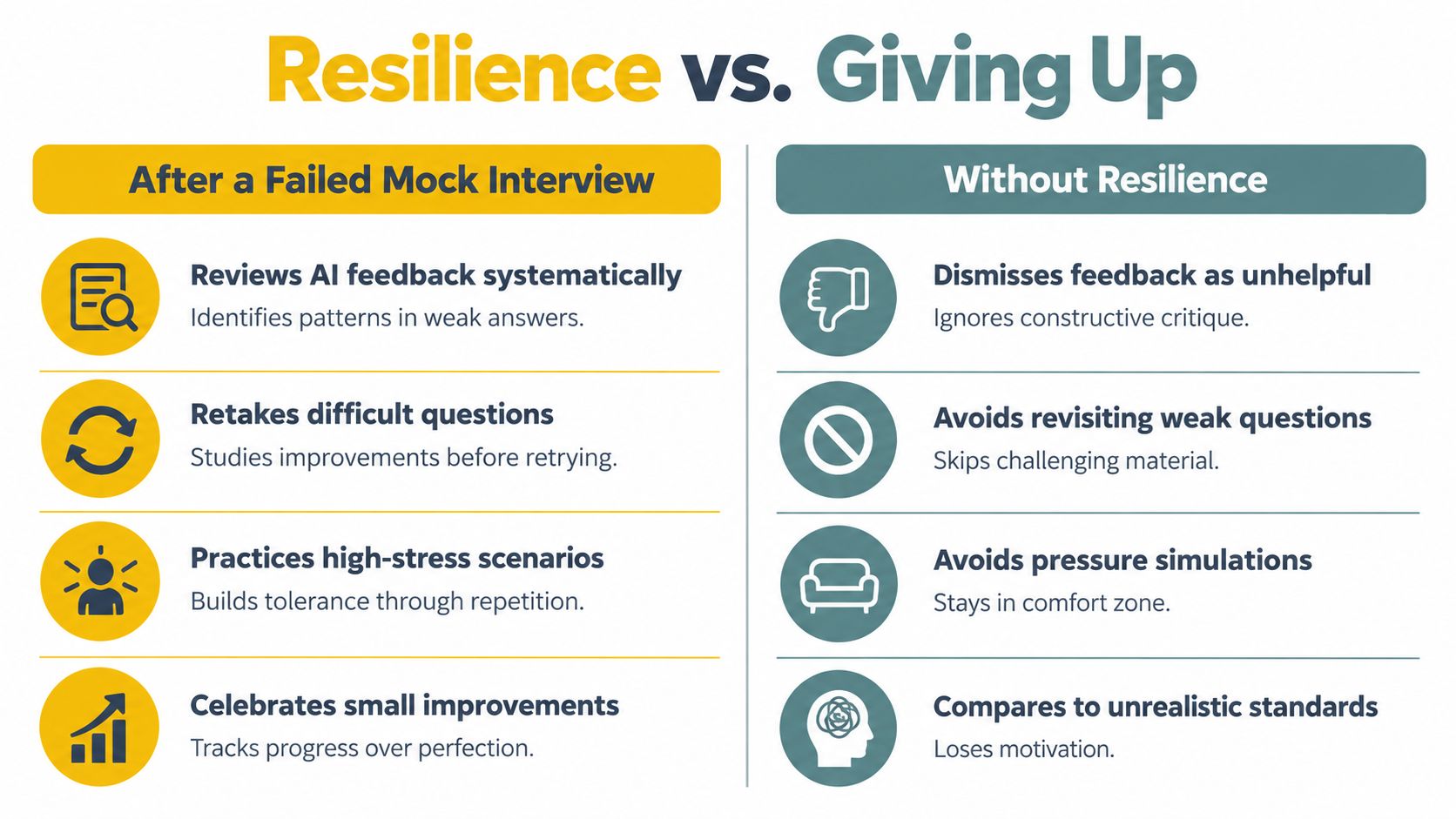
Resilience is not a fancier way to say hard-working. It points to a specific workplace behavior. You hit a setback, adjust, and return stronger.
That distinction matters. If diligence is about careful effort and discipline is about steady routine, resilience is about recovery. Use it when your example includes criticism, a missed target, a failed interview, or a rough transition into a new role.

What resilience proves
Resilience shows that pressure does not stop your progress. It also shows that you can learn without becoming defensive.
A useful way to separate it from nearby terms is to focus on the moment after the problem appears. Accountability means you own the mistake. Resilience means you recover and improve after it. Those often appear together, but they are not the same claim.
For example, a software engineer might say, “My first mock interviews exposed weak explanations, so I rewrote my answers, simplified my examples, and practiced until they were clear.” A career switcher could say, “Early feedback showed that my stories were too generic, so I tied each one to a specific result and practiced saying them out loud.”
If you need better raw material for this kind of answer, interview questions about character can help you surface examples with setbacks, feedback, and recovery.
How to use it credibly
Resilience works best when the listener can follow the sequence.
- Setback: What went wrong?
- Adjustment: What did you change?
- Outcome: How were you better the next time?
Resume and interview wording should reflect that pattern.
- Resume fit: “Responded to early client presentation feedback by revising messaging and improving delivery for later stakeholder meetings.”
- Interview fit: “I'm resilient when a weak performance exposes a gap. I review what failed, change the approach, and test the new version until it holds up under pressure.”
- Best tone: Adaptive, steady, coachable.
Be careful with the word, though. If your example is really about long-term consistency, discipline is more accurate. If your example is mainly about taking responsibility, accountability is the stronger choice. Resilience earns trust when the evidence is recovery, not just effort.
5. Professionalism
Professionalism is broader than many people think. It isn't just about dressing well or sounding formal. It includes conduct, tone, clarity, respect, judgment, and how you carry yourself when stakes are high.
That makes it one of the strongest alternatives when an interviewer seems to use “work ethic” as shorthand for trust, maturity, or reliability in team settings.
A lot of workplace communication is assessed through observable behaviors. One structured communication assessment summary recommends anchored rubrics, multiple raters, and performance-based tasks that score clarity, active listening, conflict handling, and async writing, which is a useful reminder that professionalism shows up in behaviors people can observe, not just in self-descriptions, according to this communication assessment scoring overview.
Professionalism in practice
Professionalism is a good fit when your example involves communication quality, poise, or judgment.
- Resume fit: “Maintained professional communication across cross-functional stakeholders during fast-moving project work.”
- Interview fit: “I try to bring professionalism to pressure situations by keeping my answers structured, listening carefully, and staying clear even when I need a moment to think.”
- Best tone: Mature, credible, polished.
This matters even more now because younger cohorts are projected to make up 74% of the global workplace by 2030, and workplace expectations are framed by money, meaning, and well-being rather than a simple hard-work narrative, according to Deloitte's 2025 Gen Z and Millennial Survey. In interviews, professionalism can sound more current and nuanced than “I just work hard.”
For answer framing practice, prompts about how to describe your work style in an interview help candidates translate this term into behavior.
A short explainer can also help you hear the difference in delivery and tone:
Clear speaking habits matter here too. These communication efficiency strategies can help you tighten the delivery behind the word.
6. Accountability
Accountability is one of the most useful synonyms work ethic candidates can use because it centers responsibility. It tells employers you own outcomes, admit mistakes, and follow through without excuse-making.
That makes it especially strong for project work, client work, and any role where missed details affect other people.
What accountability sounds like
This term works best when your example includes ownership. Maybe you caught a problem and fixed it. Maybe you missed something, admitted it, and corrected course. Maybe you tracked your own progress instead of assuming effort was enough.
A strong interview line might sound like this: “I'm accountable about preparation. If a mock interview shows a weak answer, I treat that as my responsibility to fix, not as a bad prompt or bad luck.”
A strong resume line could read, “Demonstrated accountability by owning deliverables and communicating risks early.”
Why it often beats work ethic
“Work ethic” can sound moralizing. Accountability sounds operational. It's clearer, more specific, and easier for an interviewer to trust.
This word is also useful because “work ethic” can trigger generational stereotypes. Recent reporting has highlighted a perception gap around Gen Z, including one survey in which 81% of managers unwilling to hire Gen Z said they lack work ethic, while other coverage argues Gen Z employees often show strong work habits despite that stereotype, as summarized in this discussion of work ethic perception gaps. Accountability helps candidates sidestep that loaded phrase and present trustworthiness directly.
Use this test: If your example includes “I owned,” “I fixed,” “I followed through,” or “I communicated early,” accountability probably fits.
For self-management outside interview prep, these sales professional time tips can reinforce the habits this word implies.
7. Proactivity
Proactivity means acting before someone tells you to. It's initiative with foresight. A proactive candidate anticipates questions, researches context, and closes gaps early instead of waiting to react.
That makes this one of the best choices for leadership-track roles, product roles, consulting, startup environments, and technical jobs where independent problem-solving matters.
When proactive is better than dedicated
Dedicated sounds committed. Proactive sounds alert and self-starting. If your main strength is that you spot needs early and move first, don't hide that behind a softer word.
Examples make the distinction clear:
- Dedicated: “I stayed committed to the process.”
- Proactive: “I researched the company's stack, identified likely system design topics, and built practice around those before the interview.”
- Best tone: Energetic, forward-looking, resourceful.
A consulting candidate might review the target industry before practicing cases. A data scientist might build custom scenarios based on the likely metrics used by the company. A software engineer might prepare questions about architecture decisions instead of waiting until the final interview round.
Good wording for resumes and interviews
Use proactivity when your actions came early, not only after feedback.
- Resume fit: “Showed proactive ownership by identifying likely stakeholder concerns and preparing responses in advance.”
- Interview fit: “I'm proactive about interview prep. I don't just answer practice questions. I look at the role, the company, and my own weak spots first, then build the prep plan around that.”
For initiative-focused examples, tell me about a time you took initiative at work is a strong practice prompt.
Be careful with this word if your examples don't show actual initiative. If the behavior was mainly consistency, discipline is more accurate.
8. Continuous Improvement
Continuous improvement is less of a trait word and more of a working style. It means you refine your performance in small, steady steps. If “work ethic” feels too static, this phrase gives you a more practical and current alternative.
It's especially useful for candidates who want to sound reflective and coachable rather than purely tough or tireless.
Why this phrasing works
Continuous improvement shows that you don't assume one good effort is enough. You review, adjust, and sharpen. That can sound stronger than “I have a strong work ethic” because it reflects how many modern teams work.
A product manager might refine stakeholder stories after each mock. A finance applicant might tighten technical explanations after every practice round. A software engineer might keep improving how they explain tradeoffs, not just whether they can solve the problem.
Resume and interview examples
This term is strongest when you describe iteration.
- Resume fit: “Applied a continuous improvement mindset to process documentation and stakeholder communication.”
- Interview fit: “I believe in continuous improvement. After each practice session, I pick one thing to fix, such as pacing, specificity, or structure, and test the revised version next time.”
- Best tone: Coachable, thoughtful, growth-oriented.
Small revisions often sound more believable than big personality claims.
This phrase can be too abstract if you leave it alone. Pair it with a specific habit, such as revising examples, tracking weak question types, or improving answer structure over repeated mock sessions.
8 Work-Ethic Traits Comparison
| Trait | 🔄 Implementation Complexity | ⚡ Resource & Time Requirements | ⭐ Expected Outcomes | 📊 Ideal Use Cases | 💡 Key Advantage / Tip |
|---|---|---|---|---|---|
| Diligence | Medium, systematic, repeatable processes | High, substantial study hours and iterations | ⭐⭐⭐⭐, comprehensive coverage; reduced anxiety | Role-specific mastery; technical-heavy interviews | Use repeated mock sessions and review incorrect answers |
| Dedication | Medium, sustained schedule and progression | High, continuous weeks of practice | ⭐⭐⭐⭐, measurable skill gains and confidence | Intensive prep for career switches or FAANG-style rounds | Set realistic timelines and track performance metrics |
| Discipline | Low–Medium, routine and self-control required | Medium, regular, scheduled sessions | ⭐⭐⭐⭐, consistent, reliable performance under pressure | Prevent last-minute cramming; maintain momentum | Block calendar time and eliminate distractions during practice |
| Resilience | Medium, requires reflection and adaptive changes | Medium, iterative practice plus emotional work | ⭐⭐⭐⭐, improved recovery; better handling of setbacks | High-stress interviews; recovering after poor performances | Treat mocks as data points; review AI feedback for patterns |
| Professionalism | Medium, focuses on tone, structure, and delivery | Low–Medium, targeted practice on communication | ⭐⭐⭐⭐, strong first impressions and clarity | Client-facing roles; international candidates | Use tone/accent settings and structure answers (e.g., STAR) |
| Accountability | Low, tracking and honest reporting systems | Low, use analytics and simple documentation | ⭐⭐⭐, transparent progress; data-driven adjustments | Candidates needing measurable improvement and mentors | Track scores and trends; share goals with a partner or mentor |
| Proactivity | Medium, planning, research, customization | Medium, extra company/role research effort | ⭐⭐⭐⭐, fewer surprises; shows initiative | Early prep; tailoring to specific companies or roles | Preview question banks and customize Copilot settings |
| Continuous Improvement | Medium, iterative refinement process | Medium, sustained, incremental effort over time | ⭐⭐⭐⭐, compound long-term gains; steady progress | Long preparation cycles; incremental skill upgrades | Make one micro-change per session and track micro-metrics |
Turn the Right Synonym Into Proof
The simplest way to choose among synonyms work ethic is to stop asking, “What sounds good?” and start asking, “What behavior am I proving?” That one shift usually improves both resume wording and interview answers.
If your story is about careful preparation, choose diligence. If it's about staying committed over time, choose dedication. If it's about routine and consistency, choose discipline. If you recovered from setbacks, use resilience. If you want to stress poise and communication, say professionalism. If you owned outcomes, use accountability. If you acted early, choose proactivity. If you kept refining your performance, continuous improvement is likely the best fit.
Then add proof. On a resume, that means attaching the word to an action or result instead of listing it as a trait. “Accountable for stakeholder communication during a deadline shift” is stronger than “strong work ethic.” “Used disciplined preparation habits for technical interviews” is stronger than “hard-working candidate.” Even when you can't use a number, you can still point to an observable behavior, a repeated habit, or a specific situation.
In interviews, the same rule applies. Don't define yourself with a label and stop there. Give a short example. A useful pattern is behavior, situation, action, outcome. For instance: “I'd describe myself as proactive. Before my last interview loop, I researched the company's likely challenges, identified where my examples were weak, and practiced those areas first. That helped me answer with more confidence and less guesswork.” The synonym sets the frame. The example earns belief.
“Work ethic” means different things to different interviewers. Some hear reliability. Others hear maturity, coachability, or professionalism. Some may even bring generational assumptions into the conversation. More precise language helps you avoid that ambiguity. It lets you say what you mean instead of hoping the interviewer interprets a buzzword the right way.
Practice the wording out loud before you use it. A phrase that looks good on a resume can sound stiff in conversation. Mock interviews help you test whether “disciplined,” “accountable,” or “professional” feels natural in your own voice, and whether your example supports the word. The goal isn't to sound polished for its own sake. The goal is to sound specific, credible, and self-aware.
The strongest candidates don't just swap in a better synonym. They match the word to the behavior, then match the behavior to evidence.
Interview Pilot helps you do exactly that. You can rehearse resume and interview language with AI mock interviews, practice against a large role-specific question bank, and adjust response style with customizable settings so words like diligent, accountable, or proactive sound natural instead of scripted. If you want to turn these traits into sharper proof, visit Interview Pilot.
Topics
synonyms work ethic
resume skills
interview preparation
work ethic synonyms
career advice
Continue reading

Career
8 Another Phrase for People Skills for Interviews
Find another phrase for people skills with eight resume-ready alternatives, interview examples, and practical guidance for choosing the right wording.
September 13, 2026
20 min read

Career
8 Sample Career Statement Examples
Explore 8 sample career statement examples for different experience levels and industries, with templates, tone guidance, and customization tips.
September 10, 2026
20 min read

Career
Average Salary Crime Scene Investigator: Full Breakdown
See the real average salary crime scene investigator roles pay in 2026, with breakdowns by region, experience, employer type, and career progression paths.
September 14, 2026
17 min read