
















AI Tools
AI Interview Coach: How It Works and How to Choose One
Learn what an AI interview coach does, which features matter, where it falls short, and how to use one ethically before your next job interview.
Interview Pilot Editorial Team
Updated November 11, 2026
17 min read
You have an interview tomorrow, your stories feel scattered, and you are not sure which example fits which question. That is the moment many candidates turn to an AI interview coach. Used well, it's a rehearsal partner that helps you organize what you already know. Used carelessly in a live interview, it can raise questions about honesty and fit.
What an AI Interview Coach Actually Does
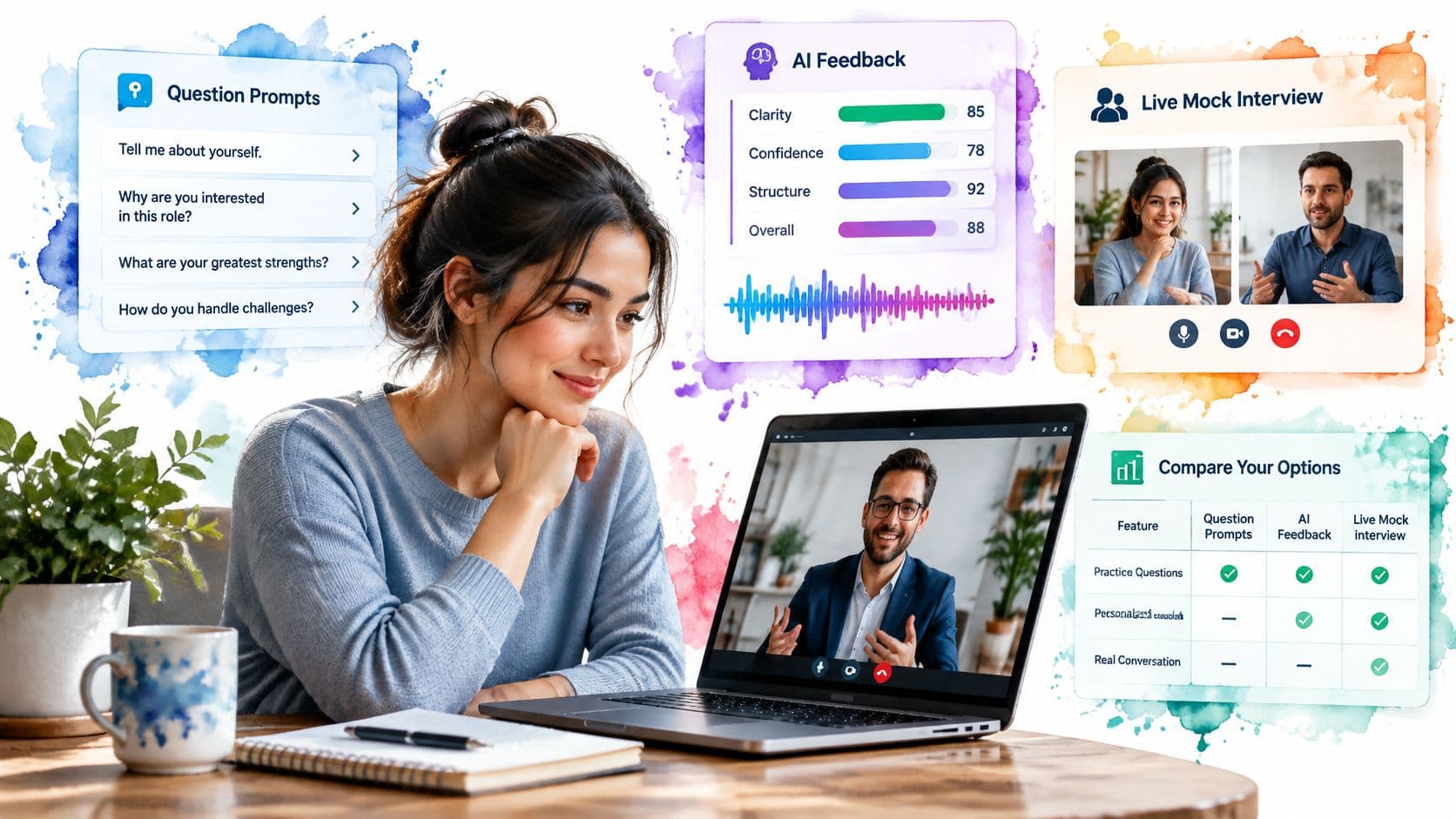
Say you're on a video call and the interviewer asks about a past project. You know the work, but your mind goes blank and the silence stretches. An AI interview coach is software built for that problem. It gives you practice questions, scores spoken or typed answers, and suggests clearer wording or structure within seconds.
Think of a flight simulator. A pilot rehearses emergencies in a simulator before flying passengers. A co-pilot is different. The co-pilot sits beside the pilot during the flight and calls out checklist items. An AI interview coach can work in both ways, and the difference matters.

Two Modes With Different Jobs
- Practice coaching: You rehearse with mock questions before the interview and get feedback you can revise and repeat.
- Live assistance: Suggested responses appear during a real interview while the interviewer is waiting for your answer.
The first mode builds your own recall. The second tries to rescue you in the moment. They aren't interchangeable, and they don't carry the same risks.
Employers are changing at the same time. iHire's State of Online Recruiting 2025 survey found 25.9% of employers were using AI somewhere in recruitment in 2025, compared with 14.7% in 2024 and 4.9% in 2023. Among employers using AI, 16.1% reported using AI to interview candidates, while no employers in the 2024 survey reported that interview use.
That shift means AI has moved from screening paperwork toward direct interaction with applicants. Your preparation now needs to cover structured, technology mediated conversations as well as face to face ones.
Keep the scope in mind. Roughly three quarters of surveyed employers were not using AI in recruitment in 2025, so human led interviews still matter. Start with one decision before your next interview. Do you need rehearsal, live help, or both?
Core Features Compared at a Glance
Feature lists look similar until you map each feature to the job it does for you. Start with rehearsal features, because they shape what you'll say long before the live call begins.
| Feature | What It Does | Best For | Check Before Relying on It |
|---|---|---|---|
| AI mock interviews | Asks role questions and evaluates your answers | Structured rehearsal before a screen call | Confirm how the scoring criteria are defined |
| Question bank | Searchable question sets, filterable by question type | Covering role-specific topics | Question sources vary; no guarantee a company will ask them |
| Real-time answer suggestions | Drafts a response during a live video or phone interview | Freezing on complex technical or behavioral questions | Suggestions must be adapted, not read word for word |
| Profile and document inputs | Tailors answers to your resume and the job description | Mapping your experience to the target role | Review what personal data is stored and for how long |
| Role-specific guides | Frameworks and preparation strategy by job family | Finance, consulting, product, software and data tracks | Check that guidance is current for your role |
| Multilingual and accent support | Transcribes and responds in many languages | Non-native speakers and global hiring | Test recognition with your own voice before the interview |
| Cross-platform apps | Desktop and mobile access | Practice on a phone, live call on a laptop | Confirm the app runs alongside your interview platform |
Mock interviews and the question bank come first in most routines. You pick a role, answer out loud, and see where your story rambles, runs long, or leaves out the result. A searchable bank then lets you fill gaps by topic instead of practicing random questions. For example, a product candidate can drill prioritization questions, while a software candidate can focus on debugging or system trade offs.
Real-time suggestions serve a narrower purpose. They can offer a starting phrase or structure when you freeze on a complex technical or behavioral question. They're only useful if you can glance, grasp the idea, and speak in your own words without a long pause.
Inputs Shape the Output
Profile and document inputs connect suggestions to your resume and the job description. Accurate inputs produce more relevant practice. Outdated bullets, inflated titles, or a generic target role produce generic answers. Review what you upload as carefully as you'd review a cover letter.
Role guides add the frameworks behind the questions for finance, consulting, product, software, and data tracks. Multilingual support helps non-native speakers practice in the language of the interview, while cross-platform access lets you rehearse on a phone and join the live call on a laptop. Interview Pilot is one example of a product that bundles these features into a single app.
Don't choose the longest feature list. Score each feature against your interview type, your timeline, and the weakness you most need to fix.
Why Structured Practice Produces Useful Feedback
Generic chat feels friendly, but it rarely tells you what to change. Structured practice works better because every attempt uses the same clear standard, so you can compare one answer with the next.
Other meta-analytic evidence reported in the interview validity meta-analysis in the Journal of Occupational and Organizational Psychology gives corrected validity of approximately 0.63 for structured interviews versus 0.20 for unstructured interviews. In plain terms, interviews with consistent questions and scoring predict job performance far better than free flowing conversation. A good AI interview coach copies that structure in practice.
Four Criteria for Useful Feedback
- Questions map to named competencies. Each prompt targets something specific, such as ownership, prioritization, conflict handling, or technical judgment.
- Answers follow a repeatable framework. For behavioral questions, Situation, Task, Action, Result keeps your story in order and stops you from skipping your own contribution.
- Scoring uses written behavioral anchors. The tool defines what a weak, adequate, and strong answer contains before it scores you.
- Feedback names the exact gap. It points to a missing metric, an unclear personal decision, absent evidence, or a weak link to the competency.
The difference is easy to hear. Vague feedback says, "weak answer." Useful feedback says, "You described the team result but not your decision. Add the trade off you chose and why you chose it." The second version gives you one concrete revision you can test in your next attempt.
Our practice evaluation guide explains how scored feedback is organized, which helps you judge whether a score reflects clear criteria or a mysterious overall impression.
How This Looks for Technical Roles
Technical rubrics need different anchors. Look for scoring on clarifying requirements, reasoning through an approach, testing edge cases, explaining complexity, naming trade offs, and communicating while you work. A candidate who jumps straight to code may solve part of the problem but still miss several scored behaviors.
Question sources deserve the same scrutiny. Interview question content may come from public materials, user submissions, internal examples or generalized interview patterns, and we don't guarantee that any question has been or will be asked by a specific company or interviewer. Treat a bank as preparation material, not a leaked script.
Before you trust a tool, run a three part check. Does it show its rubric? Does feedback tie back to named competencies? Does it state where its questions came from? If you can't answer those questions, you can't tell whether a rising score means you're improving or just learning the tool's preferences.
Live Assistance Versus Mock Practice and When Each Fits
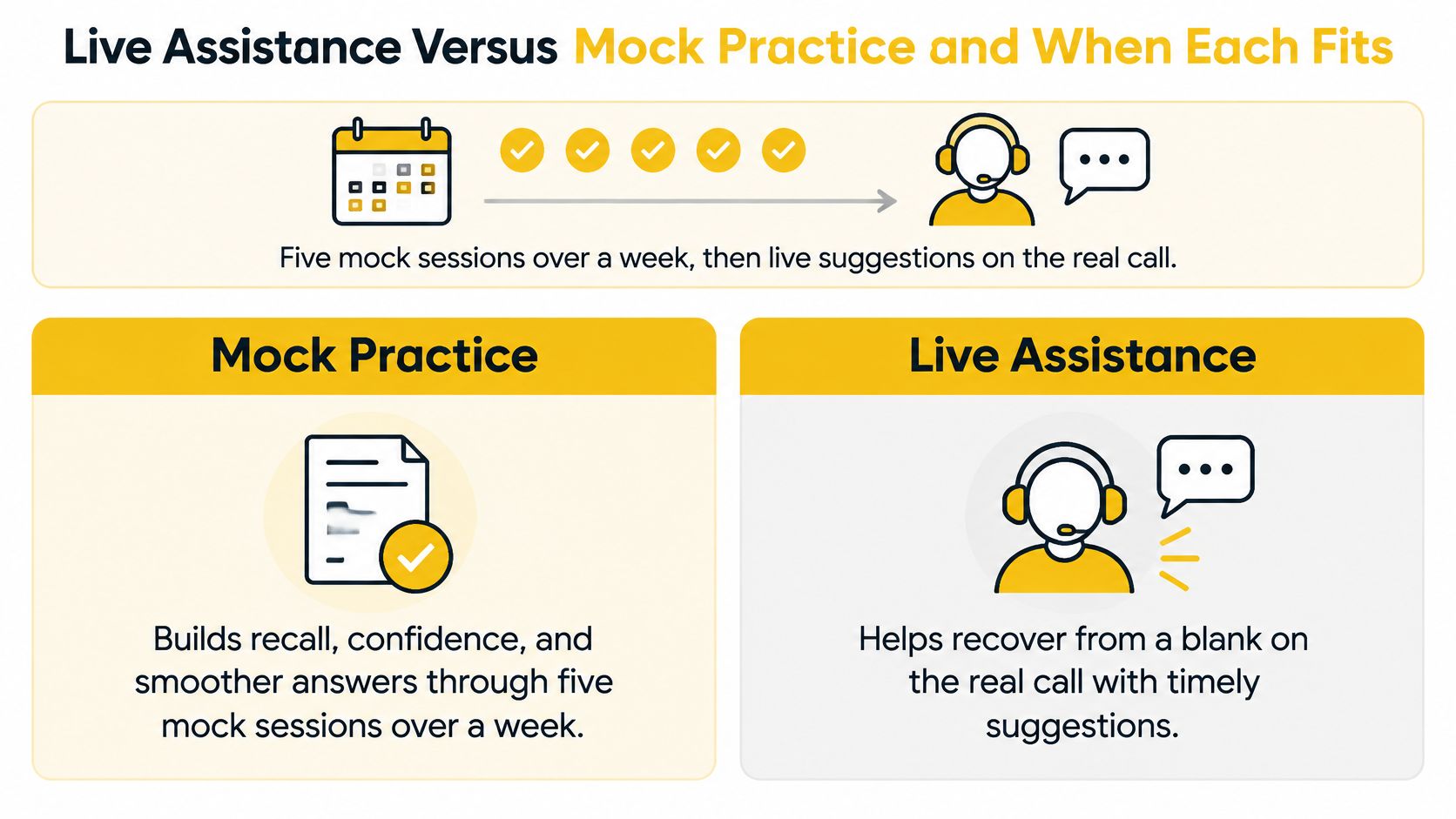
Say a candidate runs five mock sessions over a week. During the actual interview, she only looks at live support after blanking on one unexpected question. Those two uses serve different purposes.
The comparison below separates what each mode builds from the pressure and risk it adds.
| Mode | What It Builds | Pressure | Main Risk | Use When |
|---|---|---|---|---|
| Mock practice | Story recall, timing and delivery | Low | Over-rehearsed, memorized answers | One to two weeks before the interview |
| Live assistance | Recovery from a blank on a hard question | High | Scripted-sounding speech and misread suggestions | Only where the employer permits it |
Mock practice builds recall, timing, and delivery because you retrieve the story yourself. Repetition also reveals patterns, such as starting every answer with background and reaching the result too late. TP Training's online mock interview guide offers a useful companion perspective on using rehearsal to build confidence before a real conversation.
Live assistance can't build that memory for you. It works best as a prompt for a complex technical question or sudden curveball, but reading takes time. If you recite the suggestion, your pace and eye movement can make the answer sound scripted.
This short video shows the live workflow in context, so you can judge how much attention it demands during a conversation.
Our overview of how Live Copilot works sets out that in call process. Before any mock session, also check recording. Our AI mock interviews record your answer whether or not Record Interview Audio is on, because your evaluation's Delivery Score is judged from that recording.
Practical rule: Rehearse one to two weeks ahead, use live support only where the employer permits it, and always speak in your own words.
For an interview this week, choose mock practice if your stories are shaky. Consider live assistance only if permission is clear and you've already rehearsed without it.
Benefits, Limits and Why Candidates Doubt AI
The appeal is easy to understand. You can practice at midnight, repeat an answer without embarrassment, and get immediate notes instead of waiting for a friend or mentor.
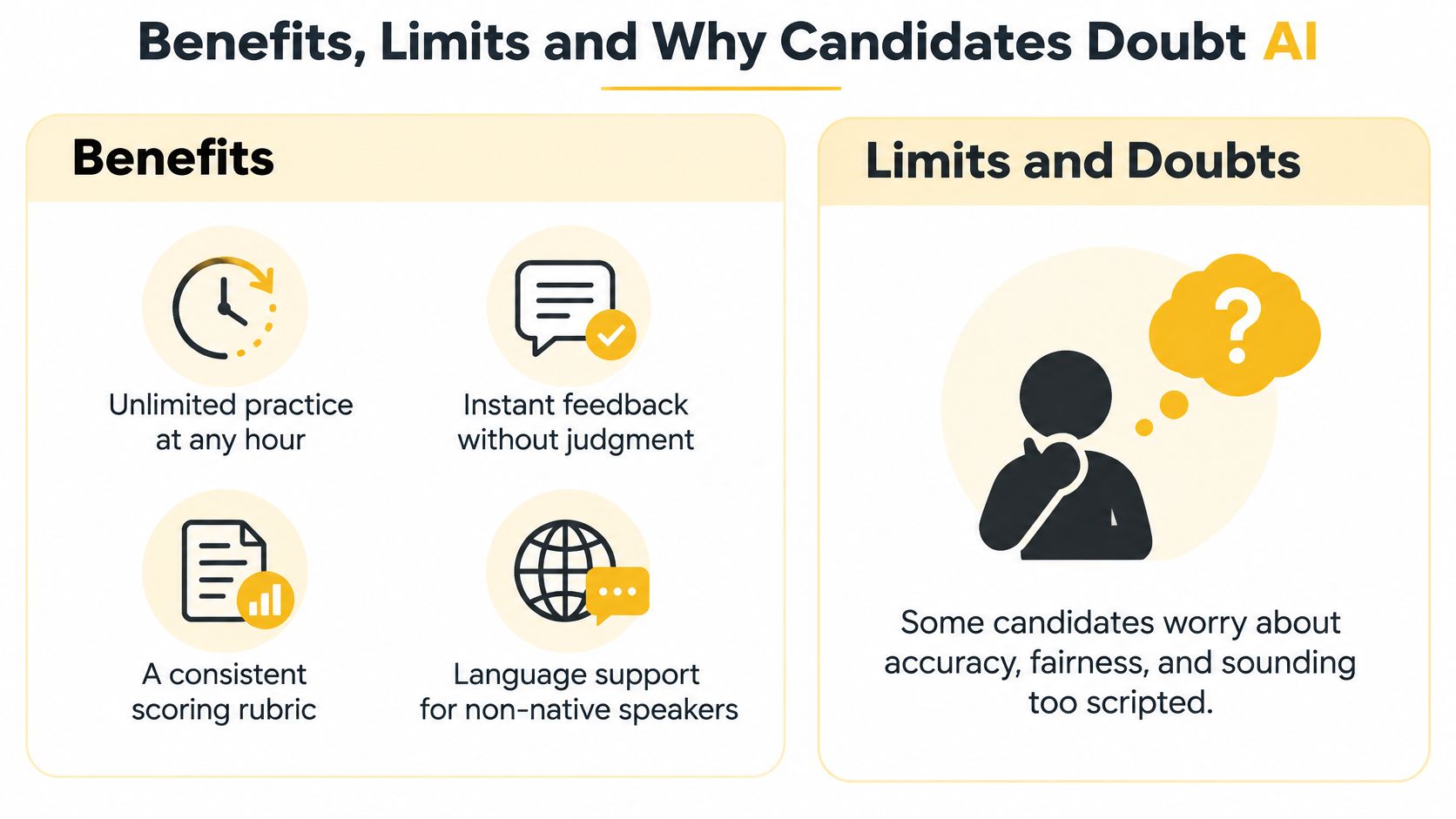
What Helps Most in Rehearsal
- Unlimited practice at any hour: You can drill one weak story until the structure feels natural.
- Instant feedback without judgment: You see timing, missing evidence, and repeated filler habits right away.
- A consistent scoring rubric: The same standard makes progress across sessions easier to spot.
- Language support: Non-native speakers can rehearse phrasing and check whether key terms are clear.
Those benefits are strongest before the interview. The tool gives you repetitions and a second look at answers you'd otherwise judge only by feeling.
Where Reliability Drops
Answers can sound generic when you recite generated text. Transcription can misread accents or technical terms, which means feedback may penalize a recognition error rather than weak reasoning. Scoring can also pull you toward pleasing the rubric instead of exercising your own judgment. Most of all, the tool can't read the interviewer, sense confusion, or know when a short answer is better than a complete framework.
No outcome is promised. We don't guarantee interview success, employment outcomes, improved performance, question accuracy, recruiter response or any other result from using the Services.
Trust is part of the picture. In Gartner's survey of 2,918 job candidates, only 26% of job applicants said they trusted AI to evaluate them fairly in 2025. Candidates have reason to ask who sees the output, how it is scored, and whether a person reviews it.
Expect similar questions about your own preparation. Be ready to explain, calmly and briefly, that you used practice tools to organize examples from your experience. An AI interview coach is a useful rehearsal partner. It isn't a substitute for knowing your own stories well enough to defend every detail.
Accessibility, Fairness and Privacy
Ask a question many candidates skip. Will this tool judge me fairly if my speech, face, voice, or communication style differs from what its builders expected?
Automated systems may rely on eye contact, voice modulation, facial expression, and other standardized social cues. Those cues aren't valid measures for everyone. They can create risk for candidates with speech impairments, neurological conditions, facial differences, or neurodivergent communication patterns.
Accent creates a separate accuracy issue. If transcription mishears words, later scoring may treat clear reasoning as confused content. A single overall accuracy score can hide that problem for particular languages, accents, speaking rates, or audio conditions.
A Fairness Check Before You Trust a Score
- Ask for subgroup accuracy. Does the provider report recognition quality by accent and language, not only as a global average?
- Ask which cues are scored. Can you turn off face, eye contact, or delivery judgments that don't fit your access needs?
- Ask for another format. Can you rehearse in writing, use captions, take extra processing time, or correct the transcript before scoring?
Adapt practice without masking who you are. Focus feedback on content, structure, and evidence. Correct misheard words instead of changing your natural accent. If the tool repeatedly misreads you, treat that as a tool limitation and seek human review or reasonable adjustments from the employer.
Privacy needs equal care. Profiles, resumes, recordings, and accommodation notes can hold personal and sometimes medical details. Comparing our explanation of how personal information is handled with any tool's retention and deletion terms shows what questions to ask before uploading documents. Check how long data is stored, who can access it, and whether you can delete recordings and transcripts yourself.
Using a Coach Without Breaking Employer Rules
More AI support doesn't always help. It can make answers generic, slow your conversational pace, or conflict with an employer's integrity expectations. The safest line is clear. Prepare with AI before the interview, and don't use undisclosed live assistance unless the employer allows it.
A Five Step Operating Guide
- Ask before the interview. Email the recruiter and ask whether external tools or AI assistance are allowed for this stage. Keep the reply.
- Rehearse, don't memorize scripts. Use mock interviews and the question bank to learn structures and retrieve your stories faster.
- Build from your own evidence. Check every date, metric, and claim. Rephrase generated wording in your voice and remove anything you can't explain.
- Ask how the employer uses AI. Find out what it measures, whether a human reviews results, and whether an alternative interview is available.
- Prepare a fallback. Decide what you'll say and do if assistance is prohibited, questioned, or stops working mid call.
Those questions reflect what candidates themselves want. In the Greenhouse candidate survey findings, 46% of surveyed candidates wanted the option to request a human interview, 39% wanted an explanation of what AI measures, and 38% wanted confirmation of human review.
Our article on whether employers can detect AI during interviews explains common warning signs employers notice, including delayed answers and language that doesn't match a candidate's prior responses. Don't treat detection as a puzzle to beat. Treat permission as the gate.
If asked about preparation, keep disclosure brief and factual. You could say, "I used an AI practice tool before today to rehearse examples from my own work, and I'm answering in my own words." That sentence separates rehearsal from live substitution.
Ask early, keep answers truthful, and be able to continue without support. Candidates who follow those steps avoid most trust problems before they start.
Choosing a Coach and Starting Your First Session
Start from your situation, not from a brand name. The feature that matters most changes with your interview format, language needs, timeline, and privacy concerns.
| Situation | Priority Feature | Reason | Check First |
|---|---|---|---|
| Technical role with live coding | Mock sessions with a technical rubric | Coding interviews reward reasoning out loud | Does the tool cover live coding questions? |
| Finance or consulting case interviews | Role-specific guides and frameworks | Case structure matters more than memorized answers | Are frameworks explained with the reasoning behind them? |
| Non-native speaker or accent concern | Multilingual support with transcript review | Lets you correct misheard words before they affect scoring | Test recognition with your own voice |
| Sensitive personal or medical details in your profile | Clear data policy and deletion control | Profiles and recordings hold personal data | Read the privacy terms before uploading documents |
| First interview in 24 hours | Quick mock with written feedback | Fast rehearsal of your top three stories | Run the five-minute pre-interview checklist |
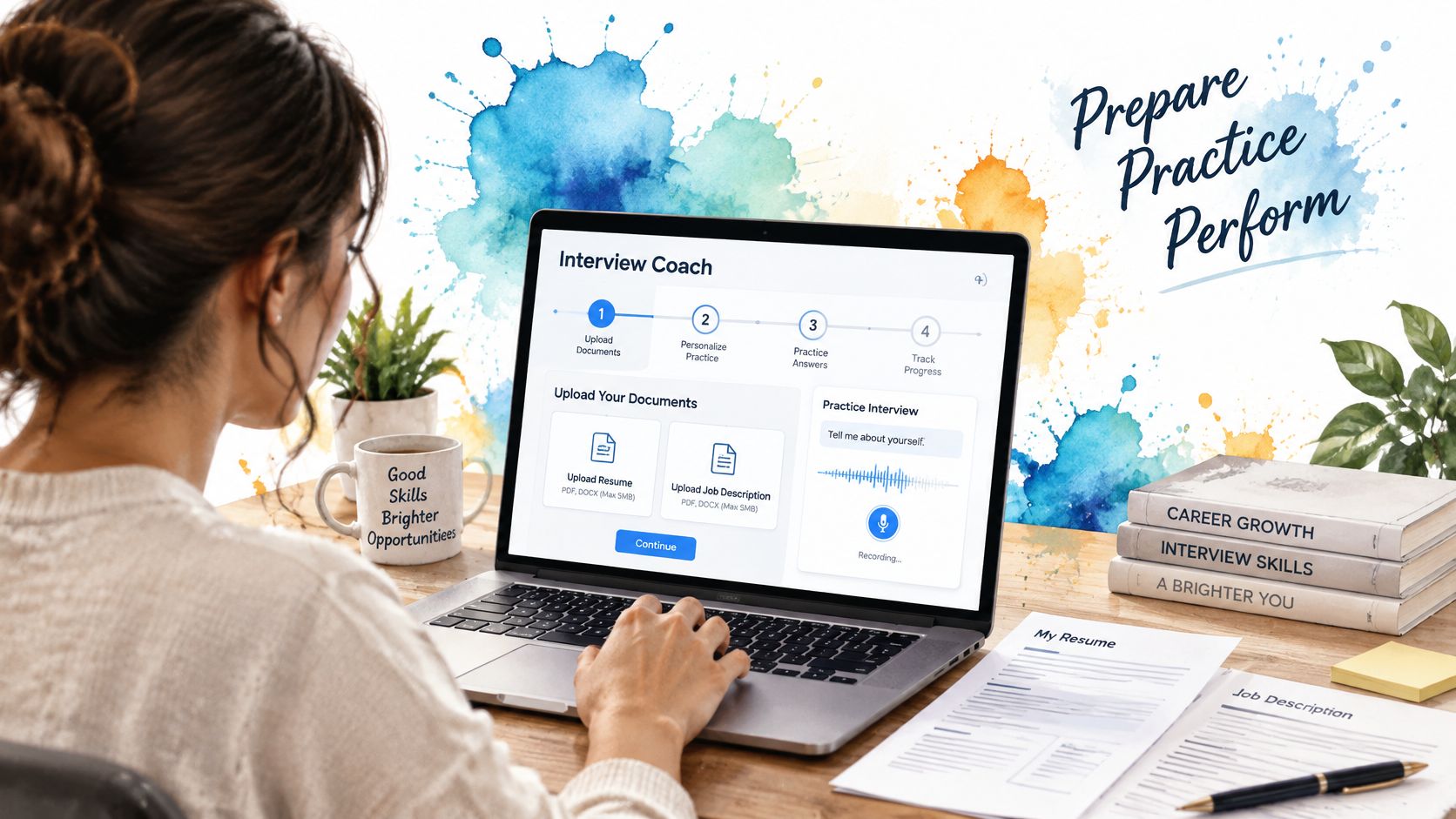
Your First Session in Order
- Upload your resume and job description. This lets practice connect your evidence to the target role.
- Run one mock on your top three stories. Read the written feedback before repeating them.
- Check the transcript. Correct misheard names, tools, and metrics before trusting the score.
- Confirm employer rules. Ask about outside assistance while you still have time to change your plan.
- Warm up for five minutes. Before a first interview, our help center suggests a 5-minute checklist. Say your top three stories aloud from memory, then review past feedback and pick one recurring pattern to fix.
You can review a past interview to see its insights, every question with Copilot's answer, and the full transcript, then rename, copy or share it. Keep only sessions you'll revisit, and manage saved material under the privacy settings you checked. If language delivery is your main barrier, the Gaeilgeoir AI guide to language tutors is a helpful companion for judging conversation practice outside interview specific tools.
Book one mock session this week. Afterward, decide whether live assistance belongs in the call at all.
Interview Pilot combines guided mock practice, a searchable question bank, and real-time Interview Copilot support so you can rehearse your own stories and get structured feedback before the live conversation. Start with one mock session, check the transcript and employer rules, and visit Interview Pilot to prepare your next interview with a clear plan.
Topics
AI interview coach
interview preparation
mock interview practice
AI interview assistant
interview practice tools
Continue reading
AI Tools
Interview Practice Online: 10 Tools Compared for 2026
Compare 10 interview practice online options, from AI copilots and mock platforms to human coaches, with use cases, limits, and listed prices.
October 24, 2026
17 min read

AI Tools
What Is Question Bank
What is question bank. Learn what a question bank is, how it is built, and how candidates use one to prepare for technical and behavioral interviews
October 16, 2026
16 min read

AI Tools
Using an AI Interview Assistant With HireVue
Can a HireVue AI interview assistant help? What each HireVue format involves, what live help can and cannot do there, the rules that apply and how to prepare.
October 25, 2026
9 min read