









AI Tools
What Is Question Bank
What is question bank. Learn what a question bank is, how it is built, and how candidates use one to prepare for technical and behavioral interviews
Interview Pilot Editorial Team
Updated October 16, 2026
16 min read

A question bank is a structured, searchable, reusable library of interview questions organized by role, skill, and difficulty, used to prepare and rehearse consistently. It can include behavioral, technical, case-based, coding, and situational questions, each connected to a specific competency or evaluation purpose.
You may be looking at a long list of interview questions right now, saving prompts from different websites, or practicing only the topics that feel familiar. Then the interview begins, the interviewer asks a follow-up you didn't expect, and the polished answer you memorized no longer fits. I've watched many candidates walk into interviews with plenty of preparation but no system for choosing the right questions or explaining their reasoning.
The difference matters. A pile of prompts gives you material to read. A well-built question bank gives you a way to find, practice, review, and improve the questions most relevant to the role you want.
What a Question Bank Really Is
A candidate enters a product manager interview having memorized dozens of prompts. The interviewer asks how they would handle competing stakeholder demands, then follows up with a new constraint. The rehearsed answer no longer fits. A question bank gives preparation a selection system, so the candidate can choose practice that matches the role, competency, difficulty, and situation.
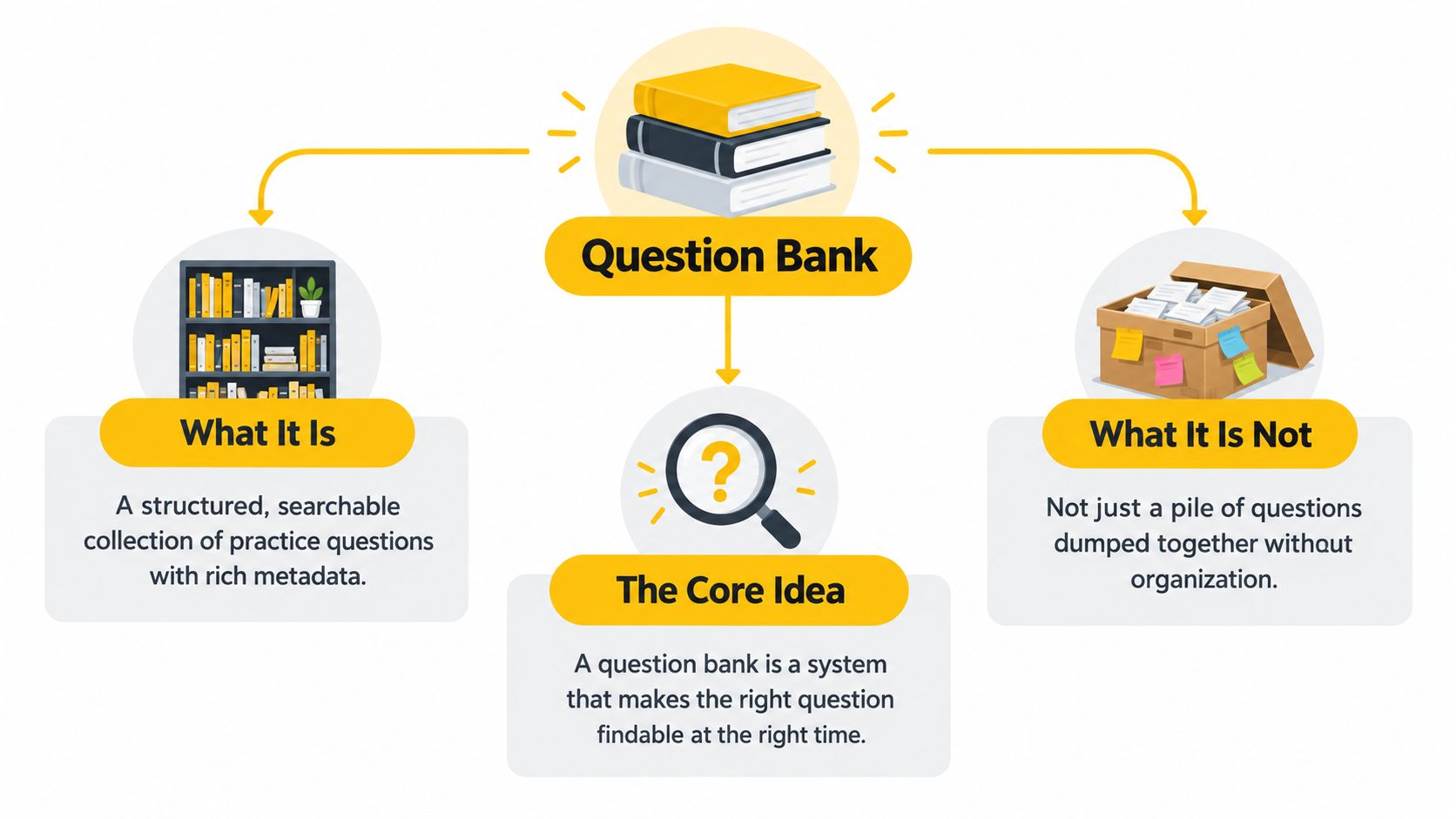
A question bank is a structured repository of assessment items used to assemble quizzes, examinations, practice sessions, or evaluations. For interview preparation, it becomes reusable assessment infrastructure. Each question can carry details such as role, competency, seniority, difficulty, question format, and intended use. Those details help you find the right prompt for a particular preparation goal instead of treating every question as equally useful.
A stocked library shows how this works. Shelves, labels, and a catalog help you find a book about a specific subject. A shoebox of sticky notes may contain valuable material, but locating a question about stakeholder management for a mid-level product role becomes a scavenger hunt. The bank supplies the organization that turns stored content into a working preparation tool.
The structure behind the questions
A professionally managed bank can include multiple-choice, true-or-false, short-answer, essay, case-based, technical, and behavioral items. In an interview setting, its organization may include:
- Role tags: Software engineer, investment banking analyst, product manager, or project manager.
- Competency tags: Communication, prioritization, financial modeling, coding, leadership, or analytical reasoning.
- Difficulty indicators: Introductory, intermediate, advanced, or a more granular estimate.
- Format labels: Behavioral, technical, case, coding, situational, or resume-based.
- Evaluation guidance: A model response, scoring rubric, explanation, or follow-up prompts.
This structure supports the same purpose across education, professional certification, recruitment, interview preparation, and skills testing. Assessment organizations describe item banks as planned collections used to construct assessments, with each item connected to information about its content and use. A question bank definition and overview describes the repository model as well.
You can apply the model to a coding interview by filtering for algorithms and debugging, or to a finance interview by selecting valuation and transaction questions. A teacher can also assemble different examinations from items covering the same learning objectives.
Practical rule: If you cannot explain why a question belongs in your preparation set, the bank is not doing enough work for you.
A useful bank answers three questions: What am I practicing? Why does it matter for this role? How will I know whether my answer is improving? That turns preparation into deliberate practice, with each prompt connected to a competency and a way to review performance.
What Separates a Real Question Bank From a List
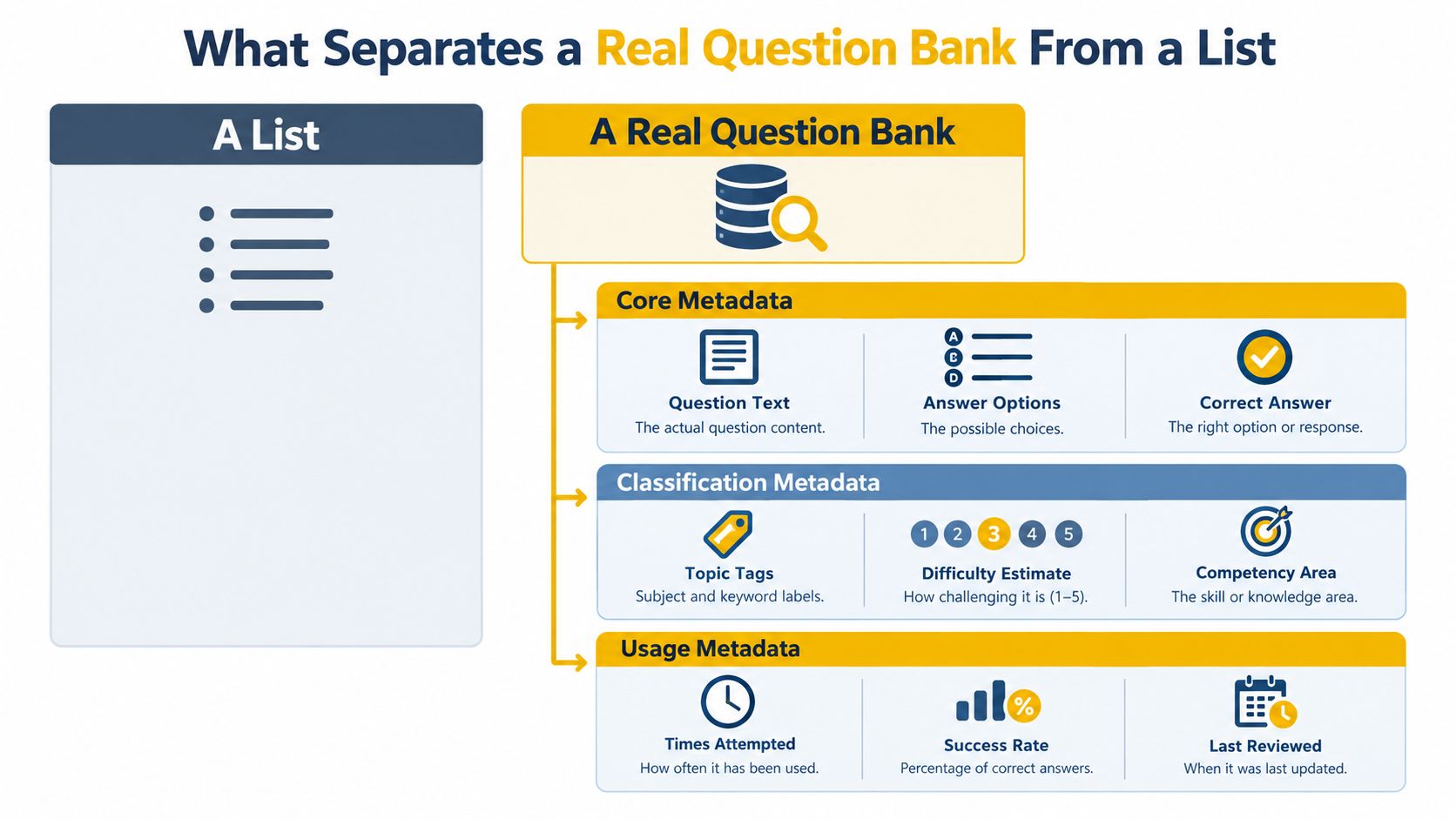
A simple list tells you what questions exist. A real question bank tells you how each question should be used. That difference sits in the metadata attached to each item.
A technical question might be tagged with the programming concept it tests, the expected level of difficulty, the role it suits, the answer format, and the common mistakes candidates make. A behavioral prompt might be linked to ownership, conflict resolution, or decision-making, along with a rubric for judging whether the answer includes a clear situation, action, and result.
Four layers of trust
Tagging makes targeted retrieval possible. Instead of scrolling through every prompt, you can find questions for a specific role, seniority, competency, or format. This matters when your interview is close and your preparation time is limited.
Validation checks whether the item is accurate, clear, accessible, relevant, and scored consistently. The UK assessment authority describes an item bank as a database containing item, assessment, and process information, with checks covering areas such as accuracy, clarity, context, marks, and difficulty in its assessment development handbook.
Calibration uses evidence from real responses to understand how an item performs. A mature bank may track average score, standard deviation, difficulty, discrimination, distractor effectiveness, validity, reliability, and response history. A research report on electronic item banks explains that quantitative item characteristics can come from live-test performance, helping designers build assessments with known difficulty and improve comparability across versions. You can read the supporting assessment research report on electronic item banks.
Purpose alignment connects the question to the ability being assessed. A clever puzzle may be interesting, but it isn't automatically useful for a project manager interview. A question belongs in your practice set when it reflects a real job scenario or tests a competency the employer needs.
The need for review is clear from the evidence cited in the assessment research. One review found 2,233 item-writing flaws across 2,913 questions, an average of approximately 0.77 recorded flaws per question. That finding doesn't mean every question bank is unreliable. It does show why quantity alone is a poor quality signal.
Here's how to judge a bank before investing your time:
| Quality signal | What to look for |
|---|---|
| Organization | Role, competency, format, seniority, and difficulty tags |
| Answer support | Explanations, rubrics, answer keys, and follow-up prompts |
| Review process | Evidence that questions are checked, revised, or retired |
| Usage evidence | Performance history or notes about how candidates respond |
| Job relevance | A clear connection to the actual role and evaluation criteria |
A candidate who memorizes an impressive answer to an irrelevant question is still underprepared. The bank becomes useful when its structure helps you practice what the interviewer is likely to evaluate.
Types of Question Banks by Role and Skill
A candidate enters a product manager interview expecting product vocabulary. The interviewer presents a prioritization trade-off, asks for success metrics, and follows up on a disagreement with a stakeholder. The surprise comes from preparing for a job title instead of the abilities the role requires. A useful question bank connects both.
Start with two dimensions: the role you want and the skill or format being assessed. The role supplies the setting. The skill identifies what the interviewer wants to observe. Together, they turn a static list into reusable assessment infrastructure.
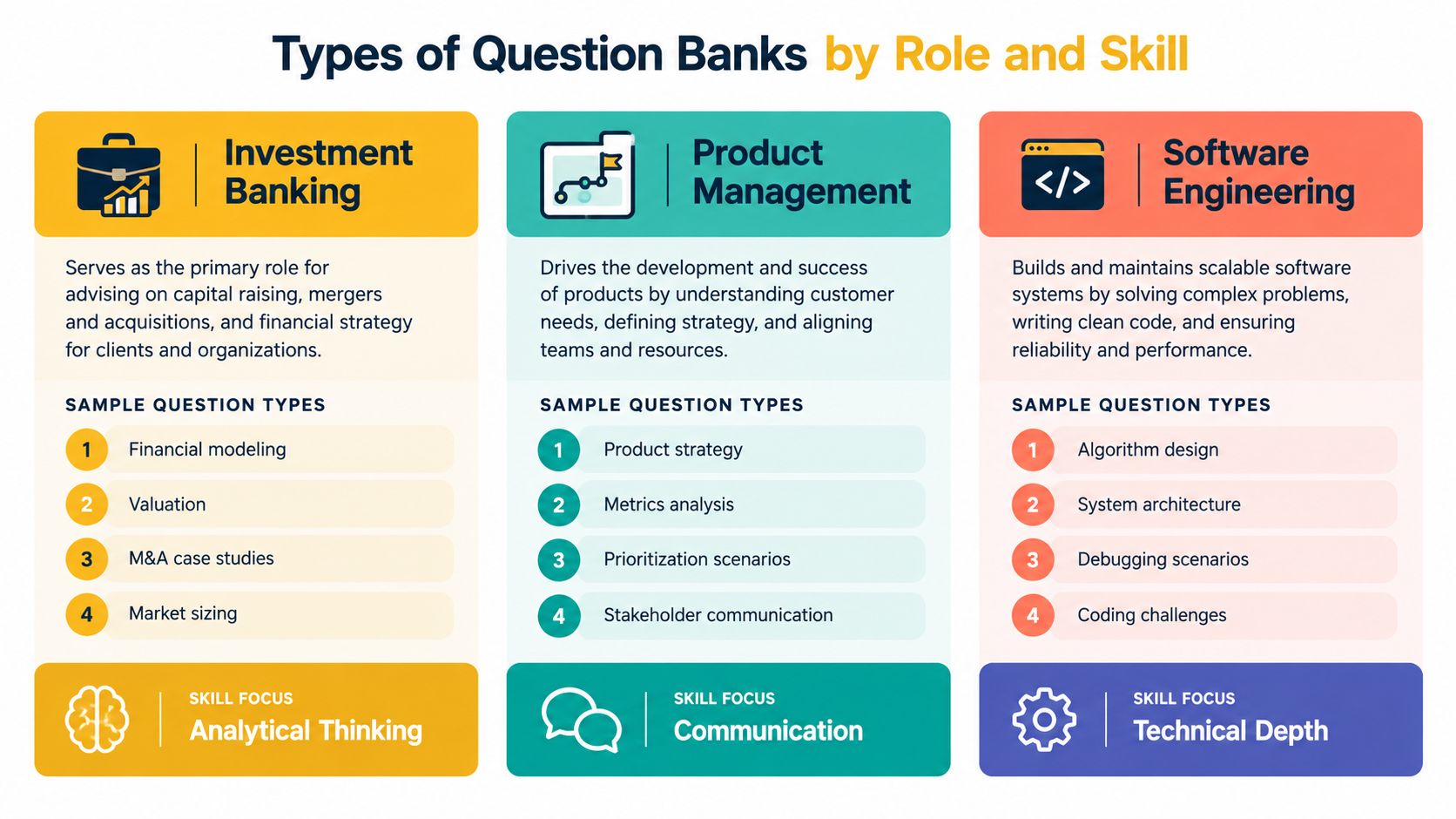
A role-based bank reflects the decisions and knowledge of a job family. An investment banking set may include valuation, financial modeling, mergers and acquisitions, and market sizing. Product management practice may cover product strategy, metrics, prioritization, and stakeholder communication. Software engineering questions may test algorithm design, system architecture, debugging, and coding.
Role-based preparation
Investment banking: Practice explaining how to value a company, walking through a transaction, interpreting financial statements, and defending an assumption in a model. Memorizing definitions leaves you exposed when the interviewer changes an assumption and asks what happens next.
Product management: Prompts may ask you to choose between competing features, define success metrics, respond to a frustrated stakeholder, or develop a product strategy. The assessment includes judgment, prioritization, and communication, not only product terminology.
Software engineering: A bank may separate data structures, algorithms, system design, debugging, and behavioral prompts. Solving coding problems matters, but so do clarifying requirements, explaining trade-offs, and adapting when constraints change.
Data science and data analysis: Practice can include experiment design, statistical reasoning, SQL, model evaluation, and explaining findings to a nontechnical audience. A technically correct result has limited value if you cannot explain its meaning for a business decision.
Consulting: Case questions may assess structuring, market sizing, quantitative analysis, synthesis, and communication. The candidate must show a logical path from the problem to the recommendation, rather than present only a final number.
Project management: Questions can combine planning, risk management, delivery trade-offs, conflict resolution, and stakeholder communication. Strong prompts resemble situations in which deadlines, scope, and resources collide.
Skill-based preparation
Skill-based banks work across job titles. Behavioral questions ask how you acted in a real situation. Situational questions present a hypothetical problem and ask how you would respond. Case questions assess structured analysis. Technical questions examine domain knowledge, while coding questions test implementation and reasoning.
These categories help you combine role context with transferable competencies. Figures cited in a measurement and evaluation course unit citing employer hiring data indicate that skills-based hiring is used for entry-level assessment and that interviews are a common point of application. Because the linked material is assessment literature rather than the original employer survey, treat the figures as context, not as a direct report from the hiring organization.
Combine both views. For product management, select product strategy questions, then add behavioral prompts about disagreement, prioritization, and ownership. For software engineering, pair coding and system design with communication and teamwork scenarios. The job title sets the context. The competency defines the evidence you need to produce.
For wider practice, browse interview questions organized by role and interview type, then narrow the prompts to the competencies in your target job description. A focused bank gives each question a purpose, so preparation becomes deliberate practice rather than random repetition.
How to Use a Question Bank to Prepare
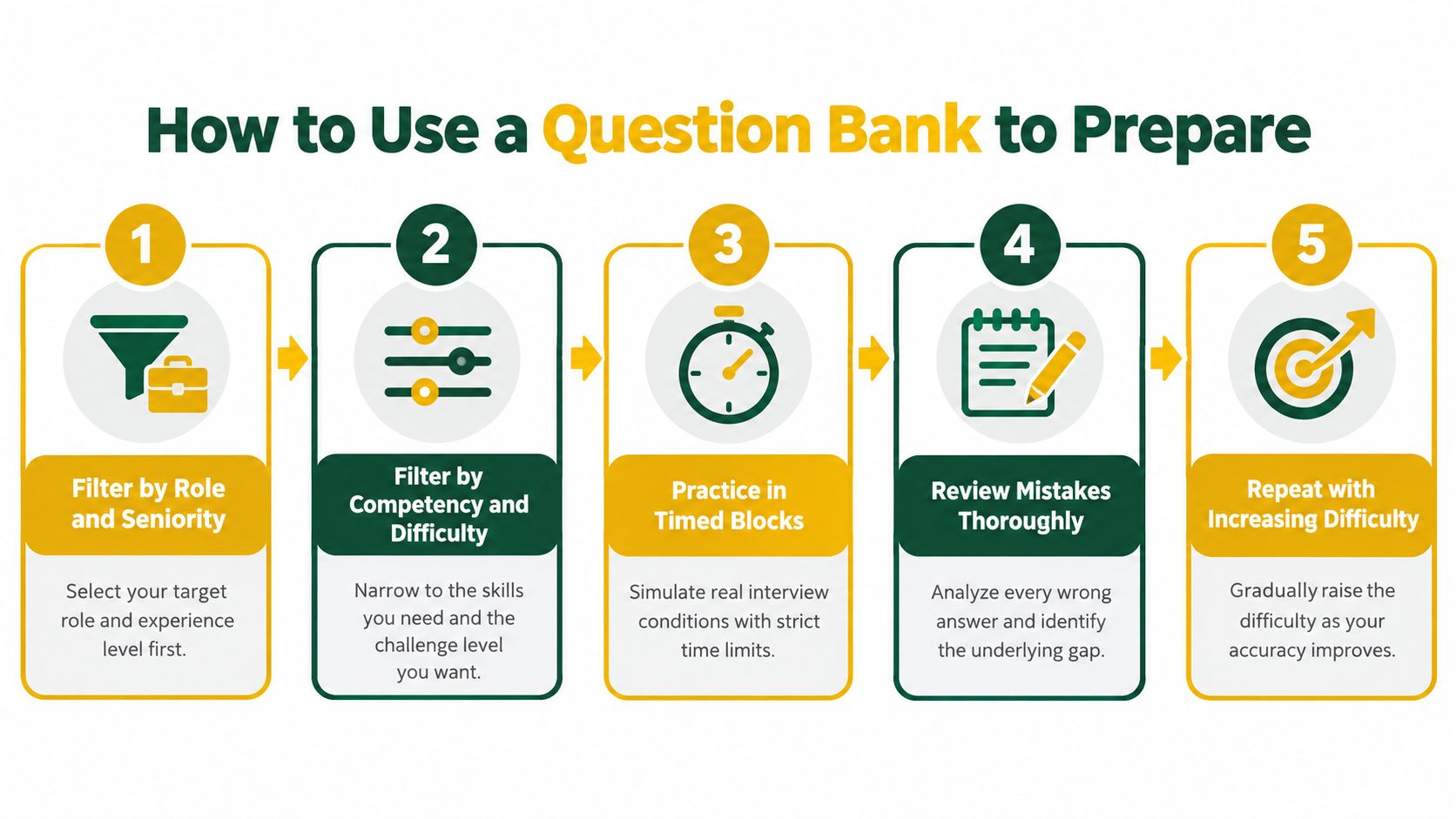
A question bank works best when you use it as a selection system, not a queue that you must finish. Start by identifying the target role and seniority. Then map the job description to three or four competencies, such as technical depth, stakeholder communication, analytical thinking, or ownership.
Build a focused practice set
Filter in this order:
- Role and seniority: Remove questions designed for a different career level or job family.
- Competency: Choose the skills the employer is likely to assess.
- Difficulty: Mix comfortable questions with prompts that expose gaps.
- Format: Include behavioral, technical, case, and follow-up practice where relevant.
- Scenario: Prefer questions that resemble the decisions and interactions the job requires.
Don't read the model answer first. Cover it, answer aloud, and explain your assumptions. If the question is technical, talk through your approach before writing code or calculating an answer. If it is behavioral, give a specific example and make your individual contribution clear.
A useful self-score can stay simple:
- Relevance: Did I answer the question that was asked?
- Structure: Could the interviewer follow my reasoning?
- Evidence: Did I use a concrete example, calculation, or technical explanation?
- Judgment: Did I explain trade-offs and limitations?
- Communication: Did I speak clearly enough for the audience?
Write one sentence about the weakest category after each practice answer. That note becomes your next filter. If your answers are relevant but unstructured, select prompts that force prioritization and synthesis. If your technical reasoning is strong but your communication is unclear, practice explaining the same solution to a technical peer and then to a nontechnical manager.
Use repetition intelligently
Return to weak competencies across separate practice sessions rather than completing every question once. Vary the wording and change the order of topics so you learn the underlying skill instead of recognizing a familiar prompt.
For school or certification preparation, a similar approach applies to resources such as GCSE Past Papers. The value isn't in racing through every available paper. It comes from attempting questions without notes, reviewing the reasoning behind errors, and returning to the topic later.
Practice rule: A smaller, balanced set that you answer deeply will usually teach you more than a huge list you skim passively.
A practical routine might include role-specific technical practice early in the week, behavioral and situational questions later, and a mixed mock session before the interview. During the final session, add follow-ups such as “Why?”, “What would you change?”, or “What happened next?” The question bank practice guidance can help you think about saving and revisiting questions instead of treating them as one-time prompts.
Common Mistakes Candidates Make With Question Banks
The most common mistake is treating the bank as a memorization list. One software candidate I worked with could solve familiar coding exercises quickly, but froze when asked to explain a trade-off or describe a difficult team interaction. The practice had built recognition, not flexible reasoning.
Another candidate preparing for finance interviews had polished technical definitions and could recite valuation formulas. When the interviewer asked for a story about influencing someone who disagreed, the answer became vague. The missing category wasn't another finance question. It was a behavioral competency that the candidate had never selected.
The habits that quietly waste preparation time
- Grinding only easy prompts: High accuracy on comfortable questions can hide gaps in advanced or unfamiliar scenarios.
- Practicing one format: Coding candidates still face behavioral questions. Finance candidates still need to communicate judgment. Consultants still need to handle follow-ups.
- Reading instead of answering: A model response feels familiar because you recognize it, not because you can produce it under pressure.
- Ignoring the second question: Interviewers often test depth with a follow-up that changes the facts or asks you to defend a decision.
- Copying the model answer: Your response should fit your experience and reasoning. A script can sound unnatural when the interviewer asks for detail.
A better approach is to take one question and create variations. For a product prioritization prompt, change the customer segment, remove a resource, or introduce a deadline. For a behavioral question, prepare the central story, then practice explaining what you learned, what you would change, and how the outcome was measured.
Your question bank should make you more adaptable, not more dependent on exact wording. If you can answer only when the prompt looks familiar, you haven't finished practicing the competency.
How Interview Pilot Turns the Question Bank Into Live Practice
More questions don't automatically create better preparation. A bank becomes more useful when it connects a role to a competency, gives you a way to rehearse, and helps you perform when the wording changes.
That quality issue is why item review matters. The assessment research cited earlier recorded 2,233 flaws across 2,913 questions, approximately 0.77 flaws per question, showing that raw volume can conceal unclear wording, weak distractors, or poor alignment. A candidate needs questions that are relevant and usable, not merely numerous.
Interview Pilot offers one example of this infrastructure in practice. Its question bank contains approximately 10,000 questions across roles including investment banking, product management, software engineering, data science, consulting, and project management. The questions are organized by role, interview type, company, and difficulty, allowing candidates to practice and save prompts instead of searching through an undifferentiated list.
From retrieval to rehearsal
The important shift is from finding a question to performing an answer. A mock interview can present prompts in sequence, require you to respond without notes, and expose whether you can maintain structure when the topic changes. That closes part of the gap between recognizing a question and handling it in a live conversation.
Interview Pilot also provides an Interview Copilot for live online interviews, generating context-aware answer suggestions for technical and behavioral questions in more than 99 languages. Profile and document inputs can tailor suggestions to a candidate's background and materials. Used responsibly, this kind of support can help candidates prepare language, compare answer structures, and rehearse difficult formats. It shouldn't replace the candidate's own judgment or misrepresent their experience.
The service is available on macOS, Windows, iOS, and Android, so preparation can continue across devices. Its role here is practical: it combines a searchable bank with mock practice and live context, rather than leaving the candidate with a static document.
You can learn more about mock interview practice and use it to test whether your preparation survives follow-up questions, time pressure, and changes in wording. The central measure isn't how many prompts you've opened. It's whether you can explain your reasoning clearly when the interviewer takes the conversation somewhere unexpected.
Your Next Steps After the Question Bank
A strong question bank has metadata, calibration, and purpose alignment. Strong preparation adds competency-based filtering, pressure practice, and reasoning review.
Before using any bank, ask:
- Does it tag questions by role, skill, format, and difficulty?
- Does it explain how items are reviewed or validated?
- Does each prompt connect to a real job scenario or competency?
- Can you practice follow-ups instead of only reading model answers?
This week, choose one target role and select 15 questions across three competencies. Answer them without notes, record the gaps in your reasoning, and repeat the weakest prompts with different wording. That exercise will teach you more about a bank's quality and your readiness than scrolling through an entire question library.
Interview Pilot applies this role-aware approach across approximately 10,000 questions and supports practice in more than 99 languages, while its mock sessions let you rehearse the pressure that static lists cannot reproduce.
Interview Pilot combines a searchable, role-based question bank with mock interview practice and live interview assistance, helping you move from reading prompts to answering them clearly. Visit Interview Pilot to choose your target role, practice across relevant competencies, and build a preparation routine you can use before your next interview.
Topics
question bank
interview prep
question bank explained
mock interview
AI interview assistant
Continue reading

AI Tools
AI Answer Generator Guide for Job Seekers
Learn what an AI answer generator is, how it works, and how to use one responsibly for interview prep without compromising accuracy or authenticity.
October 6, 2026
16 min read

AI Tools
How to Prepare for Ai Interview
How to prepare for ai interview. Learn how to prepare for an AI interview in 2026 with a step-by-step plan covering technical study, mock practice, remote
October 13, 2026
13 min read

AI Tools
AI ML Interview Questions: 7 Topics with Answer Guidance
Prepare with AI ML Interview Questions covering coding, system design, ML theory, SQL, cloud, behavioral and analytics, plus answer guidance and resources.
October 11, 2026
19 min read