









AI Tools
How to Prepare for Ai Interview
How to prepare for ai interview. Learn how to prepare for an AI interview in 2026 with a step-by-step plan covering technical study, mock practice, remote
Interview Pilot Editorial Team
Updated October 13, 2026
13 min read

You're probably staring at an interview invite right now, trying to decide whether this is a real opportunity or a trap wrapped in jargon. The job title mentions AI, the recruiter wants you “comfortable with modern tools,” and every prep article tells you to grind questions, smile, and be yourself. That advice is weak. How to prepare for an AI interview now means preparing for two things at once, the conversation in the room and the system that may be measuring you before and during it.
What an AI Interview Tests in 2026
Candidates keep preparing for the wrong target. They memorize model names and architecture trivia, then stall when the interviewer asks for a trade-off, a defended decision, or a clear answer under uncertainty. Employers want technical fluency, but they also want people who can think cleanly while the work keeps changing.
The labor market is already moving that way. The World Economic Forum's Future of Jobs Report 2025 says 86% of employers expect AI and information-processing technologies to transform their businesses by 2030, and it projects that 39% of workers' core skills will change during the 2025 to 2030 period, based on a survey of more than 1,000 companies worldwide WEF Future of Jobs Report 2025. The same report also finds that AI and big data, networks and cybersecurity, and technological literacy are the fastest-growing skill areas, while analytical thinking remains the most sought-after core skill, with approximately 70% of employers considering it essential in 2025.
The four things the interviewer is really reading for
There are four tracks here.
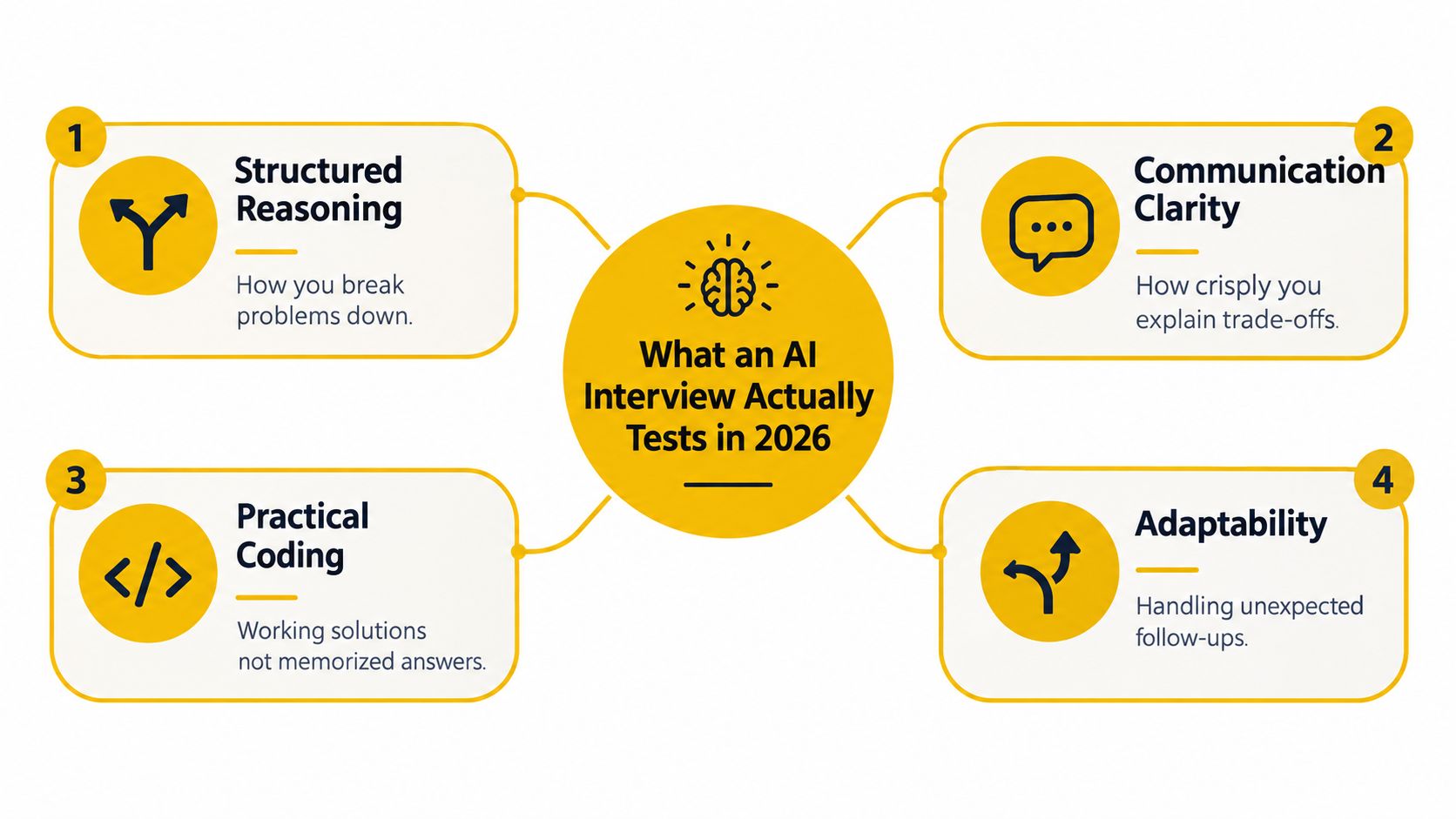
Structured reasoning. Can you break a problem down, state assumptions, and explain why your approach is safer than the obvious one?
Communication clarity. Can you make a technical idea understandable to a non-specialist without burying the important caveats?
Practical coding. Can you produce a working solution, not just name a pattern you memorized once?
Adaptability. Can you handle a follow-up that changes the framing, adds constraints, or challenges your first answer?
The mistake is treating the interview like a memory test. It is a reasoning test with live interruptions.
That is why the right prep window is not cramming harder. It is a six to twelve week system that builds fluent explanation, repeatable problem solving, and calm under pressure. If the role is technical, you need to code and explain. If the role is cross-functional, you need to show judgment, not just enthusiasm. If the interviewer is AI-assisted, assume the system may be tracking more than your words.
Technical Study Plan That Beats Grinding Problem Counts
A pile of random practice problems looks productive and teaches very little. Hiring teams do not care that you solved 200 disconnected questions if you cannot explain constraints, choose the right language for the role, and recover when someone challenges your first answer.
Use a three-phase cycle. First, identify the interview format and the competencies the role tests. Then refresh fundamentals in one primary language and practice implementation there, instead of bouncing between languages and bleeding time. Finally, rehearse timed solutions and role-specific system design so your reasoning holds up under pressure.
The process matters as much as the topic. For each problem, use the same sequence. Clarify assumptions and constraints, propose a brute-force baseline, derive the optimized approach, state time and space complexity, implement, test edge cases, and log the insight you missed. That log is where progress happens. Skip it, and you will repeat the same mistake with new problems.
A realistic benchmark is approximately three months at 11 hours per week, or 2 to 3 hours per day, spread across coding, fundamentals, system design, and behavioral communication Tech Interview Handbook. That cadence is more sustainable than a panic sprint, and it fits what working professionals can realistically maintain.
What to study and what to stop overstudying
Focus on what shows up in AI-enabled interviews:
- Data structures in context. Arrays, hash maps, heaps, trees, graphs, and queues still matter, but you need to explain why one fits a pipeline or retrieval workflow better than another.
- Evaluation logic. Be ready to talk about how you would judge quality, catch failure modes, and decide whether a system is good enough.
- Statistical reasoning. Know enough to explain uncertainty, noise, and why a result can look better than it is.
- Implementation in one language. Pick one and go deep. Switching languages mid-prep is self-sabotage.
If you cannot explain your solution while coding it, you do not own the solution yet.
For role-specific AI prep, a focused question bank helps more than a scattershot search. If you need a starting point for technical and machine-learning-oriented screening, use AI and ML interview questions as a map, not a script. One tool that can sit alongside that work is Interview Pilot, which offers guided mock interview sessions and live suggested answers during online interviews, but the discipline still has to come from you.

Behavioral Stories Built From the Job Description
Generic leadership stories don't win interviews. They blur together because they weren't built for a specific role. A hiring manager hears “I collaborated cross-functionally” and mentally deletes it unless you show the actual problem, your personal move, and the result.
Start with the job description and build an evidence matrix. List each required competency, then assign one concrete story to it using Situation, Task, Action, Result. If the posting emphasizes ownership, ambiguity, experimentation, stakeholder communication, or ethical judgment, each of those gets a slot. Six to eight adaptable stories are enough if they're strong and distinct.
Keep the result honest. State the baseline, what you changed, and what happened afterward. Then add a short reflection on what you learned, because interviewers want to know whether you can improve, not just repeat a lucky win. The best stories separate your contribution from the team's outcome, which is where weak candidates usually get sloppy.
| Evidence Matrix Template | |||
|---|---|---|---|
| Job-Description Competency | STAR Story Slot | Quantified Result | Likely AI-Specific Follow-up |
| Ownership | Story 1 | Baseline, action, outcome | How did you track responsibility? |
| Ambiguity management | Story 2 | What changed after your action | What assumptions did you make? |
| Stakeholder communication | Story 3 | Team and business result | Who challenged you and why? |
| Experimentation | Story 4 | What you tested and learned | How did you avoid false confidence? |
Don't turn STAR into a script. Use it as a structure. Research-oriented commentary has also questioned its predictive strength in some contexts, so the point is clarity, not performance theater Behavioral Interview Overview. When the interviewer starts probing, answer with assumptions, metrics, trade-offs, and rollback criteria.
Good behavioral prep sounds specific even before the follow-up questions start.
For AI roles, expect deeper probing on data quality, leakage, evaluation design, bias, privacy, deployment monitoring, and failure handling. If you can't answer those cleanly, your story is too vague.
Navigating Interviews Where AI Watches Back
A candidate can prepare the answer and still lose the interview. If an AI system is screening, transcribing, scoring tone, or flagging behavior, you are being assessed by software before a human makes a final call.
That changes the job. Gartner reported that only 26% of applicants trust AI to evaluate them fairly, 32% worry AI could cause them to fail an application, and 25% say AI evaluation reduces their trust in employers Gartner survey on applicant trust in AI evaluation. The same survey also found that 21% of U.S. organizations and 20% of U.K. organizations reported using generative AI for at least initial interviews in 2025.
Ask before you answer
Get clear on five points before interview day:
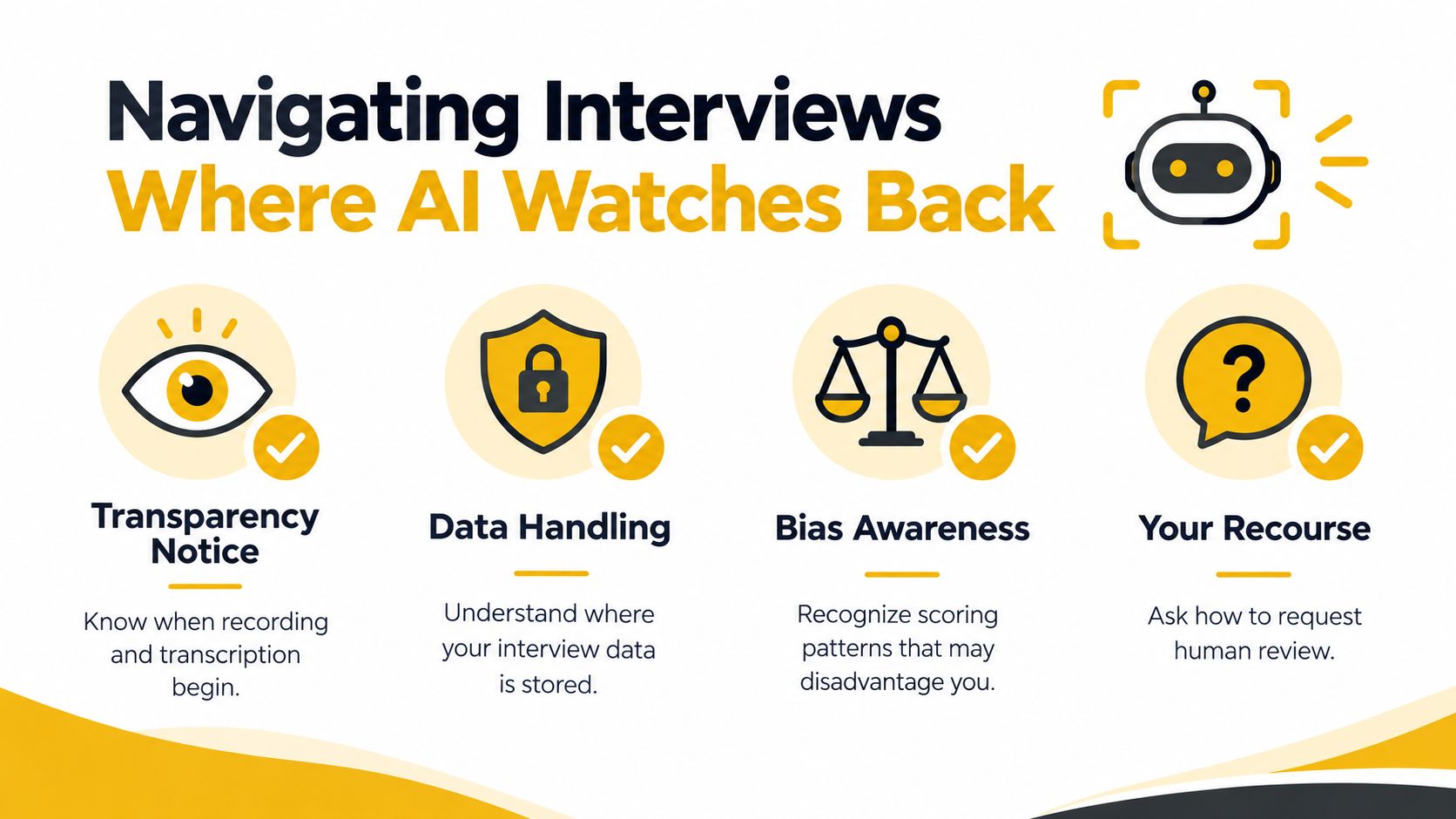
- Whether AI is screening or scoring. Ask whether it only supports a recruiter or evaluates you.
- What the system measures. Find out if it analyzes words, tone, body language, or another signal.
- How long data is retained. Recordings and transcripts should not be a mystery.
- Whether a human reviews the output. If not, you need that stated plainly.
- Whether an alternative process exists. Accessibility and fairness are part of the process, not extras.
Use this script if you need one: “Before we schedule, can you confirm whether AI will be used in any part of the interview process, and if so, what it evaluates, whether recordings are retained, and whether a human reviews the result?”
That is a professional question. It signals that you care about process quality, transparency, and your own right to a fair evaluation.
If you want help shaping answers once the process is clear, the AI answer generator guidance page shows how to structure responses without sounding canned. The point is not to game the system. The point is to know what system you are walking into.
Mock Interviews, Remote Setup, and the Pre-Flight Ritual
A mock interview that doesn't feel like the genuine thing is just a polite conversation. You need pressure, interruptions, and ugly silence. Otherwise you'll stay falsely confident right up until the actual interview exposes the gap.
Use a mix of practice partners. A peer catches obvious wording problems, a mentor catches judgment gaps, and an AI mock tool catches repetition, pacing, and missed structure. One practical option is Interview Pilot's AI Mock Interview, which gives guided practice, live transcripts, and performance feedback for live online interview rehearsal Interview Pilot AI mock interview.
Here's what to track after each session:
- First-attempt accuracy.
- Time to identify the pattern.
- Debugging mistakes.
- Whether the complexity or logic explanation was correct.
- Recurring failure types, such as boundary errors, empty inputs, recursion depth, concurrency assumptions, or scalability blind spots.
That list beats “I did 20 questions” every time.
Use the environment you'll interview in. Test your microphone, camera, browser, lighting, and backup connection. If you need a quick way to verify audio quality before the call, a sound recording test is a better use of ten minutes than another hour of passive reading.
A 20-minute pre-flight ritual
Run the same sequence before every serious interview:
- Check the room. Close noisy tabs, silence notifications, and kill anything that can steal focus.
- Check the audio. Speak at your normal pace and confirm the mic catches you clearly.
- Check captions and accessibility settings. Don't assume they'll work when you need them.
- Check the platform. Log into the exact tool the interview will use.
- Check your recovery plan. Know what you'll do if the camera glitches or the connection drops.
If the setup is shaky, your best answer still lands badly.
You also need a reset for your own nervous system. Stand up, drink water, read your opening line, and remind yourself what story you want the interviewer to leave with. Rehearsing only the words is half the job.
Accessibility, Accent, and Not Performing for the Algorithm
A lot of interview prep advice is flat-out harmful. “Maintain eye contact.” “Sound enthusiastic.” “Control your facial expressions.” That advice assumes a narrow communication style and unfairly penalizes neurodivergent candidates, non-native speakers, and anyone whose natural delivery doesn't match the model the company has decided is “professional.”
Don't optimize for fake behavior. Optimize for clarity, evidence, and job relevance. If the process analyzes tone, language, or body movement, then performing better for the machine can push you away from the actual skill being tested. A polished mask is not the same thing as competence.
Ask directly whether nonverbal signals are scored. Rehearse in your own accent and speaking pace. Test microphones and captions ahead of time. If the platform struggles to understand you, the problem isn't always your communication. Sometimes it's the system.
Practical rule: clarity beats performance, and authenticity beats model-friendly theater.
If you need to request accommodations, do it early and plainly. Say what you need, not what you fear they'll think about it. That could mean extra time, captions, a different format, or a human review step. The goal is a valid assessment, not a beauty contest for machine interpretation.
For multilingual candidates, it also helps to review a real time call translation guide so you understand the trade-offs between translation support and speaking naturally. Adapting structure and removing ambiguity is smart. Masking your identity to satisfy an opaque scoring layer is not.
Your 90-Day Prep Timeline and Interview-Day Playbook
Weeks 9 to 8 go to fundamentals and format. Weeks 7 to 5 go to problem practice with the study loop. Weeks 4 to 3 go to system design and role-specific depth. Weeks 2 to 1 go to behavioral stories and mock interviews. The final week is logistics, setup, and mental rehearsal.
On interview day, open with intent. Answer the question asked, state your assumption if the prompt is unclear, and don't panic if you need a second to think. If you don't know something, say what you do know, name the gap, and show how you'd reason from there.
The one question that sticks is simple: “What would make someone successful in this role in the first 90 days?” It tells you what the interviewer values and gives you a chance to tie your own experience back to the job.
Close with specifics. Ask about next steps, timeline, and any concern they want you to address before the decision. Then send a tight follow-up that reinforces the exact strengths you showed.
Interview Pilot gives you guided mock interviews, live suggested answers during online interviews, and a large question bank you can use to rehearse the pressure points that matter here. If you want a tool that helps you practice the conversation, not just read about it, visit Interview Pilot and use it to tighten your prep before the next interview lands.
Topics
ai interview prep
ai mock interview
interview practice
ai interview questions
technical interview
Continue reading

AI Tools
AI Answer Generator Guide for Job Seekers
Learn what an AI answer generator is, how it works, and how to use one responsibly for interview prep without compromising accuracy or authenticity.
October 6, 2026
16 min read

AI Tools
AI ML Interview Questions: 7 Topics with Answer Guidance
Prepare with AI ML Interview Questions covering coding, system design, ML theory, SQL, cloud, behavioral and analytics, plus answer guidance and resources.
October 11, 2026
19 min read

AI Tools
5 Best AI Interview Assistants in 2026
Compare five AI interview assistants for live support, practice, platform coverage, usage limits, and public pricing in 2026.
October 11, 2026
6 min read