









Interviews
Technical Interview Coaching: 10 Options Compared for 2026
Compare 10 technical interview coaching options, from expert mock interviews to AI practice tools, and pick the right one for your goals and budget.
Interview Pilot Editorial Team
Updated October 27, 2026
18 min read

You've got three weeks until an onsite loop. You've solved hundreds of practice problems alone, at your own pace, with the ability to pause and look things up. You've never explained a system design aloud while someone interrupted you, challenged a trade-off, or asked you to recover after choosing the wrong data structure.
That gap is exactly why format matters more than brand in technical interview coaching. A question bank fixes unfamiliar topics. A human mock fixes how you perform under observation. A multi-week program fixes missing fundamentals, but only if you have the time. An AI tool fixes volume and scheduling, but it can't judge nuance the way an experienced interviewer can.
The performance drop under observation isn't hypothetical. In the 2020 North Carolina State University study of 48 computer-science undergraduate and graduate students, participants in traditional observed interviews performed less than half as well as those who interviewed privately, with significantly higher stress and cognitive load.
No option below can guarantee an offer, and none should be judged on testimonials alone. Use this list by model first, provider second. Identify your main gap, your timeline, and your budget, then pick the one format that addresses that gap directly rather than stacking several tools that do the same job.
1. Ai Mock Interview
If you need repeatable practice you can start tonight, without booking a calendar slot, Interview Pilot's Ai Mock Interview is built for that constraint. It gives you guided mock sessions with automated prompts alongside a question bank of approximately 10,000 role-specific questions spanning software engineering, data, finance, consulting, product management, and project management.
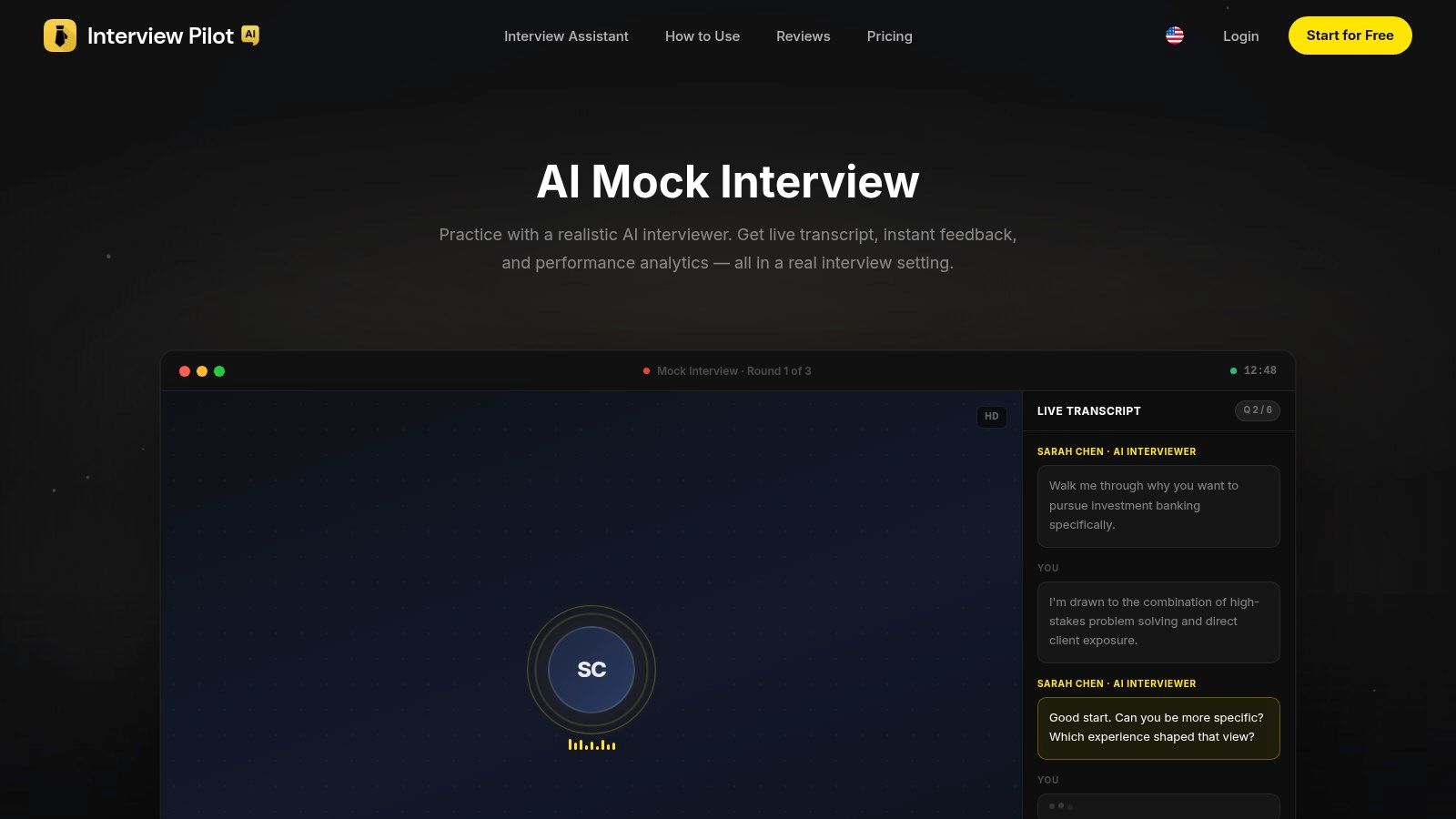
That breadth matters if you're switching tracks or interviewing across functions. For a software engineer, the value isn't memorizing answers. It's rehearsing a consistent structure you can reuse under pressure. That approach aligns with selection evidence showing mean criterion-related validity of approximately ρ = 0.42 for structured interviews, compared with about ρ = 0.19 for unstructured interviews, in the Cambridge Industrial and Organizational Psychology review of structured interviews. Structured formats use job-related questions, consistent prompts, and standardized scoring, which is why practicing a repeatable response architecture beats collecting isolated answers.
What a session involves
You rehearse common scenarios with automated prompts and guided practice, and you can use profile and document inputs to tailor answer suggestions to your background. Apps run on macOS, Windows, iOS, and Android, with service-wide support for more than 99 languages, which helps if you're preparing in a second language or across markets.
- Guided prompts: Automated prompts and guidance walk you through common interview scenarios, so each rep follows a repeatable format instead of starting from a blank page.
- Broad coverage: Technical, business, and finance tracks sit in one place, so you don't need separate tools per role.
- Personal inputs: Profile and document inputs can make practice more relevant to your actual experience.
Two limits are worth naming. Full question-bank access sits on paid plans, and automated feedback can confirm whether your answer follows a structure, not whether your explanation would hold up under sharp follow-up questions. I recommend it as a high-volume rehearsal layer, not as a replacement for one brutally honest human mock before a final loop. Use it to build fluency and consistency, then test that fluency live.
2. interviewing.io
interviewing.io is the human-expert model in its purest form: anonymous, voice-based mock interviews with experienced engineers, no video, sold as individual sessions rather than a program. It suits candidates who already know the material but lose precision when someone is watching.
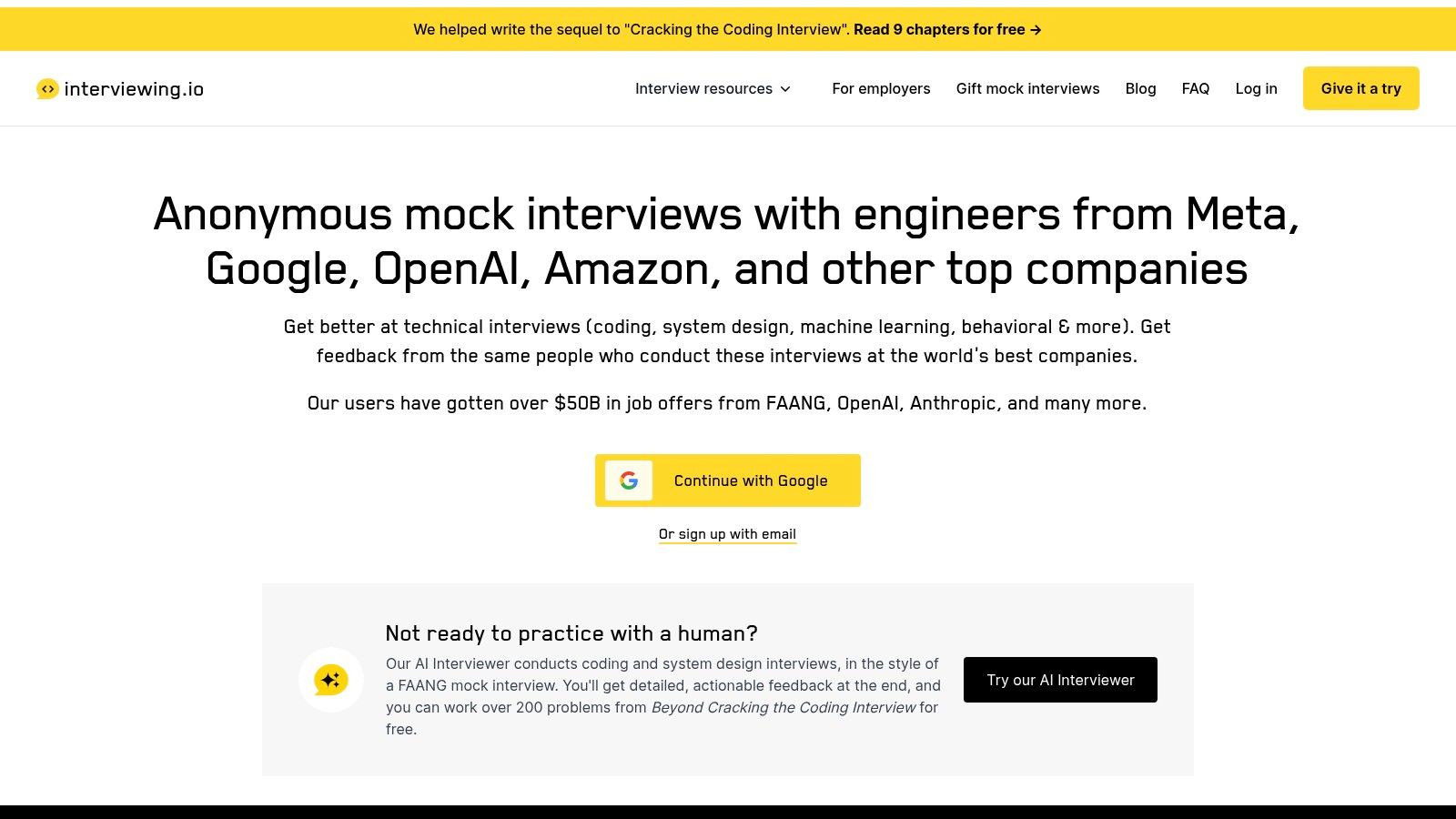
Coverage includes coding, system design, machine learning, and behavioral interviews. That spread tracks how hiring screens candidates now: in the CoderPad State of Tech Hiring 2026 survey of approximately 650 developers and recruiters, developers selected technical discussions (56%) and live-coding interviews (43%) among the most common assessment formats, while recruiters reported 60% for each.
What a session delivers is calibration. A working interviewer can catch habits automated scoring misses, like jumping to code before clarifying, long silent stretches, or failing to recover after a hint. Interviewers may also have hired at your target companies, so their pass/fail read carries more weight than a peer's guess.
- Real pressure: Voice-only anonymity lowers social awkwardness while keeping time pressure and interruption intact.
- Free entry point: AI coding and system-design practice lets you test fit before paying.
- Direct calibration: You learn whether your current level would pass, rather than just whether your code eventually works.
The trade-off is cost and scope. Expert sessions are relatively expensive for a single session, and final prices vary by interview type and interviewer, so check interviewing.io's current listed rates before booking. One mock also measures your level rather than rebuilding weak fundamentals. If yours are shaky, do structured study first and spend the paid session on verification; a resource like this best coding interview prep guide can sequence that work.
3. Formation
Formation isn't a drop-in mock. It's an intensive, personalized preparation program for software engineers, particularly experienced candidates targeting senior roles at top technology companies.
The model combines mock interviews and coaching with senior and staff engineers, tech leads, and hiring managers, plus adaptive practice matched to your target companies, timeline, and performance. Preparation covers coding, system design, and AI-assisted design interviews, alongside resume review, negotiation coaching, and broader career support.
That ongoing structure suits a specific reader. If you're a mid-level engineer who keeps reaching final rounds for senior roles and stalling on scope, ambiguity, or design depth, repeated feedback fitted to your own performance is more valuable than one isolated session. The program identifies skill gaps over time instead of giving you a single snapshot.
Buy ongoing coaching only when you have weeks to act on feedback between sessions. Without practice time in between, you're paying for diagnosis you can't use.
Monthly membership can be cancelled rather than requiring a long commitment, which reduces lock-in. Still, it's expensive compared with self-study tools or individual mocks, and it may not suit beginners who need foundational teaching first. The unlimited plan includes an outcome-based payment component, so read those terms carefully before signing. Don't let outcome language substitute for understanding exactly what you owe, when, and under what conditions.
4. Interview Kickstart
Where Formation leans personalized and senior-focused, Interview Kickstart leans curricular. Its live, online, multi-week programs combine technical coursework, mock interviews, behavioral preparation, and career coaching in one structured track.
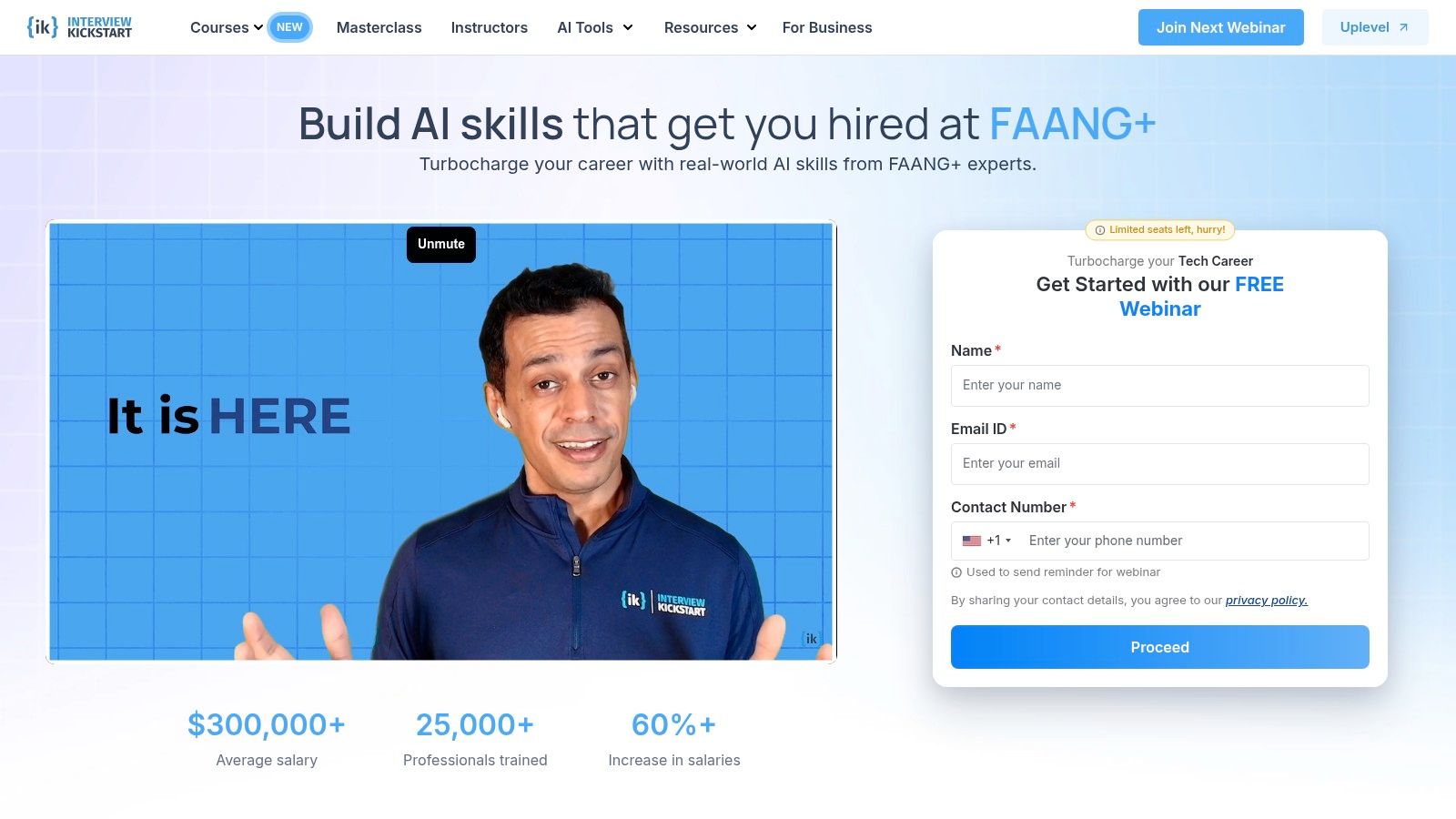
Role-specific tracks cover areas such as backend, frontend, data engineering, machine learning, and data science. Cohorts run on weekday and weekend schedules, and some programs include mock interviews and one-to-one technical or career coaching. Resume work, interview strategy, and negotiation preparation are also part of the offer.
- Structure and accountability: Live classes and support periods help if self-study keeps slipping.
- Role relevance: A backend or data track beats a generic coding course when your target loop is specialized.
- Broad coverage: You get technical study and interview practice without assembling them yourself.
The main friction is transparency and time. Pricing isn't listed openly and requires contacting an advisor or attending a webinar, which makes quick comparison hard. Multi-week programs also demand a significant commitment, so this model doesn't fit a loop in ten days. Review refund and outcome-guarantee conditions in writing before enrolling. If your timeline is short, start with a focused plan for how to prepare for a technical interview and buy only the piece you're missing.
5. Aced (formerly Exponent)
Aced (formerly Exponent) tries to cover the full ladder in one subscription. You get software engineering courses, coding exercises, video walkthroughs, interview examples, peer mock interviews, company-specific guides, and, on the higher tier, AI interview practice and feedback. Private coaching is sold separately.
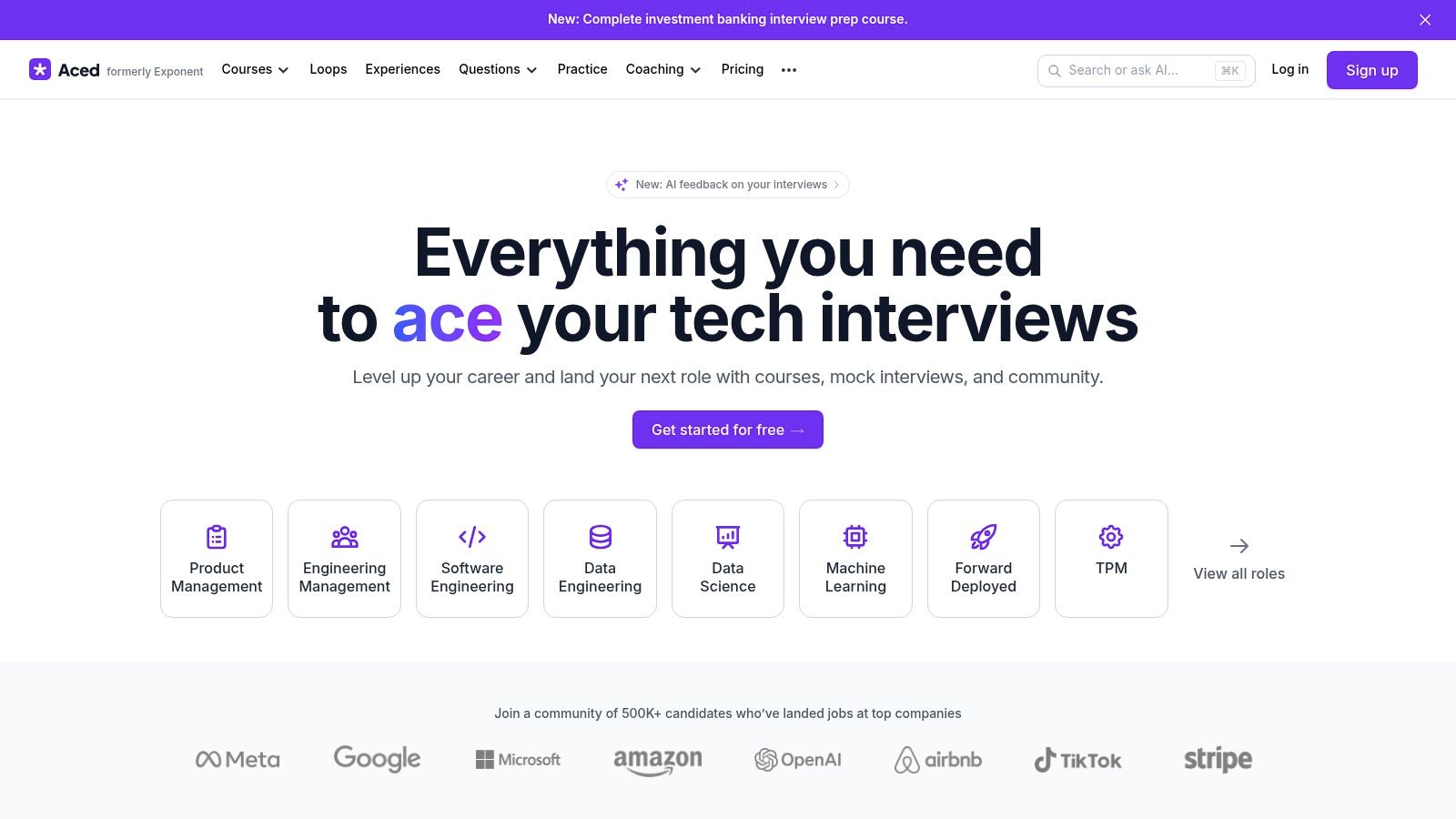
That separation is both the strength and the trap. You can start with a free membership tier and sample course material, learn a system design framework from examples, practice with a peer, then add a one-to-one coach only if you need calibration. For candidates preparing across different technology roles, the broad catalog also helps.
Don't confuse breadth with realism, though. The HackerRank analysis of real-world skills in tech interviews reports that 66% of developers prefer evaluation on real-world skills, while 77% say the assessments they encounter do not reflect the skills needed on the job. Watching walkthroughs won't close that gap unless you convert them into timed, spoken practice on debugging, trade-offs, and unfamiliar code.
Peer mocks depend entirely on finding a suitable partner, and a weak partner gives weak signal. Membership also doesn't include private sessions, so budget coaching as an add-on from the start. I recommend Aced when you want self-study structure first and optional human help later, not when you need guaranteed expert feedback this week.
6. Tech Interview Coach
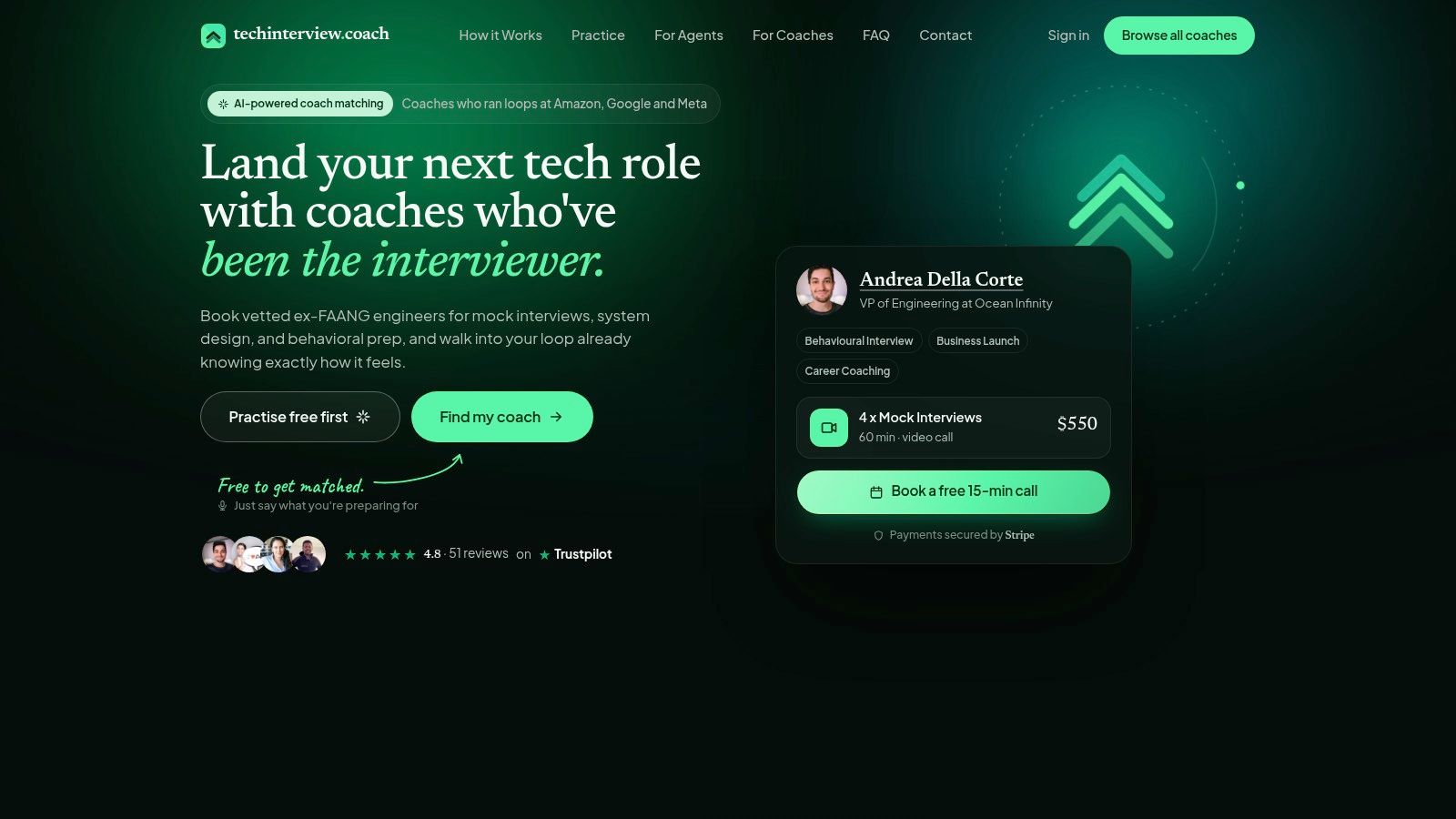
Tech Interview Coach splits the difference between free AI practice and paid human help. You can run free, self-serve AI mock interviews in a spoken format, then browse coach profiles if you want targeted feedback from a person.
How the two layers fit together
Coding practice includes an editor, system-design practice includes a whiteboard, and coverage extends to behavioral and general interviews. Coach profiles show specialties, session formats, and listed starting prices, and human sessions may include mock interviews, resume reviews, or career guidance.
That transparency helps you shop intelligently. You can test your spoken reasoning for free, spot whether your problem is code, design, or communication, then book a coach whose specialty matches that exact weakness. For a deeper comparison of formats, this overview of mock interview coaching is worth reading before you book.
- Free trial in practice: You can try the service before paying for a person.
- Visible specialties: Starting prices and focus areas are shown upfront.
- More than coding: Design and behavioral practice sit alongside algorithms.
Quality still varies by individual coach, and a listed starting rate may not apply to every session type. Vet experience yourself, ask what feedback format you'll receive, and remember that AI practice can't fully replicate an experienced interviewer's judgment about seniority signals or hiring bar.
7. Hello Interview
Hello Interview now sits in the self-paced camp: Guided Practice uses AI feedback and structured prompts for system design, low-level design, coding, and behavioral interviews, while the live mock interview and mentorship programs ended on May 31, 2026. Buy it for repeatable solo reps, not for one-to-one coaching.
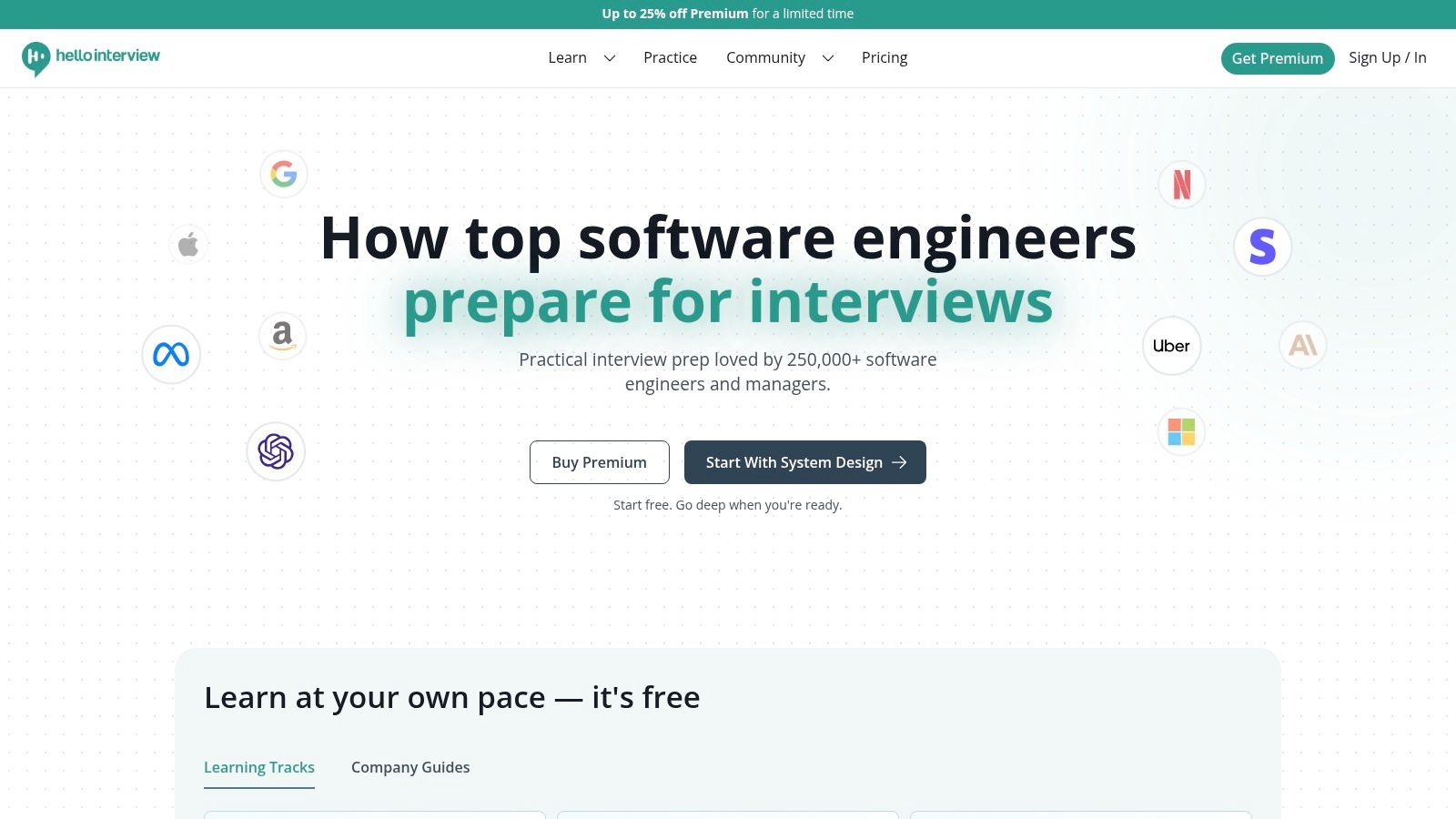
The value is in the drill design. You work through system design, low-level design, AI-enabled coding, and behavioral prompts with step-by-step feedback, a question library, premium courses, and some free content, so the same weakness can be attacked until the explanation comes out clean. Public pricing for learning products also makes it easier to decide whether the subscription belongs in your prep budget.
The structured approach reflects a well-supported pattern: interviews that use consistent, job-related formats tend to assess candidates more reliably than loose conversations. Practicing with stable frameworks makes your reasoning easier to evaluate because your claims, trade-offs, and follow-ups show up in the same places every time.
The limit is adaptivity. Guided exercises can tighten order and coverage, but they cannot recreate an interviewer who hears a vague design answer and immediately probes the weakness you hoped to skip. If your main gap is judgment under pushback, pick a human-coached option from this list; if your gap is organized repetition before a design-heavy loop, this fits.
8. Interwhew
Interwhew is a browser-based AI mock platform built around repeatable, pay-per-interview practice. There's no subscription to manage and no coach to schedule. You buy credits, run a full-length simulation, and get a written assessment.
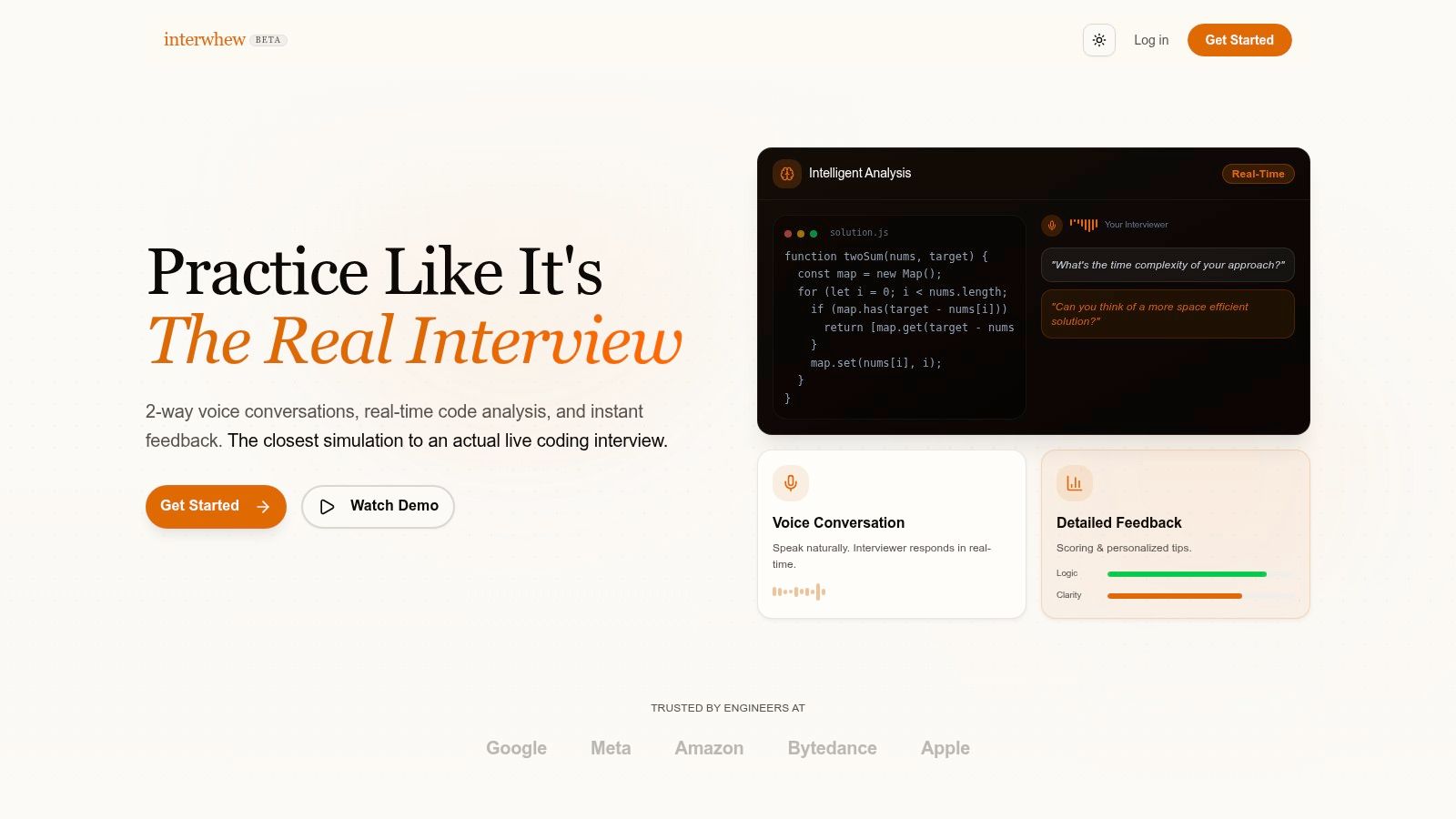
Sessions include a real-time coding environment, follow-up questions during the interview, and written feedback on problem-solving, code quality, communication, and pace. Interview credits are stated to remain valid for 12 months, which suits candidates who prepare in bursts around application cycles.
Practical rule: Pay per session when you need volume and repetition. Pay for a human when you need judgment about whether you'd actually get hired.
Compared with a static question bank, interactive follow-ups force you to defend decisions and adjust, which is closer to a real loop. Compared with a human mock, the entry cost is low and you can repeat similar problems until your narration becomes automatic.
The product is in beta, so features and pricing may change, and some interview tracks are still forthcoming. Treat its feedback as a practice signal, not a hiring verdict. AI can flag pace and obvious code quality issues, but it can't replace a coach who notices that your design sounds junior despite being technically correct. Use Interwhew for reps, then validate with a person when the outcome matters most.
9. InterviewSkool
If scheduling is your main obstacle, InterviewSkool removes it. This is an on-demand AI mock interview service for software engineers, with coding and system-design simulations you can start without an appointment, followed by a scorecard.
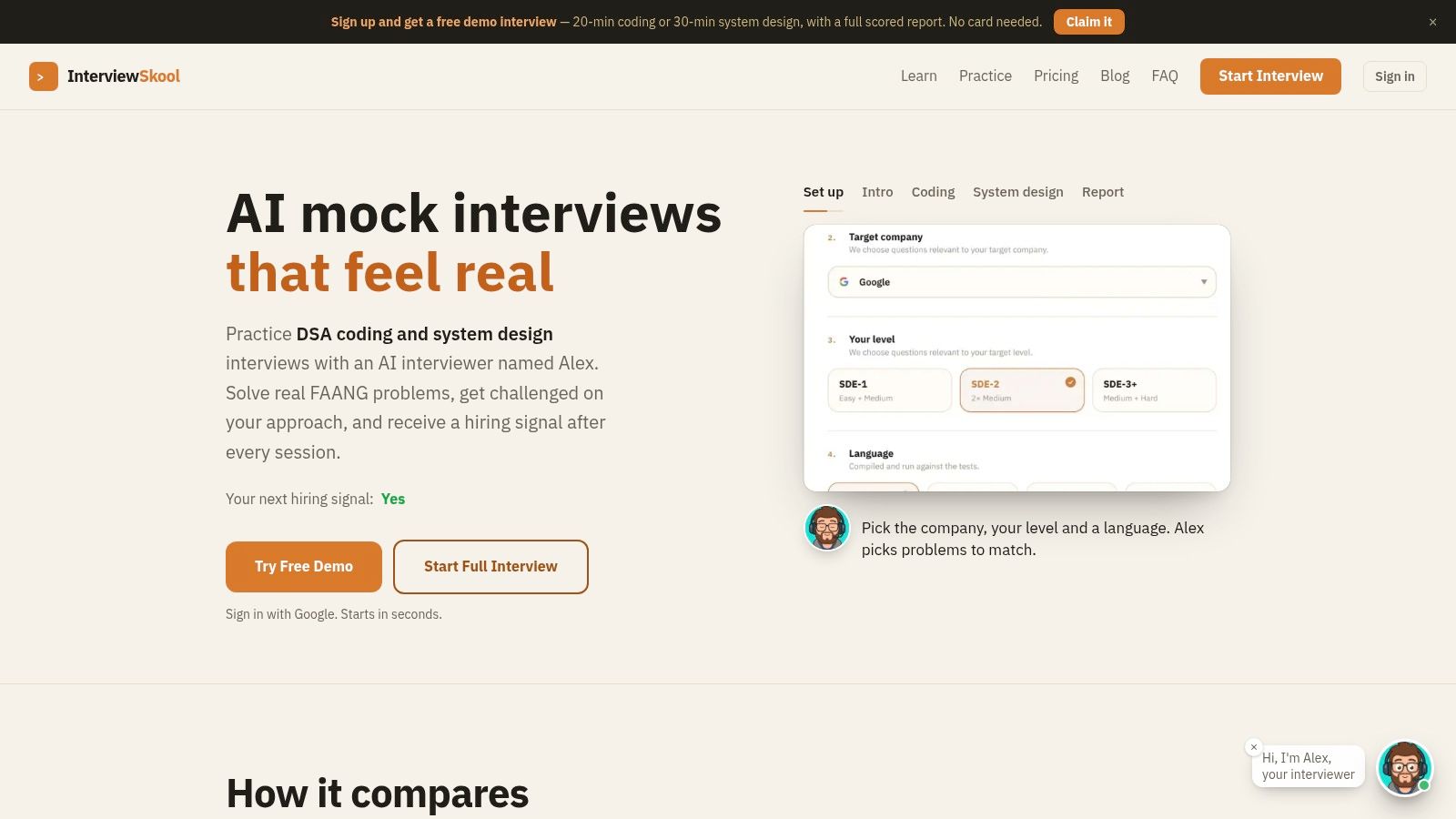
Post-interview feedback scores you across multiple dimensions, and session-based pricing is displayed on the public site. That combination makes it accessible for candidates who can't justify an expert-led mock yet, or who study late at night in another time zone.
- Immediate access: No calendar coordination when you have an hour free.
- Scorecard direction: Dimension scores tell you what to review next instead of leaving you with a vague pass or fail feeling.
- Spoken fluency: Repeated simulations build the habit of explaining your approach while you code.
Use it with clear eyes. AI evaluation may not capture the full context a human interviewer weighs, such as how you respond to ambiguity or whether your trade-offs fit the role level. Testimonials on the site also aren't independent evidence of outcomes. Verify which interview types and features are available before purchasing, and treat the tool as a practice aid that builds fluency, not a substitute for an experienced human coach before a decisive onsite.
10. ShowOffer
ShowOffer organizes preparation by company first, coaching second. Its question library sorts material by company and category, covering coding, system design, behavioral, and project-retrospective topics. You can then book optional one-to-one coaching separately.
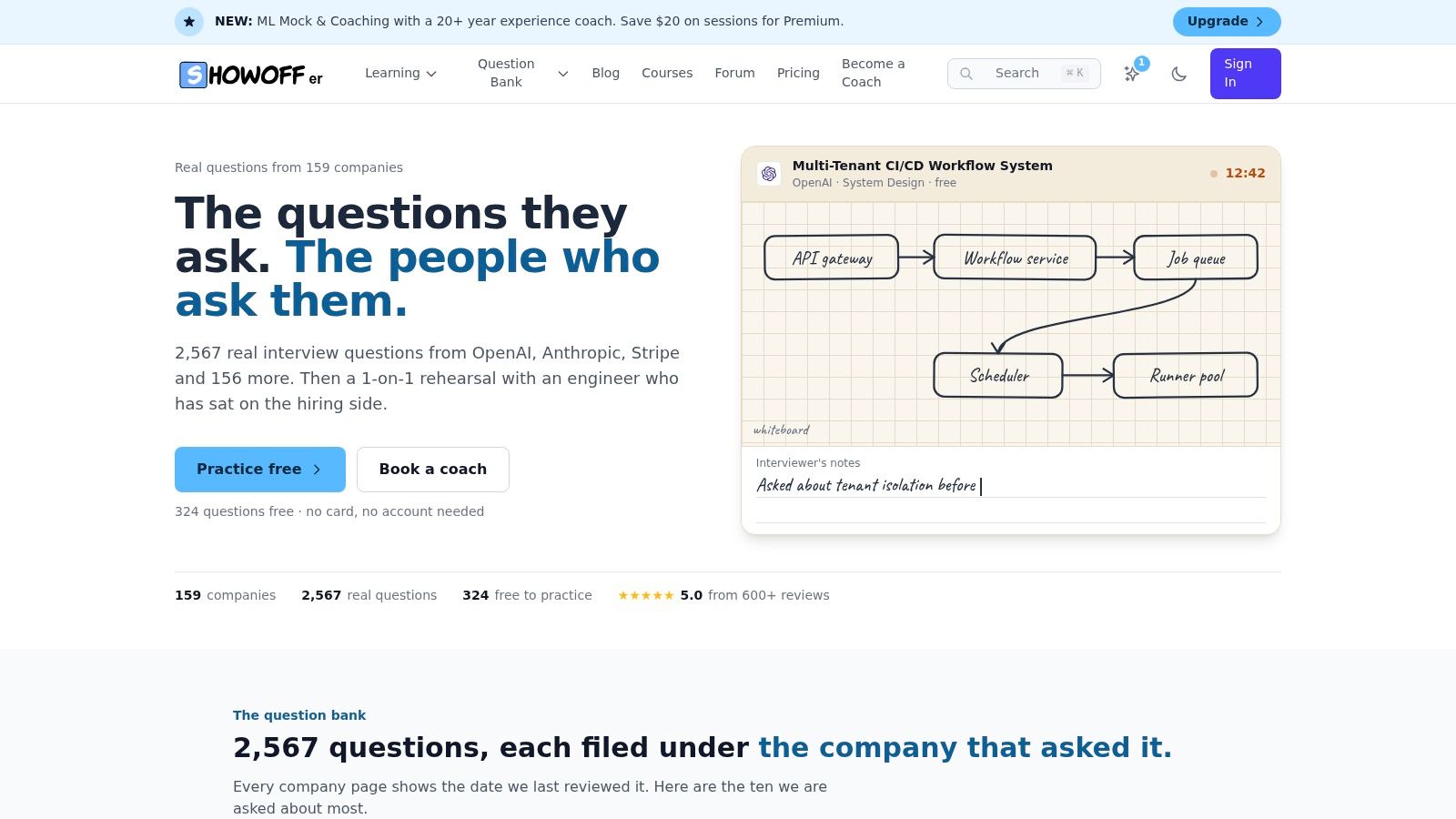
Part of the question bank is free, with separate Premium library access for more material. Human mock sessions are offered with coaches who say they have conducted interviews at the covered companies, which is what sets this apart. Company-specific organization supports targeted preparation when you know exactly where you're interviewing and want to rehearse that loop's likely emphasis.
That targeting has limits you shouldn't ignore. Candidate-reported questions are guidance, not a guarantee of what you'll be asked. Memorizing a reported question helps only if you can still solve a variant aloud, under time pressure, after a follow-up changes the constraints.
- Company focus: Useful when your loop is confirmed and near.
- Free starting point: Sample questions let you judge relevance before paying.
- Clear separation: Self-study access and one-to-one coaching are distinct purchases.
Coaching isn't included in Premium, and coach availability and fit vary by company, specialty, and timing. Book early if you want a specific background. I recommend ShowOffer as a final-stage targeting layer, after your general coding and design fundamentals are already solid.
How the 10 technical interview coaching options differ by format, feedback, pricing visibility, and best use
| Item | Format | Human Feedback | Pricing Visibility | Best For |
|---|---|---|---|---|
| Ai Mock Interview | AI-guided mock sessions and question bank | Feedback details not specified | Paid access noted; prices unclear | Broad, flexible interview practice |
| interviewing.io | Anonymous, voice-based mock interviews and AI practice | Experienced engineer feedback | Expert sessions start at $179; final price varies | Candidates seeking technical feedback from engineers |
| Formation | Ongoing coaching and adaptive practice program | Expert mentorship and mock interviews | Pricing details not specified; outcome-based terms may apply | Experienced engineers targeting senior roles |
| Interview Kickstart | Multi-week live online programs | Mock interviews and coaching in some programs | Not publicly listed; contact required | Candidates seeking structured, comprehensive preparation |
| Aced (formerly Exponent) | Courses, peer practice, AI tools, and optional coaching | Peer feedback and separately booked coaching | Free tier available; coaching is separate | Self-study across technical interview topics |
| Tech Interview Coach | Free AI practice with optional human coaching | Optional coach feedback; prices listed by profile | Coach starting prices visible; rates vary | Candidates wanting AI practice plus coach choice |
| Hello Interview | Self-paced courses and AI-guided practice | No current live human coaching | Public pricing available | Independent practice across technical interview formats |
| Interwhew | Browser-based AI interviews with coding simulations | Written AI assessment | Pay-per-interview credits; exact prices not specified | Repeatable coding practice without a subscription |
| InterviewSkool | On-demand AI coding and system-design interviews | AI scorecards | Session-based pricing displayed publicly | Flexible, affordable technical practice |
| ShowOffer | Company-specific question library and optional mock sessions | Optional human coaching | Free questions; Premium and coaching are separate | Targeted preparation for specific companies |
Build a Preparation Plan That Fits Your Goals and Budget
Start with a free diagnostic, not a purchase. Run one timed, spoken practice session in the format closest to your real loop, whether that's live coding, system design, or a technical discussion. Record where you broke down. Did you lack the knowledge, fail to communicate what you knew, or fall apart under observation and time pressure?
Those are three different problems with three different fixes. A content gap needs a course, a structured program, or targeted study. A communication gap needs repeated guided practice where you clarify, state assumptions, propose an approach, test edge cases, and explain trade-offs out loud. A pressure gap needs realistic mocks with another person watching, interrupting, and scoring you.
More problems solved alone won't fix a performance problem that only appears when someone is watching.
Choose one human session or one structured program, not several at once. Stacking providers usually means repeating introductory material and splitting your practice time so thin that no feedback loop closes. If you have three weeks, one diagnostic, focused daily reps, and one human mock in the final week will beat three subscriptions you barely open. That restraint matters for candidates without extensive time or money, a point the 2025 arXiv paper on evidence-based technical hiring preparation makes in noting that candidates rarely train in authentic settings and existing courses often fail to support preparation, contributing to stress and unpreparedness.
Before your first paid session, run a short checklist. Confirm the interview type, level, and target companies you'll rehearse. Bring two or three recent problems you failed or found ambiguous. Ask in advance what rubric or scorecard you'll receive, whether feedback is written, and how you'll track progress across sessions. Check total cost, cancellation terms, and any outcome-based payment in writing.
Candidates still value this format when it's done well. In CoderPad and CodinGame's State of Tech Hiring 2025 report, 90% of developers said a technical interview was the best setting for showcasing their skills. Coaching should help you show skills you already have, more clearly and consistently. It shouldn't promise to manufacture skills you haven't built.
Interview Pilot fits best here as a real-time and practice tool to pair with human coaching, not replace it. Use automated reps to build fluency between human sessions, then let a person judge calibration. For adjacent career perspectives beyond engineering loops, this podcast on discovery and SE careers is a useful listen. No option on this list can guarantee an outcome, and any provider implying otherwise is selling certainty that hiring doesn't offer.
If you're building daily reps between human mocks, Interview Pilot gives you guided AI mock interviews, a large role-specific question bank, and real-time support for live online interviews across desktop and mobile. Use it to practice explaining coding and design decisions aloud in a consistent structure, then bring the weaknesses it surfaces to your next human session. Visit Interview Pilot to start a practice session that fits your timeline and target role.
Topics
technical interview coaching
mock interview practice
coding interview prep
interview coach
system design prep
Continue reading

Interviews
Product Manager Interview Coaching: How to Make It Work
Learn how to use product manager interview coaching effectively, from choosing a format and curriculum to structuring mock interviews and vetting a coach.
October 24, 2026
15 min read

Interviews
How to Beat Job Interview Anxiety and Perform with Calm
Learn how to beat job interview anxiety with proven breathing, rehearsal, and recovery techniques that keep you calm and confident before and during real
October 21, 2026
14 min read

Interviews
7 Technical Interview Questions for Freshers
Prepare for interviews with technical interview questions for freshers, answer guidance, examples, and focused practice strategies for entry-level roles.
October 6, 2026
3 min read