









Interviews
Product Manager Interview Coaching: How to Make It Work
Learn how to use product manager interview coaching effectively, from choosing a format and curriculum to structuring mock interviews and vetting a coach.
Interview Pilot Editorial Team
Updated October 24, 2026
15 min read

You've got a product manager interview coming up, so you're searching for a coach, saving question lists, and wondering whether another mock round will help. The risk isn't that you'll run out of prompts. It's that you'll rehearse polished answers without learning how to defend your decisions, show what changed, or explain your role in the result.
Good product manager interview coaching should make your reasoning visible and testable. It should challenge your assumptions, ask for the evidence behind your impact claims, and give you a clear way to track which skills need work. If a session only sends you away with more templates, you've paid for homework, not coaching.
What Product Manager Interviews Actually Test
A candidate can give a sharp product-sense answer and still leave an interviewer unconvinced. They might identify a user problem, propose a sensible solution, and explain why it matters. But if they can't connect that choice to evidence, delivery constraints, team decisions, and business outcomes, the answer shows only part of the job.
That breadth comes from the role itself. On May 13, 1931, Procter & Gamble executive Neil H. McElroy proposed dedicated managers for individual products. His roughly 800-word memo argued that each manager should take responsibility for sales tracking, advertising, promotion, field testing, and customer research, rather than leaving ownership divided across departments. A history of the product manager's responsibilities helps explain why interviews assess integrated judgment, not just a technical specialty.
The model later influenced other companies. Hewlett-Packard's Bill Hewlett and David Packard adapted brand-management ideas toward engineering and solving customer problems, and product management eventually spread beyond consumer goods. The work still asks one person to connect customer needs, market evidence, execution, and commercial outcomes.
The dimensions behind the questions
Interviewers commonly evaluate customer understanding, analytical reasoning, product judgment, prioritization, communication, and execution. Those aren't separate boxes in real product work. A prioritization decision needs a clear user problem, a reason to believe the problem matters, an honest account of trade-offs, and a plan to learn whether the choice worked.
If you're mapping question types to skills, this product manager interview question guide can help you identify what different prompts are designed to surface. But don't turn the list into a memorization project. For each prompt, practise making your reasoning explicit: what you know, what you're assuming, what you'd prioritize, and what outcome would change your mind.
Practical rule: If your answer sounds like a feature pitch, back up and explain the user, evidence, and trade-off first.
When assessing a coach, look for practice that connects decisions across functions and to outcomes. Candidates who want to strengthen that broader ownership can also explore Ekipa's product ownership training. The useful question isn't how many prompts a coach can supply. It's whether their feedback helps you demonstrate ownership of a product as a business.
Comparing Coaching Formats for Your Situation
There isn't one coaching format that works for every candidate. Choose based on the gap you need to close, how soon you'll interview, and whether you need a person to challenge your judgment or more chances to practise aloud.
| Format | Best fit | Main limitation |
|---|---|---|
| One-to-one live coaching | A career switcher who needs candid feedback on product sense, or an experienced PM who needs sharper metric reasoning | Quality varies. A former PM isn't automatically a skilled coach. |
| Small-group workshop | A candidate who benefits from hearing other approaches and practising in front of peers | You may get less personal feedback and limited time for your own answers. |
| Self-paced course | Someone who needs to learn common case structures or wants a guided sequence before doing mocks | Recorded lessons can't diagnose your specific blind spots. |
| On-demand practice tool | A recent graduate who hasn't run a live case, or a candidate who needs flexible repetitions | Repetition without rigorous scoring can reinforce weak habits. |
A live coach is the strongest choice when the main problem is hard to see from your own answers. For example, a career switcher might jump into solutions before establishing which user they're solving for. A useful coach will stop the answer, ask what evidence supports that segment choice, and make the candidate try again with a clearer frame.
A group workshop can be a practical way to practise speaking under observation and compare how other candidates structure a case. Ask how much of the session is spent answering, how feedback is given, and whether you'll be scored against consistent criteria. If the workshop mainly cycles through examples while you listen, it may build familiarity without building performance.
Match the format to the gap
Self-paced material works well when you need to understand the shape of a case before you practise it. It's less useful if you already know the framework but can't apply it smoothly when an interviewer challenges your assumptions. In that situation, book a live mock or use a practice partner who will interrupt with follow-ups.
On-demand tools are useful for regular drills and answering aloud without arranging someone else's schedule. Pair them with human feedback when your weakness involves judgment, attribution, or communicating uncertainty. Those are areas where an outside listener can tell you whether your explanation answers the question.
Don't choose by popularity or sticker price alone. Choose the lightest format that gives you the feedback your specific gap requires. If you need individualized diagnosis, pay for that. If you need repetition, don't spend most of your budget on a long coaching package when a structured course and focused practice will do.
Building a Curriculum Around Four Core Competencies
A useful coaching plan follows the skills interviewers evaluate, not the order questions happen to appear in a search result. Organize your practice around product sense, execution and prioritization, quantitative reasoning, and communication and influence. These areas cover different kinds of judgment while reflecting the role's central challenge: integrating user needs, evidence, and delivery.
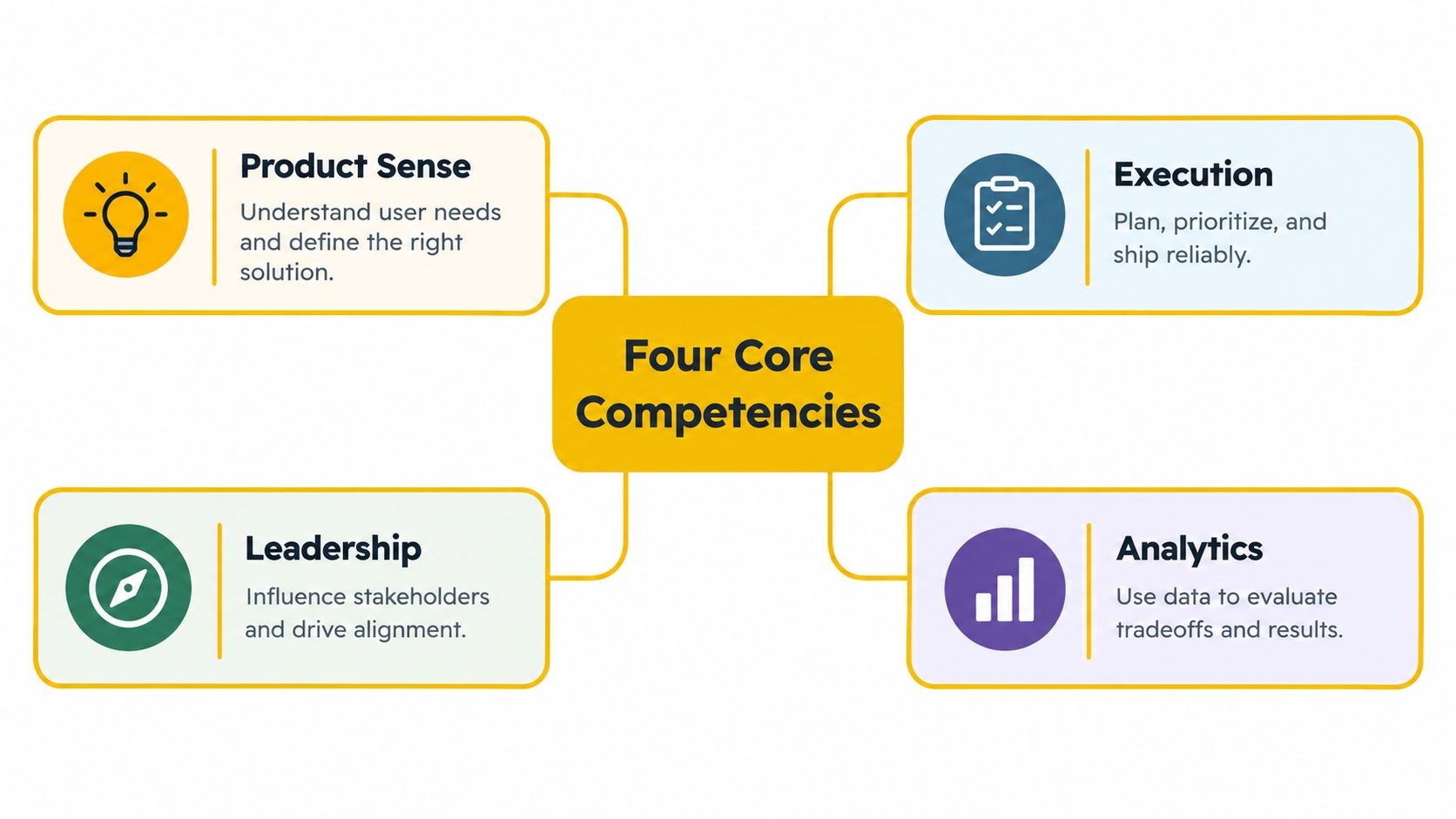
Start by writing two or three standard prompts per competency. Keep the prompts consistent enough that you can compare your answers over time. For product sense, ask how you'd improve a product for a specific user. For execution and prioritization, practise choosing among competing work under constraints. For quantitative reasoning, diagnose a metric change or define how you'd judge a feature. For communication and influence, use a conflict or alignment example and make your individual actions clear.
A four-week practice sequence
Use the same competency categories throughout the plan, but change the practice from isolated skills to full answers:
- Week one: Practise problem framing and clear communication. Ask clarifying questions, name the user, and state the goal before proposing an approach.
- Week two: Work on execution and prioritization. Explain what you'd do first, what you'd defer, and why.
- Week three: Focus on quantitative reasoning and impact stories. Define outcome measures, identify assumptions, and explain what evidence would support your conclusion.
- Week four: Mix the prompts into full case rounds. Keep the questions unseen until practice begins, then score the same competencies after each answer.
That sequence is a starting point, not a rule that every candidate must follow. If your first sessions show that your framing is strong but your metric choices are weak, revisit quantitative reasoning instead of pushing through a plan for its own sake.
The score that matters isn't how many questions you finished. It's whether you can use the same reasoning skills across different prompts.
Track competency scores and a short note on what went wrong. “Product sense, weak because I picked a solution before clarifying the user” tells you what to fix. “Practised three questions” doesn't. When a session goes badly, revisit the lowest-scoring skill and repeat it with a different prompt before returning to a full mock.
Running Mock Interviews With a Repeatable Scorecard
A mock interview that ends with "you did fine" is a wasted hour. You paid for evidence about how you reason, so demand a stated objective, a consistent rubric, and feedback written down while your answer is still fresh. Score what you did: the reasoning, the trade-offs, the attribution. Whether you sounded confident is a distraction.
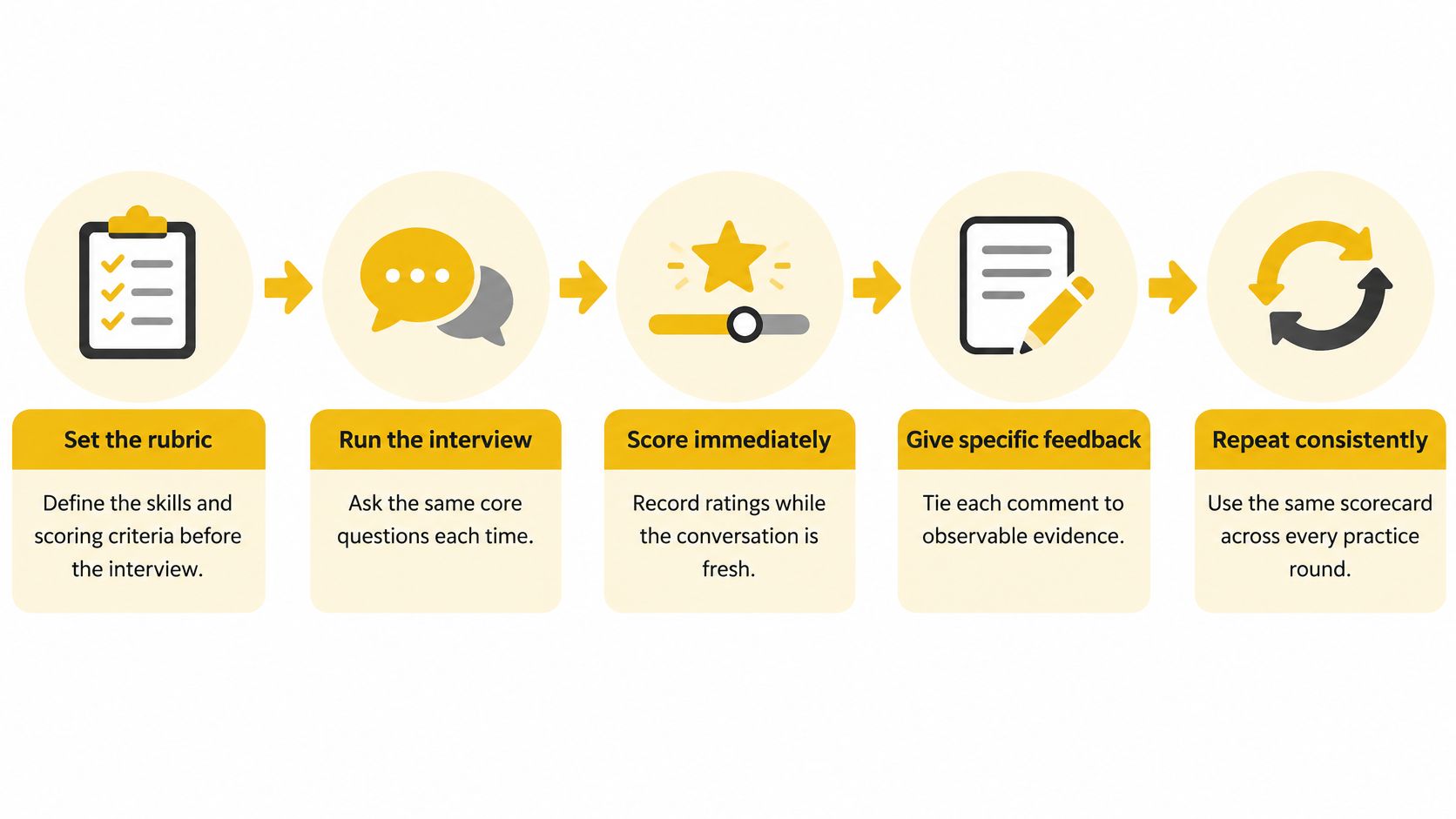
Before the mock, agree on the competency being tested, the prompt, and the constraints. In a product-design answer, push yourself to frame the problem before pitching features. Clarify the objective, name the user or business problem, state assumptions, compare options, define a success measure, and flag a risk. Framing first is the habit to build, not a quota on how many minutes you spend doing it.
Score evidence, not confidence
After the answer, score product sense, execution and prioritization, quantitative reasoning, and communication and influence. Record the specific failure mode rather than a vague impression: unclear goal, unsupported assumption, weak prioritization, missing metric, or rambling.
Say you hear "Which of these projects would you prioritize?" and immediately grab the most visible feature. In mock one, the coach flags weak prioritization because you named no criterion and deferred nothing. Next session, you rehearse an explicit trade-off model, user value against effort, and argue why the alternative loses. The mock after that tests whether the same reasoning transfers to a new scenario without a memorized script.
That transfer test is the clearest measure of a coach. Selection research consistently finds that structured interviews predict on-the-job performance better than unstructured conversations, and the same logic applies to practice: criteria defined before the mock, feedback tied to observable parts of your answer. A coach who scores your reasoning trains your reasoning. A coach who runs through question lists trains recall.
If you are also preparing for technical screens, coding interview study methods from Zemith show how deliberate repetition works in a different interview format. You can add reps through mock interview practice online, but keep the scorecard identical so a score in session five means the same thing it meant in session one.
Stress-Testing Impact Stories With Skeptical Follow-Ups
A polished STAR answer can still fall apart with one follow-up: “What was the baseline?” If you can't say what changed from what starting point, you haven't demonstrated impact. You've described an activity and attached a conclusion to it.

Take a story about improving onboarding. A coach shouldn't accept “users found it easier” as the result. They should ask what measure represented the user outcome, what the baseline was, what intervention you personally influenced, and what other changes might explain the result. If you don't have the figures, say so. Don't dress an uncertain result up as proof.
Put the evidence under pressure
Prepare for follow-ups that test five things:
- The measure: What outcome changed, and how did you distinguish it from activity such as views or clicks?
- The starting point: What did the measure look like before the intervention?
- The intervention: What changed in the product or process, and why did you choose it?
- Alternative explanations: What else could have caused the result?
- Your contribution: Which decisions or actions were yours, and where did teammates lead?
Interviewers increasingly challenge vague claims such as “improved user experience,” so practise stating the metric, baseline, intervention, outcome, and evidence for a causal link rather than relying on polished phrasing. STAR answer examples can help with story structure, but structure doesn't replace evidence.
For collaborative work, don't claim sole credit for a team outcome. Explain what the team delivered, then identify your part precisely: perhaps you changed the problem definition, secured agreement on a trade-off, or adjusted the measurement plan. If the result was negative or inconclusive, say what the evidence showed and what you learned. That's more credible than forcing a success ending.
A strong impact story can survive the question, “How do you know your decision caused that outcome?”
Use the video below as another prompt for thinking about interview preparation, then practise with a partner who will press on your evidence rather than nod along.
Choosing a Coach, Program or Practice Tool
A coach, a structured program, and a practice tool solve different problems. Don't pay for all three by default. First decide whether you need individualized diagnosis, an ordered learning path, or more chances to answer questions aloud.
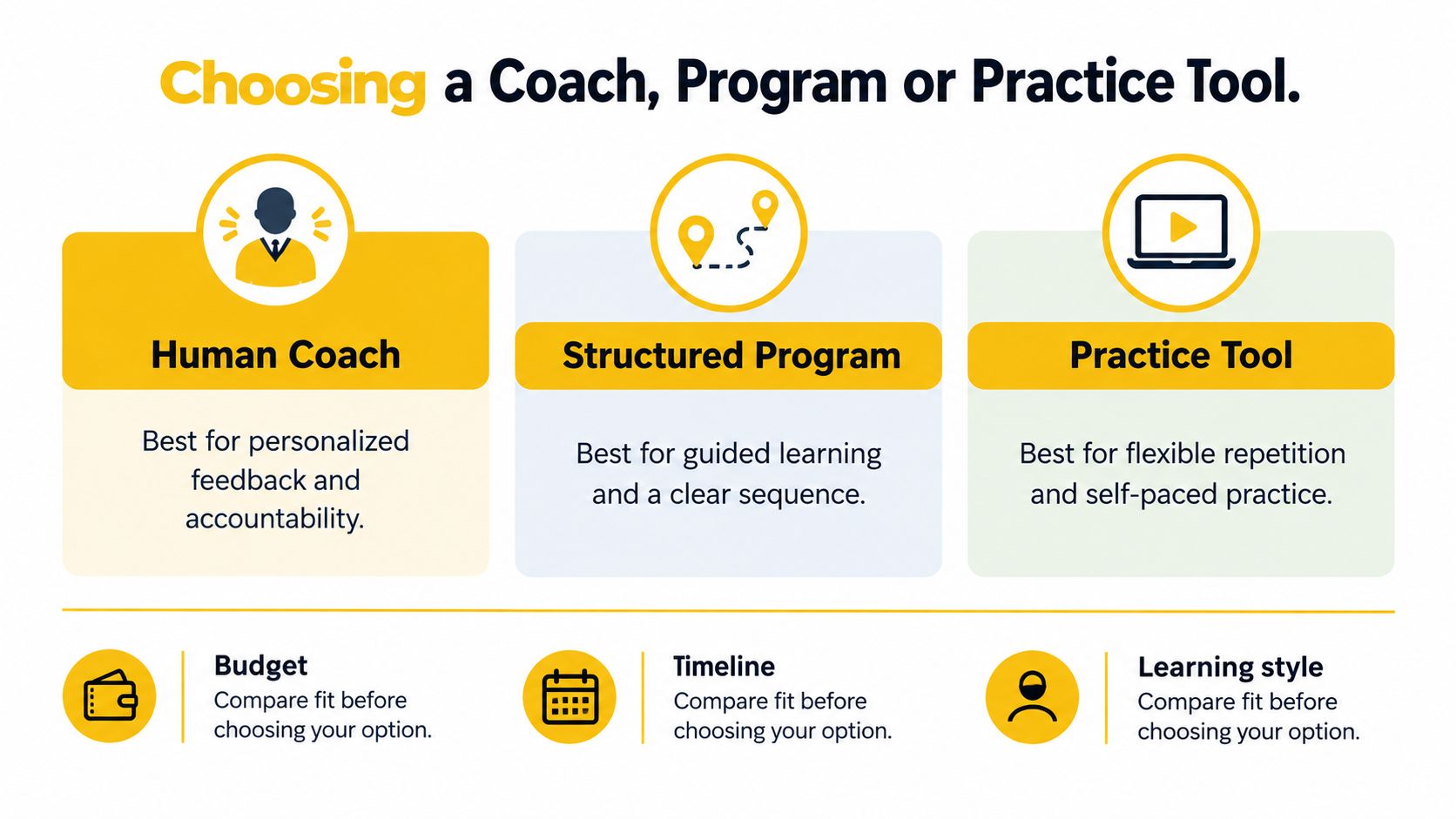
A human coach should be able to explain how they evaluate answers. Ask whether they use a rubric, record sessions for review, have recent experience with product hiring loops, and tailor practice to your target level and role. If their feedback is mostly “be more confident” or “add more detail,” ask for an example of what you should say differently and why.
A structured program can work when you need a sequence and reliable coverage of common interview formats. Check that it includes practice and feedback, not only recorded explanations. A practice tool is a good fit when you want flexible repetition, question prompts, or guided mocks, but it shouldn't be treated as an authority on whether your product judgment is sound.
Check the trade-offs before you commit
Interview Pilot is one option for candidates who want AI mock interview practice with automated prompts, a searchable question bank with full access on paid plans, role-specific guides, and native apps for macOS, Windows, iOS, and Android. It can support repetition and help you practise across question types, but it isn't a substitute for a human reviewing the quality of your reasoning and attribution. Check the rules for any interview before using assistance during a live conversation.
Use this checklist before choosing:
- Rubric: Will you receive competency-level scoring tied to evidence?
- Recording: Can you replay your answer and review where your reasoning became unclear?
- Role fit: Does the practice cover your target level, company, and interview format?
- Feedback source: Will a person challenge your judgment, or are you mainly getting automated prompts?
- Budget and timing: Can you get useful feedback before your interview without buying a package you don't need?
If a provider can't answer those questions clearly, keep looking. More content isn't automatically better coaching.
Planning Your First Two Weeks of Coaching
Start with a short self-assessment, not a subscription. Pick one product-design question, one prioritization prompt, one metric question, and one impact story. Answer aloud, record yourself, and score each response against the four competencies. Notice the specific gap: Are you jumping to features? Avoiding trade-offs? Naming activity instead of outcomes? Losing the thread while explaining your actions?
Use that first pass to choose a format. Book a human coach if you need someone to challenge your reasoning or untangle a weak story. Choose a course if you need a clearer structure before live practice. Add a tool if you need flexible repetition. Before your first session, agree on the objective, the prompts, and the scorecard. Ask the coach how they'll identify your lowest-scoring competency and what they'll do with that result.
A practical two-week start
In the first week, run an initial mock and review the recording. Write down the score and the exact moment your reasoning weakened. Use your next practice session to work on that one category, not to repeat the entire interview.
In the second week, run another mock with a different prompt, using the same scorecard. Compare the evidence in your answers rather than relying on whether you felt more confident. If the original weakness remains, keep drilling it. If it's improved, move to the next lowest-scoring category.
Today, write down three impact stories and test each one against the baseline, metric, intervention, alternative explanations, and your personal contribution. Bring the weakest story to your first mock. That gives a coach something concrete to improve and gives you a useful signal about whether their feedback is rigorous.
Interview Pilot offers guided AI mock interviews, role-specific question practice, and a searchable question bank to support your preparation. Use it to build repeatable practice, then bring your answers to a coach or partner who can challenge your reasoning and attribution. Explore Interview Pilot as one option for your next round of practice.
Topics
PM interview coaching
product manager interviews
mock interview practice
interview coach selection
PM mock interviews
Continue reading

Interviews
How to Beat Job Interview Anxiety and Perform with Calm
Learn how to beat job interview anxiety with proven breathing, rehearsal, and recovery techniques that keep you calm and confident before and during real
October 21, 2026
14 min read

Interviews
Return to Work Interview: How to Prepare After a Break
Heading back to work after a career break? Learn how to answer gap questions, prepare examples and ask smart questions in your return to work interview.
October 24, 2026

Interviews
Reasons to Call Out of Work: Valid Cases and Scripts
Explore reasons to call out of work, when to call out a colleague or issue publicly, HR and legal limits, and ready-to-use message templates.
October 23, 2026
15 min read