









Interviews
Reasons to Call Out of Work: Valid Cases and Scripts
Explore reasons to call out of work, when to call out a colleague or issue publicly, HR and legal limits, and ready-to-use message templates.
Interview Pilot Editorial Team
Updated October 23, 2026
15 min read

It's 7 a.m., your alarm is going off for the second time, and you're staring at your phone trying to decide what to type. You're not sure if you're sick enough, if your reason counts, or if your manager will think you're making an excuse. That hesitation is normal, and it's exactly why clear reasons to call out matter. The right words depend on which kind of call out you're making.
What Calling Out Really Means at Work
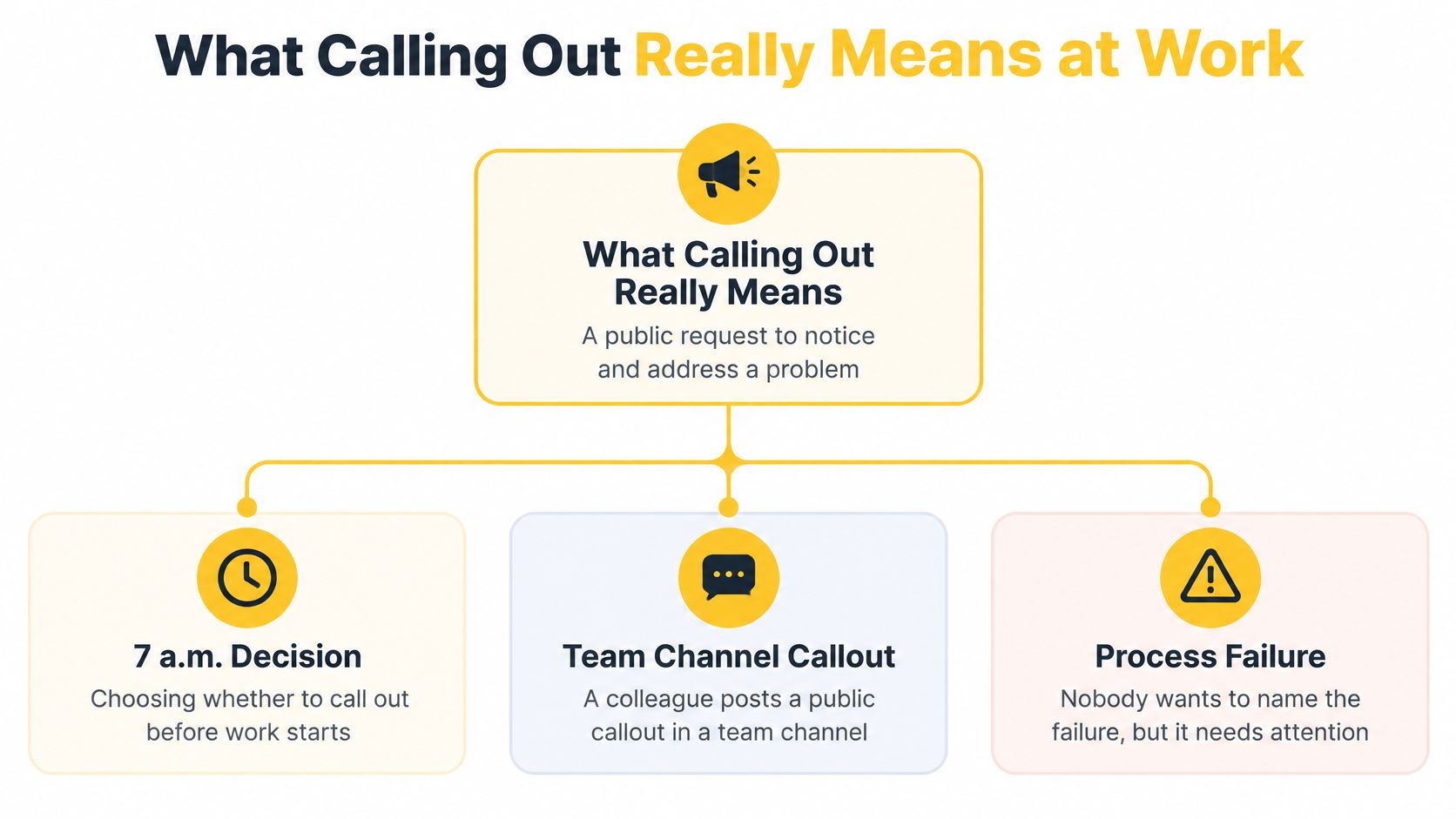
Think of calling out like a fire alarm. The sound is always loud, but it doesn't tell you whether there's a real fire, burnt toast, or someone testing the system. Context tells you how to respond. The same phrase at work can point to three very different situations, and mixing them up creates confusion for you and your manager.
First, there's calling out of work. This means notifying your employer you won't attend a shift or workday, usually because of illness, an emergency, or care duties. Your manager mainly needs timing, coverage, and a return update.
Second, there's calling out a person. This means naming someone's behavior in a team channel, meeting, or wider forum. The stakes are different here because reputation, evidence, and retaliation risk are involved.
Third, there's calling out an issue. You're flagging a process flaw, safety risk, broken handoff, or unrealistic deadline. You're not absent and you're not accusing a person. You're asking the team to notice and fix something.
How to Tell Which One You Mean
Ask yourself one question before you write anything. Are you asking for time away, asking for behavior to change, or asking for a problem to be fixed?
- Time away: Your message goes to your manager or scheduling system, and it focuses on notice and coverage.
- Behavior change: Your message needs observable facts, a private first step in most cases, and a clear record.
- Problem fix: Your message belongs in the channel where owners can act, with impact and a suggested next step.
If you can't name which of the three you're doing in one sentence, pause and clarify that first. A vague call out invites the wrong response.
That distinction also explains why advice online feels contradictory. A script that's perfect for a sick day sounds evasive for a safety concern. A direct public post that's justified for repeated harassment sounds harsh for a missed deadline. Once you label the situation correctly, the tone, channel, and level of detail become much easier to choose.
Valid Physical Reasons to Call Out Sick
Most employers accept physical illness without debate, but readers often get stuck on severity. You don't need to prove you're at your worst to stay home. You need to judge whether working would be unsafe, unproductive, or likely to spread illness.
Start with contagious illness. Flu, norovirus, a heavy cold with constant coughing, or a stomach bug puts coworkers, customers, and patients at risk. Remote work doesn't solve this if fever, vomiting, or exhaustion stops you thinking clearly.
Next are sudden symptoms that block core tasks. A severe migraine with blurred vision, dizziness, acute back pain, or an allergic reaction can make driving, lifting, screen work, or operating equipment unsafe. The issue isn't discomfort alone. It's whether you can perform essential duties without harming yourself or others.
A Simple Self Test Before You Decide
Use two questions your HR coach would ask you across the desk. Would you send a coworker home if they arrived like this, and can you do your core duties safely today?
- If you'd send them home: Call out, explain briefly, and rest. Don't negotiate with yourself because your calendar looks busy.
- If symptoms are mild and manageable: Consider working with adjustments, such as working from home, rescheduling meetings, or swapping physical tasks.
- If you're unsure but worsening: Notify early that you're unwell and may need to stop. Early warning helps your manager plan.
Injuries follow the same logic. A sprained ankle matters differently for a warehouse role than for a desk role where you can prop your leg up. Say what you cannot safely do, not just the diagnosis.
Urgent medical appointments also count when they cannot reasonably be booked outside work hours. That includes same day urgent care, a specialist slot you've waited for, or treatment that causes side effects. Give as much notice as you can and separate a planned appointment from a same day emergency in your wording.
Timing rule: Notify before your shift starts whenever possible, through the channel your workplace actually monitors. A perfect explanation sent to the wrong inbox still counts as late notice.
Check your local rules and contract for doctor's notes and self certification. Requirements vary, so don't assume a friend's workplace process applies to yours. What stays constant is honesty, early notice, and a short coverage plan. Those three habits make a legitimate sick day easy for a manager to approve, even on a busy morning.
Mental Health and Caregiving Absences
Many employees hesitate here, often because the reason feels less visible than a fever. The data shows it's a central part of modern absence, not an edge case. UK employer data shows average sickness absence reached 9.4 days in 2025, up from 7.8 days in 2023, with mental ill health as the leading reported cause of long-term absence at 41% and the second-leading cause of short-term absence at 29%, as detailed in the CIPD Health and Wellbeing at Work report for 2025.
Burnout, anxiety, panic symptoms, and medication side effects can all justify a recovery day. If you cannot concentrate, you're tearful between calls, or panic is affecting breathing and decision making, pushing through can create errors and deepen exhaustion. You're not required to disclose private medical details to make the absence valid in everyday communication.
A single day and a longer pattern need different responses. One day may help when poor sleep, acute stress, or a medication change makes today unworkable. Repeated absence, ongoing panic, or inability to return needs professional support, a conversation with HR or occupational health where available, and possibly formal leave rather than repeated same day messages.
When You Are Not the Sick Person
Caregiving creates a different doubt. You're well, so employees wonder if they're allowed to call out at all.
- A sick child who cannot attend school: This is a caregiving emergency when no other supervision is available.
- A disabled relative whose care has fallen through: Name it as a care breakdown, not as your own illness.
- An elderly parent with an urgent appointment: If it's planned, ask for flexibility early. If it's urgent and you're the only person who can attend, explain that constraint.
Don't invent a personal illness to cover care duties. That small lie creates bigger problems if dates, notes, or return conversations don't match. Say you're unavailable due to an urgent family care responsibility and give your expected update time.
Schedule flexibility is often the better first move for caregiving when the need is predictable. A shifted start, swapped shift, or remote day with clear boundaries may protect both your leave balance and your team's coverage. Same day absence fits better when supervision, safety, or emotional capacity makes real work impossible, even from home.
When Calling Out Someone Publicly Is Justified
Calling out a person publicly should never be your default, but silence isn't neutral when misconduct repeats. A joint 2021 survey by the International Labour Organization, Lloyd's Register Foundation, and Gallup of nearly 75,000 workers in 121 countries found that 22.8% of workers, about 743 million people, had experienced at least one form of violence or harassment at work, and more than 60% of victims experienced incidents repeatedly, according to the ILO summary of violence and harassment at work findings.
That repetition matters. If a behavior keeps happening, a private hope that it'll stop can leave the next person exposed. Speaking up creates a record, alerts people who can intervene, and shows patterns that one isolated complaint cannot.

A Rule of Thumb for Escalation
Start private or formal for most issues. A direct conversation, a manager report, or an HR channel gives the person a chance to correct behavior and gives the organization a chance to act. Move to a wider call out when the behavior is ongoing, the harm is clear, others are at immediate risk, or private routes have been tried and ignored.
Public doesn't have to mean social media. It can mean raising the issue in the relevant team meeting, naming it in a project channel where the conduct occurred, or refusing to let a harmful comment pass in the moment. Choose the smallest audience that can stop the harm.
Stick to observable facts. Describe behavior, date, place, and impact rather than character. Saying a colleague interrupted and mocked a presenter during the review is stronger and safer than labeling them toxic or abusive without evidence.
Avoid pile on posts, screenshots shared for entertainment, and claims you cannot support. Those habits damage your credibility and can create defamation risk if statements are false. Keep copies through legitimate channels, note witnesses, and separate what you saw from what you suspect.
Credibility check: If your call out would still stand with names removed and only actions, impact, and requested change left, you're on solid ground.
You may still feel nervous. That's understandable, especially if the person has more power. Nervousness doesn't mean you're overreacting. Use the formal route, write facts down promptly, and ask what protection and next steps apply.
Scripts and Templates for Every Situation
Good scripts do one job. They reduce follow up questions while protecting your privacy. Every effective message includes timing, reason at the right level of detail, coverage plan, and next update, as summarized in many professional communication guides for workplace messages.
| Element | What It Does | Example Phrase |
|---|---|---|
| Timing | Shows when absence or action starts | I won't be in today, Monday 12 May. |
| Reason | Gives enough context without oversharing | I'm unwell and need to rest and recover. |
| Coverage plan | Tells others how work will move | Ana has the client file and my notes are in the shared folder. |
| Next update | Sets when you'll confirm return or progress | I'll update you by 4 p.m. today about tomorrow. |
Copy Ready Wording You Can Adapt
Same day sick call: Hi Sam, I'm unwell today with flu symptoms and won't be able to work. I've left notes on the two urgent tasks in our shared board. I'll update you this evening about tomorrow.
Mental health day without medical details: Hi Priya, I'm not well enough to work today and need a sick day to recover. My meetings can be rescheduled, and I've flagged the only deadline in the team channel. I'll confirm tomorrow morning.
Notice the second script doesn't name a diagnosis. It's honest, brief, and privacy preserving. If your policy requires a category in a system, select the correct absence type there rather than adding detail in chat.
Caregiving absence: Hi Jordan, I have an urgent family care responsibility today because my child's care has fallen through. I won't be available for meetings. I'll check messages at midday for emergencies and update you tonight.
Schedule flexibility request: Hi Lee, I have a family medical appointment next Thursday morning that I need to attend. Could I start later and make up the time that evening? My deliverables won't be affected.
Team channel call out of a process or safety issue: Flagging a risk in the handoff. The approval step is missing, so orders can ship without a second check. Can the owner confirm we should pause until it's restored?
That last example names the issue, impact, and requested decision. It doesn't blame a person for a broken process. If the risk involves leave rights or a longer absence, reading guidance on protecting your job while requesting leave can help you phrase the formal request carefully before you send it.
Keep messages short and calm. Long explanations often invite debate about details that don't change the decision. Adjust greetings and formality to your company's tone, but keep the four elements. They're what your manager needs to approve, reassign, and move on.
HR and Legal Limits on Calling Out
A call out can be honest and still create risk if you use the wrong channel, miss notice rules, or make unsupported public claims. Boundaries aren't there to silence you. They determine whether your concern is protected, documented, and taken seriously.
Retaliation is the clearest reason documentation matters. In fiscal year 2024, the U.S. Equal Employment Opportunity Commission received 88,531 charges alleging employment discrimination, and retaliation was the most frequently alleged basis with 42,301 charges and a 47.8% share of all filings, ranking first for 17 consecutive years, as reported in the CWC summary of EEOC fiscal year 2024 enforcement statistics.
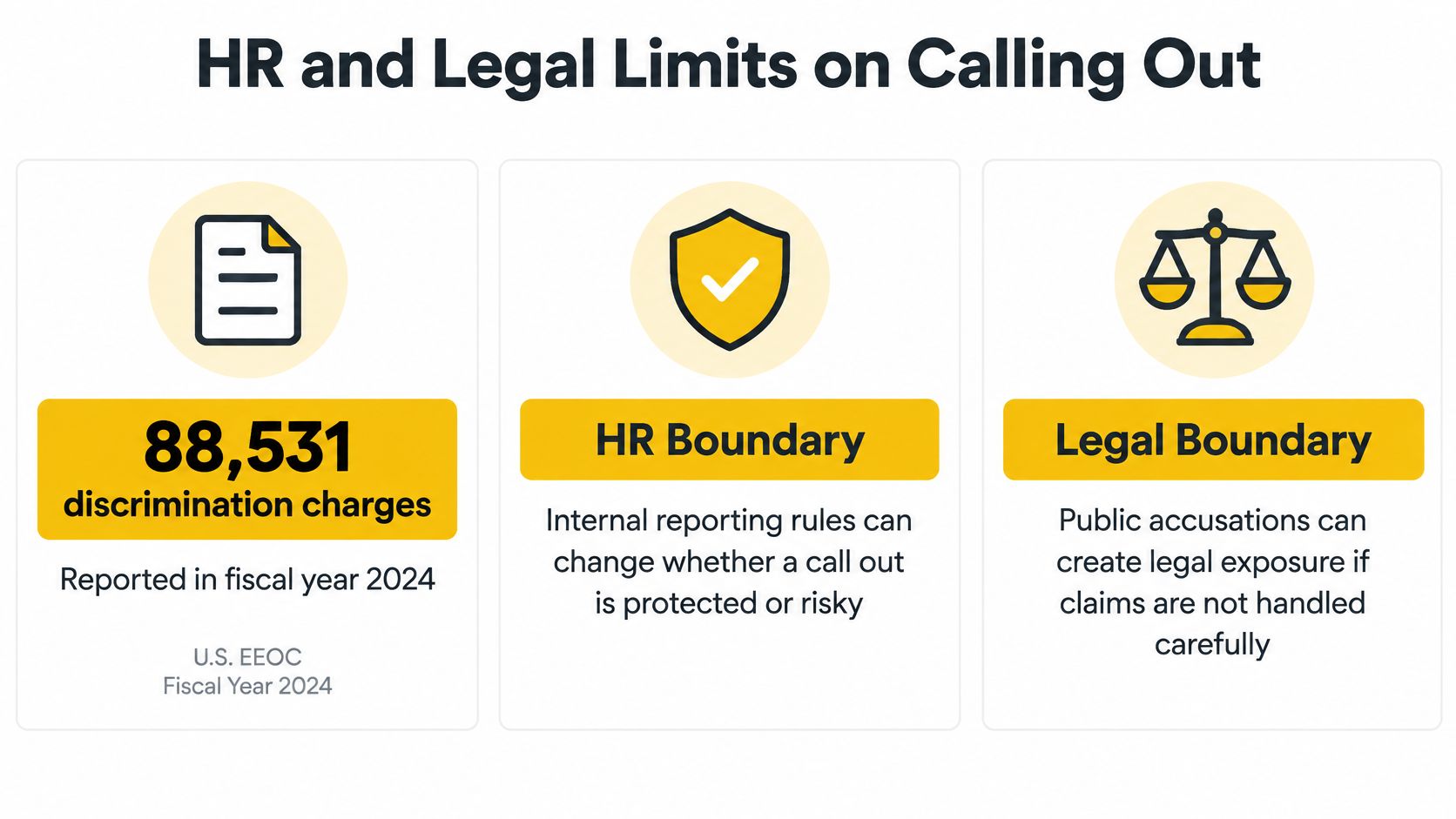
Raising concerns about harassment, discrimination, or safety is often legally protected, but the exact protection depends on your country, state, contract, and how you raise it. Sick leave notice, evidence requirements, family leave, and return to work rules also vary. Don't rely on general internet advice for a deadline or entitlement that affects your pay.
Practical Checks Before and After You Act
- Read the handbook before a crisis: Find absence reporting, evidence rules, grievance routes, and anti retaliation language while you're calm.
- Keep written records: Save dates, messages sent through proper channels, witnesses, and responses. Write facts close to the event.
- Use formal channels for serious harm: HR, compliance, safety reporting, or a regulator may fit better than a public post.
- Escalate when responses change after you speak up: Sudden schedule cuts, exclusion, or discipline after a complaint should be documented and raised promptly.
If you're a manager or owner trying to understand which policy applies, an AI legal assistant for business owners can help you organize questions, but it doesn't replace advice from a qualified employment lawyer for a live dispute. Employees facing dismissal, denied leave, or retaliation should seek that advice directly.
Honest notice plus written evidence won't solve every workplace problem, but they're the strongest safeguards most employees control themselves.
Avoid recording, sharing confidential data, or posting accusations externally without advice. Those steps can breach policy even when your underlying concern is valid. Protect the strength of your case by keeping the message factual, the channel appropriate, and the record complete.
Putting Your Call Out Plan into Practice
You now have three labels to work with. You're taking time away, addressing a person's behavior, or flagging an issue for repair. Naming the category first prevents the most common mistakes, such as oversharing medical detail for an absence or using a public blast for a private correction.
Run through four decision questions before you send anything. Is the situation urgent? Is this reason valid for this context? Can you explain it clearly in two sentences? Is there a formal channel that fits better than a public call out?
If the answer to the last question is yes, use that channel and keep a copy. If it's an absence, send timing, brief reason, coverage, and next update. If it's an issue, state impact and the decision you need.
Your Small Preparation List
- Save templates now: Keep a sick day, caregiving, and flexibility version in your notes app with names and links filled in.
- Review leave policy this week: Note reporting method, evidence rules, and who receives notice when your manager is away.
- Set your escalation rule: Decide in advance when a private conversation becomes an HR report, so you aren't inventing the threshold under stress.
Write your personal template today using the four elements you have already seen. Test the wording by reading it as your manager would. Does it answer what happens to today's work and when you'll update?
That five minute task turns a stressful 7 a.m. decision into a calm, credible message. You won't remove every doubt, but you'll stop improvising when you're ill, caring for someone, or trying to stop harm.
Clear workplace communication is also interview communication, because hiring managers notice how you explain absences, conflict, and accountability under pressure. Interview Pilot helps you practice those answers with guided mock interviews, real time support for live online interviews, and a searchable question bank built for your target role. Visit Interview Pilot to rehearse your next difficult conversation before it counts.
Topics
call out reasons
calling out sick
sick day message
calling out someone
workplace call out
Continue reading

Interviews
Top 10 Engineering Manager Interview Questions in 2026
Engineering manager interview questions on hiring, incidents, system design, and feedback, with frameworks and sample answers for your next loop.
October 23, 2026
20 min read

Interviews
10 Career Development Tools to Grow Faster in 2026
Compare 10 career development tools for 2026: interview prep, courses, assessments, skills mapping, resumes, and live AI interview support.
October 23, 2026
16 min read

Interviews
Failure Example for Interview: 4 Answers That Work
Real failure examples for interviews, with a four-step method, four sample answers, and the mistakes to avoid when you're asked about your biggest failure.
October 23, 2026