
















Interviews
Technical Interview Cheat Sheet: Topics and Workflows
Use this technical interview cheat sheet to review core topics, coding steps, Big-O, debugging and AI rules in one scannable guide.
Interview Pilot Editorial Team
Updated November 23, 2026
21 min read
In 2025, HackerRank surveyed 13,732 developers, engineering managers, recruiters, executives and students across 102 countries, and found hiring activity up 22% for lead developers, 19% for senior developers and 9% for junior developers (HackerRank's 2025 Developer Skills Report). Read that skew carefully. The roles growing fastest are the ones where a single whiteboard puzzle proves almost nothing about whether someone can do the job.
That's why a technical interview cheat sheet built as a list of solved problems misses the actual test. Modern loops check whether you can pick a data structure and defend it, read code you didn't write, debug a failure you've never seen, sketch a system under ambiguous requirements, and explain a trade-off in plain language. This guide treats the sheet as a portfolio of those skills, including the part almost every other sheet skips: what to do when the rules allow AI.
Core Topics at a Glance
A retrospective study of software-engineering interview practices from 2005 to 2026, covering four historical eras and 911 respondents recruited through software-engineering communities, reported that mean live-interview duration rose from 1.34 hours to 5.47 hours, while average rounds climbed from 2.50 to 4.64 (the 2005 to 2026 retrospective on ar5iv). The same study's combined psychological and time-burden score moved from 2.78 to 8.05.
The caveat matters: that study draws on retrospective professional reports rather than verified employer records, so treat it as evidence of perceived industry change, not a measurement of any one company's process. The direction is still the useful part. A loop that runs several hours across multiple rounds cannot be beaten by memorising fifty puzzles the night before.
Practical rule: if your preparation fits in one evening, you're preparing for a version of the interview that stopped existing years ago.
Here's the coverage map. Seven rows, each one a topic area you'll meet in some form at nearly every company that runs a technical loop.
| Topic | Core concepts to review | What interviewers check | Typical question |
|---|---|---|---|
| Data structures | Arrays, hash maps, stacks, queues, trees, graphs | Choosing the right structure and naming its trade-offs | Design an LRU cache |
| Algorithms and patterns | Two pointers, sliding window, BFS and DFS, dynamic programming, binary search | Recognising the pattern from the constraints | Find the longest substring without repeating characters |
| Complexity analysis | Big-O for time and space | Stating bounds before and after optimising | Why is your solution O(n log n)? |
| System design | Requirements, scaling, storage, caching, queues | Structuring an ambiguous problem and defending trade-offs | Design a URL shortener |
| Debugging and testing | Reproducing failures, edge cases, logging | Methodical diagnosis and test coverage | Why does this function return the wrong value on empty input? |
| Code review | Readability, correctness, security, maintainability | Spotting defects in code you did not write | Review this change for race conditions |
| Behavioral and communication | Project stories, conflict, ownership, explaining trade-offs | Clear reasoning and self-awareness | Tell me about a technical decision you later reversed |
Most of those rows recur across companies. Get fluent in pattern recognition and in explaining why one approach beats another, and you cover the majority of loops you'll face, including the ones at companies that pride themselves on unusual interviews. The rows candidates neglect are usually the bottom three, and that's exactly where experienced hires get sorted out.
Start with a self-rating, not with a problem set. Score yourself 1 to 3 on each row, where 1 means you'd freeze, 2 means you'd get through it shakily, and 3 means you could teach it. Mark the two weakest rows and work through those sections first. If everything scores a 3, you're calibrating wrong; pick the two rows where you'd be least comfortable being pushed on a follow-up question.
Assessment Formats and What They Measure
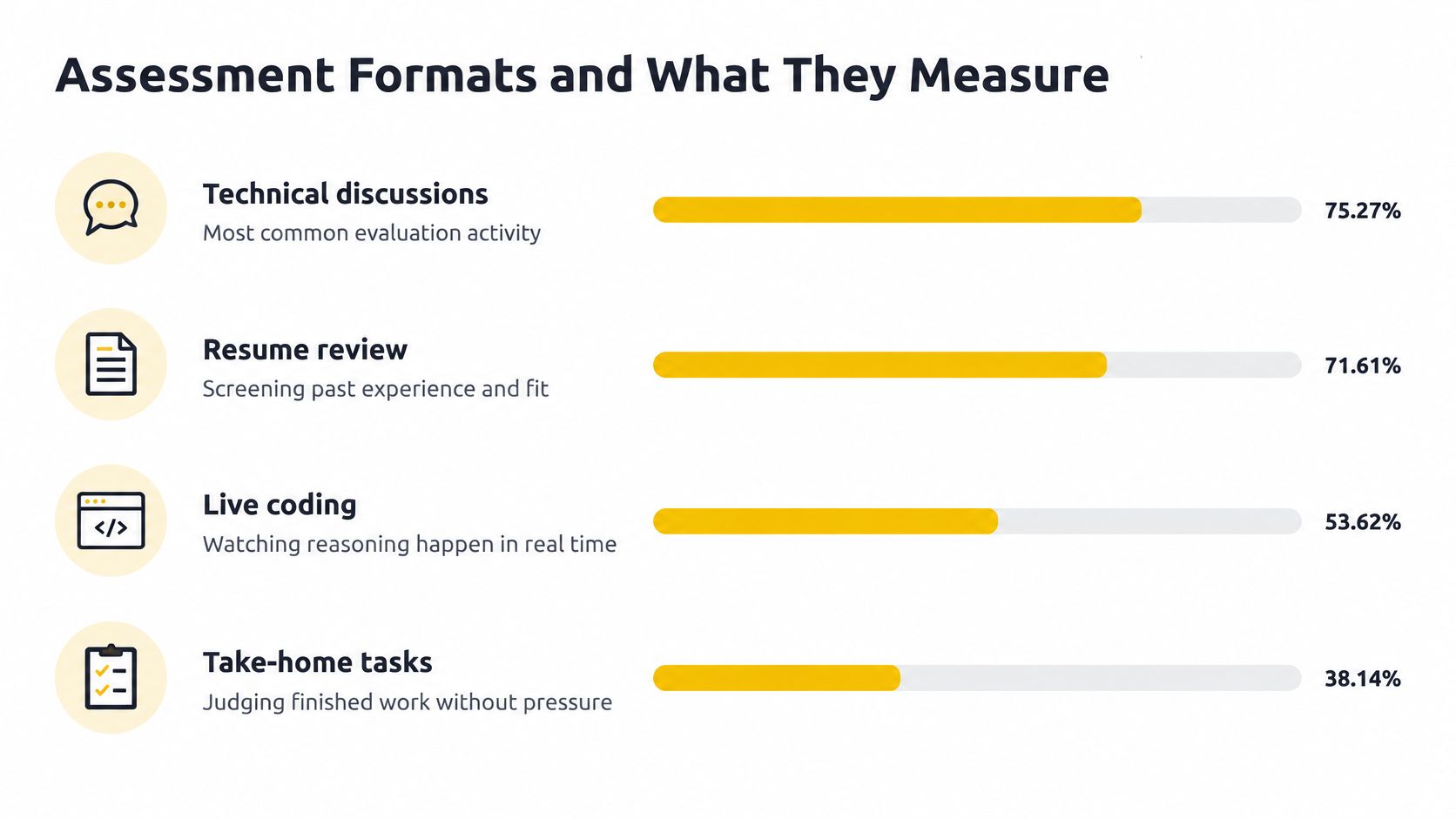
The 2025 State of Tech Hiring report from CoderPad and CodinGame draws a line most candidates miss: the difference between how employers evaluate you and what they test you with. On the evaluation side, technical discussions were used by 75.27% of respondents, resume review by 71.61%, and live-coding interviews by 49.82%. Among dedicated assessment formats, algorithmic questions led at 44.00%, and the same survey ranks the rest of the format list like this:
| Format | Share of employers | What it measures |
|---|---|---|
| Algorithmic questions | 44.00% | Problem solving under constraints |
| Real-world scenario simulations | 33.90% | Applied judgement on realistic tasks |
| Code-review tasks | 27.81% | Reading and critiquing existing code |
| System-design problems | 25.52% | Architecture and trade-off reasoning |
| Language-independent questions | 25.14% | Logic without tying it to one language |
| Pair-programming sessions | 18.48% | Collaboration while coding |
Each row maps to a different skill, and a single onsite loop can stack three of them in one day. The candidate who solves the algorithm but can't say why they chose a hash map over a sorted array loses points in the discussion round. The candidate who designs a clean system but never asks about read volume loses the design round in the first five minutes. Treat the formats as a portfolio of distinct skills, because each one punishes a different weakness.
Language-independent questions deserve a note because candidates misread them. When an interviewer asks for pseudocode or a solution in a language you barely know, they're testing whether your reasoning survives without the comforts of your usual library. Say the logic out loud in plain steps before you write anything.
How to allocate prep time when you don't know the company: algorithms first, always, because the format is near-universal. Then read the job posting. "Senior", "staff" or "architect" in the title means add system design next. "Pairing", "ensemble" or "cross-functional team" means add code review and collaborative problem solving.
Match the format list to the posting before you schedule any practice. A candidate preparing for a data engineering role at a company that lists repository debugging in the loop should not spend six weeks on dynamic programming.
Complexity Reference for Common Operations
You need these bounds at instant recall, because interviewers ask for them mid-sentence and hesitation reads as unfamiliarity.
| Structure or algorithm | Operation | Time | Space |
|---|---|---|---|
| Array | Access by index | O(1) | O(n) |
| Linked list | Access by index | O(n) | O(n) |
| Hash map | Lookup, insert, delete | O(1) average | O(n) |
| Balanced binary search tree | Search, insert | O(log n) | O(n) |
| Min heap | Insert, extract minimum | O(log n) | O(n) |
| Binary search | Search a sorted array | O(log n) | O(1) |
| Merge sort | Sort | O(n log n) | O(n) |
| Quicksort | Sort (average case) | O(n log n) | O(log n) |
| BFS or DFS on a graph | Traversal | O(V + E) | O(V) |
| Dijkstra with a binary heap | Shortest path | O((V + E) log V) | O(V) |
How to read these numbers under pressure
Anchor every bound to input size, because that's what the interviewer is really asking. On a million items, an O(n log n) sort does roughly twenty million units of work while an O(n²) approach does about a trillion, which is the difference between finishing in under a second and never finishing at all. When someone asks "can you do better", they're asking whether you can move one row down this table.
Three traps that cost points
- Quoting average hash-map cost as worst case. Say "O(1) average, O(n) worst case when every key collides" and you've answered a question they hadn't even asked yet. Claiming flat O(1) invites the follow-up that exposes you.
- Forgetting recursion stack space in DFS. A recursive traversal of a deep graph uses O(V) stack space in the worst case, on top of the visited set. Say it before they ask, because deep recursion on a skewed tree is a classic production outage.
- Ignoring space when the question sets a memory limit. If the interviewer mentions a constraint on memory, they're steering you away from the obvious auxiliary structure. Read the constraint as a hint about the intended solution.
If you can't state the space cost of your own solution, you haven't finished solving it.
State the bound for your own answer before the interviewer asks, then state it again if you optimise. Narrating complexity is free and it's one of the clearest signals of seniority you can give in a forty-five-minute round. For worked examples that pair each pattern with the bound it produces, this set of coding interview question walkthroughs is a reasonable place to rehearse the pairing.
Seven Steps for Solving a Live Coding Question
Live coding rewards a process you can repeat under stress. The candidates who struggle are rarely the ones who don't know the algorithm; they're the ones who start typing in the first ninety seconds and then can't explain what they wrote.
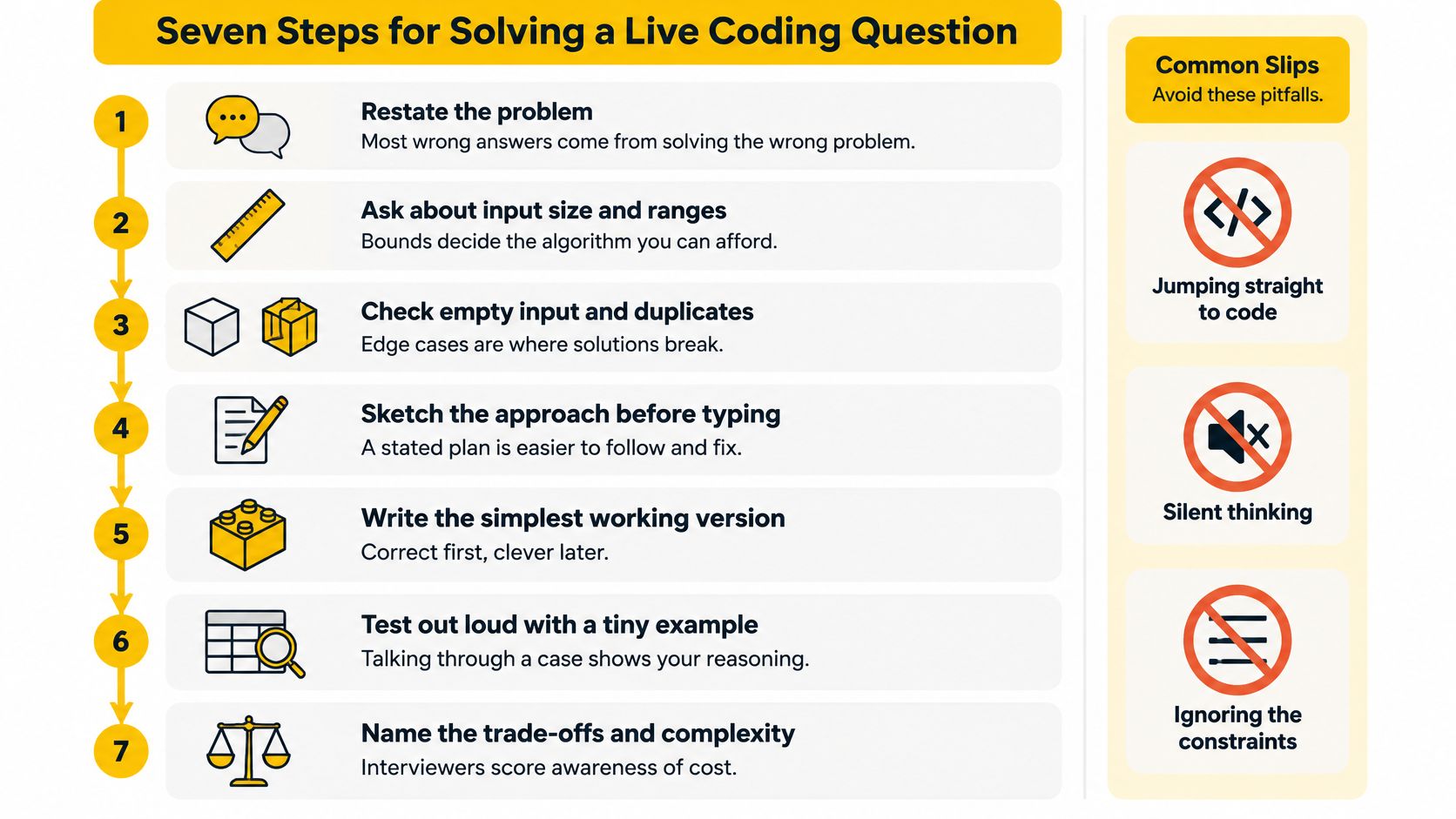
- Restate the problem in your own words. Most wrong answers come from solving a slightly different problem than the one asked. One sentence back to the interviewer catches the mismatch while it's still cheap to fix.
- Ask about input size, value ranges, empty input and duplicates. The bounds decide which algorithm you can afford; a brute-force scan is fine on a thousand items and fatal on a million. Asking also signals that you think about constraints before code.
- State your assumptions out loud. Write them in a comment if you want them on the record. The interviewer can correct an assumption in five seconds, and that's far better than discovering it during the trace.
- Walk through a brute-force solution and its complexity. A working baseline is worth more than a half-finished clever idea. It also gives you a fallback if the optimisation stalls.
- Name the pattern that removes the bottleneck. A hash map for repeated lookups, two pointers when the input is sorted, a heap when you keep extracting the extreme value. Say why that pattern applies rather than jumping straight into the implementation.
- Code in small pieces and narrate each decision. The usual slip here is going silent for several minutes. Silence reads as uncertainty even when your reasoning is solid, and it stops the interviewer from steering you early.
- Trace one normal case and two edge cases by hand, then state final complexity and one trade-off. Run the empty input and a single-element input at minimum. Close by naming what you'd change if memory were tight or the data were streaming.
| Signal in the problem | Pattern to try | Typical cost |
|---|---|---|
| Repeated lookups or pair matching in unsorted input | Hash map | O(n) time, O(n) space |
| Sorted array with a pair or triplet target | Two pointers | O(n) time, O(1) space |
| Contiguous subarray or substring with a limit | Sliding window | O(n) time |
| Sorted input and a target value | Binary search | O(log n) time, O(1) space |
| Shortest path in an unweighted graph | BFS | O(V + E) time, O(V) space |
| Connected components or tree traversal | DFS | O(V + E) time, O(V) space |
| Optimal choice over overlapping subproblems | Dynamic programming | Depends on state count |
| Repeated access to the smallest or largest item | Heap | O(log n) per push or pop |
For a standard 45-minute round, a workable budget is about 5 minutes clarifying, 10 minutes designing, 20 minutes coding and 5 minutes testing, with the remaining slack absorbing interruptions. That split shifts the moment the interviewer changes a constraint mid-solution. When they do, stop coding, restate the new requirement, and say what breaks in your current approach. Adapting deliberately scores better than patching without comment.
Debugging and Code Review Under Time Pressure
Memorised puzzle practice has its limits. A candidate who has drilled two hundred problems can still freeze when handed an unfamiliar repository with a failing test, because the skill being tested is diagnosis rather than recall. Debugging and code review rounds come up less often than algorithmic questions, but they carry outsized weight in senior hiring decisions. They show how you reason about code you didn't write, under a clock, with the interviewer watching every decision.

A debugging workflow you can run out loud
- Reproduce the failure with the smallest input that triggers it. Shrink the case before you theorise; a minimal reproduction usually reveals the cause by itself. If the input is large, cut it in halves until the failure disappears, then step back one level.
- Form two or three hypotheses about the cause. Say them aloud in order of likelihood. Interviewers score the hypothesis set, not just the eventual fix, and a candidate who lists three plausible causes reads as senior even when the first guess is wrong.
- Inspect evidence rather than guessing. Read the failing value, the log line, the call path. State the expected value before you check the actual one, because the gap between the two is usually where the bug lives. Add a print or a breakpoint at that divergence point.
- Make the smallest safe change. A one-line fix you can defend beats a refactor you can't explain. If the fix is structural, say so and propose it separately instead of expanding scope without stating it.
- Test edge cases. Empty input, a single element, boundary values, duplicate keys, and concurrent access if anything is shared.
- Explain the trade-off you accepted. Every fix buys something and costs something: a null check buys safety and adds a branch, a lock buys correctness and adds contention.
Code review checklist
- Correctness on the main path. Trace the happy path line by line before you comment on anything else.
- Edge cases and error handling. What happens on empty input, a null, a timeout, a partial write?
- Input validation and security. Untrusted input reaching a query, a shell, or a filesystem path is a finding rather than a nitpick.
- Naming and readability. Flag a name that lies about what the variable holds.
- Hidden shared state. Mutable module-level state and unguarded caches are where race conditions hide.
Work through the file in that order. Delivering a naming nitpick while a null dereference sits three lines below tells the interviewer you review cosmetics before logic. Phrase every comment as a question or a suggestion: "what happens if this list is empty?" invites the author to reason with you, while "this is wrong" shuts the conversation down and reveals nothing about your judgement. Practise the whole workflow on one real bug in an open-source project before your next loop. Reading someone else's issue thread, reproducing their failure, and writing up your diagnosis is the closest rehearsal available for a repository debugging round.
Answering System Design and Behavioral Questions
Design rounds are scored on structure, not diagram beauty. You can draw a clean architecture and still fail because you never established what the system has to do.
The design sequence
- Clarify requirements. Who uses it, what the read and write volumes look like, what latency target matters, and what happens when the system fails.
- Estimate scale with rough numbers. Requests per second and storage per year are enough. Round aggressively; the interviewer wants the order of magnitude.
- Define the core API and data model. Two or three endpoints and the shape of the main record.
- Draw the high-level components. Clients, load balancer, services, cache, database, queue. Label what flows between them.
- Deep-dive one bottleneck. Usually the hot read path or the write path. Pick whichever the interviewer leans toward.
- Name two or three trade-offs and what you'd change at ten times the load. Senior candidates distinguish themselves on that step.
The failure mode I see most often is a candidate who reaches step four in two minutes and then has nothing left for the remaining half hour. Spend real time on step one. The follow-up questions live there.
Behavioral answers in two minutes
Use a fixed structure: the situation in one sentence, the task you personally owned, the actions you took in sequence, the measurable result, and what you'd do differently. That last part is the one candidates skip, and it's the one interviewers remember, because it shows you can evaluate your own work.
Prepare three to five stories that between them cover ownership of something that shipped, a technical disagreement you resolved, a failure and what you changed afterwards, a trade-off you made with incomplete information, and a production incident you handled. One story can serve several prompts if you angle it differently, so rehearse the transitions rather than memorising scripts.
When you explain a trade-off, don't apologise for it. Say: "We chose eventual consistency here because the read path mattered more than the write path, and we accepted up to a few seconds of staleness in exchange for lower write latency. If the product needed read-your-writes, I'd change this to a quorum write." That's a complete answer: the choice, the reason, the cost, and the condition that would flip it. For a longer walkthrough of how to structure the design portion, this system design interview preparation guide covers the same sequence with worked examples.
Using AI Tools When the Rules Allow It
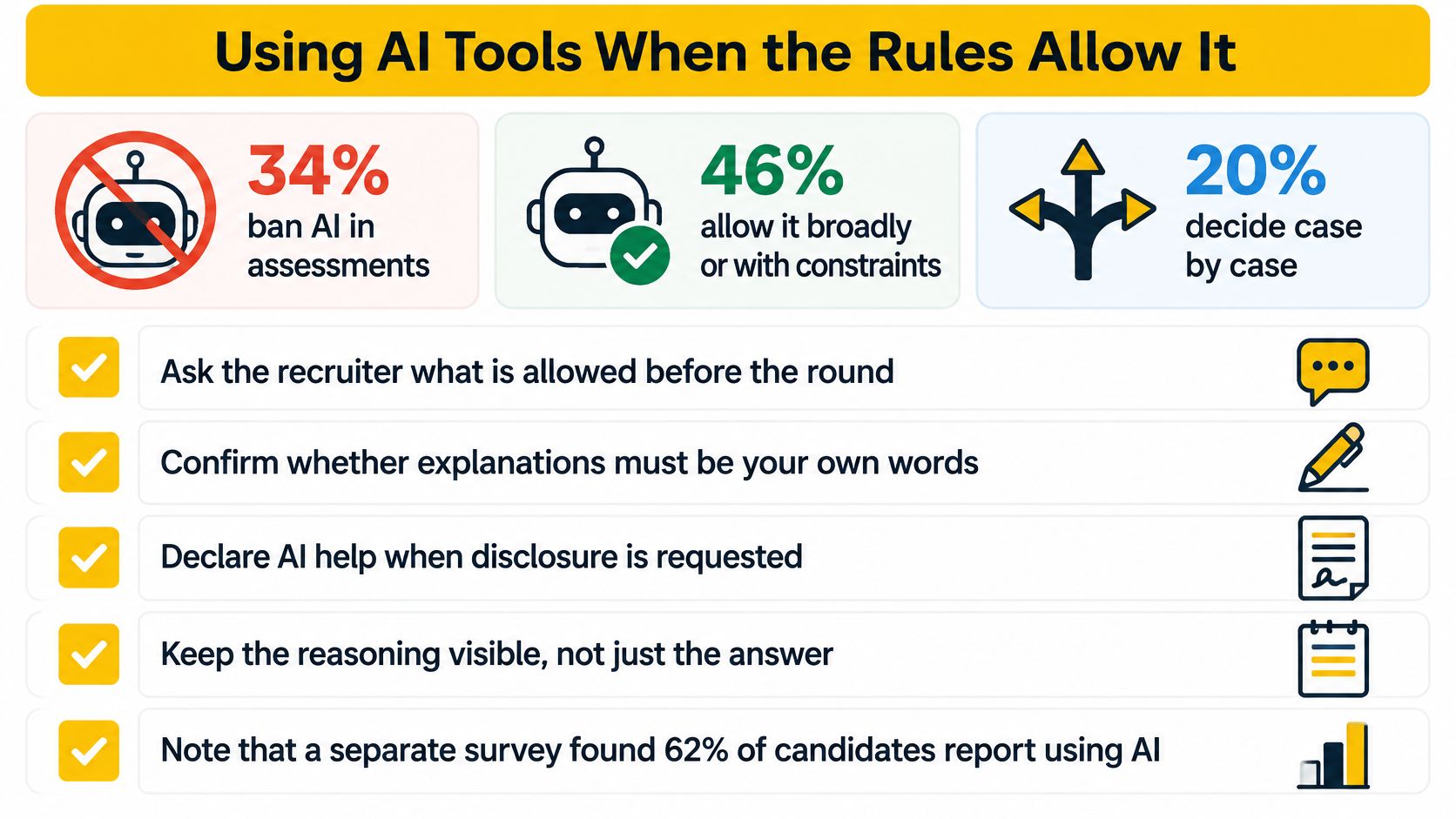
Never assume. Recent hiring data shows a fragmented market: 34% of hiring teams ban AI in assessments, 46% allow it broadly or with constraints, and 20% decide case by case (CoderPad's 2026 State of Tech Hiring report). A separate survey cited in that report found 62% of organizations still prohibit AI in technical interviews, even as engineering leaders say AI makes technical skills harder to assess. Walk in without asking and you may be disqualified for something the next company would have rewarded.
The decision sequence
- Ask the recruiter in writing which AI tools are allowed, and for what purpose. Do it before the interview, not during it. Written answers survive a change of interviewer.
- Confirm the rules again before you code. "Before I start, can I check what's permitted here?" takes ten seconds and prevents the worst outcome.
- Disclose tool use when disclosure is requested. If the instructions say to declare it, declare it plainly. Concealment is the actual offence in most policies, not the tool use.
- Keep your prompts and reasoning history. Being able to show how you got to an answer is worth more than the answer.
- Validate generated code with tests and a manual trace. Run the empty case. Trace one loop by hand. Assume nothing about correctness until you've checked it.
- Explain the trade-offs independently. Your justification has to survive without the tool's summary behind it.
Here's the part most candidates get backwards. Where AI is allowed, the strongest signal isn't producing code unaided; it's catching the tool's mistakes. An interviewer watching you spot that a generated function mishandles duplicate keys, and hearing you explain why the fix is correct, learns more about your engineering judgement than they would from a clean unaided solution. AI fluency is becoming part of technical competence, and fluency means critique, not generation.
When AI is permitted but your judgement is being scored, say: "I'll use it for the boilerplate and the test scaffolding, then walk you through where I think it's wrong."
When you're unsure whether it's allowed, say: "I haven't confirmed the policy on this, so I'll solve it without assistance and mention where I'd normally reach for a tool."
That second line costs you nothing and it demonstrates exactly the judgement the round is testing. If the policy question turns out to be murkier than you expected, this discussion of AI use in interviews and where the line actually sits covers the distinctions that matter.
Confirm the Rules and Prepare Your Own Sheet
Confirm the format before you prepare a single minute more. Message the recruiter and ask four things: the round types, the number of rounds, the programming language and tools allowed, and whether AI use is permitted. Write the answers at the top of your sheet, because they decide which parts of it apply. Then use the format table above to predict the loop instead of guessing from the job title alone.
Build the sheet from what you actually miss
A personal sheet beats a borrowed one because it tracks your own gaps. Five components are enough:
- Patterns you can recognise from signals. Take the rows from the constraint table that you'd spot in under thirty seconds, and rewrite the rest as trigger phrases until they stick.
- Complexity lines you mix up. Quicksort's space cost and DFS's recursion stack are the usual culprits.
- Three debugging steps you've practised on real code. Each one run on an actual bug, from reproduction to confirmed fix.
- Four or five behavioral stories. Each with a result you can state in one sentence and a lesson you can name.
- One system design outline. The six-step sequence, adapted to the problem in front of you, so you can apply it to a URL shortener or a rate limiter without starting from scratch.
Add one more line if AI tools might be permitted: your default position for each format. Writing "fine for the take-home, unconfirmed for live rounds" takes ten seconds and saves you improvising a policy answer mid-interview.
Run two timed practice sessions a week. Each covers a single coding problem plus one design or behavioral prompt, then closes with a written review of what slowed you down. The review is the part that compounds; skipping it turns practice into performance.
Before a first interview, run a five-minute checklist: confirm the joining link, the start time in your local timezone, the language setting and the rules you confirmed in writing.
Interview Pilot also provides mock interviews, structured question sets and role-specific guides as supporting preparation alongside whatever you already use. If you want a place to keep your growing list of patterns, trigger phrases and lessons, this guide to how to keep a commonplace book explains a note-taking habit that suits interview prep well: one page, indexed by theme, revisited before each round.
Interview Pilot gives you a real-time AI interview copilot that works through coding problems, system design prompts and behavioral questions during live online interviews, plus AI mock interviews and a question bank of roughly 10,000 questions across technical and non-technical roles. If you'd rather rehearse the seven-step workflow with feedback than read about it, the mock sessions are built for exactly that. Visit Interview Pilot to see the software engineer question set and start a practice round.



Topics
interview cheat sheet
coding interview prep
system design interview
Big-O cheat sheet
interview preparation
Continue reading

Interviews
Software Engineer Technical Interview Questions and Answers
Master software engineer technical interview questions and answers with worked approaches, practice tips, and resources for algorithms, systems, and design.
October 4, 2026
19 min read
Interviews
Interview Questions Vice Principal: 10 Q&A Tips
Ace your next interview with the top 10 interview questions vice principal candidates face, plus sample answers and practical preparation advice.
November 23, 2026
25 min read
Interviews
Work Life Balance Question: How to Answer It Well in 2026
Learn how to answer a work life balance question with a four-step framework, sample answers, and a scoring rubric to rehearse before your interview.
November 23, 2026
15 min read