
















AI Tools
AI Interview Cheating: What Counts and How to Stay Honest
Learn what counts as AI interview cheating, why detection falls short, and how to use AI for interview prep without crossing the line.
Interview Pilot Editorial Team
Updated November 16, 2026
16 min read
You're on a video call, the interviewer asks how you handled a difficult stakeholder, and a second window suggests an answer. You recognise the situation, but the wording isn't yours. Reading it might help you sound confident. It might also give the employer a misleading impression of what you can explain without help.
That's the central tension in AI interview cheating. The question isn't just whether a tool is allowed. It's whether the interview reveals your ability to do the job, or your ability to present an answer generated by something else.
What Counts as AI Interview Cheating
Hidden assistance crosses the clearest line when an employer expects unaided answers and the candidate uses help the rules prohibit. Preparation is different from substitution. Asking AI to challenge an example you've written isn't the same as reading its suggested response while an interviewer believes you're answering independently.
Permission also matters. An employer might deliberately allow AI in a coding exercise because using it is part of the work. Another might prohibit it to assess foundational knowledge. Neither rule tells you what's allowed in a different employer's assessment.
Common AI Uses and Whether They Count as Cheating
| Situation | Usually acceptable | Usually cheating | Deciding question |
|---|---|---|---|
| Practising answers with AI before the interview | Yes, if you rewrite and rehearse them yourself | Memorising AI scripts to deliver word for word as your own account | Could you explain each answer without notes? |
| Researching the company and role with AI | Yes | Rarely an issue | Does the employer ban outside research? |
| Drafting a take-home assignment with AI | Only where the brief allows it | Submitting AI work as unaided when the brief forbids it | What does the brief say about AI? |
| Reading AI-suggested answers during a live call | Only where the employer explicitly allows it | Yes, in most unaided interviews | Did the employer permit real-time assistance? |
| AI support for accessibility or language needs | Usually acceptable when disclosed and agreed in advance | Undisclosed use presented as unaided performance | Did you ask the employer first? |
| Using outside AI tools during a live coding or online assessment | Only where allowed | Yes, when the test forbids outside tools | Are outside tools permitted in this assessment? |
Memorisation needs a distinction. Rehearsing a truthful account of your experience isn't automatically misconduct. Delivering a generated script that invents decisions, achievements or expertise is misrepresentation, even if you memorised it before joining the call.
In a 2025 Blind survey, 20% of verified professionals said they'd secretly used AI tools during job interviews, with 2,510 responses to that question, according to The Indian Express's account of the survey. That describes respondents' reported behaviour, not the proportion of all job seekers who cheat.
Silence isn't permission
Candidates can reasonably argue that AI resembles coaching, editing or other preparation aids. Employers can reasonably distinguish those activities from an undisclosed system supplying answers during an assessment. The practical dividing line is what the employer agreed to assess, under which conditions.
Take-home assignments and coding tests deserve particular care because their written instructions may allow some tools while excluding others. An open-book assessment isn't necessarily an open-AI assessment.
Before using AI, ask: Could I explain this answer unaided, and would the employer approve if they knew how I produced it?
How Common AI Interview Cheating Has Become
Employers reporting that they frequently encountered cheating rose from 7% in 2024 to 15% in 2025, according to written evidence submitted to a UK Parliament committee. Those figures describe employer reports, not independently verified counts of candidate misconduct.
Employer Responses to AI Interview Cheating, 2024 and 2025
| Measure | 2024 | 2025 |
|---|---|---|
| Employers frequently encountering cheating | 7% | 15% |
| Employers who never suspected or identified cheating | 22% | 15% |
| Employers saying generative AI is causing them to redesign selection processes | 23% | 33% |
| Employers reviewing processes in response to generative AI | 46% | |
| Employers with no approach to detect or address misconduct | 30% | |
| Most common form reported, undisclosed AI use during interviews | 61% |
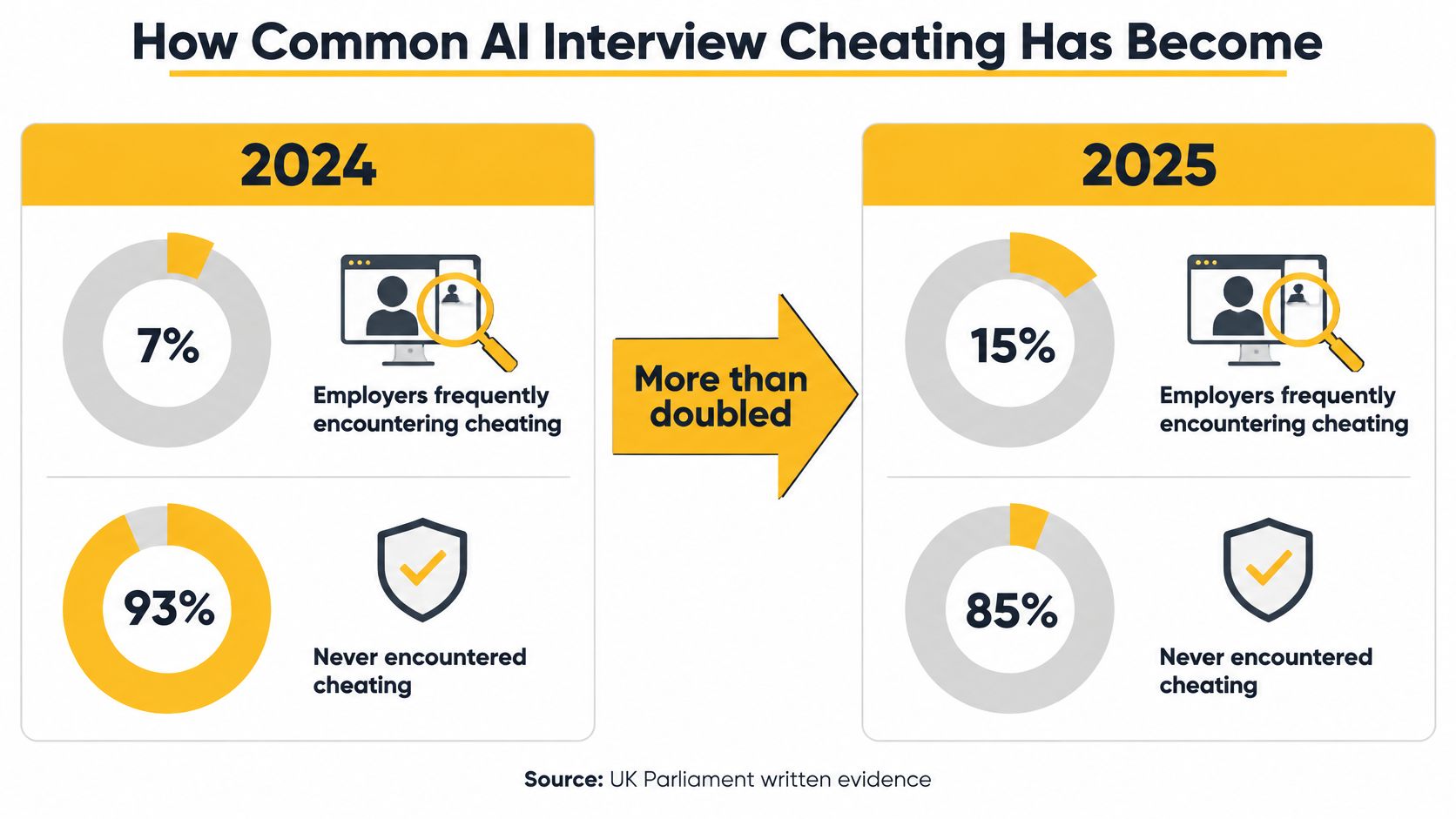
Employer reports cannot establish how many applicants used AI, how often suspicions were accurate, or whether the same candidate appeared in multiple selection processes. The figures therefore do not show that most candidates cheat. They do suggest that some hiring teams are responding to concerns while others have no defined approach.
That gap matters because candidates can adopt tools quickly, while employers must set rules, communicate them, train assessors and decide how to handle disputed cases. Redesigning a process might mean clarifying which AI uses are permitted, seeking clearer evidence of independent skill, or assessing work that includes AI assistance. Those aims call for different policies.
What the employer response means
For a broader comparison of the measures discussed in coverage of this issue, see this overview of AI interview statistics. Self-reported use, employer suspicion and observed performance are different kinds of evidence, and none alone establishes whether a candidate can do the job.
For candidates, preparation should leave them able to explain the choices behind an answer, including alternatives they rejected and details they left out. The distinction between a polished response and demonstrated ability is what employers need their assessments to reveal.
Why AI-Assisted Answers Distort Hiring Decisions
A candidate gives a clear account of resolving a stakeholder dispute: they gather requirements, negotiate priorities and agree on a phased rollout. An interviewer could reasonably score the answer highly. But if asked what changes when the budget disappears, the candidate may repeat the original plan or struggle to explain an alternative. A polished response shows presentation skill; a follow-up can reveal whether the candidate understands the decision behind it.
A preregistered 2025 experiment involving 245 Prolific participants randomly assigned people to interviews without ChatGPT, interviews using verbatim ChatGPT answers, or interviews using personalised answers generated from résumé information and instructions, according to the study published in the International Journal of Selection and Assessment. Both AI-assisted groups received substantially higher overall performance and answer-content evaluations than the unaided group.
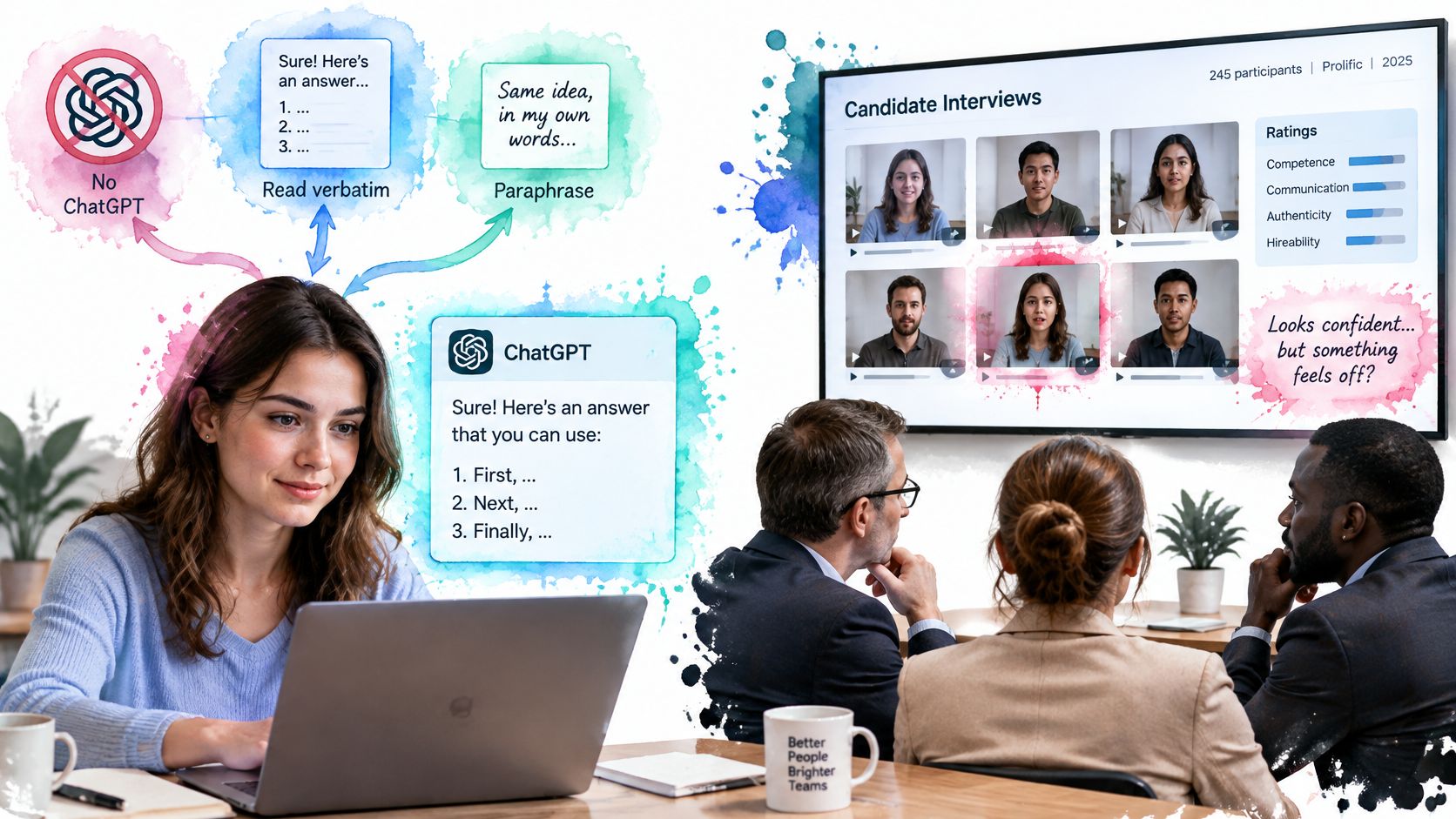
The distinction between preparing with AI and using it to answer during an assessment matters. Personalisation does not resolve the question of contribution: an answer can reflect a candidate's real background while supplying reasoning or framing they might not produce independently. Editing AI-generated wording alone does not establish who supplied the substance.
The Australian Computer Society's reporting on the Canadian mock-interview study also describes lower ratings for honesty and procedural justice among AI-assisted candidates, including those who edited generated answers. This reporting concerns the same experimental evidence, not an independent replication.
Where a strong answer stops being evidence
A follow-up that changes a key condition can test whether the candidate can adapt their reasoning. If the interviewer removes the budget for the phased rollout, the candidate might identify a lower-cost option, explain its trade-offs and revise the plan. Or they might struggle to move beyond the prepared answer.
Neither outcome, by itself, proves whether AI was used. The exchange instead illustrates a hiring risk: a strong initial answer can create an impression of competence that the candidate's ability to reason through a changed scenario may or may not support.
What the experiment leaves uncertain
A controlled mock interview can show that assistance changes evaluations under the tested conditions. It cannot establish that every AI-assisted candidate lacks skill, or that higher interview scores translate into stronger workplace performance. Conventional interviews, too, may fail to measure competence fully.
Candidates may view assistance as a way to express abilities that nerves obscure. Employers may view undisclosed assistance as interfering with the comparison they intended to make. The distinction that matters for hiring is whether an answer provides evidence of the candidate's own relevant judgment, not whether it sounds convincing.
Polish is a hypothesis about competence, not proof of it.
Why Detection Signals Fall Short
A candidate glances away, pauses before answering or speaks fluently. Each behavior may prompt a neutral follow-up, but none reliably establishes AI use or a rule violation.
A peer-reviewed study of asynchronous interviews notes that AI detectors designed for written text are unsuitable for directly analysing spoken video responses. It also found no difference in delivery ratings between conditions, cautioning against assumptions that AI assistance has a distinctive performance style.
Detection Signals and Their Main Weakness
| Signal | What it may suggest | Main weakness |
|---|---|---|
| Eye movement away from the screen | Reading from another window | Normal thinking patterns and some disabilities produce the same movement |
| Response latency | Pausing to fetch an answer | Nerves, language switching and network lag can add the same delay |
| Browser or screen monitoring | Other tabs or apps open | Captures unrelated activity and raises privacy concerns |
| Polished, generic phrasing | Scripted or generated answer | Strong candidates also speak clearly, and edited AI text can sound natural |
| AI detector applied to a transcript | Text generated by a model | Detectors built for written text are unsuitable for spoken video responses |
These are possible explanations, not diagnostic tests. A candidate might glance toward an agreed accommodation, pause to translate a phrase mentally or lose time because the interviewer's audio broke up. Someone using prohibited assistance might show none of the expected behaviours.
Transcripts add uncertainty. They remove aspects of the original exchange and may contain transcription errors, so a score based on text alone is not a direct record of what happened on the candidate's device.
Monitoring has costs beyond accuracy
Screen access can expose personal notifications, unrelated documents and information the employer does not need. Before introducing monitoring, hiring teams should specify what they collect, who reviews it, how long they retain it and how candidates can challenge a conclusion.
A guide for editors reviewing AI drafts discusses the difference between provenance claims and text classification. That distinction can inform how detection tools are understood, but editorial checks do not validate an interview assessment.
Unreliable detection does not mean assistance is guaranteed to go unnoticed. Interview Pilot does not guarantee that any part of its services will be undetectable, invisible or uninterrupted, or compatible with every operating system, browser, conferencing tool, proctoring tool or employer system.
The discussion of whether employers can detect AI during interviews provides further context. Employers should validate each signal against the decision it is meant to support. Evidence of a rule violation and evidence of job competence are different questions, and detection alone answers neither adequately.
Assessment Designs That Test Real Understanding
Employers should prioritise demonstrations of understanding over attempts to infer hidden tool use. A better-designed assessment can produce useful hiring evidence even when the interviewer can't determine exactly how a candidate prepared.
The starting point is the job. If employees must independently diagnose problems, test that ability. If they'll use AI at work, consider an explicitly AI-permitted task that tests how they check outputs, identify errors and take responsibility for decisions.
Assessment Designs That Reveal Understanding
| Design | How it works | What it reveals |
|---|---|---|
| Live follow-up questions | Extend the answer under a new constraint | Whether the candidate understands the reasoning or only the script |
| Varied scenario | Change one variable from the original prompt and ask what changes | Whether skills transfer beyond a memorised answer |
| Critique own answer | Ask what they would change and why | Ability to evaluate and adapt their own work |
| Work sample | Short task completed during or shortly after the interview | Practical skill under real constraints |
| Post-interview reasoning check | Brief call or written note explaining key decisions | Consistency between stated answers and independent reasoning |
These formats are recommendations, not a promise that an assessment becomes cheat-proof. Their value is that they give assessors more relevant material to evaluate than a polished opening response or a suspicious glance.
Make the scoring match the task
Consider a data analyst asked to investigate falling sales. Rather than rewarding a long list of techniques, an assessor can examine whether the candidate defines the business question, checks the reliability of the inputs and distinguishes an association from a possible cause.
A useful scoring guide makes those behaviours explicit:
- Assumptions: Does the candidate identify information they need before committing to an approach?
- Trade-offs: Can they explain what their chosen method sacrifices?
- Verification: Do they propose a credible way to check their conclusion?
- Revision: Can they correct an error without pretending the original answer was sound?
Consistency matters. Give candidates comparable opportunities to demonstrate these behaviours, rather than making follow-ups more hostile whenever someone seems nervous.
Agreed accessibility or language support can remain in place while assessors test the relevant skill. The aim isn't to remove every aid. It's to avoid confusing a communication barrier with a lack of competence, while preserving the ability the employer needs to measure.
A useful work sample asks whether someone can make and defend a decision, not whether they can perform confidence on camera.
Candidates preparing for this kind of interview should expect a scenario to change. Learn why your approach works, where it stops working and what information would make you choose differently.
How to Prepare With AI Within the Rules
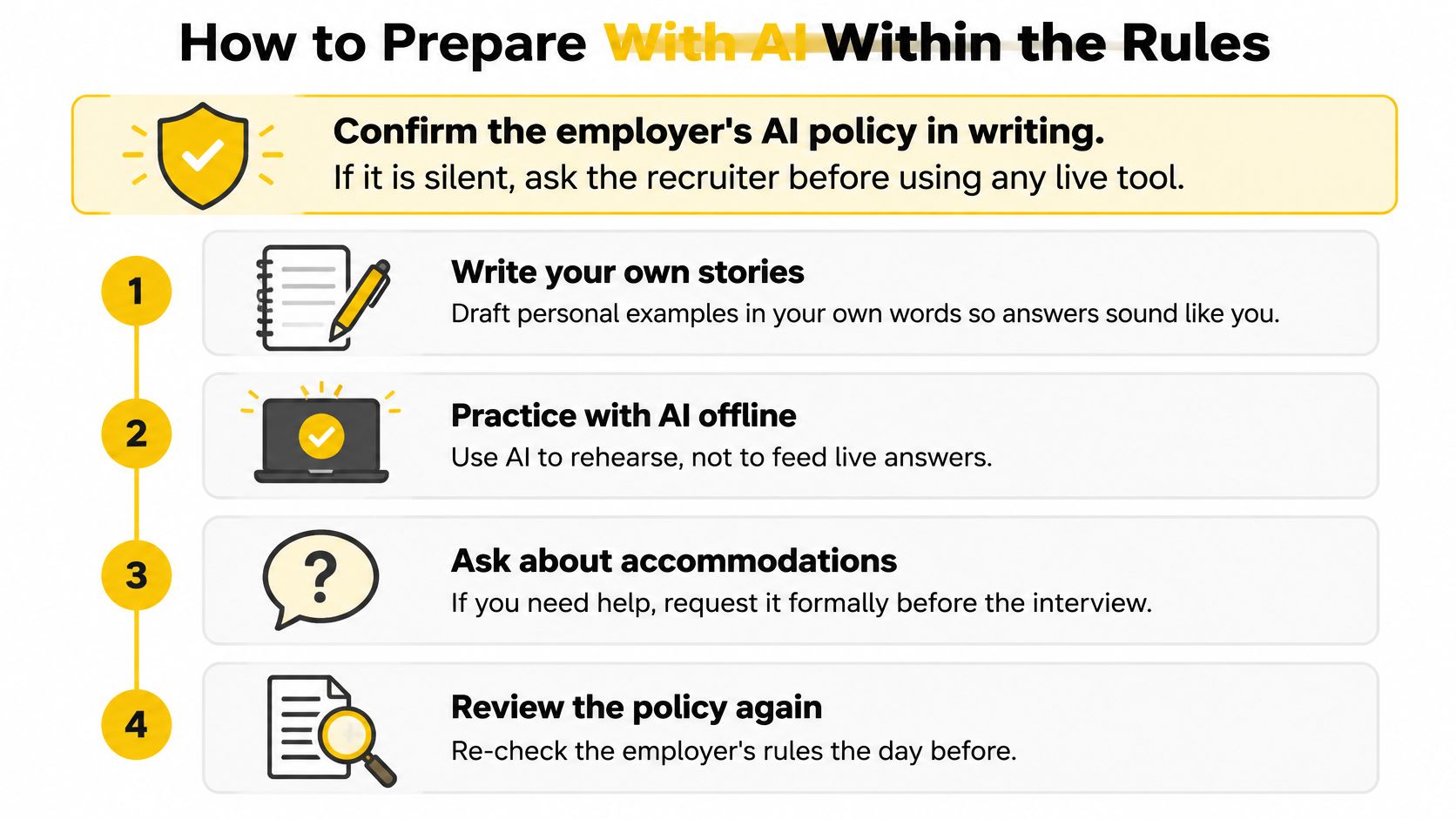
Confirm the employer's AI policy in writing. If the instructions are silent, ask the recruiter before using any live tool. Describe the intended function, such as transcription, translation, code completion or suggested answers, because permission for one doesn't automatically cover another.
Keep the response with your interview instructions. Recheck it before each assessment stage, particularly when moving from a conversation to a coding test or take-home assignment. Different stages may assess different abilities.
Build answers you can defend
Write your own stories first. Start with likely questions about teamwork, mistakes, difficult decisions, leadership and role-specific challenges. Use your own project records, feedback and notes to recover what happened, without uploading confidential employer material to an AI service.
Separate the team's achievement from your contribution. Record what you decided, why you chose it, what happened and what you'd change. If you can't verify a result, describe it accurately rather than adding an impressive-sounding figure.
Ask AI to critique, not replace. Give it an anonymised draft and ask it to identify vague claims, missing context, unsupported outcomes and weak transitions. Request questions about missing measurements, not invented metrics.
A useful instruction is to flag any sentence that claims impact without explaining how the candidate knows. You remain responsible for deciding whether the criticism fits your actual experience.
Rewrite in words you'd say aloud. Remove expressions you wouldn't normally use and claims you couldn't explain. Keep the structure that helps you communicate, but don't preserve wording merely because it sounds senior.
For a technical answer, be able to explain the mechanism behind each term. For a behavioural answer, be able to distinguish your reasoning at the time from what you learned afterwards.
The preparation workflow should keep ownership of the answer with you.
Practise retrieval rather than recitation
Rehearse aloud without notes. Record yourself and time the answer, using any duration guidance the employer gives. Listen for whether the decision is understandable, not whether every sentence matches your draft.
If you lose your place, restart from the main point instead of trying to recover a memorised line. You're practising access to your experience, not performance of a script.
Generate follow-ups, then answer independently. Ask AI to challenge an assumption, remove a resource or change a deadline. Hide its suggested response before answering.
Afterwards, compare your reasoning with its suggestions. Accept useful criticism, but check whether the proposed alternative fits the scenario. An AI-generated follow-up can be helpful without its model answer being correct.
Audit every claim. Identify anything in your answer that invites a deeper question: a technology choice, a financial result, a management decision or a lesson learned. Explain each without opening your draft.
Mark weak areas for study rather than asking AI to cover them with stronger phrasing. If you don't know an answer, practise identifying what you'd need to investigate.
For structured rehearsal, we offer AI mock interviews with an evaluation of your answers. The AI interview coaching guide provides preparation context, but Interview Pilot doesn't guarantee interview success, employment outcomes, improved performance, question accuracy, recruiter response or any other result.
Agree on support before the interview
If you need accessibility or language support, discuss it with the employer in advance and confirm the arrangement. Explain what the support does so the assessor can distinguish agreed assistance from an answer-generation function. You don't need to present every support need as a request for AI-generated answers.
Avoid live answer suggestions unless the employer has explicitly permitted them. A tool's availability doesn't establish that it belongs in a particular assessment, and permission to use it for rehearsal doesn't extend to the interview itself.
The final preparation test is practical: every answer should be one you could defend without a screen. When someone changes the scenario, you should still be able to give a clear, reasoned response, including an honest explanation of what you don't yet know.
Interview Pilot offers AI mock interviews and answer evaluations for structured rehearsal. Visit Interview Pilot to practise explaining your experience, identify answers that need more work and prepare within your prospective employer's rules.


Topics
AI interview cheating
interview ethics
AI interview prep
job interview honesty
AI detection hiring
Continue reading

AI Tools
AI ML Interview Questions: 7 Topics with Answer Guidance
Prepare with AI ML Interview Questions covering coding, system design, ML theory, SQL, cloud, behavioral and analytics, plus answer guidance and resources.
October 11, 2026
19 min read

AI Tools
10 AI Tools for Job Seekers in 2026: Resume to Interview
Compare 10 AI Tools for Job Seekers across resumes, ATS checks, mock interviews, and job search automation, with honest pros, cons, and use cases.
October 10, 2026
18 min read
AI Tools
Live Transcription App Comparison: 10 Options for 2026
Compare the top live transcription app options for interview practice, from Otter.ai and Notta to Zoom and Teams captions, with free plans and limits.
November 16, 2026
19 min read